
Nothing kills a good video faster than muddy, distant, or echoey audio. You can fix a slightly underexposed frame in post, but you cannot salvage a track where the dialogue is buried under room rumble or wind noise. Every serious videographer, vlogger, or live streamer eventually hits the same wall — the built-in camera mic is simply too omnidirectional to separate your subject from the environment. The right shotgun mic changes that completely, collapsing the distance between your lens and your subject’s voice.
I’m Min — the co-founder and writer behind Gadgets Feed. I’ve spent countless hours parsing frequency response graphs, comparing self-noise floors, and stress-testing directional rejection patterns to find which on-camera mics actually deliver clear dialogue without handing you a handful of headaches.
Whether you’re shooting interviews, vlogs, or cinematic short films, upgrading your audio rig starts with finding the best camera microphone that matches your camera’s plug-in power, your shooting environment, and your need for a clean, uncompromised signal-to-noise ratio.
How To Choose The Best Camera Microphone
Choosing a camera microphone isn’t just about picking the cheapest model with a 3.5mm jack. You have to match the mic’s power requirements to your camera, understand its directional pattern, and decide whether you need battery-free operation for run-and-gun shoots. Here’s what matters most.
Power Source: Plug-in Power vs. Battery vs. USB
Camera microphones fall into three power camps. Passive mics like the Rode VideoMicro draw electricity directly from your camera’s 3.5mm jack — convenient but reliant on your camera providing at least 3V of plug-in power. Active mics use an internal battery (Sennheiser MKE 400) for consistent voltage and often include preamp boost. Newer hybrid mics like the COMICA VM10 PRO offer digital USB output for smartphones and tablets, giving you flexibility across platforms without worrying about phantom power.
Directional Pattern and Rejection
Super-cardioid or shotgun patterns are the gold standard for on-camera mics. They capture sound primarily from the front (the subject) while rejecting audio from the sides and rear. The narrower the acceptance angle, the better the mic will isolate a single speaker in noisy environments. A cardioid mic is less aggressive and may pick up room reflections. Always confirm the pattern before buying — omni-directional capsule mics defeat the entire purpose of a camera-mounted solution.
Build-in Filters and Gain Control
Low-cut filters (like 75Hz or 150Hz) roll off rumble from air conditioning, traffic, or handling vibrations. A three-stage sensitivity switch (as found on the Sennheiser MKE 400) lets you pad the signal when recording loud sources. Stepless gain control, available on digital-output mics like the COMICA VM10 PRO, gives you fine-grained volume adjustment during recording. These features reduce the amount of post-processing you’ll need later.
Quick Comparison
On smaller screens, swipe sideways to see the full table.
| Model | Category | Best For | Key Spec | Amazon |
|---|---|---|---|---|
| Rode VideoMic Pro+ | Premium | Pro-level run-and-gun filmmaking | 130dB SPL max, 74dBA self-noise | Amazon |
| Sennheiser MKE 400 | Premium | DSLR/mirrorless with AAA battery power | Low-cut filter + 3-step gain pad | Amazon |
| Rode VideoMic GO II Helix | Mid-Range | Hybrid use (camera + USB-C devices) | Dual 3.5mm & USB-C output, 57g | Amazon |
| Rode VideoMicro | Mid-Range | Compact, no-battery plug-and-play | 42g, 80mm length, all-metal body | Amazon |
| COMICA VM20 | Mid-Range | OLED battery display + low-cut filters | 300mAh Li-on, 60hr standby | Amazon |
| COMICA VM10 PRO | Value | Smartphone/tablet digital recording | Super-cardioid, USB-C + 3.5mm, 37g | Amazon |
| Deity V-Mic D4 Mini | Budget | Ultra-light with extra aux input | 20mph wind rating, passive, 150g | Amazon |
In‑Depth Reviews
1. RØDE VideoMic Pro+

The RØDE VideoMic Pro+ sits at the top of the pile because it solves the two biggest pain points of serious on-camera audio: consistent power and advanced filtering. Its built-in LB-1 lithium-ion rechargeable battery (backed by a Micro USB port for continuous use) eliminates the “dead-battery-at-the-worst-moment” fear. The Rycote Lyre suspension isolates the capsule from handling vibration better than any elastic-band design, making this mic a workhorse for handheld shooting or gimbal work.
Its digital switching lets you toggle high-pass filter, high-frequency boost, and a safety channel in seconds without diving into menus. The safety channel records audio at -10dB simultaneously, saving your dialogue if the subject unexpectedly shouts. With a frequency response of 40Hz–20kHz and a self-noise of 74dBA, it captures rich, full-bodied voice without adding hiss — even in challenging environments like busy streets or echoey conference rooms.
The trade-off is weight and size: at roughly 122g and a bit longer than the VideoMicro, it’s noticeable on small mirrorless bodies. Also, if you primarily shoot interviews on the go with a smartphone, its analog-only 3.5mm output requires extra adapters. For DSLR and mirrorless shooters who need pro-level reliability, this is the ultimate investment.
Why it’s great
- Rycote Lyre suspension for superior vibration damping.
- Digital switching for high-pass filter, boost, and pad.
- Auto on/off via plug-in power detection.
Good to know
- Heavier than budget options; noticeable on small cameras.
- No USB digital output — analog only.
2. SENNHEISER MKE 400

Sennheiser brings its pro-audio pedigree to the compact on-camera market with the MKE 400, a super-cardioid shotgun that combines exceptional build quality with thoughtful controls. The integrated low-cut filter rolls off rumble below 300Hz, while the three-step sensitivity switch (gain/medium/pad) lets you dial in the perfect level for everything from a quiet conversation to a noisy sports event. The metal housing feels dense and reassuring — no plastic creaks when you mount it on your camera’s cold shoe.
One of its strongest assets is the integrated headphone output jack with its own volume wheel. You can monitor what’s actually being recorded in real-time without extra wires or adapters. The included dead-cat windshield handles light breeze well, and the internal suspension mount keeps handling noise to a minimum.
The downsides? It does not include a USB-C digital output, so connecting directly to a smartphone requires the included TRRS cable plus potentially a Lightning adapter. Some users report the cold shoe mount can twist under heavy cable strain, though it is secure for normal use. If you need a bomb-proof, long-battery-life shotgun for field work, this is your mic.
Why it’s great
- Built-in headphone monitoring with volume control.
- Three-step sensitivity switch for flexible gain staging.
- AAA battery lasts ~100 hours; globally replaceable.
Good to know
- No USB digital output — analog 3.5mm only.
- Cold shoe mount can loosen under heavy cable pull.
3. RØDE VideoMic GO II Helix

The VideoMic GO II Helix is RØDE’s answer to the multi-platform creator. It packs a 3.5mm TRS output for traditional cameras and a USB-C output that works natively with smartphones, tablets, and computers — no extra adapters needed. The HELIX isolation mount replaces the classic Rycote Lyre with a compact, lightweight suspension that still does an admirable job cutting out handling noise and vibration.
At just 57 grams, it’s remarkably unobtrusive on small bodies like the Sony ZV-E1 or a GoPro cage. The mic draws power directly from the host device via plug-in power or USB, so there are no batteries to charge or swap. It includes a deluxe windshield that effectively tames wind noise up to moderate breezes, and the RØDE Central software unlocks a high-pass filter and high-frequency boost — though you’ll need a computer to configure them.
There is no onboard gain control or headphone monitoring. That simplicity is a strength for run-and-gun shooters who just want plug-and-play quality, but a limitation if you need precise level adjustment in the field. Audio quality is very clean, with a self-noise of 79dBA — slightly higher than the Pro+, but well within acceptable range for most content.
Why it’s great
- Dual 3.5mm and USB-C outputs for camera and mobile use.
- Extremely lightweight (57g) — ideal for small cameras.
- No battery needed; powered by host device.
Good to know
- No onboard gain control or headphone monitoring.
- Slightly higher self-noise (79dBA) than pro-tier options.
4. Rode VideoMicro

The Rode VideoMicro is a passive, no-frills shotgun that has earned a reputation as the first upgrade for any videographer. It weighs only 42 grams and measures 80mm — barely larger than a standard lens cap — so it disappears on any camera and fits inside most camera bags without adding bulk. Because it draws power directly from the camera’s plug-in power (minimum 3V), there is zero setup beyond plugging in the included TRS cable.
Audio quality is genuinely impressive for its size and price point. The super-cardioid pattern rejects side and rear noise effectively, delivering clear, focused dialogue even in busy environments like coffee shops or trade show floors. The included Rycote Lyre shock mount (borrowed from Rode’s higher-end mics) does a fantastic job isolating the capsule from camera handling noise. Many users report it works flawlessly with GoPro Hero cameras via the SC7 TRRS cable, making it a top pick for action videographers.
There is no battery, no filters, no gain knob, and no headphone jack — absolute minimalism. The self-noise floor is 20dBA (very quiet), but there is no way to adjust the signal level if your camera’s preamp adds hiss in quiet scenes. For pure simplicity and portability, this mic is unmatched.
Why it’s great
- Ultra-compact and featherlight (42g).
- No batteries; true plug-and-play operation.
- Excellent rear sound rejection performance.
Good to know
- No onboard controls — no filter, gain, or monitor.
- Relies on camera providing at least 3V plug-in power.
5. COMICA VM20

The COMICA VM20 punches above its mid-range position by packing pro-level features into an affordable package. The standout is the OLED screen that shows remaining battery capacity in real-time — a rare convenience that saves you from guessing whether your mic is about to die mid-interview. The built-in 300mAh lithium-ion battery can be topped up via USB-C even while recording, and the mic claims up to 60 hours of standby time.
Acoustically, the VM20 employs a super-cardioid condenser capsule with two low-cut filter modes (75Hz and 150Hz) plus a ten-level gain adjustment from -43dB to -23dB. This flexibility lets you fine-tune the mic for different environments — crank the gain for a quiet whisper, engage the low-cut for a windy beach shoot, then roll off the pad when your subject shouts. The Rycote-style shock mount reduces handling vibration, and the package includes both TRS and TRRS cables for camera and smartphone compatibility.
The biggest caveat: some units have reported battery failure after a few months of light use, though COMICA’s warranty service generally replaces defective units quickly. The included windshield is thin and may pick up wind rustle outdoors — budget for an aftermarket dead cat if you shoot in open air. For controlled indoor or studio vlogging, the VM20 delivers fantastic clarity at a reasonable cost.
Why it’s great
- OLED battery level display — no guesswork.
- Two low-cut filters (75Hz/150Hz) and 10-step gain.
- Super-cardioid with excellent side rejection.
Good to know
- Battery durability concerns reported after several months.
- Included windshield is thin; prone to wind noise outdoors.
6. COMICA VM10 PRO
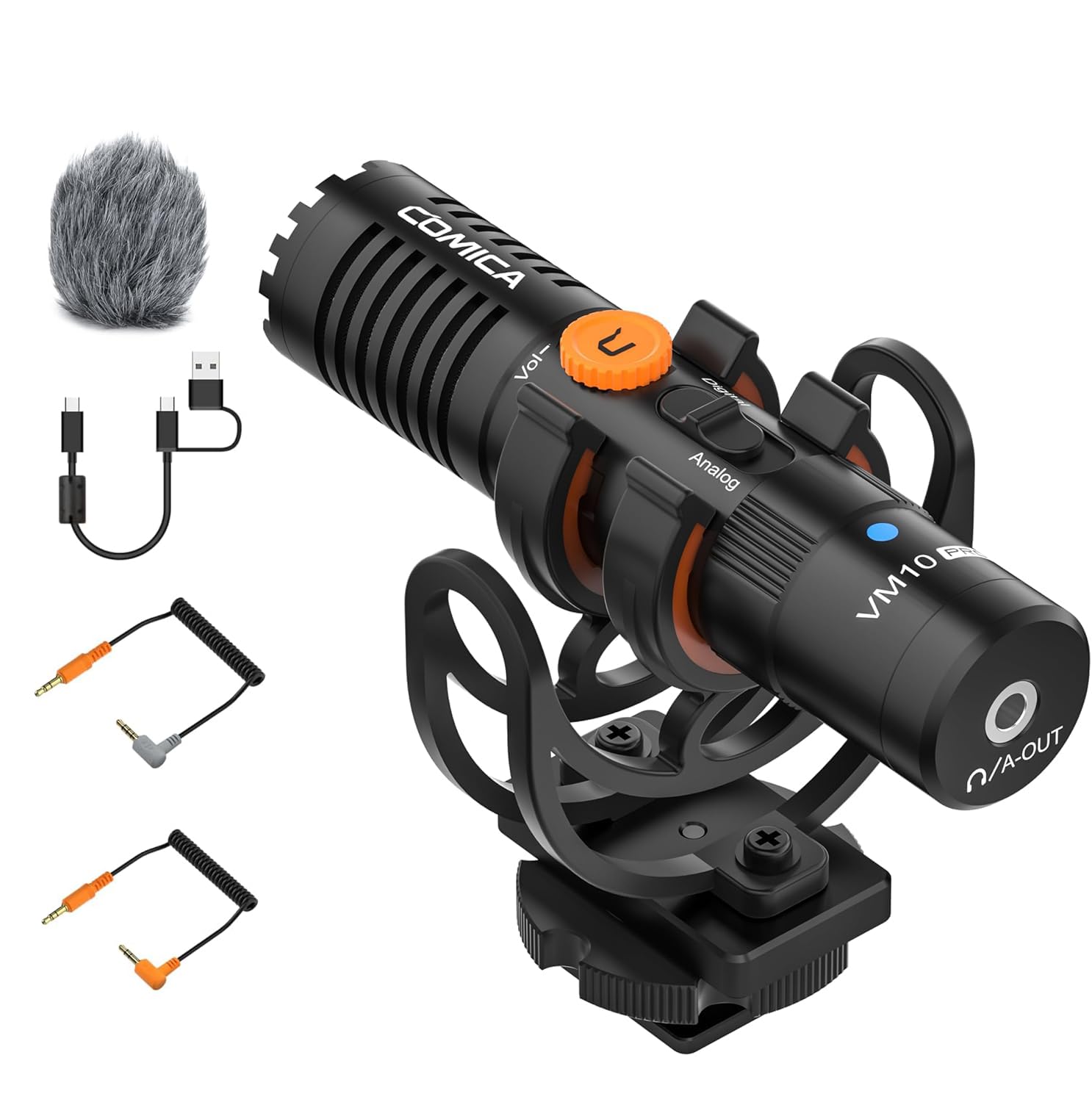
The COMICA VM10 PRO is built for the mobile-first creator. Its ability to switch between analog (3.5mm) and digital (USB-C) output makes it equally at home on a DSLR, an iPhone (adapter required), an Android phone, or a laptop. The 100% aluminum housing and integrated shock mount reduce electromagnetic interference and handling noise, while the super-cardioid pattern cuts background chatter effectively.
One of its smartest features is the stepless gain control, which is only active in digital mode. This lets you fine-tune the input level on the fly when recording directly to a phone or computer — a level of control usually reserved for more expensive models. The mic weighs just 37 grams, so it won’t weigh down a smartphone gimbal or a compact camera rig. User reports highlight excellent voice clarity at distances up to 20 feet with gain set to 50%.
It lacks a headphone monitoring jack, which is unfortunate for critical shoots where you need to verify audio in real-time. The analog performance on a PC was reported as quiet by some users, requiring software mic boost. Also, it uses a micro-USB port for charging (the included USB-C cable is for data/audio), so you need to carry an extra cable. For under mid-range money, the VM10 PRO offers exceptional cross-platform flexibility.
Why it’s great
- Analog and digital output modes for unmatched compatibility.
- Stepless gain control in digital mode.
- Ultra-light at 37 grams.
Good to know
- No headphone monitoring jack.
- Analog PC performance quiet without mic boost.
7. Deity V-Mic D4 Mini

Deity’s V-Mic D4 Mini manages to stand out in the budget tier by offering a surprising extra: a dedicated 3.5mm auxiliary input for a second microphone channel. This allows you to simultaneously record a lavalier mic or a second shotgun into the same recording, though both signals share the same track — a trade-off worth noting for interview setups. The mic itself is super-cardioid, passive (uses camera plug-in power), and includes both TRS and TRRS cables so it works with smartphones out of the box.
Audio quality is warm and crisp according to user reports, with no sibilance issues. The 20mph wind rating means the included faux-fur windshield handles light outdoor breezes, and the all-plastic construction keeps weight down to 150g — heavier than the VideoMicro but still manageable on a mirrorless body. The shock mount is functional but reviewers note it feels a bit flexible and wobbly compared to metal alternatives.
The auxiliary input is its killer feature, but it has a caveat: when you plug a secondary source into the 3.5mm input, both the D4’s internal capsule and the external mic are recorded onto the same track. This makes it impossible to separate them in post, which can sound hollow if the two sources are in different acoustic spaces. If you only need a single good shotgun channel, the D4 delivers excellent performance at an entry-level cost.
Why it’s great
- Built-in 3.5mm auxiliary input for a second mic channel.
- Includes TRS and TRRS cables for camera and phone.
- Warm, crisp audio with no sibilance.
Good to know
- Aux input records both mics on the same track.
- Shock mount feels flexible and less rigid than premium models.
FAQ
Does the Rode VideoMicro work with a GoPro without extra adapters?
What does the low-cut filter on the Sennheiser MKE 400 actually do to my audio?
Can I charge the COMICA VM20 while recording continuously?
Final Thoughts: The Verdict
For most users, the best camera microphone is the RØDE VideoMic Pro+ because it combines pro-level build, digital filtering, and rechargeable battery in a single package that handles anything from run-and-gun documentaries to controlled studio shoots. If you want the lightest, most portable passive mic for your small camera, grab the Rode VideoMicro. And for multi-platform creators who need both analog and USB-C output, the RØDE VideoMic GO II Helix offers unmatched versatility without weighing down your rig.