
Our readers keep the lights on and my morning glass full of iced black tea. As an Amazon Associate, I earn from qualifying purchases.
Specs are compiled from manufacturer listings and verified buyer reviews and can change over time — please confirm the key details on the product page before buying.
Your camera freezes in the middle of a burst because its buffer is full. A slow SD card turns a perfect action shot into a missed moment. The right card keeps your camera ready, so you can shoot continuous 4K or full-resolution RAW without watching a progress bar creep across the screen.
I’m Min — the founder and writer behind Gadgets Feed. This guide is built by comparing the manufacturers’ published specifications and the patterns across verified customer reviews, so you get each pick’s real strengths and trade-offs instead of marketing spin.
Whether you shoot with a mirrorless body, a DSLR, or a compact camcorder, the goal is the same: no skipped frames and no stuttering playback. That is why this roundup of the best camera sd cards focuses on read and write speeds, video speed classes, and real-world durability — not just capacity numbers on the label.
Quick Picks
- Kingston Canvas React Plus 32GB SD Card — Pro Grade
- SANDISK 128GB Extreme PRO SD UHS-I Card — Top Performer
- Lexar 128GB Professional Silver SD Card — Best Value
- [Older Version] SanDisk 128GB Extreme PRO SDXC UHS-I Card — Proven Workhorse
- SanDisk Ultra 64GB Class 10 SDXC UHS-I Memory Card — Compact Companion
- Elecacc 32GB SD Card, 2 Pack — Budget Champion
How To Choose The Best Camera SD Cards
Not all SD cards are built the same. A card that works fine for a point-and-shoot can choke in a modern mirrorless camera shooting 4K 60fps. Here are the three specs that separate a reliable card from a frustrating one.
Read and write speeds
Read speed is how fast you copy files off the card to your computer — great for saving time, but it does nothing while you shoot. Write speed is the critical number: it determines how many continuous frames your camera can fire before the buffer fills up, and whether your 4K video drops frames mid-clip. Look for the card’s write speed, not just the big marketing number on the package.
Video speed class (V30, V60, V90)
The “V” rating guarantees a minimum sustained write speed in MB/s (megabytes per second, or how much data the card can save every second). A V30 card writes at least 30 MB/s continuously — enough for most 4K video. V60 doubles that floor to 60 MB/s, and V90 guarantees 90 MB/s for demanding codecs (formats for compressing video) like 8K or high-bitrate 4K All-I (a codec that saves every frame individually, needing more speed). If you shoot video on a modern camera, never go below V30.
Capacity and UHS bus interface
UHS-I (Ultra High Speed Phase I) cards top out around 170-250 MB/s theoretical speeds and work in every SD-compatible camera made in the last ten years. UHS-II cards have an extra row of pins and can hit 300 MB/s and beyond, but your camera must have a UHS-II slot to benefit. Mixing them backwards works fine — a UHS-II card in a UHS-I slot runs at UHS-I speeds. Capacity is pure math: a 128 GB card holds roughly 1,200 24-megapixel RAW frames or about 200 minutes of 4K 30fps video.
Quick Comparison
On smaller screens, swipe sideways to see the full table.
| Model | Best For | Read Speed | Write Speed | Capacity | Amazon |
|---|---|---|---|---|---|
| Kingston Canvas React Plus | Professional 4K/8K video | 300 MB/s | 260 MB/s | 32 GB | Amazon |
| SanDisk Extreme PRO (New) | High-volume stills + UHD | 250 MB/s | 170 MB/s | 128 GB | Amazon |
| Lexar Professional Silver | 4K video + enthusiast use | 225 MB/s | 160 MB/s | 128 GB | Amazon |
| SanDisk Extreme PRO (Older) | 4K UHD + burst mode | 170 MB/s | 90 MB/s | 128 GB | Amazon |
| SanDisk Ultra | Point-and-shoot / casual | 80 MB/s | — | 64 GB | Amazon |
| Elecacc 2-Pack | Older devices / budget | 90 MB/s | — | 32 GB | Amazon |
In‑Depth Reviews
1. Kingston Canvas React Plus 32GB SD Card

The UHS-II rocket that clears your buffer instantly for steady 8K recording.
When you push a modern camera body to its limits — think high-bitrate 4K All-I or uncompressed 8K — you need a card that writes as fast as the sensor can fire. A V90 rating (a “video speed class” meaning the card guarantees at least 90 MB/s continuous writes) means this Kingston Canvas React Plus will not drop a single frame. Its write speed of 260 MB/s is higher than the 140 MB/s rated on the Lexar Professional Silver. That extra headroom keeps your camera ready for the next shot. Buyers report using this card across Sony a7 IV and R6 Mark II bodies, noting its “very good performance in terms of writing speed.” It weighs 5 grams versus the 4-gram SanDisk Ultra.
The trade-off: capacity tops out at 32 GB in this model, so you will swap cards more often on a long shoot. That small size is the price you pay for the UHS-II V90 rating. If your camera has a UHS-II slot and you shoot video, this is the card that keeps pace.
Speed seekers: Professional shooters using UHS-II bodies who need frame-by-frame reliability for 4K/8K video — if you do not own a UHS-II camera, you will pay for speed you cannot use.
High storage needs: 32 GB fills quickly on high-bitrate clips; budget for a multi-pack or a larger-capacity UHS-II card.
2. SANDISK 128GB Extreme PRO SD UHS-I Card
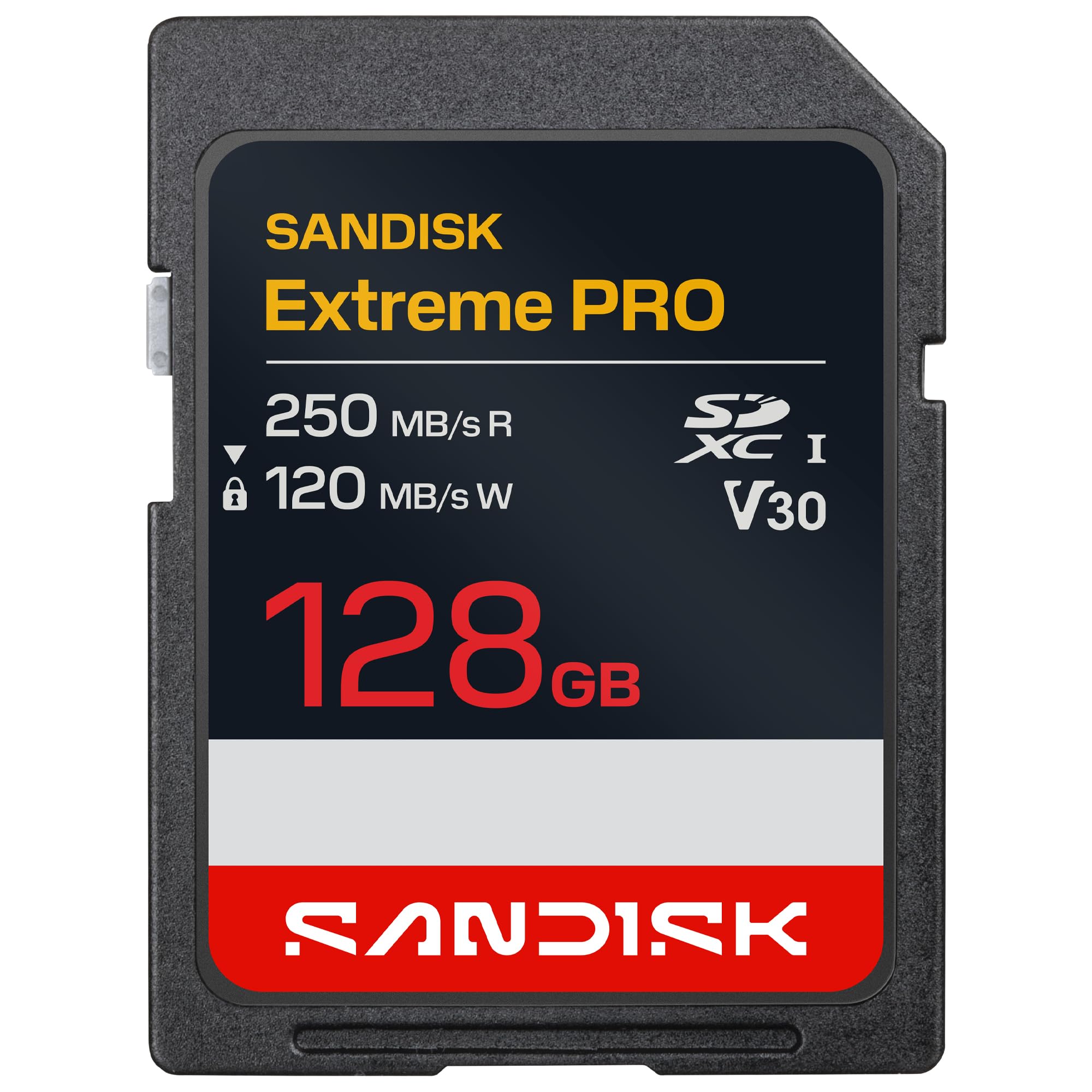
The speed-and-capacity balance for 4K UHD shooting and high-res stills — faster writes than the older SanDisk Extreme PRO and more space than the Kingston.
This card solves two frustrations at once: 128 GB of space and a write speed of 170 MB/s that clears your buffer quickly. That is 170 MB/s versus 90 MB/s on the budget Elecacc 2-pack, and 128 GB versus 32 GB on that card. The V30 (a “video speed class” guaranteeing at least 30 MB/s continuous writes) rating means smooth 4K UHD recording at 30 fps. Reviewers call it “fast, reliable SD card — great for photos and video” and note zero read errors. The build is dust-proof, water-proof, and temperature-proof, so you can take this card into dirty or wet environments without losing data.
Unlike the UHS-II Kingston above, this is a UHS-I card, so it works in every camera made in the last decade. The catch: if your camera has a UHS-II slot, you are leaving some top-end performance on the table. But for most enthusiast and semi-pro users, this Extreme PRO is the most balanced option.
Professional use: Enthusiast photographers and videographers who want a single, fast card for all-day stills and 4K UHD — it is the card to buy over the SanDisk Extreme PRO older version at 170 MB/s versus 90 MB/s write speed.
Budget limited: You need UHS-II speeds for 8K or high-bitrate codecs — step up to the Kingston Canvas React Plus.
3. Lexar 128GB Professional Silver SD Card
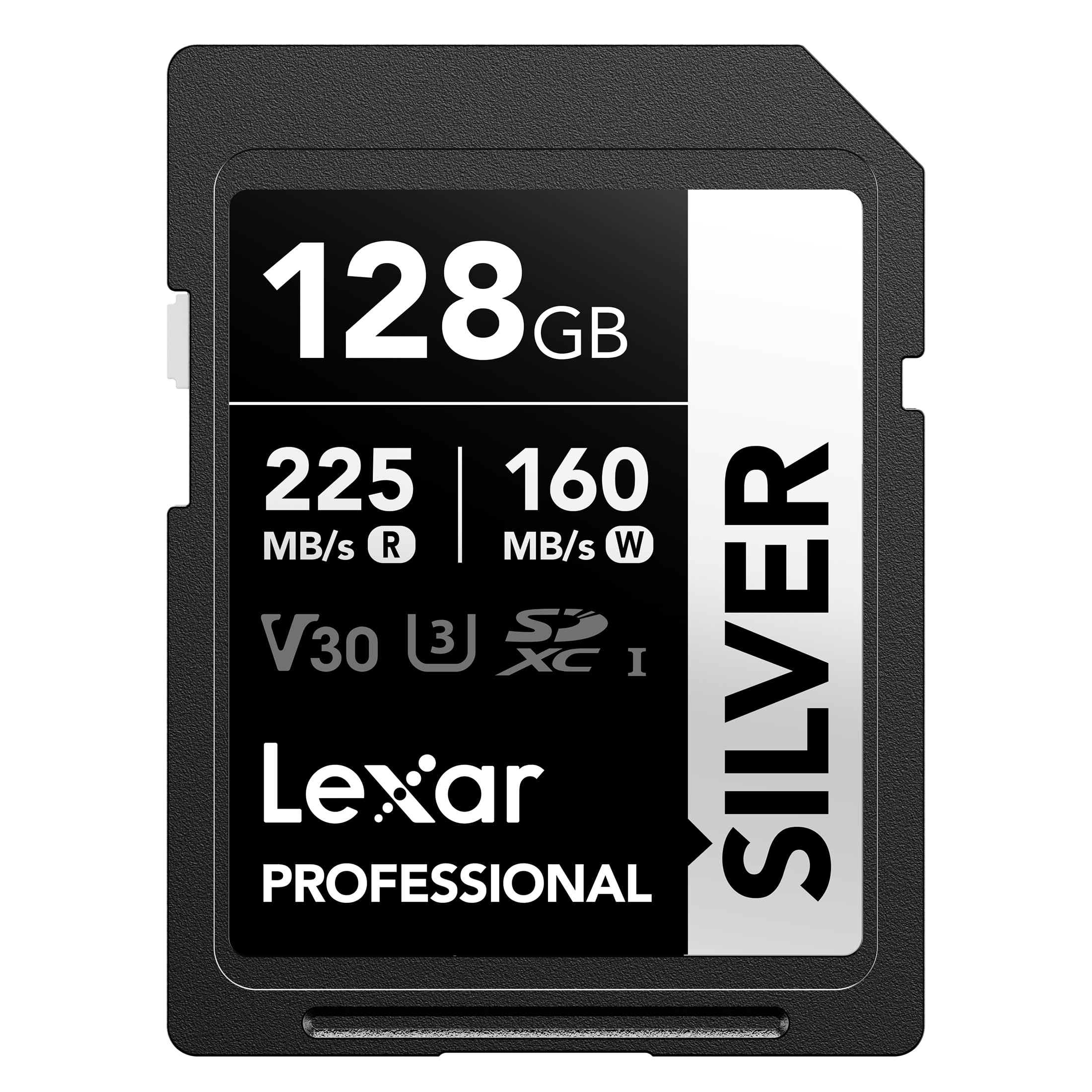
Takes the gap out of your shot-to-shot speed on a Canon Rebel without emptying your pocket — with a lifetime warranty.
The Lexar Professional Silver 128 GB writes at 160 MB/s, which buys you uninterrupted shooting on mid-range DSLR bodies. One reviewer confirmed it “eliminates significant shot lag on Canon Rebel T6i” and noted it supports over 1,000 RAW+JPEG shots. It is wear-proof, drop-proof, temperature-proof, x-ray-proof, and shockproof. It includes the Lexar Recovery Tool and a lifetime limited warranty for confidence.
Where it falls slightly short of the SanDisk Extreme PRO is write speed: 160 MB/s versus 170 MB/s is a small gap, but noticeable if you fill a buffer with 30-megapixel RAW frames. However, for most enthusiast shooters with Canon, Sony, Nikon, or Fujifilm bodies, this card is fast enough to feel responsive.
Everyday shooter: You want a 128 GB card with speedy V30 video performance and a long warranty for a reasonable outlay — the price-to-value ratio beats the SanDisk Extreme PRO for light burst shooting.
Extreme speed: You shoot heavy continuous bursts in RAW on a high-megapixel body — the SanDisk Extreme PRO’s 170 MB/s write gives you a little more headroom.
4. [Older Version] SanDisk 128GB Extreme PRO SDXC UHS-I Card

The card that proved SanDisk’s Extreme PRO formula works, now at a discount — but with a 90 MB/s write speed versus 170 MB/s on the new version.
This previous-gen Extreme PRO writes at 90 MB/s and transfers at up to 170 MB/s. Owners mention it “dramatically improved 4K video upload speed on Sony a6300 (30 min vs 1-2 hrs).” At 128 GB, it holds the same capacity as the current version, but at a noticeably lower write speed. That 90 MB/s write matches the budget Elecacc 2-pack below, so you pay a premium here for SanDisk’s proven durability and reliability. It is temperature-proof, water-proof, shock-proof, and x-ray-proof.
The main catch: this version has been discontinued by the manufacturer, so availability may be inconsistent and you are buying old stock. The current-gen Extreme PRO at a similar price gives you 170 MB/s write speed versus 90 MB/s here, so the newer card is the smarter buy unless this one is deeply discounted.
Value pick: A reliable 128 GB card if you find a clearance deal, especially for a backup or a non-video camera — but do not buy it if the current Extreme PRO is available for a small premium.
5. SanDisk Ultra 64GB Class 10 SDXC UHS-I Memory Card

A reliable, speedy pick for everyday point-and-shoot shooting and trail cams — at 64 GB, you get more space than the Kingston 32 GB, but no video speed rating for 4K.
If your camera is a compact point-and-shoot or a trail cam, you do not need U3 or V30 ratings. The SanDisk Ultra 64 GB delivers a read speed of up to 80 MB/s, which buyers call “fast read/write speeds; quick transfers.” It weighs just 4 grams, making it lighter than the 5-gram Kingston Canvas React Plus. It is waterproof, temperature-proof, x-ray-proof, magnet-proof, and shock-proof. It is perfect for an older DSLR, a children’s camera, or a wildlife trail cam where the card sits out in the elements for weeks.
The one thing it cannot do: shoot continuous 4K video. It lacks a U3 or V30 rating, so sustained write performance for high-bitrate video is not guaranteed. Casual Full HD 1080p clips work fine. That makes this a great budget choice for stills-only cameras and compact camcorders running at 1080p, but not for modern mirrorless video work.
Casual use: Point-and-shoot cameras, trail cams, and older DSLR bodies that only shoot stills or Full HD video — if you want 4K, the SanDisk Extreme PRO is your upgrade.
6. Elecacc 32GB SD Card, 2 Pack
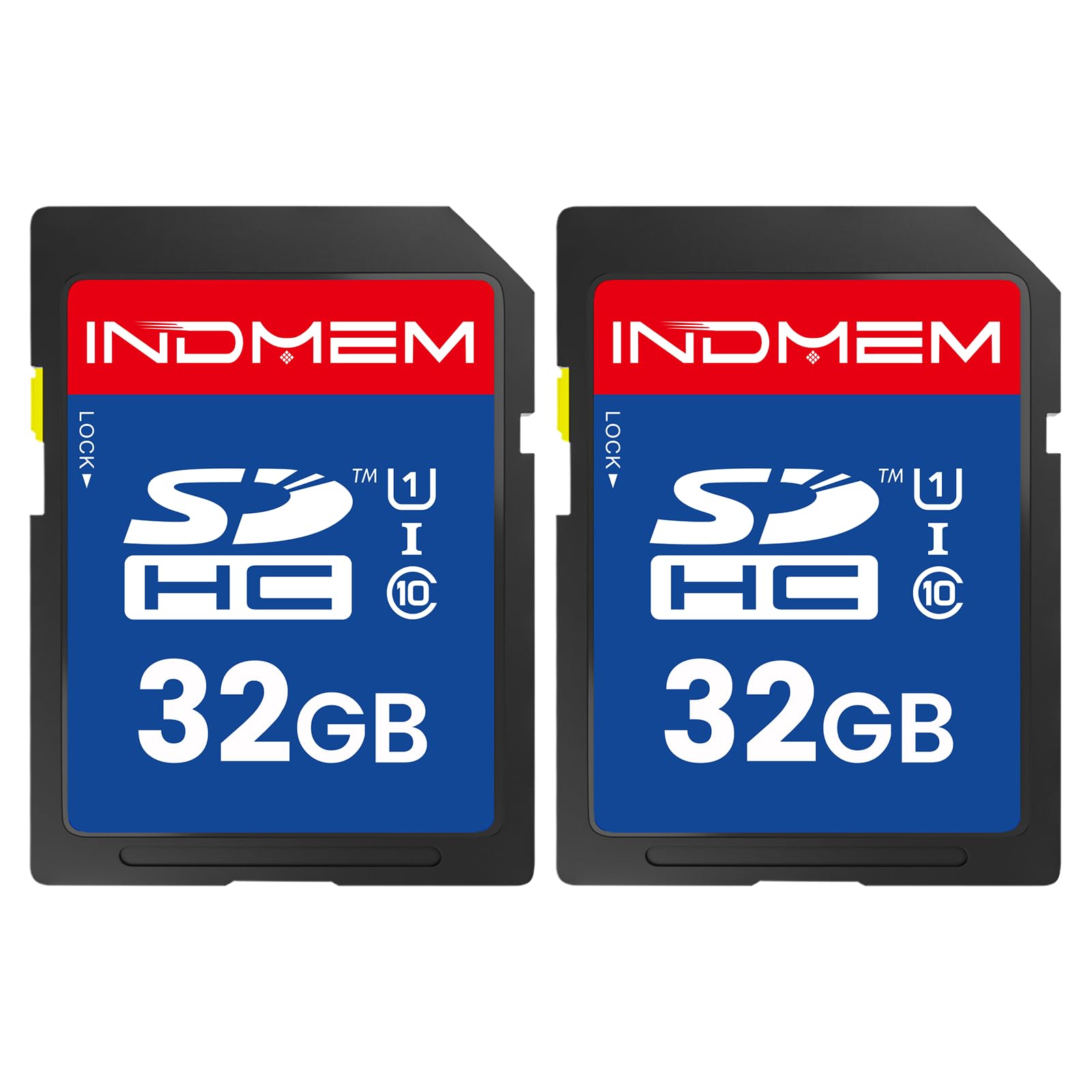
The two-pack that brings a vintage camera back to life without breaking your budget — but skip it for any 4K work.
Not every camera needs a 250 MB/s card. If you own a digital camera from the early 2000s, a game console, a 3D printer, or a CNC machine, this Elecacc 2-pack is exactly what you need. Each card holds 32 GB and reads at 90 MB/s. Reviewers specifically praise it for older devices, noting “I have an older camera from 2004. I tried to use a bigger sd card on it but it wouldn’t work. But this Sd card worked perfectly.” The cards are built with anti-static and UV-proof protection, plus a built-in error correcting code (ECC — checks for data corruption during transfer) to catch errors.
The catch: these are UHS-I U1 Class 10 cards, so they support Full HD 1080p video but not 4K. The 32 GB capacity per card is small by modern standards. If you need a pair of cheap, reliable SD cards for low-resolution cameras or non-camera devices, this two-pack is a solid value. For any modern mirrorless or DSLR work, look at the faster options above.
Multiple devices: Vintage cameras, game consoles, 3D printers, or any device that only supports SDHC — it is the budget pick for up to two devices.
High speed: You shoot 4K video or need more than 32 GB per card — the 128 GB Lexar or SanDisk options are a better fit.
Understanding the Specs
Video Speed Class (V30, V60, V90)
The “V” number stands for the minimum sustained write speed in MB/s (megabytes per second — the amount of data a card can save every second) that a card will hold during video recording. A V30 card guarantees at least 30 MB/s continuous — enough for most 4K UHD footage. V60 guarantees 60 MB/s, which handles 4K 60fps with higher bitrates, and V90 guarantees 90 MB/s for 8K or 4K All-I codecs. If your camera manual lists a V-class requirement, you must meet or exceed it to avoid frame drops.
UHS Bus Speed (UHS-I vs UHS-II)
UHS-I (Ultra High Speed Phase I) cards have a single row of pins and top out at about 170-250 MB/s theoretical speed. UHS-II cards have a second row of pins and can reach 300 MB/s and beyond. Your camera must have a UHS-II slot to take advantage of the extra speed. A UHS-II card will work in a UHS-I slot but runs at UHS-I speeds. Always check your camera’s manual for which type of slot it has before buying a UHS-II card.
FAQ
Will a UHS-II card work in a UHS-I camera slot?
What does V30 mean on a camera SD card?
How long does a 128 GB SD card hold in photos or video?
Can I use a camera SD card in a Nintendo Switch or 3D printer?
Why does write speed matter more than read speed for shooting?
What is the difference between Class 10, U3, and V30?
Is an SD card with 170 MB/s write speed fast enough for 4K video?
How do I format an SD card for my camera?
Does the SanDisk Extreme PRO come with a card reader?
Are SD cards waterproof and shockproof?
Final Thoughts: The Verdict
Across the board, the best camera sd cards winner is the SanDisk Extreme PRO 128GB because it delivers the best balance of 170 MB/s write speed, 128 GB capacity, and proven reliability for 4K UHD video and high-res stills without requiring a UHS-II slot. If you shoot professional 8K or high-bitrate video on a UHS-II body, the Kingston Canvas React Plus is the clear speed king at 300 MB/s read and 260 MB/s write. And for budget-minded shooters with older cameras or non-camera devices, the Elecacc 2-pack is a cheap and reliable way to keep two devices running without spending much at all.
How We Picked
We do not accept paid placement, and we did not hands-on test every unit. Instead, we match each pick to a real buyer and use-case by comparing the manufacturers’ published specifications against the patterns in verified customer reviews — so you get each pick’s real strengths and trade-offs instead of marketing copy.
Sources & Methodology
Specifications: manufacturer listings and product documentation. Review insights: verified customer reviews, as of July 2026. Pricing: not shown on this page (it changes often); check the current price via the retailer link.
As an Amazon Associate, Gadgets Feed earns from qualifying purchases. This does not affect which products we feature.
Product prices and availability are accurate as of the date/time indicated and are subject to change. Any price and availability information displayed on Amazon at the time of purchase will apply to the purchase of this product. As an Amazon Associate I earn from qualifying purchases.
CERTAIN CONTENT THAT APPEARS ON THIS SITE COMES FROM AMAZON. THIS CONTENT IS PROVIDED "AS IS" AND IS SUBJECT TO CHANGE OR REMOVAL AT ANY TIME.
Amazon and the Amazon logo are trademarks of Amazon.com, Inc. or its affiliates.