
Our readers keep the lights on and my morning glass full of iced black tea. As an Amazon Associate, I earn from qualifying purchases.
Specs are compiled from manufacturer listings and verified buyer reviews and can change over time — please confirm the key details on the product page before buying.
You line up a shot, press record, slide the camera, and the footage jerks — a ruined take. The whole point of a camera slider is smooth, professional movement that keeps viewers focused on the scene, not the gear. Getting that glide means picking the right rail: one that fits your camera weight, your shot length, and your budget.
I am Min, the founder of Gadgets Feed. This guide compares published specs from manufacturers and patterns across verified customer reviews. You get each pick’s real strengths and trade-offs, not marketing language.
A good camera slider is about the trade-offs between weight capacity, slide length, and the motor system that keeps your footage steady.
Our Picks at a Glance


How To Choose The Best Camera Slider
Picking a slider means matching rail length, motor type, and weight limit to your gear. A slider that is too short limits your creativity; one that is too heavy stays home. Here is what matters.
Slide Length vs. Portability
Longer rails give wider, more dramatic movement, but they are heavier and harder to pack. A 24-inch slider fits in a carry-on and works for desk shots. A 48-inch slider lets you do sweeping landscape pans but needs more space in the field. For a solo shooter, a shorter, lighter rail often gets used more because it is always in your bag.
Motorized vs. Manual
A manual slider is lighter, cheaper, and never runs out of battery, but every push adds a tiny bit of human shake. A motorized slider uses an electric motor to pull the carriage at a steady speed. That means jitter-free footage and programmable shots like time-lapse, but it adds weight, cost, and a battery to charge.
Payload and Stability
The maximum weight recommendation tells you the heaviest camera body, lens, and accessories the slider can move without binding or shaking. A lightweight mirrorless setup might weigh under 3 pounds, but a full-frame body with a 70-200mm lens can exceed 6 pounds. If the payload is too low, the motor strains and footage jerks. If it is high, the slider feels overbuilt for a small camera.
Quick Comparison
| Model | Best For | Slide Length | Max Payload | Motor Type | Amazon |
|---|---|---|---|---|---|
| Neewer 3 Wheels Dolly★ Best Overall | Battery-powered wheel dolly | N/A | 6.6 lbs | Electric Motor | Amazon |
| IFOOTAGE Shark Slider Nano II 660Gimbal Pro | Gimbal integration | 17″ | 15.4 lbs | Brushless Motor | Amazon |
| GVM 48″/120cm Motorized Slider | Long reach + app control | 48″ | 20 lbs | Electric Motor | Amazon |
| GVM Motorized 31″ Slider | All-around motorized work | 31″ | 20 lbs | Stepper Motor | Amazon |
| Zeapon Micro4 E1000 | Heavy payloads + speed | 42″ | 26 lbs | Brushless Motor | Amazon |
| Zecti 24″/60cm Slider | Travel-friendly manual | 24″ | 4.4 lbs | Manual | Amazon |
| NEEWER 16″/40cm Slider | Budget tabletop use | 16″ | 4.4 lbs | Manual | Amazon |
In-Depth Reviews
1. Neewer 3 Wheels Wireless Video Camera Dolly
Our pick — over 4★ from 950+ verified ratings; the strongest balance of quality and price.
A battery-powered wheel dolly that drives itself along a table or wall for circular or straight-line shots.
This is not a traditional rail slider — it is a wheeled dolly that drives itself across smooth surfaces. The three wheels adjust 180 degrees, so you can set it to travel straight or in a creative circle. The wireless remote controls start, stop, direction, and speed from up to 19.7 feet away. Three speed settings are available: 1.4 cm/s, 2.4 cm/s, and 3.0 cm/s. A built-in 1800mAh rechargeable battery provides up to 6 hours of run time, with four LED indicators showing charging and power status.
The dolly supports up to 6.6 pounds and uses a convertible 1/4-inch to 3/8-inch screw, so it works with most DSLRs, mirrorless cameras, and smartphone holders. It is compact when folded: 5.31 inches square and 2.36 inches tall. Shoppers say it “has worked well for my cinematic shots” and call it “sturdy, well-built.” It requires a smooth surface; on rough terrain the wheels bounce. One customer observed the onboard microphone picks up motor noise, so you will need an external mic for clean audio.
The main limitation is that you cannot get a perfectly straight dolly shot without a straight edge or track — the wheels pivot, and a precise straight line takes trial and error. Reviewers also note the dolly does not retain its speed setting after shutdown, so you have to reset it each time you power on. It is best for dynamic, moving-camera footage on tables or counters where you want a creative panning effect without a full slider setup.
Wireless Freedom
- Battery-powered with 6-hour runtime and wireless remote
- 180° adjustable wheels for straight or circular paths
- Packs down to a 5.3″ cube
Trackless Limits
- Onboard mic picks up motor noise — external mic needed
- Precise straight lines require practice and a smooth surface
- Does not retain speed setting after shutdown
Best for creative angles: If you want a moving camera sliding along a wall or circling a product on a table, this dolly is nimble and wireless.
Not for repeat precision: The lack of speed memory and the wheel-path setup make it less reliable for repeatable, identical takes.
2. IFOOTAGE Shark Slider Nano II 660
The slider that locks onto DJI gimbals and delivers smooth moves up to 15.4 pounds.
If you own a DJI gimbal like the RS4 or RS3 Pro, this slider is built for you. It pairs directly with the included Nano II-RS adapter, so you control the slider and the gimbal from one interface. You get 360° unlimited pan — the camera never hits a hard stop. The brushless motor (an electric motor that uses magnetic fields instead of physical brushes, making it quieter and more durable) operates under 20dB — quieter than a whisper. Buyers report it handles a 10-pound rig vertically with the gimbal attached, and one reviewer noted it “replaces Edelkrone due to app disconnection issues.”
The AI Dynamic Tracking feature in the iFootage Moco app lets the carriage follow a face or object automatically, so you do not need an operator. For multi-camera-style shoots, Multi-Target Mode lets you set up to 4 preset points and switch between them mid-recording. You can also push it by hand as a manual slider; the friction feels smooth without motor drag.
The downside? At 6.8 pounds, it is not ultralight, and mounting it on a tripod requires support on both ends. The 17-inch slide range is shorter than the Zecti’s 24-inch rail, which limits wide panoramic moves. But the trade-off is a compact rail that fits in the included carrying bag. One reviewer wished for a “delay after last key frame” to avoid an abrupt return, but overall buyers call it the “best slider, ever” for gimbal shooters.
Gimbal-First Design
- Direct DJI RS2/RS3/RS4 integration via included adapter
- Smooth performance with intelligent stabilization algorithm
- USB-C PD 60W powers slider, gimbal, and camera from one cable
Trade-Offs to Know
- 17″ slide range is shorter than some competitors’ 24″+ rails
- Needs support on both ends when mounted on a tripod
- No built-in allen wrench storage
Best for gimbal shooters: If you own a DJI RS-series gimbal and want synchronized, silent slider moves up to 15.4 pounds.
Reconsider if: You need a long slide range for wide shots — the 17″ travel is limiting for full-frame landscapes.
3. GVM 48″/120cm Motorized Camera Slider

A four-foot rail that combines app control and time-lapse in a portable carbon fiber body.
The 48-inch slide is the headline. It gives you nearly double the travel of most mid-range sliders, which means you can do sweeping landscape pans or slow reveals across a full product lineup. It is made of carbon fiber, so at 4 kilograms it is surprisingly portable for its length. It comes with a carry bag that owners mention holds up well to light travel. The app control replaces a wired remote with a smartphone interface, letting you program the slider remotely while you stand behind the camera.
One reviewer praised the “ramp in/out” feature, where the slider gradually accelerates and decelerates at the start and end of a move. That subtle touch makes footage look less robotic. It supports 6 shooting modes including time-lapse, video capture, and a 120° panoramic shot. The motor torque (the pulling force the motor uses) is adjustable from 1% to 100%, so you can fine-tune it for different payloads.
But the remote is clunky — customers note the physical controller is not intuitive and takes patience to learn. The center rod, which adjusts camera pan during the slide, can flex at extreme angles. Because the motor sits on one end, the rail needs two tripods or light stands for stable support. With long heavy lenses, the light frame can wobble at height.
Long-Range Workhorse
- 48″ rail provides sweeping, cinematic movement
- Adjustable torque from 1% to 100% for fine control
- Carbon fiber keeps weight manageable at 4kg
What You Give Up
- App and remote both have a learning curve
- Needs two support points (tripods/stands) for stability
- Battery drains faster at high motor speeds
Reach for this if: You need the longest possible slide for landscape, interview, or product reveals and are okay managing two tripods.
Honest limit: The 48″ rail demands a larger bag and setup space — it is not a grab-and-go option for tight rooms.
4. GVM Motorized Camera Slider, 31″ Carbon Fiber
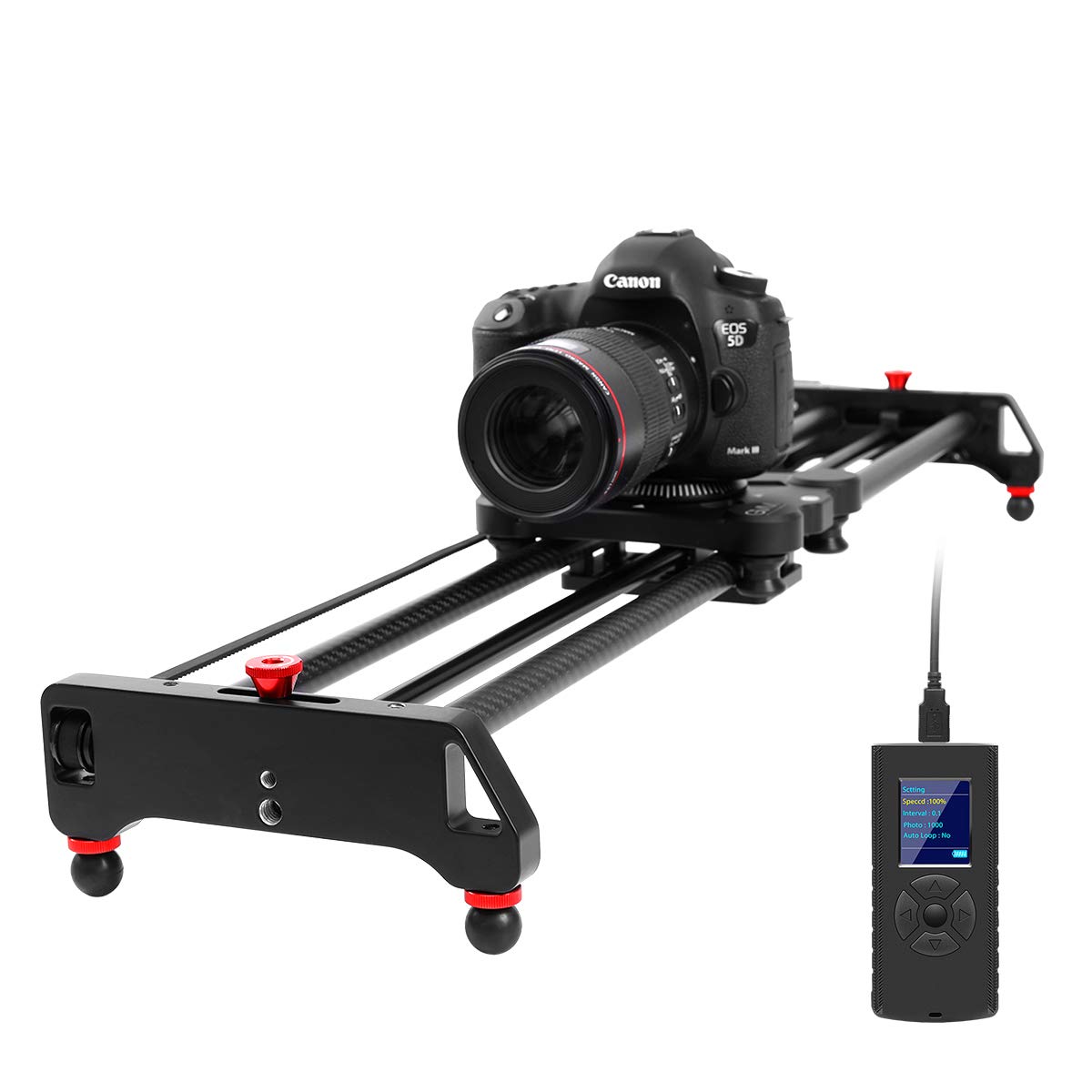
A 31-inch carbon fiber rail with three shooting modes and a remote in a lightweight body.
This is the balance for most video creators. The 31-inch slide provides enough travel for slow reveals and product shots without being too long for a standard bag. The silent stepper motor driver (a motor that moves in small, precise steps so the carriage glides without audible whine) keeps footage quiet. At 3.3 pounds, it is extremely light for a motorized slider. Reviewers point out it handles “12lb rigs without vibration,” and one reviewer says it “runs 8hrs on NPF970 battery.”
The slider has three modes: horizontal, tracking, and 120° panoramic. The rod position determines the mode — up-left and down-right for tracking, down-left and up-right for panorama. The remote lets you set start and end points, then the slider loops automatically. The time-lapse mode captures up to 1000 photos with adjustable step distance, so you can program an overnight sunset shot. One reviewer called it “a must have for content creators” after finding a YouTube setup guide.
The biggest trade-off is the remote — multiple shoppers say it feels “cheap, plastic, clicky” with a basic menu that takes practice. The included manual is confusing enough that one buyer nearly threw it away before finding a video guide. But the slider itself is praised as “durable” and “smooth”; the cost went into the rail, not the controller. It is sharper at night than the IFOOTAGE Nano II because of the extra torque range.
Weight-to-Length Champion
- 3.3 lb carbon fiber body is light enough for any tripod
- 20 lb payload handles heavy rigs without vibration
- 3 shooting modes (horizontal/tracking/panoramic) in one compact rail
The Catch
- Remote feels cheap and the manual is confusing
- No memory for start/stop points when powered off
- Setup for parallax shots takes about 15 minutes of practice
Our top pick: The 31″ GVM offers the best mix of slide length, payload, and portability for most filmmakers.
skip it if: You want a plug-and-play controller — this one requires a short learning curve.
5. Zeapon Micro4 E1000

A 42-inch rail that carries up to 26 pounds and runs high-speed dolly zooms at the press of a button.
If you shoot with a heavy cinema rig — a Sony FX6 or a Canon C300 with a big lens — this is the slider that handles the load. Its 26-pound payload is the highest in this lineup, with a brushless motor that runs silently at normal speeds. The headline is high-speed mode: a single button press changes the motor behavior for fast slides, making dolly zoom shots possible without swapping motors. At high speed, the max payload drops to 2.5kg, but the effect is instant and smooth.
The OLED touchscreen built into the slider body means you do not need a phone to program moves. You can set waypoints, time-lapse parameters, and loop sliding directly on the screen. The speed knob adjusts the carriage speed mid-move with no delay — twist it and the slider responds in real time. One buyer mentioned the “dual-barrel system” adds stability for heavy overhead dolly shots, and another called it “precise and repeatable for product videos and macro work.”
The downsides? At 7.21 kilograms, it is the heaviest slider here, and the shipping package is cumbersome. Some units show a slight bow in the rail under heavy loads, which can cause a tiny wave in footage. One reviewer gave it 1 star, complaining the app “makes the device itself unfunctionable” and that firmware updates are not available. For audio recording, the motor noise becomes noticeable at high speeds.
Payload King
- 26 lb maximum weight recommendation handles cinema rigs
- One-button high-speed mode for dolly zoom shots
- OLED touchscreen provides full control without a phone
Heavy Reality
- At 7.21 kg, it is the bulkiest option — not for travel
- App issues reported, including unavailable firmware updates
- Audible motor noise at high speeds compromises audio
Built for heavy rigs: If your camera and lens combo exceeds 15 pounds, this is the only slider here that handles it comfortably.
Overkill for mirrorless: The weight, size, and app quirks make it excessive for a kit-lens mirrorless setup.
6. Zecti Camera Slider 24″/60 cm

A 24-inch carbon fiber manual slider that delivers smooth, jolt-free shots at an entry-level price.
For anyone starting out in video or needing a packable slider for travel vlogging, the Zecti is the smart buy. At 1.4 pounds, it is dramatically lighter than the GVM 31-inch motorized slider (which weighs 3.3 pounds — a 2.4x difference). The rail uses four precision bearings (small metal rollers that let the carriage glide quietly and smoothly) and a double interior carbon fiber rail system. Buyers report “good quality, smooth jolt-free shots, excellent price.”
The slider mounts horizontally, vertically, diagonally, and sideways via multiple 1/4-inch and 3/8-inch screw holes on the carriage and ends. The removable legs have non-skid rubber feet, and a bubble level helps you level the rail on uneven ground. At 24 inches, it fits in a carry-on, and the included carrying bag is scratch-resistant. One owner reported it has “15.7” travel” with “adjustable friction,” so you can control the glide tension for a slower push.
The catch is that this is a manual slider — you push the carriage by hand, so you have to practice a steady motion. The friction knob helps, but you do not get the repeatability of a motorized slider. A few owners mention the screws can arrive overtightened, causing a sticky slide; loosening them with the included L-shaped wrench fixes it.
Light & Smooth
- 1.4 lb carbon fiber body is easy to pack in any bag
- Four precision bearings provide quiet, jolt-free motion
- Multiple mounting threads for flexible placement on tripod or flat surface
Manual Only
- No motor — requires steady hand push for consistent speed
- 24″ travel may feel short for wide landscape shots
- Screws can arrive overtightened, causing sticky slide; needs adjustment
Ideal travel companion: At 1.4 lbs, this slider disappears into a bag and sets up in seconds on any flat surface.
Not for repeat shoots: Manual control means every push is slightly different — you cannot program an exact speed for multiple takes.
7. NEEWER 16in/40cm Carbon Fiber Camera Slider
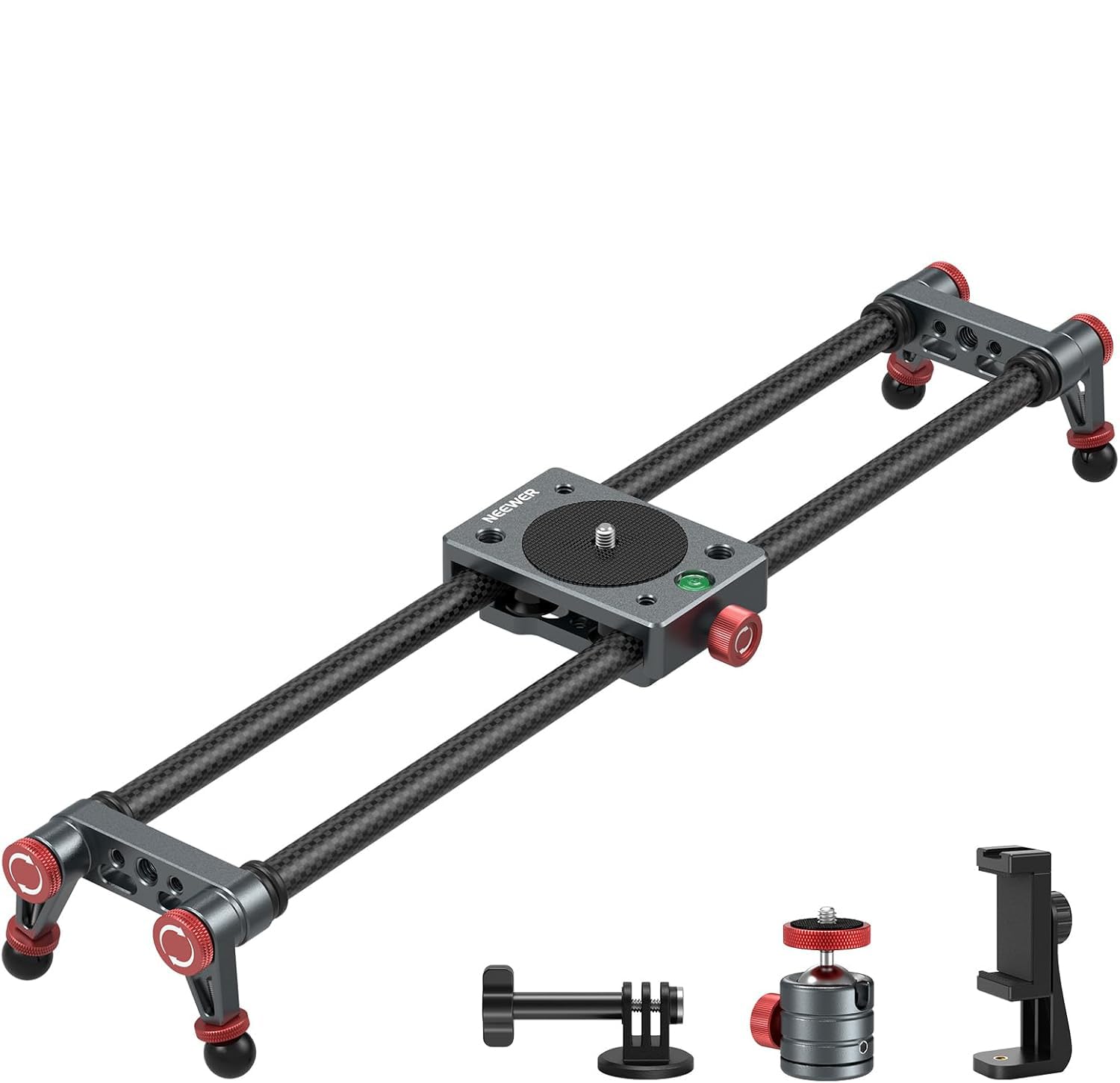
A 16-inch carbon fiber slider for tight tabletop shots, with a ball head and phone clamp included.
If your filming environment is a desk — cooking videos, product reviews, unboxings — this short slider is the most practical. At 16 inches, it takes up almost no tabletop space, yet still gives enough travel for a smooth push-in on a product. The rail is carbon fiber and aluminum alloy, and it carries 4.4 pounds horizontally. It includes a mini ball head with 360° rotation and 90° tilt, plus a phone clamp for smartphones and a mount adapter for GoPro or Insta360 cameras.
The adjustable legs improve from 2 to 5 centimeters, letting you level the rail on uneven surfaces. A bubble level on the carriage helps you check alignment. The side tension knob locks the carriage in place once you have the right framing. Customers note it is “lightweight, quiet slider; works on cheap tripods or flat surfaces” with “no noise during slide, perfect for audio recording.”
At 21.16 ounces, it is 20% heavier than the Neewer wheel dolly, but still compact enough for a camera bag. The main complaint is not the slider itself — multiple reviewers point out the included carrying bag’s zipper fails on the first day. The 16-inch length is also limiting for wider scenes; for a shoulder-width interview slide, you want the Zecti 24-inch or the GVM 31-inch.
Complete Kit
- Includes ball head, phone clamp, and action camera mount
- Adjustable legs for leveling on uneven tabletops
- Noiseless sliding is ideal for audio recording
Short & Frustrating
- 16″ rail limits movement to very tight shots
- Carrying bag zipper reportedly fails on first use
- Manual control only — no motorized option
Perfect for product videos: The short rail fits on a desk and the kit includes every mount for any camera or phone.
Look elsewhere for: Interview shots where the subject is more than 3 feet from the lens — 16″ is too short for wide reveals.
Understanding the Specs
Slide Length and Travel Distance
The slide length is the total rail length, but what matters is the travel distance — how far the carriage actually moves. A 24-inch slider may only offer 15 inches of travel because the carriage and end caps take up space. Longer travel gives wider, more dramatic shots but makes the slider heavier and harder to pack. For tight tabletop work, 16 inches works; for landscapes or interviews, 31 to 48 inches gives you the range to show motion.
Maximum Weight Recommendation
This is the heaviest camera and lens the slider can handle without binding or shaking. Light mirrorless kits weigh around 2-3 pounds; a full-frame body with a 70-200mm f/2.8 can hit 6-8 pounds. Adding a follow-focus motor or gimbal pushes past 10 pounds. Always match the slider’s payload to your heaviest rig — overloading causes the motor to struggle (on motorized sliders) or the bearings to catch (on manual ones), producing jerky footage.
FAQ
Can I use a camera slider on a tripod?
What is the difference between a manual and a motorized camera slider?
How much weight can a camera slider handle?
Will a camera slider work with my smartphone?
Is a longer camera slider always better?
How do I keep a camera slider smooth?
Can I use a camera slider for time-lapse photography?
What is a brushless motor and why does it matter?
Final Thoughts: The Verdict
If you want a lightweight travel slider, grab the Zecti 24″ for its 1.4-pound build and smooth manual glide. And for heavy cinema rigs up to 26 pounds, the Zeapon Micro4 E1000 stands out for its payload and high-speed dolly zoom capability.
How We Picked
We do not accept paid placement. Every pick is matched to a real buyer and a real use-case; we do not hands-on test units.
Sources & Methodology
Specifications: manufacturer listings and product documentation. Review insights: verified customer reviews, as of July 2026. Pricing: not shown on this page (it changes often); check the current price via the retailer link.
As an Amazon Associate, Gadgets Feed earns from qualifying purchases. This does not affect which products we feature.