
Whether you’re chasing a fast-moving subject through a crowded venue or executing a slow cinematic reveal, the difference between amateur-looking footage and a polished production comes down to one thing: how well your camera is stabilized. Handheld shots introduce micro-jitters that no software filter can fully erase, which is why a dedicated three-axis gimbal has become the non-negotiable tool for serious videographers.
I’m Min — the co-founder and writer behind Gadgets Feed. I’ve pored over payload ratings, motor torque figures, battery runtimes, and compatibility lists across dozens of stabilizer models to isolate the ones that genuinely deliver smooth, repeatable results for specific shooting scenarios. This guide cuts through the marketing noise so you can match a gimbal to the exact camera and lens combination you actually own.
Every best camera stabilizer recommendation here was evaluated on payload capacity, battery endurance, and the precision of its tracking algorithms to ensure real-world reliability on set.
How To Choose The Best Camera Stabilizer
Selecting the right gimbal starts with your camera body and the heaviest lens you plan to use. A stabilizer rated for 2 kg (4.4 lbs) will struggle with a full-frame DSLR attached to a 70-200 mm f/2.8, even if the body itself fits within the weight limit. Motor strength, battery life, and the availability of native vertical modes are equally critical for efficient shoots.
Payload Capacity and Motor Torque
The listed payload is the maximum static weight the motors can hold in balance, but dynamic movements — pans, tilts, running shots — demand headroom. Aim for a gimbal whose max payload exceeds your heaviest rig by at least 0.5 kg. Models with carbon fiber arms or upgraded torque motors handle larger lenses without overheating or losing calibration mid-shot.
Battery Runtime and Charging Speed
All-day shoots require batteries that last 10 hours or more. Look for gimbals supporting PD fast charging, ideally 18W or higher, so a 30-minute break can top up enough juice for another hour of operation. Swappable battery grips (like the DJI BG70 series) offer limitless endurance if you carry a spare.
Native Vertical Shooting and Control Features
Social media content demands quick vertical framing. Gimbals with dedicated quick-release plates that slide into a vertical position eliminate the need for L-brackets or awkward rebalancing. Similarly, built-in AI tracking modules or detachable remote handles allow solo creators to keep themselves in frame without an operator.
Quick Comparison
On smaller screens, swipe sideways to see the full table.
| Model | Category | Best For | Key Spec | Amazon |
|---|---|---|---|---|
| DJI RS 4 Pro Combo | Premium | Cinema & heavy rigs | 4.5 kg / 10 lbs payload | Amazon |
| DJI RS 4 | Premium | Pro mirrorless setups | 3 kg / 6.6 lbs payload | Amazon |
| Zhiyun Crane 4E | Premium | Heavy mirrorless & cine | 6 kg payload | Amazon |
| Zhiyun Weebill 3S Combo | Mid-Range | All-day & sling-mode shooting | 2 kg / 4.4 lbs payload | Amazon |
| DJI RS 4 Mini Combo | Mid-Range | Travel & compact mirrorless | 2 kg / 4.4 lbs payload | Amazon |
| ZHIYUN CINEPEER Weebill 3E | Mid-Range | Hybrid shooters & long runtime | 3 kg / 6.6 lbs payload | Amazon |
| FeiyuTech SCORP 2 KIT | Mid-Range | AI tracking & gesture control | 2.5 kg / 5.5 lbs payload | Amazon |
| FeiyuTech SCORP-C | Budget-Friendly | Solo creators & compact rigs | 2.5 kg / 5.5 lbs payload | Amazon |
| FeiyuTech SCORP Mini-3-Pro | Budget-Friendly | Multi-device & action cameras | 2 kg / 4.4 lbs payload | Amazon |
In‑Depth Reviews
1. DJI RS 4 Pro Combo
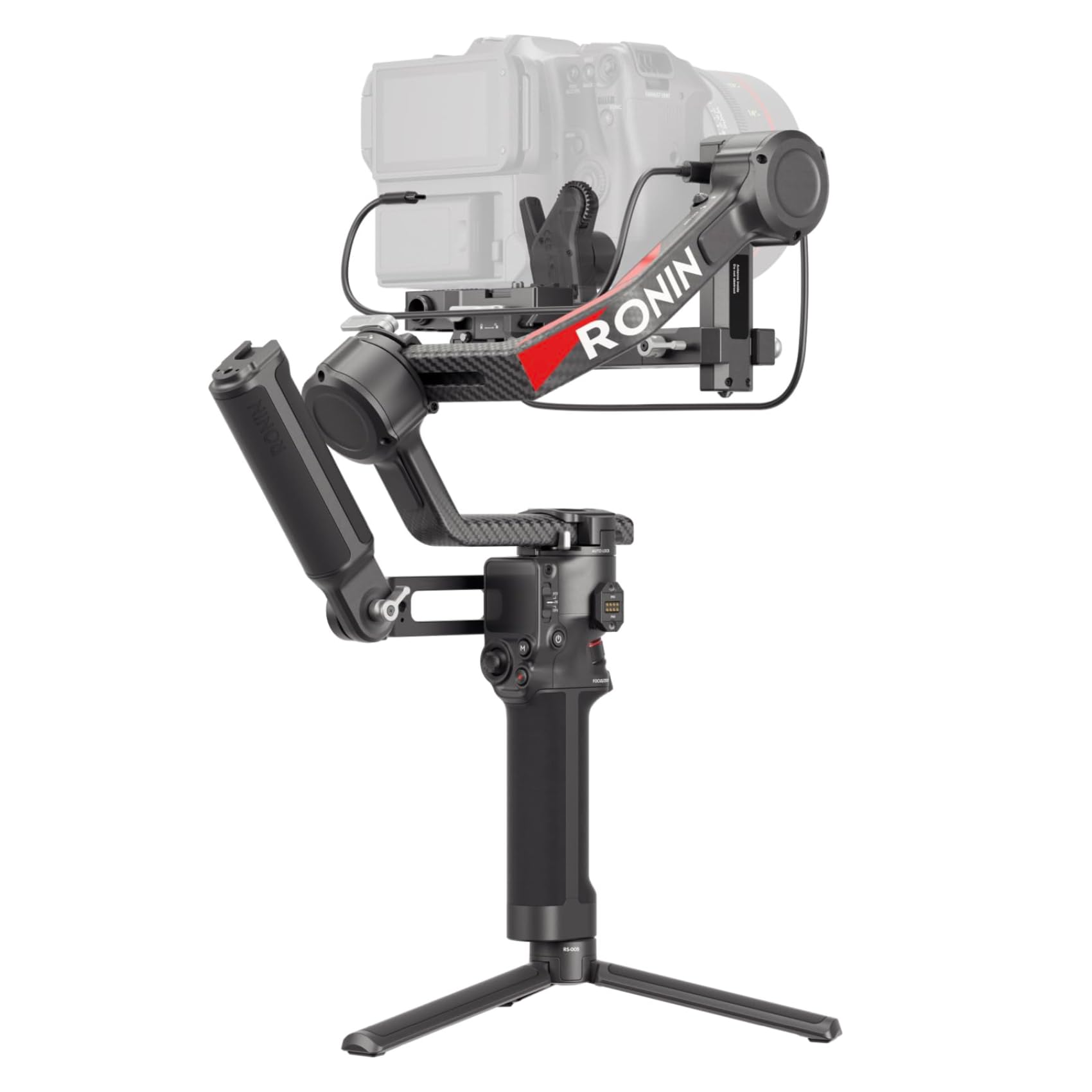
The DJI RS 4 Pro Combo represents the ceiling of handheld stabilization for cinema cameras. Its 4.5 kg (10 lbs) payload and 20% torque increase over the RS 4 allow it to balance rigs like a Sony FX6 or a Canon C70 with a heavy cine lens attached. The carbon fiber axis arms reduce weight while increasing structural rigidity, and the second-generation native vertical switch lets you slide between landscape and portrait framing in seconds without extra brackets.
What sets the RS 4 Pro apart is the Focus Pro LiDAR module, which projects 76,800 ranging points out to 20 meters. This gives solo operators reliable autofocus on manual cinema lenses — a feature that previously required a dedicated focus puller. The Combo bundle includes the BG30 battery grip, a Ronin Image Transmitter for wireless video streaming, and a Focus Pro Motor, making it a complete production ecosystem out of the box.
Battery life hits 12 hours on the included grip, and the optional BG70 extends that to 29 hours while powering the camera and accessories via 18W USB-C output. The trade-off is weight: at 1.84 kg (4 lbs) without the camera, this is not a travel gimbal. It is designed for professional shoots where stability, payload headroom, and ecosystem integration outweigh portability.
Why it’s great
- Supports full cinema rigs with 10 lbs payload
- LiDAR autofocus works with manual lenses
- Modular design with wireless video transmission included
Good to know
- Heavy and bulky for travel or one-camera bags
- Steep learning curve for first-time gimbal users
2. ZHIYUN Crane 4E
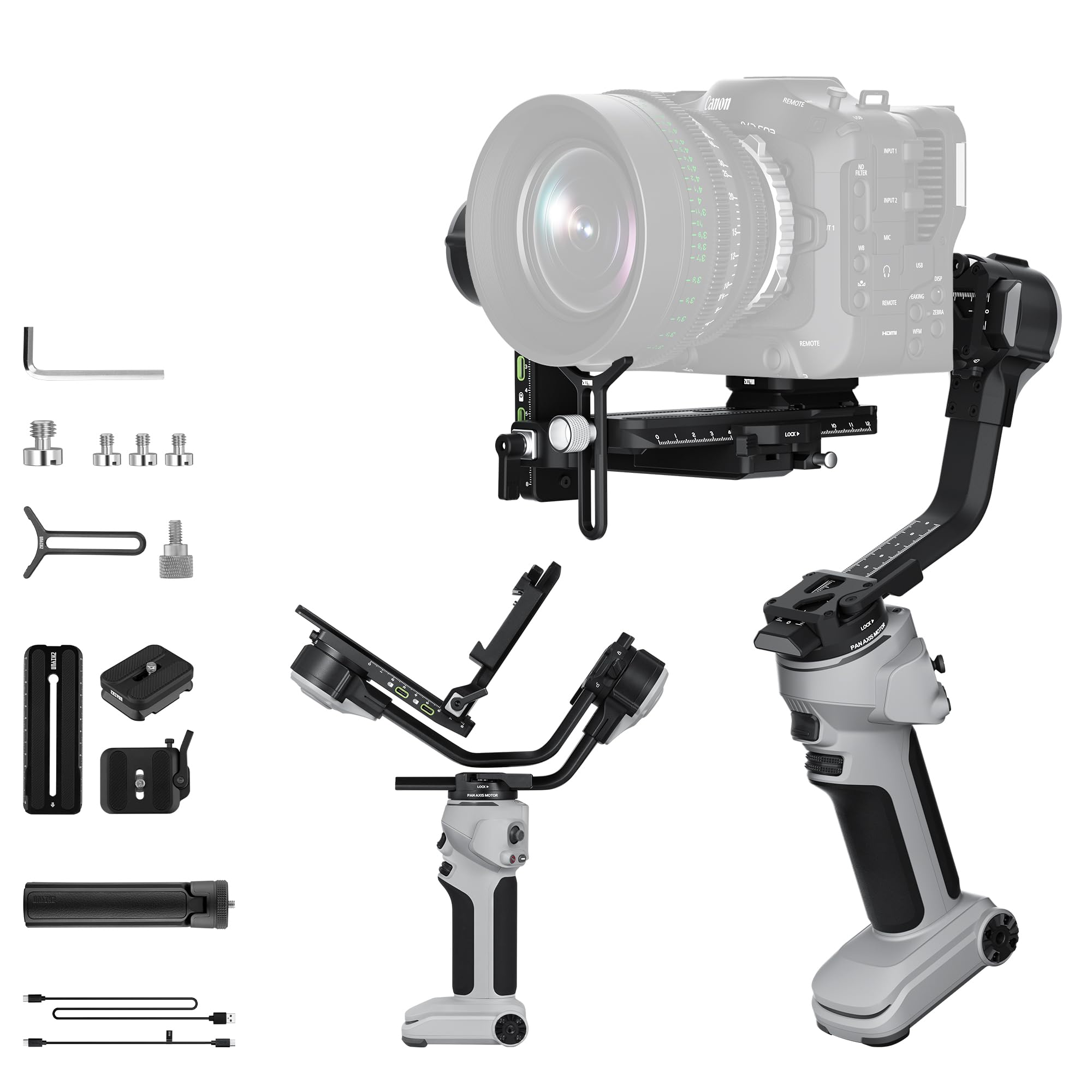
The ZHIYUN Crane 4E is a heavyweight champion in the mid-premium tier, rated to carry up to 6 kg — enough for a Canon C300 with a standard zoom. Its 2600 mAh battery delivers 12 hours of runtime, and the 25W PD fast charging refills the battery in about two hours. The integrated side wheel gives you direct control over shutter, aperture, and ISO without reaching for the camera body.
Native horizontal-to-vertical switching is handled through the quick-release plate system, so you can rotate the camera into portrait orientation without rebalancing the entire rig. The Crane 4E also accommodates two servo focus motors simultaneously, making it suitable for dual-operator follow-focus setups on narrative or commercial shoots. The build quality feels dense and industrial, with metal components throughout.
Bluetooth shutter control eliminates the need for a physical cable on supported cameras, though some users report the record button glitching on specific Canon models. The companion app receives consistent criticism for its clunky interface and unreliable hardwire connection. If you can live without a polished mobile app, the raw stabilization performance and payload capacity are outstanding for the price.
Why it’s great
- 6 kg payload handles cine cameras with ease
- Native vertical shooting without additional hardware
- Fast 25W PD charging stops downtime
Good to know
- App and Bluetooth connectivity can be finicky
- Setup requires careful balancing for larger lenses
3. DJI RS 4

The DJI RS 4 occupies the sweet spot between pro-level capability and everyday usability. Its 3 kg (6.6 lbs) payload comfortably balances a Sony A7S III with a 24-70 mm f/2.8, and the Teflon-coated axis arms make fine balancing adjustments buttery smooth. The second-generation native vertical shooting plate lets you switch to portrait mode without unseating the camera, and the joystick mode switch toggles between PF, PTF, and FPV without diving into menus.
The tilt axis has been extended by 8.5 mm over the previous generation, providing extra balancing room for larger lens hoods or cage-mounted accessories. The RSA communication port opens the door to the DJI accessory ecosystem, including the Tethered Control Handle and third-party remote ring grips. Battery life stands at 12 hours on the included BG21 grip, and the optional BG70 grip pushes that to 29.5 hours with 18W camera charging.
For most hybrid shooters, the RS 4 hits the perfect balance: it handles a serious mirrorless rig without the bulk of a pro cinema gimbal. The autolocking axes and responsive follow modes make it fast to deploy, and the image stabilization is rock-solid even during quick orbits. The only real compromise is the non-replaceable internal battery, though the swappable grip mitigates this for all-day shoots.
Why it’s great
- Effortless balancing with Teflon-coated arms
- Native vertical switch in under 10 seconds
- RSA port supports extensive accessory ecosystem
Good to know
- Internal battery is not user-replaceable
- Heavy setups may require the BG70 battery grip
4. ZHIYUN CINEPEER Weebill 3E

The Weebill 3E is proof that you don’t need to spend top dollar to get a 3 kg payload and a 16-hour battery. Weighing just 990 grams (2.2 lbs), it is one of the lightest high-payload gimbals on the market, making it an excellent choice for run-and-gun shooters who carry their rig through airports and city streets. The A4-paper-sized folded dimensions (12 x 8 x 3 inches) slide easily into a backpack compartment.
Native vertical shooting is achieved by mounting the quick-release plate directly to the vertical arm, bypassing the need for an L-bracket. Bluetooth shutter control pairs automatically after the first connection, so you can start and stop recording wirelessly. The Sling Mode 2.5 upgrade — using a separately purchased wrist rest and telescopic sling grip — reduces fatigue by over 50% during low-angle shots, a feature that professional event shooters will appreciate.
The main limitation is that only the Panasonic control cable is included in the box; Canon, Sony, and Nikon users must buy additional cables separately. The y-axis also lacks full 360-degree rotation, which restricts some creative panning shots. Despite these constraints, the Weebill 3E delivers exceptional stabilization and runtime for its weight class, making it the budget-friendly flagship of the Zhiyun camera stabilizer lineup.
Why it’s great
- 3 kg payload in a sub-1 kg body
- 16-hour battery covers all-day productions
- Sling Mode 2.5 reduces arm fatigue significantly
Good to know
- No camera control cables for Canon or Sony included
- Y-axis rotation is limited, not 360 degrees
5. DJI RS 4 Mini Combo

The DJI RS 4 Mini Combo is built for creators who prioritize speed and portability without sacrificing stabilization quality. The auto axis locks unfold and lock in under one second — no more fumbling with manual thumb screws when a moment is about to happen. Its 2 kg (4.4 lbs) payload accommodates the majority of mirrorless cameras with standard zooms, plus the included RS Intelligent Tracking Module keeps a subject framed during orbit and follow shots.
Switching from horizontal to vertical takes roughly ten seconds thanks to the redesigned quick-release plate, and the Briefcase Handle included in the Combo makes low-angle shots comfortable for extended periods. The Teflon-enhanced balancing ensures that changing a lens or adding a small monitor doesn’t throw off your calibration. Responsive Follow Mode gives the gimbal an immediate reaction speed to fast hand movements, which is useful for action sequences.
A notable downside is the non-replaceable battery — once it degrades, the entire gimbal needs service. Additionally, Bluetooth and wired camera control can’t run simultaneously, meaning you lose zoom control if you use a wireless trigger. The tracking module only recognizes human subjects, not animals or vehicles. Still, for a lightweight kit that fits in a camera cube and deploys in seconds, the RS 4 Mini Combo is hard to beat.
Why it’s great
- Auto axis locks deploy in under one second
- Intelligent tracking module included for solo creators
- Briefcase handle enables fatigue-free low angles
Good to know
- Internal battery is not user-replaceable
- Bluetooth and wired camera control cannot run simultaneously
6. Zhiyun Weebill 3S Combo

The Weebill 3S Combo refines the sling-grip concept that Zhiyun pioneered, integrating an LED fill light into the body that delivers up to 1000 Lux peak illuminance with adjustable color temperature from 2600K to 5500K. This built-in light eliminates the need for an external on-camera LED, simplifying your rig for run-and-gun or real estate filming. The Sling Mode 2.5 with the included wrist rest and base reduces shoulder fatigue during long handheld takes.
Portrait-to-landscape switching happens directly on the quick-release module without removing the camera, and the integrated lock structure ensures the camera stays balanced through the transition. Bluetooth shutter control lets you trigger record and photo from the gimbal handle, and the PD fast charging fills the battery to full in two hours for 11.5 hours of operation. The combination of a comfortable grip angle, responsive joystick, and customizable front wheel makes the Weebill 3S one of the most intuitive gimbals to operate.
At 1 kg (2.2 lbs), the Weebill 3S is lightweight enough for all-day use, and the included padded backpack offers ample space for the gimbal, wrist rest, and a small camera body. The main drawback is the 2 kg payload limit — it won’t handle a BMPCC 4K fully rigged. Additionally, some users report the manual is sparse; Zhiyun’s QR-code video tutorials are essential for first-time setup.
Why it’s great
- Integrated LED fill light with variable color temperature
- Sling Mode 2.5 reduces arm strain dramatically
- Intuitive controls and quick portrait switching
Good to know
- 2 kg payload insufficient for heavily rigged cinema cameras
- Setup instructions are incomplete; rely on video guides
7. FeiyuTech SCORP 2 KIT

The FeiyuTech SCORP 2 KIT integrates an AI tracking sensor directly into the gimbal body, so you don’t need to buy a separate module or pair a phone app. Making an “OK” hand gesture initiates subject tracking, which follows a person’s movement without any additional input. The L-shaped quick-release plate allows native vertical shooting by sliding directly onto the vertical arm, and the Kit version includes ARRI rosettes, an expandable module, and a carbon fiber rod for accessory mounting.
The 2.5 kg (5.5 lbs) payload covers most mirrorless bodies with f/2.8 zooms, and the wireless Bluetooth shutter control handles start/stop and focus without a cable. The touchscreen interface on the grip lets you navigate modes quickly, and the gun-handle design provides a natural bevel that sits comfortably in the palm. Runtimes are solid for a full shoot day, and the stabilization algorithm — powered by Feiyu’s 2025 quaternion engine — keeps footage steady even during high-speed motion.
The AI tracking only reframes subjects in landscape orientation, which means portrait shooters lose the benefit of automatic framing. Also, the touchscreen menu can be sluggish, and some users report that balancing a zoom lens requires a compromise (you may need to set the lens halfway through the zoom range before calibrating). Still, for the price, the built-in AI and included Kit accessories make the SCORP 2 a compelling option for solo content creators.
Why it’s great
- Built-in AI tracking responds to hand gestures
- Native vertical shooting via L-shaped plate
- Kit version includes ARRI rosettes and carbon rod
Good to know
- AI tracking only works in landscape mode
- Balancing zoom lenses requires a fixed zoom position
8. FeiyuTech SCORP-C

The FeiyuTech SCORP-C sets a high bar for budget-friendly gimbals by offering a 2.5 kg (5.5 lbs) payload and a 2,500 mAh battery that delivers 10–13 hours of runtime. The integrated hanging handle lets you shoot upright or underslung with complete lens control, and the beveled grip edges fit the hand naturally. Three-axis motor locks prevent unwanted movement during transport, while the five-way center-of-gravity adjustment and memory slider make rebalancing repeatable between setups.
Advanced features like A-B trajectory memory, flash mode (three-axis fast follow), and space mode (three-axis follow for dizzying effects) are accessible through the mode switch, giving you creative options without needing a phone app. The package includes a full set of control cables covering Sony, Canon, Nikon, Panasonic, and Fujifilm, so no extra purchases are necessary. 18W fast charging adds 30 minutes of runtime in just five minutes of charging.
The main drawback is the learning curve — the manual is sparse and YouTube tutorials are scarce compared to DJI or Zhiyun. Some users find the sliding mechanisms stiff initially, and the thumb stick can feel jerky for smooth pans. However, for its payload capacity, battery life, and included cable kit, the SCORP-C offers outstanding value for creators on a tight budget who are willing to invest some setup time.
Why it’s great
- 2.5 kg payload with 13-hour runtime at this price point
- Includes full cable set for major camera brands
- Integrated hanging handle for underslung shooting
Good to know
- Setup instructions are sparse with limited tutorial support
- Sliding mechanisms can feel stiff initially
9. FeiyuTech SCORP Mini-3-Pro

The SCORP Mini-3-Pro is the only gimbal in this lineup that officially supports mirrorless cameras, compact cameras, action cameras, and smartphones — a true four-in-one tool. Its AI Tracking 4.0 module achieves a 0.003-second response time and extends tracking range to 18 meters with 360-degree infinite follow. The detachable remote handle allows you to walk away from the gimbal and control it from a distance, which is perfect for solo creators filming themselves.
Payload capacity sits at 2 kg (4.4 lbs), enough for a Canon R50 or a Sony A6400 with a kit lens. The Stabilization 10.0 algorithm keeps footage smooth during high-speed motion, and the modular quick-release system lets you switch between horizontal and vertical framing without tools. The package includes a GoPro adapter, a smartphone holder, and a full set of cables, covering virtually every consumer camera format.
The motor strength is a limiting factor — users report it struggles when adding an external light or microphone to the camera. The initial setup directions are somewhat incomplete, and rebalancing between portrait and landscape modes is cumbersome. But for a creator who shoots across multiple devices (Sony mirrorless in the morning, GoPro on a bike ride, iPhone at a dinner), the SCORP Mini-3-Pro eliminates the need to own separate gimbals for each device.
Why it’s great
- Works with mirrorless, action cams, and smartphones
- 18-meter AI tracking with sub-second response
- Detachable remote handle for solo filming
Good to know
- Motor weakens with added accessories like lights
- Rebalancing for portrait/landscape is time-consuming
FAQ
Will a 2 kg payload gimbal support my Sony A7 IV with a 24-70 mm f/2.8?
Why does my gimbal shake when I use a telephoto lens?
Final Thoughts: The Verdict
For most users, the best camera stabilizer winner is the DJI RS 4 because it balances a 3 kg payload, Teflon-smooth balancing, and native vertical shooting in a package that is professional enough for commercial work yet portable enough for travel. If you want an ergonomic grip with an integrated fill light and sling-mode support, grab the Zhiyun Weebill 3S Combo. And for heavy cinema rigs or multi-camera productions that demand LiDAR autofocus and wireless video transmission, nothing beats the DJI RS 4 Pro Combo.