
Our readers keep the lights on and my morning glass full of iced black tea. As an Amazon Associate, I earn from qualifying purchases.
Specs are compiled from manufacturer listings and verified buyer reviews and can change over time — please confirm the key details on the product page before buying.
Hiking with a camera is a constant battle: either the strap saws into your neck, or the camera bounces against your chest with every step. The right strap locks your gear flat against your body, frees both hands for scrambling, and lets you draw the camera to your eye in one smooth motion. For most hikers, a sling-style strap or harness that transfers weight off your neck onto your shoulder or torso is the best solution.
I’m Min — the founder and writer behind Gadgets Feed. This guide is built by comparing the manufacturers’ published specifications and the patterns across verified customer reviews, so you get each pick’s real strengths and trade-offs instead of marketing spin.
Whether you carry a compact mirrorless or a heavy telephoto, this camera strap for hiking guide explains which designs actually stay secure on rocky trails and which remain comfortable after hours of walking.
Our Picks at a Glance

How To Choose The Best Camera Strap For Hiking
Hiking demands a camera strap that handles uneven terrain, full hands, and backpack layers. The ground is uneven, your hands are often full, and you might wear a backpack over everything. A strap that works at a city wedding can be miserable on a mountain trail.
Decide between sling carry and a torso harness
A sling loops over one shoulder and holds the camera at your hip or ribs, so the weight rests on your shoulder instead of your neck. A torso harness clips around your chest and pins the camera against your body, which stops bouncing almost completely. The harness style is the most stable for scrambling but can feel warmer and tighter against your chest.
Check the load rating against your gear
Mirrorless cameras and telephoto lenses are heavy, so you need a strap rated for the load that won’t fail mid-hike. A strap rated for 90kg (about 198 lbs) gives you that safety margin, but the mounting hardware and your camera’s lugs matter just as much. Some straps connect to the camera’s bottom tripod socket, which is more secure for big lenses than the tiny strap loops on the body.
Look for one-handed length adjustment
You will want to cinch the strap tight while climbing and loosen it for a quick shot. Straps with quick-pull adjusters at both ends let you change length on the move. A strap that requires two hands and fiddling with buckles will frustrate you on a windy ridge.
Quick Comparison
| Model | Best For | Carry Style | Load Rating | Pad Width | Amazon |
|---|---|---|---|---|---|
| Peak Design Slide Lite★ Best Overall | Versatile all-day sling | Sling / Neck | 200 lbs anchors | 32mm | Amazon |
| BLACKRAPID RS-4Telephoto Choice | Heavy telephoto hiking | Sling | — | Pad included | Amazon |
| Cotton Carrier Skout G2 | Scrambling & climbing | Torso harness | No max weight | Padded shoulder | Amazon |
| PGYTECH Strap Pro | Active shooters & runners | Sling / Harness | 90kg | 60mm | Amazon |
| PGYTECH Wide Padded | Comfort on large kits | Sling / Neck | 90 KG | 1.8 inches | Amazon |
| PGYTECH Neck Strap Air | Compact mirrorless | Neck / Sling | 90KG | Breathable fabric | Amazon |
| OP/TECH Super Classic | Budget neck comfort | Neck | — | Padded neoprene | Amazon |
In‑Depth Reviews
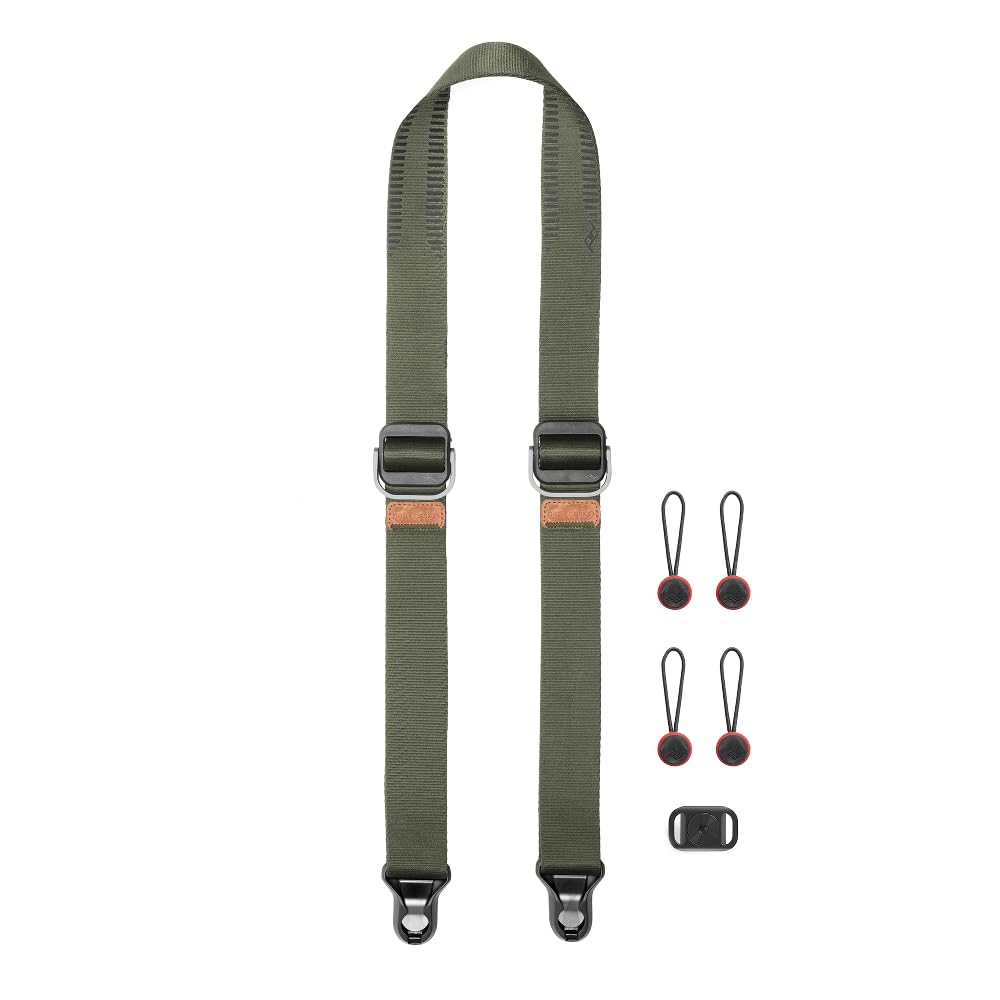
1. Peak Design Slide Lite Camera Strap
Our pick — over 4.5★ from 7,500+ verified ratings; the strongest balance of quality and price.
The hyper-adjustable all-rounder that transitions from neck to sling mid-trail
This is the strap the crowd — 4.8 stars across 7,500+ owners — keeps coming back to, and the reason is its dual-sided 32mm seatbelt webbing. One side glides smoothly across your jacket for repositioning, while the opposite grippy side locks the strap in place when you want stability. That split personality makes it the most versatile choice for hiking, where you switch between walking and shooting constantly.
The quick-release system is the standout feature: the Anchor Link connectors are rated to 200 lbs (a figure that gives serious confidence with a heavy body) and include visible wear indicators so you know when they need replacing. Buyers report the one-hand quick-pull adjusters let you change length on the fly, and that dual connection points keep the camera balanced without that annoying flop. As owners mention, “It’s perfect for mirrorless cameras. The strap is plenty comfortable enough, and it’s easy to use sling-style while hiking around.”
The catch is honest: with full-size professional bodies, a few owners find the slim profile slightly less cushioned over very long days, and the tight anchor slots take a moment to thread. This is a premium pick at a mid-range price, and the build quality — nylon webbing with aluminum adjusters — justifies the reputation. It is lighter and less bulky than the BLACKRAPID RS-4 below, while still carrying serious glass.
Why hikers love it
- One-hand length adjustment works mid-stride
- 200 lbs rated anchors with wear indicators
- Dual-sided webbing: glide or grip as needed
Who should think twice
- Slim pad is less cushioned on the heaviest rigs
- Anchor slots can feel tight to thread quickly
Reach for this if: you want one strap that does sling, neck, and shoulder duty without switching gear.
Look elsewhere if: you carry a massive telephoto all day and need maximum padding under the strap.
2. BLACKRAPID RS-4 Retro Classic Sling
The original sling design that takes heavy glass off your neck entirely
This is the pick for hikers carrying a big telephoto, because it mounts to the camera’s tripod socket and lets the rig hang at your hip instead of swinging from your neck. The thin, low-profile foam pad sits on either shoulder, and the front and rear spring cam locks let you adjust the fit quickly. Owners with a 200-600mm zoom specifically report the strap makes long carries bearable where a neck strap simply would not.
Weight distribution is the whole point here: the camera rests against your side, keeping your neck and spine free, and the CR3 swivel mount lets the camera rotate smoothly as you move. A small zippered pocket on the pad stores a memory card or cash while you walk, and the safety tether adds backup protection against accidental drops. Customers note it “relieves neck pain from heavy camera/lens combos” and swings the camera to shooting position in seconds.
The trade-off: because the camera hangs freely, the strap can shift on your shoulder without an under-arm stabilizer, and the carabiner-style connector can scratch a camera body if you are careless. It weighs only 150 g, so it adds almost nothing to your pack. Unlike the Cotton Carrier harness below, this leaves your chest fully open for ventilation — a real plus on hot climbs.
Built for heavy glass
- Keeps weight off the neck entirely
- Rotating mount prevents strap twisting
- Built-in zip pocket for cards or cash
Trail caveats
- Camera hangs loose and can shift without a stabilizer
- Metal connector could scratch the camera body
Best for: wildlife and landscape hikers carrying long, heavy lenses who want the camera off their neck.
Not ideal for: trail runners who need the camera pinned flat with zero movement.
3. Cotton Carrier Skout G2 Sling Harness

The chest harness that pins your camera flat for real scrambling
For the steepest trails, ladders, and rock climbs, this harness keeps your camera locked to your chest. It slips over one shoulder and clips around your torso, holding the camera against your chest with a patented twist-and-lock system so nothing moves. The Kodra synthetic canvas with DWR coating (a water-repellent finish) shrugs off light rain, and the hardened nylon 6 receiver plate keeps the mount rigid. At 215.5g, the harness itself is light enough that you forget it is there.
The package is genuinely complete: it includes a quick-release safety tether to prevent accidental drops, a slip-over weather cover, a stainless steel marine-grade mounting bolt, and an Allen key for installation. Owners rate the stability as the defining trait — one used it through Antelope Canyon climbing ladders and rocks, and another says it eliminated neck pain entirely by moving weight to the shoulders. The quick-release tether weighs just 16g, so the backup protection adds no noticeable bulk.
The honest limitations: the chest-mounted design can feel warm against your body during exertion, and because the camera sits tight to your chest, it is best suited to small or medium setups — owners say a full-frame body with a 100-500mm lens is simply too heavy. The waist strap adjusts from 26 to 57 inches, so it fits a wide range of hikers, but the single-shoulder style is not for everyone. This is a premium-priced, purpose-built tool rather than a general-purpose strap.
Scramble-ready security
- Camera locks flat with zero bounce
- Complete kit with tether and weather cover
- Hands-free draw for quick shots
Honest trade-offs
- Can feel warm against the chest on hot hikes
- Best for small to medium camera setups
Choose this for: climbers, scramblers, and anyone who needs the camera pinned tight and hands fully free.
skip it if: you carry a pro-level telephoto — the shoulder harness is better for that weight.
4. PGYTECH Camera Strap Pro Harness
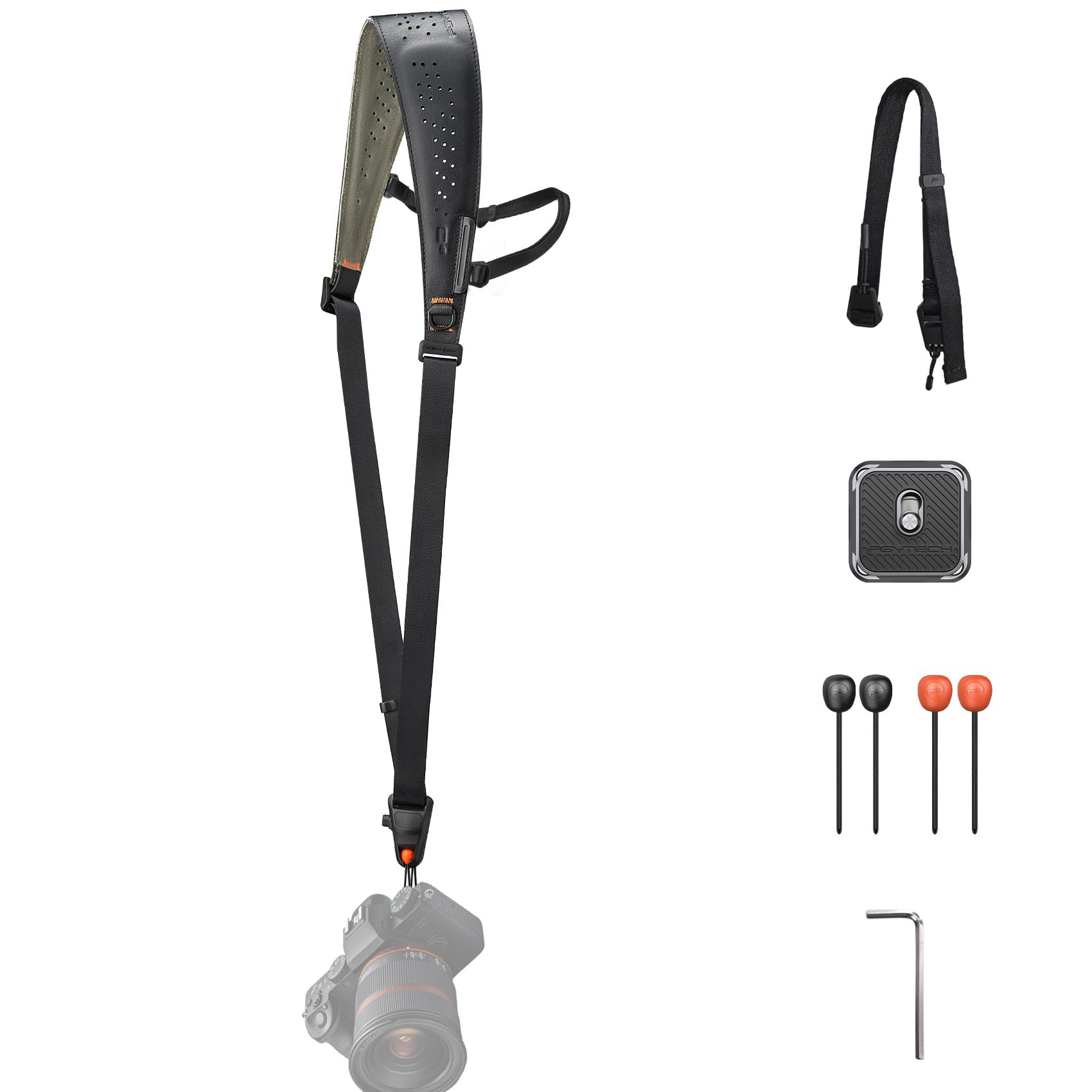
A hybrid sling-harness with a detachable underarm strap for running and bending
This is the strap for the most active hikers — the ones who jog, bend, and change lenses without stopping. The detachable underarm strap is 4-position adjustable and locks the camera firmly so it never slips off your shoulder mid-motion, which is exactly what running and scrambling demand. Detach it in seconds and you have a clean crossbody sling for casual walking.
Comfort is engineered hard here: the 60mm ergonomic shoulder pad combines genuine leather with EPDM foam and 56 vent holes to keep air moving, plus a soft suede lining that grips your shoulder without slipping. Owners confirm it handles heavy rigs like an OM1 MKII with a 150-600mm lens without digging in, and the slide lock prevents the camera from swinging. Length adjusts from 32.6 to 57 inches for users from 4.9 to 6.2 feet tall — a genuinely wide fit range.
The load rating is the headline: 90kg max on the high-strength UHMWPE cords, with a three-layer webbing that shows a yellow wear indicator before it becomes dangerous. The built-in D-ring holds lens caps or tools. The fit does get mixed feedback from owners, which is worth respecting — a few find the underarm strap fiddly to position. It is heavier and more complex than the simpler Peak Design Slide Lite, but it offers a stability level those simpler straps cannot match.
Motion-proof design
- Underarm strap stops shoulder slip during running
- 90kg rated cords with yellow wear indicator
- 60mm leather pad with 56 vent holes
Consider this first
- Underarm strap position takes time to dial in
- More complex than a simple sling
Pick this if: you run, bend, and move aggressively while hiking and refuse to lose the camera off your shoulder.
Pass on it if: you want the simplest possible strap for casual walks.
5. PGYTECH 1.8″ Wide Padded Camera Strap
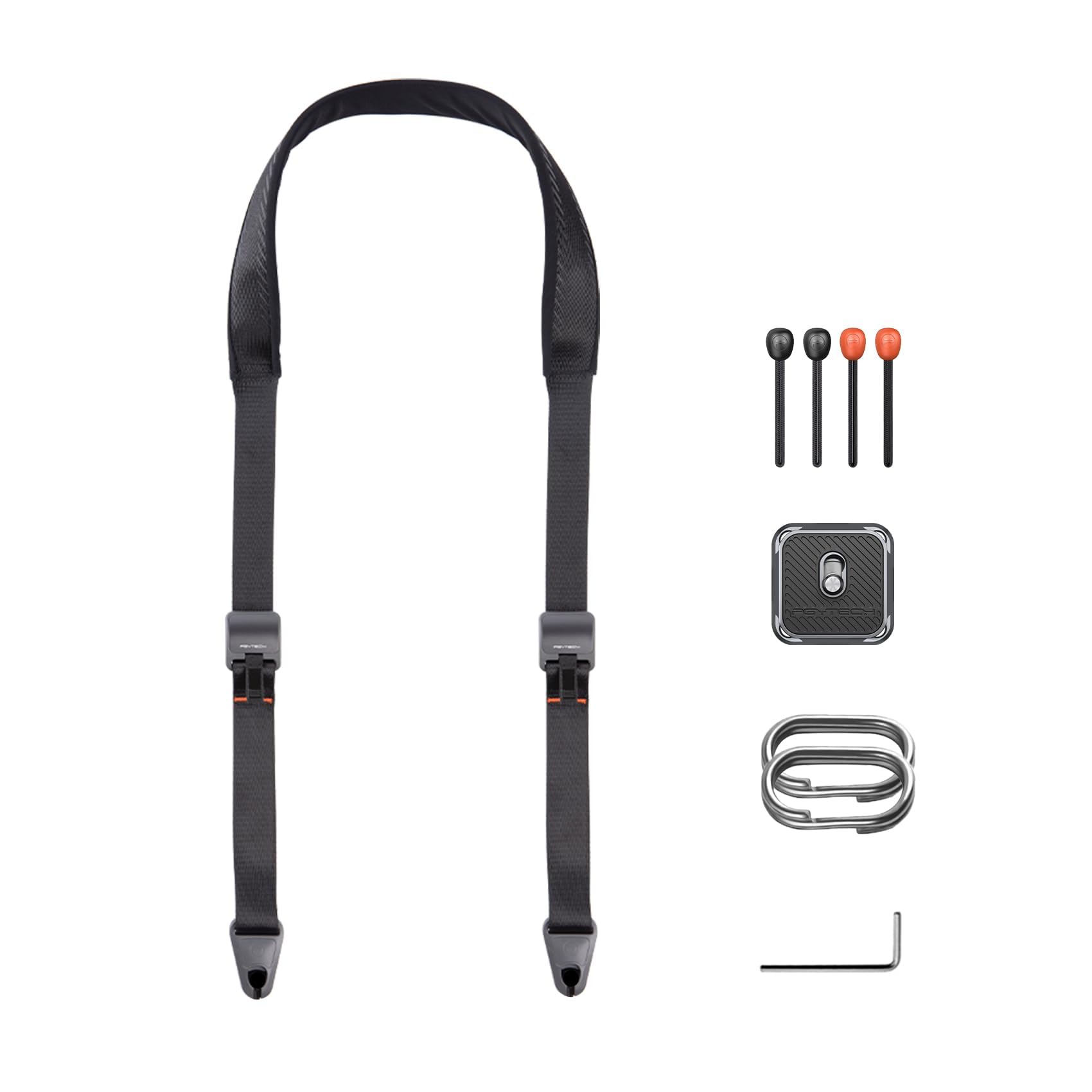
A wide, soft shoulder pad that makes heavy kits feel noticeably lighter
If your complaint with every strap is that it digs into your shoulder, this is the answer. The 1.8-inch padded section is lined with EPDM material — a soft, elastic foam — that spreads the load across a wider area, and owners consistently describe it as wider, thicker, and softer than the stock straps that ship with cameras. It works well over one shoulder or across the body, and the anti-twist round design keeps the strap from flipping as you walk.
Made from UHMWPE, the strap is rated to carry 90 KG and is ten times stronger than steel wire of the same weight — a figure that removes any doubt about supporting a large camera and lens. The quick-release connector uses a dead-center locking mechanism, so there is no risk of the camera falling off regardless of the angle of force, and you can release it one-handed by pressing the top. Quick adjusters at both ends let you fine-tune the fit to your body.
One owner mentioned using it for a Yellowstone trip and found it handled a large camera and lens with no bouncing. A fair caveat: the quick bead is designed to be hard to release accidentally, which means inserting it takes a firm push. It lacks the underarm strap of the Strap Pro above, so it is best for steady hiking rather than running. It is lighter and less bulky than the Peak Design Slide gear while delivering comparable comfort at a friendlier value point.
Wide-load comfort: the 1.8-inch EPDM-lined pad is the standout reason owners switch to this strap for big lenses.
One honest gripe: the secure ball lock requires a deliberate push to engage, so quick swaps take a second longer.
6. PGYTECH Neck Strap Air Quick-Release

A feather-light neck strap with a rotating ball mount that self-untwists
This is the pick for hikers with compact mirrorless cameras like the Canon G7 X or Sony ZV-E10 who want a strap that disappears on the trail. The surface fabric is eco-friendly, skin-safe, and breathable — a real advantage when you are sweating under the sun. It weighs almost nothing, and reviewers point out it distributes weight nicely without digging into the shoulder or neck.
The signature feature is the ball quick head connector: it can be buckled blindly from any angle, and the rounded rotating anchors twist with the camera so the strap never tangles. The PA+GF reinforced connector provides strength with a soft touch. Built from tear-resistant Dyneema fiber, the strap is rated to stand a load of 90KG, and a replace warning tells you to swap it promptly when the yellow layer shows through.
The dual-sided knots allow free adjustment for sling carry too, and it converts easily even after you disassemble the camera — saving storage time in a pack. Owners praise how it folds into a camera case repeatedly without being ruined. A practical note: it is slightly too thick to fit the small ring on a Nikon Z6 without a triangle adapter. For the price, it is a strong value pick that compares well against the heavier Peak Design Slide Lite for lightweight mirrorless kits.
Light-load favorite: breathable fabric and a blind-buckle ball head make this easy for compact mirrorless shooters.
Size check: thick cords may need an adapter for cameras with small strap rings.
7. OP/TECH USA Super Classic Camera Strap

The budget neck strap that beats pricier rivals on the simple things
For hikers who prefer a classic neck strap and do not want to spend much, this OP/TECH USA design is a proven crowd-pleaser at the entry level. The Comfort-Stretch neoprene pad absorbs shock and reduces neck and shoulder fatigue, with a textured nonslip backing that keeps the strap securely on your shoulder while you walk or shoot handheld. At just 3.5 ounces, it adds essentially nothing to your pack weight.
The smart detail is the quick-release Uni-Loop connector system: the disconnects sit three inches from the camera body mounts, so when you detach the strap, only a small loop stays on the camera — perfect for stowing the body in a bag without the strap flapping around. Owners specifically say this strap stays adjusted and does not slip, unlike pricier designs they tried. It supports DSLR, SLR, mirrorless, and even binoculars, and it is built in the USA with a lifetime warranty against defects.
The honest trade-off is length: owners note it runs short for taller users, though extensions are available. It is also best suited to mid-weight cameras — heavier bodies may strain the stretch. This is a straightforward value pick for someone hiking with a lightweight mirrorless or DSLR who wants proven comfort without engineering overkill.
Value comfort
- Neoprene pad absorbs shock and stays put
- Quick disconnects leave only a small loop on the camera
- Lifetime warranty from a US brand
Know before you buy
- Runs short for taller users
- Best with light to mid-weight cameras
Reach for this if: you want a simple, padded neck strap at a friendly price and shoot a lightweight camera.
Look elsewhere if: you are tall and need a long sling-style carry instead of a neck loop.
Understanding the Specs
Load Rating (kg or lbs)
This number tells you how much weight the strap material and connectors are built to handle before failing. A 90kg rating gives huge margin for a heavy body and lens, and some straps add visible wear indicators so you can see when the cord is weakening. Bigger is safer, but a high rating matters only if your camera’s own mounting points are strong too.
Carry Style: Sling vs Neck vs Harness
A neck strap puts weight on your cervical spine, which causes fatigue on long hikes. A sling transfers it to one shoulder and holds the camera at your hip. A torso harness clips around your chest and pins the camera flat so it cannot bounce. The style you choose depends entirely on how aggressively you move on the trail.
Quick-Release Connectors
These let you detach the strap from the camera instantly, which is essential for tripod work, bag storage, or switching to a wrist strap. Better systems lock securely so the camera cannot fall off regardless of force angle, and some are designed to be buckled blindly from any angle — a real benefit when you are shooting fast.
Pad Width and Material
A wider pad spreads the camera’s weight over more of your shoulder, which reduces pressure points. Materials like EPDM foam add softness and elasticity, while genuine leather or breathable fabric with vent holes keeps air moving so you do not overheat. Match the pad to the weight of your kit: bigger lenses need wider, thicker pads.
FAQ
How is a sling strap different from a neck strap for hiking?
What does the 90kg load rating on a camera strap mean for me?
Will a quick-release strap come off accidentally on the trail?
Can I use a strap with my full-frame DSLR and big telephoto lens?
Is a torso harness or a shoulder sling better for rough terrain?
What should I do if the strap is too long or too short for my height?
How do I know when to replace a paracord-style camera strap?
Why does the camera strap keep twisting while I hike?
Final Thoughts: The Verdict
For most hikers, the best camera strap for hiking is the Peak Design Slide Lite because it pairs genuine all-day comfort with the fastest one-hand adjustments on the trail. If you carry heavy telephoto glass, the BLACKRAPID RS-4 takes the weight off your neck entirely. And for scrambling and climbing where zero movement matters most, the Cotton Carrier Skout G2 pins your camera flat and hands-free. The sheer volume of positive owner feedback backing the Slide Lite — thousands of hikers calling it the only strap they need — makes it the safest first choice for almost anyone.
How We Picked
We do not accept paid placement. Every pick is matched to a real buyer and a real use-case; we do not hands-on test units.
Sources & Methodology
Specifications: manufacturer listings and product documentation. Review insights: verified customer reviews, as of August 2026. Pricing: not shown on this page (it changes often); check the current price via the retailer link.
As an Amazon Associate, Gadgets Feed earns from qualifying purchases. This does not affect which products we feature.