
Choosing the right video camera means navigating sensor sizes, frame rates, stabilization systems, and codec depths that directly determine whether your footage looks cinematic or like a home video. The gap between a pocket gimbal camera and a full-frame mirrorless body is measured in stops of dynamic range, not just dollar signs.
I’m Min — the co-founder and writer behind Gadgets Feed. I’ve spent hundreds of hours cross-referencing sensor specifications, bit rates, autofocus point counts, and real-world thermal performance to isolate which bodies actually deliver on their feature sheets.
After deep analysis of every modern contender, this guide delivers the definitive verdict on the best camera/video camera for serious creators who demand lifelike color, reliable tracking, and post-production flexibility from their primary capture tool.
How To Choose The Best Camera/Video Camera
Video-centric cameras today demand a balance of sensor resolution, frame-rate flexibility, codec efficiency, and thermal management. Ignoring any one of these pillars can produce footage that looks soft, noisy, or requires a rig the size of a suitcase. Focus on the three factors that separate a capable video tool from a compromise.
Sensor Size and Native ISO Performance
Micro Four Thirds (MFT), APS-C, and Full-Frame sensors each carry distinct advantages for video work. MFT bodies like the Blackmagic Pocket Cinema Camera 4K offer deep depth of field and dual native ISO up to 25600, preserving detail in dim interiors. Full-frame sensors such as the 24.2MP chip in the Canon EOS R8 deliver wider dynamic range and shallower depth of field for cinematic separation, but demand more expensive glass and larger rigs for stabilization. APS-C sensors like the 20.9MP Nikon Z50 II represent a middle ground, balancing low-light capability against lens affordability.
Codec Depth and Bit Rate
The codec you record determines how much latitude you have in post-production. A camera that outputs 10-bit 4:2:2 internally — like the Panasonic LUMIX G85 or the Blackmagic Pocket models — preserves smooth color gradients and allows significant exposure adjustments without banding. Cameras limited to 8-bit 4:2:0, typical of entry-level DSLRs, posterize skies and skin tones when pushed. For grading intensive work, seek Blackmagic RAW or Apple ProRes support; for quick delivery workflows, 4K 10-bit H.265 at 150 Mbps is adequate.
Stabilization and Rolling Shutter Management
Handheld gimbal-style cameras like the DJI Osmo Pocket 3 use mechanical 3-axis stabilization to eliminate micro-jitters entirely, but are limited by fixed-wide lenses. Interchangeable lens cameras rely on 5-axis in-body image stabilization (IBIS) or optical stabilization in the lens. The Panasonic LUMIX G85 offers class-leading dual IBIS plus OIS in its kit lens, producing smooth walking footage. Rolling shutter — the skewing effect from panning quickly — is severe on some Sony Alpha ZV-E10 units; faster readout sensors in the Sony a7 III and Canon EOS R8 minimize this distortion for action scenes.
Quick Comparison
On smaller screens, swipe sideways to see the full table.
| Model | Category | Best For | Key Spec | Amazon |
|---|---|---|---|---|
| DJI Osmo Pocket 3 | Gimbal Camera | Vlogging & travel | 1″ CMOS · 4K/120fps | Amazon |
| Panasonic LUMIX G85 | Mirrorless | Hybrid stills/video | 16 MP MFT · Dual IS | Amazon |
| Panasonic LUMIX G100 | Compact Mirrorless | Entry-level vlogging | 20 MP MFT · 360° Audio | Amazon |
| Canon T7 Rebel | Entry DSLR | Learning photography | 24.1 MP APS-C · 1080p | Amazon |
| Sony Alpha ZV-E10 | Vlogging Mirrorless | Streaming & product reviews | 24.2 MP APS-C · 4K 30p | Amazon |
| Nikon D7500 | DSLR | Action & wildlife | 20.9 MP APS-C · 8 fps | Amazon |
| Blackmagic Pocket 4K | Cinema Camera | Narrative & interviews | 4096×2160 · 13 stops DR | Amazon |
| Canon EOS R8 | Full-Frame Mirrorless | Pro content creation | 24.2 MP FF · 4K 60p | Amazon |
| Nikon Z50 II | Compact Mirrorless | Travel & everyday | 20.9 MP APS-C · 4K 60p | Amazon |
| Sony a7 III | Full-Frame Mirrorless | Hybrid pro work | 24.2 MP FF · 693 AF points | Amazon |
| Blackmagic Pocket 6K Pro | Cinema Camera | High-end production | 6144×3456 · Int. ND filters | Amazon |
In‑Depth Reviews
1. DJI Osmo Pocket 3 Creator Combo

This pocket-sized gimbal camera packs a 1-inch CMOS sensor that records 4K at 120fps with 10-bit D-Log M color, delivering over one billion colors for post-production grading. The 2-inch rotating touchscreen makes horizontal-to-vertical switching instant, while ActiveTrack 6.0 keeps faces centered during movement. The built-in stereo mic and included DJI Mic 2 transmitter capture clear audio for vlogging without external gear.
The 3-axis mechanical stabilization is genuinely gimbal-quality, allowing smooth running shots and panning at full telephoto reach. Battery life hits 166 minutes on a single charge, and the USB-C PD charging refills quickly between takes. The Creator Combo adds a wide-angle lens, battery handle, mini tripod, and carrying bag, turning the Pocket 3 into a complete run-and-gun kit.
Reviewers consistently report ditching their smartphone for video after testing the Pocket 3’s low-light performance and stabilization. The 1-inch sensor captures night scenes with minimal noise, and the haptic feedback on the screen makes one-handed operation intuitive. The only compromise is the fixed wide-angle lens — you cannot swap glass for extreme telephoto shots.
Why it’s great
- Gimbal-quality 3-axis stabilization in a pocket form factor
- 1-inch sensor delivers superior low-light footage vs. smartphone sensors
- Creator Combo includes mic, wide-angle lens, and tripod for all-in-one kit
Good to know
- Fixed wide-angle lens limits telephoto reach
- Gimbal mechanism feels delicate — requires careful carrying
2. Blackmagic Design Pocket Cinema Camera 6K Pro

The Blackmagic Pocket Cinema Camera 6K Pro is built for serious filmmaking, featuring a Super 35 sensor with 13 stops of dynamic range and dual native ISO up to 25,600. It records in 12-bit Blackmagic RAW and Apple ProRes, offering maximum grading flexibility. The active Canon EF lens mount opens access to decades of affordable, high-quality glass.
Built-in 2-, 4-, and 6-stop ND filters let you control exposure without external matte boxes, an essential feature for outdoor shoots. The 5-inch HDR tilt LCD is bright enough for daytime monitoring, and dual CFast 2.0/SD card slots plus USB-C external SSD recording solve storage anxiety. The included DaVinci Resolve Studio license means you can start color grading immediately.
Reviewers praise the 6K Pro for running all day without overheating, even in studio conditions. The internal ND filters are highlighted as a game-changer for run-and-gun production. The main tradeoff is the lack of continuous autofocus — manual focus or a follow-focus system is required, and the NP-F570 battery should be considered an emergency backup only, with external power recommended for extended takes.
Why it’s great
- 13 stops dynamic range and dual native ISO for pristine shadow detail
- Built-in ND filters eliminate external matte box rigging
- 12-bit Blackmagic RAW and ProRes recording for professional color grading
Good to know
- No continuous autofocus — manual focus or follow-focus required
- Battery life is limited; external power recommended for long sessions
3. Sony a7 III Full-Frame Mirrorless

Sony’s a7 III remains a benchmark hybrid camera thanks to its 24.2MP back-illuminated full-frame sensor and 693 phase-detection AF points covering 93% of the frame. It shoots 14-bit uncompressed RAW stills at up to 10 fps, and records 4K Full HD video with full pixel readout and no pixel binning. The 15-stop dynamic range ensures smooth tonal transitions even in high-contrast scenes.
The NP-FZ100 battery delivers approximately 710 shots per charge, class-leading endurance for a mirrorless body. The 28-70mm kit lens provides a reliable starting range, and the E-mount ecosystem offers hundreds of native and adapted lenses. Reviewers consistently note the AF is fast and precise, with excellent low-light performance and incredible battery life that often eliminates the need for a spare.
The main compromises are complex menu navigation — Sony’s menu system is dense — and the kit lens requiring an upgrade to unlock the sensor’s full potential. Weather sealing is adequate for light rain but not harsh environments. Despite its age, the a7 III still competes with newer entries because of its AF system, battery, and image quality.
Why it’s great
- 693 AF points with 93% coverage for reliable subject tracking
- ~710 shot battery life — class-leading endurance
- Full-frame 24.2MP sensor with 15-stop dynamic range
Good to know
- Menu navigation is dense and unintuitive
- Kit lens is adequate but benefits from an upgrade for serious work
4. Canon EOS R8 Mirrorless

The Canon EOS R8 is Canon’s lightest full-frame RF mount camera, pairing a 24.2MP CMOS sensor with the DIGIC X processor for uncropped 4K 60p video oversampled from 6K. Dual Pixel CMOS AF II covers the entire frame with 1,053 AF zones and detects people, animals, and vehicles — including aircraft and trains — using deep learning. The 0.39-inch OLED EVF with 120 fps refresh rate and 3-inch vari-angle touchscreen provide responsive composition.
Canon Log 3 and HDR PQ recording are available for flat profiles, and the UVC/UAC support means it functions as a webcam via a single USB cable. The R8 shoots up to 40 fps with electronic shutter and full autofocus, making it suitable for action and sports. Reviewers praise its fantastic autofocus, outstanding photos and video, and excellent low-light performance relative to its weight and price.
The tradeoffs are significant: no in-body image stabilization, a small LP-E17 battery offering around 500 photos or 1 hour of 4K video, and a single SD slot. Overheating can occur after approximately 30 minutes of continuous 4K 60p recording. It is a lightweight tool optimized for deliberate shooting, not all-day run-and-gun.
Why it’s great
- Uncropped 4K 60p oversampled from 6K for sharp detail
- Dual Pixel CMOS AF II with deep-learning subject detection
- Lightest full-frame RF body — ideal for travel and gimbal use
Good to know
- No IBIS — relies on lens stabilization or external support
- Small battery and single SD slot limit extended shooting
5. Panasonic LUMIX G85

The Panasonic LUMIX G85 is a Micro Four Thirds mirrorless camera that excels at handheld shooting thanks to its 5-axis in-body dual image stabilization working in concert with lens optical stabilization. The 16MP sensor omits a low-pass filter, delivering approximately 10% more fine detail than previous 16MP MFT sensors. The 12-60mm Power O.I.S. kit lens provides an effective 24-120mm full-frame equivalent range.
4K QFHD video recording at 3840×2160 with the 4K Photo mode lets you extract 8MP stills at 30 fps, useful for action sequences. The magnesium alloy body is weather-sealed, and the 3-inch tilt touchscreen and 2360K-dot OLED viewfinder make composition easy in bright conditions. Reviewers note the stabilization is outstanding, the controls are intuitive, and the image quality with the kit lens is excellent for beginners and intermediate users.
The main shortcomings are that the 16MP sensor limits stills resolution compared to APS-C competitors, and the autofocus can be sluggish in low light when shooting 4K video. Battery life is not remarkable, and there is no headphone jack for audio monitoring. For video creators prioritizing stabilization and lens variety over raw megapixels, the G85 remains a value champion.
Why it’s great
- 5-axis dual image stabilization produces smooth handheld footage
- Weather-sealed magnesium alloy body for outdoor durability
- 12-60mm kit lens covers wide-to-telephoto range with OIS
Good to know
- 16MP sensor limits stills resolution vs. APS-C
- Autofocus slows in low light during 4K video recording
6. Blackmagic Pocket Cinema Camera 4K

The original Pocket Cinema Camera 4K uses a 4/3-inch sensor with a native 4096×2160 DCI 4K resolution and 13 stops of dynamic range, recording to Blackmagic RAW and Apple ProRes. Dual native ISO up to 25,600 keeps noise low in dim conditions. The MFT lens mount is compatible with native micro four thirds glass and adapters for Canon EF and vintage lenses.
The 5-inch LCD eliminates the need for an external monitor, and the USB-C port allows direct recording to external SSDs, which is cost-effective for long shoots. The included DaVinci Resolve Studio license covers professional color grading and editing. Reviewers consistently describe the Pocket 4K as studio-quality gear that paid for itself in a single day of production, with beautiful texture and dynamic range even with vintage lenses.
The camera lacks continuous autofocus, in-body stabilization, and a flip screen, making it unsuitable for vlogging. Battery life from the LP-E6 is approximately 30 minutes — effectively an emergency power source. The screen brightness of ~250 nits is unviewable in direct sunlight. This camera is designed for rigged narrative, interview, and documentary work, not casual handheld shooting.
Why it’s great
- 13 stops dynamic range and dual native ISO for professional-grade footage
- Blackmagic RAW and ProRes recording with included DaVinci Resolve Studio
- USB-C external SSD recording saves on media costs
Good to know
- No continuous AF, IBIS, or flip screen — requires rigging for stable shots
- Battery is emergency-only; external power recommended
7. Nikon Z50 II Two-Lens Kit

The Nikon Z50 II pairs a 20.9MP DX-format APS-C sensor with 4K UHD/60p video and 120p slow-motion in Full HD. The Picture Control button offers 31 built-in color presets that can be customized and saved, with cloud-based downloads via Nikon Imaging Cloud. Nine distinct subject detection types — including dedicated bird and airplane modes — make autofocus reliable for wildlife and aviation shooters.
The kit includes the NIKKOR Z DX 16-50mm f/3.5-6.3 VR and the 50-250mm f/4.5-6.3 VR, providing an equivalent 24-375mm zoom range with optical stabilization. The SnapBridge app transfers photos to a smartphone in seconds. Reviewers praise the camera as a great travel system that is lightweight, compact, and produces beautiful shots right out of the box.
The menu system takes time to learn, and the camera is more photography-focused than video-focused — it is not a replacement for dedicated cinema gear. The dual-lens kit is a complete starter package but the variable aperture zooms limit low-light performance. For family, travel, and hobbyist use, the Z50 II offers a modern, connected mirrorless experience.
Why it’s great
- Two-lens kit covers 24-375mm equivalent with VR stabilization
- 31 built-in color presets with cloud customization for easy creative looks
- 9 subject detection types including dedicated bird and airplane modes
Good to know
- Menu system is complex for beginners
- Variable aperture kit lenses limit low-light versatility
8. Sony Alpha ZV-E10

The Sony ZV-E10 is purpose-built for vloggers, featuring a 24.2MP APS-C Exmor CMOS sensor with a BIONZ X processor that oversamples 4K from 6K with full pixel readout. The Product Showcase Setting transitions focus from your face to an object instantly, and the Background Defocus button toggles shallow depth of field at the press of a button. USB streaming works with a single cable.
The 425 contrast-detection AF points combined with 693 phase-detection points deliver fast, reliable Eye AF for both humans and animals. The camera is lightweight and runs without overheating in typical use. Reviewers call it a massive upgrade from older Sony APS-C bodies, praising the 4K quality, log profile support, and flip screen for self-recording.
The ZV-E10 has severe rolling shutter, and the tiny LCD practically requires an external monitor for framing. There is no in-body image stabilization, and the 4K 30p mode uses a heavy crop. Face and Eye AF do not work in 4K 30p, and the battery lasts only about 25 minutes when recording 4K continuously. These caveats make it a niche tool best suited for controlled studio or desk setups.
Why it’s great
- 4K oversampled from 6K with full pixel readout for sharp video
- Product Showcase and Background Defocus buttons for quick vlog features
- Lightweight body ideal for desk streaming and controlled setups
Good to know
- No IBIS and heavy rolling shutter limit handheld use
- Battery life is short (~25 min 4K) and LCD is too small for framing
9. Nikon D7500

The Nikon D7500 is a 20.9MP DSLR that inherits the image processing, metering, and ISO range from the flagship D500. The 51-point AF system with 15 cross-type sensors and group area AF delivers reliable subject tracking at up to 8 fps continuous shooting. The 3.2-inch tilting touchscreen is responsive for live view and video framing.
4K Ultra HD video with stereo sound, power aperture control, and auto ISO provides manual exposure control during recording. The 18-140mm f/3.5-5.6G ED VR kit lens covers a versatile 27-210mm equivalent range with optical stabilization. Reviewers highlight the excellent battery life, fast and accurate autofocus, and weather-resistant build that makes the D7500 a durable workhorse for outdoor and wildlife photography.
As a 2017 model, the D7500 lacks modern mirrorless features like eye AF in video, in-body stabilization, and a high-resolution EVF. The optical viewfinder is excellent for stills but video work relies on the rear LCD. The deep discount from its original price makes it a compelling option for beginners and mid-level users who want a robust DSLR with proven image quality.
Why it’s great
- 51-point AF system with D500-derived image processing for clean high-ISO shots
- 18-140mm VR kit lens covers wide-to-telephoto range with stabilization
- Excellent battery life and weather-sealed build for outdoor shooting
Good to know
- 8-year-old design lacks mirrorless video features like eye AF and IBIS
- Video framing relies on rear LCD — no high-res EVF for recording
10. Canon T7 Rebel Bundle
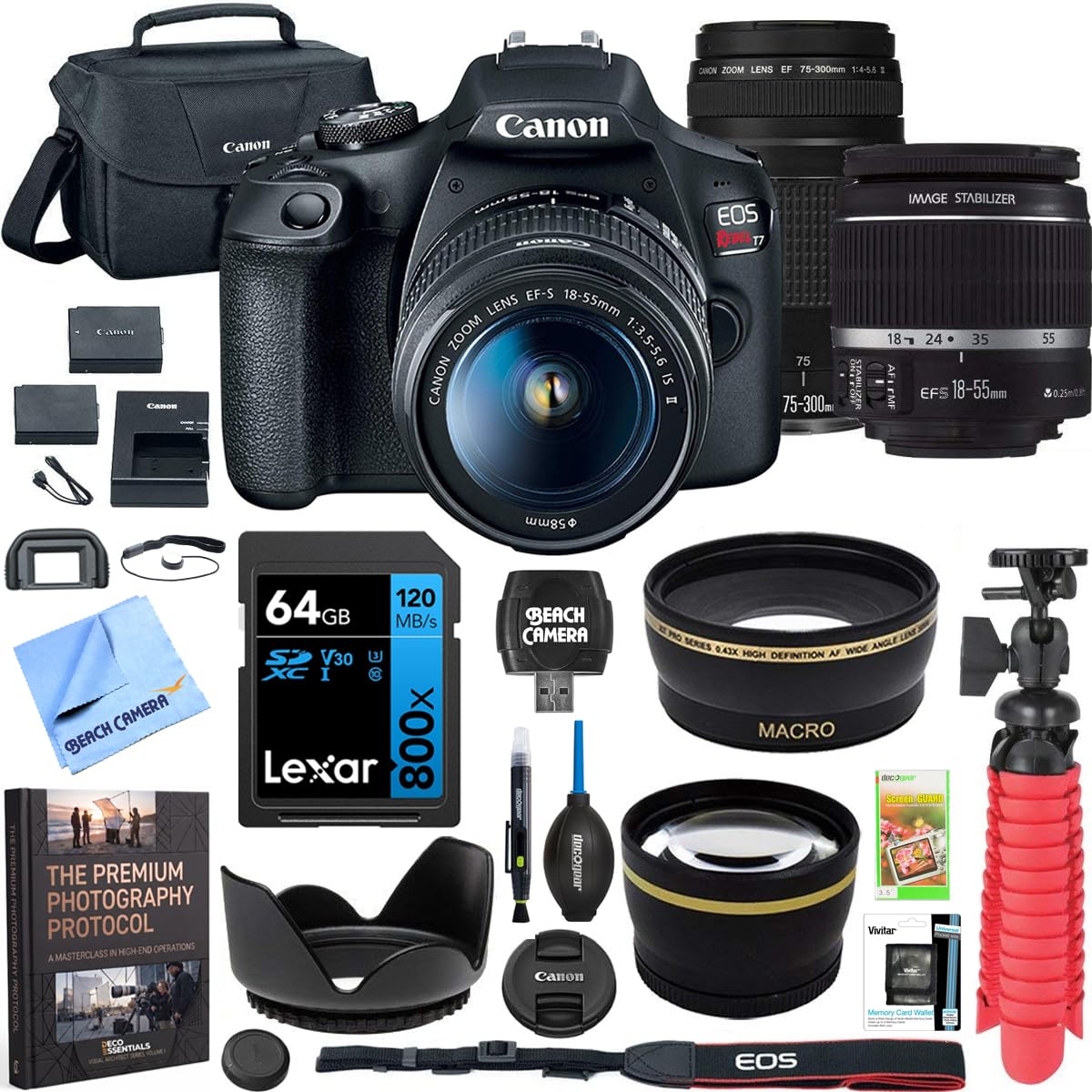
The Canon T7 Rebel is a 24.1MP APS-C DSLR bundled with the EF-S 18-55mm IS II and EF 75-300mm III double zoom lenses, providing a combined 29-480mm equivalent range. The DIGIC 4+ image processor supports ISO up to 6400 (expandable to 12800) and continuous shooting at 3 fps. Built-in Wi-Fi and NFC enable remote shooting and wireless image transfer.
The bundle adds a 64GB SDXC memory card, tabletop tripod, cleaning kit, and lens accessories, creating a complete starter kit. The 9-point AF system with AI Servo AF is basic but functional for learning composition and exposure. Reviewers find the bundle value compelling, calling it a great investment for beginners, with amazing photo quality and an easy-to-use interface.
The T7 has significant limitations: 1080p video only, no 4K, a 3-inch 920K-dot LCD that feels dated, and the DIGIC 4+ processor is slow by modern standards. The included 75-300mm lens lacks image stabilization, which can be challenging in lower light. The battery drains unusually fast in some units. This is an entry-level learning platform, not a serious creative tool.
Why it’s great
- Complete bundle with two zoom lenses covers wide to telephoto reach
- 24.1MP APS-C sensor delivers clean stills for learning composition
- Built-in Wi-Fi and NFC for easy image transfer to smartphone
Good to know
- 1080p only — no 4K video recording capability
- Slow 3 fps burst and 9-point AF system limit action photography
11. Panasonic LUMIX G100

The Panasonic LUMIX G100 is a compact Micro Four Thirds mirrorless camera featuring a high-performance built-in microphone with 360-degree tracking audio that auto-adjusts to record clearly in various environments. It captures 4K 24p/30p video and 4K photos, with frame markers for social media aspect ratios. The iA (intelligent auto) mode handles exposure and focus for beginners, while manual modes grow with your skills.
V-Log L recording is available for flat color grading, and the 5-axis Hybrid I.S. reduces blur for handheld shots. The 12-32mm lens included is a retractable pancake zoom that keeps the camera pocketable. Reviewers say the G100 produces beautiful photos with great color tones and excellent video quality, noting that the image stabilization from Panasonic is second to none.
The major flaw is the 4K video recording time limit; the camera stops at the maximum time, which is severely restrictive for event or long-form recording. The 8-bit internal recording limits color grading flexibility compared to 10-bit alternatives. The AF is contrast-detection only, which hunts in low light. For casual vlogging and short clips, the G100 is a capable and compact option but cannot serve as a primary production camera.
Why it’s great
- Built-in 360-degree tracking microphone eliminates external audio gear
- Compact MFT body with 4K recording and V-Log L for grading
- Intelligent Auto mode makes it easy for beginners to capture quality footage
Good to know
- 4K video recording has a short maximum time limit
- Contrast-detection AF hunts in low-light conditions
FAQ
Should I choose a full-frame or APS-C sensor for video work?
What is the practical benefit of 10-bit video over 8-bit?
Does in-body image stabilization replace a gimbal for video?
What is rolling shutter and why does it matter?
Final Thoughts: The Verdict
For most users, the best camera/video camera winner is the DJI Osmo Pocket 3 Creator Combo because its integrated gimbal, 1-inch sensor, and complete accessory kit deliver professional-grade stabilization and image quality in a pocketable form factor. If you want full-frame depth and advanced autofocus, grab the Canon EOS R8. And for serious narrative and interview work where dynamic range and codec depth are non-negotiable, nothing beats the Blackmagic Design Pocket Cinema Camera 6K Pro.