
Choosing a camera that excels at video recording means balancing sensor size, frame rate capabilities, stabilization technology, and codec support — a decision that directly impacts whether your footage looks cinematic or amateurish. The market spans pocket-sized gimbals, APS-C hybrids, full-frame powerhouses, and dedicated cinema bodies, each optimized for different shooting styles and environments.
I’m Min — the co-founder and writer behind Gadgets Feed. I’ve spent hundreds of hours analyzing the technical specifications and real-world performance data of cameras in this crowded segment to separate the true video performers from the also-rans.
This guide delivers a meticulously curated selection of the best video-capable cameras, from compact vlog tools to professional cinema rigs, so you can confidently identify the right camera with video recording for your creative needs and budget.
How To Choose The Best Camera With Video Recording
The ideal video camera must serve your specific workflow — a run-and-gun vlogger has opposite needs from a studio-based filmmaker. Prioritize sensor size for dynamic range, frame rates for slow motion, and bit depth for color grading flexibility.
Sensor Size and Video Crop
Full-frame sensors offer the best low-light performance and shallow depth of field, but many cameras crop into the sensor when recording certain frame rates. Check if 4K 60p uses the full width or a Super 35/APS-C crop — a crop reduces field of view and changes your lens’s effective focal length.
Frame Rate and Bit Depth
60 fps enables smooth slow motion at 24 or 30 fps playback, while 120 fps allows quarter-speed slow-mo. For color grading, 10-bit 4:2:2 footage holds far more color information than 8-bit 4:2:0, producing smoother gradients and eliminating banding in skies or shadows.
Stabilization Form Factor
In-body image stabilization (IBIS) works with any lens to reduce handheld shake, but mechanical gimbal stabilization — like DJI’s 3-axis system — delivers a higher degree of smoothness by physically isolating the camera’s motion. For run-and-gun shooting, a stabilized body or gimbal-integrated camera eliminates the need for additional support gear.
Quick Comparison
On smaller screens, swipe sideways to see the full table.
| Model | Category | Best For | Key Spec | Amazon |
|---|---|---|---|---|
| DJI Osmo Pocket 3 Creator Combo | Gimbal Camera | Vlogging on the move | 1″ CMOS + 4K 120fps + 3-Axis Stabilization | Amazon |
| Sony Alpha 7 IV | Full-Frame Hybrid | Professional hybrid work | 33MP BSI + 4K 60p 10-bit 4:2:2 | Amazon |
| Panasonic LUMIX S5II | Full-Frame Hybrid | Unlimited video recording | 24.2MP + Phase Hybrid AF + Active I.S. | Amazon |
| Canon EOS R8 | Full-Frame Entry | Lightweight content creation | 24.2MP + 4K 60p 6K Oversampled | Amazon |
| Nikon Z6 III | Full-Frame Video Hybrid | Internal RAW recording | 6K 60p N-RAW + 4000-nit EVF | Amazon |
| Blackmagic Pocket Cinema Camera 6K G2 | Cinema Camera | Professional filmmaking | Super 35 + 6K 6144×3456 + 13 Stops DR | Amazon |
| Sony a7 III | Full-Frame Hybrid | Budget full-frame 4K | 24.2MP BSI + 693 AF Points | Amazon |
| Canon EOS 5D Mark IV | DSLR Workhorse | Reliable event shooting | 30.4MP + 4K Motion JPEG + Dual Pixel AF | Amazon |
| Nikon Z 7II | High-Resolution Full-Frame | High-res stills + 4K | 45.7MP + 4K 60p + Dual Card Slots | Amazon |
| Panasonic LUMIX G85 | Mirrorless MFT | Budget 4K with IBIS | 16MP MFT + 5-Axis IBIS + 4K | Amazon |
| Blackmagic Pocket Cinema Camera 4K | Cinema Camera | Entry cinema on a budget | 4/3″ + 4096×2160 + 13 Stops DR | Amazon |
In‑Depth Reviews
1. DJI Osmo Pocket 3 Creator Combo
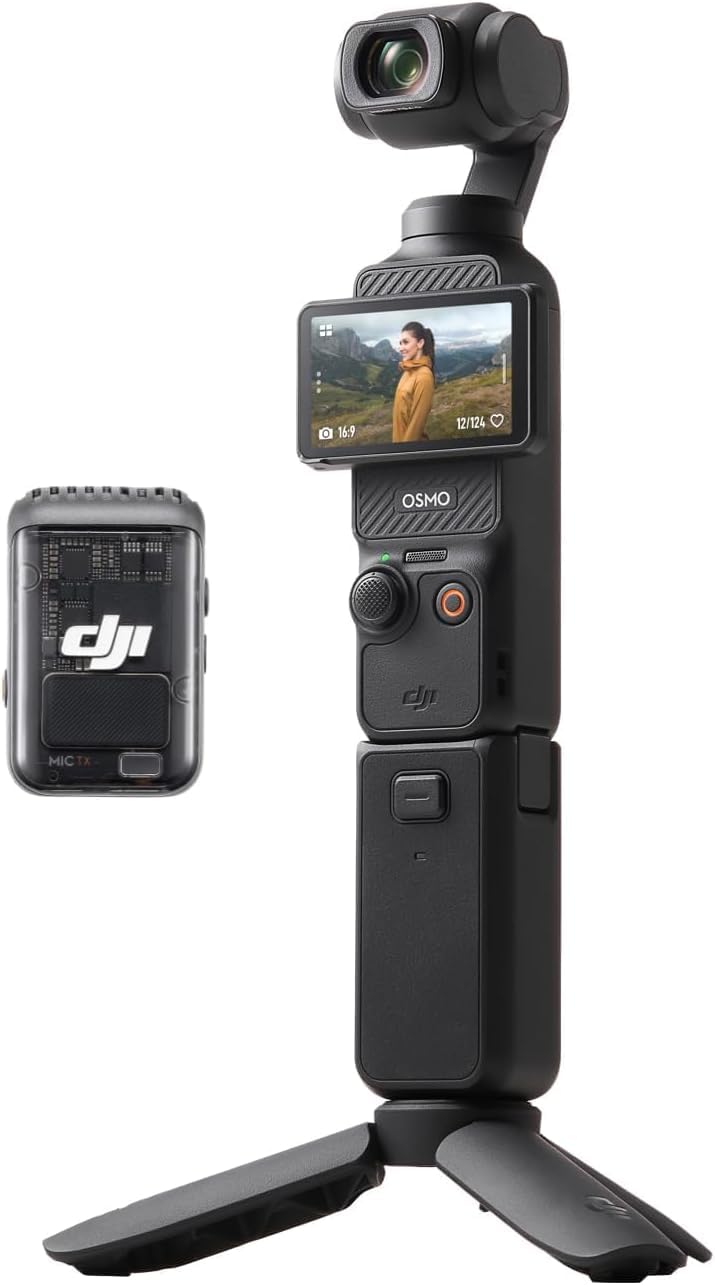
The DJI Osmo Pocket 3 redefines pocketable video with a 1-inch CMOS sensor that captures 4K footage at up to 120 frames per second, combined with a built-in 3-axis mechanical gimbal that eliminates the need for external stabilization. The 2-inch rotatable touchscreen seamlessly switches between horizontal and vertical framing, making it ideal for multi-platform content creation without any rigging.
ActiveTrack 6.0 locks onto subjects and keeps them center-frame even during dynamic movement, while the included DJI Mic 2 transmitter delivers broadcast-quality audio that pairs wirelessly via OsmoAudio. The 10-bit D-Log M color profile records up to one billion colors, providing substantial latitude for post-production grading.
Battery life reaches 166 minutes on a single charge, and the Creator Combo bundle adds a battery handle, wide-angle lens, mini tripod, and carrying bag — turning a compact camera into a complete run-and-gun vlogging kit. The only trade-off is the inherent fragility of the exposed gimbal mechanism during rough handling.
Why it’s great
- 1-inch sensor outperforms smartphone cameras significantly in low light
- 3-axis mechanical gimbal delivers cinematic smoothness without post-production warp
- Creator Combo adds professional audio and extended battery out of the box
Good to know
- Gimbal mechanism requires careful handling and storage
- Digital zoom limited to 2x without loss of resolution
2. Sony Alpha 7 IV

The Sony Alpha 7 IV is a benchmark hybrid camera, pairing a 33-megapixel full-frame back-illuminated Exmor R sensor with the BIONZ XR processing engine for 4K 60p recording in 10-bit 4:2:2. The 7K oversampling in 4K 30p mode renders exceptionally sharp, detailed footage with minimal moiré, while the S-Cinetone color profile produces pleasing skin tones straight out of camera.
Real-time Eye AF for humans and animals covers 693 phase-detection points over 93% of the sensor area, locking onto subjects with reliability even in challenging lighting. The articulating touchscreen and in-body stabilization make handheld shooting practical, and dual card slots (CFexpress Type A and SD) provide flexible workflow options.
Battery performance exceeds 2,000 shots per charge, but the camera body does include a slight crop when shooting 4K 60p with stabilization enabled. The menu system, though improved from earlier Sony generations, still requires time to master for new users.
Why it’s great
- 7K oversampled 4K 30p delivers exceptional sharpness and detail
- S-Cinetone profile provides cinematic color science with minimal grading
- Fast, reliable phase-detection AF with face and eye tracking
Good to know
- Slight crop in 4K 60p with active stabilization engaged
- Menu system remains more complex than competitors from Canon and Nikon
3. Panasonic LUMIX S5II
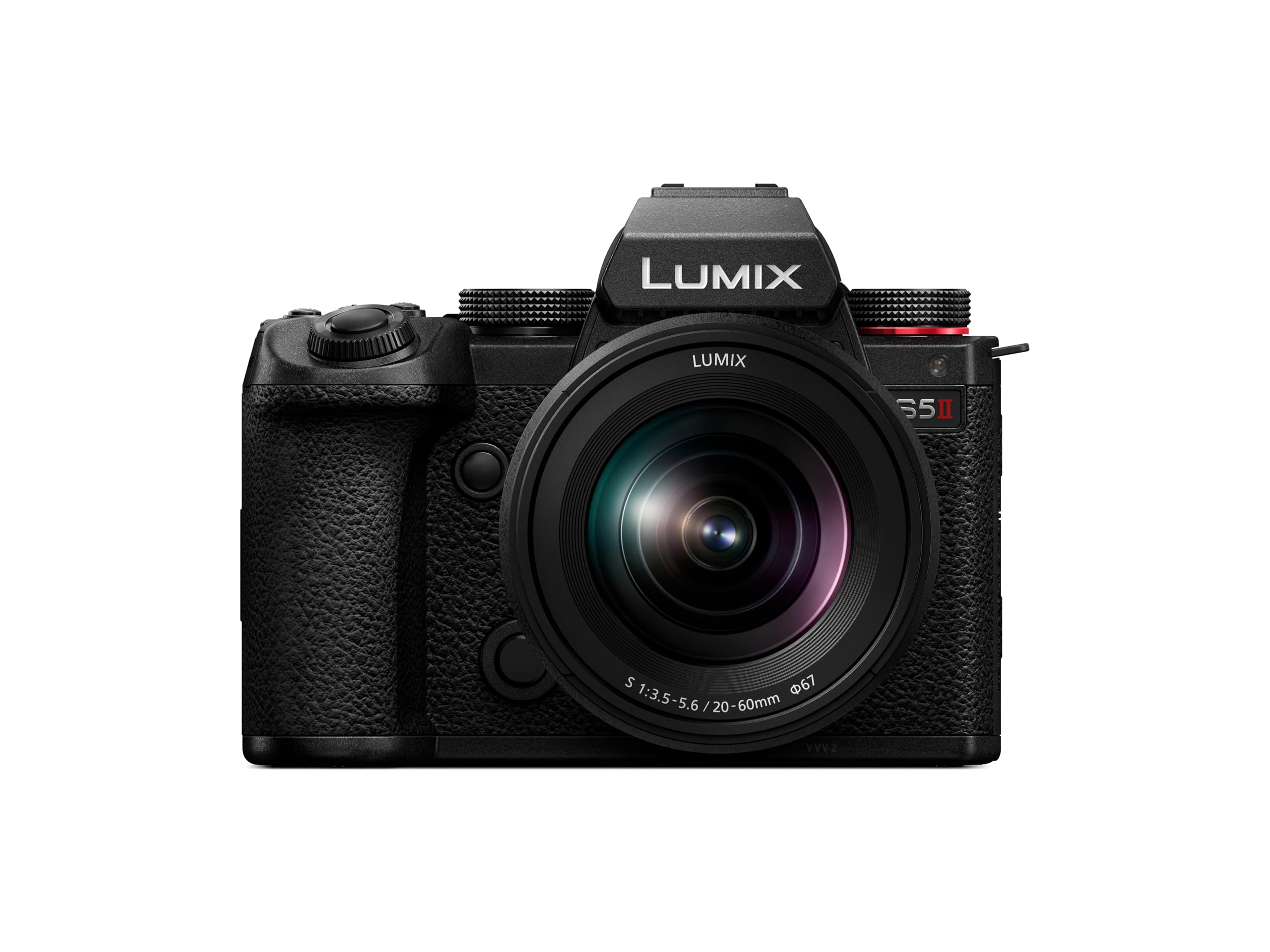
The Panasonic LUMIX S5II marks a turning point for the series by introducing phase-detection autofocus while maintaining the class-leading video features Panasonic is known for. The full-frame 24.2-megapixel sensor records 6K 30p Open Gate footage for flexible reframing, and thanks to an internal fan and heat sink, achieves unlimited recording time in 10-bit 4:2:2 without overheating.
Active I.S. technology compensates for walking motion better than standard IBIS, reducing the need for a gimbal in many run-and-gun scenarios. The 14-stop V-Log/V-Gamut capture delivers wide dynamic range and the REAL TIME LUT feature lets you apply custom color grading in-camera, streamlining post-production.
The bundled 20-60mm kit lens provides a versatile starting range, though the L-mount ecosystem — with Sigma, Leica, and Panasonic glass — is still maturing compared to Sony E or Canon RF. Battery life is adequate for a day of shooting but benefits from the optional battery grip during extended video sessions.
Why it’s great
- Unlimited 4:2:2 10-bit recording via internal cooling fan
- Phase Hybrid AF finally solves Panasonic’s autofocus reputation
- Active I.S. provides gimbal-style stabilization for walking shots
Good to know
- L-mount lens selection is not as extensive as Sony or Canon
- Battery life moderate for intensive video shooting
4. Canon EOS R8

The Canon EOS R8 is the lightest full-frame RF-mount mirrorless camera, weighing just 414 grams, and it borrows the core imaging pipeline from the higher-end R6 Mark II. Uncropped 4K 60p video is oversampled from 6K to produce sharp, detailed footage with minimal rolling shutter, and the Canon Log 3 profile provides 10-bit color depth for grading flexibility.
Dual Pixel CMOS AF II covers the entire frame with 1,053 zones and uses deep learning to detect people, animals, vehicles, and even aircraft and trains. The 0.39-inch OLED EVF offers up to 120 fps refresh rate for smooth tracking, and the vari-angle LCD touchscreen makes vlogging and low-angle shooting intuitive.
There is no in-body image stabilization, relying instead on lens-based IS, and battery life is modest — approximately 500 shots or one hour of continuous video. The 4K 60p mode can trigger overheating after about 30 minutes in warm environments, making it better suited for shorter clips and controlled conditions.
Why it’s great
- Incredibly lightweight for a full-frame camera with advanced video features
- Dual Pixel AF II with subject detection for people, animals, and vehicles
- Uncropped 4K 60p from 6K oversampling delivers excellent sharpness
Good to know
- No in-body image stabilization present in the body
- Overheating can occur after 30 minutes in 4K 60p mode
5. Nikon Z6 III

The Nikon Z6 III is a video-first full-frame camera that records 6K 60p internal N-RAW and oversampled 4K UHD at up to 120 fps, making it one of the most capable hybrid bodies under for filmmakers. The 4000-nit, 5760k-dot electronic viewfinder with DCI-P3 color gamut is the brightest on the market, maintaining a clear image even in direct sunlight.
Autofocus detection operates down to -10 EV, with deep-learning subject recognition that tracks human faces as small as 3% of the frame. The AF system is roughly 20% faster than the Z6 II, providing reliable acquisition for fast-moving subjects. Dual card slots accept CFexpress Type B and SD UHS-II for flexible backup strategies.
The ISO range of 100-64000 (expandable to 204800) handles low-light environments exceptionally well, but the battery life lasts around two hours of continuous video, making an external battery grip a practical addition for longer shoots. The learning curve for Nikon’s menu system is gentler than Sony’s but still requires some adjustment for first-time Nikon users.
Why it’s great
- 6K 60p internal N-RAW recording for professional post-production flexibility
- 4000-nit EVF remains usable in bright outdoor conditions
- Excellent low-light autofocus down to -10 EV
Good to know
- Battery life is around 2 hours during continuous video recording
- Menu system has a learning curve for first-time Nikon users
6. Blackmagic Pocket Cinema Camera 6K G2

The Blackmagic Pocket Cinema Camera 6K G2 is a dedicated cinema body built around a Super 35 sensor with a native resolution of 6144 x 3456 and 13 stops of dynamic range. The EF/EF-S lens mount grants access to an enormous catalog of affordable lenses, while dual native ISO up to 25,600 ensures clean footage in low-light environments.
Recording options include 12-bit Blackmagic RAW and Apple ProRes, with storage handled by CFast 2.0, SD UHS-II, or external SSDs via USB-C. The large 5-inch adjustable tilt LCD serves as monitor and control surface, eliminating the need for external monitoring gear. DaVinci Resolve Studio is included for end-to-end post-production.
The primary limitation is battery life — the included NP-F570 lasts roughly 60 minutes — and the camera relies entirely on manual focus since it lacks continuous AF. The ergonomic grip and lightweight carbon fiber composite body make it easier to handle on a gimbal than competing cinema cameras, but it is a specialized tool for intentional shooting rather than casual use.
Why it’s great
- 13 stops of dynamic range and 12-bit RAW for professional-grade color grading
- EF lens mount provides access to a huge range of affordable and vintage glass
- Built-in DaVinci Resolve Studio license saves thousands on post-production software
Good to know
- Battery life is only about 60 minutes per charge
- No continuous autofocus — everything must be manual
7. Sony a7 III

The Sony a7 III remains a formidable entry point to full-frame video, featuring a 24.2-megapixel back-illuminated Exmor R sensor with 15 stops of dynamic range and ISO sensitivity up to 204800. The 693 phase-detection AF points cover 93% of the sensor, providing reliable tracking during video recording, and silent shooting at 10 fps with AF/AE tracking keeps workflow unobtrusive.
4K video recording uses full pixel readout without pixel binning, delivering sharp detail at 30 fps with the ability to capture HDR footage for display on compatible screens. The NP-FZ100 battery offers exceptional longevity — around 710 shots per charge — which outlasts most competitors in this tier.
The kit lens (28-70mm f/3.5-5.6) is decent for starting out, but upgrading to brighter glass reveals the sensor’s true low-light capabilities. The menu system is notoriously dense, though frequently updated firmware has added features and improved stability. The a7 III lacks a 10-bit internal recording mode, which limits color grading flexibility compared to newer competitors.
Why it’s great
- 15 stops of dynamic range at an accessible price point
- Industry-leading battery life for full-frame mirrorless cameras
- 693-point phase-detection AF with excellent subject tracking
Good to know
- Limited to 8-bit internal recording, reducing color grading latitude
- Menu system is complex and requires time to navigate efficiently
8. Canon EOS 5D Mark IV

The Canon EOS 5D Mark IV is a legacy professional DSLR that still commands respect for its robust build, reliable Dual Pixel CMOS AF, and 30.4-megapixel full-frame sensor. It records 4K Motion JPEG video at 30 or 24 fps, offering high-quality frames for extraction as stills, though the Motion JPEG codec creates large file sizes that require fast memory cards and significant storage.
DIGIC 6+ processing enables 7 fps continuous shooting and an ISO range of 100-32000 (expandable to 50-102400), delivering solid low-light performance that competes with many modern mirrorless bodies. Built-in Wi-Fi and GPS support location-stamped workflow needs, particularly useful for travel and event photographers who also shoot video.
The optical viewfinder and robust weather-sealed magnesium alloy body provide durability that mirrorless cameras often lack, but the 4K video crop factor (~1.7x) narrows the effective field of view, requiring wider lenses than expected. The 5D Mark IV is a pragmatic choice for photographers who shoot video as a secondary function and prioritize reliability above all else.
Why it’s great
- Proven durability with weather-sealed magnesium alloy construction
- Dual Pixel CMOS AF provides smooth and responsive video autofocus
- Excellent high-ISO performance and dynamic range for a DSLR
Good to know
- 4K Motion JPEG codec produces very large file sizes
- Approximately 1.7x crop factor in 4K video mode
9. Nikon Z 7II

The Nikon Z 7II is built around a 45.7-megapixel full-frame sensor that excels in resolution-critical applications while still delivering solid 4K UHD 60p video. The dual EXPEED 6 processors provide 3.3 times more buffer capacity than the original Z 7, enabling faster continuous shooting and improved AF performance with 493 phase-detection points.
Dual card slots accept CFexpress/XQD and UHS-II SD cards, offering flexibility and redundancy for professional workflows. The body is compatible with a vertical battery grip for extended shooting sessions, and USB-C constant power and charging support livestreaming and timelapse projects without battery anxiety.
The Z 7II accepts the vast catalog of F-mount NIKKOR lenses via the FTZ adapter (sold separately), ensuring no lens investment is wasted. However, the camera does not record 10-bit video internally, and its video AF, while good, is not quite as snappy as Sony’s latest tracking systems. For shooters who need extreme resolution in stills alongside capable 4K video, the Z 7II is a specialist tool.
Why it’s great
- 45.7MP sensor provides massive resolution for cropping and large prints
- Dual card slots with CFexpress/XQD and SD for professional workflow flexibility
- USB-C constant power for extended video and timelapse shooting
Good to know
- No internal 10-bit video recording capability
- Video autofocus performance lags behind Sony’s latest generations
10. Blackmagic Pocket Cinema Camera 4K

The Blackmagic Pocket Cinema Camera 4K introduced professional cinematic video to an affordable price point, featuring a 4/3-inch sensor with a native DCI 4K resolution of 4096 x 2160 and 13 stops of dynamic range. The active Micro Four Thirds lens mount opens up an extensive ecosystem of compact, affordable glass including vintage adapted lenses that give unique character to footage.
Recording options include 12-bit Blackmagic RAW and Apple ProRes up to 4K, with storage on SD UHS-II, CFast 2.0 cards, or external SSDs via USB-C. The 5-inch LCD display is bright and large enough to serve as a primary monitor, and the included DaVinci Resolve Studio key provides a complete end-to-end color grading workflow.
The Pocket 4K has no continuous autofocus or in-body stabilization, and its LP-E6 battery lasts only about 30–45 minutes, making external power or a battery grip almost mandatory for serious shoots. The camera’s image quality, however, remains competitive with cameras costing several times more, especially for controlled studio and interview environments.
Why it’s great
- 13 stops of dynamic range with 12-bit Blackmagic RAW at this price point is exceptional
- MFT lens mount with active adapter support for virtually any lens system
- DaVinci Resolve Studio included for professional grading and finishing
Good to know
- Battery life is very short (~30-45 minutes) without external power
- No continuous autofocus or in-body stabilization
11. Panasonic LUMIX G85

The Panasonic LUMIX G85 is a budget-friendly micro four thirds mirrorless camera that punches well above its weight for video, featuring 5-axis in-body image stabilization that works in both stills and 4K video. The 16-megapixel sensor has no low-pass filter, which boosts fine-detail resolution by approximately 10% compared to standard 16MP MFT sensors.
The bundled 12-60mm Power O.I.S. lens provides a versatile zoom range with optical stabilization that pairs with the IBIS system for exceptionally smooth handheld footage. 4K QFHD video recording (3840 x 2160) is complemented by 4K Photo mode and Post Focus, allowing users to select the focus point after capturing the shot.
The magnesium alloy body is weather-sealed for outdoor shooting, and the OLED live viewfinder (2360K dots) and 3-inch touch LCD provide clear monitoring. Autofocus can be sluggish in low-light conditions when shooting 4K, and the camera lacks a headphone jack for audio monitoring, but for the price, the G85 delivers IBIS and weather sealing that rivals cameras costing much more.
Why it’s great
- 5-axis in-body image stabilization provides smooth handheld 4K video
- Weather-sealed magnesium alloy body for outdoor shooting confidence
- Excellent value with versatile 12-60mm kit lens and IBIS included
Good to know
- Autofocus can be slow in low light when recording 4K
- Missing headphone jack for audio monitoring during video
FAQ
What is the most important spec for video quality in a camera?
Do I need a camera that records 10-bit video?
Is in-body image stabilization necessary for video?
What is the advantage of a cinema camera over a mirrorless camera for video?
Final Thoughts: The Verdict
For most users, the camera with video recording winner is the DJI Osmo Pocket 3 because it combines a 1-inch sensor, 4K 120fps, and 3-axis gimbal stabilization in an ultra-portable form factor that requires zero setup. If you need a full-frame hybrid for professional work, grab the Sony Alpha 7 IV. And for dedicated cinema production with max grading flexibility, the Blackmagic Pocket Cinema Camera 6K G2 delivers unmatched dynamic range and RAW recording at a competitive price.