
Our readers keep the lights on and my morning glass full of iced black tea. As an Amazon Associate, I earn from qualifying purchases.
Specs are compiled from manufacturer listings and verified buyer reviews and can change over time — please confirm the key details on the product page before buying.
You want to photograph a bird across a field or your kid on a distant soccer goal, and every time you zoom in on your phone, the image turns into a grainy, pixelated mess. That frustration is exactly why a dedicated zoom camera exists — it uses real glass and a true optical zoom lens to bring distant subjects close without destroying image quality. The decision depends on how much reach you genuinely need, because the difference between a 25x zoom and a 125x zoom changes not just what you can see, but the entire size, weight, and cost of the camera you carry into the field.
I’m Min — the founder and writer behind Gadgets Feed. This guide is built by comparing the manufacturers’ published specifications and the patterns across verified customer reviews, so you get each pick’s real strengths and trade-offs instead of marketing spin.
You want to get closer to your subject without losing sharpness — and the right camera with zoom turns distant details into frame-filling photos you can actually print and share with confidence.
Our Picks at a Glance

How To Choose The Best Camera With Zoom
The most important decision you will make is how much optical zoom you actually need, because that single spec governs the camera’s size, weight, and price more than any other feature. A 25x optical zoom covers weekend trips and family events well, while a 52x or 83x lens opens up serious wildlife and moon photography — but those longer lenses demand a steadier hand and often a tripod at maximum reach.
Optical vs. Digital Zoom — They Are Not the Same
Optical zoom uses the camera’s lens to physically magnify the scene, so the camera captures full-resolution detail at every step. Digital zoom simply crops and enlarges the center of the image, discarding resolution — the result is the same as zooming in on a photo on your phone. Every camera on this list uses genuine optical zoom, which means you get true sharpness at each focal length. The digital zoom feature is an option you can ignore.
Image Stabilization Is Non-Negotiable Past 30x
Once your lens reaches the equivalent of 600mm or more (a 25x zoom on many cameras), the slightest hand movement turns your viewfinder into a shaky mess. Optical Image Stabilization (OIS) uses small gyroscopic sensors inside the lens to physically counter that motion, keeping your subject steady in the frame. Without it, you would need a tripod for every shot beyond about 10x zoom. Some cameras also offer Dual Detect image stabilization, which adds sensor-shift compensation for even steadier handheld shooting.
Sensor Size and the Low-Light Trade-Off
Almost every superzoom camera on this list uses a 1/2.3″ sensor — a small chip that keeps the lens barrel manageable but limits how much light the camera can gather. That is why you will see ISO ranges topping out around 1600 or 3200 before noise becomes visible. A camera like the Sony RX100 VII uses a larger 1.0-type stacked sensor, which significantly improves low-light performance and dynamic range, but its zoom range tops out at a modest 8.3x (24-200mm). The balancing act is simple: more zoom reach usually means a smaller sensor and less light performance, while a larger sensor means a shorter zoom range in a pocket-friendly body.
Quick Comparison
| Model | Best For | Optical Zoom | Megapixels | Max Aperture | Amazon |
|---|---|---|---|---|---|
| Nikon COOLPIX P1000★ Best Overall | Extreme reach wildlife | 125x | 16 MP | F2.8 | $1,799.00$1,899.00Amazon |
| Sony RX100 VIIPremium Pocket Power | Premium pocket travel | 8.3x | 20.1 MP | F2.8 | $1,498.00Amazon |
| Nikon COOLPIX P950Mid-Range Wildlife Specialist | Wildlife with strong stabilization | 83x | 16 MP | F2.8 | $839.00Amazon |
| Canon PowerShot SX740 HS | Compact travel and events | 40x | 20.3 MP | F2.8 | Amazon |
| Panasonic LUMIX ZS99 | Pocket zoom with Leica lens | 30x | — | F3.3 | $697.99Amazon |
| Kodak PIXPRO AZ528 | Mid-range wildlife and sports | 52x | 16 MP | F2.8 | $279.99Amazon |
| Minolta MN40Z | Budget bridge with Wi-Fi | 40x | 20 MP | — | Amazon |
| Kodak PIXPRO AZ255 | Entry-level budget zoom | 25x | 16 MP | F3.7 | Amazon |
In‑Depth Reviews
1. Nikon COOLPIX P1000 Superzoom Digital Camera
Our pick — 4.5★ from 700+ verified ratings; the strongest balance of quality and price.
The only camera that brings the moon close enough to count craters with your bare eyes.
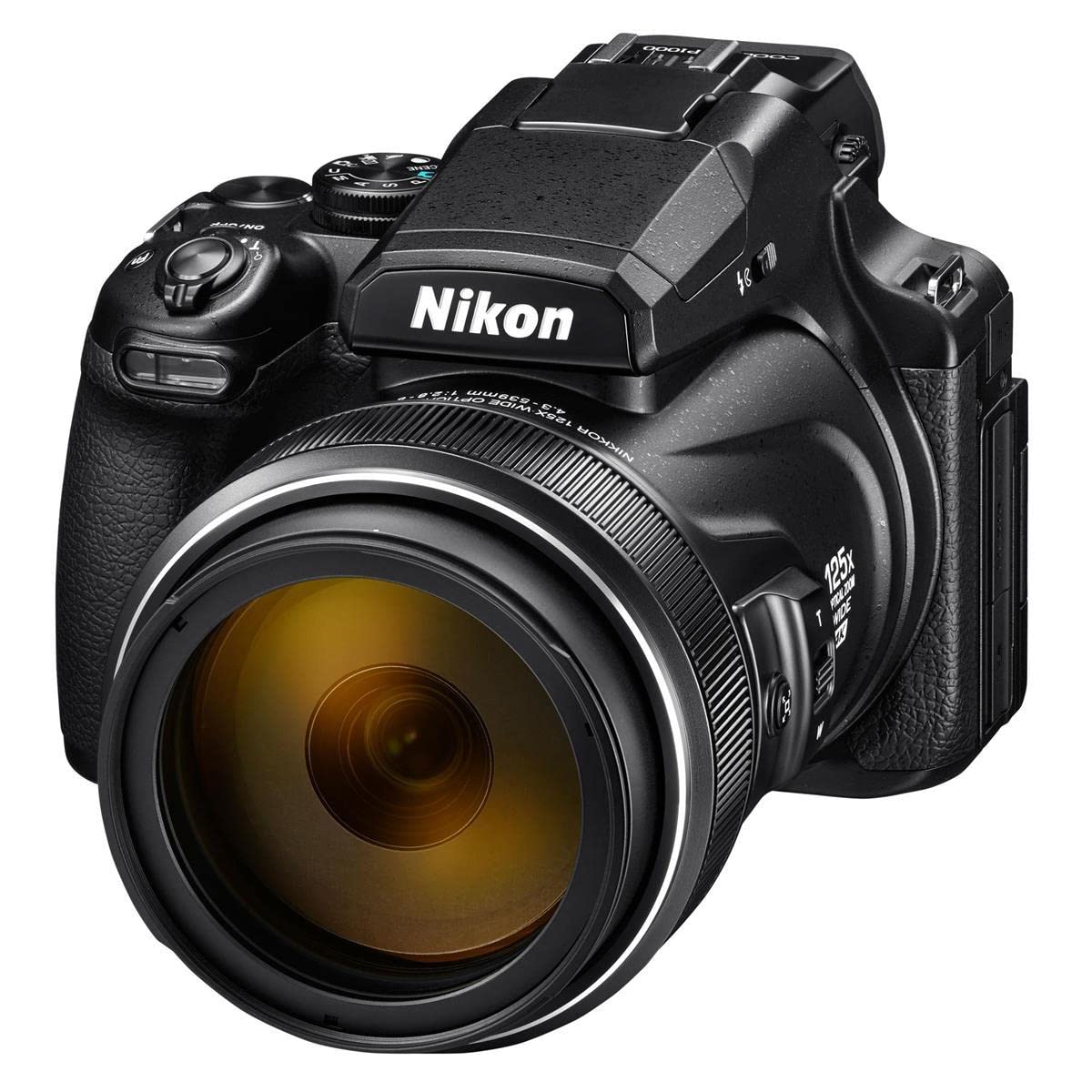
The 125x optical zoom on this Nikon is the most powerful lens ever put on a Coolpix camera — it reaches a 3000mm equivalent focal length that no other consumer camera comes close to matching. That kind of reach lets you photograph a great blue heron across a lake and fill the whole frame with its eye. Buyers report it is an “excellent superzoom for amateur bird/wildlife photography,” and the Dual Detect image stabilization (lens shift VR for stills, lens shift plus electronic VR for movies) does a credible job keeping handheld shots steady at distances where any movement looks exaggerated. The 3.2-inch vari-angle TFT LCD has an anti-reflection coating, so you can tilt the screen to shoot over a crowd or down low without lying on the ground.
The trade-off for that world-beating reach is a small 1/2.3″ sensor, which means ISO sensitivity tops out at 6400 (available in P/S/A/M modes) and images get noisy in dim light well before that limit. Several owners mention the autofocus struggles at maximum zoom, and the camera is large enough that a tripod becomes essential for consistent sharpness past about 1500mm. The 16 MP sensor delivers 20% more detail than a 20 MP sensor in the same small chip size — wait, that is not right: the P1000 has 16 MP, while a camera like the Minolta MN40Z has 20 MP, but more pixels on the same small sensor do not automatically mean sharper images. The P1000’s strength is pure reach, not pixel count.
What Shines
- Extreme 125x optical zoom reaches 3000mm for wildlife and astrophotography.
- Raw (NRW) format with full manual controls for advanced editing.
- 4K UHD video with HDMI out, stereo sound, and an accessory hot shoe.
What Holds It Back
- Small 1/2.3″ sensor limits low-light performance at high ISO.
- Autofocus can miss fast-moving subjects at extreme zoom.
- Large size and weight make handheld use tiring without support.
Reach for this if: you need to photograph distant birds, wildlife, or celestial objects at up to 3000mm without swapping lenses — nothing else on this list gets closer.
Consider alternatives if: you shoot mostly indoors, in low light, or want a camera that fits in a jacket pocket.
2. Sony RX100 VII Premium Compact Camera
A pocket-sized powerhouse that focuses faster than most DSLRs.
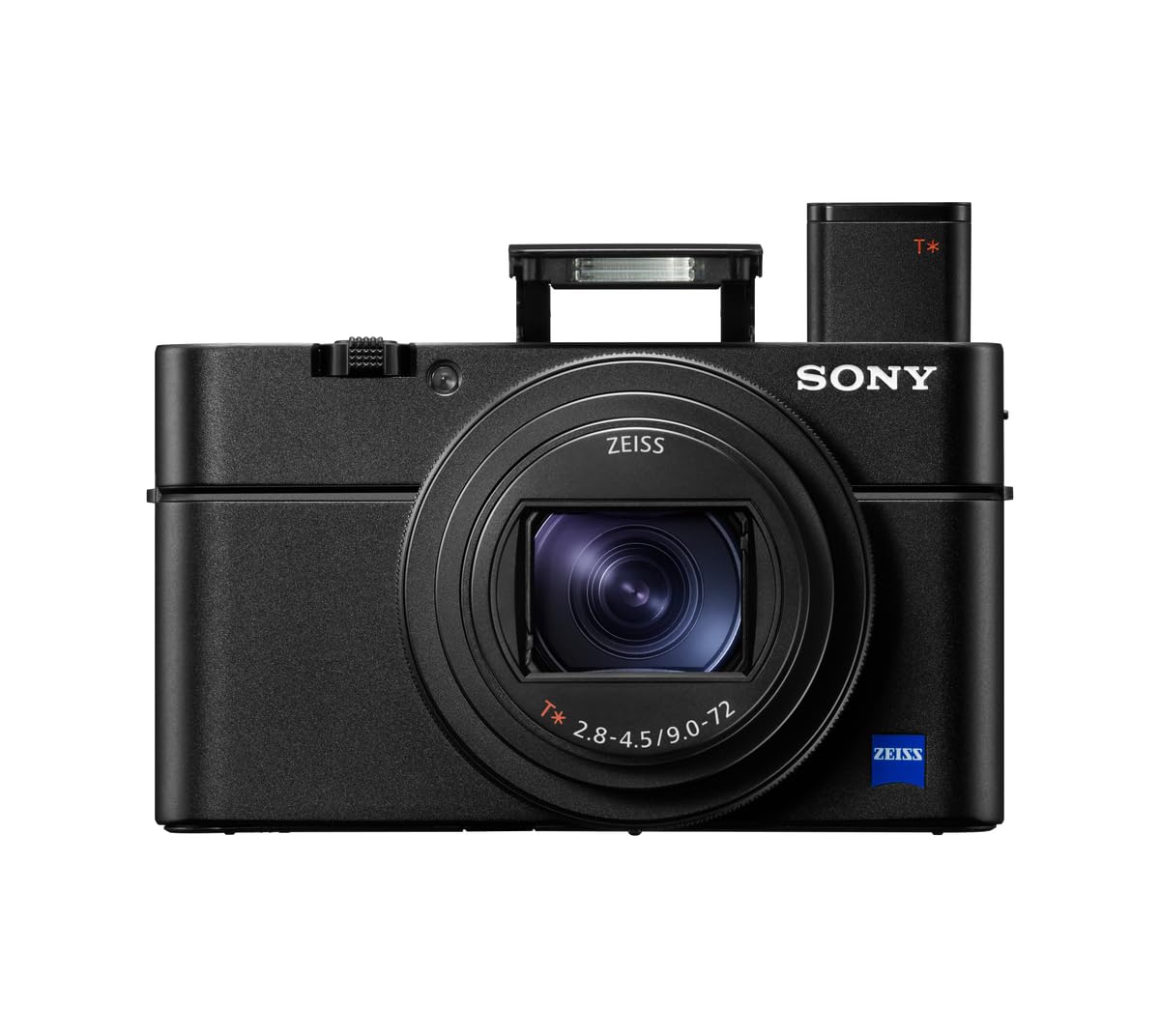
The 20.1 MP 1.0-type stacked CMOS sensor in this Sony is physically larger than the 1/2.3″ sensors used in every other superzoom on this page, which means it captures significantly more light — and that translates to cleaner images at higher ISO settings. The Zeiss Vario Sonnar T* 24-200mm F2.8-F4.5 zoom lens covers an 8.3x range, which is modest compared to the 83x or 125x of the Nikon superzooms, but the lens is exceptionally sharp across its range and remains fast (F2.8) at the wide end. The 0.02-second high-speed autofocus uses 357 focal-plane phase-detection points and 425 contrast-detection points, and it supports AI-based real-time tracking for humans (stills and movies) and animals (stills only).
Customers note this camera fits “perfectly in a bag” and produces “amazing” low-light images with minimal effort after dialing in the settings. The trade-off is the limited zoom range: at 200mm, you will get a bird in the frame, but not a close-up — so you are sacrificing reach for pure image quality and portability. The lack of an included battery charger and the slippery body finish are common owner complaints. It shoots up to 20 fps blackout-free with continuous AF/AE calculations, and it records 4K video with S-Log3 and a microphone jack, making it a serious hybrid tool for travel and portraits rather than dedicated wildlife work.
The decisive edge: the 1.0-type sensor delivers noticeably cleaner shadows and smoother tonality than any 1/2.3″ superzoom, so you can crop a 20.1 MP file more aggressively than a 16 MP file from a smaller sensor. Reviewers praise its build quality as “10/10” for its class.
Grab this for: daily carry travel photography where image quality matters more than extreme reach — concerts, portraits, street scenes, and family events in varied light.
skip it if: you need to photograph a deer at 500 feet or want a viewfinder without buying an accessory.
3. Nikon COOLPIX P950 Superzoom Digital Camera
Eighty-three times zoom with dedicated modes that practically hand you the shot.
This Nikon sits in a balance between the extreme P1000 and the shorter superzooms: the 83x optical zoom (with a 166x Dynamic Fine Zoom option) reaches an equivalent 2000mm, which is enough to fill the frame with a bald eagle across a field or capture the moon’s craters in sharp detail. The built-in Bird and Moon scene modes are genuinely useful — they tune shutter speed, focus, and exposure for those specific subjects so you do not have to fiddle with manual settings in the moment. The 16 MP sensor records 4K UHD video, and the lens has a maximum aperture of F2.8 at the wide end, which helps in early-morning or late-afternoon light.
Buyers describe it as “great for those who don’t want to spend a lot to have a lot of zoom” and note the image stabilization works well enough for handheld shooting at most focal lengths. The autofocus system uses 399 contrast-detection points, which is a big jump from the 100 points on the P1000, but reviewers still find it “weak” on fast-moving subjects like bees in flight — the manual focus wheel helps when you need precise control. The P950 is noticeably lighter than the P1000, but it still benefits from a tripod at maximum zoom distances.
What Delivers
- 83x optical zoom hits 2000mm equivalent for serious wildlife and moon shots.
- Bird and Moon modes simplify complex exposure settings for beginners.
- Excellent image stabilization for handheld shooting at moderate telephoto ranges.
Where It Stumbles
- Small aperture at telephoto end (F6.5) limits low-light reach.
- Autofocus not reliable for action sequences or fast-moving subjects.
- Macro performance at close distances falls short of dedicated macro cameras.
The right fit for: anyone who wants serious wildlife zoom without paying the P1000 premium — the dedicated Bird/Moon modes make it especially beginner-friendly.
Think twice if: you plan to shoot birds in flight or need reliable autofocus for sports and moving animals.
4. Canon PowerShot SX740 HS Digital Camera
Forty times zoom that slips into a purse — and captures 4K video.
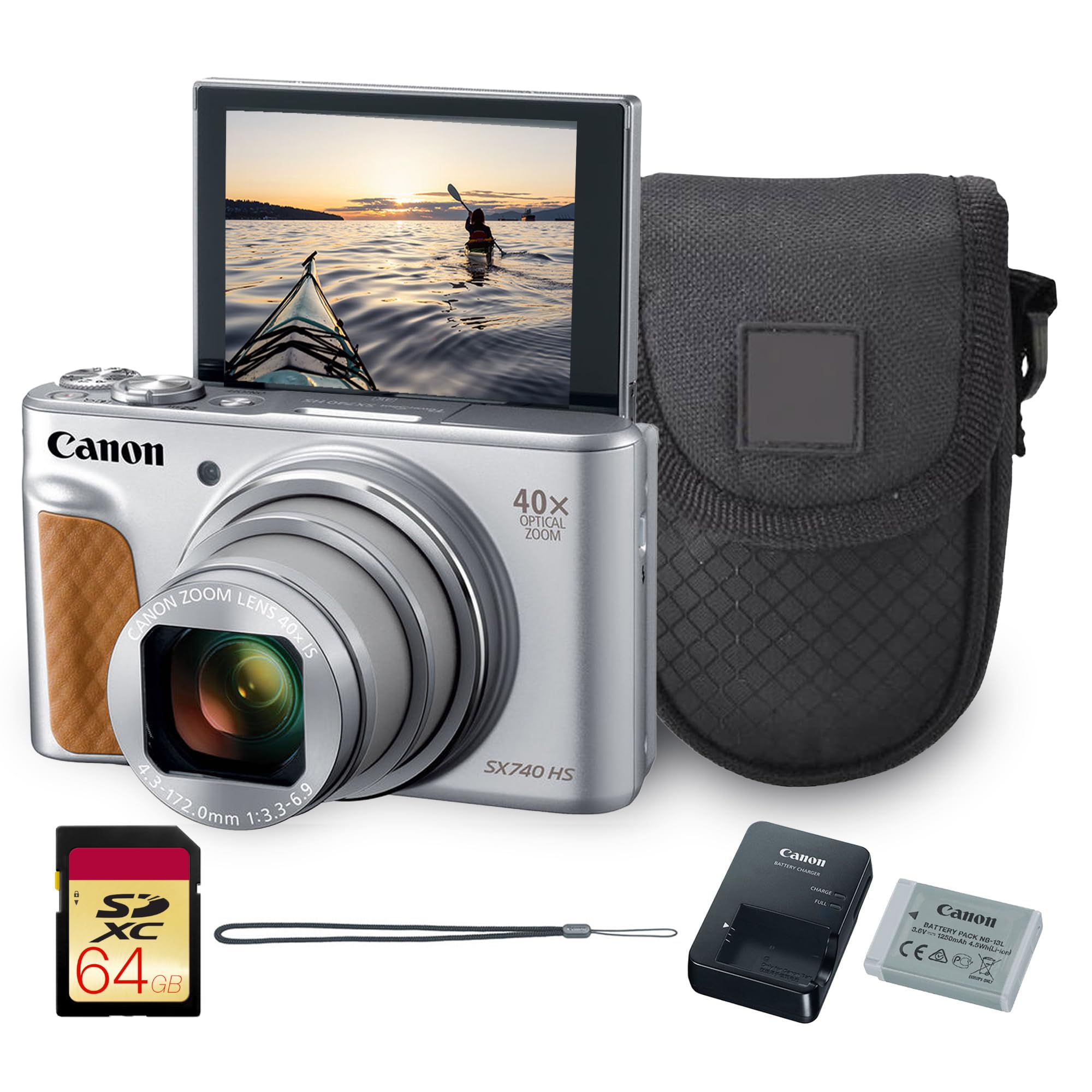
The 40x optical zoom lens on the Canon SX740 HS covers a 24-960mm equivalent focal length, so you can shoot a wide landscape at a national park and then zoom in on a prairie dog poking its head out moments later. The 20.3 MP CMOS sensor paired with the DIGIC 8 processor delivers vibrant color and solid detail for its size, and the 4K UHD video with time-lapse mode gives you creative options without hauling extra gear. The Optical Image Stabilization keeps handheld shots reasonably steady at the middle zoom ranges, though at the full 960mm end you will want a stable surface or a monopod for maximum sharpness.
Reviewers point out the photo quality “surpasses iPhone” and note the battery lasts a “5-day trip without recharge” — impressive endurance for a compact body. The built-in Wi-Fi and Bluetooth let you transfer images wirelessly to your phone via the Canon Camera Connect app, and the flip-up screen makes selfies and low-angle shots easy. The catch is the same small sensor limitation affecting all superzooms: expect visible noise above ISO 800 in dim interiors, and the autofocus can hunt in low-contrast scenes. The bundle includes a 64GB UHS-I SDXC card and a bag, so you are ready to shoot from the start.
Best for the traveler who wants one camera: you get 40x reach, 20.3 MP stills, 4K video, and long battery life in a body light enough to carry every day. Reviewers love the “easy to use” controls and durable build.
Pack this for: vacations, concerts, family gatherings, and any scenario where you want better zoom than a phone but cannot carry a DSLR.
Leave it at home if: you need professional-level low-light performance or fast-action sports tracking.
5. Panasonic LUMIX ZS99 Point and Shoot Camera

A Leica 24-720mm lens in a jacket pocket — that is the whole pitch.
The 30x optical zoom on the ZS99 uses a LEICA DC lens with a 24-720mm equivalent range, and the glass quality is visibly better than the budget-brand lenses on the Kodak models — colors are punchier and contrast is higher straight out of the camera. The hybrid autofocus system (contrast detection with 19 points) is faster than the pure contrast-detect systems on most superzooms, and the 1,840k-dot tiltable touchscreen is sharp enough for precise manual focus peaking. You can shoot 4K video at 30p, and the 120fps HD high-speed video gives you slow-motion creative options.
Shoppers say the ZS99 takes “better photos than Sony SX 740” — specifically mentioning nicer quality and easier handling despite less zoom range — and praise the “high color accuracy” that requires “minimal editing.” The 60x Intelligent Zoom extends reach further by combining optical and digital processing, but as with any digital zoom, you lose resolution. The included USB Type-C charging is convenient for travel (no proprietary charger needed), and the Bluetooth v5.0 sends images to your phone with a dedicated button. Weakness: the autofocus can be “poor” in low light per some reviews, and the LCD is hard to read in direct sunlight.
Lens Quality Standout
- LEICA 24-720mm zoom delivers noticeably better color and contrast than budget superzooms.
- Tiltable 1,840k-dot touchscreen for flexible shooting angles.
- USB Type-C charging and Bluetooth v5.0 for easy travel and transfer.
Limitations to Know
- Autofocus can struggle in dim or low-contrast lighting.
- LCD screen visibility drops in bright outdoor conditions.
- No viewfinder — framing is entirely through the screen.
Pick this for: daytime travel photography where you want a high-quality 24-720mm zoom that fits in a pocket and delivers Leica lens character without the Leica price.
Choose something else if: you need a viewfinder, reliable low-light autofocus, or more than 30x reach for distant wildlife.
6. Kodak PIXPRO Astro Zoom AZ528-BK
Fifty-two times zoom with a backside-illuminated sensor that handles dusk better than budget rivals.
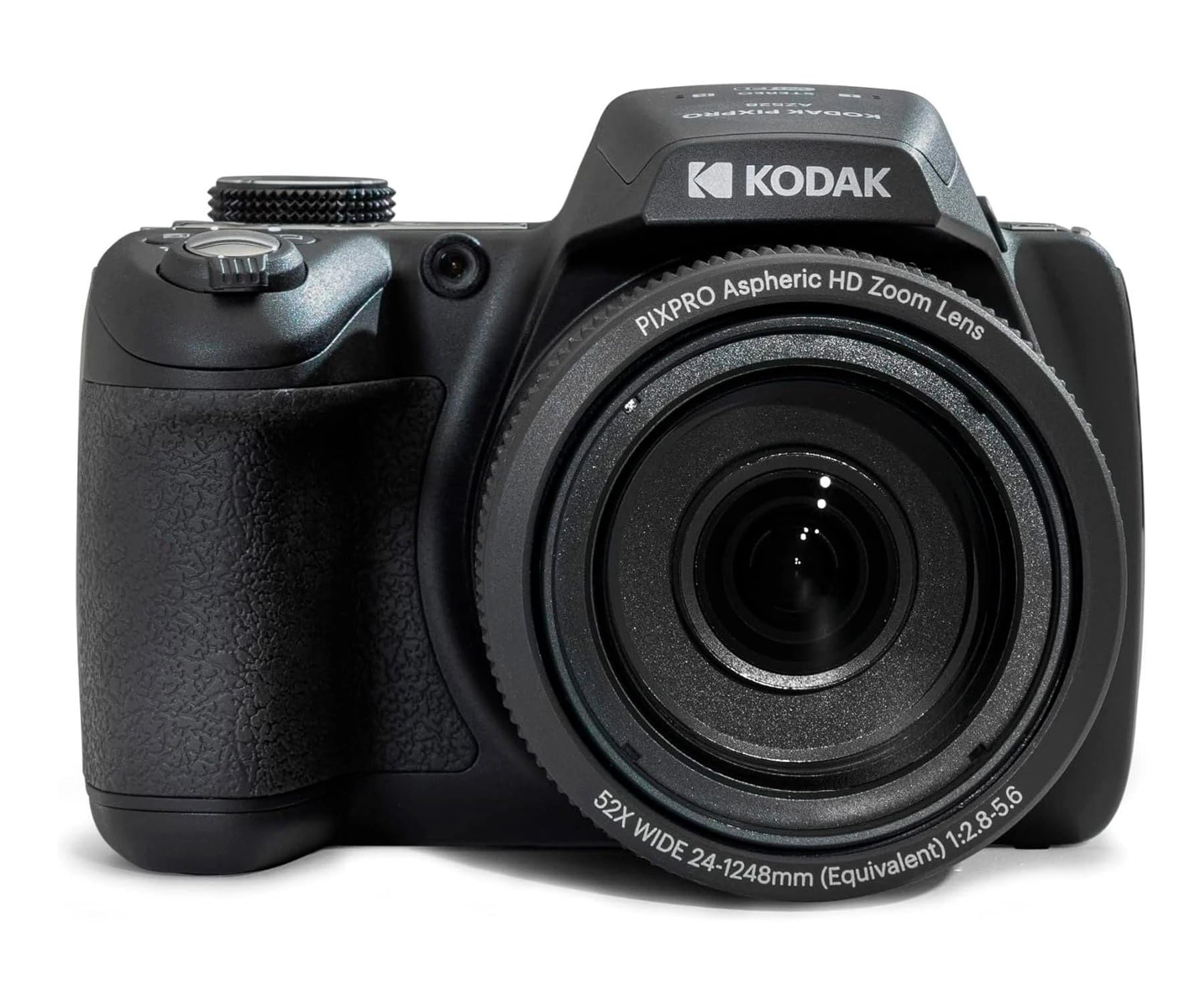
The 52x optical zoom on this Kodak (24-1248mm equivalent) is a serious step up from entry-level 25x cameras, letting you reach deer at a field edge or a performer on a distant stage. The 16 MP BSI CMOS sensor uses backside-illumination technology that collects more light than traditional front-illuminated sensors, so shots at twilight or in overcast conditions come out cleaner than you would expect at this tier. The optical image stabilization works at every zoom level, and you can shoot at 6 fps burst rate to capture a sequence of a bird taking off and pick the sharpest frame afterward.
Buyers report the AZ528 is “great for wildlife” and “easy to learn,” and one reviewer captured a “great photograph of a Carolina chickadee” using it. The built-in Wi-Fi lets you control the camera from a smartphone and transfer shots immediately, and the USB-C charging is fast. The catch: the body scuffs easily, and the included rechargeable LB-060 battery runs out quicker than the bigger NiMH packs on the budget Kodak models — a spare battery is a smart buy. The 3-inch LCD is clear enough for outdoor composition, but reviewers recommend downloading the manual online rather than using the printed booklet.
Where it wins: at this price point, you get 52x zoom, a BSI sensor for better low-light performance, and 6 fps burst — a combination you would have paid much more for a few years ago. The Wi-Fi remote shooting feature is a bonus for group portraits where you want to be in the shot.
Best for: the hobbyist birdwatcher or sports parent who wants 52x zoom with decent low-light handling and does not need the bulk or expense of an 83x or 125x camera.
Not for you if: you need reliable autofocus for fast action, or you prefer a more rugged body that hides scuffs and bumps better.
7. Minolta MN40Z 20MP Digital Camera
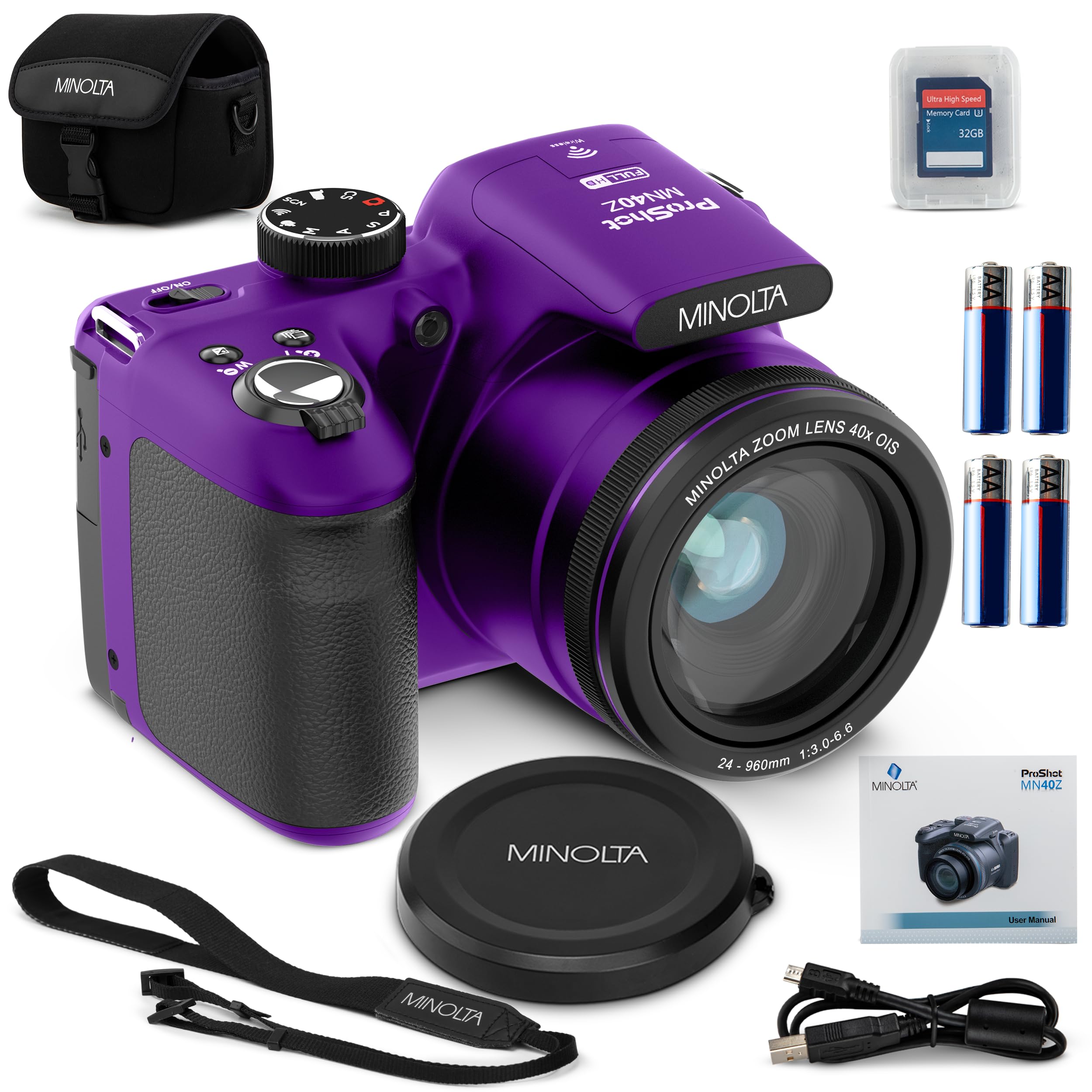
Forty times zoom for under the cost of a dinner out — with Wi-Fi sharing.
The 40x optical zoom and 20 MP sensor on the Minolta MN40Z give you more pixels than the 16 MP Kodak AZ255, and the optical image stabilization helps keep daytime telephoto shots from turning into blurs. The 1080p Full HD video at 30fps is adequate for family events and travel vlogs, and the built-in Wi-Fi lets you transfer images directly to a smartphone for sharing. The 3.0-inch LCD screen is bright enough for composing shots outdoors, and face, smile, and blink detection features help you capture portraits where everyone actually has their eyes open.
Owners mention the “40x optical zoom works well outdoors” and describe it as a “great value beginner/travel camera” with “good daylight picture quality.” The camera uses replaceable AA batteries, which owners prefer because you can swap in fresh alkalines or rechargeable NiMH cells on a long trip instead of waiting for a proprietary battery to charge. The autofocus is “a bit slow” per reviews, and the controls take some practice to master — but the instruction booklet is clear and helpful for first-time users. This is a solid entry-level bridge camera for someone who wants real optical reach without the premium price of the Nikon or Panasonic options.
Value Highlights
- 40x optical zoom with Wi-Fi sharing at entry-level pricing.
- 20 MP sensor for more detailed crops than a 16 MP camera.
- AA battery power — easy to replace anywhere in the world.
Honest Limitations
- Autofocus is slower than mid-range and premium competition.
- ISO range of 100-3200 produces visible noise above 800 in dim light.
- No viewfinder — composing entirely on the 3.0-inch LCD.
Suits: the casual photographer on a strict budget who wants real optical reach and the convenience of Wi-Fi transfer without learning complex menus.
Trade-off: the slow autofocus and AA battery drain mean this is not a camera for fast action or extended all-day shooting without spare batteries.
8. Kodak PIXPRO AZ255 Digital Camera

The lowest-cost way to get 25x optical zoom in your hands today.
The 25x optical zoom on the Kodak AZ255 (24-600mm equivalent) is a genuine optical zoom lens, not digital cropping — so a bird at 100 feet becomes a clear subject that fills a decent portion of the frame, something your phone simply cannot do. The 16 MP CMOS sensor captures photos that are sharp enough to print at 8×10 inches, and the built-in Optical Image Stabilization keeps the viewfinder steady enough for handheld shots at the mid-zoom ranges. The 1080p Full HD video is smooth and the camera starts working immediately with the included four AA batteries.
Buyers describe the 25x zoom as “excellent for distant subjects” and call this a “great camera for beginners” with “good battery life.” The 24mm wide-angle end is genuinely wide — you can capture a full mountain panorama or a group of people around a dinner table without stepping backward into a door. Weaker points: the small 1/2.3″ sensor cannot produce usable handheld photos in dim indoor lighting, and the autofocus uses only 9 contrast-detection points, so it hunts in low-contrast scenes. A few reviewers found the image quality disappointing compared to even a modern smartphone in good light, but that misses the point — this camera’s job is optical reach that phones lack.
Where it fits: a first “real” camera for a child or teen interested in wildlife and travel, or a backup camera for hiking trips where you do not want to risk an expensive body. It shoots from the start with AA batteries and accepts Class 10 SD cards up to 512 GB for a full day of shooting.
Ideal for: the absolute budget-conscious buyer who needs optical zoom for daytime outdoor subjects and values simplicity and low entry cost over advanced features.
Pass on this if: you shoot in low light, need fast autofocus for action, or want 4K video — stepping up to the AZ528 or a Panasonic ZS99 will serve you better.
Understanding the Specs
Optical Zoom Power
This is the single spec that defines this entire category. Optical zoom uses the camera’s lens to physically magnify the scene — a 25x zoom covers 24-600mm equivalent, a 52x zoom reaches 24-1248mm, and a 125x zoom (the Nikon P1000) extends to an astonishing 3000mm. The zoom ratio tells you how many times more magnified the longest focal length is compared to the widest. You get full image resolution at every step, unlike digital zoom which crops into the sensor and reduces quality. More zoom means a physically larger and heavier lens barrel, which is why the P1000 weighs significantly more than a 25x or 30x compact.
Megapixels and Sensor Size
Megapixels (MP) determine the maximum print size you can make — a 16 MP image is sharp enough for a 20×30 inch print at normal viewing distance, while a 20.1 MP image gives you more cropping flexibility. What matters more than pixel count is the physical size of the sensor. All the superzooms on this list except the Sony RX100 VII use a 1/2.3″ sensor, which is small and limits how much light the camera can gather. The Sony uses a larger 1.0-type sensor, which delivers notably cleaner shadows and smoother color gradation, especially at higher ISO settings where smaller sensors get noisy.
FAQ
What does optical zoom mean on a camera?
How many times zoom do I need for wildlife photography?
Will a bridge camera with long zoom work for sports?
Is 20 MP better than 16 MP in a superzoom camera?
Can I use a superzoom camera for professional work?
How does image stabilization work at long zoom ranges?
What is the difference between a bridge camera and a DSLR?
Which camera with zoom is best for low-light conditions?
Final Thoughts: The Verdict
If you want one dependable pick, the best camera with zoom overall is the Nikon COOLPIX P950 because it delivers 83x optical zoom with excellent image stabilization and dedicated Bird/Moon modes at a significantly lower price than the world-record P1000, making it the balance for wildlife and travel. If you want ultimate portability and image quality in a pocket-friendly body, grab the Sony RX100 VII. And for those who need extreme zoom reach that no other camera on the market can match, the Nikon COOLPIX P1000 will bring subjects into frame that you could not otherwise see without a spotting scope.
How We Picked
We do not accept paid placement. Every pick is matched to a real buyer and a real use-case; we do not hands-on test units.
Sources & Methodology
Specifications: manufacturer listings and product documentation. Review insights: verified customer reviews, as of July 2026. Pricing: not shown on this page (it changes often); check the current price via the retailer link.
As an Amazon Associate, Gadgets Feed earns from qualifying purchases. This does not affect which products we feature.
Related Guides
Product prices and availability are accurate as of the date/time indicated and are subject to change. Any price and availability information displayed on Amazon at the time of purchase will apply to the purchase of this product. As an Amazon Associate I earn from qualifying purchases.
CERTAIN CONTENT THAT APPEARS ON THIS SITE COMES FROM AMAZON. THIS CONTENT IS PROVIDED "AS IS" AND IS SUBJECT TO CHANGE OR REMOVAL AT ANY TIME.
Amazon and the Amazon logo are trademarks of Amazon.com, Inc. or its affiliates.