
That grainy shot of your kid’s winning goal. The sunset that looked electric but turned into a muddy orange blur. The concert photo where the singer is a tiny pixelated blob. Most cameras promise to fix these moments, but the gap between a sensor that merely captures light and one that translates it into emotion is wider than most spec sheets let on. Choosing the right body means understanding how glass, sensor size, and processing speed conspire to either save or destroy your memory.
I’m Min — the co-founder and writer behind Gadgets Feed. I spend my time buried in datasheets, tearing apart dynamic range charts and autofocus point maps to find the real-world performance differences that separate a keeper from a delete.
This guide cuts through the marketing to help you match your specific shooting style to the right body. Whether you need blistering burst rates for action or massive megapixel counts for detail, we break down the best camera options across every tier.
How To Choose The Best Camera
Buying a camera today means navigating a complex landscape of sensor formats, lens mounts, and autofocus systems. Your choice should hinge on what you shoot most—portraits, wildlife, video, or travel—not just the highest megapixel count on a sticker.
Sensor Size: The King of Image Quality
Full-frame sensors (typically 35mm-equivalent) offer superior dynamic range and high-ISO performance compared to APS-C or Micro Four Thirds sensors. A 24MP full-frame sensor generally resolves finer detail with less noise than a 24MP APS-C sensor because each pixel is physically larger, capturing more light. For low-light shooting or shallow depth-of-field portraits, prioritize full-frame.
Autofocus: Speed Meets Precision
Phase-detection autofocus (PDAF) is essential for tracking fast-moving subjects like sports or wildlife. Modern hybrid systems combine PDAF with contrast-detection for accuracy. The number and coverage of AF points determine how well a camera locks onto a subject at the edge of the frame. Systems with 693 or more phase-detect points offer the most reliable real-time tracking for erratic movement.
Video Capabilities: Beyond 4K
For hybrid shooters, internal recording bit depth (10-bit 4:2:2 offers far more color information than 8-bit), frame rates (4K 60p for smooth slo-mo), and codec support (ProRes, RAW) are critical for professional-grade footage. Overheating limits on some bodies can cap recording time, so look for active cooling if you shoot long interviews or events.
Quick Comparison
On smaller screens, swipe sideways to see the full table.
| Model | Category | Best For | Key Spec | Amazon |
|---|---|---|---|---|
| Canon EOS R5 | Mirrorless | High-Resolution Hybrid | 45MP Full-Frame / 8K RAW | Amazon |
| Fujifilm X-H2 | Mirrorless | APS-C Resolution Leader | 40MP APS-C / 8K Video | Amazon |
| Sony Alpha 7 IV | Mirrorless | All-Round Full-Frame | 33MP / 4K 60p 10-bit | Amazon |
| Nikon D850 | DSLR | Studio & Landscape | 45.7MP / 9 FPS | Amazon |
| Panasonic LUMIX S5II | Mirrorless | Video Hybrid | 24.2MP / Phase Hybrid AF | Amazon |
| Canon EOS 5D Mark IV | DSLR | Pro Workhorse | 30.4MP / 4K Motion JPEG | Amazon |
| Sony a7 III | Mirrorless | Battery Life Champion | 24.2MP / 693 AF Points | Amazon |
| Nikon Z 6II | Mirrorless | Versatile Low-Light | 24.5MP BSI / Dual Slots | Amazon |
| Canon EOS RP | Mirrorless | Entry Full-Frame | 26.2MP / 4K Crop | Amazon |
| OM SYSTEM E-M10 Mark IV | Mirrorless | Budget Compact | 20MP MFT / 5-Axis IBIS | Amazon |
| Panasonic LUMIX TZ/ZS99 | Point & Shoot | Travel Superzoom | 30x Optical Leica Zoom | Amazon |
In‑Depth Reviews
1. Canon EOS R5 Mirrorless Camera

The Canon EOS R5 is the high-resolution hybrid benchmark. Its stacked 45-megapixel backside-illuminated sensor delivers exceptional dynamic range and incredibly fine detail for both stills and 8K RAW video. The DIGIC X processor enables 12 fps mechanical and 20 fps electronic burst rates without blackout, while Dual Pixel CMOS II AF with 1053 points covers nearly 100% of the frame with Eye Control AF for instant subject acquisition.
Video shooters get 4K up to 120fps and 8K 30p internal recording in 10-bit 4:2:2, though the latter can trigger thermal limits on extended takes. The 5‑axis in-body stabilization (IBIS) provides up to 8 stops of compensation, making handheld long exposures possible. The high-resolution EVF, articulating touchscreen, and dual card slots (CFexpress + SD) complete a formidable package for demanding professionals.
Build quality is top-notch with weather sealing, and the RF mount ecosystem is growing rapidly. While the price is steep, the combination of resolution, speed, and video specs makes it the single most versatile camera for serious hybrid shooters who need uncompromising quality across every discipline.
Why it’s great
- Outstanding 45MP sensor with great dynamic range
- Dual Pixel AF with Eye Control is incredibly fast
- 8K raw and 4K 120fps internal recording options
- Excellent IBIS for handheld shooting
Good to know
- Premium price point
- Overheating potential with extended 8K recording
- Battery life is average for its class
- Requires CFexpress cards for full performance
2. Fujifilm X-H2 Mirrorless Camera

Fujifilm’s X-H2 revolutionizes the APS-C segment with the world’s first 40-megapixel backside-illuminated X-Trans CMOS 5 HR sensor. The X-Processor 5 engine enables 8K/30p internal 10-bit 4:2:2 Apple ProRes recording and blackout-free bursts at 15 fps mechanical or 20 fps electronic. The 425-point hybrid autofocus system with deep learning subject detection handles moving subjects with impressive reliability, though it can occasionally hunt in very low contrast scenes.
The 7‑stop in-body image stabilization is highly effective for video panning and handheld stills. Pixel Shift Multi-Shot combines 20 frames to deliver 160-megapixel stills for the ultimate in fine-art detail. The dedicated PSAM dial and wealth of customizable buttons give advanced users precise control. The body is slightly larger than the X-T4 but remains compact compared to full-frame rivals.
Film Simulation modes continue Fujifilm’s tradition of gorgeous straight-out-of-camera JPEGs, reducing post-processing time significantly. The proprietary X-Trans color filter array also minimizes moiré without an optical low-pass filter. For photographers who prioritize resolution in a compact system, the X-H2 is a unique and potent tool.
Why it’s great
- 40MP APS-C sensor offers class-leading resolution
- 8K internal recording with ProRes
- Excellent film simulations reduce editing time
- 7‑stop IBIS for stable handheld work
Good to know
- Lacks clickable command dials
- Removed some filter settings from earlier models
- Requires high-quality glass to resolve 40MP
- CFexpress Type B card needed for 8K
3. Sony Alpha 7 IV Full-frame Mirrorless

The Sony a7 IV represents one of the best balanced full-frame cameras on the market. Its 33MP Exmor R back-illuminated sensor, paired with the BIONZ XR processor, delivers a 1.8x readout speed improvement over the a7 III. Real-time Eye AF for humans and animals remains supremely accurate even in dim lighting, and the 693 phase-detect points provide 93% frame coverage for reliable tracking.
Video capabilities are pro-grade: oversampled 4K 30p from 7K with full pixel readout, plus 4K 60p in Super 35mm mode, all in 10-bit 4:2:2 S-Cinetone color science for excellent out-of-camera footage. The IBIS system offers 5.5 stops of shake compensation, and the improved grip and menu system are far superior to earlier Sony bodies. Battery life is outstanding, comfortably exceeding 2000 shots per charge.
The only notable compromise is a 1.5x crop in 4K 60p, which forces you to switch lenses for wider angles. Dual card slots (CFexpress Type A + SD) add flexibility, while S-Log3 and S-Cinetone profiles give colorists room for grade-heavy projects. It is an exceptional all-rounder for hybrid shooters who demand reliability.
Why it’s great
- 33MP sensor with superb dynamic range
- Real-time Eye AF is incredibly reliable
- 4K 60p 10-bit with beautiful S-Cinetone
- Excellent battery life
Good to know
- 4K 60p has a 1.5x crop factor
- Rear dial placement can be awkward
- Menu system still dense despite improvements
- No built-in flash
4. Nikon D850 FX-Format Digital SLR

The Nikon D850 remains the reference DSLR for studio and landscape photography. Its 45.7MP backside-illuminated sensor offers class-leading dynamic range and no optical low-pass filter, delivering stunning detail and moiré-free images. The 153-point AF system with 99 cross-type sensors provides fast and accurate phase detection even in very low light, crucial for wildlife and event work.
Burst shooting reaches 9 fps at full resolution with full AF—impressive for a DSLR. The tilting touchscreen, illuminated buttons, and focus shift shooting mode are practical tool for macro and product photographers. 4K UHD time-lapse is generated in-camera, and slow motion at 120 fps in 1080p adds creative options. Battery life is exceptional; a single charge lasts thousands of shots.
The main trade-off is the DSLR form itself: no electronic viewfinder for previewing exposure, and video autofocus lags behind mirrorless systems. RAW files are enormous, demanding fast SD or XQD cards and plenty of storage. It is a magnificent optical viewfinder machine that produces images still competitive with mirrorless heavyweights.
Why it’s great
- 45.7MP sensor with amazing dynamic range
- Industry-leading 153-point AF system
- Excellent battery life for long shoots
- Focus stacking and remote time-lapse features
Good to know
- Very large file sizes require fast storage
- Video autofocus is poor
- Heavy body compared to mirrorless options
- WiFi implementation can be finicky
5. Panasonic LUMIX S5II Mirrorless Camera
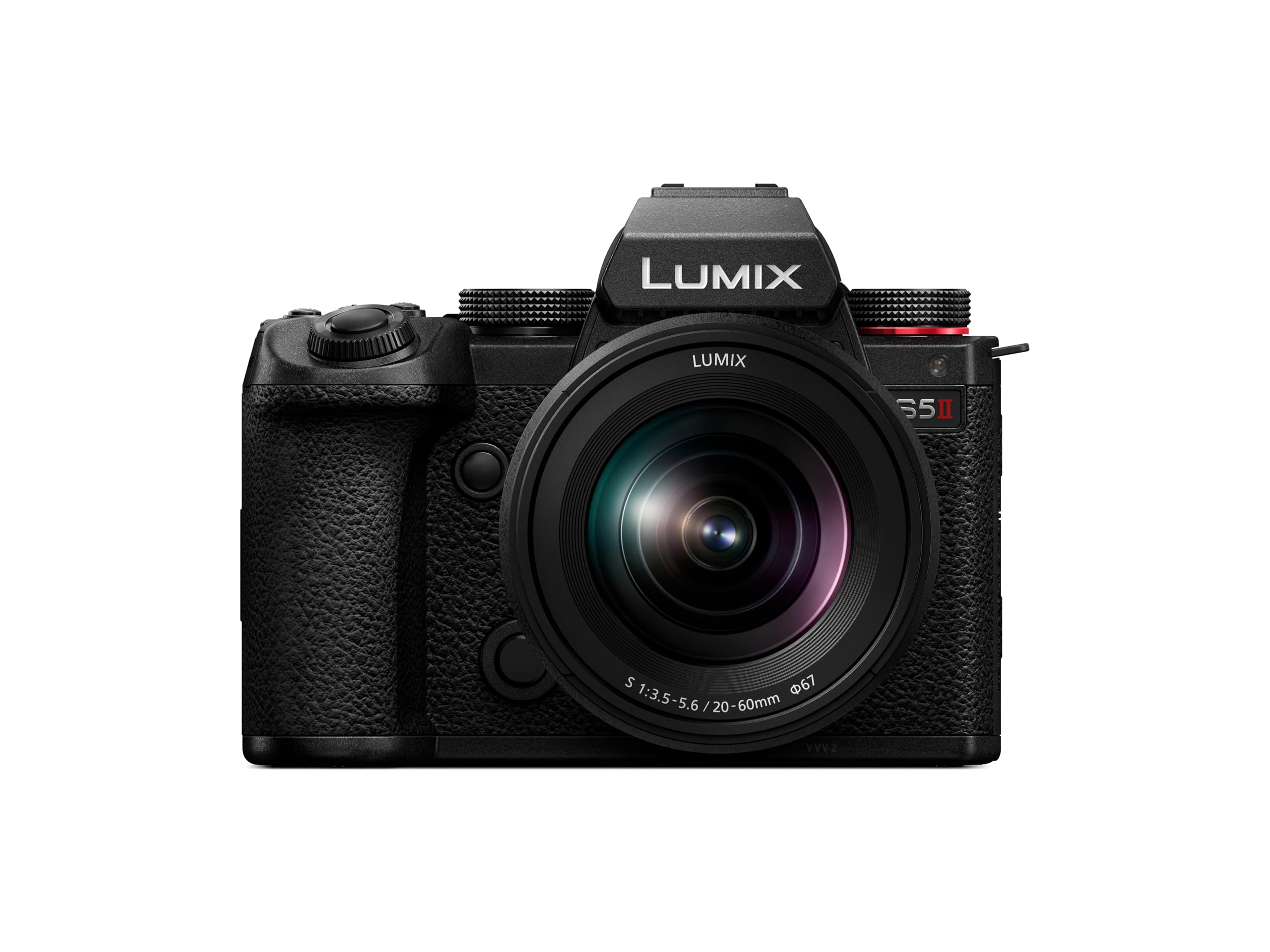
The LUMIX S5II finally delivers the phase-detect autofocus that Panasonic users have been demanding. The Phase Hybrid AF system uses 779 phase-detect points for fast, reliable subject tracking in both stills and video—a massive leap over the older contrast-detect DFD system. The 24.2MP full-frame CMOS sensor provides excellent color science and dynamic range, while the new heat-dissipation mechanism (small fan plus heatsink) enables unlimited 4:2:2 10-bit recording without overheating.
Active I.S. technology is genuinely impressive, allowing smooth handheld walking shots that reduce the need for a gimbal. 14+ stop V-Log/V-Gamut capture provides serious color grading flexibility, and Real Time LUT support lets you apply custom color grades in-camera for immediate delivery. The L-mount ecosystem offers access to lenses from Leica, Sigma, and Panasonic.
The kit lens (20-60mm F3.5-5.6) provides a useful wide-to-standard range, but battery life is below average, requiring spare packs for long outings. The body feels solid and compact, and the intuitive menu system is one of the best in its class. It is a top-tier hybrid for filmmakers and content creators who prioritize video features without sacrificing photo quality.
Why it’s great
- Reliable Phase Hybrid AF is excellent
- Unlimited 4:2:2 10-bit video recording
- Active I.S. handles walking shots smoothly
- 14+ stop V-Log for serious color grading
Good to know
- Battery life is below average
- Settings may need to be re-saved on power cycles
- Square body design can feel less ergonomic
- Limited native long-zoom lens options
6. Canon EOS 5D Mark IV Digital SLR
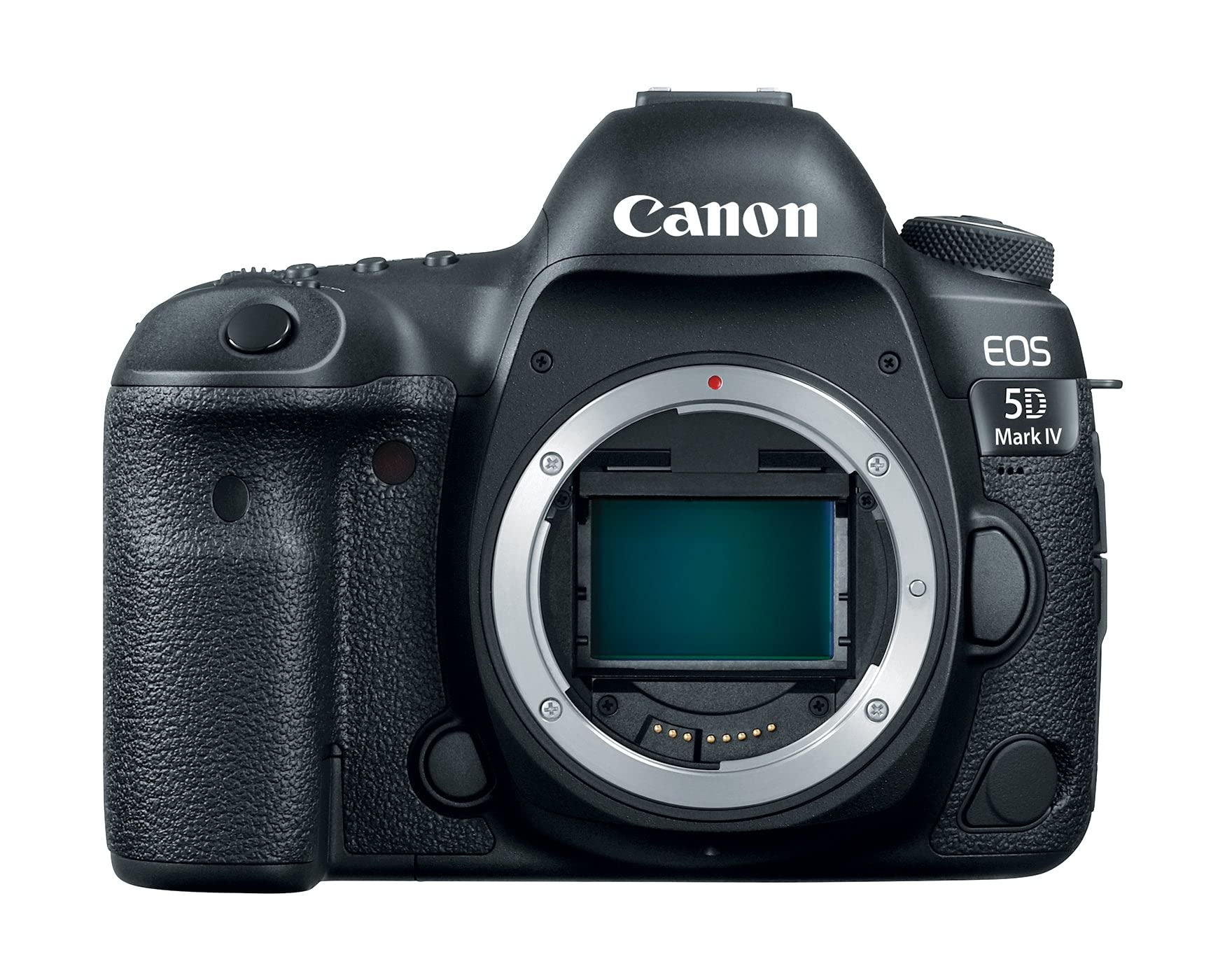
The Canon 5D Mark IV is a legendary workhorse that has earned its place in countless professional kits. Its 30.4MP full-frame CMOS sensor, paired with the DIGIC 6+ processor, offers reliable 7 fps continuous shooting and a native ISO range of 100-32000 that produces very usable high-ISO files. The 61-point phase-detection AF system with 41 cross-type sensors delivers reliable and customizable autofocus even in challenging conditions.
The Dual Pixel CMOS AF system works seamlessly with the touchscreen for quick focus point selection in Live View and video. Video recording hits 4K Motion JPEG at 30fps, but the file sizes are large and the codec is less efficient than modern alternatives. The 3.2” touchscreen LCD is clear, and the built-in Wi-Fi and GPS (though battery-draining) are practical for travel and location tagging.
Build quality is exceptional, with comprehensive weather sealing suitable for demanding environments. The optical viewfinder is bright and comfortable, and the ergonomics are refined after years of iteration. Its dynamic range, while improved over the Mark III, trails some direct competitors. For photographers who value reliability above all, the 5D IV remains a trusted studio and event camera.
Why it’s great
- Robust weather-sealed build quality
- Dual Pixel AF provides responsive Live View focus
- Enhanced dynamic range over Mark III
- Reliable 61-point AF for quick action
Good to know
- 4K Motion JPEG creates huge files
- No vari-angle screen limits angles
- Dynamic range trails current mirrorless sensors
- GPS significantly drains battery life
7. Sony a7 III Full-Frame Mirrorless

The Sony a7 III set a new standard for affordable full-frame mirrorless performance. Its 24.2MP Exmor R backside-illuminated sensor offers 15 stops of dynamic range and excellent high-ISO performance, clean up to ISO 12800. The 693 phase-detect AF points cover 93% of the frame, delivering fast and reliable autofocus that remains competitive with newer models. Silent shooting at 10 fps with AE/AF tracking is effective for discreet event photography.
Battery life is a standout feature: the NP-FZ100 battery can deliver approximately 710 shots per charge, a massive improvement over earlier Sony bodies. In-body image stabilization provides 5 stops of compensation, making handheld low-light work viable. The 4K video is oversampled from full pixel readout, producing sharp footage without many of the crop issues of the a7 III’s successors.
The kit lens (28-70mm f3.5-5.6) is decent but uninspiring in low light; upgrading to a faster prime maximizes the sensor’s potential. The menus remain complex and the touchscreen functionality is limited. At its current price point, the a7 III offers extraordinary value for shooters transitioning to full-frame without sacrificing performance.
Why it’s great
- Excellent dynamic range and low-light performance
- Class-leading battery life for mirrorless
- Fast and reliable 693-point AF system
- 10 fps silent shooting is discreet and effective
Good to know
- Menu system is complex and layered
- Kit lens is not great in low light
- Touchscreen functionality is limited
- Single UHS-II card slot is limiting
8. Nikon Z 6II Full-Frame Mirrorless

The Z 6II is a refined full-frame performer that excels in low-light and general versatility. Its 24.5MP backside-illuminated CMOS sensor captures impressive dynamic range and clean files up to ISO 25600. Dual processors enable improved autofocus performance and a generous 14 fps continuous shooting with full AF tracking. The 273-point hybrid AF system is fast and sensitive down to -6 EV, making it highly capable in dim conditions.
The 5‑axis in-body stabilization delivers up to 5 stops of compensation, which is very effective for handheld video. 4K UHD video is oversampled from full-frame pixel readout, providing sharp footage. Dual card slots (CFexpress/XQD + UHS-II SD) offer flexibility and redundancy, while USB-C charging and constant power support extended video sessions. The ergonomics are classic Nikon: comfortable grip, intuitive controls, and a bright electronic viewfinder.
Compatibility with over 360 F-mount lenses via the FTZ adapter protects older glass investments. The Z-mount system is excellent, though the native lens lineup is still expanding. The Z 6II lacks a swing-out front-facing screen, which may disappoint vloggers. It is a well-rounded option for event and travel photographers who want excellent low-light and solid video in a manageable body.
Why it’s great
- Excellent low-light AF down to -6 EV
- Dual card slots for redundancy and speed
- Comfortable ergonomics with intuitive controls
- USB-C power delivery for long sessions
Good to know
- Screen does not flip forward for self-filming
- Focus tracking can occasionally lose subjects
- Native Z-mount lens lineup still maturing
- Requires extra batteries for heavy use
9. Canon EOS RP + RF24-105mm Lens Kit

The Canon EOS RP is the lightest and most affordable way to enter full-frame mirrorless. The 26.2MP sensor delivers pleasing color science and solid image quality, especially in good light. The Dual Pixel CMOS AF system provides fast and smooth autofocus in both stills and video, with face and eye detection that works well for portraits and vlogging. The 2.36-million-dot OLED electronic viewfinder is sharp and clear.
The RF 24-105mm F4-7.1 IS STM kit lens offers a versatile zoom range with 5 stops of optical image stabilization, making it a capable travel companion. The camera supports a clean HDMI output for webcam use, and the battery life is sufficient for 3+ hours of typical use. The body is notably compact and lightweight, making it easy to slip into a bag compared to DSLR rivals.
The main compromises are visible when pushing the sensor: 4K video has a heavy crop and limited to 24p, and dynamic range lags behind larger sensors. The single UHS-II SD slot is fine for enthusiasts but limits speed for professionals. For those seeking an accessible gateway to full-frame Canon RF glass, the EOS RP delivers true versatility at an accessible cost.
Why it’s great
- Lightest and most affordable full-frame entry
- Dual Pixel AF is fast and reliable
- Compact body is easy to travel with
- Great color science straight out of camera
Good to know
- 4K video has a heavy crop factor
- Dynamic range trails larger sensors
- Single card slot is limiting
- Kit lens is soft at edges and slow aperture
10. OM SYSTEM E-M10 Mark IV Silver

The OM SYSTEM E-M10 Mark IV is a well-built Micro Four Thirds camera that packs a surprising amount of value. The 20MP Live MOS sensor uses a TruePic VIII processor for snappy performance. The in-body 5-axis image stabilization provides up to 4.5 stops of compensation, allowing sharp handheld exposures in low light that would challenge many larger cameras. The flip-down monitor and dedicated selfie mode make it vlogger-friendly.
The 16 Art Filters (including Instant Film) add fun creative options, while the 121-point contrast-detect AF system is accurate for slow-to-moderate movement. The compact 14-42mm EZ pancake kit lens is impressively small, allowing the entire setup to fit in a jacket pocket. The retro aesthetic and dial-driven controls appeal to enthusiasts who enjoy a tactile shooting experience.
Battery life is average, requiring spare packs for day-long outings. The Micro Four Thirds sensor has a 2x crop factor, which limits shallow depth-of-field compared to larger sensors, and the warm wireless app connection can be slow for image transfer. It is a perfect travel or everyday photography companion for those wanting interchangeable lens flexibility without the weight.
Why it’s great
- Excellent IBIS for low-light handholding
- Compact and lightweight design
- Flip-down screen for selfies and vlogging
- Fun creative filters and retro style
Good to know
- 2x crop factor limits depth of field
- Contrast-detect AF struggles with fast action
- Battery life is average
- App/WiFi connection can be slow
11. Panasonic LUMIX TZ/ZS99 Point and Shoot

The Panasonic LUMIX ZS99 (TZ99 outside the US) brings the iconic Leica 24-720mm equivalent 30x optical zoom to a truly pocketable body. The 20.3MP MOS sensor captures detail well in good light, while the 1,840k-dot tiltable touchscreen gives framing flexibility from high or low angles. The 4K video at 30p and 4K PHOTO burst mode (30fps) let you extract stills from motion, which is useful for unpredictable moments.
The zoom range is the defining reason to buy this camera. At 720mm (35mm equivalent), you can capture distant wildlife, stage performances, or landmarks with remarkable reach for a device that slips into a jeans pocket. Bluetooth v5.0 with a dedicated Send Image button makes sharing quick. The wide end (24mm) is genuinely wide, making it suitable for landscapes and group photos.
Image quality drops in low light or at full telephoto, especially past ISO 1600, and the autofocus can hunt in complex scenes. The lack of a viewfinder forces reliance on the LCD screen, which can be hard to see in bright sunlight. It is a specialized tool: a daylight travel zoom champion that prioritizes reach over low-light performance and is ideal for concerts, sports, and family trips.
Why it’s great
- 30x optical zoom with Leica glass in a pocketable body
- 24-720mm range covers wide to super-telephoto
- Tiltable touchscreen for flexible framing
- Bluetooth sharing is fast and easy
Good to know
- Image quality drops above ISO 1600
- Autofocus can be slow and hunt in low light
- No viewfinder limits bright-day shooting
- LCD screen can be hard to read outdoors
FAQ
Do I need a full-frame sensor for professional quality photos?
What does IBIS mean and how many stops do I need?
Does a higher megapixel count mean better image quality?
Is a dedicated camera still worth it now that smartphones are so good?
Final Thoughts: The Verdict
For most users, the camera winner is the Canon EOS R5 because it delivers an unmatched blend of high resolution, blazing autofocus, and professional video specs in a single body. If you want excellent full-frame hybrid performance without the top-tier price, grab the Sony Alpha 7 IV. And for the ultimate travel zoom that fits in your pocket, nothing beats the Panasonic LUMIX ZS99.