
The difference between a blurry, lifeless snapshot and a photograph you’d actually frame comes down to one thing: control over light and focus. A dedicated camera hands you that control through a larger sensor, a real optical viewfinder, and the ability to swap lenses for any situation — tools no smartphone, regardless of its processing power, can truly replicate. Choosing the right body, however, means navigating the confusing fork between DSLR and mirrorless, APS-C and Micro Four Thirds, and deciding which lens kit keeps you shooting, not stuck in menus.
I’m Min — the co-founder and writer behind Gadgets Feed. I’ve spent hundreds of hours analyzing sensor sizes, autofocus point counts, burst rates, and lens roadmaps to find the bodies that make the learning curve shallow and the ceiling high enough to grow into, not out of.
Whether you’re capturing your kid’s first soccer goal or finally taking that travel photography dream seriously, this guide cuts through the clutter to recommend the best cameras for beginners that balance image quality, usability, and long-term value without breaking the bank on day one.
How To Choose The Best Cameras For Beginners
Starting your photography journey with the right body means understanding a few non-negotiable specs. Your first camera should forgive beginner mistakes, offer a clear upgrade path, and match how you actually shoot — not just what looks good on a spec sheet.
Sensor Size: The Foundation of Image Quality
An APS-C sensor offers a 1.5x crop factor and roughly 370 square millimeters of light-capturing surface, delivering notably better noise performance and background blur than the smaller 1-inch or Micro Four Thirds sensors. For a beginner, APS-C strikes the ideal sweet spot between cost and low-light capability.
Autofocus System: Hit Your Focus Every Time
Phase-detection autofocus points covering over 80 percent of the frame — like Sony’s 425-point array or Nikon’s 209-point hybrid system — ensure fast, accurate eye-tracking for people and animals. Avoid contrast-detect-only systems, as they hunt and slow down in dim lighting.
Lens Ecosystem: Your Upgrade Path
A camera is only as good as the glass you mount on it. An established mount like Canon RF-S, Sony E, or Nikon Z gives you access to affordable prime lenses (think 35mm f/1.8) — your ticket to sharp, bright images without spending thousands.
Quick Comparison
On smaller screens, swipe sideways to see the full table.
| Model | Category | Best For | Key Spec | Amazon |
|---|---|---|---|---|
| Sony Alpha A6100 | Mirrorless | Fast action & eye AF | 425 phase-detection points | Amazon |
| Nikon Z 30 | Mirrorless | Vlogging & travel | 4K uncropped / 209 AF points | Amazon |
| Canon EOS R100 | Mirrorless | Lightweight entry mirrorless | 24.1 MP / Dual Pixel CMOS AF | Amazon |
| Panasonic LUMIX G100 | Mirrorless | Audio-focused video & vlogs | Built-in 360° tracking mic | Amazon |
| Sony Alpha ZV-E10 | Mirrorless | Vlogging with bokeh control | 4K oversampled from 6K | Amazon |
| Nikon D7500 | DSLR | Versatile all-round DSLR | 51-point AF / 8 fps burst | Amazon |
| Nikon D3500 | DSLR | Pure beginner simplicity | 24.2 MP / Guide Mode | Amazon |
| Canon EOS Rebel T7 Bundle | DSLR | All-in-one starter kit | 24.1 MP / Wi-Fi & NFC | Amazon |
| Canon EOS 2000D / Rebel T7 (Renewed) | DSLR | Budget dual-lens reach | Two-lens kit (18-55mm + 75-300mm) | Amazon |
| Sony Alpha a3000 | Mirrorless | Budget APS-C mirrorless entry | 20.1 MP APS-C sensor | Amazon |
| OM SYSTEM Olympus E-M10 Mark IV | Mirrorless | Compact travel with IBIS | 5-axis IBIS / 4.5 stops | Amazon |
In‑Depth Reviews
1. Sony Alpha A6100 Mirrorless Camera with 16-50mm Zoom Lens

The Sony A6100 combines a 24.2MP APS-C Exmor sensor with a front-end LSI that pushes the base ISO up to 51,200 while maintaining impressive detail. Its 425 phase-detection points blanket 84 percent of the frame, giving you real-time eye-tracking for both humans and animals that stays locked even during erratic movement. The 180-degree tiltable touchscreen flips forward for selfies, and the electronic viewfinder (though basic) works well in bright outdoor conditions.
Shooting at 11 frames per second with continuous AF/AE tracking makes this body ideal for capturing fast-moving kids or pets. The kit’s 16-50mm power zoom lens is compact enough for daily carry, and the Sony E-mount ecosystem offers affordable primes like the 35mm f/1.8 OSS — a natural first upgrade. The menu system is dense but customizable, and once you set the Fn button shortcuts, you rarely dig into sub-menus.
Battery life is typical for mirrorless at roughly 420 shots per charge, but the USB charging means you can top up from a power bank during a day out. The lack of in-body stabilization is the biggest trade-off — you’ll rely on lens-based OIS or a monopod for steady video. For a beginner who values speed and eye-AF over IBIS, this is the most future-proof sub-thousand-dollar pick.
Why it’s great
- Best-in-class autofocus speed and eye-tracking
- 11 fps burst with live AF/AE
- Massive lens library through Sony E-mount
Good to know
- No in-body image stabilization
- Menu system is dense and cluttered
- Kit lens can be fragile over time
2. Nikon D7500 DSLR with 18-140mm Lens

The Nikon D7500 inherits the D500’s 20.9MP sensor and EXPEED 5 processor, delivering class-leading image quality and noise control up to ISO 51,200. The 51-point AF system with 15 cross-type sensors paired with group-area AF tracks subjects across the frame at up to 8 fps — enough to catch a dog mid-jump or a player sliding into base. The 3.2-inch tilting touchscreen LCD has 922K dots, and the optical viewfinder offers a bright, lag-free experience that mirrorless still struggles to match at this price.
The 18-140mm f/3.5-5.6 VR lens is the true unsung hero here: a 7.8x zoom range covering wide-angle to short telephoto, with Vibration Reduction that gives you about 3.5 stops of handheld latitude. That single lens replaces two kit lenses, saving bag space and lens-swapping hassle. It’s weather-sealed against dust and moisture, so a drizzle won’t end your shoot. The D7500’s battery life — rated at 950 shots per charge — is nearly double that of most mirrorless competitors in this guide.
4K UHD video at 30 fps comes with power aperture control and a 4K time-lapse mode, though the lack of a fully articulated screen limits selfie-style vlogging. The body is heavier (around 640g without lens) than the mirrorless options, but the trade-off is a robust, glove-friendly grip and tactile button layout. It’s an eight-year-old design, but the sensor and AF still compete with today’s mid-range bodies.
Why it’s great
- Superb battery life (950+ shots)
- Versatile 18-140mm VR kit lens
- Durable weather-sealed build
Good to know
- Heavy compared to mirrorless alternatives
- Screen tilts but does not flip forward
- No in-body image stabilization
3. Sony Alpha ZV-E10 Mirrorless Vlog Camera

The ZV-E10 is the video-first sibling of the A6100, sharing the same 24.2MP APS-C Exmor sensor and BIONZ X processor but adding vlogger-specific hardware. The 4K footage is oversampled from a 6K readout with full pixel readout and no pixel binning — meaning sharper, more detailed video than the A6100 delivers. The Background Defocus button instantly toggles the aperture to its widest setting for that creamy bokeh effect, while Product Showcase Mode transitions focus from your face to an object held up to the lens in under a second.
The built-in directional microphone with a windscreen is serviceable for talking-head videos, and the USB-C connection allows plug-and-play live streaming at 4K 30p over HDMI or 1080p 60p over USB. The 180-degree flip screen is bright enough for outdoor framing, and the grip is larger than the A6100’s, making one-handed recording more stable. Battery life is the weak link — expect about 25 minutes of 4K recording before the LP-E10 drains — but USB-C power delivery means you can shoot while plugged into a battery pack.
The kit 16-50mm power zoom lens covers most vlogging framing needs, and the Sony E-mount gives you access to wide primes like the Sigma 16mm f/1.4 for low-light indoor recording. Rolling shutter is noticeable during quick pans, and the lack of in-body stabilization forces you to rely on lens OIS or post-production software. For a beginner solely focused on video and streaming, this is the best dedicated body under the premium tier.
Why it’s great
- Oversampled 4K from 6K readout
- One-button bokeh and product showcase modes
- Plug-and-play USB streaming
Good to know
- Poor battery life for video
- No in-body stabilization
- Noticeable rolling shutter
4. Nikon Z 30 with 16-50mm Lens

The Nikon Z 30 is Nikon’s most compact mirrorless body — lighter than the Sony ZV-E10 by 35 grams — and it packs a 20.9MP APS-C sensor with a hybrid AF system spanning 209 points. Eye-detection autofocus works reliably for both people and pets, and the 4K video is recorded at full sensor width with no crop, so your wide-angle zoom stays wide. The 16-50mm retractable lens is a pancake-style zoom that collapses flush with the body for jacket-pocket storage.
The Z 30’s dedicated vlogger features are well-thought-out: a flip-out selfie screen, a red REC light on the front to indicate recording, and a built-in stereo microphone with adjustable sensitivity that reduces wind noise better than most onboard mics. USB-C power delivery lets you shoot for extended periods without swapping batteries, and the camera doubles as a plug-and-play 1080p 60p webcam via a single USB cable. The Z-mount lens lineup has grown substantially, with the Z 28mm f/2.8 and Z 40mm f/2 offering affordable fast-primes for low-light work.
The main trade-off is the lack of an electronic viewfinder — you’re framing entirely through the 3-inch screen, which can be tough in midday sun. The sensor is also a 20.9MP unit versus the 24.2MP found in comparable Sony bodies, but in practice the image quality, dynamic range, and color science are excellent. For vloggers and casual creators who prioritize portability and video over an EVF, the Z 30 is hard to beat at its price tier.
Why it’s great
- Lightest mirrorless body in class
- 4K video with no crop
- USB-C continuous power and streaming
Good to know
- No electronic viewfinder
- 20.9MP sensor is lower resolution than some competitors
- Lens selection still growing compared to Sony E-mount
5. OM SYSTEM Olympus E-M10 Mark IV with 14-42mm EZ Lens

The OM SYSTEM E-M10 Mark IV uses a 20MP Micro Four Thirds sensor paired with an in-body 5-axis image stabilization system rated at 4.5 shutter speed steps — meaning you can handhold at 1/4 second and still get sharp results. The 14-42mm EZ pancake lens retracts to a near-flat profile, making the full kit small enough to slide into a winter coat pocket. The flip-down monitor enables a dedicated selfie mode that automatically switches on when the screen rotates down, and the 121-point contrast-detect AF is snappy in good light.
The Micro Four Thirds system offers the widest selection of compact, affordable glass in the mirrorless world, including the Olympus 45mm f/1.8 (a fantastic portrait prime for under ) and the Panasonic 20mm f/1.7 II pancake. The 4K video is clean and stabilized, though the contrast-detect AF can hunt in low light. The 16 Art Filters — including Instant Film — add a fun, creative layer for beginners who want JPEGs that feel finished straight out of camera.
Battery life is about 360 shots per charge, and the camera charges via Micro-USB (not USB-C), which feels dated in 2024. The physical controls — twin dials, dedicated buttons for ISO and exposure compensation — are excellent for learning manual exposure. It’s not the absolute sharpest sensor in this guide, but the combination of IBIS, compact size, and a mature lens system makes it the most practical travel companion.
Why it’s great
- Class-leading 5-axis in-body stabilization
- Extremely compact with pancake zoom
- Huge Micro Four Thirds lens ecosystem
Good to know
- Contrast-detect AF hunts in low light
- Micro-USB charging (not USB-C)
- 20MP MFT sensor smaller than APS-C
6. Canon EOS R100 with RF-S 18-45mm Lens

The Canon EOS R100 enters as the smallest and lightest body in the EOS R series, weighing just 356 grams with the RF-S 18-45mm lens attached. Its 24.1MP APS-C CMOS sensor pairs with the DIGIC 8 processor and Dual Pixel CMOS AF covering 143 zones — including human face and eye detection for both stills and video. That AF system is fast enough to track a moving subject across the frame at 6.5 fps, and the animal- and vehicle-detect AF modes make it surprisingly capable for wildlife beginners at an entry-level price.
The RF-S 18-45mm f/4.5-6.3 IS STM lens includes Optical Image Stabilization rated at 4 stops, which helps in dim conditions despite the slow maximum aperture. The 4K video is capped at 24 fps, which is fine for cinematic clips but not ideal for action or standard 30p. The camera body features a built-in electronic viewfinder with 2.36 million dots — bright and punchy for composing in sunlight — and the 3-inch LCD supports touch for menu navigation and focus point selection.
The R100 lacks a fully articulating screen, limiting selfie and vlogging use, and the single SD slot is UHS-I only, slowing high-speed burst write times. The RF-S lens mount grants access to Canon’s excellent RF glass, including the affordable RF 35mm f/1.8 Macro IS STM. For a pure photography beginner who wants Canon’s color science and Dual Pixel AF without paying Canon’s higher-tier prices, the R100 is a smart entry point.
Why it’s great
- Dual Pixel CMOS AF with eye detection
- Smallest and lightest R-series body
- Electronic viewfinder included
Good to know
- 4K video limited to 24 fps
- Screen does not flip forward
- Slow kit lens aperture in low light
7. Panasonic LUMIX G100 with 12-32mm Lens

The LUMIX G100 is purpose-built for creators who prioritize audio quality alongside image quality. Its built-in microphone system uses three capsules in a 360-degree array that automatically tracks the sound source — whether you’re filming yourself in a room or following a subject outside — and the audio auto-adjusts sensitivity to avoid clipping. The Micro Four Thirds sensor records 4K 24/30p video and 20MP stills, and the included 12-32mm f/3.5-5.6 pancake zoom collapses to tiny dimensions for jacket-pocket portability.
The iA (intelligent auto) mode handles exposure and focus decisions so beginners get clean results without diving into menus, while the full manual controls remain available for when skills sharpen. The camera also works as a plug-and-play webcam via USB, and the LUMIX Sync app enables wireless file transfer and remote control. The 5-axis Hybrid I.S. stabilizes video and stills effectively, though high-speed panning can reveal the contrast-detect AF’s limitations.
The biggest limitation is the 4K video recording time limit — the G100 cuts off at around 10 minutes, which kills its utility for long interviews or classroom recording. The electronic viewfinder has 3.68 million dots and is excellent for composing, but the screen is fixed and does not flip forward. For short-form content where audio clarity matters more than runtime, the G100’s mics and compact size are unique selling points.
Why it’s great
- Best built-in microphone of any camera in this guide
- Ultra-compact with 12-32mm pancake lens
- Excellent EVF resolution (3.68M dots)
Good to know
- 4K video limited to roughly 10 minutes
- Screen does not flip forward
- Contrast-detect AF hunts in dim conditions
8. Nikon D3500 DSLR with 18-55mm VR Lens (Renewed)

The Nikon D3500 remains the gold standard for absolute beginners thanks to its Guide Mode — a built-in tutorial system that explains each setting in plain English and walks you through specific scenarios like “freeze action” or “blur background.” The 24.2MP APS-C sensor lacks an optical low-pass filter, delivering noticeably sharper images than many consumer DSLRs from its generation. The 11-point AF system is basic but reliable, and the 5 fps burst rate is enough for casual action. The optical viewfinder is large, bright, and lag-free — a primary advantage over entry-level mirrorless at this price tier.
The bundled 18-55mm f/3.5-5.6G VR lens includes Vibration Reduction, and the EN-EL14a battery delivers roughly 1,200 shots per charge — class-leading endurance that lets you leave the charger at home on weekend trips. The body is compact for a DSLR at just 126.5 x 64 x 94 mm, and the deep grip feels secure even with larger lenses. This renewed unit comes with a 90-day warranty and includes all original accessories.
The Snapbridge app for wireless image transfer is notoriously unreliable, and the lack of a touchscreen makes menu navigation slower than modern mirrorless competitors. The 18-55mm lens is optically decent but slow at f/3.5-5.6, meaning you’ll struggle indoors without a flash or a faster prime. For a beginner who wants to learn photography fundamentals with a tactile, long-battery camera, the D3500 is still the best teacher on the market.
Why it’s great
- Guide Mode teaches photography fundamentals
- Excellent battery life (1,200+ shots)
- Sharp 24.2MP sensor with no OLPF
Good to know
- No touchscreen
- Snapbridge app is unreliable
- Basic 11-point autofocus system
9. Canon EOS Rebel T7 DSLR Bundle with 18-55mm Lens
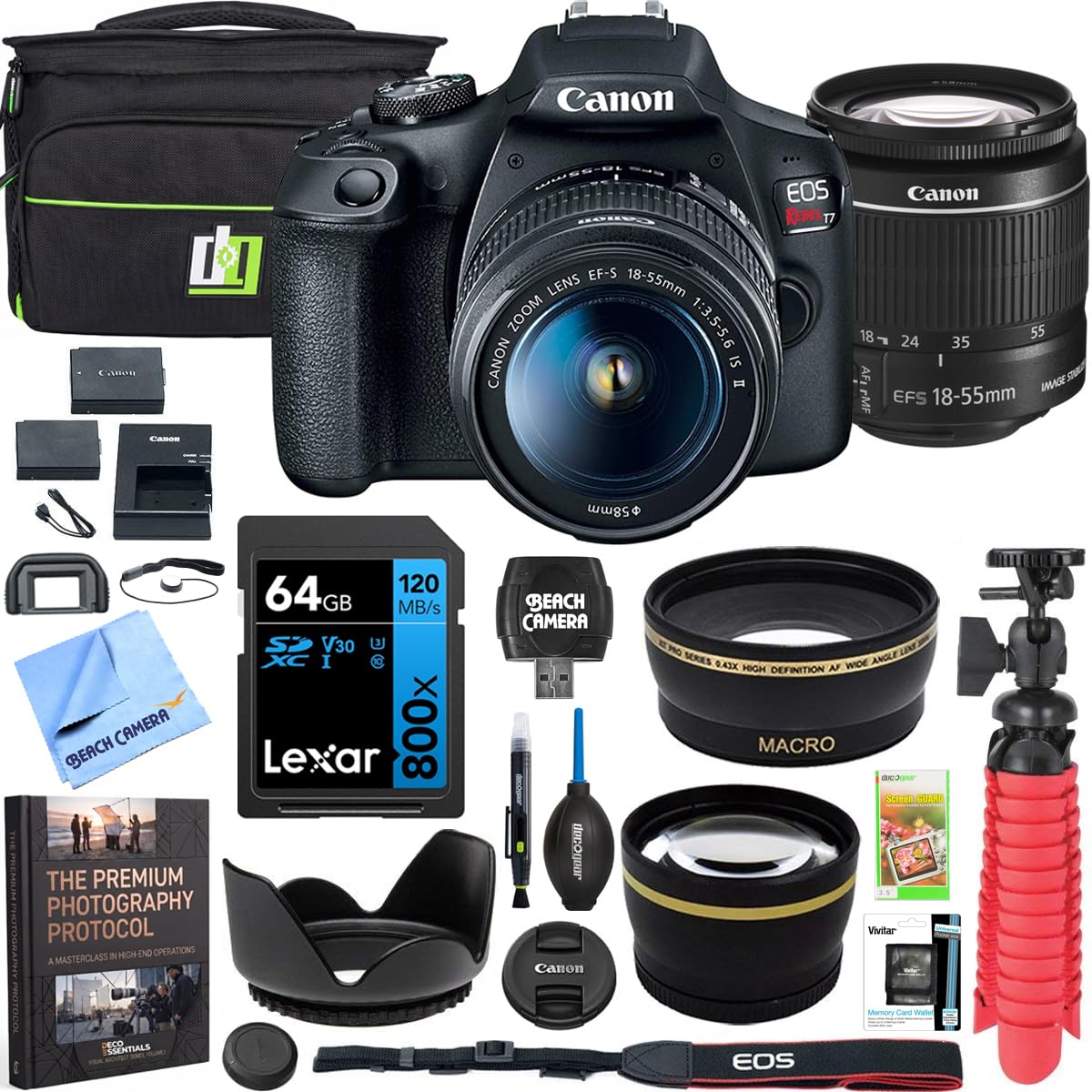
The Canon EOS Rebel T7 is the last generation of Canon’s entry-level DSLR, and this bundle packages it with a 64GB SD card, an extra battery, a 60-inch tripod, a medium camera bag, and a set of 58mm filters (UV, CPL, ND8) plus wide-angle and telephoto auxiliary lenses. The 24.1MP APS-C sensor with DIGIC 4+ processor produces Canon’s signature accurate color science, and the 9-point AF system with a single cross-type center point is perfectly adequate for stationary subjects. The optical viewfinder offers a clear 95 percent frame coverage, and the 3-inch LCD has 920K dots for review.
The EF-S 18-55mm f/3.5-5.6 IS II lens includes optical stabilization, and the EF mount gives access to Canon’s enormous library of affordable EF and EF-S glass — the 50mm f/1.8 STM (“nifty fifty”) is a upgrade that transforms low-light portraits. Built-in Wi-Fi with NFC allows wireless image transfer and remote camera control via the Canon Camera Connect app, though the connection process is slower than modern Bluetooth implementations. The LP-E10 battery is rated for 500 shots per charge.
The bundled accessories are mixed in quality: the tripod is flimsy and the included bag is small for a body plus the 18-55mm lens alone. The auxiliary wide-angle and telephoto adapter lenses reduce image sharpness and introduce distortion. For a new photographer, the most useful items in the bundle are the extra battery, the 64GB SD card, and the cleaning kit. The camera itself is a proven beginner platform, but the accessories require selective use.
Why it’s great
- Comprehensive starter bundle with two batteries
- Canon’s color science and huge EF lens library
- Wi-Fi for easy image sharing
Good to know
- Bundled tripod and bag are low quality
- Only 9 AF points with single cross-type
- Battery drains faster than Nikon D3500
10. Canon EOS 2000D / Rebel T7 Dual Lens Bundle (Renewed)

This renewed bundle pairs the same Canon EOS 2000D (the international version of the Rebel T7) with both the EF-S 18-55mm f/4-5.6 IS II and the EF 75-300mm f/4-5.6 III telephoto zoom — giving you a combined focal range from 28.8mm equivalent wide-angle to 480mm equivalent telephoto. The 75-300mm lens opens up wildlife, sports, and compressed-portrait opportunities that a single kit zoom cannot reach, all within a single bundle price. The body’s 24.1MP APS-C sensor and DIGIC 4+ processor are identical to the standard T7, offering the same image quality and 9-point AF system.
The bundle includes a 64GB SanDisk SD card, a full-size tripod, a backpack, a 58mm filter kit, an ultra-bright slave flash, a memory card reader, and cleaning tools. The 18-55mm lens covers everyday walk-around shooting, while the 75-300mm gets you to distant subjects — though its f/5.6 maximum aperture at 300mm demands good light for sharp results. Wi-Fi with NFC enables wireless transfer and remote control, and the Canon Camera Connect app works with both iOS and Android.
The renewed rating means the camera and lenses are inspected and carry a 90-day warranty, but the bundle’s extra accessories (especially the wide-angle and telephoto converter lenses) are optically poor and should be set aside in favor of the two Canon-brand zooms. The manual is a thin English-only booklet, and the 3 fps continuous shooting speed limits action photography. For a budget-minded beginner who wants two focal ranges from day one, this bundle delivers reach without a second purchase.
Why it’s great
- Two-lens kit covers wide to 480mm telephoto
- 64GB SD card and bag included
- Renewed with 90-day warranty
Good to know
- 75-300mm lens requires good light
- Bundle accessories are low quality
- Thin manual and no in-depth guidance
11. Sony Alpha a3000 ILCE-3000K with 18-55mm OSS Lens

The Sony a3000 is an odd but effective entry: a mirrorless camera housed in a DSLR-style body with a large grip and an eye-level electronic viewfinder. The 20.1MP APS-C Exmor sensor captures excellent image quality up to ISO 400, with manageable noise up to ISO 800 — performance that still beats any smartphone. The included 18-55mm f/3.5-5.6 OSS lens features optical steady shot stabilization, and the lens mount provides access to Sony’s extensive E-mount system.
The a3000’s EVF is a low-resolution 0.2-inch unit (200K dots), but it’s functional for framing in bright outdoor conditions where the 3-inch LCD washes out. The 25-point contrast-detect AF is slow by modern standards and hunts in dim light, but for stationary or slow-moving subjects it locks reliably. The body is powered by a rechargeable NP-FW50 battery that charges via USB, and battery life is average at roughly 320 shots per charge.
This is a discontinued model, meaning no warranty support from Sony itself, and the autofocus speed is noticeably behind even entry-level current bodies. The kit lens is well-regarded optically but offers the same slow f/3.5-5.6 aperture as its competitors. For a budget floor — someone who wants APS-C sensor quality at the lowest possible entry cost — the a3000 delivers image files that can absolutely be printed, framed, and shared. It lacks the features to grow with you, but it gets you started.
Why it’s great
- Lowest price for any APS-C mirrorless body
- Includes electronic viewfinder
- Access to Sony E-mount lens ecosystem
Good to know
- Autofocus is slow and hunts in low light
- Low-resolution EVF and LCD
- Discontinued model with limited support
FAQ
Should I buy a mirrorless or DSLR as a complete beginner?
How many megapixels do I really need as a beginner?
What does a 50mm f/1.8 lens do that my kit lens cannot?
Final Thoughts: The Verdict
For most users, the best cameras for beginners winner is the Sony Alpha A6100 because its 425-point phase-detection autofocus, 11 fps burst rate, and massive Sony E-mount ecosystem give you the fastest learning curve and the longest upgrade path. If you want weather-sealed durability and a versatile 18-140mm all-in-one lens, grab the Nikon D7500. And for vlogging-first beginners who need oversampled 4K and a one-button bokeh toggle, nothing beats the Sony Alpha ZV-E10.