
The gap between a smartphone clip and a cinematic frame comes down to one thing: the body you build your rig around. Whether you are capturing fast-moving sports, run-and-gun documentary work, or polished YouTube content, the sensor size, bit rate, and autofocus logic of your camera body determine how much usable footage you walk away with. Choosing the wrong body means fighting rolling shutter, hunting focus, or swapping lenses every five minutes.
I’m Min — the co-founder and writer behind Gadgets Feed. I’ve spent hundreds of hours cross-referencing sensor readout speeds, codec depth, and real-world autofocus hit rates to separate the spec-sheet heroes from the cameras that actually deliver stable, sharp footage in the field.
This guide covers eleven camera bodies that earn their keep in real production environments, from budget mirrorless kits to full-frame cinema powerhouses. These are the best cameras for filming you can trust for reliable image quality and professional-grade feature sets.
How To Choose The Best Cameras For Filming
Picking the right filming body goes beyond counting megapixels. Video performance is driven by sensor readout, codec depth, autofocus reliability, and stabilization. Understanding these four pillars will prevent you from buying a camera that looks good on paper but produces soft, jittery footage.
Sensor Readout and Rolling Shutter
Every CMOS sensor reads lines sequentially, creating a delay between the top and bottom of the frame. Slow readout causes rolling shutter — that wobbly, jelly effect when you pan or shoot fast motion. Cameras with faster sensor readout (typically full-frame stacked sensors or global shutter designs) produce cleaner footage during movement. For run-and-gun filming, prioritize bodies that list their readout speed or have a reputation for minimal rolling shutter artifacts.
Codec Depth and Color Science
8-bit footage records only 256 levels per color channel, which posterizes quickly in sky or shadow gradients when you push the grade. 10-bit and 12-bit (ProRes, Blackmagic RAW, Canon RAW Light) give you 1024 or 4096 levels per channel, letting you recover highlights and shadows without banding. If you plan to color grade at all, choose a body that records at least 10-bit internally or via HDMI out. Log profiles like C-Log, S-Log, and V-Log expand dynamic range further by flattening the tonal curve.
Autofocus System and Lens Motor Compatibility
Phase-detection autofocus (PDAF) is far more reliable for video than contrast-detection, which hunts back and forth. Dual Pixel CMOS AF (Canon) and the hybrid phase systems in Sony and Panasonic bodies offer smooth, continuous tracking that locks onto eyes and faces. The lens motor also matters — STM and linear motors are silent and smooth for video, while older ultrasonic motors can produce audible clicks that the internal mic picks up.
In-Body Stabilization and Rigging Requirements
In-Body Image Stabilization (IBIS) lets you shoot handheld without a gimbal for static or slow-moving shots, saving setup time and weight. Some systems offer 5-axis stabilization that works in tandem with lens-based OIS (Dual I.S.). If you plan to film mostly on sticks or gimbals, IBIS is less critical. If you are a solo operator following action, a body with robust IBIS — like the Panasonic G85 or G97 — dramatically increases your hit rate for smooth footage.
Quick Comparison
On smaller screens, swipe sideways to see the full table.
| Model | Category | Best For | Key Spec | Amazon |
|---|---|---|---|---|
| Sony a7 III | Full-Frame Mirrorless | Hybrid photo/video and low-light shooting | 15-stop dynamic range; 693 PDAF points | Amazon |
| Blackmagic Pocket 6K | Cinema Camera | Professional filmmaking with RAW color grading | 6K/50fps Blackmagic RAW; Super35 sensor | Amazon |
| Canon EOS R8 | Full-Frame Mirrorless | Lightweight vlogging and 4K60 oversampled video | 4K60 uncropped from 6K oversample; C-Log3 | Amazon |
| Canon EOS R10 | APS-C Mirrorless | High-speed continuous shooting and subject tracking | 15fps mechanical; 4K video; DIGIC X | Amazon |
| Canon R50 V | APS-C Mirrorless | Vlogging and content creation with flip screen | 4K30 uncropped; 120fps slow-mo at 1080p | Amazon |
| Panasonic LUMIX G85 | Micro Four Thirds Mirrorless | Stabilized handheld 4K on a budget | 5-axis Dual I.S.2; 4K30 no crop | Amazon |
| Panasonic LUMIX G97 | Micro Four Thirds Mirrorless | Content creators needing V-Log L and no recording limits | 4K30 unlimited; 12-stop V-Log L; USB-C | Amazon |
| Canon EOS R100 | APS-C Mirrorless | Entry-level 4K with Dual Pixel AF | 4K24; 120fps HD; 24.1MP APS-C sensor | Amazon |
| Canon R100 Bundle | APS-C Mirrorless Bundle | Beginners wanting an all-in-one starter kit | Same 24.1MP sensor; includes 64GB card and bag | Amazon |
| Canon EOS R5 C | Cinema/Hybrid (Renewed) | 8K internal RAW with active cooling | 8K60 internal Cinema RAW Light; fan cooling | Amazon |
| Blackmagic Cinema 6K | Full-Frame Cinema Camera | Cinematic full-frame with L-Mount lens selection | Full-frame 6K sensor; 13 stops DR; 12-bit BRaw | Amazon |
In-Depth Reviews
1. Sony a7 III Full-Frame Mirrorless with 28-70mm Lens

The Sony a7 III remains the benchmark for full-frame hybrid performance because its Exmor R back-illuminated sensor reads out fast enough to minimize rolling shutter while delivering 15 stops of dynamic range. The 693 phase-detection points cover 93% of the frame, which means eye and face tracking locks on reliably even when your subject moves through cluttered backgrounds. For filming, the 4K HDR recording and S-Log2/S-Log3 profiles give you the color latitude to match expensive cinema cameras in post.
The 28-70mm kit lens is decent for general use, but pairing this body with a fast prime or a G Master zoom unlocks the sensor’s true low-light performance. The battery life is exceptional — roughly 710 shots per charge or about two hours of continuous recording — which is rare for a mirrorless body at this level. The dual SD card slots let you record proxy files alongside your main footage, a feature that solo shooters find invaluable.
On the downside, the menu system is dense and the 4K60 recording mode is absent (4K30 is the maximum). The 8-bit internal codec will show some banding in flat gradients compared to 10-bit alternatives. But for a do-everything full-frame body with reliable autofocus and excellent low-light handling, the a7 III is still tough to beat.
Why it’s great
- Industry-leading phase-detection AF covers almost the entire frame.
- 15-stop dynamic range and S-Log profiles allow heavy color grading.
- Outstanding battery life for a full-frame mirrorless body.
Good to know
- Limited to 4K30 recording; no internal 10-bit.
- Menu system is complex and not touch-friendly for video.
2. Blackmagic Design Pocket Cinema Camera 6K
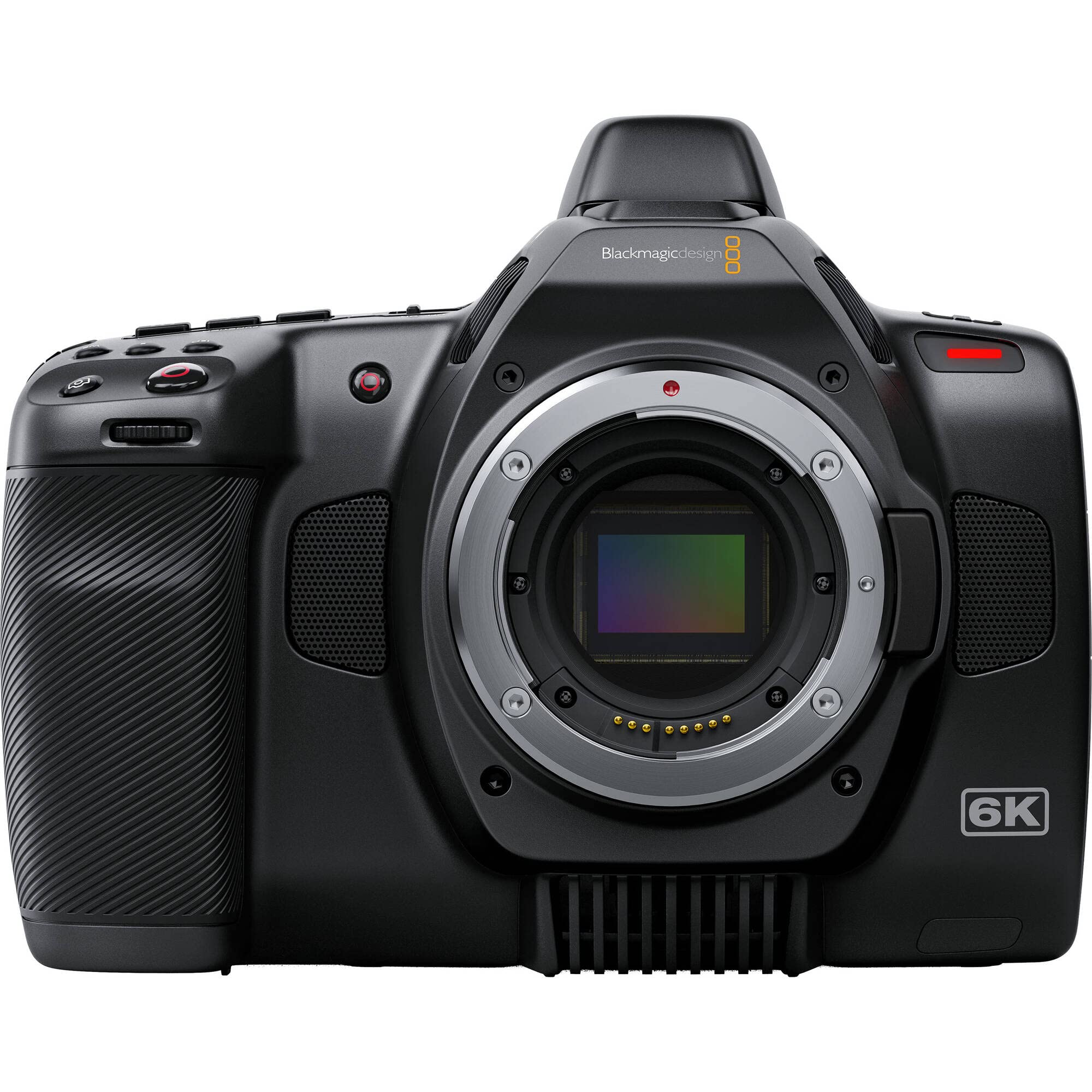
The BMPCC6K is built for one purpose: producing gradeable, cinematic video. Its Super35 sensor records 6K at up to 50fps and 4K DCI at 60fps in Blackmagic RAW, which gives you 12-bit color depth for pushing shadows and recovering highlights without artifacts. The dual native ISO (400 and 3200) means you can shoot in dim interiors or night exteriors with minimal noise, and the 13 stops of dynamic handle contrasty scenes that would clip cheaper sensors.
The EF lens mount is a double-edged sword — you get access to decades of affordable Canon glass, but the camera relies purely on contrast-detection autofocus. For narrative filmmaking and tripod-based work that is fine, but run-and-gun shooters will need to pull focus manually or use an external follow-focus system. The 5-inch touchscreen is bright and responsive, though an external monitor helps in direct sunlight.
Battery life is the biggest trade-off: the included LP-E6 will drain in about 30–40 minutes of recording. Most users rig this camera with a V-mount battery plate or a large NP-F battery grip. The included DaVinci Resolve Studio license covers the editing and color grading workflow, so you are not paying extra for software. If your priority is image quality and color flexibility over portability, this is the strongest cinema body in its price bracket.
Why it’s great
- 12-bit Blackmagic RAW at 6K for maximum post-production flexibility.
- Dual native ISO delivers clean low-light footage.
- Includes full DaVinci Resolve Studio license.
Good to know
- Contrast-detect AF only; manual focus is the standard workflow.
- Small internal battery requires external power for extended shoots.
3. Canon EOS R8 Mirrorless Camera Body

The EOS R8 packs the same 24.2MP full-frame sensor and DIGIC X processor found in the much more expensive R6 Mark II into a body that weighs just 461 grams. For filmmakers, the headline feature is uncropped 4K60 that is oversampled from a 6K readout, producing exceptionally sharp footage with minimal moiré. The Dual Pixel CMOS AF II covers the entire frame with 1,053 zones and uses deep learning to track people, animals, and even aircraft.
Canon Log 3 is available for a flat gamma curve that preserves 12 stops of dynamic range, and the 180fps high-frame-rate mode at 1080p gives you 6x slow-motion for action replay. The vari-angle touchscreen is ideal for vlogging and low-angle shots. UVC/UAC support means you can plug the R8 directly into a computer and use it as a high-end webcam without capture cards.
The obvious omissions are IBIS and a second card slot. Without in-body stabilization, your handheld footage will show micro-jitters unless you use stabilized RF lenses or a gimbal. The LP-E17 battery is small — expect just over an hour of continuous 4K60 recording before swapping packs. For creators who want the full-frame look and Canon color science in a lightweight travel-friendly body, the R8 delivers where it matters most.
Why it’s great
- Oversampled 4K60 from 6K produces sharp, detailed footage.
- Ultra-light body makes it easy to rig on a gimbal or travel with.
- UVC/UAC plug-and-play for live streaming and video calls.
Good to know
- No in-body stabilization; requires stabilized lenses or a gimbal for smooth handheld work.
- Single UHS-II SD card slot and small battery limit long recording sessions.
4. Canon EOS R10 RF-S18-150mm Lens Kit

The EOS R10 is Canon’s fastest APS-C body, capable of 15fps continuous shooting with the mechanical shutter and 23fps with the electronic shutter. That speed transfers directly to video in the form of subject detection that stays locked on fast-moving athletes or wildlife. The 24.2MP CMOS sensor combined with the DIGIC X processor delivers 4K30 uncropped video and 4K60 with a slight crop, both with Dual Pixel AF for smooth rack focusing.
The 18-150mm kit lens provides a versatile 8.3x zoom range equivalent to roughly 29-240mm in full-frame terms, covering wide-angle establishing shots through telephoto close-ups. The lens includes optical stabilization that pairs with the camera’s digital stabilization for handheld use. The bright OLED viewfinder and fully articulating screen make it easy to frame shots from any angle, including front-facing for self-recording.
Where the R10 falls short for serious filmmakers is the lack of 10-bit internal recording and the modest 4K60 crop. The single UHS-II card slot also means you cannot simultaneously record proxies. If your primary need is quick-turnaround content with reliable autofocus and a long zoom reach without swapping lenses, the R10 kit is a practical all-rounder.
Why it’s great
- Fast burst rates and excellent subject tracking for action filming.
- Versatile 18-150mm kit lens covers wide to telephoto without switching glass.
- Compact body with good ergonomics and a bright EVF.
Good to know
- No 10-bit internal recording; 8-bit 4:2:0 limits grade flexibility.
- 4K60 has a 1.56x crop factor that changes lens reach.
5. Canon EOS R50 V with 14-30mm RF-S Lens
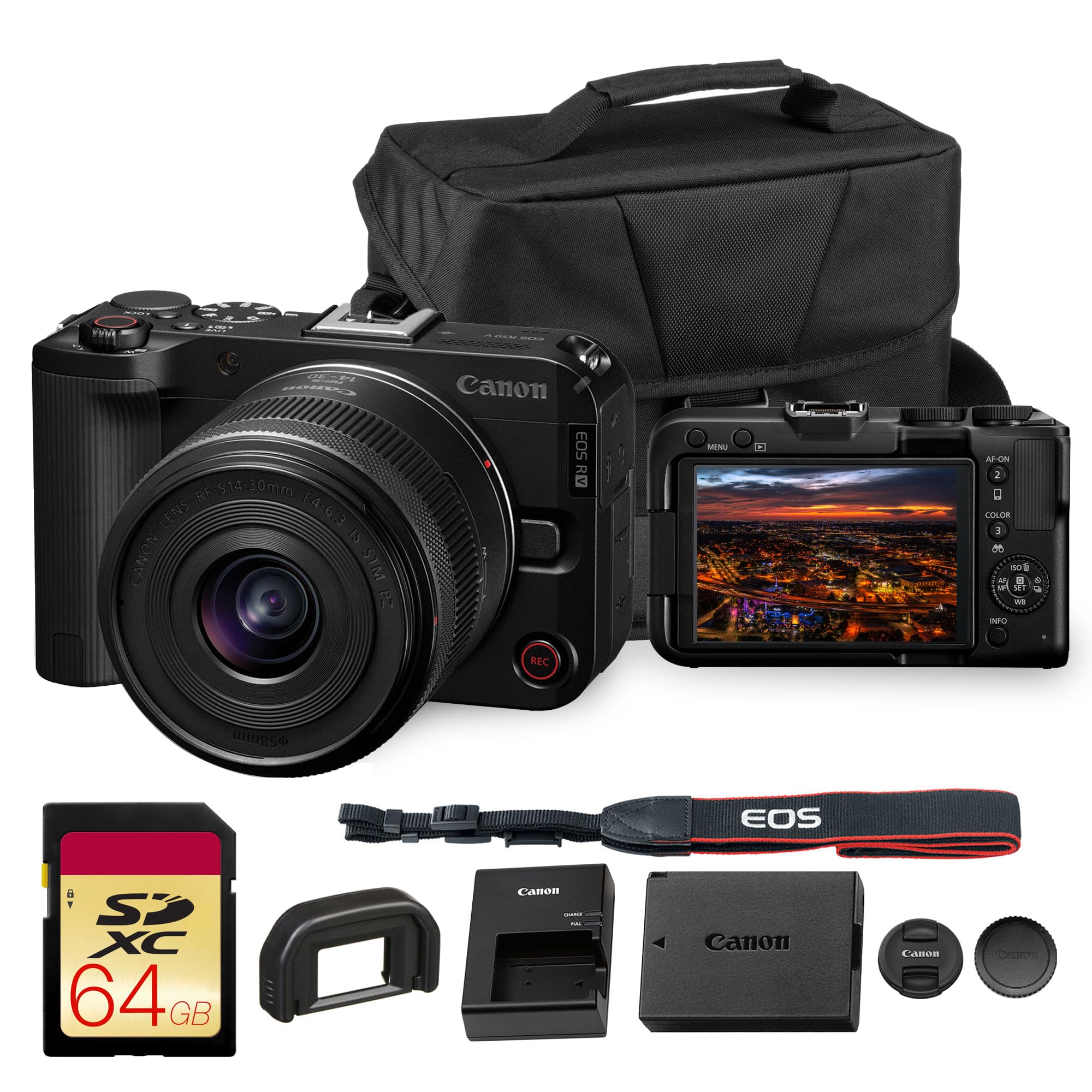
The EOS R50 V is purpose-built for vloggers and content creators who need a lightweight rig that captures sharp 4K footage right out of the box. The 24.2MP APS-C sensor and DIGIC X processor deliver uncropped 4K30 video, and the 120fps high-frame-rate mode at 1080p lets you create smooth 4x slow-motion sequences. The fully articulating flip screen moves to the front for self-recording, which is essential for solo creators who need to frame themselves while talking to the lens.
The included 14-30mm f/4-6.3 IS STM PZ lens is a wide-angle zoom with power zoom capability, allowing slow, smooth zooms during recording or fast switching via a lever. The STM motor is silent, so the mic never picks up focus or zoom noise. The body supports vertical video mode, and UVC/UAC support means you can stream in 4K directly over USB-C without additional capture hardware.
The primary limitation is the variable aperture of the kit lens, which restricts light in dim conditions. The 14-30mm is wide but not especially fast, so you will want to add a fast prime (like the RF 50mm f/1.8) for low-light filming. The contrast-detect autofocus in certain modes is slower than the phase-detect systems in higher-end Canon bodies, but for controlled vlogging and static talking-head shots it is perfectly reliable.
Why it’s great
- Flip screen and power zoom lens ideal for vlogging and live streaming.
- Uncropped 4K30 with 120fps slow-motion at 1080p.
- UVC/UAC plug-and-play streaming over USB-C.
Good to know
- Kit lens aperture is slow at f/4-6.3; low-light performance requires a brighter lens.
- Autofocus can hunt in low-light scenarios compared to higher-end Dual Pixel systems.
6. Panasonic LUMIX G85 with 12-60mm Power O.I.S. Lens

The G85 is the gateway into serious video stabilization without a gimbal. Its 5-axis Dual I.S.2 combines sensor-shift stabilization with lens-based OIS to produce smooth handheld footage even when walking slowly. The 16MP Micro Four Thirds sensor lacks a low-pass filter, which resolves fine detail that competitors’ sensors might blur, and 4K30 video records without any crop, keeping your lens’s full angle of view.
The 12-60mm kit lens offers a 24-120mm equivalent range, which is useful for everything from wide landscapes to moderate telephoto portraits. The magnesium-alloy body includes weather sealing, so dust and light rain do not interrupt a shoot. The OLED viewfinder (2,360K dots) is bright and responsive, and the touchscreen tilts for waist-level filming. Dedicated controls for ISO, white balance, and exposure compensation allow fast adjustments without diving into menus.
The main trade-off is the 16MP sensor, which produces less dynamic range than larger APS-C or full-frame sensors. Contrast-based autofocus can hunt in dim lighting, especially during 4K recording. The G85 also lacks a headphone jack and has no unlimited 4K recording — it stops at around 29 minutes. For the price, the stabilization alone makes it a compelling starter body for handheld video work.
Why it’s great
- Best-in-class IBIS that lets you shoot smooth handheld footage.
- Weather-sealed magnesium body for outdoor reliability.
- 4K30 uncropped with no low-pass filter for extra sharpness.
Good to know
- Contrast-detect AF struggles in low light and with fast movement.
- Lacks headphone jack and 4K recording is limited to 29 minutes.
7. Panasonic LUMIX G97 with 12-60mm Lens
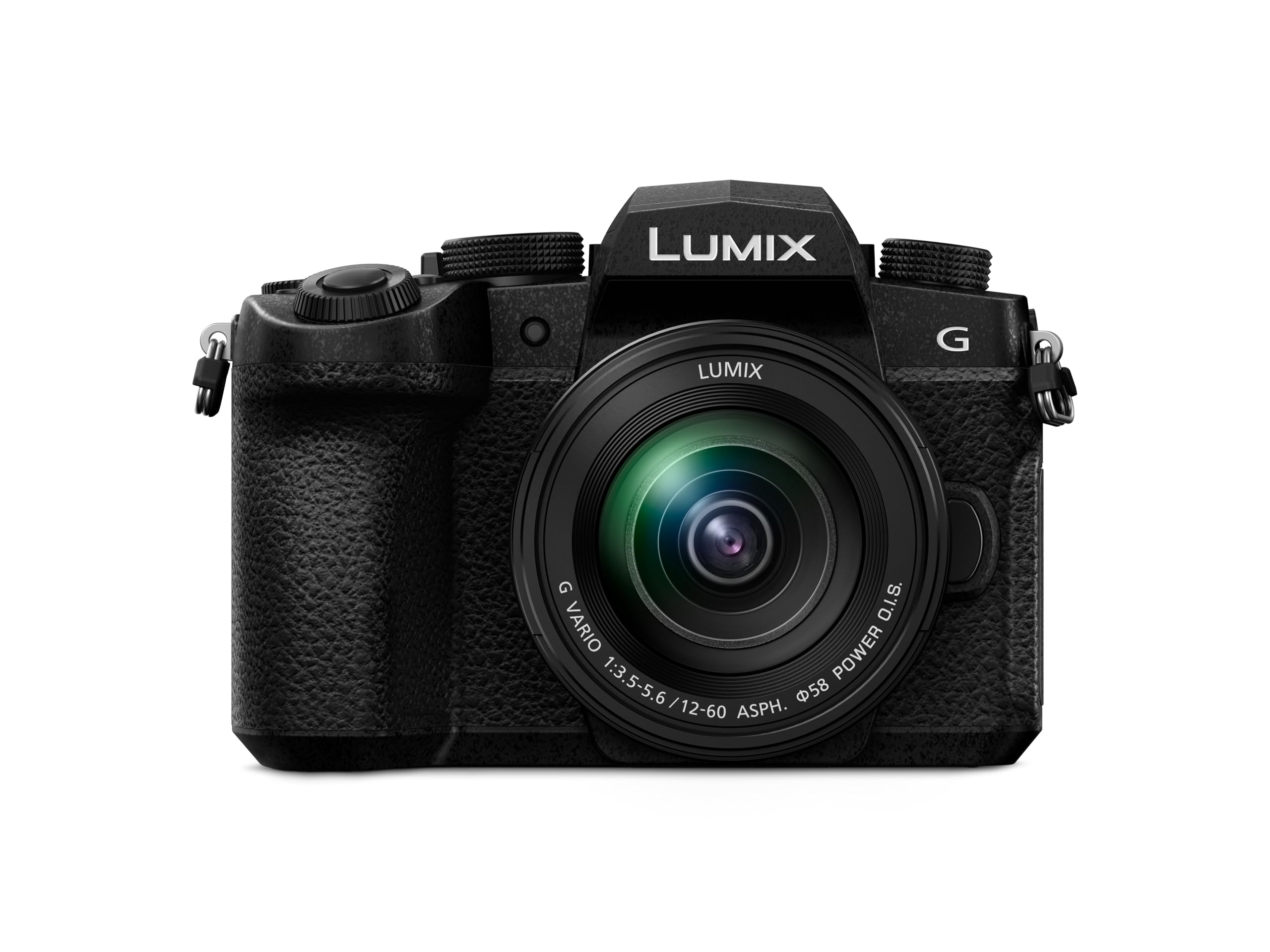
The G97 improves on the G85 formula by removing the 29-minute recording limit, adding a higher-resolution 20MP sensor, and including V-Log L preinstalled — a flat gamma profile that preserves 12 stops of dynamic range for color grading. The 5-axis Dual I.S.2 remains, and the 12-60mm kit lens provides the same versatile 24-120mm equivalent zoom range. For content creators who need unlimited recording in 4K30 without overheating, this body delivers reliable run times.
The updated OLED live viewfinder (2,360K dots) and the 1,840K-dot free-angle touchscreen make framing easy in bright conditions. Dedicated dials for ISO, white balance, and exposure compensation speed up manual adjustments, which is crucial when switching between controlled interior shots and changing outdoor light. USB-C charging lets you power the camera from a battery pack during long recordings.
Where the G97 stumbles is the same contrast-detect autofocus system that can hunt in low light or with fast-moving subjects. The 20MP sensor shows slightly less detail at pixel level than the older 16MP sensor without AA filter in certain tests. If your filming style relies on continuous autofocus, this camera may require occasional manual override. For studio work, interviews, and controlled environments, the G97 is a reliable, stabilization-heavy option.
Why it’s great
- No recording limit on 4K30; perfect for long interviews or live events.
- 12-stop V-Log L preinstalled for cinematic color grading.
- USB-C power delivery for extended battery-free shooting.
Good to know
- Contrast-detect autofocus can be sluggish in low contrast or dim scenes.
- No full-frame sensor; micro four thirds crop means less background separation.
8. Canon EOS R100 with RF-S18-45mm Lens Kit

The EOS R100 is Canon’s most affordable entry into the RF mirrorless system, and it brings Dual Pixel CMOS AF — a feature usually reserved for much pricier bodies — to the budget tier. The 24.1MP APS-C sensor paired with the DIGIC 8 processor captures 4K24 video with phase-detection autofocus that covers 143 zones. For beginners transitioning from a phone or a compact camera, the face and eye tracking means you can film moving subjects without constant manual focus corrections.
The 18-45mm kit lens collapses to a very compact size, making the R100 easy to toss in a day bag. The 120fps HD recording mode lets you create 4x slow-motion clips for social media, and the Wi-Fi connection transfers files to your phone without cables. The user interface includes a dedicated Creative Assist mode that explains how each setting affects the image, which is useful for learning exposure basics.
The R100 sacrifices several pro features to hit its attractive price point: the screen is fixed (no tilt or flip), the EVF is small, and the 4K video is limited to 24fps with a crop factor. There is also no headphone jack or USB-C charging. If your primary goal is learning the fundamentals of video on a Canon RF body with reliable autofocus, the R100 is a solid teaching tool, but its limitations will become apparent as your skills grow.
Why it’s great
- Dual Pixel AF at a budget price for smooth focus transitions.
- Compact and lightweight; easy to carry for daily practice and travel.
- Wi-Fi connectivity simplifies transferring footage to a phone.
Good to know
- 4K video is limited to 24fps with a crop; no 4K60.
- Fixed LCD screen makes high- and low-angle filming difficult.
9. Canon EOS R100 Bundle with 64GB Card & Bag
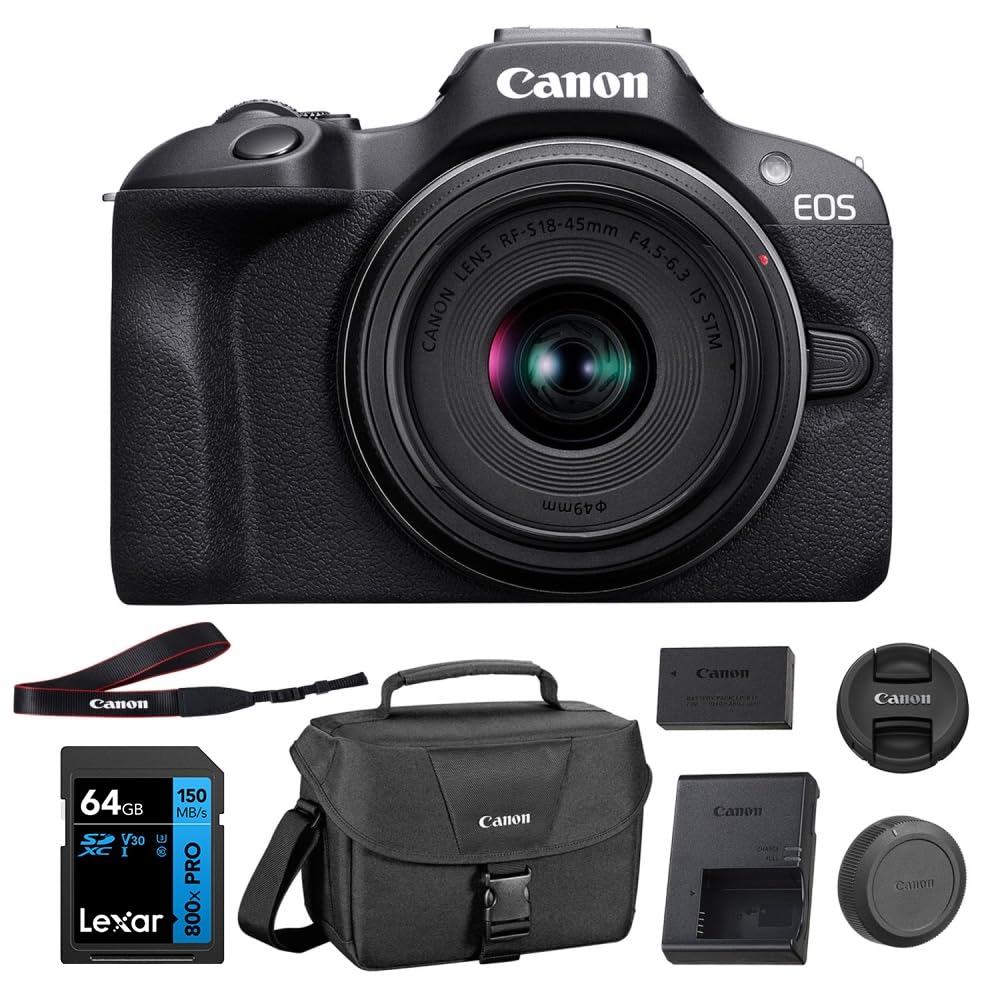
This bundle packages the same EOS R100 camera and 18-45mm lens from the previous review with a Lexar 64GB UHS-I SD card and a Canon EOS 200ES shoulder bag. For a beginner who does not already own memory cards or a camera bag, this removes the need to buy accessories separately and ensures you can start filming immediately. The hardware specs are identical to the solo R100 kit, so all autofocus, sensor, and video limitations apply.
The 64GB card stores roughly 90 minutes of 4K24 footage or over 2.5 hours of Full HD video, giving beginners enough capacity for a weekend of shooting without swapping cards. The shoulder bag includes padded dividers that fit the R100 with the kit lens attached plus space for an extra lens or battery. For a parent setting up a teen for a school video project or a casual YouTuber starting their first channel, this bundle provides a complete starter kit in one box.
Bear in mind that the included card is UHS-I, which has write speeds around 80–100MB/s — adequate for 4K24 but not fast enough for high-bitrate 4K60 or Raw burst photography. The bag offers basic protection but no weather sealing. If you want the simplest, most complete out-of-box experience for learning the RF system, this bundle saves you the hassle of separate purchases.
Why it’s great
- Complete starter kit with all essential accessories included.
- Shoulder bag provides convenient storage and basic protection.
- Same Dual Pixel AF and sensor quality as the standard R100 kit.
Good to know
- UHS-I card may bottleneck future upgrades to high-bitrate recording.
- Bag lacks rain cover or heavy-duty padding for rough travel.
10. Canon EOS R5 C Mirrorless Digital Cinema Camera (Renewed)

The EOS R5 C is the most powerful hybrid cinema body Canon makes, capable of recording 8K at 60fps internally in Cinema RAW Light with no time limit — all enabled by an internal cooling fan that prevents overheating during long takes. The 45MP full-frame sensor and DIGIC X processor deliver 12-bit color at 8K, giving you extreme cropping ability and future-proofed resolution. Dual Pixel CMOS AF II (1,053 zones) works in both photo and video, tracking subjects with the same reliability as the R8 but with the added stability of a fan-cooled chassis.
For professional workflows, the R5 C supports Cinema RAW Light, ProRes, and H.265 recording. The modular design includes 13 assignable buttons, an expanded interface for external monitors and microphones, and simultaneous internal plus external recording to SSD via USB-C. The XF-AVC codec is available for broadcast-friendly files, and the HDR monitoring (HLG/PQ) helps you preview Rec. 2020 output without expensive external recorders.
The renewed status is the major asterisk: many units sold through this listing are international grey-market models that do not qualify for Canon USA repair or warranty service. The camera also lacks IBIS, so handheld 8K footage will require support from gimbals or rigs. Battery life is short without a high-capacity external pack. If you need 8K RAW capabilities and are comfortable with grey-market risks, the R5 C offers cinema features in a form factor that can double as a stills camera.
Why it’s great
- 8K60 internal Cinema RAW Light with active fan cooling prevents overheating.
- Dual Pixel AF II works reliably across the entire frame for video.
- ProRes and XF-AVC support for broadcast and post-production compatibility.
Good to know
- Grey-market units may lack Canon USA warranty and service support.
- No IBIS; requires gimbal or rig for smooth handheld 8K filming.
11. Blackmagic Design Cinema Camera 6K (Full Frame, L Mount)

The Blackmagic Cinema Camera 6K brings full-frame image quality to the L-Mount alliance, giving filmmakers access to Leica, Panasonic, and Sigma glass. Its 6048 x 4032 sensor captures 6K in Blackmagic RAW at up to 60fps, with 13 stops of dynamic range and dual gain ISO up to 25,600 for clean low-light footage. The built-in optical low-pass filter (OLPF) reduces aliasing and moiré, making the image look more organic and film-like right out of the camera.
The 5-inch HDR LCD touchscreen outputs 1,500 nits — bright enough to see in direct sunlight — and supports both touch-to-focus and metadata overlays for framing. Recording options include CFexpress Type B cards for high-bitrate RAW and USB-C external SSDs for longer sessions. The mini XLR input with phantom power means you can plug professional microphones directly into the camera body without an external audio recorder. DaVinci Resolve Studio is included, so your entire editing, color, and audio pipeline is covered by one license.
The trade-off is the L-Mount lens ecosystem, which is less extensive and more expensive than Canon EF or Sony E. Battery life is also limited: the included NP-F570 runs about 45–60 minutes, and most shooters will want a battery grip or external V-mount power. There is no autofocus system at all — this is a manual-focus cinema tool, and you will need a follow-focus rig or high-quality cinema lenses for precise pulls. If your goal is the purest full-frame image quality and you control the lighting and focus, the BMCC6K is unbeatable at this price.
Why it’s great
- Full-frame 6K sensor delivers exceptional image quality and dynamic range.
- L-Mount opens access to Leica, Sigma, and Panasonic cine glass.
- mini XLR with phantom power and DaVinci Resolve Studio included.
Good to know
- No autofocus; requires manual focus workflow and follow-focus rig.
- Battery life is short; external power solution recommended for all-day shoots.
FAQ
Why do cinema cameras not include autofocus?
What sensor size is best for filming on a budget?
Can I use vintage lenses with these cameras?
Do I need a gimbal if my camera has IBIS?
Final Thoughts: The Verdict
For most users, the best cameras for filming winner is the Sony a7 III because its hybrid performance, reliable PDAF, and full-frame dynamic range suit everything from narrative shorts to events and vlogs. If you want professional-grade RAW and don’t need autofocus, grab the Blackmagic Pocket 6K. And for a lightweight full-frame body that excels at 4K60 with C-Log3, nothing beats the Canon EOS R8.