
A concert hall, a dimly lit restaurant, or the blue hour after sunset — these are the proving grounds for a point-and-shoot camera. Most smartphone cameras fall apart here, eating detail with aggressive noise reduction, leaving you with blurry, grainy shots. A serious low-light compact lives in a different world, where a large sensor and a fast, wide aperture lens capture ambient light with a clarity that no phone can match.
I’m Min — the co-founder and writer behind Gadgets Feed. This guide is the result of hundreds of hours analyzing sensor sizes, maximum aperture ranges, in-body stabilization specs, and real-world ISO performance to separate the contenders from the noise.
Finding a truly capable compact requires looking past marketing hype and focusing on measurable specs, which is why we built this definitive list of the best cameras for low light point and shoot.
How To Choose The Best Cameras For Low Light Point And Shoot
A low-light compact camera is defined by three core components: sensor size, lens speed, and image stabilization. While megapixel count gets all the attention, these three specs dictate whether your evening shots will be usable or destined for the trash bin.
Sensor Size: The Foundation of Light Capture
The single most important spec for low light is the physical size of the sensor. A 1-inch type sensor (like the Sony RX100 series) captures roughly 4x more light per pixel than a standard 1/2.3-inch sensor found in budget superzooms. Move up to an APS-C sensor (like the Fujifilm X100VI or Ricoh GR IIIx) and you gain roughly 1.5 stops of high-ISO performance, meaning you can shoot in darker conditions with less visible noise. For true low-light mastery, a 1-inch sensor is the absolute floor; APS-C is the gold standard.
Maximum Aperture: The Lens’s Appetite for Light
The aperture, expressed as an f-number like f/1.8 or f/2.8, controls how wide the lens opens. An f/1.8 lens lets in about 3.5 stops more light than an f/6.4 lens at the telephoto end of a superzoom. That difference translates directly into faster shutter speeds and lower ISOs, producing cleaner handheld shots in dim conditions. A fixed or short-zoom lens with a constant fast aperture (f/1.8 to f/2.8) is ideal; avoid cameras that drop to f/5.6 or slower at the long end if low light is your priority.
Image Stabilization: The Handheld Safety Net
IBIS (In-Body Image Stabilization) is a game-changer for low-light point-and-shoot photography. A camera with 5-6 stops of stabilization (like the Fujifilm X100VI) allows you to shoot at shutter speeds one-sixteenth of a second or slower while keeping handheld shots sharp. This lets you use lower ISOs and keep noise in check. Optical lens stabilization is good, but IBIS is superior for low-light because it works with every lens and supports the sensor’s full movement range.
Quick Comparison
On smaller screens, swipe sideways to see the full table.
| Model | Category | Best For | Key Spec | Amazon |
|---|---|---|---|---|
| Fujifilm X100VI | Premium | Ultimate Low-Light IQ | 40.2MP APS-C, 6-stop IBIS | Amazon |
| Ricoh GR IIIx | Premium | Pocketable Street Shooter | 24.2MP APS-C, IBIS | Amazon |
| Sony RX100 III | Premium | Low-Light Compact Zoom | 20.1MP 1-inch, f/1.8-2.8 | Amazon |
| Sony ZV-1 II | Premium | Vlogging in Low Light | 1-inch sensor, f/1.8-4.0 | Amazon |
| Panasonic ZS99 | Mid-Range | Travel & Concert Zoom | 30x zoom, 24-720mm | Amazon |
| Nikon COOLPIX P950 | Mid-Range | Superzoom Reach | 83x optical zoom | Amazon |
| Canon PowerShot V10 | Mid-Range | Pocket Vlogging | 1-inch sensor, f/2.8 | Amazon |
| Xtra Muse | Mid-Range | Gimbal-Stabilized Video | 1-inch CMOS, 4K/120fps | Amazon |
| Kodak PIXPRO AZ528 | Budget | Entry-Level Zoom | 52x optical zoom, f/2.8 | Amazon |
In‑Depth Reviews
1. Fujifilm X100VI

The Fujifilm X100VI is the king of low-light fixed-lens compacts. Its 40.2MP X-Trans CMOS 5 HR sensor delivers exceptional high-ISO performance, while 6-stop in-body image stabilization lets you handhold shots at absurdly slow shutter speeds. The f/2 lens and built-in 4-stop ND filter give you full creative control over exposure in both dark and bright scenes.
Film simulation modes like Velvia and Nostalgic Neg produce stunning out-of-camera JPEGs that need no editing. The hybrid viewfinder is a tactile joy, and the 6.2K video capability is a bonus. Autofocus can occasionally hunt in very low contrast, and the battery life is short when using IBIS, but the image quality is transformative.
This camera makes every shot feel intentional. It’s not a replacement for a full-frame mirrorless, but as a dedicated low-light point-and-shoot, it is currently unmatched in its class. The 23mm f/2 lens (35mm equivalent) is a versatile, walk-around focal length that forces creative discipline.
Why it’s great
- Massive 40.2MP APS-C sensor produces clean, high-detail images up to ISO 12800
- 6-stop IBIS enables sharp handheld shots at 1/8 second exposure
- Class-leading film simulations for beautiful JPEGs straight from camera
Good to know
- Battery life is short; expect to carry two spare batteries for a full day shoot
- No weather sealing; a filter adapter is recommended for dust protection
- Inconsistent autofocus in very dim, low-contrast scenes
2. Ricoh GR IIIx

The Ricoh GR IIIx packs an APS-C sensor into a body that fits in a standard jeans pocket — the ultimate stealth low-light camera. The 40mm equivalent f/2.8 lens provides a natural field of view that feels like a human eye, and the SR (Shake Reduction) IBIS gives you three stops of handheld stability. The 0.8-second startup time means you never miss a moment.
Image quality is staggering for a camera this small. The GR Engine 6 processes images with exceptional sharpness and delivers beautiful film simulation color profiles. The snap focus system is perfect for street photography. Autofocus is fine but not class-leading, and there is no built-in flash, no EVF, and no 4K video — this is a pure stills camera.
If you want a true pocket camera that produces APS-C image quality in low light, nothing else comes close to the GR IIIx. It is a specialist tool for the photographer who values portability above all else.
Why it’s great
- APS-C sensor in the most pocketable body available; true jeans-pocket camera
- IBIS enables sharp shots at slower shutter speeds despite small body
- 0.8-second startup time and immediate snap focus for instant capture
Good to know
- No built-in flash; no EVF; no 4K video — strictly a stills machine
- Lack of weather sealing makes it vulnerable to dust and moisture
- Battery life is poor; carrying three spare batteries is the norm
3. Sony RX100 III

The Sony RX100 III remains a low-light classic. Its 24-70mm f/1.8-2.8 Zeiss Vario-Sonnar T* lens is incredibly fast for a zoom compact, letting in enough light for handheld shooting in venues where other compacts fail. The 20.1MP 1-inch sensor balances resolution and noise perfectly, producing clean images through ISO 3200.
The pop-up EVF is a rare and welcome addition, and the tilting 180-degree screen is useful for overhead shots. The f/1.8 aperture at the wide end is a full stop faster than most competitors. The menu system is dense and the battery life is middling, but the image quality-to-size ratio is phenomenal for a zoom compact.
For concert and event photography where you need some flexibility in focal length, the RX100 III is still a top-tier choice. The fixed-lens compacts from Fujifilm and Ricoh beat it on absolute sensor size, but its zoom versatility makes it the best pocketable low-light zoom.
Why it’s great
- Fast f/1.8-2.8 zoom lens is exceptional for a pocket-sized compact
- Pop-up EVF is a huge advantage over competitors in bright exterior conditions
- 1-inch sensor and Zeiss optics produce clean, sharp low-light images
Good to know
- Menu system is cluttered and can be overwhelming for new users
- Battery performance is average; expect around 200 shots per charge
- Screen vulnerability to scratches; a screen protector is a must
4. Sony ZV-1 II

The Sony ZV-1 II is tailored for content creators who need low-light performance on video. The 18-50mm f/1.8-4.0 lens is wider than its predecessor, and the 1-inch sensor delivers clean video up to 1600 ISO. The directional 3-capsule mic with a windscreen accessory is the best built-in audio you will find on a compact camera.
Real-time Eye AF and subject tracking are incredibly reliable, even in dimly lit cafes or evening settings. The product showcase mode is a clever feature for vloggers. The ZV-1 II lacks Optical Steadyshot, relying solely on electronic stabilization, which crops the frame. Battery life is mediocre for video recording, and the built-in cooling isn’t sufficient for extended 4K clips in warm environments.
If your primary need is low-light vlogging with smooth autofocus, the ZV-1 II is the best dedicated tool. For stills-only work, the RX100 III offers better lens speed and raw image quality.
Why it’s great
- 1-inch sensor and wide f/1.8 aperture provide clean, bright low-light video
- Reliable Real-time Eye AF and face tracking work well in dim conditions
- Built-in directional mic with windscreen is best-in-class for a compact
Good to know
- No Optical Steadyshot; electronic stabilization introduces heavy crop in video mode
- Battery drains quickly when recording 4K; an external battery pack is recommended
- Overheating issues may occur in warm conditions during long recording sessions
5. Panasonic LUMIX ZS99

The Panasonic ZS99 (TZ99 in Europe) offers an extraordinary 24-720mm Leica DC Vario-Elmar lens in a pocketable body. The 30x optical zoom reaches concert stages and wildlife across a park, and the 4K PHOTO mode captures 30fps bursts for selecting the perfect frame. The 1840k-dot tiltable touchscreen is bright and responsive.
Low-light performance is limited by the f/3.3-6.4 aperture — at the telephoto end, f/6.4 is very slow. ISO 1600 is usable, but ISO 3200 shows noticeable grain. In good lighting, the color accuracy is excellent, and the built-in Bluetooth 5.0 makes image transfer seamless. The body is lightweight and fits comfortably in a jacket pocket.
The ZS99 is the best travel zoom for those who occasionally shoot in dim conditions. It’s not a specialist low-light camera, but its sheer focal length versatility makes it a strong all-rounder for bright concerts, daytime use, and travel.
Why it’s great
- 30x Leica zoom (24-720mm equivalent) covers wide-angle to extreme telephoto
- 4K PHOTO burst mode at 30fps ensures you never miss a key moment
- Excellent color accuracy with minimal editing needed for daytime shots
Good to know
- Aperture narrows to f/6.4 at telephoto; low-light performance is weak at full zoom
- Image quality at ISO 1600+ is noisy; this is a daylight-centric camera
- Autofocus can be slow and unintuitive in complex scenes
6. Nikon COOLPIX P950

The Nikon COOLPIX P950 is a superzoom beast with an 83x optical zoom that reaches 2000mm (35mm equivalent). This is a camera built for lunar photographers and birders. The VR image stabilization is genuinely impressive, allowing reasonable handheld shots at extreme telephoto lengths. The 16MP sensor and dual-detect optical VR work together to steady the viewfinder.
Low-light performance is a trade-off for the massive zoom range. The f/2.8 aperture at wide angle drops to f/6.5 at maximum zoom, severely limiting light capture at distance. The bird and moon scene modes simplify shooting for specific subjects. The autofocus can hunt on zoomed-in subjects, but the manual focus wheel is conveniently placed and responsive. The body is not pocketable — it is a large, DSLR-style camera.
The P950 wins on being the only compact that can capture a moon crater or a distant eagle at dusk. If you need extreme reach and accept the low-light compromises that come with it, this is your tool.
Why it’s great
- 83x optical zoom (2000mm equivalent) is unparalleled for long-distance low-light capture
- VR image stabilization performs well even at maximum zoom extension
- Dedicated bird and moon scene modes simplify challenging subjects
Good to know
- f/6.5 aperture at 2000mm makes low-light shooting very difficult at full zoom
- Large, heavy body is not pocketable; it requires a bag or strap
- Autofocus can struggle with fast-moving subjects in dim light
7. Canon PowerShot V10

The Canon PowerShot V10 is a unique vlogging-first compact with a fixed 19mm f/2.8 lens and a built-in stand that folds into the body. Its 1-inch back-illuminated CMOS sensor and f/2.8 aperture deliver clean 4K/30p video in moderate low light. The V10 is extremely small and portable, fitting into a fanny pack or large pocket.
The retractable front-facing screen is a godsend for self-recording. The three stereo microphones provide surprisingly clear audio, and the third mic reduces background noise. There is no zoom, no flash, and no EVF — this camera is a video-first tool. The battery life is short and the camera can feel unbalanced in bright backlight, but for a dedicated vlogging compact it is one of the most user-friendly options.
The PowerShot V10 is the easiest path to good-looking low-light vlogs if you want a dedicated camera that’s not a smartphone. Its simplicity is its strength.
Why it’s great
- 1-inch sensor and f/2.8 aperture provide clean, bright video in dim settings
- Built-in folding stand allows hands-free vlogging from any surface
- Excellent stereo mic array with background noise reduction for clear audio
Good to know
- No optical zoom; you are locked into a fixed 19mm (35mm equiv.) lens
- Short battery life; video recording drains the battery noticeably faster than stated
- Cannot handle extreme backlighting; dynamic range is limited
8. Xtra Muse

The Xtra Muse is a pocket camera with a built-in 3-axis gimbal and a 1-inch CMOS sensor capable of 4K video at 120fps. This is essentially a DJI Pocket 3 alternative at a lower price point. The gimbal stabilization is genuinely impressive, delivering smooth, locked-in footage even while running. Face and object tracking work reliably, keeping you in frame during active vlogs.
The 1-inch sensor handles low-light video decently, though it’s not as clean as the Sony ZV-1 II or Canon V10. The 10-bit X-Log color mode allows significant color grading flexibility in post. The battery lasts around 161 minutes on average, which is reasonable for a gimbal camera. The touchscreen is responsive and easy to navigate. Build quality is solid for the price, though it lacks the premium feel of DJI.
If you need stabilized 4K footage in low light without spending Sony money, the Xtra Muse is a compelling value. It’s a specialized vlogging tool that prioritizes smoothness above all.
Why it’s great
- Built-in 3-axis gimbal stabilizer delivers exceptionally smooth handheld video
- 1-inch CMOS sensor with 4K/120fps capture and 10-bit X-Log color
- Very good value proposition compared to the DJI Pocket 3
Good to know
- Low-light video quality is good but not on par with Sony or Canon 1-inch compacts
- Build quality and haptics feel more budget than premium
- Accessories like DJI Pocket 3 mics require firmware updates to function
9. Kodak PIXPRO Astro Zoom AZ528
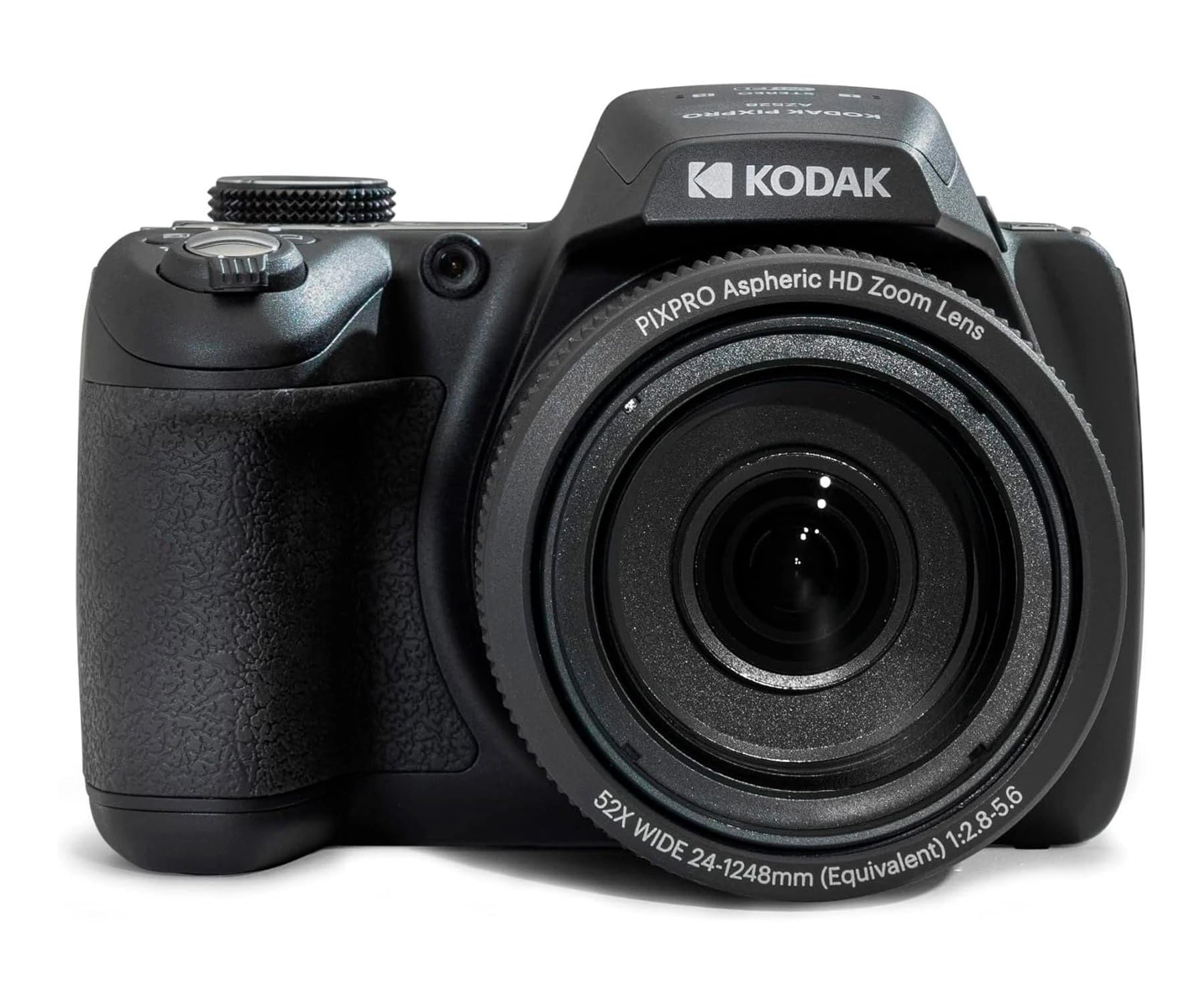
The Kodak PIXPRO AZ528 is a budget-friendly superzoom with a 52x optical zoom, a 24mm wide-angle lens, and a 16MP BSI CMOS sensor. It offers an impressive reach for the price, capturing distant subjects that similarly priced compacts cannot touch. The f/2.8 aperture at wide angle is decent for a budget camera, and OIS helps keep telephoto shots stable.
Low-light performance is limited by the small 1/2.3-inch sensor — ISO 800 is the practical ceiling. The autofocus is contrast-detection based and can be slow in dim light. The burst mode at 6fps is useful for action. Battery life is acceptable, and the Wi-Fi connectivity makes sharing easy. The plastic body feels light but scuffs easily.
The AZ528 is a good entry-level superzoom for daytime wildlife and sports. If your main priority is low-light quality, save for a 1-inch sensor model. But for a budget zoom that reaches far, this is a capable starting point.
Why it’s great
- 52x optical zoom (24mm to 1248mm equivalent) is excellent for a budget camera
- f/2.8 aperture at wide angle is decent for its price category
- Easy to use with intuitive controls, ideal for beginners
Good to know
- Small 1/2.3-inch sensor produces significant noise above ISO 800
- Contrast-detect AF is slow in low-light conditions
- Plastic body scuffs easily; body is not rugged or weather-sealed
FAQ
Is a larger sensor always better for low-light point and shoot cameras?
What does f/1.8 versus f/2.8 mean for shooting in the dark?
Can I use a tripod with any compact for better low light shots?
Final Thoughts: The Verdict
For most users, the best cameras for low light point and shoot winner is the Fujifilm X100VI because it combines a massive 40.2MP APS-C sensor with 6-stop IBIS and stunning film simulations for unmatched low-light stills. If you want a pocketable APS-C body with a natural 40mm lens, grab the Ricoh GR IIIx. And for a compact zoom that retains fast aperture values, nothing beats the Sony RX100 III.