
A single powerful beam changes everything after the sun drops over the treeline. The right camp flashlight turns a dark, disorienting trail into a manageable path, lights up the tent interior without blinding your partner, and signals for help when things go sideways. The wrong one leaves you fumbling with dead batteries in the cold.
I’m Min — the co-founder and writer behind Gadgets Feed. I’ve spent hundreds of hours cross-referencing ANSI ratings, battery chemistries, emitter specs, and real-world runtime claims to separate marketing hype from genuinely useful illumination for the campsite.
This guide compares seven distinctly different lighting tools — compact EDC lights, high-capacity lanterns, and long-throw spotlights — so you can confidently pick the right tool for your specific gear list. After reading this guide, you’ll know exactly which best camp flashlight matches the terrain you’ll be walking into.
How To Choose The Best Camp Flashlight
Picking the right camp flashlight isn’t about grabbing the brightest number on the box. Real-world performance depends on beam pattern, runtime at usable brightness, battery type and rechargeability, and the physical interface you’ll operate with cold or wet hands. Start by defining your primary use-case: pocket-sized for hiking, area-lighting for the campsite, or long-range spot illumination for reconnaissance and emergency signaling.
Lumens, Beam Distance, and CRI
Total light output (lumens) matters most for flooding a tent or cooking area. For trail spotting and distance visibility, look at beam distance in meters or candela rating — a 300-lumen light with a tight reflector can out-throw a 1000-lumen flood light. Color Rendering Index (CRI) affects how accurately you see trail obstacles and map contours; lights with a CRI of 90 or higher show richer color and less eye strain during long reads.
Battery System and Runtime Strategy
Integrated lithium-ion packs (like the 5000mAh in the Glocusent lantern) offer convenience and USB-C recharging, but when the battery dies, the light is dead until a power source appears. Lights that run on replaceable 18650 cells (like the Tughlax 3-pack or the Wurkkos FC12C) let you carry spare batteries and extend your trip by swapping instead of waiting for a charge. Alkaline AAA lights, like the Rayovac, are budget-friendly and ubiquitous, but suffer in cold temperatures and produce more waste.
Durability, Water Resistance, and Interface
Camp lights get dropped on rocks, splashed in rain, and buried in snow. Look for IP67 or IP68 ratings if you expect submersion, IPX4 for splash resistance. Drop resistance matters — the Rayovac survives 30-foot drops, while the Coleman is impact-resistant to 1 meter. Interface preference is personal: single tail-click switches work with gloved hands, side-switch menus with multiple modes are less intuitive in the dark but offer more settings. A lockout feature prevents accidental activation in your pack.
Quick Comparison
On smaller screens, swipe sideways to see the full table.
| Model | Category | Best For | Key Spec | Amazon |
|---|---|---|---|---|
| Nitecore EDC29 | Tactical EDC | Ultra-compact carry & high output bursts | 6500 lm / 437 yd throw / 0.76″ thick | Amazon |
| Coleman Classic Rechargeable Lantern | Campsite Lantern | Area lighting & device charging | 800 lm / 4800mAh / 45 hrs low | Amazon |
| Wurkkos FC12C | Tactical EDC | EDC with regulation & throw | 1600 lm / 332 m throw / constant current | Amazon |
| Sigoobal Spotlight | Long-Range Spotlight | Maximum distance & solar charging | 2000 lm claimed / 1640 ft / 9600mAh | Amazon |
| Tughlax 3-Pack | Budget 3-Pack | Spares & multi-user camps | 700 lm / 18650 cells / LCD display | Amazon |
| Glocusent Lantern | Lantern Hybrid | 360° area light & power bank | 1500 lm max / 5000mAh / 200 hrs low | Amazon |
| Rayovac Virtually Indestructible | Budget Tough | Extreme durability & simple operation | 300 lm / 480 ft beam / 39 hrs low | Amazon |
In‑Depth Reviews
1. Nitecore EDC29

The Nitecore EDC29 pushes the boundary of what fits in a jeans pocket. At only 0.76 inches thick and 5.6 ounces, this flat-profile light delivers a staggering 6500 lumens in burst mode and throws a beam 437 yards. The built-in Li-Po battery charges via USB-C in 75 minutes, and the OLED screen shows lumen output and remaining charge — a rare feature in a pocket flashlight that eliminates the battery guesswork.
Dual tail switches allow separate control of flood and spot emitters, plus a rapid-lock slider prevents accidental activation inside a bag. The auto-dimming sensor adjusts output when pointed at nearby objects, protecting night vision. Real-world users praise the build quality and thermal management for a light this compact, though the turbo sustain time is limited to around 7 seconds before stepping down to protect the electronics.
This light is purpose-built for EDC carry and short-burst high-output needs — law enforcement, security, and urban preparedness. For camping, it excels as a backup or for quick trail checks, but its runtime at high settings is brief, and the flat shape doesn’t suit being left standing on a table. If you prioritize pocket profile and raw power in a tiny package, the EDC29 is unmatched.
Why it’s great
- Class-leading 6500 lumen output in a 0.76″ slim design
- OLED display shows exact lumen level and battery percentage
- USB-C fast charging with 75-minute full recharge
- Two lockout modes for safe pocket carry
Good to know
- Turbo mode sustains only about 7 seconds before thermal step-down
- Runtime on low (15 lumens) is ~65 hours — good but not max for the category
- Flat shape doesn’t work well as a standing table light
- Higher price point than bulkier competitors
2. Coleman Classic Rechargeable LED Lantern

The Coleman Classic Rechargeable merges retro gas-lantern aesthetics with modern LED efficiency. Output tops out at 800 lumens — enough to illuminate a full picnic table or a 4-person tent. The built-in 4800mAh lithium-ion battery delivers 5 hours on high and an impressive 45 hours on the low setting, making it suitable for multi-night excursions without worrying about finding a USB outlet every day.
IPX4 water resistance and 1-meter impact resistance add peace of mind in drizzle or a drop from the picnic table. The large bail handle with an integrated carabiner clips onto tent loops or tree branches easily. A hidden USB-A port charges your phone directly from the lantern — a practical emergency power bank for extended trips or unexpected delays.
This lantern is purpose-designed for stationary campsite area lighting. It lacks the focused beam for trail navigation or the SOS and color modes of the Glocusent competitor, but it compensates with proven Coleman durability and a simple three-level rotary switch that works with gloved hands. The nostalgic design earns bonus points around the campfire.
Why it’s great
- 45-hour runtime on low setting covers a week-long trip
- Integrated carabiner and bail handle for versatile hanging
- USB-A port charges phones and devices from the battery
- Classic design with proven drop and splash resistance
Good to know
- Max 800 lumens — bright enough for camping but not for long-distance scanning
- No SOS strobe or multiple color temperature options
- Recharging the lantern takes several hours via USB-C
- Bulky compared to modern compact lanterns
3. Wurkkos FC12C
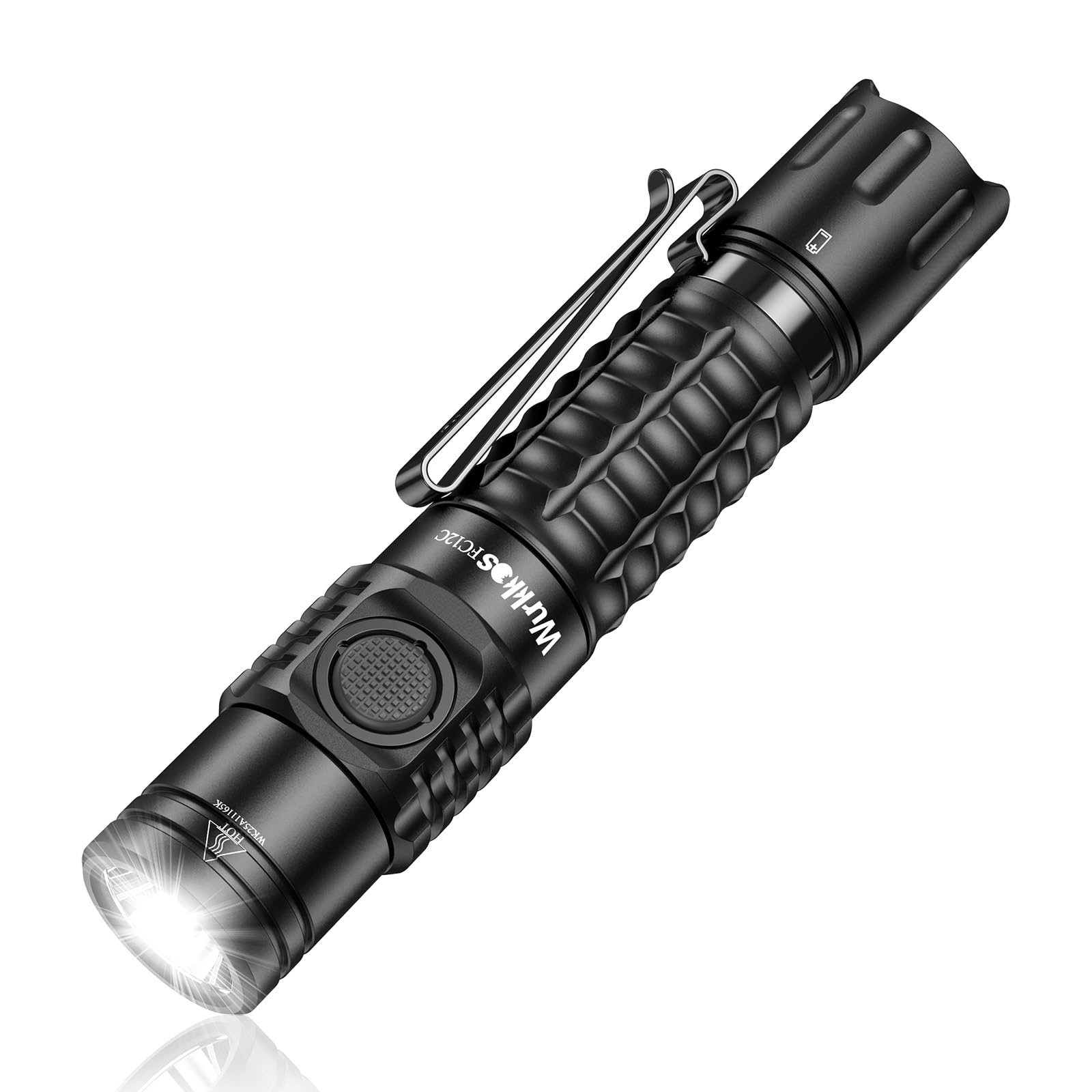
The Wurkkos FC12C is a tactical-flavored EDC light that delivers a balanced blend of throw and flood with its high-efficiency constant current circuit. That circuit eliminates PWM flicker, producing a clean, comfortable 1600-lumen beam that reaches 332 meters. The tail switch controls power on/off, while the side button scrolls through 6 modes including a stepless dimming ramp from 1 to 1600 lumens — a feature rarely seen at this price.
An 18650 lithium-ion cell (sold separately) powers the light, giving you the option to carry spares for multi-day trips without waiting for a recharge. USB-C charging in roughly 2 hours tops off the supplied battery. IP68 waterproofing and aero-grade aluminum construction with type-III hard-anodized finish mean the FC12C handles rain, submersion, and drops without complaint.
For campers who want a single light that works for both hiking and tent tasks, the FC12C is hard to beat. The instant-access turbo and moonlight modes via tail switch are intuitive, and the memory function recalls your last brightness setting. Beam tint is a cool 6000K — very bright but slightly clinical compared to warmer options. This is a serious light for serious outdoor use at a mid-range price.
Why it’s great
- Constant current circuit provides flicker-free, stable output
- Stepless dimming from 1 to 1600 lumens for precise brightness selection
- IP68 waterproof — survives full submersion
- USB-C rechargeable with replaceable 18650 battery
Good to know
- Battery is not included — must purchase separately
- Cool 6000K tint may cause more glare in fog or dust
- Mode cycling through side button can be slightly clunky in the dark
- No magnetic tailcap included
4. Sigoobal Spotlight

The Sigoobal Spotlight brings a massive 9600mAh battery and solar charging capability to the campsite spotlight category. The P90 chip drives the main front light through three modes (high, medium, strobe) with a claimed 2000,000 lumens and a beam distance of 1640 feet — figures that should be taken with skepticism, but real-world users confirm it far outthrows typical handheld spotlights and even outperforms competitors. The side panel adds 24 LED beads for area-lighting lantern use plus a red-blue emergency warning mode.
Two charging methods — direct USB-C and solar panel input — give flexibility for off-grid charging. The ABS and aluminum alloy construction, combined with a silicone protective casing, makes this light impact-resistant from 3 meters and IPX5 water-resistant, suitable for rainy conditions. Included color filters (white, blue, yellow, red) let you swap beam colors for different tasks like reading maps or preserving night vision.
This spotlight is purpose-built for boaters, hunters, and car-campers who need maximum throw for scanning fields, docks, or camp perimeters. Its size and weight (1.34 pounds) make it less suitable for backpacking, but the shoulder strap improves portability. The sticky trigger and requirement to cycle through all modes to turn off are minor ergonomic annoyances.
Why it’s great
- Gigantic 9600mAh battery offers extremely long runtime
- Solar charging option for off-grid refueling
- Throws farther than many spotlights at five times the price
- Dual-function front spot + side lantern panel
Good to know
- Lumen claim (2000,000) is unrealistic — expect a very bright but not 2-million lumen output
- Must cycle through all modes to turn off — no dedicated off button
- Heavier and bulkier than standard handheld flashlights
- Solar charging is slow and depends on direct sunlight intensity
5. Tughlax 3-Pack Rechargeable Flashlights
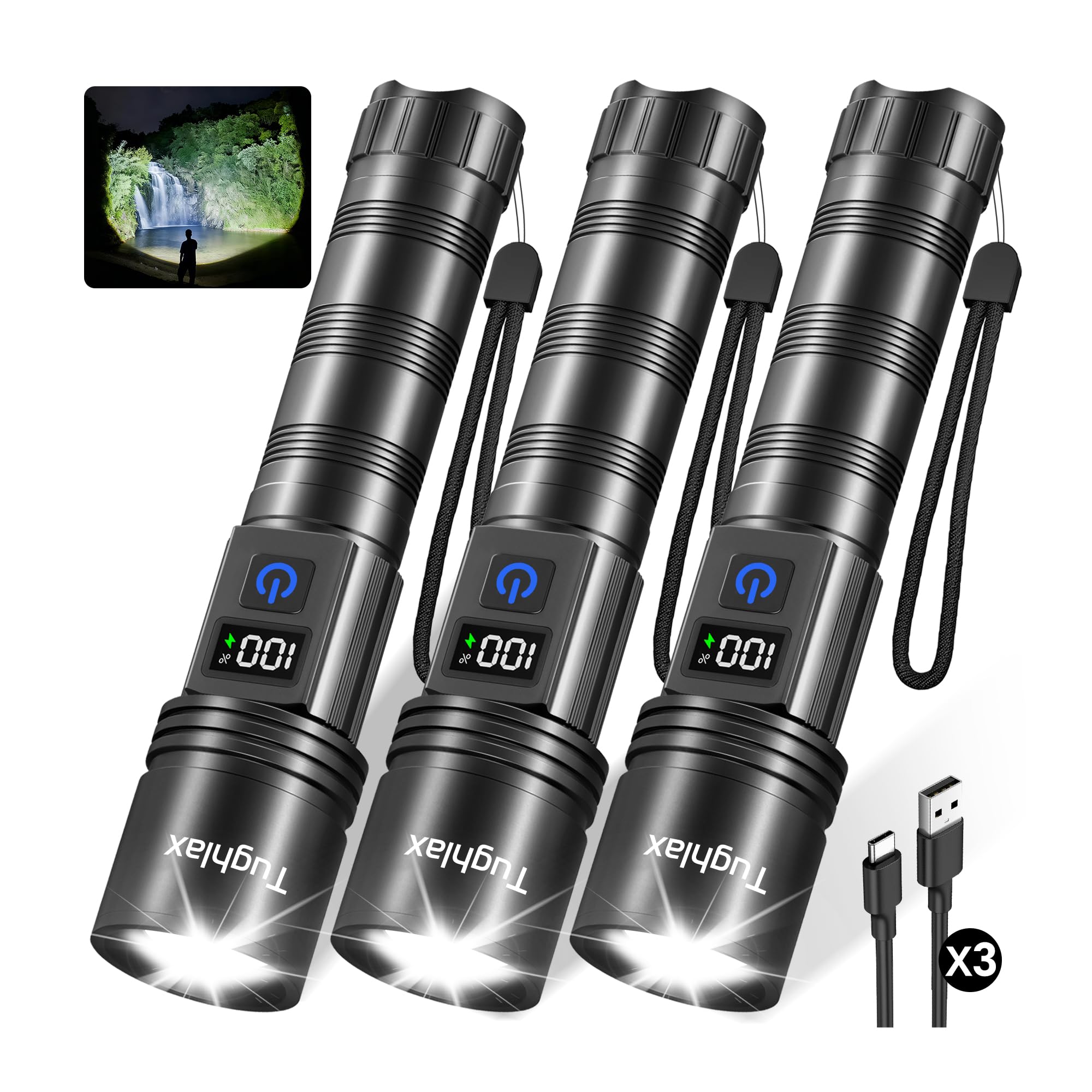
The Tughlax 3-Pack offers an incredible value proposition: three rechargeable flashlights with built-in 18650 cells, USB-C charging, and a digital LCD power display for under . Each unit outputs 700 lumens with adjustable focus that switches between flood and spot by sliding the head. The 5-mode interface (High, Medium, Low, Strobe, SOS) is simple enough for any family member to operate, and the compact aluminum body (5.9 inches) slides easily into a pocket or tackle box.
Real-world runtime tests show about 2.5 hours on high mode with a 2-hour recharge time. The LCD shows remaining battery percentage — a premium feature rarely seen at this price point — which lets you know exactly when to plug in. Each light includes a lanyard and USB-C cable. The IPX4 weatherproofing handles light rain, making these practical for wet campsite conditions.
These lights are ideal for families who want multiple reliable flashlights scattered around the campsite, truck, and home without spending + per unit. The replaceable nature of the 18650 batteries means you can swap in fresh cells instead of throwing away the light when the internal battery degrades. However, the 700-lumen output is modest compared to single premium lights, and the user interface requires cycling through modes sequentially without memory.
Why it’s great
- Three flashlights with built-in 18650 batteries for less than the cost of one premium light
- Digital battery percentage display prevents unexpected shutdowns
- Adjustable zoom from flood to spot beam
- USB-C charging with replaceable batteries
Good to know
- 700 lumens is adequate but not impressive for longer distance throwing
- Mode cycling is linear — no shortcut to turn on at previous setting
- Battery life drops sharply below 25% charge
- No known replacement batteries from major brands; third-party compatibility is uncertain
6. Glocusent 135 LED Camping Lantern
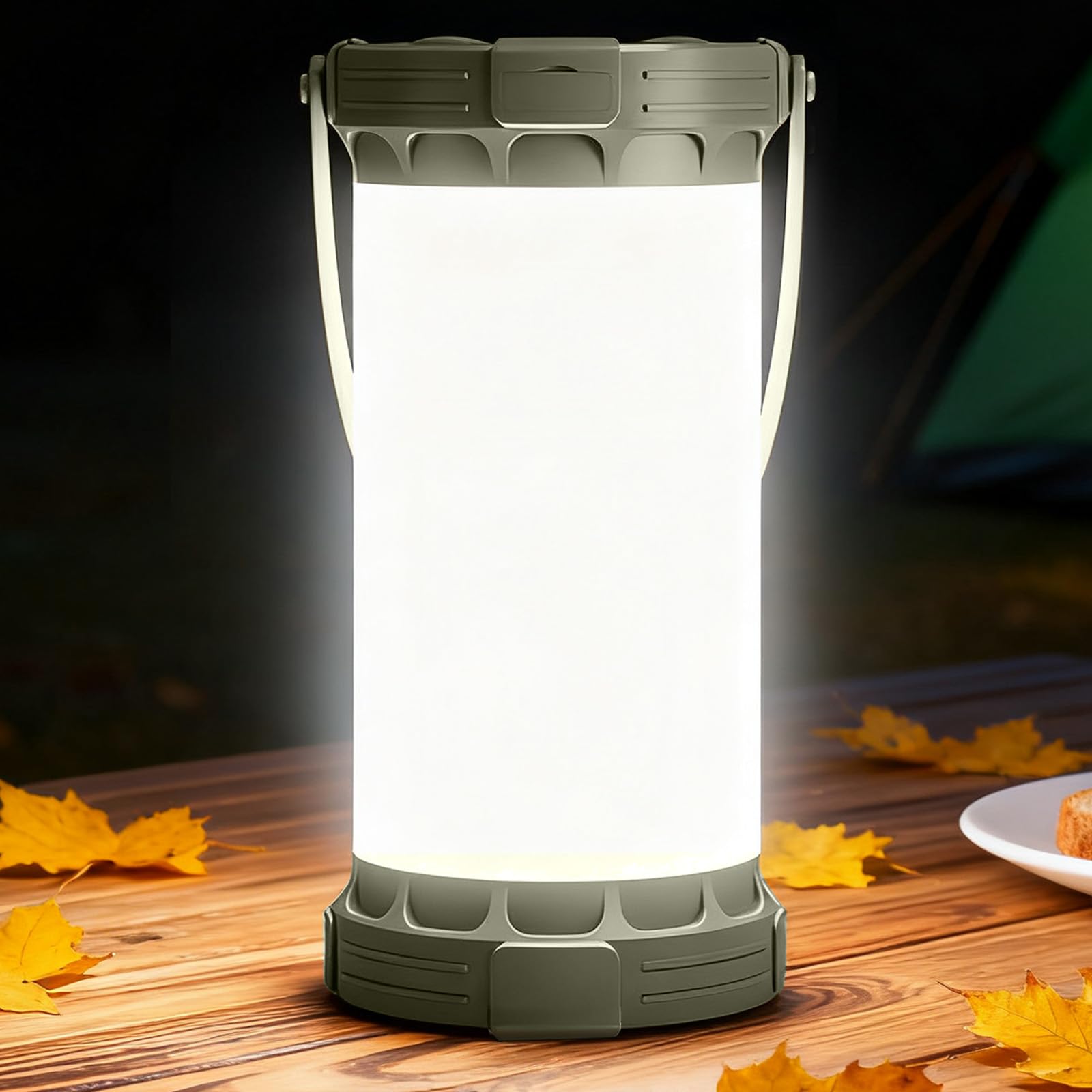
The Glocusent Lantern packs 135 LEDs into a compact 299-gram body to deliver 360-degree shadow-free illumination covering 200 square feet. Output reaches 1500 lumens in burst mode (limited to 3 minutes) with five dimmable levels and three color temperatures (3000K warm, 4500K neutral, 6000K cool) that adapt to fog, reading, or general visibility. The 5000mAh battery lasts up to 200 hours on the lowest brightness setting — enough for a full week of nighttime use.
IP44 water resistance handles light rain and splashes, while the rubberized exterior and top-mounted handle provide a secure grip. The bottom hook and top handle let you hang or place the lantern anywhere. A USB-C port supports power bank functionality to charge your phone — a useful emergency backup. The SOS red strobe adds an extra layer of safety for signaling during unexpected situations.
This lantern excels as a dedicated campsite area light. Its 360-degree dispersion creates cozy ambient lighting for dinner, card games, or tent reading without harsh hot spots. The multiple color temperatures and brightness levels give it an edge over the simpler Coleman for campers who value ambiance and task-specific lighting. For backpackers, the 299g weight is reasonable for a lantern, though not ultralight.
Why it’s great
- Three color temperature options (3000K/4500K/6000K) for any scene
- 200-hour runtime on low setting covers extended trips
- 360-degree shadow-free light covers 200 sq ft
- USB-C port doubles as a power bank for emergency phone charging
Good to know
- IP44 rated — splash-proof but not submersible like IP67 lights
- 1500-lumen turbo mode is limited to 3-minute bursts
- No single-beam focus for distance spotting
- Rechargeable pack can’t be swapped in the field
7. Rayovac Virtually Indestructible LED Flashlight

The Rayovac Virtually Indestructible has built a reputation through sheer durability. Rated to survive drops of up to 30 feet, with shatterproof components and a shock-absorbing rubber bezel, this budget light takes abuse that would destroy many premium flashlights. Its 300-lumen output is modest by modern standards, but the 480-foot beam distance is respectable, and the energy-saving mode delivers 39 hours of runtime from three included AAA alkaline batteries.
The tail-cap switch is recessed but easy to find in the dark, and the simple two-mode interface (high and low) avoids the mode-cycling complexity that frustrates novice users. IP67 waterproofing means it survives submersion in up to 3 feet of water for 30 minutes. The rubber-armored ends cushion drops effectively, and the aluminum body with hard rubber bezels has proven reliable for everyday carry in demanding environments like construction sites and frequent drop scenarios.
For campers on a strict budget, or for keeping a “beater” light in the glove box, tackle box, or emergency kit, the Rayovac is a compelling choice. However, its reliance on AAA batteries (which drain in roughly one hour on high) and the lack of rechargeability mean higher long-term cost and environmental waste. The missing pocket clip and lanyard eyelet are minor annoyances. The lifetime warranty adds confidence.
Why it’s great
- Extreme 30-foot drop survival rating — among the toughest in this guide
- IP67 waterproof — survives submersion up to 3 feet for 30 minutes
- Simple two-mode interface won’t confuse in an emergency
- Lifetime manufacturer warranty
Good to know
- Alkaline AAA batteries drain quickly on high (approx 1 hour) — budget for replacements
- No rechargeable battery option — disposable battery cost adds up over time
- 300 lumens is the lowest output in this guide
- No pocket clip or lanyard attachment point
FAQ
How many lumens do I actually need for camping?
Are rechargeable camp flashlights better than battery-powered ones?
What is the difference between flood and spot beam patterns in camp flashlights?
Can I use a tactical flashlight as a camp flashlight?
Final Thoughts: The Verdict
For most campers, the best camp flashlight winner is the Wurkkos FC12C because it delivers premium build, constant current regulation, and versatile stepless dimming at a mid-range price point — a single light that excels for both hiking and nighttime camp tasks. If you prioritize pocket carry and raw output, grab the Nitecore EDC29 for its ultra-slim 6500-lumen design with OLED display. And for family campsite area lighting that doubles as a power bank, nothing beats the Coleman Classic Rechargeable Lantern with its classic look and 45-hour runtime.