
Our readers keep the lights on and my morning glass full of iced black tea. As an Amazon Associate, I earn from qualifying purchases.
Specs are compiled from manufacturer listings and verified buyer reviews and can change over time — please confirm the key details on the product page before buying.
Camping solar panels are the difference between rationing your phone battery and running a fan all night. The real question isn’t whether to buy one — it’s which wattage and weight trade-off actually fits how you camp. This guide breaks down the seven foldable panels worth your money, focusing on real output, connector compatibility with your power station, and how much weight you’re willing to carry.
I’m Min — the founder and writer behind Gadgets Feed. This guide is built by comparing the manufacturers’ published specifications and the patterns across verified customer reviews, so you get each pick’s real strengths and trade-offs instead of marketing spin.
Whether you’re topping up a Jackery after a cloudy hike or powering a weekend RV setup, the right camp solar panels keep your gear alive without hauling a rooftop rig into the backcountry.
Our Picks at a Glance


How To Choose The Best Camp Solar Panels
Before you buy, understand that a “100W” label is a best-case ceiling, not a guarantee. The panel’s efficiency rating, the angle of the sun, and the thickness of clouds all shave real watts off that number. Your job is to pick a panel whose real-world output still meets your needs on an average camping day.
Match the Connector to Your Power Station
The single biggest compatibility mistake is buying a panel with the wrong output cable. Most portable power stations from Jackery, EcoFlow, and Anker use either XT60, Anderson, or DC7909 (8mm) inputs. A good panel ships with a multi-connector cable so you don’t need to buy adapters separately — check the included connectors before you order.
Efficiency Beats Raw Wattage in Low Light
Monocrystalline cells with efficiency ratings around 23-25% convert more sunlight into power than older polycrystalline panels. That matters most on overcast days or when you can only position the panel at a poor angle. A higher-efficiency 100W panel will out-produce a lower-efficiency one in the same weak sunlight.
Weigh the Portability Cost
Folded size and weight determine whether a panel lives in your car trunk or on your back. Panels under 6 lbs fold flat enough for a backpack, while heavier suitcase-style panels with rigid frames are better for RV or basecamp use where you drive to the site. Be honest about how far you’ll carry it.
Quick Comparison
| Model | Best For | Max Power | Efficiency | Weight | Amazon |
|---|---|---|---|---|---|
| ZOUPW 100W★ Best Overall | Universal compatibility | 100 watts | 23.5% | 9.5 lbs | Amazon |
| Renogy E.Flex 100WPremium Pick | Lightweight premium build | 100 watts | 25% | 7.3 lbs | Amazon |
| HQST 100W | Ultra-light carry | 100 watts | 25% | 5.91 lbs | Amazon |
| FlexSolar 100W | Compact backpack fold | 100 watts | 23%+ | 4.1 lbs | Amazon |
| DOKIO 100W | RV battery charging | 100 watts | — | 10.1 lbs | Amazon |
| EBL 100W | High-output value | 100 watts | 23% | — | Amazon |
| FlexSolar 60W | Light-duty backup | 60 watts | 24% | 2.6 lbs | Amazon |
In‑Depth Reviews
1. ZOUPW 100W Portable Solar Panel
Our pick — over 4.5★ from 650+ verified ratings; the strongest balance of quality and price.
The Swiss Army knife of solar panels that speaks every power station’s language.
This is the pick for anyone who owns more than one brand of power station or plans to upgrade later. The ZOUPW ships with a 5-in-1 connector cable covering DC8020 for newer Jackery models, XT60 for EcoFlow and Anker, Anderson for original Jackery, plus DC7909 and DC5521 for older units — no extra adapters to buy. That 10-foot cable gives you flexible positioning to chase the sun across your campsite.
At 100 watts with 23.5% efficiency from A+ monocrystalline cells, it out-powers the FlexSolar 60W by a 67% margin (100W vs 60W), and its 4.96A amperage beats that panel’s 3.03A by 64%. The two adjustable kickstands let you angle it at 45° to grab up to 25% more sunlight than laying it flat. Buyers report it tops up a Jackery Explorer 300 from 84% to 100% in about 20 minutes even on a cloudy day.
The trade-off is weight — 9.5 lbs with a folded size of 24.13 x 21.06 x 1.77 inches. It’s fine for car camping and RV trips but heavy for a long backpacking carry. The built-in USB-C PD port (15V/3A) and two USB-A ports (including QC3.0 at 12V/1.5A) let you charge phones directly without a power station in between. A 12-month warranty backs the ETFE-coated IP67 waterproof panel.
What Wins People Over
- The 5-in-1 cable fits 99% of power stations without adapters
- IP67 waterproofing holds up to rain and splashes
- Magnetic easy-carry handle simplifies transport
The Trade-Offs
- At 9.5 lbs it’s heavy for backpacking
- USB-C PD is capped at 45W, not the full 60W
Reach for this if: you own several different power station brands or plan to upgrade later — this panel’s 5-in-1 connector cable fits nearly any port you throw at it, so you won’t need a new panel when you switch gear.
Look elsewhere if: every ounce counts on your back; the FlexSolar 100W folds lighter at 4.1 lbs.
2. Renogy 100W E.Flex Portable Solar Panel
The 16BB N-Type cell panel that squeezes 25% efficiency into a 7.3 lb frame.
Renogy brings its rigid-panel expertise to the portable world with the E.Flex. The headline is the 25% efficiency from 16BB N-Type cells, which beats standard 9BB 100W panels sitting at 22.5%. In practical terms, that means more power from the same patch of sunlight — a real edge on overcast days when every photon counts.
It undercuts the ZOUPW’s weight at 7.28 lbs, folding to 22.99 x 22.54 x 1.57 inches with a magnetic closure instead of snap or Velcro. The quadfold design includes four kickstands with 3-angle adjustment (40°/50°/60°) and a built-in accessory pouch for cables. You can charge three devices at once through USB-C PD (45W max) and two USB-A ports (18W and 15W), while the MC4 output feeds your power station or 12V battery system.
Owners mention reliable 100W output in full sun and 70-80W input in clouds when charging Anker stations. The honest caveat is that real-world max output often lands around 87W rather than the full 100W, and the included MC4 cable is only 3 feet with no adapters — you’ll want your own for tight setups. It’s IP65-rated against dust and splashes, and UL 61730 certified with a 2-year material and workmanship warranty.
Certified confidence: UL 61730 certification plus CE, RoHS, and FCC compliance give this panel a safety pedigree most competitors lack.
Size it up: the 5.66A amperage is the highest in this lineup, feeding big power stations faster at the same 100W rating.
Best for: campers who want premium build quality and verified safety standards without buying a heavy rigid panel.
Think twice if: you need universal adapters from the start — the short MC4 cable means carrying your own connectors.
3. HQST 100W Portable Solar Panel
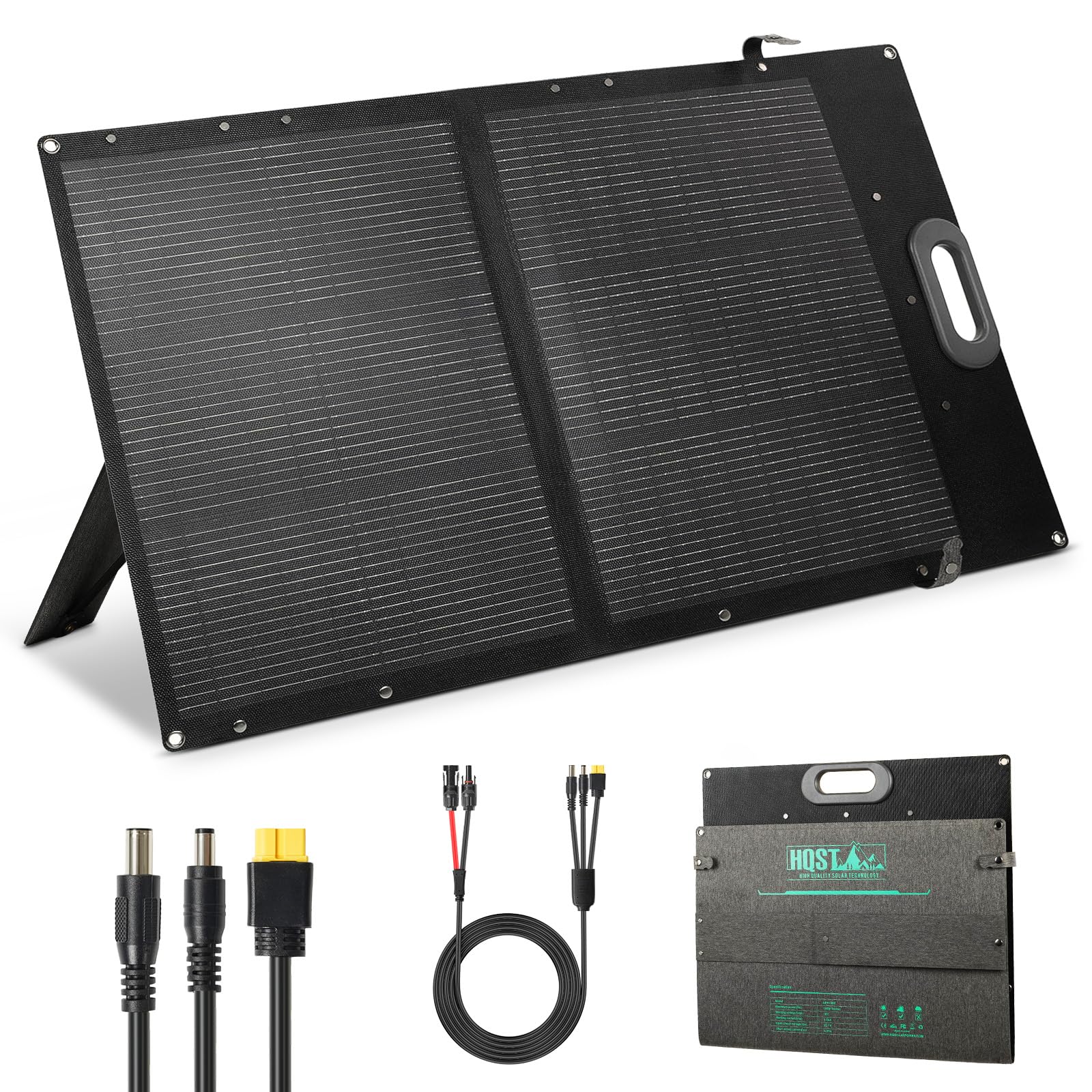
A 5.91 lb featherweight that carries the crowd’s confidence with 25% N-Type efficiency.
The HQST is the value king of this list, and the crowd has spoken loudly — it’s the most-reviewed panel here with a 4.5-star average across nearly a thousand owners. At 5.91 lbs, it’s up to 40% lighter than most portable panels, roughly the weight of five water bottles. Folding to just 1.38 inches thick, it slips into a car trunk or backpack without hogging space.
The N-Type cells deliver up to 25% efficiency and outperform standard PERC cells in low-light conditions. That’s the spec that matters when clouds roll in at the beach or campsite. The 4.9 ft 3-in-1 adapter cable (XT60, DC7909 8mm, DC5521) covers most popular power stations from Jackery Explorer 500/300 to EcoFlow, BLUETTI, Goal Zero, and Anker. Two adjustable kickstands angle from 40° to 70° and keep the rigid frame stable on uneven ground.
Reviewers have recorded up to 169W in ideal conditions, though that’s above the rated 100W and weather-dependent. The IP67 waterproof rating with a PVDF-coated outer layer resists scratches and rain. The recurring note is packaging — some units arrive with dented frames from shipping, so inspect yours on arrival. The fully laminated construction eliminates stitched seams where water could seep in.
Why It’s a Fan Favorite
- The 5.91 lb weight rivals panels half its wattage
- 25% N-Type efficiency shines in low light
- 4.9 ft 3-in-1 cable covers major power stations
Keep an Eye On
- Shipping damage is the most common complaint
- Connector compatibility gets mixed feedback for some stations
Grab it for: campers who want a genuinely light 100W panel at a price that undercuts premium rivals.
skip it if: you need the absolute highest output — some customers note real-world wattage below the EBL’s numbers.
4. FlexSolar 100W Foldable Solar Panel
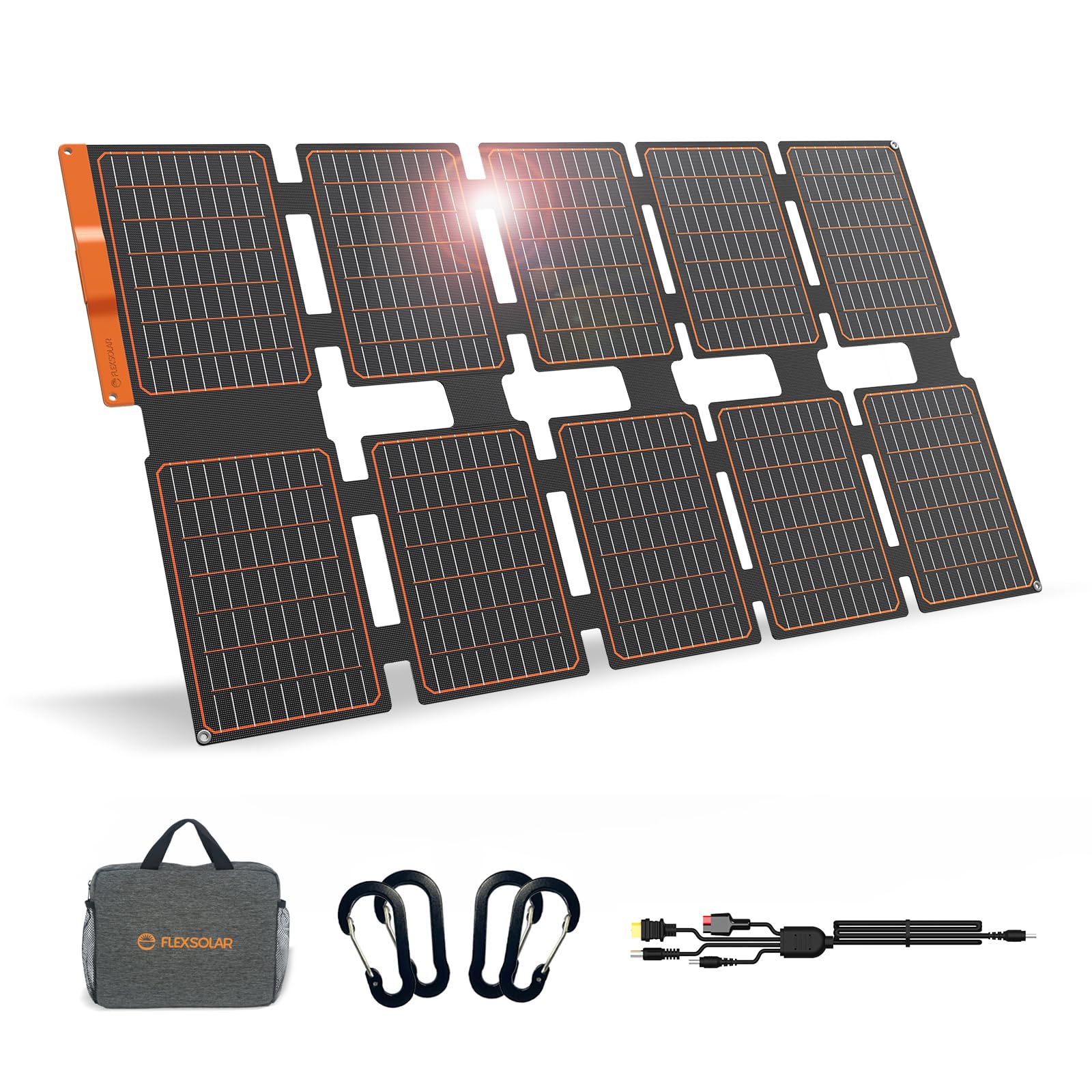
The 4.1 lb 100W panel that folds thinner than your laptop bag.
This FlexSolar is the lightest 100W panel in the entire lineup at 4.1 lbs (1.85kg), folding to a compact 12.99 x 10.43 x 2.17 inches with a sleek 0.59-inch profile. It’s the panel you grab when hiking miles to camp but still want 100W of charging muscle. The unfolded size of 45.47 x 26.18 inches captures maximum sunlight while staying easy to handle.
Monocrystalline silicon cells with E-Film lamination hit 23%+ efficiency, providing reliable performance on overcast days. The 4-in-1 charging cable (DC5521, DC7909, Anderson, XT60) pairs with PD 3.0 45W USB-C and 18W USB-A outputs for direct device charging. Reviewers point out 70W horizontal in Maine July, up to 85W max, with one noting near-100W: DC 90W and USB-C 56W.
The catch is durability — a few shoppers say panels stopping after a couple of hours, and the DC output can heat up at 60W+. Reliability and durability get mixed feedback, so this is best for gentle use rather than harsh daily abuse. The IP67 waterproof and dustproof rating protects against rain, dust, and sand, making it a solid emergency backup. A premium carry bag is included for transport.
Backpack dream: the notebook-sized fold and 4.1 lb weight make this the easiest 100W panel to justify carrying on a trail.
Realistic output: expect 70-85W typical, not the full 100W, and avoid sustained high DC draw to protect longevity.
Choose it for: hikers and backpackers who prioritize weight above all else and use their panel gently.
Pass if: you plan daily high-wattage charging — the DOKIO’s rigid frame handles sustained use better.
5. DOKIO 100W Foldable Solar Panel Suitcase
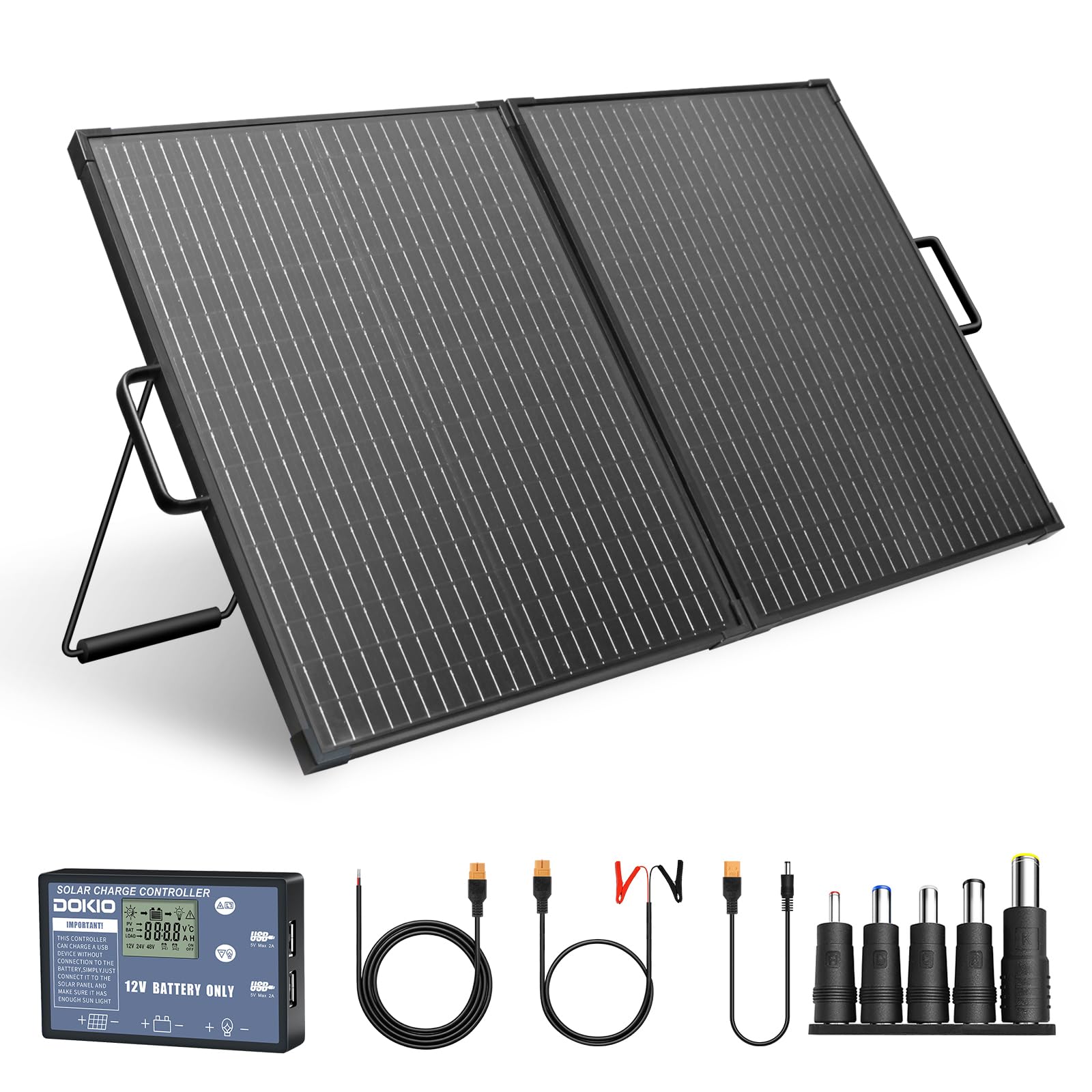
The rigid suitcase-style panel with a built-in 10A controller for direct battery hookup.
The DOKIO is different from every other panel here because it includes a detachable LCD charge controller right in the box. That means you can connect it directly to a 12V battery with alligator clips — no separate controller purchase needed. It unfolds to 38.8 x 23.8 x 0.7 inches with a metal grip for carrying, folding to a 1.3-inch thickness.
Built with N-type cells and a corrosion-resistant aluminum frame with reinforced corner guards, it shrugs off extreme temperatures from -40°F to 185°F and handles 5400Pa snow load and 2400Pa wind. The built-in smart PWM charging technology protects against reverse polarity, overcharge, short circuit, and reverse current. A 5V 2A USB port handles direct phone charging, while the 9.8ft extended cable with a 30° adjustable bracket helps you track the sun.
Owners praise it for charging RV batteries efficiently on cloudy days during week-long beach camping. The 10-year power output warranty is the longest in this lineup. The honest downside is build quality — some describe it as flimsy, with wobbly legs and a case that lacks padding. One owner’s first unit shattered in shipping before the replacement arrived fine, so handle the glass panels with care and inspect on arrival.
Ready from the start
- 10A controller with LCD display included — no extra purchase
- 10-year power output warranty is the longest here
- Handles extreme temps and high wind loads
Handle With Care
- At 10.1 lbs it’s the heaviest panel on this list
- Build quality gets mixed feedback — wobbly legs, unpadded case
Best for: RV owners who want a complete plug-and-play battery solution without buying a controller separately.
Not for: backpackers — the 10.1 lb weight and rigid glass panels belong in a vehicle, not on your back.
6. EBL 100W Portable Solar Panel
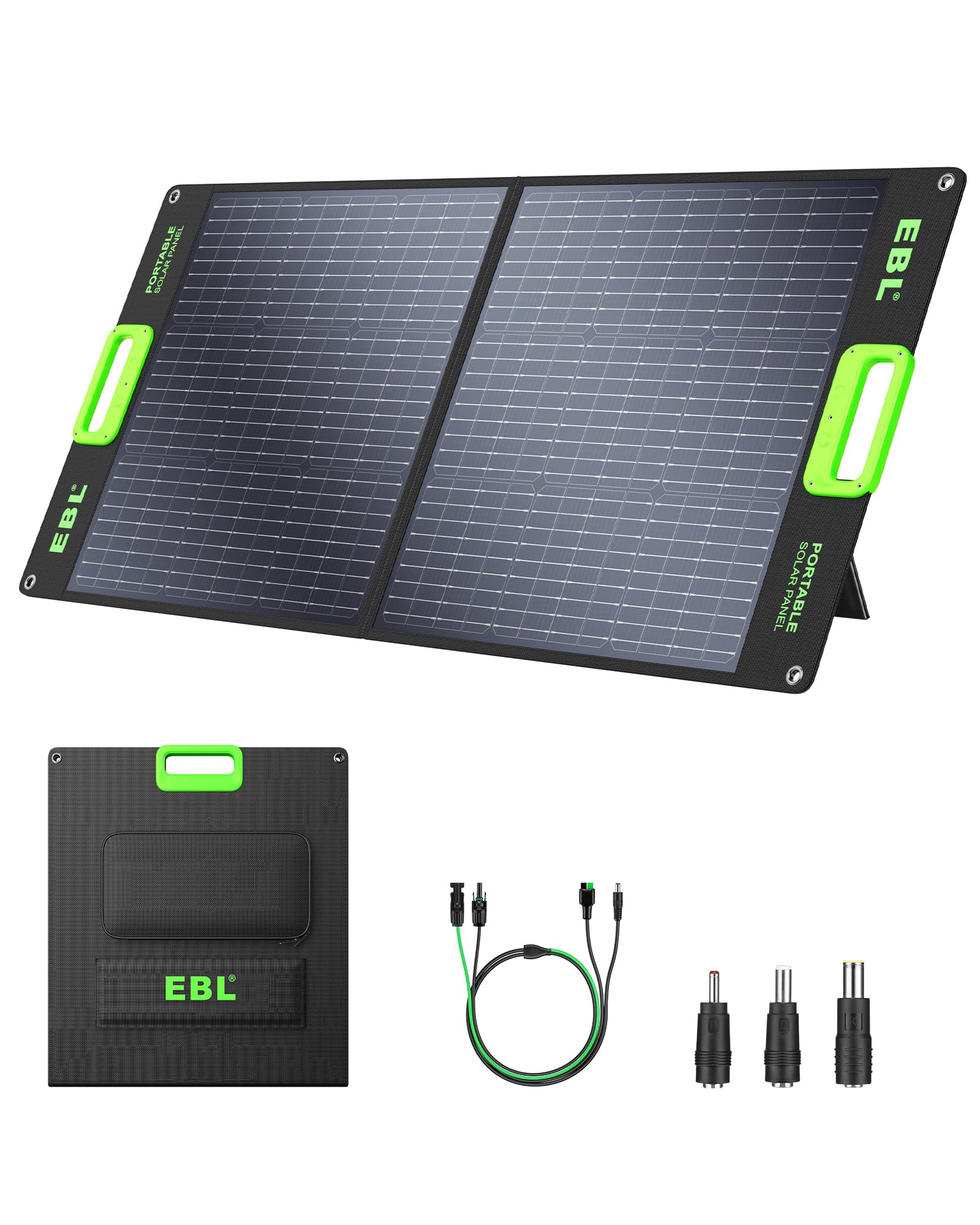
The panel that routinely over-delivers, pulling 148-191W from a 100W rating.
If raw output is your obsession, the EBL is the sleeper hit. Owners consistently exceed the rated wattage — one hit 191W, another saw steady 148W in Ohio afternoon sun, and a third measured 165W on an Anker Solix C1000 in winter. That’s remarkable headroom from a 100W-rated panel with 23% high-efficiency monocrystalline cells.
The upgraded universal compatibility includes multiple connector sizes to match various power stations and even some laptops. Two kickstands mount the panel at a 45° angle to capture 20% more sunlight than flat laying, with a soft rubber magnetic handle for easy folding. The Smart IC provides overcharging, overheating, and short-circuit protection. Included cables cover MC4 to Anderson, MC4 to DC5521, plus adapters for 5.5×2.1mm to various sizes.
The IP65 water resistance handles splashes but shouldn’t sit in heavy rain — the EBL is less sealed than the IP67 panels here. The built-in ETFE laminated material resists wear, and owners note it holds up well on windy days of 15-20 mph. Charging speed gets consistent praise, with buyers noting it can top up generators in about half the time of smaller panels.
Overachiever: the 148-191W real-world readings make this the highest-output panel per rated watt in this lineup.
Compatibility check: no XT60 cable in the box — verify your power station’s input before ordering if you use EcoFlow or Anker.
Buy it if: you want maximum real-world watts and own a power station that uses Anderson or DC5521 inputs.
Choose another if: you need XT60 compatibility from the start or IP67-level weather sealing for heavy rain.
7. FlexSolar 60W Foldable Solar Panel

The 2.6 lb laptop-sized panel that tops up small stations and phones on the go.
Not every camp setup needs 100 watts. This 60W FlexSolar folds to 9.8 x 12 x 1 inches — roughly the size of a laptop — and weighs just 2.6 lbs (1.2kg) with the junction box and accessories. It’s the panel for small-to-medium solar generators under 300Wh, power banks, iPads, and smartphones.
The A+ monocrystalline silicon cells reach up to 24% energy conversion, and the E-film surface layer offers high strength with good transparency. You get three output options: QC3.0 USB-A (18W max), PD3.0 USB-C (40W max), and DC (60W max at 20V-28V). An intelligent chip identifies connected devices and adjusts output current for the fastest safe charge, with an LED indicator light showing charging status. It reaches 60W in direct sunlight and 30-40W when slightly cloudy.
Buyers report charging CPAP battery packs in 2-3 hours flat on the ground, and one brought a Solix 300 to 100% in about 8 hours at 45-60W in full sun. The practical notes: there’s no kickstand so you lay it flat (reducing output), and no carry handle or Velcro to hold it folded. It’s IP65 dustproof and waterproof, but the junction box isn’t waterproof — keep that part dry. Two carabiners are included for hanging.
Easy Carry, Real Output
- 2.6 lbs folds to laptop size for easy packing
- 24% efficiency is competitive with premium panels
- Three output ports handle phones, tablets, and small stations
Know the Limits
- No kickstand — laying flat cuts real-world output
- Junction box isn’t waterproof despite the IP65 rating
Reach for it: weekend campers with a small power station who want minimal weight and don’t need 100W of capacity.
Move up if: you run a fridge or CPAP all night — the 60W output will struggle to keep up with bigger draws.
Understanding the Specs
Efficiency Percentage
The efficiency rating (23%, 24%, 25%) tells you how much sunlight becomes electricity. A 25% panel converts a quarter of the light hitting it into power, while the rest is lost as heat. Higher efficiency means faster charging in the same sunlight and better performance when clouds thin the light. This matters most for compact panels where you can’t add more surface area.
IP Water Resistance Ratings
IP ratings tell you how well a panel resists dust and water. IP65 means it’s dust-tight and can handle low-pressure water jets — fine for a splash but not for dunking. IP67 adds full protection against temporary immersion, so it survives a sudden downpour better. For camping, IP67 gives you more confidence in heavy rain, but note the rating usually covers the panel surface only — the junction box and ports still need their own shielding.
FAQ
Will a 100W panel charge my Jackery or EcoFlow power station?
How much actual power will I get in real-world conditions?
What’s the difference between IP65 and IP67 waterproofing?
Can I charge my phone directly from a solar panel?
How heavy is too heavy for a portable solar panel?
Do I need a charge controller with my solar panel?
Is a 60W panel enough for camping?
Can I connect two panels together for more power?
Final Thoughts: The Verdict
The camp solar panels winner is the ZOUPW 100W because its 5-in-1 connector cable ends the guesswork of which port fits — and nearly 700 owners averaging 4.6 stars back it up. If you want the lightest premium build with verified safety, the Renogy E.Flex is the pick. And for RV owners who want to plug straight into a battery, the DOKIO with its included 10A controller is the one to reach for.
How We Picked
We do not accept paid placement. Every pick is matched to a real buyer and a real use-case; we do not hands-on test units.
Sources & Methodology
Specifications: manufacturer listings and product documentation. Review insights: verified customer reviews, as of August 2026. Pricing: not shown on this page (it changes often); check the current price via the retailer link.
As an Amazon Associate, Gadgets Feed earns from qualifying purchases. This does not affect which products we feature.