
A camp stove that sputters in a breeze or takes forever to boil water turns a promising meal into a frustrating wait. The difference between a great outdoor cooking experience and a miserable one often comes down to a few key specifications — wind resistance, BTU output, and fuel type. Whether you’re car camping with a family or hiking solo, the right camp stove delivers consistent heat when you need it most.
I’m Min — the co-founder and writer behind Gadgets Feed. I analyze technical specifications, user reliability data, and real-world performance metrics across dozens of outdoor cooking systems to separate marketing hype from usable features.
After sifting through customer feedback and spec sheets, I’ve curated the most reliable options available. This guide breaks down the best camp stove options for every cooking style and trip length.
How To Choose The Best Camp Stove
Choosing a camp stove starts with understanding your typical cooking scenario. The three most important variables are fuel type, BTU output, and physical size. Each factor directly influences how your stove performs in wind, cold, and at altitude.
Fuel Type: Propane, Butane, Isobutane, or White Gas
Propane is the most widely available and works well in cold temperatures down to -40°F, but the 1lb green cylinders produce waste. Butane is cheaper and quieter but stops vaporizing below 31°F. Isobutane blends (found in backpacking canisters) perform better in cold than pure butane but still struggle below 20°F without a pressure regulator. White gas (Coleman fuel or naphtha) is the gold standard for sub-zero and high-altitude conditions — it self-pressurizes and doesn’t lose output as the tank empties. For car camping, propane is the most convenient. For backpacking, choose isobutane or white gas depending on your winter needs.
BTU Output: What You Actually Need
BTU (British Thermal Unit) measures raw heat output. A single burner producing 8,000 to 10,000 BTU is enough to boil 1 liter of water in 3-5 minutes under calm conditions. Backpacking stoves typically deliver 8,000-12,000 BTU. Two-burner car camping stoves range from 20,000 to 40,000 total BTU. More BTU means faster boil times and better performance in wind, but excessive heat makes simmering difficult. A stove with a good regulator (like the MSR PocketRocket Deluxe or Jetboil MightyMo) balances high output with fine flame control, letting you boil quickly and then simmer gently.
Weight and Packability
Backpackers need a stove under 6 ounces. The Jetboil MightyMo weighs just 3.36 ounces and packs into a small pouch that fits inside a cook pot. Car camping stoves like the Coleman Classic 3-Burner or Camp Chef Everest 2X weigh 15-19 pounds and are designed for tabletop use. For backpacking, the weight difference of even 2 ounces matters over a multi-day trek. For drive-in camping, prioritize cooking area and wind protection over grams saved.
Quick Comparison
On smaller screens, swipe sideways to see the full table.
| Model | Category | Best For | Key Spec | Amazon |
|---|---|---|---|---|
| Camp Chef Everest 2X | Premium | Group car camping / high wind | 40,000 total BTU | Amazon |
| Coleman Cascade 3-in-1 | Premium | Versatile cooking (grill, griddle, stove) | 24,000 total BTU | Amazon |
| Coleman Classic 3-Burner | Premium | Large group meals / tailgating | 28,000 total BTU | Amazon |
| Optimus Svea Brass | Premium | High altitude / white gas reliability | 4,780 BTU (white gas) | Amazon |
| MSR PocketRocket Deluxe | Mid-Range | Ultralight backpacking / simmer control | 2.9 oz weight | Amazon |
| Jetboil MightyMo | Mid-Range | Ultra-compact backpacking / fast boil | 3.36 oz weight | Amazon |
| GasOne Dual Fuel | Budget-Friendly | Car camping / emergency preparedness | 15,000 BTU (single burner) | Amazon |
In‑Depth Reviews
1. Camp Chef Everest 2X 2-Burner Portable Camping Stove

The Camp Chef Everest 2X delivers 40,000 total BTU across two burners — 20,000 BTU each — making it the most powerful portable camping stove in this lineup. It boils 1 liter of water in about 2 minutes, even in breezy conditions, thanks to the folding lid that doubles as a robust windscreen. The matchless ignition fires instantly every time, and the precise control knobs allow genuine simmering, which is rare at this power level.
With a 215 square inch cooking surface, you can fit two 12-inch pans or a large griddle simultaneously. The drip tray simplifies cleanup after greasy meals, and the integrated carry handle makes transport straightforward despite its 15-pound weight. Customer reviews consistently praise its wind resistance and build quality, with several noting it outperforms older Coleman models in both heat output and simmer control.
One recurring note from buyers is that the proprietary connector doesn’t easily accept standard aftermarket regulator hoses — you’re stuck with the included pipe fitting unless you buy an adapter. That said, the factory connection works flawlessly with 1lb propane cylinders, and the stove’s overall reliability justifies the premium price for serious camp cooks. The Everest 2X is the standard by which two-burner camp stoves are measured.
Why it’s great
- Class-leading 40,000 BTU output boils water faster than any competitor in this class
- Excellent integrated windscreen protects flames in moderate to strong gusts
- Precise simmer control despite the high heat ceiling
Good to know
- Proprietary connector limits aftermarket hose compatibility without an adapter
- At 15 lbs, it’s heavy for anything beyond car camping
2. Coleman Cascade 3-in-1 Outdoor Camp Stove
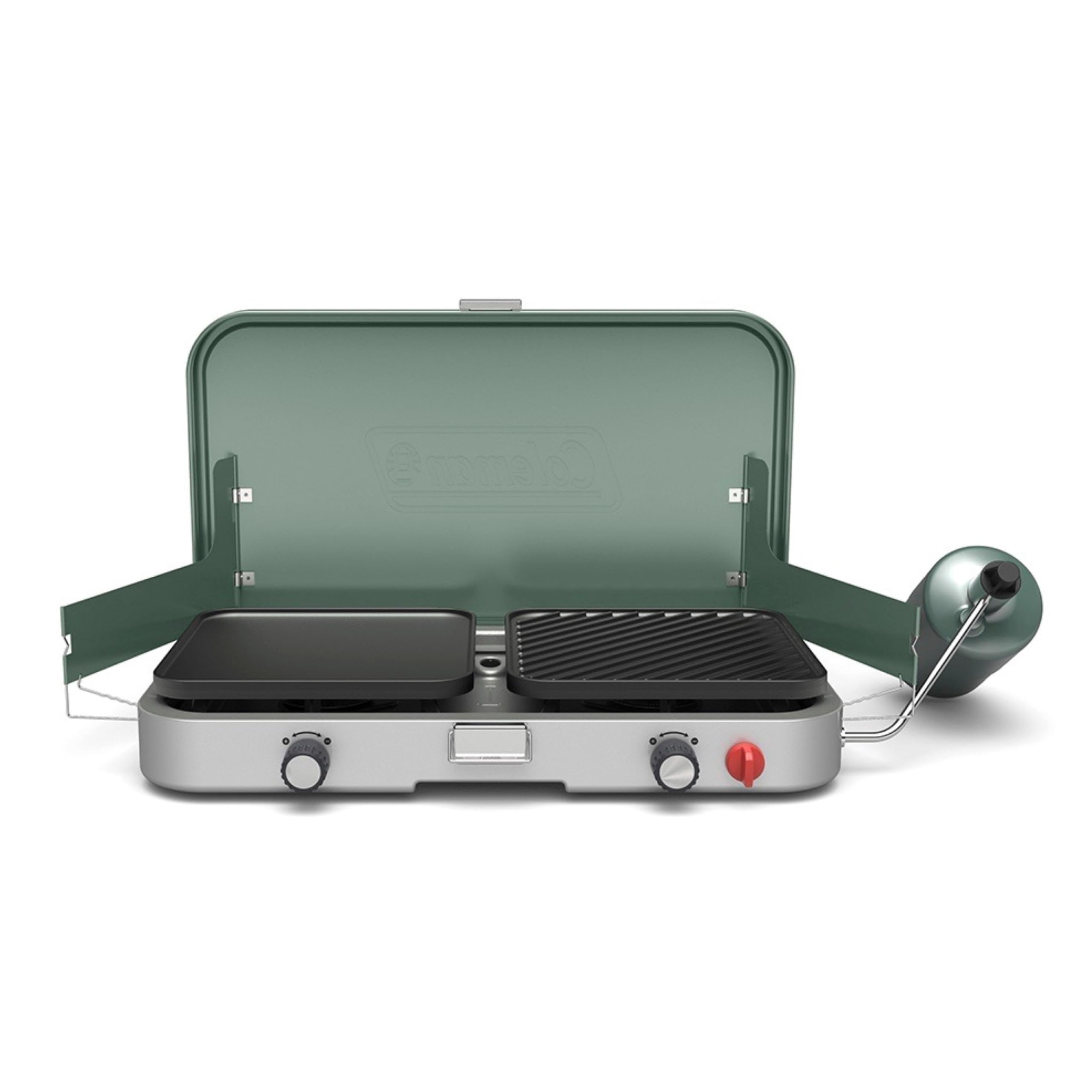
The Coleman Cascade 3-in-1 is a unique hybrid that functions as a two-burner stove, a grill, and a griddle — all with the same base unit. The removable cast-iron grill and griddle accessories slide onto the burner area, letting you cook pancakes, eggs, burgers, or seared steak without bringing extra cookware. The 24,000 total BTU output (12,000 per burner) is less powerful than the Camp Chef Everest 2X but perfectly adequate for most family camping meals.
The rotary ignition lights reliably, and the improved knob rotation offers noticeably better simmer control than older Coleman models. The recessed carry handle and nylon case for accessories make transport tidy, though at 15.8 pounds it’s firmly in car-camp territory. The two wind guards help shield flames, though some buyers note they’re smaller than the wind blocks on original Coleman stoves. The aluminized steel cooktop is easy to wipe clean after use.
Customer feedback highlights the quality of the cast-iron accessories — they heat evenly and hold temperature well. The only consistent criticism is that it’s larger than expected and requires a sturdy table. One buyer noted the propane wand stored inside the burner area can shift during transport, but it doesn’t scratch the finish. For campers who want the flexibility of a stove, griddle, and grill in one package without buying separate units, this is the most versatile option available.
Why it’s great
- Cast-iron grill and griddle included — no extra cookware needed for multi-style cooking
- Improved knob rotation allows genuine low-heat simmering
- Durable build with easy-clean aluminized steel cooktop
Good to know
- At 15.8 lbs and 22 inches wide, it requires a large table for stable use
- Wind guards are shorter than classic Coleman designs
3. Coleman Classic 3-Burner Propane Camping Stove

The Coleman Classic 3-Burner delivers 28,000 total BTU across three adjustable burners, offering enough cooking area to fit two 12-inch pans or three 8-inch pans simultaneously. That makes it ideal for feeding a group of six or more people on a single trip. The push-button InstaStart ignition is famously reliable, and the wind-blocking panels fold down to serve as side tables, adding valuable prep space when you’re cooking outdoors.
The pressure regulator maintains consistent output even in cold conditions, and the 3-year limited warranty backs the build quality. On high, all three burners use a full 1lb propane cylinder in about 45 minutes, so it’s worth bringing extra fuel for long cooking sessions. The controls are functional but not precise — several customers note that achieving a low simmer is tricky compared to smaller stoves. Cleaning is straightforward because the entire grill surface lifts off for access to the burner area.
Buyers consistently praise the warranty support: one reviewer reported a leaky regulator pipe and received a full replacement stove quickly and at no cost. The biggest design gripe is that the regulator connection at the right rear forces the 1lb propane cylinder to sit behind the stove, which can be awkward in tight spaces. A common workaround is using an extension hose adapter and a separate carrying case for better stove placement. For large-family car camping and tailgating, this stove’s three-burner capacity is unmatched.
Why it’s great
- Three burners provide enough capacity for large pots and multiple dishes at once
- Wind-blocking panels double as side tables for extra prep space
- Coleman’s warranty support is responsive and reliable
Good to know
- Low-flame simmer control is imprecise compared to premium two-burner stoves
- Propane cylinder placement behind the stove can be inconvenient in tight spaces
4. Optimus Svea Brass Backpacking Camp Stove

The Optimus Svea is a heritage piece of mountaineering gear that has been in continuous production since 1955. Built from solid brass, it uses a self-pressurizing design — the radiant heat from the burner pressurizes the white gas fuel tank as it runs, eliminating the need for a separate pump that can freeze or break at altitude. This stove runs on white gas or naphtha fuel, which doesn’t lose pressure in extreme cold the way canister stoves do, making it the go-to choice for climbers above treeline.
The integrated brass windscreen doubles as a 0.6-liter cookpot, creating a compact, self-contained system. The burner produces 4,780 BTU — modest compared to propane stoves, but white gas burns hotter per unit volume and the Svea will boil 1 liter of water in about 4 minutes. The flame is adjustable, but simmer control is less precise than modern regulated stoves because the single throttle controls both fuel flow and pressurization. Owners report that the recommended 45-minute runtime on a full tank is realistic, and the stove can be recovered from water submersion and running again in two minutes.
The Svea has a learning curve. Users emphasize practicing at home, using a filtered funnel to avoid clogging the jet, and using 1ml of 90% isopropyl alcohol in the priming cup instead of white gas to reduce soot. The brass construction adds weight (1.34 lbs), and the fuel tank gets very hot during operation — a metal stove stand is recommended to avoid melting gear. But for alpine missions where reliability at -20°F is non-negotiable, this stove has no equal.
Why it’s great
- Self-pressurizing white gas design works reliably in extreme cold and high altitude
- Solid brass construction with decades of proven expedition reliability
- Compact all-in-one system with built-in windscreen and cookpot
Good to know
- Requires practice and attention to priming procedure
- Heavier and less fuel-efficient than modern ultralight canister stoves
5. MSR PocketRocket Deluxe Ultralight Camping Stove

The MSR PocketRocket Deluxe weighs just 2.9 ounces and folds down to a size that fits inside a 700-milliliter titanium cup alongside a fuel canister and mini lighter. Despite its tiny footprint, it packs a pressure regulator that maintains consistent output as the canister cools and the fuel level drops — a feature usually found only in larger, heavier stoves. This regulator lets the PocketRocket Deluxe boil 1 liter of water in 3.5 minutes even in cold weather, and the broad burner head provides surprisingly good wind resistance for its size.
One of the standout features is the built-in piezo push-start igniter, which is protected inside the burner body for maximum durability. The flame adjusts smoothly from a full-boil roar down to a gentle simmer — multiple reviewers report successfully cooking hashbrowns without burning them, a rare feat for ultralight stoves. The three folding pot supports create a stable platform for cook pots up to about 1.5 liters.
In direct comparison tests, the PocketRocket Deluxe boiled 4 cups of water faster and used less gas than similar competing models at 48°F with no wind. The included storage bag is minimalist but functional. The only real limitation is that it requires a threaded isobutane-propane canister, which isn’t as universally available as propane. And while the regulator improves cold-weather performance, it still struggles below 10°F compared to white gas stoves. For anyone counting grams on a multi-day trek, this is the gold standard.
Why it’s great
- Pressure regulator maintains consistent output in cold weather and with low fuel
- Excellent simmer control for an ultralight stove — cooks hashbrowns without burning
- Weighs only 2.9 oz and packs incredibly small
Good to know
- Requires threaded isobutane-propane canisters, which are less common than propane
- Cold-weather performance drops below 10°F despite regulator
6. Jetboil MightyMo Ultralight Camping Stove

The Jetboil MightyMo is engineered specifically for fast boil times and fuel efficiency. Jetboil claims it reaches a rolling boil in roughly 3 minutes while consuming half the fuel of traditional systems — and customer reviews consistently confirm these numbers. The 2,900-watt maximum energy output translates to about 9,900 BTU, which is efficient for a backpacking stove. The four-turn regulator provides incremental heat adjustments from a whisper-soft simmer to a full-throttle boil, making it suitable for sautéing greens or simmering sauces, not just heating water.
Weighing just 3.36 ounces, the MightyMo is barely heavier than the MSR PocketRocket Deluxe, but it offers a slightly different trade-off. It uses Jetboil’s proprietary FluxRing technology when paired with their cook pots (sold separately), but it also works as an open-platform stove with standard cookware using the included pot support. The push-button igniter is reliable and consistent down to 20°F. The included fuel can stabilizer adds stability on uneven ground, and the storage pouch keeps everything organized.
The most consistent customer complaint is the lack of built-in wind protection. The MightyMo’s flame is easily extinguished by a moderate breeze, so using a separate windscreen is recommended for anything beyond calm conditions. One buyer reported that the regulator failed on the first trip — while still functional, it showed a flow irregularity. Jetboil’s 1-year warranty covers such issues, but it’s worth noting. For backpackers who prioritize fast water boiling and fuel efficiency above all else, the MightyMo is the best choice.
Why it’s great
- Boils water in about 3 minutes with half the fuel consumption of traditional systems
- Four-turn regulator allows excellent simmer control for real cooking
- Ultra-light at 3.36 oz with compact storage pouch
Good to know
- No built-in wind protection — flame easily extinguished by a breeze
- Some units have reported regulator issues during early use
7. GasOne 15,000 BTU Dual Fuel Portable Camping Stove

The GasOne GS-3900PB punches far above its price class by offering dual-fuel capability (butane and propane) with a 15,000 BTU output that rivals much more expensive single-burner stoves. It runs on standard 8-ounce camping fuel cartridges (butane) and 1-pound propane cylinders using the included adapter, giving you fuel flexibility that’s rare at this level. The brass burner head with dual spiral flame and 15,000 BTU means it can boil water faster than many backpacking stoves, and the four-sided windblocker provides genuine wind resistance.
The piezo-electric ignition eliminates the need for matches, and the adjustable heat dial offers reasonable flame control. The built-in fuel heating strip helps butane vaporize in cooler conditions, extending its usable temperature range below 31°F. The heavy-duty carrying case protects the stove during transport, and rubber feet prevent sliding on tables or tailgates. The safety mechanisms — a pressure sensor cartridge ejection system and gas flow cut-off — add peace of mind, especially for families.
Customer feedback is overwhelmingly positive, with a 4.9-star average across multiple reviews. The most common praise is for its build quality relative to the price: stainless steel construction, brass burner, and robust plastic case. The main limitation is that it’s not backpacking-friendly — at 6 pounds with the case, it’s strictly for car camping, picnics, and emergency kits. Some users mention that propane adapter positioning can be awkward, but the versatility of running either fuel type outweighs the minor inconvenience. For budget-conscious campers who need a reliable single-burner stove, this is the obvious pick.
Why it’s great
- Dual-fuel capability (butane and propane) provides flexibility and backup options
- 15,000 BTU brass burner delivers high heat output for fast boiling
- Four-sided windblocker and safety pressure sensor add durability and peace of mind
Good to know
- Heavy for its size at 6 lbs — not suitable for backpacking
- Propane adapter positioning can be awkward in tight spaces
FAQ
Can I use a normal pot on a backpacking stove?
How does altitude affect camp stove performance?
What’s the difference between a regulated and unregulated stove?
Final Thoughts: The Verdict
For most users, the best camp stove is the Camp Chef Everest 2X because its 40,000 BTU output and excellent wind resistance make it the most capable two-burner stove for car camping. If you want ultralight performance for backpacking, grab the MSR PocketRocket Deluxe — its pressure regulator and simmer control are unmatched at 2.9 ounces. And for high-altitude expeditions where canisters fail, nothing beats the Optimus Svea Brass white gas stove.