
Camper AC units are the single most argued-about component in any RV build: how much cooling you need, how much noise you can tolerate, and how many amps your generator or battery bank has to spare. The difference between a restful night at 68°F and a sweaty, generator-droning disaster is entirely about matching the unit’s BTU output, efficiency rating, and decibel floor to your camper’s size and power system. This is a durable-goods purchase you’ll live with for years, so getting the spec stack right the first time matters.
I’m Min — the co-founder and writer behind Gadgets Feed. I’ve spent hundreds of hours cross-referencing SEER ratings, comparing inverter startup surges against soft-starter capabilities, and mapping decibel claims against real owner reports to build this guide for serious camper buyers.
Whether you run a 30-amp trailer, a 50-amp fifth wheel, or solar off-grid, this deep-dive into the best camper ac unit will arm you with the data to make a confident, long-term investment.
How To Choose The Best Camper AC Unit
Choosing the right rooftop AC for your camper is about balancing three conflicting variables: the physical size of your space, the electrical capacity of your system, and your personal tolerance for noise. A unit that is too powerful will short-cycle and waste energy, while one that is too weak will run endlessly and never hit your target temperature. Here’s how to break it down.
BTU Rating vs. Square Footage
A 13,500 BTU unit is the standard for most travel trailers and small fifth wheels up to about 300 square feet. Bump up to 15,000 or 16,000 BTU for larger rigs, especially if you have slide-outs or poor insulation. Over-specifying BTU for a small camper leads to frequent on-off cycling, which increases wear and reduces dehumidification—so match the rating to the actual cubic volume of your living space.
Inverter Compressor vs. Traditional Scroll
Inverter compressors ramp up and down smoothly instead of slamming on and off. This cuts startup amp draw from a spike of 18-25 amps down to a gentle 1.5-3 amp ramp, making inverter units ideal for lithium battery banks, smaller inverters, and quiet generators. Non-inverter units are simpler and cheaper to repair but they hit harder on your electrical system and are louder during startup.
Noise Level (dB) and Placement
A unit rated at 55 dB is roughly as loud as a normal conversation, while a 42-43 dB unit approaches library-level quiet. In a camper where the AC is directly above the bed or seating area, every extra decibel matters. Non-ducted units tend to sound louder because air is dumped directly into the room, while ducted units can mask some mechanical noise but require a compatible ceiling plenum.
Quick Comparison
On smaller screens, swipe sideways to see the full table.
| Model | Category | Best For | Key Spec | Amazon |
|---|---|---|---|---|
| FOGATTI 16K BTU | Premium | Whisper-quiet 43dB performance | 16,000 BTU / 43dB / heat pump | Amazon |
| TOSOT 16000 BTU | Premium | All-weather cooling and heat | 16,000 BTU / 43dB / works down to 23°F | Amazon |
| RecPro 15K Ducted/Non-Ducted | Premium | Ducted & non-ducted flexibility | 15,000 BTU / 55.4dB / heat pump | Amazon |
| Furrion Chill Cube 18K | Premium | High efficiency on 30A | 18,000 BTU / variable speed / 850W steady | Amazon |
| Coleman-Mach 15 | Mid-Range | Strong cooling for 33-ft Class A | 15,000 BTU / scroll compressor | Amazon |
| TURBRO Inverter 13.5K | Mid-Range | Inverter technology on a budget | 13,500 BTU / 9 amp steady / 1.6 amp start | Amazon |
| Dometic FreshJet 3 | Mid-Range | Lightweight upgrade for Dometic owners | 15,000 BTU / e-coated coils / plug-and-play | Amazon |
| ASA Electronics ACM135 | Mid-Range | Budget-friendly 13.5K rooftop | 13,500 BTU / metal base pan / 3-speed fan | Amazon |
| VEVOR 15000 BTU | Mid-Range | Fast cooling for 129 sq ft spaces | 15,000 BTU / 65dB / R32 refrigerant | Amazon |
| Dometic Penguin II | Premium | Low-profile, eco-friendly cooling | 13,500 BTU / R-410A / 12.75 in height | Amazon |
| ZAFRO 16000 BTU Portable | Budget | Portable solution for tents & small vans | 16,000 BTU / 42dB / 72-hr drainage-free | Amazon |
In‑Depth Reviews
1. FOGATTI RV Air Conditioner 16K BTU
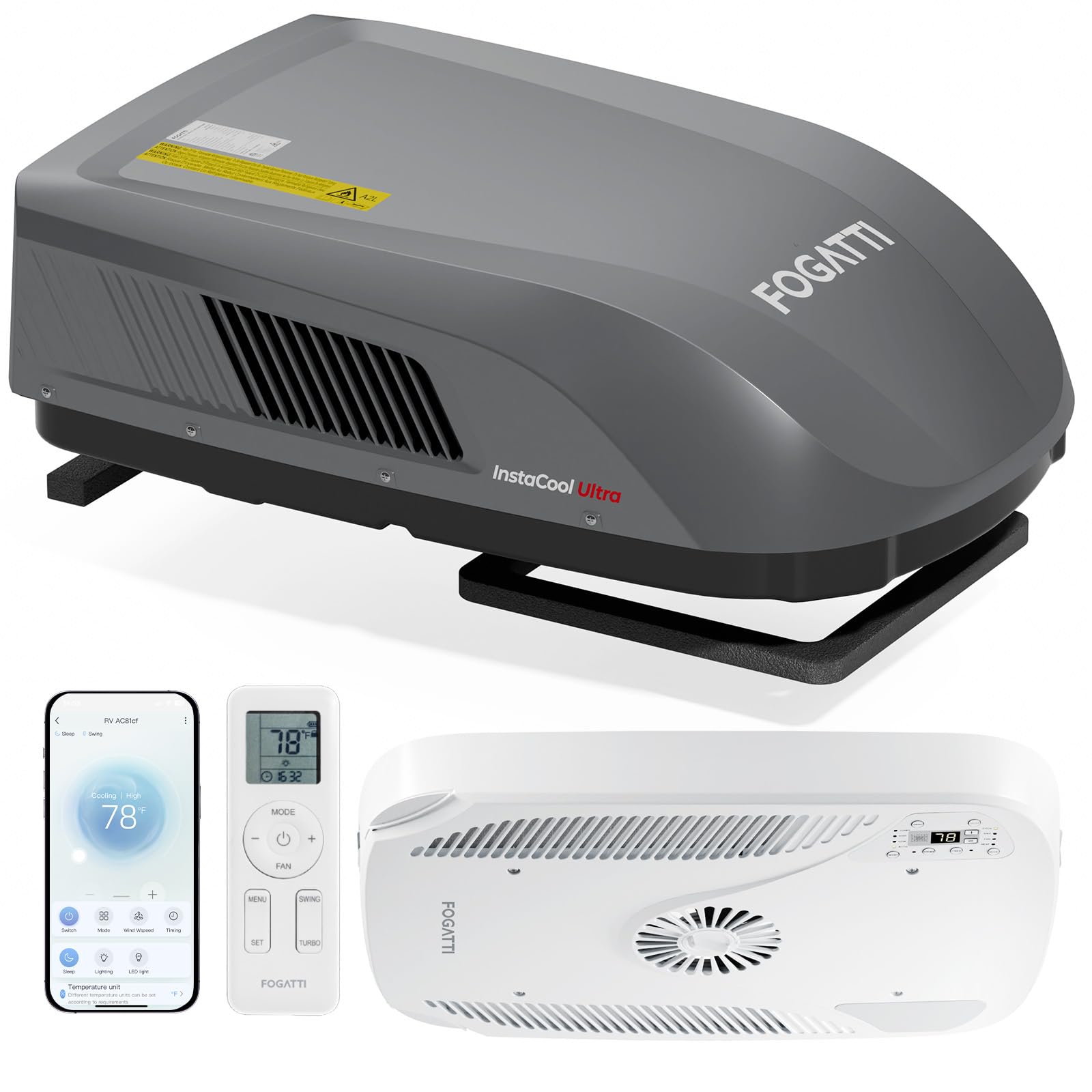
The FOGATTI 16K strikes a near-perfect balance between cooling power, noise, and features for a 36-foot camper. Its 16,000 BTU output coupled with a 12,500 BTU heat pump delivers year-round comfort, and the dual-motor, triple-fan system pushes 418 CFM for 30% faster temperature changes compared to standard units. The 43dB rating makes it one of the quietest rooftop ACs available, and the 12.2-inch low-profile height avoids bridge clearance issues on taller rigs.
Installation is non-ducted, meaning it drops cool air directly through the ceiling vents without requiring complex ductwork. The ADB panel offers 0-85 degree automatic oscillation, and control happens via remote, wall touchscreen, or WiFi app. With an EER of 11.8, the efficiency is well above the baseline, and the shock-absorbing dual-layer base keeps the compressor stable over rough roads.
User reports confirm the unit cools a 42-foot toy hauler effectively, with supply vent temperatures dropping as low as 4°F above ambient before settling at 12°F delta. The downside is that the package is heavy at 111 pounds, requiring two people for roof installation. The non-ducted design also limits flexibility if you later want to add ducted ceiling distribution.
Why it’s great
- Exceptionally quiet 43dB operation
- 16K BTU with integrated heat pump
- WiFi, remote, and touchscreen control options
Good to know
- Heavy at 111 lbs—requires two-person install
- Non-ducted only; no ducted kit available
2. TOSOT 16000 BTU RV Air Conditioner

The TOSOT 16000 BTU model is engineered for all-weather camping: it cools at up to 115°F ambient and provides 12,500 BTU of heat pump warmth down to 23°F. The scroll compressor is rated at 43dB, which is 32% quieter than conventional RV ACs, and the unit fits standard 14.25 x 14.25-inch roof openings. For campers in the 16-24 foot range (Class B, Class C, or small travel trailers), this is the sweet spot for power-to-noise ratio.
Control flexibility is a strong point—WiFi connectivity via the Gree+ app, a physical remote, and a timer function give you remote scheduling and temperature management. The non-ducted design simplifies installation, though the unit ships in two separate packages, so you need to confirm both have arrived before starting work. Owners report that it keeps a 32-foot trailer at 70°F even in 105°F sun, and the adjustable vents with sweep mode eliminate hot spots.
The main longevity concern is that some users report difficulty with customer service after the first year, particularly if the rooftop seal leaks and causes the indoor unit to fail. For buyers who keep their trailers long-term, consider applying an extra bead of Dicor sealant around the gasket during installation to extend the service life.
Why it’s great
- 43dB whisper-quiet operation
- Heat pump works down to 23°F ambient
- WiFi app control with timer scheduling
Good to know
- Ships in two packages—track both
- Post-warranty support can be inconsistent
3. RecPro RV Air Conditioner 15K
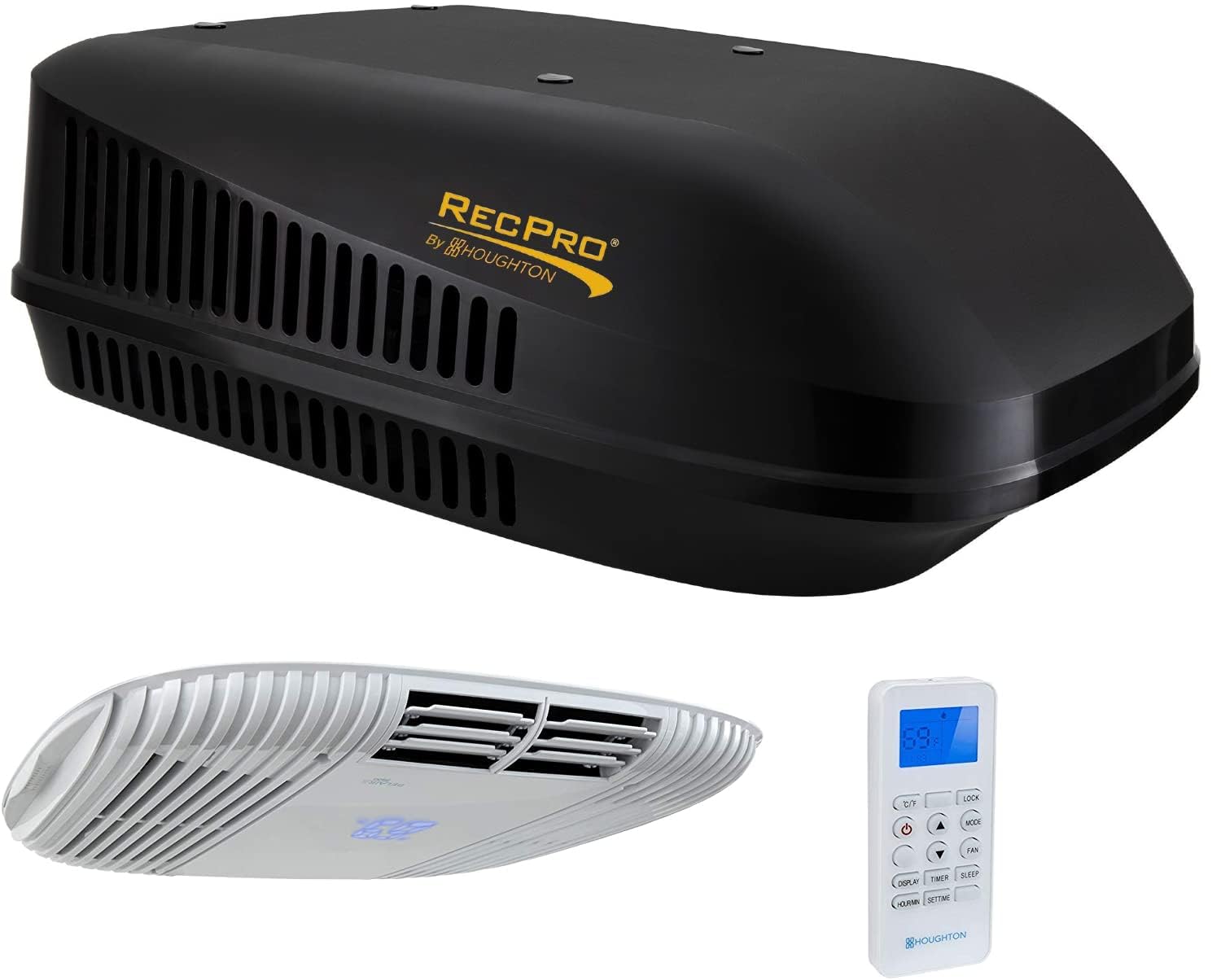
The RecPro 15K is the most flexible unit in this list because it works with both ducted and non-ducted systems straight out of the box. Its 15,000 BTU output is paired with a heat pump for 4-season use, and the scroll compressor draws low amps—making it viable for 30-amp campgrounds without tripping breakers. The noise level is rated at 55.4 dB, which is quieter than a Dometic Briskair but louder than the 43dB inverter models. For the price, you get a lot of capability in a single rooftop unit.
The LED touchscreen display on the ceiling assembly and the included wireless remote mean you won’t need to run thermostat wiring. The unit’s aerodynamic, UV-resistant shell reduces drag and should hold up against sun exposure over multiple seasons. Owners frequently note that the heat pump is a game-changer for shoulder-season camping, eliminating the need to fire up the propane furnace on cool spring mornings.
On the noise front, some owners report the fan runs continuously in heat pump mode to prevent coil freezing, which can be a minor annoyance at night. The plastic shell has also shown small stress cracks in a few units, though these appear cosmetic and don’t affect cooling performance. It’s a well-built unit but not silent—consider this if you prioritize absolute quiet over flexibility.
Why it’s great
- Ducted and non-ducted compatible in one unit
- Low amp draw for 30A campgrounds
- Integrated heat pump for 4-season comfort
Good to know
- 55.4 dB is louder than premium inverter units
- Plastic shell may develop cosmetic cracks
4. Furrion Chill Cube 18K BTU Variable Speed

The Furrion Chill Cube is the most powerful unit here at 18,000 BTU, but its real strength is the variable-speed compressor that continuously ramps up and down instead of cycling on and off. This eliminates the abrupt amp spikes that trip breakers—steady-state draw is around 850 watts, roughly half of what a standard 15K unit pulls. That makes it exceptionally friendly for solar setups, lithium battery banks, and 30-amp pedestals where every watt counts. The unit weighs 72.4 lbs, about 10% lighter than comparable models, and its aerodynamic black housing reduces drag on the highway.
The Chill Cube requires a separate Air Distribution Box (ADB) sold separately, which adds to the total cost but gives you the option of ducted or non-ducted installation. Owners who replaced older Dometic units report dramatically quieter operation—even in Turbo mode, the mechanical noise is lower than the fan on a tower cooler. In a 37-foot fifth wheel, a single 18K unit maintains 72°F in 95°F sun with no problem.
Not everything is perfect. The variable-speed compressor in some units produces a low-frequency vibration that resonates through the RV frame, and the taller profile may not fit under some low-clearance covers. There is also no heat strip option available despite the heat label on some listings, so this is strictly a cooling unit. Plan for an electric space heater or furnace for below-freezing nights.
Why it’s great
- 18K BTU with variable speed for amp efficiency
- Quiet ducted operation
- Lightweight at 72.4 lbs
Good to know
- ADB sold separately—adds to cost
- No heat pump; cooling only
5. Coleman-Mach 15 48204 Series

The Coleman-Mach 15 is a battle-tested upper unit that delivers 15,000 BTU of cooling through a scroll compressor and 1/3 HP fan motor. It is designed as a direct replacement for the Mach 3 series and fits standard 14×14 roof openings. The external shroud measures 13.8 inches high, which is slightly taller than some low-profile units, so verify your cover clearance before ordering. This is an upper unit only—you will need a separate ceiling assembly and control system to complete the installation.
Owners report that this unit produces noticeably colder air than the 13.5K BTU Mach 3, with supply air temperatures dropping 15-20°F below ambient. In a 33-foot Class A motorhome, a single Mach 15 keeps the interior frigid even in South Florida summers. The 2-piece shroud design makes installation easier than the older Mach 3, and the pre-installed foam seal is watertight. It is also surprisingly quiet for a non-inverter unit—quieter than the Mach 3 13.5K in owner comparisons.
The catch is weight: at over 80 lbs, lifting it onto the roof is a two-person job. Some units have arrived with damaged shrouds or missing internal components like freeze sensors, and warranty support can be slow. Also, because it lacks an inverter soft-start, the startup amp draw can surge above 18 amps, requiring a 3500-watt generator or a hard-start capacitor for smaller generators.
Why it’s great
- Proven cold air output in extreme heat
- Quieter than older Mach 3 units
- Fits standard 14×14 roof openings
Good to know
- Upper unit only—no ceiling assembly included
- Heavy at 80+ lbs—requires two people
6. TURBRO Inverter 13.5K BTU RV Air Conditioner

The TURBRO 13.5K Inverter is a game-changer for anyone running a smaller power system. Its inverter compressor starts at just 1.6 amps and runs at a steady 9 amps while cooling—meaning it can operate off a 1500-watt inverter and 200 amp-hours of battery without a soft starter. The unit is only 10 inches thick, making it 35% thinner than most rooftop ACs, which reduces air drag and improves fuel efficiency on highway drives. It also includes a heat pump with up to 4x the output of traditional electric heaters, plus fan and dry modes for dehumidification.
The slim profile fits all RVs, campers, and food trucks with a 14.25 x 14.25-inch roof opening, and the modular ducting design supports flexible installation. The ceiling assembly features an LED atmosphere light in blue, yellow, or white, and control is handled via WiFi app or physical remote. Owners who replaced a Coleman 13.5K report vastly improved comfort with no temperature freeze-thaw spikes, and the heat pump works reliably down to about 20°F ambient.
Noise is the main compromise: even at low fan speed, the unit is louder than premium inverter models from TOSOT or FOGATTI, and the built-in thermostat can read 10-15°F low because the plastic housing gets cold and skews the sensor. A workaround using the Tuya app with an external sensor helps, but it’s an extra step. For the inverter efficiency and sub-2-amp startup alone, though, this is a great fit for off-grid campers.
Why it’s great
- 1.6 amp startup—runs on small inverters
- Only 10 inches thin
- Heat pump for year-round use
Good to know
- Loud even on low fan setting
- Thermostat reads low due to plastic cover
7. Dometic FreshJet 3 Series 15K BTU

The FreshJet 3 Series from Dometic is built around a lightweight design that reduces roof load, making it a strong choice for older campers or weight-sensitive rigs. The 15,000 BTU output is paired with Dometic’s proprietary e-coated evaporator coils, which use a flexible epoxy polymer coating to resist corrosion much better than bare copper or aluminum coils. For coastal campers or anyone parking near saltwater, this feature alone can add years of life. The unit is backwards-compatible with existing Dometic ADB (air distribution box) units for a straightforward swap.
Owners upgrading from the Dometic Briskair II report a significant drop in noise—the FreshJet is much quieter even at higher fan speeds. Continuous draw runs about 1.6-1.7 kW while cooling, with the fan pulling around 450W. Startup is around 2000W, which is manageable with a 3500W generator. Installation is plug-and-play if you already have a Dometic ceiling assembly, taking about 1.5 hours with two people. The cooling performance is impressive: one owner cooled a 25-foot trailer from 80°F to 64°F in 30-45 minutes.
The packaging has been a recurring issue: several units arrive with broken mounting tabs or damaged foam seals due to insufficient padding in the box. Dometic’s customer service can resolve damage claims, but the inconvenience is frustrating for a unit at this price. Also, a small number of owners report the wire to the compressor burning up after two months, suggesting a quality-control gap in some production batches.
Why it’s great
- E-coated coils resist corrosion
- Quieter than older Dometic models
- Lightweight for easier roof installation
Good to know
- Packaging often damaged in transit
- Some quality-control issues reported
8. ASA Electronics ACM135 Advent Air 13.5K BTU

The ASA Advent Air ACM135 is a straightforward, no-frills rooftop unit that delivers 13,500 BTU of cooling through a rigid metal base pan and a thick watertight vent opening gasket. It is built for standard 14.25 x 14.25-inch roof openings and runs on 115V AC power. Three fan speeds give you basic airflow control, and an optional plug-in heat strip is available if you want supplemental warmth. For the price, you get a durable, simple-to-service unit with no WiFi, no inverter, and no app to mess with—just cooling.
Owners in the Southwest have reported that it keeps a trailer cool even in 115°F+ Arizona heat when powered by a 3500W generator. Several reviewers used it as a direct replacement for a failed Dometic unit and found the ASA to blow colder air while running quieter. Installation is straightforward for anyone comfortable on a roof, but you will need a ceiling assembly as this is an upper unit only.
The biggest issue is inconsistency in what you receive. Some buyers report that the unit arrives without the ceiling assembly, controls, manual, wiring diagram, or mounting bracket, even though the listing implies a complete set. The included mounting screws have also been reported as too short by multiple owners. Make sure to read the listing carefully and confirm you are getting the full package or order the control kit separately.
Why it’s great
- Rugged metal base pan for durability
- Cools well in extreme ambient heat
- Simple design—easy to service
Good to know
- Upper unit only—may lack ceiling assembly
- Mounting screws may be too short
9. VEVOR RV Air Conditioner 15000 BTU
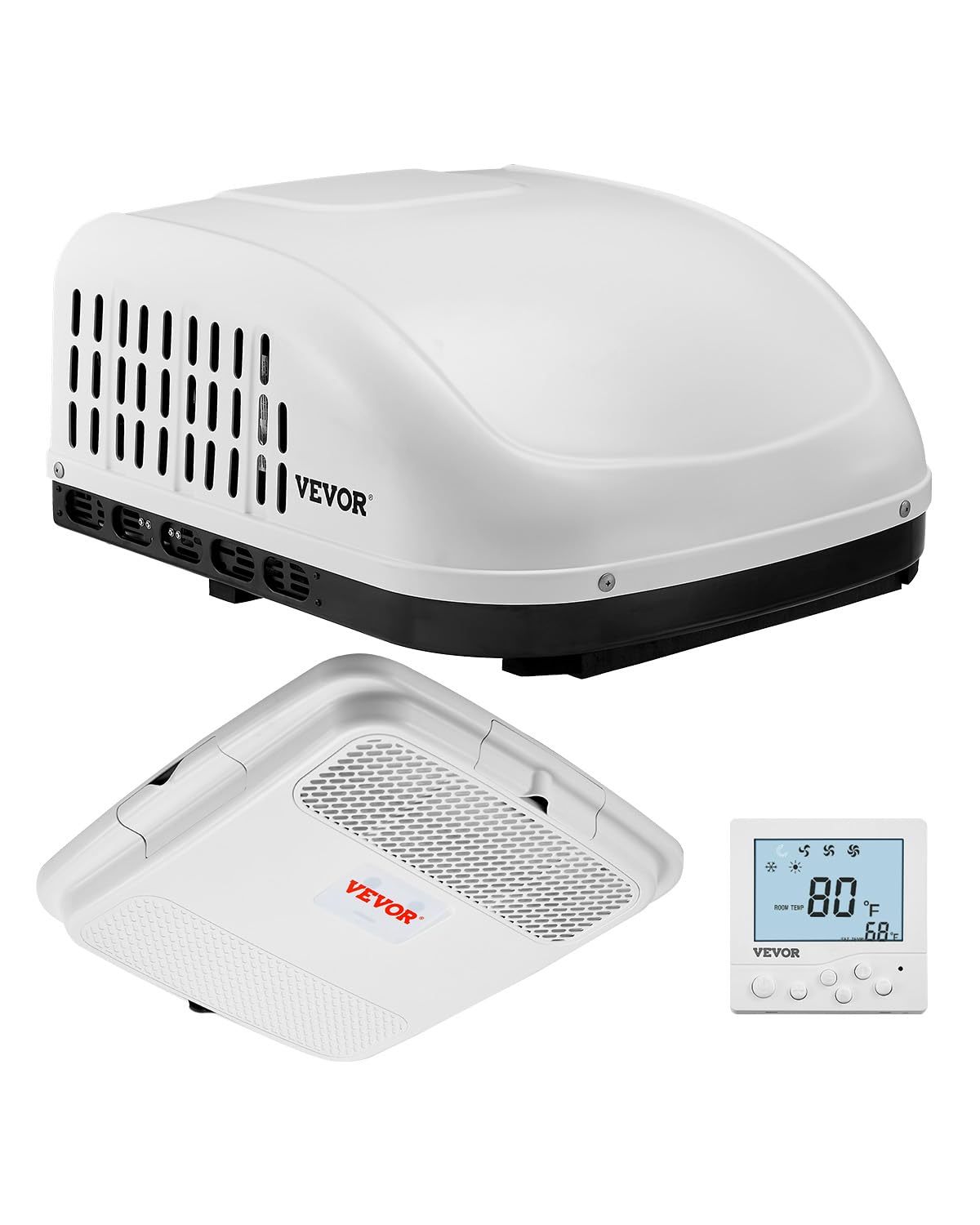
The VEVOR 15K uses R32 refrigerant, which has a lower global warming potential than R410A and cools slightly more efficiently at the same pressure. The 15,000 BTU compressor delivers 4395W of cooling power for spaces up to 129 square feet, and the unit claims a 10-minute cooldown time from activation. Three modes—Auto, Cooling, and 3-Speed Fan—are controlled through an intuitive ceiling-mounted panel, and the 65dB noise rating is reasonable for the BTU class. The non-ducted design fits standard 14.25 x 14.25-inch openings without ductwork modifications.
The EPP material shell provides good insulation and resists deformation from sun exposure. Owners report that delivery times are often faster than expected, and the unit cools extremely well once installed, maintaining temperatures well below the setpoint. The included instructions are clear, and the R32 refrigerant charge is pre-installed, so there is no need for vacuuming or charging.
Quality control is a polarizing issue: some owners describe the unit as a piece of junk that cycles on and off every 2-3 minutes without cooling effectively, while others praise its performance in hot conditions. The 65dB noise floor is louder than the premium inverter units, and some units have had defective compressors straight out of the box. For the price, you are rolling the dice on consistency, so buy from a seller with a good return policy.
Why it’s great
- R32 refrigerant for lower eco-impact
- Fast shipping and easy installation
- Pre-charged—no HVAC tools needed
Good to know
- Variable quality control—some units defective
- 65dB noise is louder than premium options
10. Dometic Penguin II 13.5K BTU

The Dometic Penguin II stands out for its low-profile design—just 12.75 inches tall—which reduces wind resistance and improves highway fuel economy. The EPP foam housing keeps the unit lightweight while improving cooling efficiency, and the rib-reinforced base pan adds structural durability for rough roads. It uses R-410A refrigerant, which is more eco-friendly than older R-22 systems. This is a cool-only unit with no pre-installed controls, so you will need a separate CCC2 or CT thermostat to make it run.
Owners who upgraded from a Coleman Mach 3 report significantly better cooling on a 32-foot trailer in 90°F heat, and the unit works well with a conversion kit for non-standard roof cutouts. The “cool shot” feature directs a blast of air for initial cool-down, which is useful during the first few minutes after parking. The low-profile height is a major advantage if you store your camper in a low-clearance garage or drive through areas with height restrictions.
The main drawback is that this unit is not very quiet—it’s rated at 1 Sone, which translates to roughly the noise of a quiet refrigerator, but in a camper directly above the bed, it is clearly audible. The unit also requires a separate thermostat and control board, which adds cost and complexity to the install. Make sure your camper has the CCC2 wiring harness already installed, or budget for the adapter kit when pricing the total project.
Why it’s great
- Low-profile 12.75-inch height for clearance
- R-410A refrigerant is eco-friendly
- Rib-reinforced base for road durability
Good to know
- Cooling only—no heat pump option
- Requires separate thermostat and wiring
11. ZAFRO Smart Inverter Portable 16000 BTU
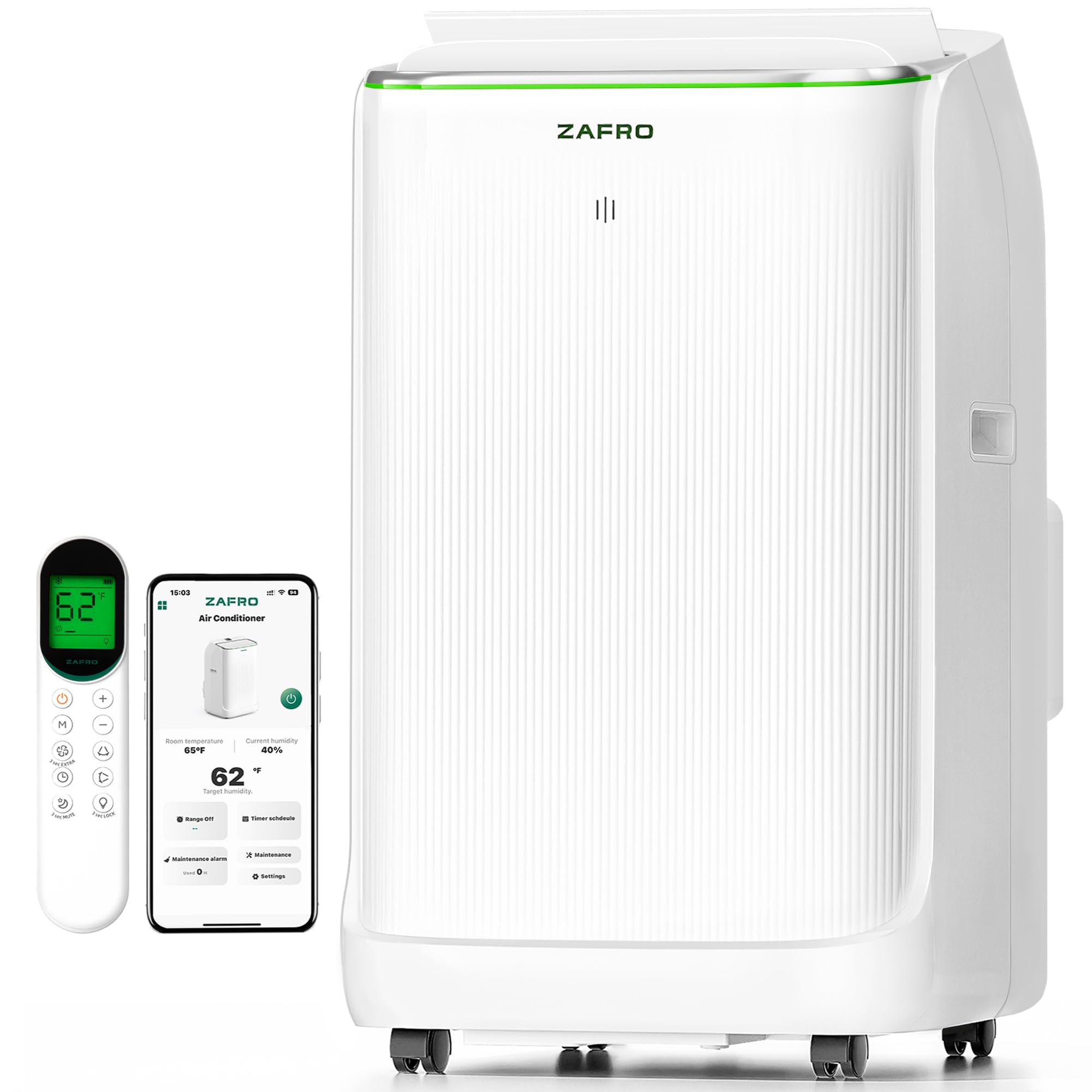
The ZAFRO is the only portable option in this roundup, and it serves a very specific niche: campers, tents, and small vans that lack a roof opening or cannot support a rooftop unit’s weight. Its 16,000 BTU (12,000 BTU SACC) dual-hose system delivers 500 cubic meters per hour of airflow, and the inverter compressor reduces energy consumption with a CEER of 12.8—well above the 7.83 standard. The self-evaporating system eliminates manual draining for up to 72 hours in humidity under 90%, which is a major convenience for campers who do not want to empty a bucket every few hours.
The ZAFRO runs at 42dB in sleep mode, making it one of the quietest portable units available. The smart app and remote control let you schedule cooling remotely, and the six operating modes (Cool, Dry, Fan, Sleep, Extra, Eco) give you flexibility for different weather conditions. Four-way oscillation directs airflow both vertically and horizontally. For off-grid setups, the inverter’s soft start is compatible with smaller generators and battery inverters.
The major trade-off is that a portable unit requires window access for the dual exhaust hoses, which means you will need a window adapter kit and some installation effort every time you set up camp. The included window panel is also reported as too thin, leaving gaps that reduce cooling efficiency. It is a solid solution for temporary setups, but for a permanent camper installation, a rooftop unit will always be cleaner and more efficient.
Why it’s great
- 72-hour drainage-free operation
- 42dB quiet sleep mode
- App control with 6 operating modes
Good to know
- Needs window access for exhaust hoses
- Window panel may leave gaps
FAQ
How many BTU do I need for a 30-foot travel trailer?
Can I run a rooftop AC off a 2000W generator?
What is the difference between ducted and non-ducted AC in an RV?
Is a heat pump worth the extra cost for a camper AC?
Final Thoughts: The Verdict
For most users, the best camper ac unit winner is the FOGATTI 16K BTU because it combines the highest cooling capacity with whisper-quiet 43dB operation and a heat pump, all in a low-profile package that fits standard roof openings. If you prioritize extreme energy efficiency for off-grid solar setups, grab the TURBRO Inverter 13.5K. And for flexibility between ducted and non-ducted systems, nothing beats the RecPro 15K.