
A camper that feels like a refrigerator at 3 AM isn’t a retreat — it’s a survival test. The right heat source transforms a cold tin box into a cozy sanctuary, whether you’re boondocking in subzero temps or just trying to take the chill off a weekend trip. Propane, diesel, and electric options each deliver very different heat experiences, and choosing wrong means restless nights or wasted fuel.
I’m Min — the co-founder and writer behind Gadgets Feed. My research for this guide involves cross-referencing BTU ratings, fuel consumption rates, safety certifications, and real-world user data from hundreds of cold-weather campers to separate the heaters that hold up from the ones that flicker out.
Whether you run a pop-up trailer, a converted van, or a hard-sided RV, the best camper heater for your rig comes down to fuel availability, space size, and how much quiet you need when the mercury drops.
How To Choose The Best Camper Heater
Selecting a heater for a camper is not the same as picking one for a garage or a living room. The confined volume, limited ventilation, and reliance on battery or LP reserves demand a tighter set of criteria. Focus on these three pillars before you buy.
Fuel Type Determines Your Freedom
Propane heaters are the most common — easy to find, simple to operate, and many are certified for indoor use with low-oxygen shutoff sensors. Diesel heaters dominate the van-life crowd because they sip fuel from your vehicle’s tank and produce dry, forced-air heat without open flames. Electric camper heaters are quiet and require zero combustion, but you need shore power or a hefty battery bank to run them beyond a few hours. Match the fuel to how you camp: propane for weekenders, diesel for extended off-grid trips, electric for hookup-only stays.
BTU Output vs. Camper Volume
A common mistake is over-buying BTU output for a small space. A 4,000 BTU heater easily warms a 100-square-foot tent or small pop-up, while a 9,000 BTU unit handles a 225-square-foot RV cabin. Diesel heaters in the 5kW to 8kW range (roughly 17,000 to 27,000 BTU) can heat a well-insulated Class C or a small bus. Oversizing wastes fuel and creates uncomfortable temperature swings. Measure your camper’s floor area in square feet, then match it to the heater’s rated coverage.
Safety Certifications Aren’t Optional
Any heater used inside a camper while people sleep must have an Oxygen Depletion Sensor (ODS) and a tip-over automatic shutoff. These are mechanical dead-man switches that cut the gas or fuel instantly if oxygen drops or the unit gets knocked over. For diesel heaters, look for models with sealed combustion chambers and exhaust routing that vents outside the vehicle — never pipe exhaust into the living space. Always pair any combustion heater with a separate battery-powered CO detector for redundancy.
Quick Comparison
On smaller screens, swipe sideways to see the full table.
| Model | Category | Best For | Key Spec | Amazon |
|---|---|---|---|---|
| Mr. Heater Portable Buddy | Propane Radiant | Small campers & tents | 9,000 BTU / 225 sq ft | Amazon |
| VEVOR All-in-One Diesel Heater | Diesel Forced Air | Off-grid RVs & vans | 8 kW / 215-269 sq ft | Amazon |
| Ruasveltan 18,000 BTU Propane Heater | Propane Radiant | Large RVs & cabins | 18,000 BTU / 450 sq ft | Amazon |
| Caframo True North | Electric Forced Air | Shore-power campers | 5,200 BTU / 170 sq ft | Amazon |
| LF Bros 5kW Diesel Heater | Diesel Forced Air | Garages & medium campers | 17,000 BTU / 215-269 sq ft | Amazon |
| Heat Hog 4,000 BTU Propane Heater | Propane Radiant | Ultra-compact tents | 4,000 BTU / 100 sq ft | Amazon |
| Dometic FreshJet 3 Series | RV Rooftop A/C | Cooling & heating RVs | 15,000 BTU / Noise 58.5 dB | Amazon |
In‑Depth Reviews
1. Mr. Heater Portable Buddy 9,000 BTU
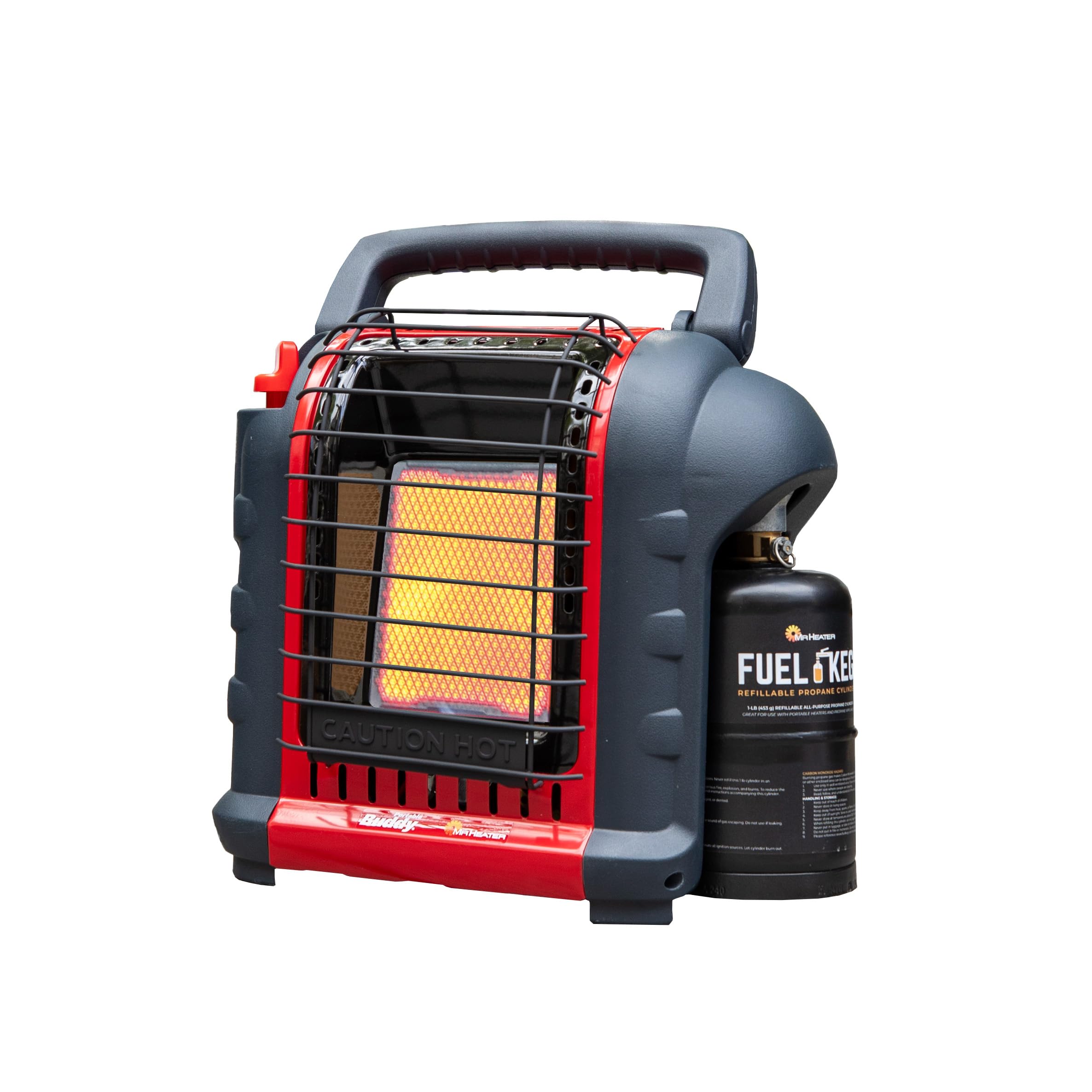
The Mr. Heater Portable Buddy is the most trusted propane camper heater on the market for good reason. It delivers 4,000 or 9,000 BTU of radiant infrared heat, covering up to 225 square feet — plenty for a small RV, large tent, or truck camper. The piezo ignition lights reliably on a flat surface, and the self-extinguishing cabinet materials add a layer of fire safety that budget units skip entirely.
On the low setting, a 1-pound propane cylinder runs about 5.4 hours, which covers a full night of sleep. Users consistently report that it can warm a 10×10 tent from near-freezing to comfortable in under 30 minutes. The radiant heat feels like standing next to a portable sun — no noisy fan, no forced air, just silent infrared warmth that penetrates clothing and bedding.
The built-in low-oxygen sensor and tip-over shutoff make it one of the few propane heaters certified for indoor recreational use. One nuance: after changing the tank, you need to bleed the air from the fuel line and let the pilot stabilize for 30-60 seconds before the burner stays lit. Pair it with a 20-pound tank and a hose kit for multi-night trips without swapping disposables.
Why it’s great
- Dual heat settings give precise BTU control for different camper sizes
- ODS and tip-over shutoff meet indoor safety standards
- Silent operation with no fan noise
Good to know
- Radiant heat doesn’t circulate behind obstacles or into adjacent rooms
- Fuel line needs bleeding after every tank change
2. VEVOR 8kW All-in-One Diesel Heater
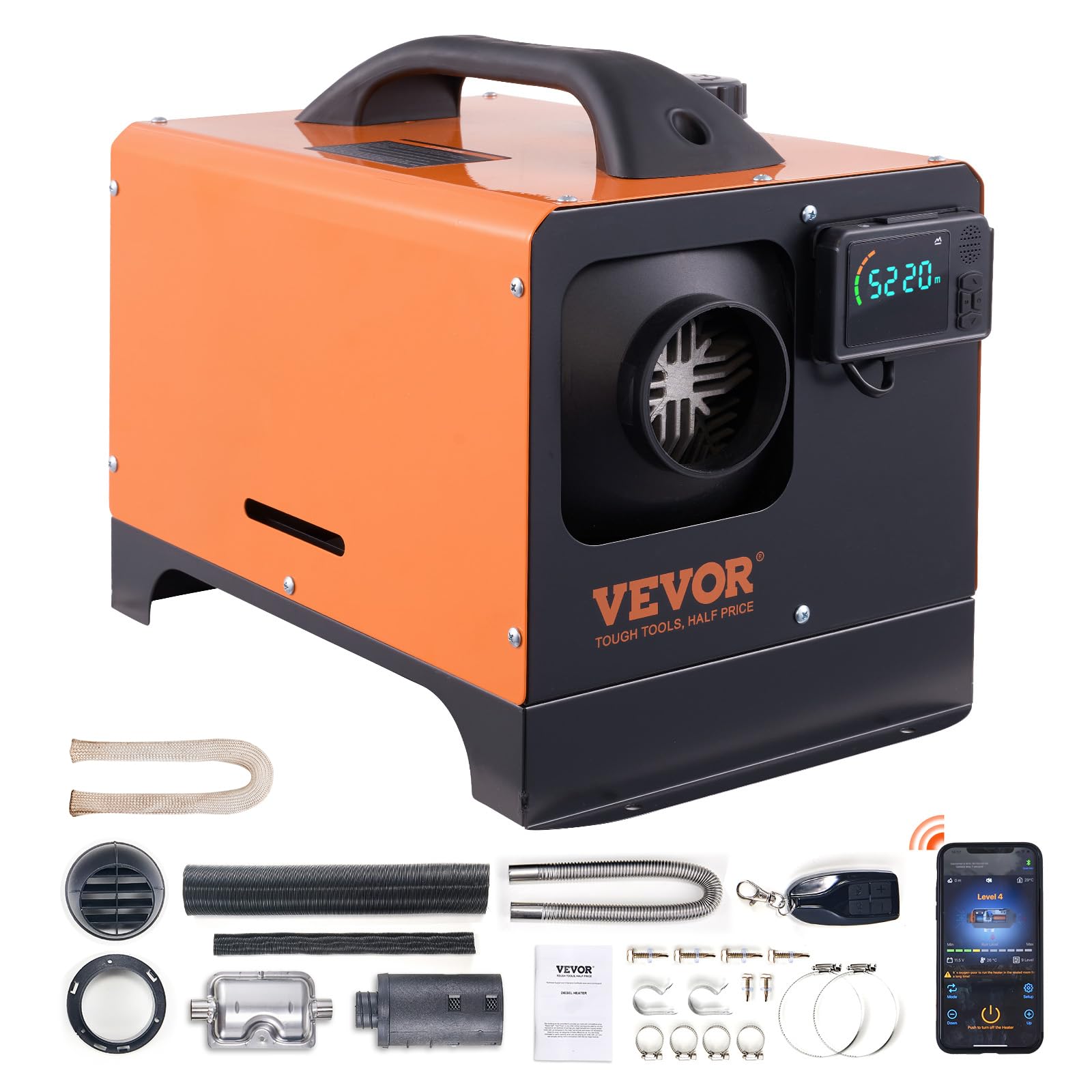
For extended boondocking in extreme cold, the VEVOR 8kW diesel heater is a powerhouse that changes the game. It produces 8 kW of forced-air heat (roughly 27,000 BTU) and covers 215-269 square feet — enough to warm a fifth-wheel or a small skoolie. The all-in-one design means the fuel tank, burner, and controller are integrated into a single portable unit, so no complex installation is required.
This unit runs on 12V DC from your vehicle battery, consuming about 1 gallon of diesel per night at moderate settings. The automatic altitude compensation adjusts combustion up to 18,045 feet, making it viable for mountain camping without manual tweaking. The Bluetooth app control lets you preheat the camper from up to 98 feet away — game-changer for cold mornings.
Real-world reports show it maintaining 65-75°F inside a 400-square-foot insulated garage during subzero conditions. The low-noise fuel pump is quieter than many competitors, though some users note a faint clicking rhythm at idle. The overheating protection kicks in at 518°F, and the unit includes a voice broadcast for status alerts. The only trade-off is that the 5-liter tank runs about 8 hours at full output — plan for refueling overnight on long trips.
Why it’s great
- Portable all-in-one design with no permanent installation needed
- Bluetooth app control for remote preheating
- Altitude compensation up to 18,000 feet
Good to know
- Fuel pump noise may be audible in quiet RVs
- Some units experience temp sensor failures within months
3. Ruasveltan 18,000 BTU Propane Cabinet Heater
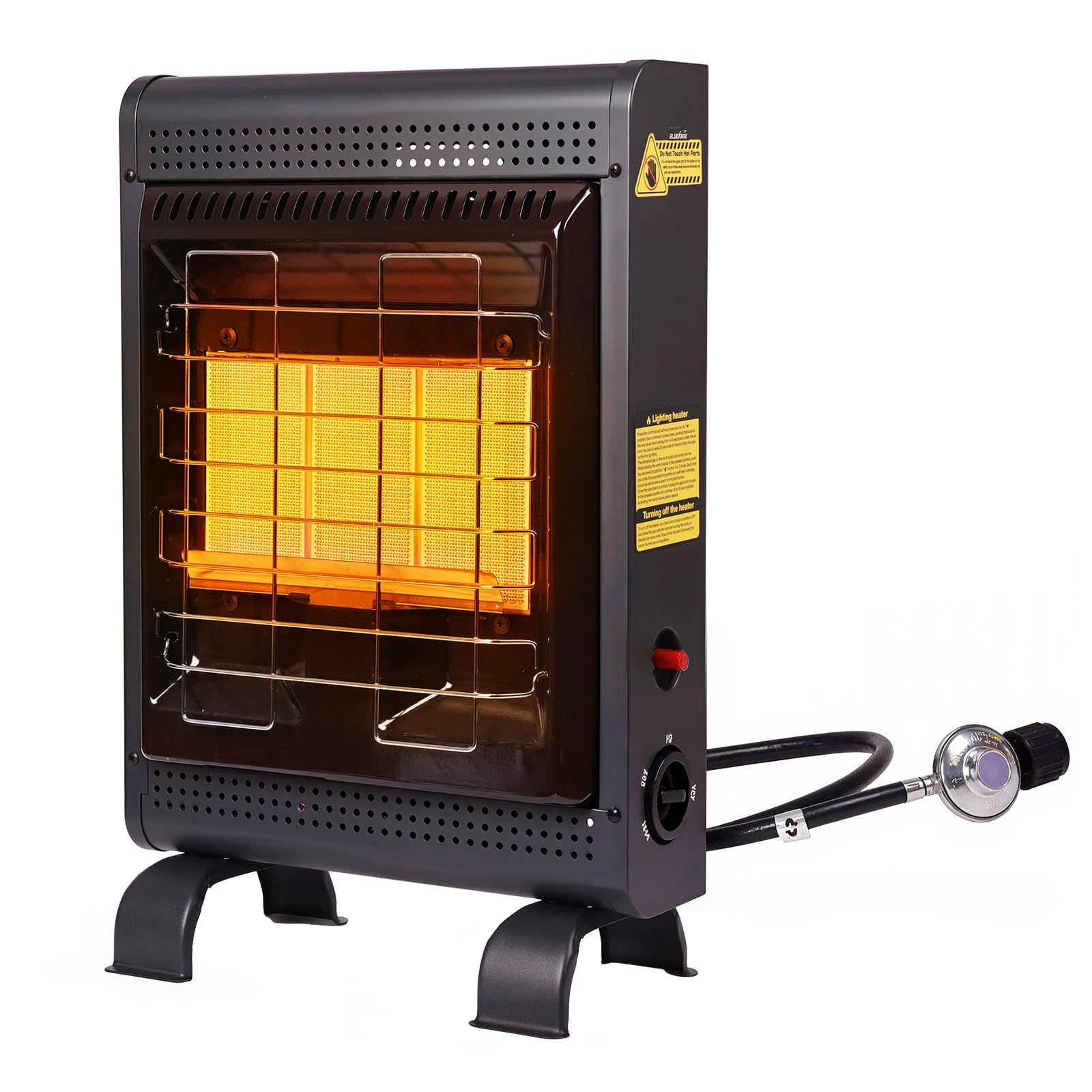
When you need serious heating muscle for a larger RV, cabin, or workshop, the Ruasveltan 18,000 BTU propane heater delivers three adjustable heat settings — 6,000, 12,000, or 18,000 BTU — covering up to 450 square feet. The collapsible cabinet design wraps around a standard 20-pound propane tank, making it stable and self-contained without requiring a dedicated fuel line or external hose.
The ceramic radiant panel uses infrared heat that warms people and objects directly rather than circulating hot air. This is ideal for drafty spaces where forced-air heat escapes quickly. On the low setting, the manufacturer claims up to 69 hours of runtime from a single 20-pound tank — enough for an entire long weekend without refueling. The built-in windscreen helps when using it on a porch or patio in breezy conditions.
The dual safety setup includes an ODS for low-oxygen detection and a tip-over auto shutoff. One important handling note: the initial ignition produces a small blue flame from the front grill, so stand to the side rather than directly in front when lighting. Users report that it warms a living room-sized space effectively during power outages, and it runs silently since there is no fan or blower motor.
Why it’s great
- Three-stage BTU control for precise temperature management
- Collapsible cabinet fits around standard 20 lb propane tank
- 69-hour runtime on low setting
Good to know
- Initial ignition produces a flame that shoots from the front grill
- Some users report persistent ceramic odor during first break-in
4. Caframo True North 5,200 BTU Electric Heater

The Caframo True North is the gold standard for electric camper heating — built in Canada with a 5-year warranty, a solid steel housing, and a low-profile design that prevents tip-overs. It outputs 5,200 BTU (1,500 watts) with three heat levels and two fan speeds, covering up to 170 square feet. This is a forced-air heater, so it circulates warmth evenly rather than blasting one spot with infrared radiation.
The standout feature is the anti-freeze setting, which automatically turns the heater on when the ambient temperature drops to 38°F. This is invaluable for winter RV storage or for campers who leave their rig parked in cold climates. The mechanical controls mean it won’t need a reset after a power outage — it returns to the last setting automatically, which is critical for unattended freeze protection.
Users consistently praise its quiet operation — the fan on low is barely audible, making it suitable for sleeping spaces. At 12.5 amps on high, it can run on most 15-amp camper circuits without tripping breakers. The compact footprint (11.25 x 8 x 5 inches) tucks into tight corners. The only limitation is that it requires shore power or a robust inverter system — it’s not an off-grid solution.
Why it’s great
- Anti-freeze mode automatically protects against freezing temps
- All-metal construction with 5-year warranty
- Mechanical controls survive power outages without reset
Good to know
- Requires shore power — not suitable for off-grid boondocking
- Internal thermostat may drift over years of use
5. LF Bros 5kW All-in-One Diesel Heater
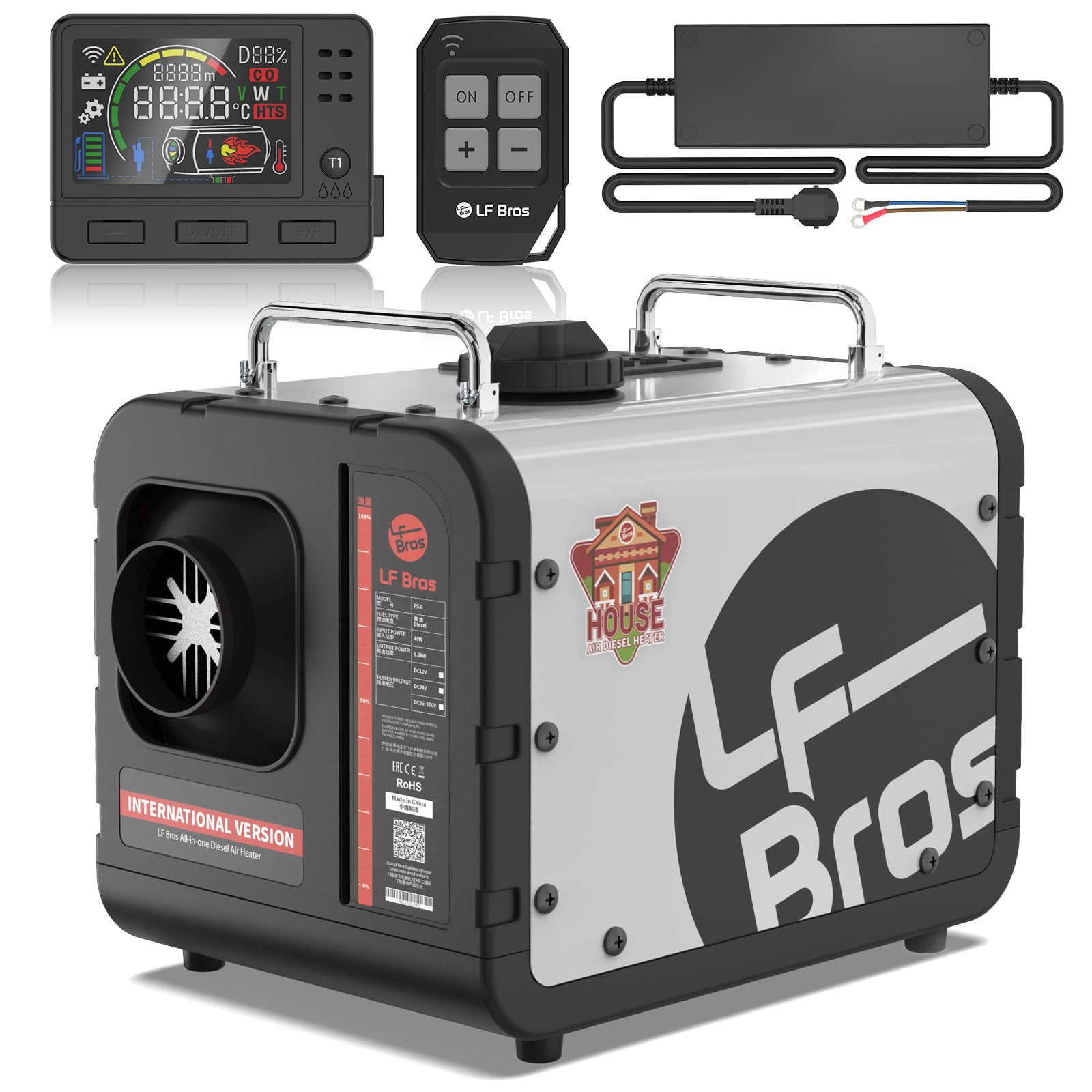
The LF Bros 5kW diesel heater bridges the gap between portable convenience and premium build quality. It supports 12V, 24V, and 110V power inputs — the included 110V transformer means you can plug it directly into a wall outlet in your garage, basement, or camper without buying extra parts. The 17,000 BTU output heats 215-269 square feet, making it suitable for medium RVs, pop-ups, and workspaces.
What sets this unit apart is the spill-proof fuel tank cover with internal threading — similar to a car’s gas cap — which prevents diesel from sloshing out on rough roads. The LCD remote works up to 100 feet, and the pump is notably quieter than many budget Chinese diesel heaters. Users report that 1 gallon of diesel lasts 8-12 hours at full power and over 19 hours on low, making fuel costs negligible compared to propane.
The packaging is premium — the heater arrives in a foam-protected box that doubles as storage for the off-season. Customer service responsiveness is a recurring theme in user reviews, with several reports of DOA units being replaced without requiring the defective item to be returned first. The only installation quirk is that the exhaust routing requires the muffler to be placed first in the line, which some users reroute with a purchased elbow adapter.
Why it’s great
- Triple-voltage support (12V/24V/110V) with included transformer
- Spill-proof fuel cap prevents diesel leaks on bumpy terrain
- Long runtime — 19+ hours per gallon on low setting
Good to know
- No dedicated outside air intake for combustion
- Exhaust muffler placement may require modification for ideal routing
6. Heat Hog 4,000 BTU Propane Radiant Heater
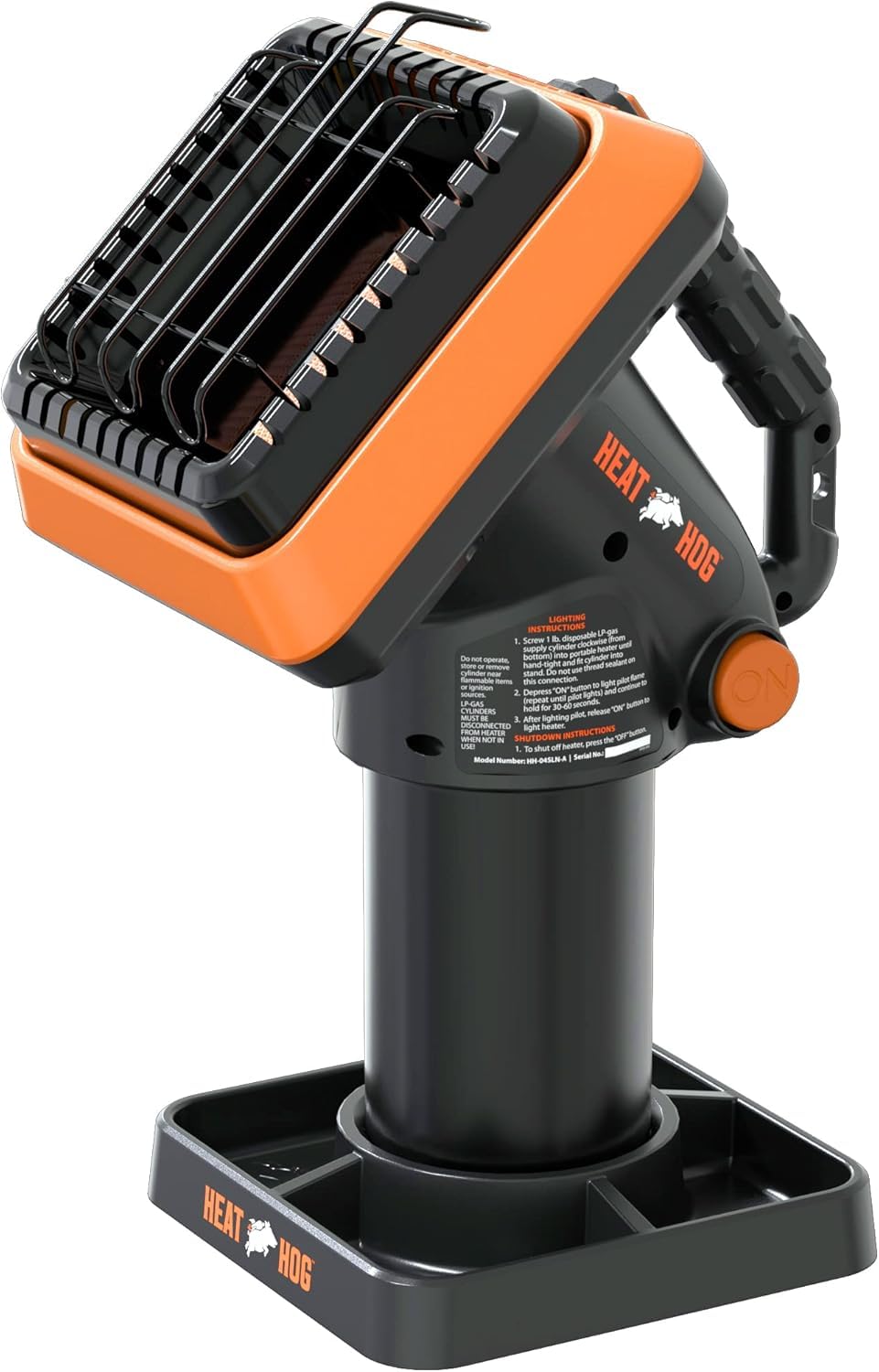
The Heat Hog 4,000 BTU is a compact, entry-level propane radiant heater designed for small spaces up to 100 square feet — perfect for a two-person tent, a small pop-up, or a boat cabin. The angled head design allows you to direct the heat exactly where you need it, and the curved plaque technology widens the heating arc by 33 degrees compared to standard flat-panel radiants.
It runs on standard 1-pound propane cylinders and requires no electricity at all — pure mechanical simplicity. The safety guard, tip-over switch, and ODS sensor provide the same protection found on units twice the price. Users report that it keeps tent bedding warm when aimed inside from an open flap, and it’s light enough to toss in a gear bag without thinking twice.
The main caveat is quality control — multiple customer reviews mention receiving units in clearly returned, damaged packaging that were defective on arrival. The company’s customer service is responsive (they shipped replacements quickly), but the initial failure rate is higher than average. If you get a working unit, it performs exactly as advertised for small-space heating. It’s best bought as a backup or for short trips where packing light matters most.
Why it’s great
- No electricity required — runs purely on propane
- Angled head directs heat precisely where needed
- Compact and lightweight for backpacking
Good to know
- Quality control issues — some units arrive previously returned and defective
- Only 4,000 BTU — insufficient for camper vans or larger tents
7. Dometic FreshJet 3 Series 15K BTU Rooftop AC

The Dometic FreshJet 3 Series is a rooftop air conditioner and heat pump designed specifically for RVs, delivering 15,000 BTU of cooling and heating power. This is not a portable unit — it requires rooftop installation with a 14×14 inch opening, making it suitable for RVs that already have a roof penetration. The lightweight design (just under 80 pounds) reduces roof load compared to older Dometic models.
The e-coated evaporator coils are a unique differentiator — Dometic is the only RV HVAC manufacturer using this flexible epoxy polymer coating, which provides exceptional corrosion resistance against road salt, humidity, and UV exposure. At 58.5 decibels, it’s noticeably quieter than the older Briskair II units. The SEER rating of 13 is respectable for RV equipment, translating to lower power draw during extended use.
It is backwards-compatible with existing Dometic ADB control boxes, so upgrading a 13.5K or 15K unit often takes under an hour as a plug-and-play swap. Startup draw hits about 2,000 watts before settling to 1.6-1.7 kW steady-state, which requires a 30-amp shore connection or a generator with enough surge capacity. The main reliability concern is that some units have experienced burnt compressor wires after two months, though Dometic’s customer service generally handles replacements.
Why it’s great
- E-coated evaporator coils resist corrosion far longer than standard coils
- Plug-and-play upgrade for existing Dometic roof openings
- Quieter operation than previous generation RV ACs
Good to know
- Requires permanent rooftop installation — not portable
- Needs 30-amp shore power or generator — not suitable for off-grid
FAQ
Can I safely use a propane camper heater inside my tent while sleeping?
What size diesel heater do I need for a medium-sized RV?
How long does a 1-pound propane cylinder last in a camper heater?
Can I leave a camper heater running unattended overnight?
Final Thoughts: The Verdict
For most users, the best camper heater winner is the Mr. Heater Portable Buddy because it strikes the perfect balance of safety-certified indoor use, silent radiant heat, and dual BTU settings that adapt to tents or small RVs. If you want diesel-powered long-range autonomy for off-grid trips, grab the VEVOR 8kW All-in-One Diesel Heater with its Bluetooth preheating and altitude compensation. And for shore-power campers who value silent electric warmth with automatic freeze protection, nothing beats the Caframo True North with its anti-freeze mode and 5-year warranty.