
A camper inverter is the component that separates glamping from roughing it, turning your 12V battery bank into the 120V AC power your appliances actually speak. Unlike a generator, an inverter hums along silently behind a cabinet, giving you a microwave, a CPAP machine, a refrigerator, and charging ports without fumes or noise that disturb the peace. The critical difference between a reliable build and a frustrating one comes down to waveform type, surge capacity, and how low the idle draw sips from your battery overnight.
I’m Min — the co-founder and writer behind Gadgets Feed. Over many hours of technical research, I’ve parsed spec sheets and real-world test logs for pure sine wave inverters, focusing on surge handling, conversion efficiency, and compatibility with modern lithium battery chemistry.
This guide breaks down the most capable 12V and 24V pure sine wave units on the market to help you find the best camper inverter for your rig, battery capacity, and power budget.
How To Choose The Best Camper Inverter
Picking the right inverter for your camper means understanding your power load, battery voltage, and installation constraints. A mismatch here leaves you either unable to start your air conditioner or draining your battery bank to zero before sunrise.
Match Continuous Wattage to Your Largest Appliance
Every inverter is rated for continuous wattage and surge wattage. A 2000W continuous inverter can run a 1500W microwave plus some lights, but the surge rating (often 4000W for a few seconds) needs to cover the startup draw of a rooftop air conditioner or a water pump. If your rig runs a 15,000 BTU AC, you need at least 2000W continuous plus strong surge capability — or consider a 3000W unit for headroom.
Pure Sine Wave vs. Modified Sine Wave
All premium camper inverters sold today are pure sine wave. Modified sine wave units create audible buzzing in motors, cause electronics to run hot, and can damage sensitive devices like CPAP machines, laptop chargers, or variable-speed appliances. Pure sine wave delivers power indistinguishable from shore power at home, making it the only safe choice for a modern camper.
Idle Consumption and Battery Type Compatibility
An inverter left switched on but unloaded still draws power. A high-quality unit draws under 30W at idle, while older designs can suck 50W or more — that’s a 40Ah overnight drain on a 100Ah battery. Additionally, if you’re using LiFePO4 batteries, ensure the inverter has an adjustable low-voltage cutoff so it doesn’t shut down prematurely on a battery that still has usable capacity.
Quick Comparison
On smaller screens, swipe sideways to see the full table.
| Model | Category | Best For | Key Spec | Amazon |
|---|---|---|---|---|
| GIANDEL 2000W (PS-2000SDR) | Pure Sine Wave | Best Overall Balanced Pick | 90% efficiency, 4100W surge | Amazon |
| GIANDEL 2000W (GS-2000SAR-GFCI) | Pure Sine Wave | UL Listed Safety | UL/GFCI outlets, 4100W surge | Amazon |
| VOLTWORKS 2000W | Pure Sine Wave | Lithium Battery Tuning | Adjustable low-voltage cutoff | Amazon |
| LiTime 2000W | Pure Sine Wave | Four AC Outlets Built-In | 4 AC outlets, 4000W surge | Amazon |
| BELTTT 3000W | Pure Sine Wave | Heavy Load Headroom | 6000W peak, 23ft remote | Amazon |
| OLTEANP 2500W | Pure Sine Wave | Built-In Transfer Switch | 12ms auto ATS, 5000W peak | Amazon |
| GIANDEL 3000W | Pure Sine Wave | Max Surge & Timer | 6100W surge, programmable timer | Amazon |
| Renogy 2000W 24V | Pure Sine Wave | 24V Battery Systems | 92% efficiency, UL/CSA | Amazon |
| PowerDrive PWD3000P | Modified Sine Wave | Bluetooth Monitoring | BT app, 39in cables | Amazon |
In‑Depth Reviews
1. GIANDEL 2000W Pure Sine Wave Inverter (PS-2000SDR)

This GIANDEL 2000W unit hits the sweet spot of power, efficiency, and price for most camper vans and small RVs. With 2000W continuous output and a 4100W surge peak held for two seconds, it fires up a 1500W microwave or a 1350 BTU air conditioner without tripping. The pure sine wave output eliminates that annoying hum in audio equipment and keeps induction cooktops running smoothly. Owners report powering a pellet stove, WiFi, and a TV simultaneously from a 100Ah LiFePO4 battery with no cable warming or shutdowns.
The enclosure is aluminum alloy with an intelligent cooling fan that only kicks in when the internal temperature hits 35°C or the load exceeds 800W — that keeps the inverter whisper-quiet during light use. The package includes a 15-foot wired remote with an LCD screen showing input voltage, output wattage, and fault codes, plus a 20A hardwire terminal block for permanent installation. Three service centers in the US back the 18-month warranty, so support is local if you need it.
One experienced RVer noted that the unit requires proper gauge wiring (2 AWG for high loads) and that the remote must be held for four seconds to start certain electronic-switch tools — a minor ergonomic detail for an otherwise robust performer. For the vast majority of camper owners running typical loads, this is the most balanced choice on the list.
Why it’s great
- Clean pure sine wave with 90% conversion efficiency for longer battery run time
- Intelligent fan stays off at low load, reducing noise inside the camper
- UL-listed components and 18-month hassle-free warranty with US service centers
Good to know
- Wired remote requires a 4-second hold to engage some high-surge electronic tools
- Heavy gauge battery cables (2 AWG or thicker) recommended for full 2000W output
2. GIANDEL 2000W Pure Sine Wave Inverter (GS-2000SAR-GFCI)
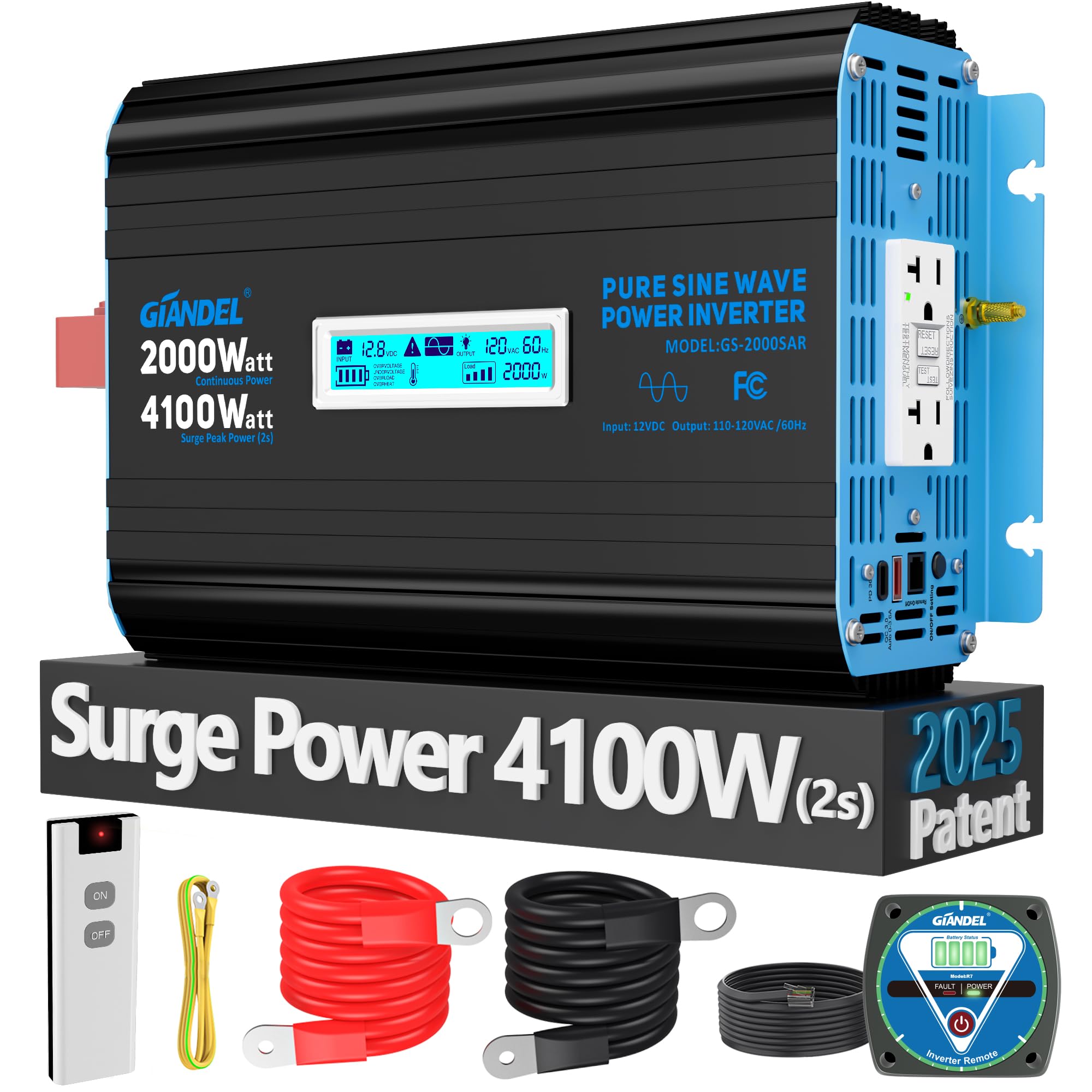
This variant of the GIANDEL 2000W steps up the safety game with UL458-approved 20A GFCI outlets, making it a strong pick for wet environments like boat galleys or camper kitchens where ground fault protection is critical. The GFCI outlets mean you don’t need a separate bonding plug for your RV system — the inverter handles the neutral-ground bond internally, simplifying installation. The big LCD screen displays input voltage, output wattage, battery status, and protection codes so you always know what your system is doing.
The surge capacity mirrors the standard model at 4100W for two seconds, and real-world users have tested it running a 1670W microwave without problems. The aluminum housing provides the same durable heat dissipation, and the thermal-managed fan only spins up when the load passes around 120W, keeping the unit quiet during light duty. A 15-foot wired remote comes included for convenient on/off control and battery voltage monitoring from inside the cabin.
Installers should note that this GFCI version lacks a 3-wire hardwire option for Romex, so it’s best used with the included AC outlets and the hardwire terminal block for high-power appliances. A few users mentioned that the LCD voltage reading can be off by 0.3V compared to a multimeter, but Giandel’s customer service was responsive in addressing the issue. For campers that see rain, coastal air, or any moisture, the GFCI outlets make this the safer bet.
Why it’s great
- UL458 GFCI outlets add critical ground fault protection in wet camper environments
- Large LCD display shows real-time input voltage, load watts, and battery status
- No bonding plug needed — neutral-ground bond handled internally
Good to know
- No hardwire Romex option; uses AC outlets and terminal block
- LCD voltage accuracy may vary slightly from multimeter readings
3. VOLTWORKS 2000W Pure Sine Wave Inverter
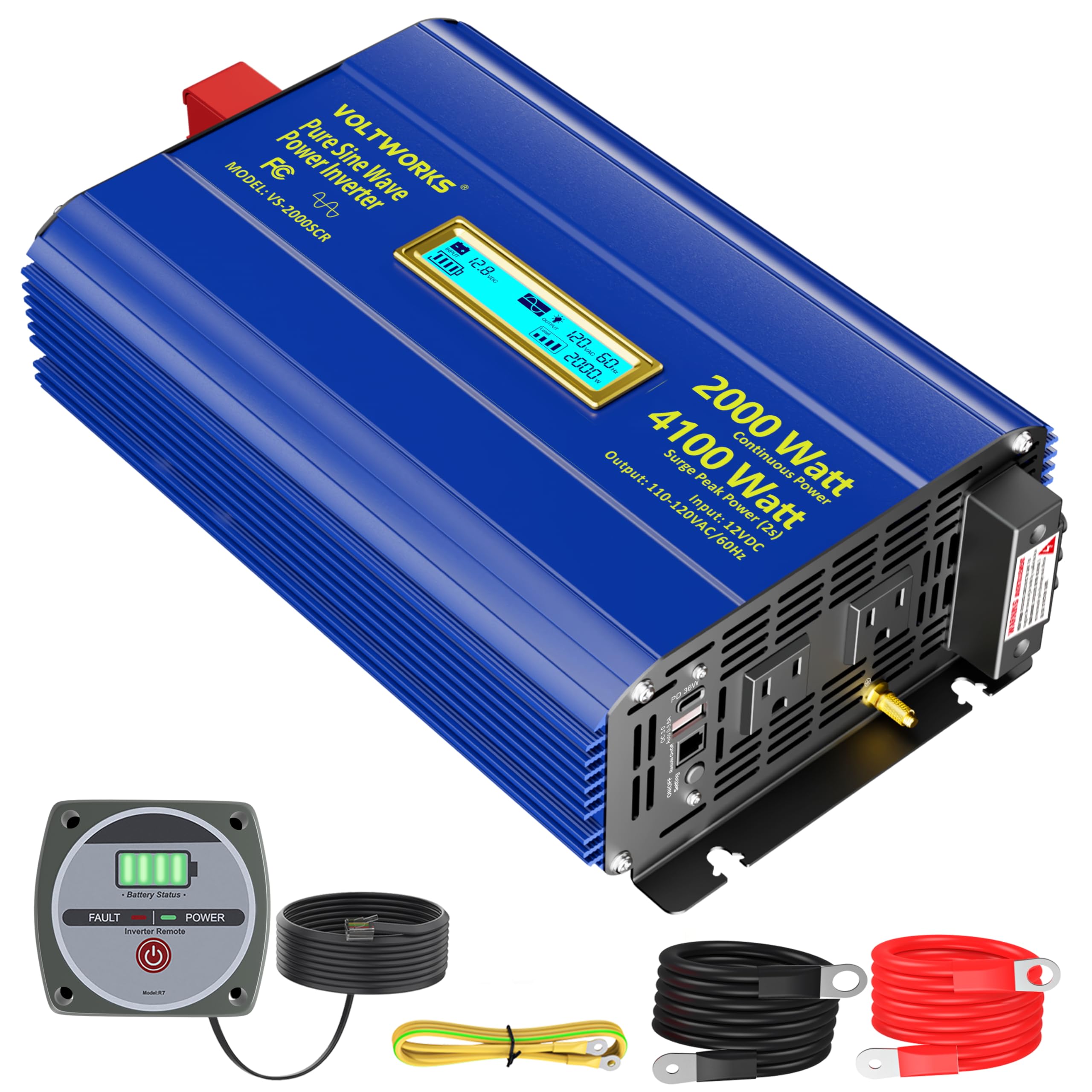
The VOLTWORKS 2000W delivers a feature that matters more than most buyers realize: an adjustable input voltage cutoff that can be tailored to LiFePO4 battery chemistry. Standard inverters often cut off at 10.5V, which leaves usable capacity on the table for lithium batteries that can safely discharge lower. This unit lets you set the low-voltage protection from 9.5V to 11.5V, maximizing your usable Ah without damaging the battery. The 4100W surge handles inductive loads like small air conditioners and water pumps, and the idle draw is around 3W — far lower than many competitors that pull 40W doing nothing.
The unit includes PD36W USB-C and 3.6A USB-A ports for fast device charging, plus two standard AC outlets and a 40A hardwire terminal. The 15-foot 4P4C RJ10 remote controller provides battery monitoring and on/off switching from anywhere in the camper. A product liability insurance policy from AIG backs the unit, which is a level of buyer protection rarely seen at this tier.
Two criticisms surfaced in testing: the M6 DC input studs feel undersized (M8 would be better for 145A loads) and the included battery cables are adequate but not premium. Still, the combination of lithium tuning, near-silent operation under 800W, and the 18-month warranty makes this a compelling choice for campers running LiFePO4 battery banks who want to squeeze every drop of capacity.
Why it’s great
- Adjustable low-voltage cutoff optimizes usable capacity for LiFePO4 batteries
- Extremely low 3W idle draw reduces battery drain during inactive periods
- Product liability insurance by AIG provides extra buyer protection
Good to know
- M6 DC input studs are small for high-current 145A loads
- Included battery cables are functional but not heavy-duty for full 2000W output
4. LiTime 2000W Pure Sine Wave Inverter

LiTime brings its reputation from the LiFePO4 battery world into the inverter space with this 2000W unit that packs four built-in AC outlets — a rare convenience for campers who need to plug in multiple devices without a power strip. The 4000W surge handles startup loads for most RV appliances, and the conversion efficiency exceeds 90%, so your battery bank goes further. The remote LCD display shows battery voltage, load power, and internal temperature, giving you full system visibility from the driver’s seat.
The housing is compact at 14.17 x 7.42 x 4 inches and weighs only 9 pounds, making it easy to mount in tight cabinet spaces. Dual intelligent cooling fans regulate heat without running constantly, and the inverter is rated to operate in temperatures from -20°C to 40°C — important for campers that see cold-weather boondocking. The unit is CE, FCC, and RoHS certified, and LiTime offers phone support with same-day response times.
A recurring note from long-term owners is that the on/off switch can become finicky after about a year of use, requiring multiple presses to engage. Several users simply leave the inverter switched on and use the main battery disconnect or solar charge controller to manage power. For the price and the convenience of four outlets, this is a strong mid-range contender for camper vans with moderate power needs.
Why it’s great
- Four AC outlets eliminate the need for a separate power strip in most setups
- Compact 9-pound build fits easily in tight RV cabinet spaces
- Operates in extreme temperatures from -20°C to 40°C
Good to know
- On/off switch may become unreliable after a year of regular use
- Idle draw is higher than some competitors at an estimated 8-10% of capacity
5. BELTTT 3000W Pure Sine Wave Inverter

For campers running high-draw appliances like a 15,000 BTU air conditioner, an induction cooktop, or a space heater simultaneously, the BELTTT 3000W provides the headroom needed to avoid nuisance overload trips. With 3000W continuous output and a massive 6000W peak surge, this inverter swallows the startup spike of even the most demanding compressors. The conversion efficiency tops 93% under normal load, and the no-load draw is notably low at around 1A standby — about 12W — keeping overnight battery drain manageable.
The package includes a 23-foot wired remote controller, two 1/0 AWG battery cables, nine 45A fuses, and a thimble spanner. The remote makes it easy to mount the inverter in a vented compartment and still monitor battery voltage and output status from the living area. The housing combines aluminum with sturdy plastic, and users running it in hot sheds reported that the unit ran cooler than expected during summer testing.
Quality control has one red flag: a buyer reported receiving a unit with heavily corroded connection posts, so it’s wise to inspect the DC terminals immediately upon arrival. The AC outlets are also spaced closely together, making it hard to plug in two large wall-wart power bricks side by side — a 20A power strip solves this. For the power output per unit of cost, the BELTTT 3000W is hard to beat for full-size RVs running heavy loads.
Why it’s great
- 6000W peak surge handles the startup of large RV air conditioners and compressors
- 93% conversion efficiency and low 1A standby power preserve battery reserves
- 23-foot remote cable provides flexible monitoring from the camper cabin
Good to know
- Some units have arrived with corroded DC connection posts — inspect on delivery
- AC outlets are too close together for large power bricks; use a power strip
6. OLTEANP 2500W Pure Sine Wave Inverter with Transfer Switch

The OLTEANP 2500W distinguishes itself by including a built-in Automatic Transfer Switch (ATS) that switches between battery inverter power and shore power in about 12 milliseconds — seamless enough that your CPAP machine or refrigerator controller never notices the transition. This eliminates the need for a separate ATS box, saving space and wiring complexity in a camper’s electrical bay. With 2500W continuous and 5000W peak surge, it has enough juice to run a 15,000 BTU RV air conditioner without a soft starter, according to a professional RV tech who installed it in a 2021 Winnebago.
The unit includes a 15-foot wired remote with an LCD display that shows input voltage, output status, and fault alerts. Two AC outlets and a hardwire terminal give you flexible connection options. The housing is light blue metal with a spark-free circuitry design for safe connections. OLTEANP backs it with a 12-month warranty and 24/7 customer service that multiple reviewers praised for thorough troubleshooting assistance.
One quibble: the battery monitor in the remote is calibrated for lead-acid batteries, so it shows 80% when a LiFePO4 battery is actually at 20% — a known mismatch that requires cross-referencing with a proper battery monitor. The included user manual could be clearer, and the neutral-ground bonding switch location is not well documented. For campers who want a single-box solution for inverter and ATS functionality, this unit delivers excellent value.
Why it’s great
- Built-in 12ms ATS eliminates separate transfer switch for cleaner installation
- 2500W continuous / 5000W peak runs a 15K BTU AC without soft starter
- Excellent customer support with 24/7 availability and hands-on troubleshooting
Good to know
- Remote battery monitor inaccurate for LiFePO4 — shows 80% when battery is at 20%
- User manual is poorly written and neutral-ground bonding switch is hard to locate
7. GIANDEL 3000W Pure Sine Wave Inverter (PS-3000SAR)
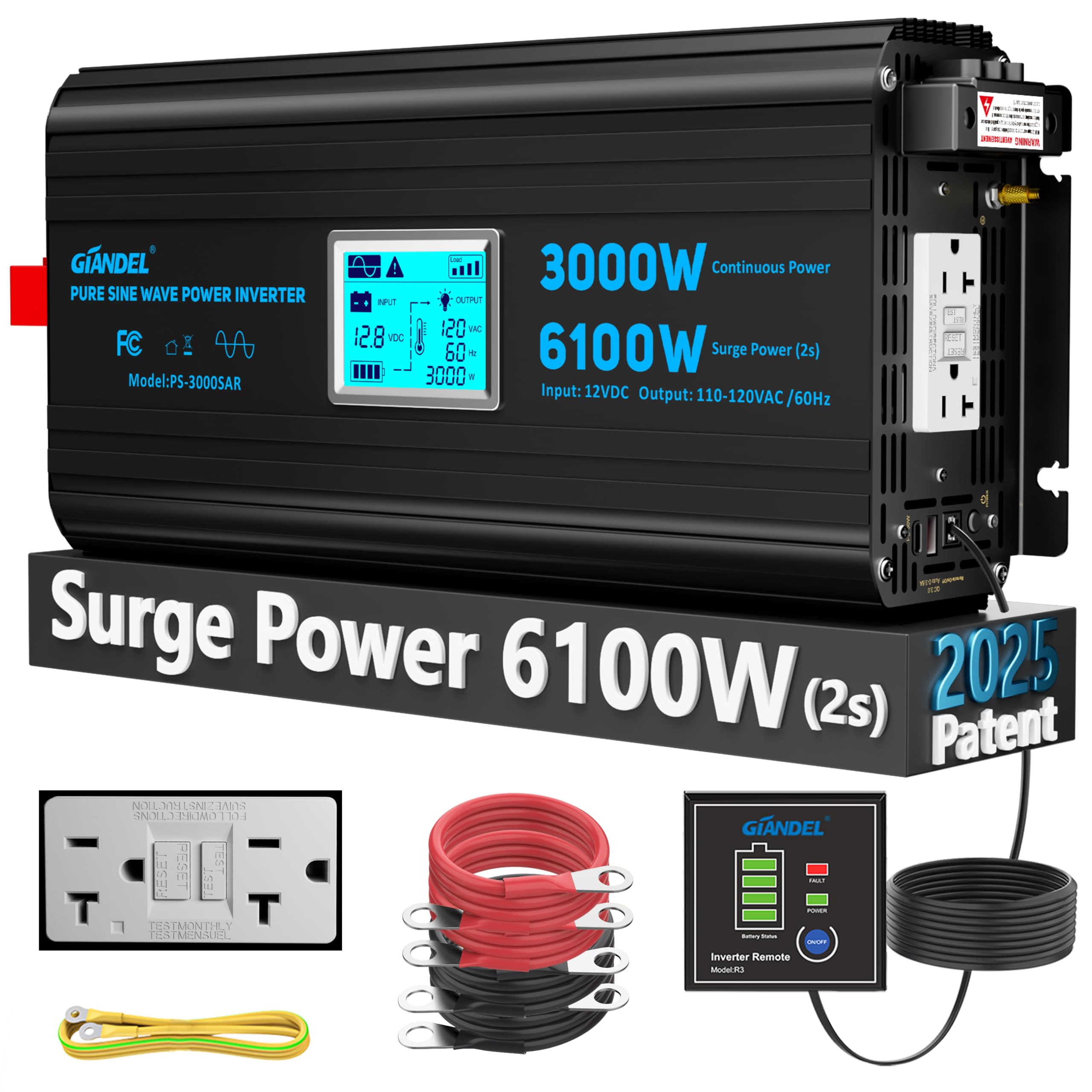
At 3000W continuous with a 6100W surge for two seconds, this GIANDEL model is the heavy artillery for campers running multiple high-power loads like a water heater, air conditioner, and microwave at the same time. The adjustable input voltage function (settable from 9.5V to 11.5V) makes it compatible with AGM, lead-acid, deep cycle, lithium, and LiFePO4 batteries alike. A unique programmable working time presetting (code F5) lets you set the inverter to run for anywhere from 1 minute to 100 hours and then automatically shut off — useful for timed water heating or overnight appliance cycles.
The big full-angle LCD screen reads inverter temperature in addition to the usual voltage, wattage, and protection codes. The cooling fan is controlled but loud when fully engaged — several users described it as “loud but effective.” The 30-foot wired remote is generous for mounting the inverter in the back of a truck camper or a basement compartment. The unit is FCC approved, meaning it’s friendly with radios and speakers, which is important for campers with sound systems or ham gear.
One reviewer measured a 0.3V discrepancy between the LCD and a Fluke multimeter, which may matter for integrated solar/shunt systems where voltage accuracy is critical. The fan engagement is aggressive under load, and the housing requires adequate ventilation to prevent cumulative heat buildup during extended high-power operation. For campers who need the extra surge capacity and the unusual timer function, this 3000W unit brings genuine premium value.
Why it’s great
- 6100W surge handles nearly any camper appliance startup load without tripping
- Programmable timer (1 min to 100 hours) allows automated shutoff for specific use cases
- FCC approved for minimal radio interference — good for communications gear
Good to know
- Cooling fan is loud under sustained high load — requires well-ventilated mounting
- LCD voltage reading may be off by 0.3V, which can affect integrated system monitoring
8. Renogy 2000W 24V Pure Sine Wave Inverter

For campers that have adopted a 24V electrical system — increasingly common in larger RVs and solar conversions because it halves the current for the same power — the Renogy 2000W offers a made-to-match solution. With 92% energy efficiency and UL/CSA certifications, this inverter pairs naturally with Renogy’s own 24V battery and solar charger ecosystem. The 4000W peak power handles the startup of a 15A household appliance without issue, and the compact size (16.94 x 8.99 x 3.75 inches at 10.1 pounds) fits neatly into a 24V distribution center.
The unit includes two AC outlets plus a terminal block for hardwired loads, and the remote control switch lets you monitor and operate the inverter from a distance. Users running full-size RVs report that it runs their AC, refrigerator, and lights without breaking a sweat. The five protection features (over-voltage, low-voltage, overload, short circuit, and over-temperature) are standard but well-implemented, and Renogy’s support team is responsive, though one owner had a unit fail at 6 months and needed some back-and-forth to get a replacement.
The 24V input requirement excludes anyone running a standard 12V house battery bank, which remains the majority of campers. If you’re on 24V, however, options are far more limited, and Renogy’s reputation for reliability makes this a straightforward choice. The idle noise under full load is noticeable but not worse than other units in this power class.
Why it’s great
- 92% efficiency maximizes range from 24V battery banks
- UL/CSA certified for safety and insurance compliance
- Seamless integration with Renogy’s solar and battery ecosystem
Good to know
- Only compatible with 24V systems — not for standard 12V camper house batteries
- A small number of units have failed within the first year; warranty process requires effort
9. PowerDrive PWD3000P 3000W Inverter with Bluetooth

The PowerDrive PWD3000P takes a different approach with Bluetooth wireless monitoring via the free PowerDrive Plus app, giving you remote access to battery voltage, power output, and error codes from your smartphone. The digital display detaches from the inverter body for remote placement up to 23 feet away, and the heavy-duty 39-inch cables included make installation straightforward. Four 3-prong AC outlets, a USB 2.4A port, and a USB-C 3.0A fast-charge port provide plenty of connectivity for a truck camper or car camping setup.
The critical distinction here is that this is a modified sine wave inverter, not pure sine wave. Modified sine wave output is fine for resistive loads like coffee makers, toasters, and incandescent lights, but it creates audible buzzing in motor-driven appliances (refrigerators, fans, pumps) and can cause sensitive electronics like laptop chargers and CPAP machines to run hot or fail prematurely. In a camper environment where a variable-speed fridge or an induction cooktop is common, this limits the use cases.
The 3000W continuous power is genuine — users report running a fridge, a microwave, a Keurig, and multiple chargers simultaneously in a semi truck without issues. The Bluetooth feature is genuinely useful for monitoring from the driver’s cab. If your camper build uses only simple resistive appliances and you want app-based remote monitoring at a budget-friendly entry point, this works — but the waveform limitation means it won’t suit most modern camper builds with inverter-driven appliances.
Why it’s great
- Bluetooth monitoring via smartphone app provides convenient remote status checking
- Detachable LCD display with 23-foot cable for flexible mounting placement
- 3000W continuous power easily handles multiple high-draw resistive loads
Good to know
- Modified sine wave output can cause buzzing and overheating in motors and sensitive electronics
- Not suitable for camper builds with induction cooktops, variable-speed fridges, or CPAP machines
FAQ
Can a 2000W inverter run my RV air conditioner?
How do I calculate what size inverter my camper needs?
What size wire do I need for my camper inverter installation?
Should I leave my camper inverter on all the time?
Do I need a transfer switch for my camper inverter?
Final Thoughts: The Verdict
For most users, the best camper inverter winner is the GIANDEL 2000W (PS-2000SDR) because it delivers a strong 4100W surge, 90% efficiency, a quiet intelligent fan, and an 18-month warranty at a price that doesn’t bust your build budget. If you want GFCI safety for wet environments, grab the GIANDEL GS-2000SAR-GFCI. For campers running a full-size AC and heavy loads, nothing beats the surge headroom of the BELTTT 3000W.