
Our readers keep the lights on and my morning glass full of iced black tea. As an Amazon Associate, I earn from qualifying purchases.
Specs are compiled from manufacturer listings and verified buyer reviews and can change over time — please confirm the key details on the product page before buying.
That wet spot spreading across your camper ceiling means water has already found a way through the roof membrane. The right coating can stop that damage fast and keep your rig dry for years. The challenge is cutting through the confusion between silicone, acrylic, and rubber formulas to pick the one that actually bonds to your roof material. Below, you get each pick’s real strengths and trade-offs, backed by published specs and what buyers report.
You need a coating that matches your roof: EPDM rubber, TPO, fiberglass, or metal. Pick the wrong chemistry, and you are looking at peeling, cracking, and a leaky rig within a season. This guide breaks down the best camper roof coating options by what they are made of, how they go on, and who they actually work for.
Our Picks at a Glance

How To Choose The Best Camper Roof Coating
Every camper roof coating is a chemical gamble unless you match it to your roof’s material. EPDM rubber, TPO, fiberglass, and metal each need a different adhesive chemistry to bond properly. Picking the wrong one means peeling, cracking, and a leaky rig within a season.
Check Your Roof Material First
Your roof’s surface determines the entire coating decision. Silicone-based products bond well to nearly everything — EPDM, TPO, fiberglass, PVC, metal, and even spray foam — and they often skip the primer step. Acrylic elastomeric coatings are specifically for metal or aluminum roofs and should not go on EPDM or TPO. Polyurethane formulas offer wide compatibility but may need a dedicated primer for best adhesion on certain surfaces.
Measure Coverage Realistically
Coverage rates vary a lot between brands, and the number on the label assumes a perfectly smooth surface. Silicone coatings typically cover around 55 to 60 square feet per gallon in a single coat. Acrylic and polyurethane options often claim 50 to 200 square feet per gallon, but that range depends on roof texture and whether a second coat is needed. Buy extra to account for absorption into porous or aged roofing.
Understand Dry Time and Cure Time
Dry-to-touch and fully-cured are not the same thing. Many coatings dry to the touch in 4 to 6 hours but require a full 24 to 48 hours before they can handle rain or standing water. Low temperatures below 50°F can stretch that cure window wide open. Check the recommended application temperature range before you plan your weekend project.
Decide Between Single Coat and Multi-Coat Systems
Some high-solids silicones are designed for a single heavy coat, which saves time and material. Acrylic and polyurethane coatings usually perform best with two or more thin coats to build up the proper membrane thickness. A single-coat system is faster but less forgiving if you miss a spot, while multi-coat builds redundancy into the repair.
Quick Comparison
| Model | Best For | Coverage Per Gallon | Material Type | Dry Time | Amazon |
|---|---|---|---|---|---|
| Marlin 100% Silicone (5 Gal)★ Best Overall | Long-term single-coat protection | 60 sq ft | Silicone | 1 day | Amazon |
| Xmntdo Polyurethane (1 Gal)Budget Champion | Budget-friendly DIY seal | 50 sq ft | Polyurethane | 4-6 hrs (touch) | Amazon |
| Dicor Acrylic Elastomeric (1 Gal)Metal Roof Specialist | Metal RV roofing | 200 sq ft | Acrylic | — | Amazon |
| BEEST Liquid Rubber (1 Gal) | Versatile multi-surface sealing | 50 sq ft (2 coats) | Acrylic Elastomeric | 4 hrs (recoat) | Amazon |
| Countryman 100% Silicone (1 Gal) | No-primer silicone application | 55 sq ft | Silicone | — | Amazon |
| Rust-Oleum 710 (5 Gal) | Heat reflection on large roofs | ~66 sq ft (1st coat) | Elastomeric | 24 hrs | Amazon |
| Gardner-Gibson Sta-Kool (5 Gal) | Fast-drying camper refresh | — | Acrylic | 30 mins (touch) | Amazon |
| EverBond Liquid Rubber (4.75 Gal) | Heavy-duty flexible membrane | 50 sq ft | Rubber | 6 hrs (touch) | Amazon |
In‑Depth Reviews
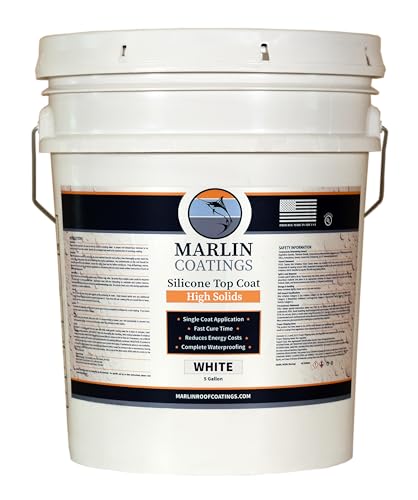
1. Marlin Coatings 100% Silicone Roof Sealant (5 Gallon)
Our pick — over 4.5★ from 450+ verified ratings; the strongest balance of quality and price.
Apply one thick coat and forget about your roof for years.
This 100% silicone, self-leveling (flows into cracks on its own) coating is the pick for anyone who wants a long-term seal and hates recoating. A single gallon covers 60 square feet and bonds directly to EPDM (ethylene propylene diene monomer, a synthetic rubber roof), TPO (thermoplastic polyolefin, a plastic-like roof membrane), PVC, fiberglass, spray foam, and metal — usually without a primer. The key spec is the Solar Reflective Index of 113 (a measure of how well it bounces heat away, where 100 is excellent): this bright white finish deflects heat so well that owners mention noticeably cooler interiors during summer. One reviewer noted it “lasts 6+ years with no peeling/cracking/water fatigue,” which is longer than you will get from the Xmntdo polyurethane coating in this list.
The only real catch is the upfront cost — a 5-gallon bucket is an investment, but it is cheaper than a roof replacement. The consistency is thick, so you will need a heavy-duty paint stirrer and strong arm. Some customers note peeling if the old roof was not cleaned properly before application.
smooth silicone coverage
- True single-coat application saves an entire weekend
- Self-leveling formula fills gaps without extra work
- High reflectivity keeps the camper noticeably cooler
Higher upfront cost
- Premium price for the 5-gallon pail
- Thick consistency requires a heavy-duty mixer
- Peeling can occur if the rip is not cleaned properly
Large area projects: You want a long-term seal and prefer one heavy coat over multiple thin layers.
Budget constraints: Your budget is tight for a single bucket or you only need a small patch-up on a tiny trailer.
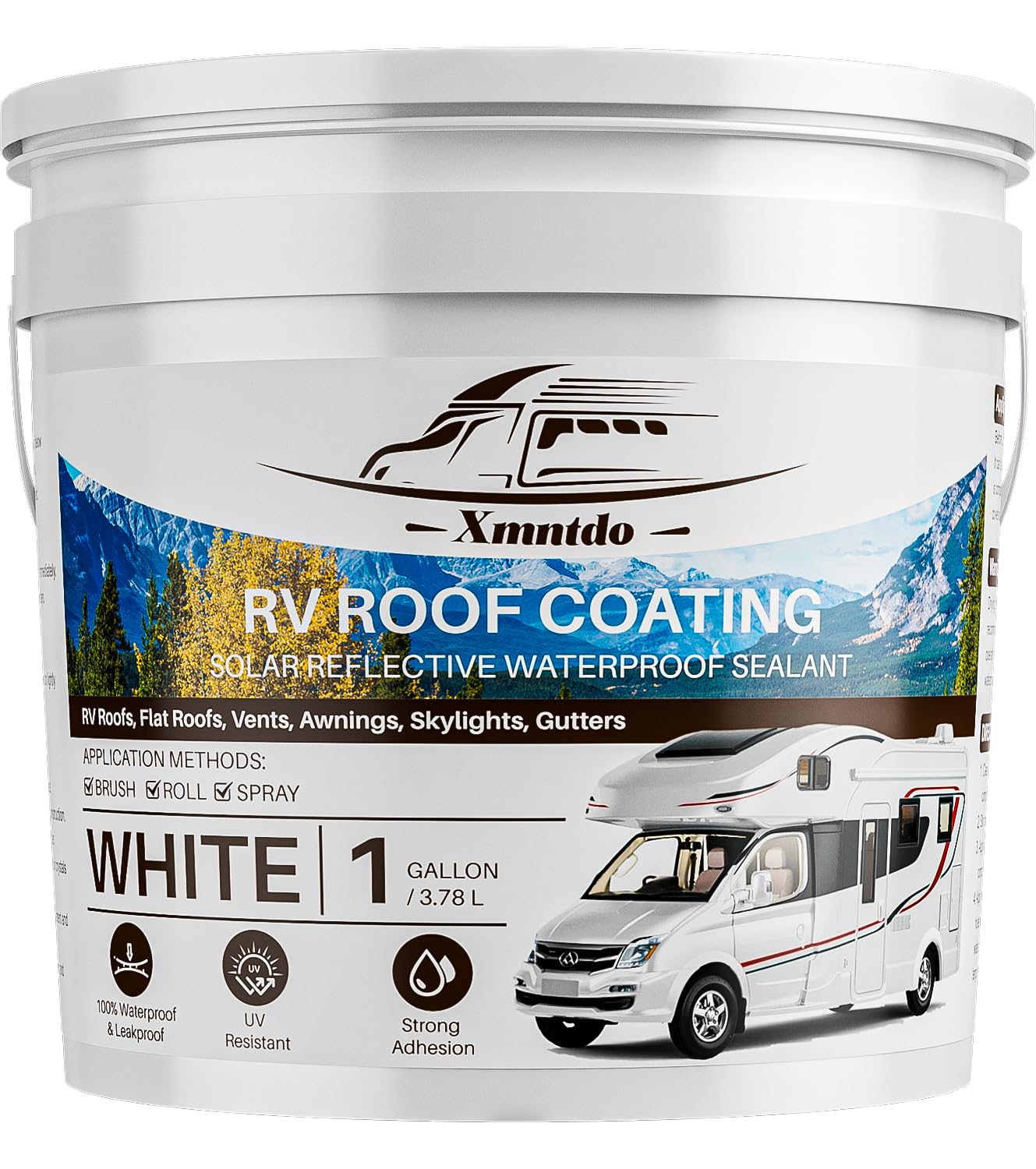
2. Xmntdo RV Roof Sealant (1 Gallon)
A wallet-friendly seal that stops leaks for less, on a smaller rig or a targeted repair.
This polyurethane (a flexible, plastic-like resin) coating is a strong contender if you are sealing a smaller rig or just need to stop a few specific leaks without a big investment. It goes on like paint with a brush or roller and dries to the touch in 4 to 6 hours. Full cure — when it is fully waterproof — takes 24 to 48 hours depending on thickness and humidity. It covers 50 square feet per gallon, matching many pricier options but costing less. It bonds to EPDM, TPO, fiberglass, and aluminum roofs, plus skylights and vent covers. The formula is solar reflective, which helps reduce interior temperatures on hot days. Owners praise the quality and ease of use for beginners. However, adhesion gets mixed feedback: some found it stuck well, while others wished for a stronger grip. The manufacturer suggests a dedicated primer for EPDM and TPO for best results.
The biggest trade-off compared to the Marlin silicone is that it is a thinner coating, so you will likely need the recommended second coat to build full protection. One buyer mentioned it “dries clear and invisible in ~20 hours,” which means you need patience before rain can hit it.
Small repairs: A budget-friendly refresh on a smaller camper or a targeted leak repair on a tight timeline.
Full roof jobs: You want a single-coat system, a thicker membrane, or the longest possible lifespan between recoats.
3. Dicor Acrylic Elastomeric Coating (1 Gallon)
Use this only on metal roofs — it gives a reflective matte finish that cools on hot days.
This is an acrylic elastomeric (a flexible, water-based paint-like) coating made specifically for metal RV roofing. Dicor explicitly warns “not recommended for EPDM rubber or TPO roofing.” The coverage is generous at 200 square feet per gallon because the consistency is lighter than silicone. One owner on an older aluminum roof said that on a 90°F day, the roof went from “burn to the touch” to “cool to the touch” after just two thin coats. That is a bigger improvement than you might get from the Rust-Oleum 710 without proper surface prep. However, durability and rust resistance are mixed: some find it holds up for years, while others report peeling and rust showing through within a season, especially on roofs with existing rust.
The cure time is finicky. On an 80°F day with low humidity, the coating may run and thin out on sloped surfaces. Owners recommend a high-nap roller for better coverage on textured metal.
RVs and campers: Metal RV roofs where heat reflection is the priority and the surface is in good shape.
Flat metal roofs: Your roof is EPDM, TPO, or rubber — this product is simply not designed for those surfaces.
4. BEEST RV Roof Coating (1 Gallon)

An American-made liquid rubber that sticks to EPDM, TPO, metal, and fiberglass without harsh solvents.
BEEST makes a flexible liquid rubber coating that works on EPDM, TPO, metal, aluminum, fiberglass, and PVC. The coverage rate is 50 square feet per gallon for the final recommended thickness, meaning you will need two to three heavy coats. It is solvent-free and ultra-low VOC (volatile organic compounds — chemicals that evaporate into the air), so it is safer to apply around people and pets. Owners describe it as thick and non-runny, with excellent grab on smooth and textured surfaces. One said “make sure you get the cleaner first and you will finish with a virtually new waterproof roof.” The manufacturer states that EPDM roofs must use a primer first.
Unlike the Xmntdo polyurethane, this requires multiple coats, which means more time. Some owners find it thick enough to build a strong layer quickly, while others call it too thin and wish for more body. The 48-hour full cure time at 40-90°F is standard, but you need a dry weekend.
Sunny climates: You want a US-made, low-VOC option that bonds to a wide range of roof materials.
Heavy rain areas: You want a true single-coat system or you are not ready to invest in a separate primer for EPDM roofs.
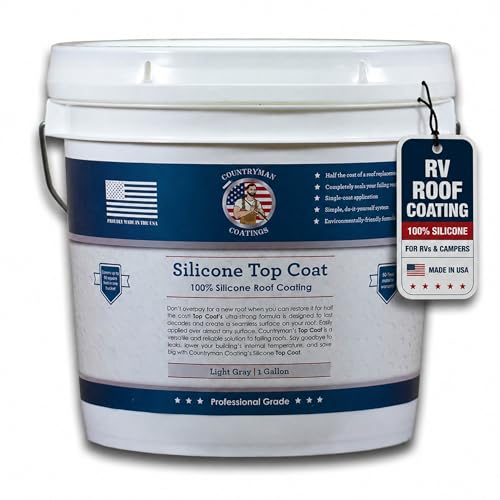
5. Countryman Coatings 100% Silicone Roof Coating (1 Gallon)
A light-gray 1-gallon silicone that skips the primer step on most surfaces.
Countryman offers a 100% silicone top coat in a compact 1-gallon size, good for smaller campers or repairs. The manufacturer states “no primer required” and claims it exceeds building code adhesion over metal, EPDM, modified-bitumen (asphalt-based roofing), PVC, TPO, spray foam, concrete, and even old acrylic or silicone coatings. Coverage averages 55 square feet per gallon for a single thick coat. The brand claims the reflectivity reflects nearly 90% of UV rays (ultraviolet radiation from the sun), which would mean a cooler roof surface. Owners say application is smooth and easy, with one using a 3/8-inch nap roller. One owner reported it stopped leaks on an EPDM roof joint where “a dozen other patches failed.”
The color is light gray rather than bright white, so it is less reflective than the Marlin silicone. Cleanup requires vinegar or alcohol, and you should plan to discard brushes and rollers after use.
Green builders: A no-fuss silicone application on mixed roof surfaces where priming would be a hassle.
Quick fixes: Buyers who want a bright white finish for maximum heat reflection or a 5-gallon economy bucket.
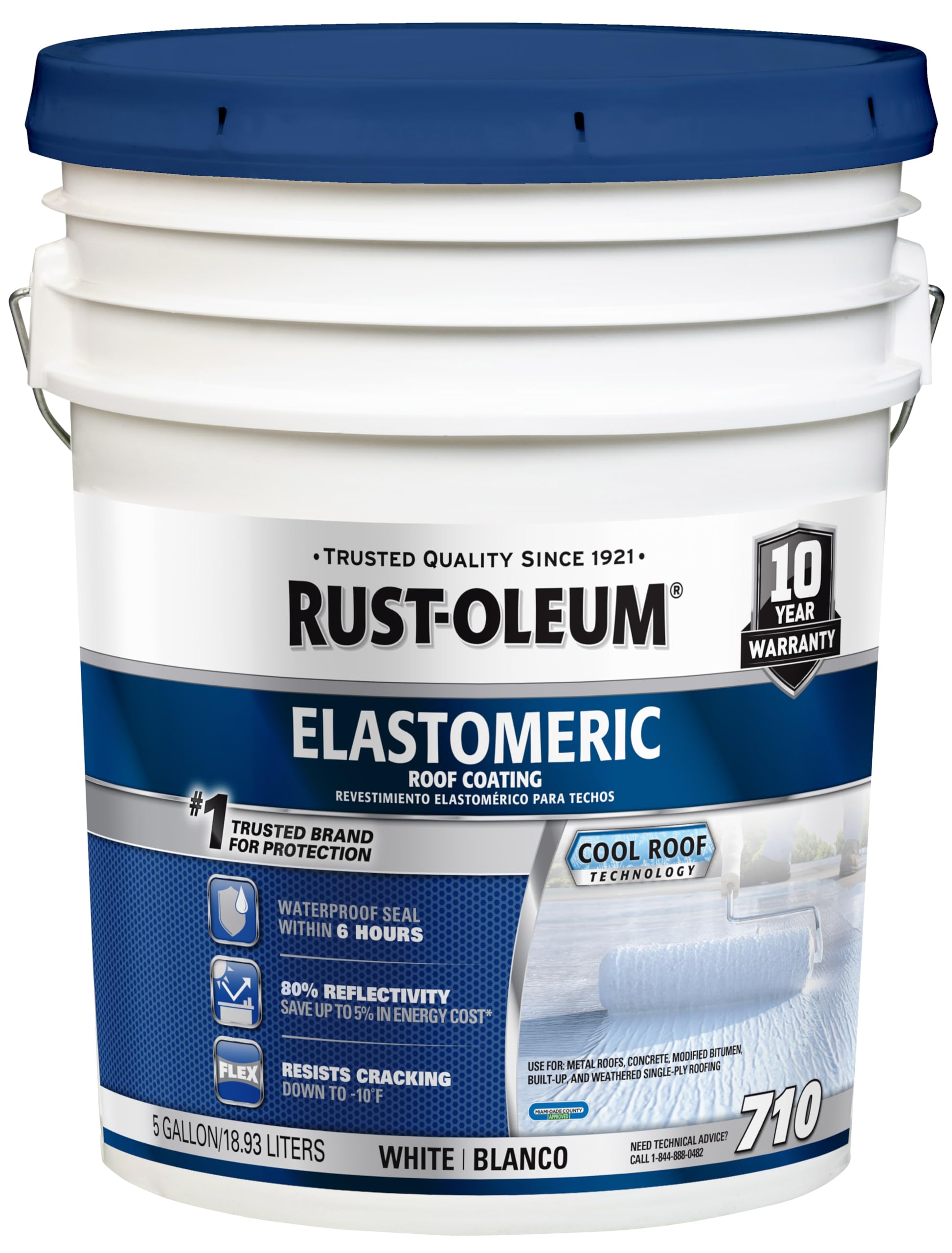
6. Rust-Oleum 710 Elastomeric Roof Coating (5 Gallon)
A 5-gallon workhorse that bounces 84% of the sun’s heat off your roof, dropping interior temperatures by 5-8°F.
Rust-Oleum’s 710 elastomeric coating delivers an 84% initial reflectivity, which the manufacturer says drops to 74% after weathering — still strong enough to noticeably lower interior temperatures. Reviewers point out a 5-8°F reduction on the top floor of their rig after two coats. At the recommended thickness of 1.5 gallons per 100 square feet per coat, the 5-gallon pail covers roughly 333 square feet in a single coat, or 167 square feet with two coats. This makes it a better pick than the Xmntdo polyurethane for a large roof where heat reduction is a priority. Application is straightforward — use a 3/4-inch nap roller without any stirring. It is rain resistant in 6 hours and fully cures in 24 hours at 50% humidity. One Florida buyer says it “reflects sun, cools roof” and that their “hand no longer burns” when touching the surface.
Durability gets mixed marks. Some owners find it lasts better than other brands; others say it is not durable enough for their climate. The coating needs two or more coats — one buyer learned that thin coats wash off in rain.
Commercial roofs: Large camper roofs where heat reduction is a priority and you have a full weekend for a multi-coat job.
Sensitive noses: You need a small quantity, a single-coat system, or the longest possible lifespan between recoatings.
7. Gardner-Gibson Sta-Kool 15-Year Turbo-Dri (5 Gallon)
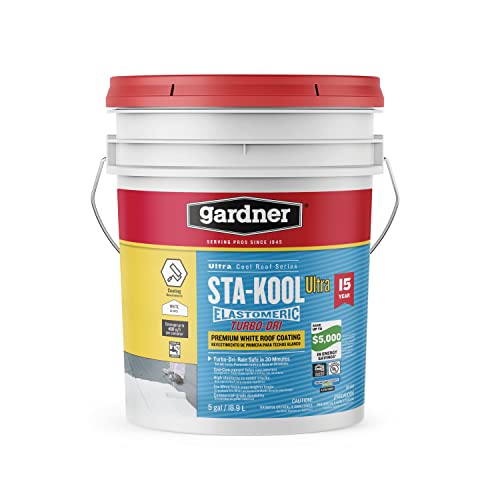
Touch-dry in 30 minutes and fully cured in 3 hours — the fastest turnaround in this lineup.
Time is the scarce resource on a camping trip. This white acrylic coating’s Turbo-Dri technology means it is touch-dry in just 30 minutes and fully cured in 3 hours, which is dramatically faster than the Marlin silicone’s 1-day cure. This makes it a strong candidate for a same-day refresh when weather is unpredictable. Owners say it goes on like yogurt with a 1/2-inch nap roller. Water-base cleanup means soap and water work while it is still wet. The coverage is generous enough to handle a full-size camper with the 5-gallon pail. One owner called it “easy to apply” and noted it made an old camper roof “look like new.”
The “15-year” number on the label is a brand marketing claim, not a guarantee — durability gets mixed reviews, and some owners find it does not hold up as long as heavier silicone options. You need to “roll it on as thick as you possibly can” for proper coverage, one owner shared after their first coat was too thin.
Time-sensitive jobs: A fast, same-day camper roof refresh where you cannot wait 48 hours for a cure.
DIY beginners: Long-term heavy-duty protection on a full-time RV that sees harsh sun year-round.
8. EverBond RV Roof Waterproof Sealant (4.75 Gallon)

A thick liquid rubber membrane backed by a limited lifetime warranty — built for a full roof restoration on a big rig.
EverBond uses a solvent-free, ultra-low VOC liquid rubber formula that rolls on like thick paint and stays flexible in all temperatures. The 4.75-gallon pail covers a 30-foot RV at 50 square feet per gallon for the final recommended thickness. It bonds to wood, TPO, metal, aluminum, foam, and EPDM, making it versatile for mixed-material roofs. Application is DIY-friendly: clean the roof, apply the first coat, wait 4 hours, then apply a second coat. Full cure takes 48 hours between 40-90°F. One owner on a neglected older roof said “the roof was terrible” and after application “it worked out so well I’ll never use anything else.” The limited lifetime warranty applies to product failure, not application errors.
Drying time and leak resistance get mixed feedback. Some owners find it dries quickly in warm weather (6 hours above 75°F), while others report it takes too long or that leaks appeared after about a week. Some call it perfectly thick, while others find it lighter than expected.
Flat roofs: A comprehensive roof restoration on a full-size RV where flexibility and a manufacturer warranty are important.
Steep slopes: You need a guaranteed fast dry time or a single-coat application for a small trailer.
Understanding the Specs
Coverage Rate (Square Feet Per Gallon)
This is the number that tells you how much roof area a single gallon of coating will cover at the recommended thickness. A higher number is not always better — it often means the coating is thinner and will need multiple coats to build the right membrane. Silicone coatings usually land around 55-60 sq ft per gallon for a single thick coat. Acrylic options may claim 200 sq ft per gallon but require a thinner layer, so you actually end up using a similar amount of material when you factor in the second coat. Measure your roof length and width in feet, multiply them, and divide by the coverage rate to figure out how many gallons you need.
Solar Reflective Index (SRI)
The SRI is a number from 0 to 100+ that measures how well a surface reflects sunlight and releases absorbed heat. A standard black roof sits near 0 while a highly reflective white roof can hit 100 or more. The higher the SRI, the less heat gets transferred into your camper during summer. For context, the Marlin silicone coating in this lineup has an SRI of 113 — that is excellent reflectivity that can significantly lower interior temperatures. If you camp in hot climates or park in full sun, a coating with a high SRI makes a noticeable difference in comfort and air conditioning load.
Dry Time vs. Full Cure Time
These two numbers are not the same. “Dry to the touch” means the surface is set enough that dust and light debris will not stick to it. “Full cure” means the coating has reached its maximum strength and is fully waterproof. A coating might dry to the touch in 30 minutes (the Gardner-Gibson Sta-Kool), but still need 3 hours to fully cure. Silicone and polyurethane coatings often need 24 to 48 hours for a full cure. Never expose a coating to rain before its full cure window — even a light shower can wash away uncured material and force a do-over.
Material Type: Silicone vs. Acrylic vs. Polyurethane vs. Rubber
Silicone coatings are the most durable option, lasting 6+ years without peeling or cracking, and they resist ponding water and UV exposure. They bond to almost every roof surface without a primer but are harder to clean up (vinegar or alcohol required). Acrylic elastomeric coatings are water-based with easy cleanup, but they are not recommended for EPDM or TPO rubber roofs and can peel if moisture gets trapped underneath. Polyurethane strikes a balance — it is flexible and bonds well but can take longer to cure. Liquid rubber is solvent-free and ultra-low VOC with good flexibility, but it may need multiple coats and longer cure times in cooler weather.
FAQ
Can I apply a silicone coating over an old acrylic coating?
How long does a silicone roof coating really last on a camper?
What is the difference between self-leveling and non-leveling roof coating?
Can I use a regular house paint roller to apply roof coating?
Will a white roof coating actually keep my camper cooler?
Is primer always required before applying roof coating?
Do I need to remove the old roof coating before applying a new one?
How do I clean the roof surface before applying a new coating?
Can I apply roof coating in cold or humid weather?
Final Thoughts: The Verdict
For most owners, the camper roof coating winner is the Marlin Coatings 100% Silicone because one thick coat covers 60 square feet and delivers the longest lifespan without peeling or cracking. If you want a budget-friendly entry point for a smaller rig, grab the Xmntdo Polyurethane. And for a fast, same-day refresh on a metal roof that dries in 30 minutes, the Gardner-Gibson Sta-Kool is the one to reach for.
How We Picked
We do not accept paid placement. Every pick is matched to a real buyer and a real use-case; we do not hands-on test units.
Sources & Methodology
Specifications: manufacturer listings and product documentation. Review insights: verified customer reviews, as of July 2026. Pricing: not shown on this page (it changes often); check the current price via the retailer link.
As an Amazon Associate, Gadgets Feed earns from qualifying purchases. This does not affect which products we feature.