
Dragging a generator into the wilderness defeats the entire purpose of escaping the grid. A good camper solar panel system turns every hour of daylight into silent, storable energy—but the difference between a panel that trickle-charges your phone and one that actually runs your fridge comes down to cell technology, watt density, and real-world angle management, not marketing labels.
I’m Min — the co-founder and writer behind Gadgets Feed. I dig through datasheets, monitor customer performance reports across hundreds of installations, and cross-reference conversion efficiency claims with actual amperage output to separate panels built for a weekend from systems engineered for full-season reliability.
Whether you are tricking out a van, retrofitting a travel trailer, or building a permanent off-grid camp, this guide to the best camper solar panels breaks down how N-Type cells, bifacial designs, and integrated charge controllers change the math on what you can actually power off the sun.
How To Choose The Best Camper Solar Panels
The right panel for your camper is not just about wattage—it is about how efficiently that panel converts sunlight in the specific angles, weather, and roof space your camper provides. Three factors determine real-world performance more than any other spec.
Cell Technology & Conversion Efficiency
Standard polycrystalline cells hover around 18-20% efficiency. Premium monocrystalline panels reach 23-25%. N-Type cells with 16 busbars (16BB) reduce electron travel distance and minimize micro-crack risks, delivering higher output in low-light conditions like dawn, dusk, or overcast afternoons. Bifacial panels add another 10-15% yield by capturing reflected light off the ground or roof surface.
Portable vs. Permanent Mounting
Foldable suitcase panels (100W-200W) let you chase the sun by repositioning throughout the day—critical if your camper sits under tree canopy or parked in variable shade. Permanent rooftop installations are simpler, theft-proof, and ideal for sunny open campsites, but you lose the ability to tilt or relocate. Hybrid setups using portable panels with MC4 adapters feeding into a roof-mounted MPPT controller offer the best of both worlds.
Charge Controller & Connector Compatibility
Suitcase-style panels often include a built-in PWM (pulse width modulation) charge controller, which works but wastes up to 20% potential power compared to an MPPT (maximum power point tracking) controller. If your camper already has an MPPT solar input on your power station, bypassing the panel’s built-in PWM and connecting directly via MC4 or XT60 yields significantly faster charging. Always verify your power station’s input voltage limit before pairing—a 100W panel pushing 18V into a 60W-limited generator will only draw 60W.
Quick Comparison
On smaller screens, swipe sideways to see the full table.
| Model | Category | Best For | Key Spec | Amazon |
|---|---|---|---|---|
| Renogy 200W E.Flex | Portable | High-efficiency mobile off-grid | 25% N-Type / 16BB | Amazon |
| HQST 200W Ultra-Light | Portable | Ultra-light portable charging | 11 lbs / 16BB N-Type | Amazon |
| Renogy 200W Kit (Permanent) | Permanent Kit | Full rooftop install with battery management | 30A PWM Controller + Bluetooth | Amazon |
| TWELSEAVAN 200W | Portable | Fast device charging / wide power station compatibility | 60W USB-C PD / 8-in-1 MC4 | Amazon |
| ECO-WORTHY 200W N-Type | Rooftop | Permanent roof install / high heat tolerance | 25% Efficiency / Bifacial | Amazon |
| ZOUPW 100W | Portable | Entry-level 100W portable with wide connector support | 23.5% Efficiency / 9.5 lbs | Amazon |
| DOKIO 100W Suitcase | Portable Suitcase | Direct battery charging with controller | PWM Controller / 18V Output | Amazon |
| FlexSolar 100W | Portable | Ultra-light 100W / IP67 waterproof | IP67 / 4.1 lbs / 45W USB-C | Amazon |
| NESTOUT 14W | Ultra-Portable | Backpacking / phone & power bank top-up | 14W / 21.5 oz / Digital Ammeter | Amazon |
In‑Depth Reviews
1. Renogy 200W E.Flex Portable Solar Panel
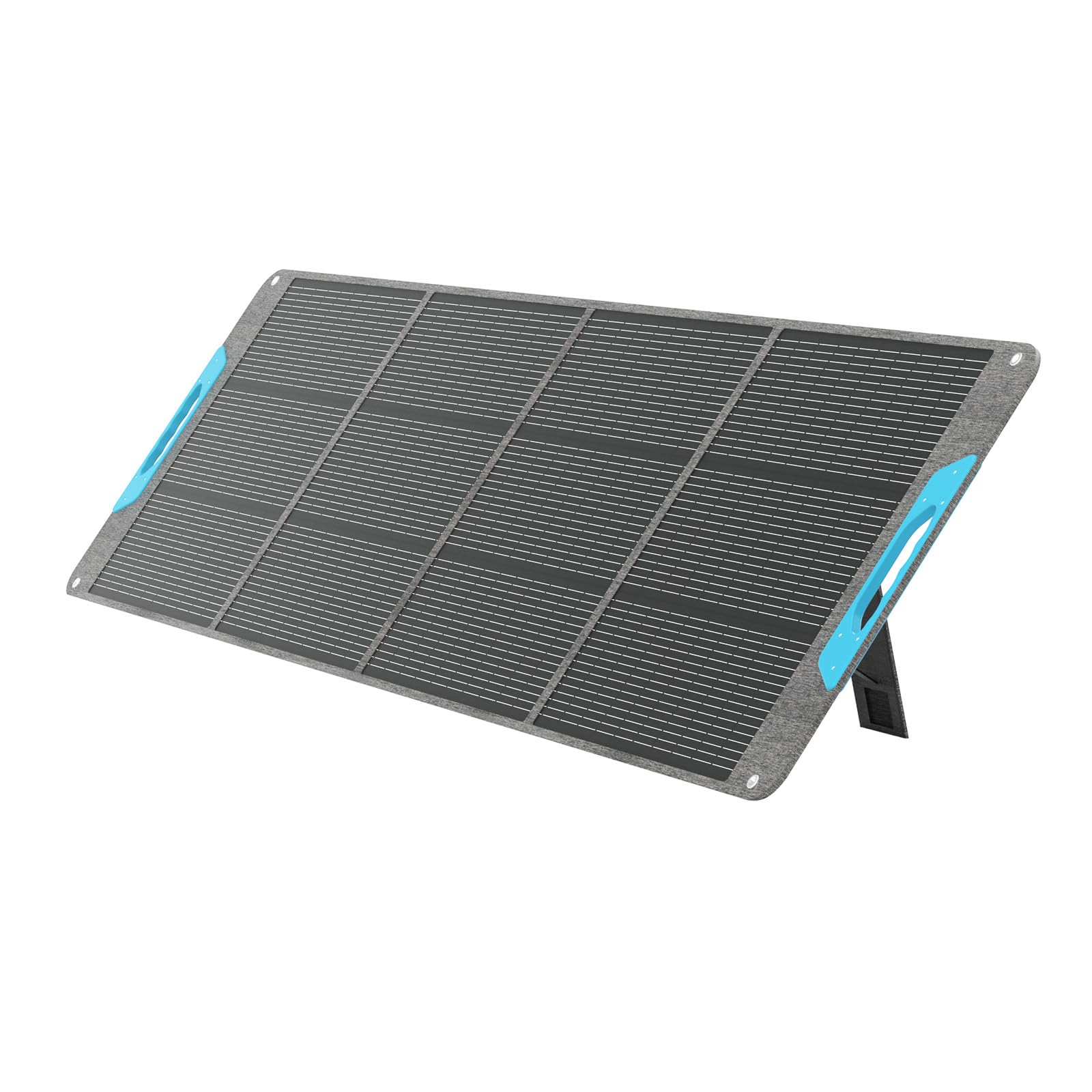
The Renogy 200W E.Flex sets the benchmark for portable camper solar with its 16BB N-Type cell architecture delivering a verified 25% conversion efficiency—higher than the typical 22.5% found in standard 9BB 200W folding panels. Weighing only 13.89 lbs with a quadfold design and magnetic closure, it packs down to 23.72 x 22.99 x 1.97 inches for easy stowage in tight camper compartments.
Four adjustable kickstands provide three angle positions (40°/50°/60°) to optimize sun capture on uneven ground, while the integrated 45W USB-C PD and dual USB-A ports allow simultaneous device charging alongside the MC4 output feeding your main power station. UL 61730 certification and a 2-year material warranty reinforce the build quality expected from Renogy’s ecosystem.
Real-world tests show 154W output flat-mounted on a truck bed in partial sun, and over-spec peak wattage in full Florida sun with parallel/ series configurations. The included carrying pouch feels basic for the price tier, but the core charging performance—especially with MPPT-equipped power stations—justifies the premium position.
Why it’s great
- Industry-leading 25% N-Type cell efficiency in a sub-14 lb portable frame
- Quadfold magnetic design with three kickstand angles for optimal sun tracking
- Backed by UL 61730 safety certification and a 2-year warranty
Good to know
- Included travel bag is minimal for the price point
- USB-C PD maxes at 45W rather than 60W found on some competitors
2. HQST 200W Ultra-Light Portable Solar Panel
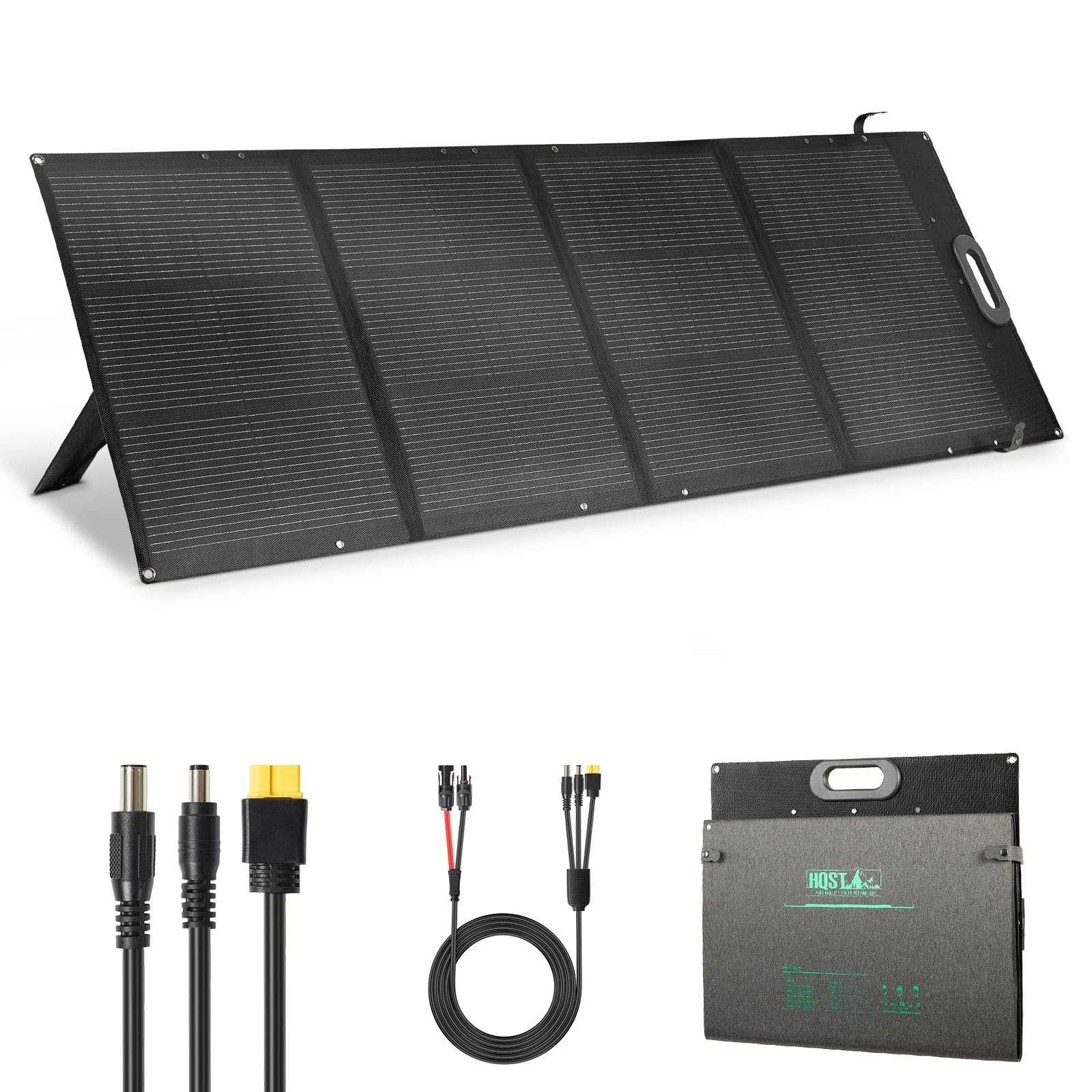
HQST targets the weight-conscious camper with a 200W portable panel that tips the scale at just 11 lbs—up to 37% lighter than comparable 200W folding units. The 16BB N-Type cell design pushes conversion efficiency above 25%, while the fully laminated construction with PVDF coating eliminates stitched seams that often fail in wet environments.
Two adjustable kickstands offer a 40°-60° range for stable positioning on uneven terrain, and the 4.9 ft 3-in-1 adapter cable (XT60, DC7909, DC5521) provides plug-and-play compatibility with most major power stations including Jackery, EcoFlow, BLUETTI, and Goal Zero. The panel folds to just 1.97 inches thick with integrated buckles for trunk storage.
Customer reports confirm the 200W rating holds under standard sun conditions with MPPT controllers, producing usable current even on overcast days. The rigid design resists the collapse issue seen in softer folding panels. Packaging protection has drawn occasional criticism, with minor frame dents reported in transit, but performance remains unaffected.
Why it’s great
- Class-leading 11 lb weight for a 200W portable panel
- Seamless laminated construction with PVDF coating for weather resistance
- Wide 3-in-1 adapter cable works with most popular power stations
Good to know
- Shipping packaging could be more protective; minor frame dents reported
- No integrated USB-C PD port—relies solely on MC4/power station output
3. Renogy 200W Monocrystalline RV Solar Panel Kit

This complete all-in-one kit from Renogy eliminates guesswork for permanent rooftop installations. It includes two 100W monocrystalline panels (41.8 x 20.9 x 1.4 inches each), an Adventurer-Li 30A PWM charge controller with Bluetooth module, 30 ft of 10AWG adaptor kit, Y-branch connectors, and cable entry housing—everything needed for a turnkey 200W system.
The panels feature a corrosion-resistant aluminum frame rated for 2400Pa wind and 5400Pa snow loads, with pre-drilled holes for straightforward roof mounting. The Adventurer-Li controller supports lithium, AGM, gel, and flooded lead-acid batteries with protections against overcharging, overload, short-circuit, and reverse polarity. The BT-1 Bluetooth module enables real-time monitoring via the Renogy DC Home app.
Users report keeping a 55 qt fridge and exhaust fan running continuously on a single 200W setup, with 100% battery recovery during peak sun hours. The PWM controller is adequate for a starter system, though upgrading to a Victron MPPT noticeably improves charging speed for those expanding capacity later. Some users note the Renogy app connectivity can be finicky.
Why it’s great
- Complete kit with panels, controller, wiring, and Bluetooth monitoring
- Rugged aluminum frame certified for high wind and snow loads
- Supports multiple battery chemistries out of the box
Good to know
- PWM controller limits efficiency compared to MPPT upgrade
- Renogy DC Home app has inconsistent Bluetooth pairing reports
4. TWELSEAVAN 200W Portable Solar Panel

The TWELSEAVAN 200W stands out for its 60W USB-C PD output—the highest direct device-charging port in this comparison—allowing users to fast-charge laptops, tablets, and smartphones without a separate power station. The monocrystalline cells with ETFE lamination achieve 24% efficiency with over 95% light transmittance for improved low-light performance.
An 8-in-1 MC4 converter cable system includes five distinct connectors (Anderson, XT60, DC8020, DC7909, DC5521) plus three additional DC adaptors, covering Jackery, EcoFlow, BLUETTI, Anker, and others. Four adjustable kickstands provide stable ground positioning, and the 9.8 ft cable offers flexibility for sun-chasing placement up to 15.7 lbs total weight.
Real-world tests show 177W output during winter sun with an Anker SOLIX C300, and full recovery of a BLUETTI AC180 from 60% to 100% in roughly 4 hours on cloudy days. The XT60 connector may register as DC input rather than solar input on some EcoFlow units, limiting amperage to 8A. A 24-month warranty and 30-day money-back guarantee provide solid post-purchase protection.
Why it’s great
- 60W USB-C PD enables direct laptop charging in the field
- Comprehensive 8-in-1 MC4 adapter system covers almost every power station
- Four adjustable kickstands with 9.8 ft cable for flexible positioning
Good to know
- XT60 connector may not register as solar input on EcoFlow Delta 2
- Heaviest portable in class at 15.7 lbs
5. ECO-WORTHY 200W N-Type Bifacial Solar Panel
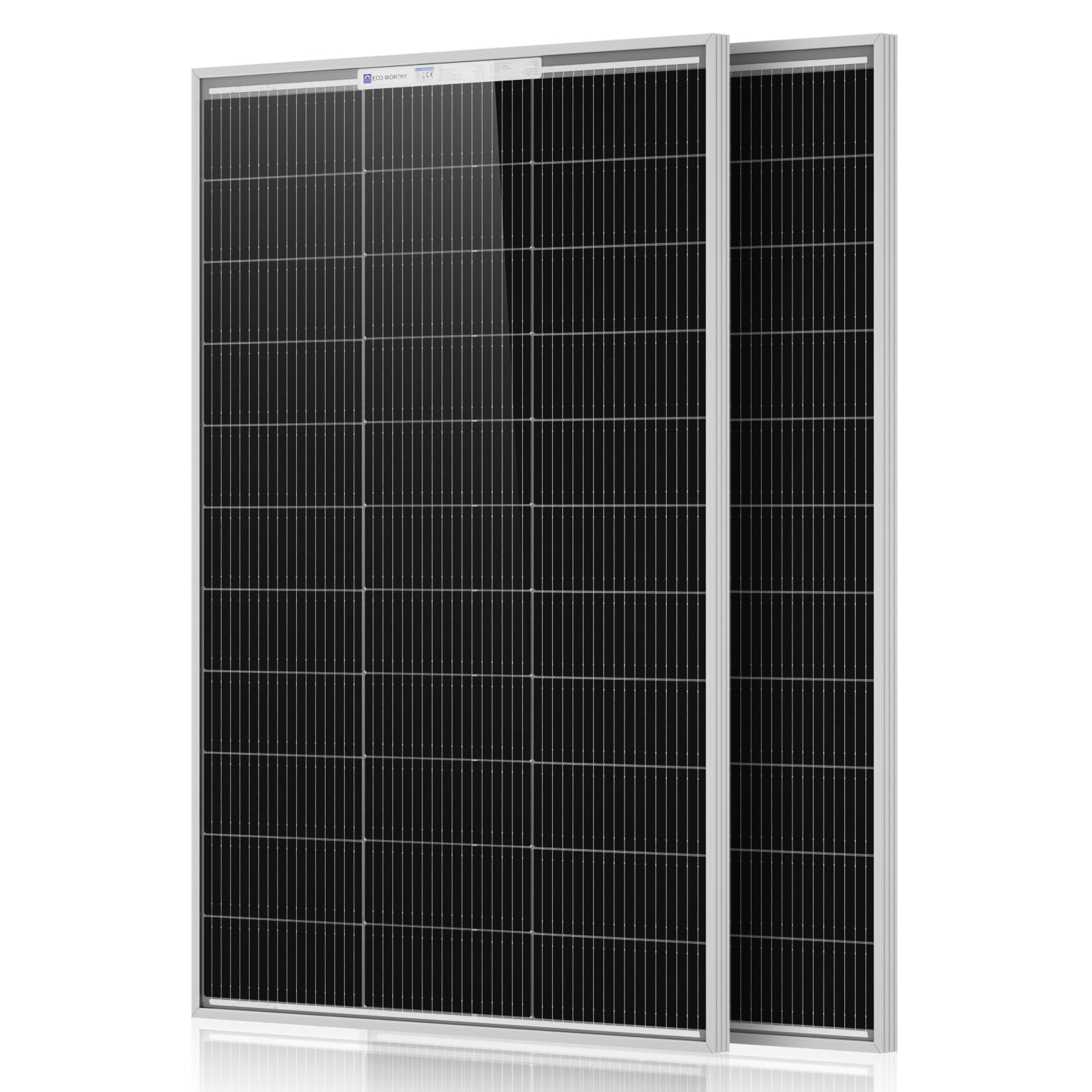
ECO-WORTHY’s N-Type 200W panel brings bifacial technology to the camper rooftop market. The dual-sided design generates up to 15% additional output from reflected light off the roof membrane or ground, while the 16BB N-Type cells deliver 25% front-side conversion efficiency with superior low-light performance at dawn, dusk, and under cloud cover.
Each 100W panel measures 35.63 x 23.03 x 1.18 inches—thinner than the standard 1.38-inch frame—with pre-drilled mounting holes and a 3.2mm tempered glass front. IP68 protection and a low temperature coefficient minimize power loss in extreme summer heat or desert environments, making it ideal for southwest camping. The 5400Pa snow load rating supports year-round rooftop use.
Users running 12-panel arrays on shuttle buses report consistent output and solid build quality at a cost significantly below premium monocrystalline brands. The corner guards have a secondary use as DIY shelving brackets, which speaks to the sturdy frame design. Note that rated 100W per panel requires perfect sun conditions; real-world output on partial cloud averages around 75-80% of spec.
Why it’s great
- Bifacial design adds up to 15% yield from reflected light
- N-Type cells with 25% efficiency and exceptional low-light performance
- Thinner profile (1.18 in) with IP68 protection for harsh weather
Good to know
- Rated wattage requires direct perfect sun; expect 75-80% in partly cloudy conditions
- Bifacial benefit depends on reflective roof surface mounting
6. ZOUPW 100W Portable Solar Panel

The ZOUPW 100W hits a sweet spot in the budget-to-mid-range gap with Grade A+ monocrystalline cells achieving 23.5% efficiency and an upgraded 5-in-1 solar cable covering DC8020 (Jackery 1000V2/2000 series), XT60 (EcoFlow/Anker/BLUETTI), Anderson (Jackery original), DC7909/8mm, and DC5521 connectors. This eliminates the need for separate adaptors when swapping between different power stations.
Two adjustable kickstands allow 45° angling for up to 25% more sunlight capture than flat laying. The ETFE laminated front is IP67 waterproof rated, though the zippered pocket that houses the built-in controller should be kept closed during rain. Direct device charging includes a USB-C PD 15V/3A port and two USB-A ports (one QC3.0 12V/1.5A).
Users report excellent performance with Jackery Explorer 300—charging 84% to 100% in roughly 20 minutes on a cloudy day—and strong head-to-head competition with panels costing significantly more. The magnetic handles and comfortable grip make transportation easy. The 9.5 lb weight is reasonable for a 100W folding unit, and the 12-month warranty with lifetime technical support adds reassurance.
Why it’s great
- 5-in-1 MC4 adapter cable covers Jackery, EcoFlow, Anker, BLUETTI, and more
- 23.5% Grade A+ monocrystalline cells with IP67 ETFE lamination
- Direct USB-C PD port supports 15V/3A device charging
Good to know
- 9.5 lbs is heavier than other 100W portable panels
- Kickstands lack multi-angle adjustability beyond 45°
7. DOKIO 100W Solar Suitcase
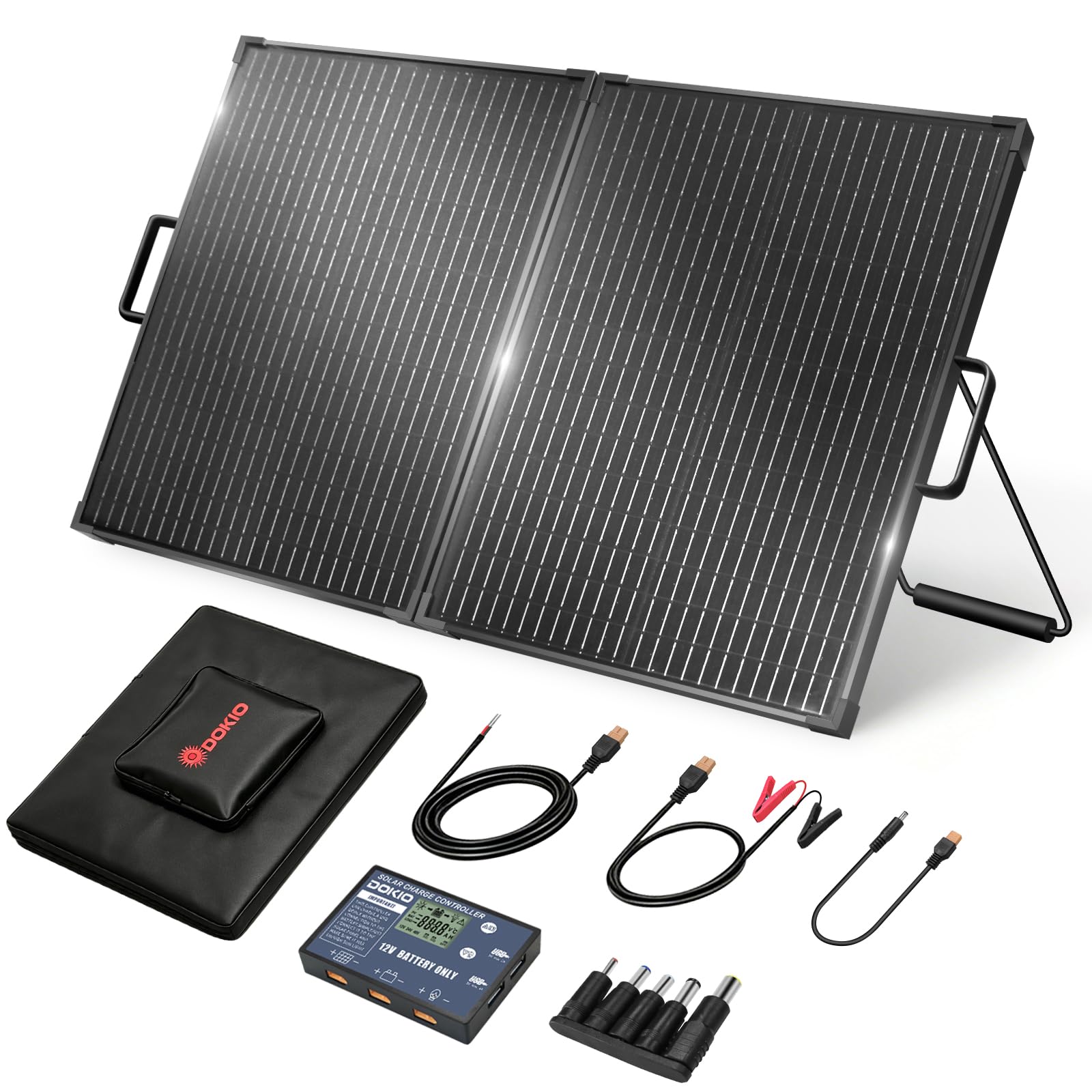
DOKIO’s 100W suitcase panel is designed for plug-and-play simplicity with a built-in PWM charge controller, alligator clips, and a 9.8 ft cable. The rigid aluminum frame with tempered glass folds into a briefcase form factor (23 x 19.3 x 1.3 inches) with a carry handle and included bag for transport. The adjustable bracket allows angle tuning for optimal sun exposure.
The integrated PWM controller offers intelligent protection against reverse polarity, overcharging, short-circuit, and reverse current. Two 5V 2A USB ports provide direct device charging for phones and small electronics without needing a separate battery. The panel outputs 18V nominal, making it compatible with standard 12V lead-acid, AGM, and gel batteries out of the box.
The leg stand is described as flimsy but adequate, and upgrading the PWM controller to an MPPT unit doubled charging speed in some installations. Polarity reversal has been known to damage USB ports, so double-checking battery polarity with a multimeter is recommended before first connection.
Why it’s great
- True out-of-box experience with included PWM controller and alligator clips
- Tempered glass and aluminum frame for long-term durability
- 9.8 ft cable allows panel repositioning without moving the battery
Good to know
- PWM controller limits efficiency; MPPT upgrade significantly improves charging speed
- Polarity reversal can damage integrated USB ports
8. FlexSolar 100W Portable Solar Panel
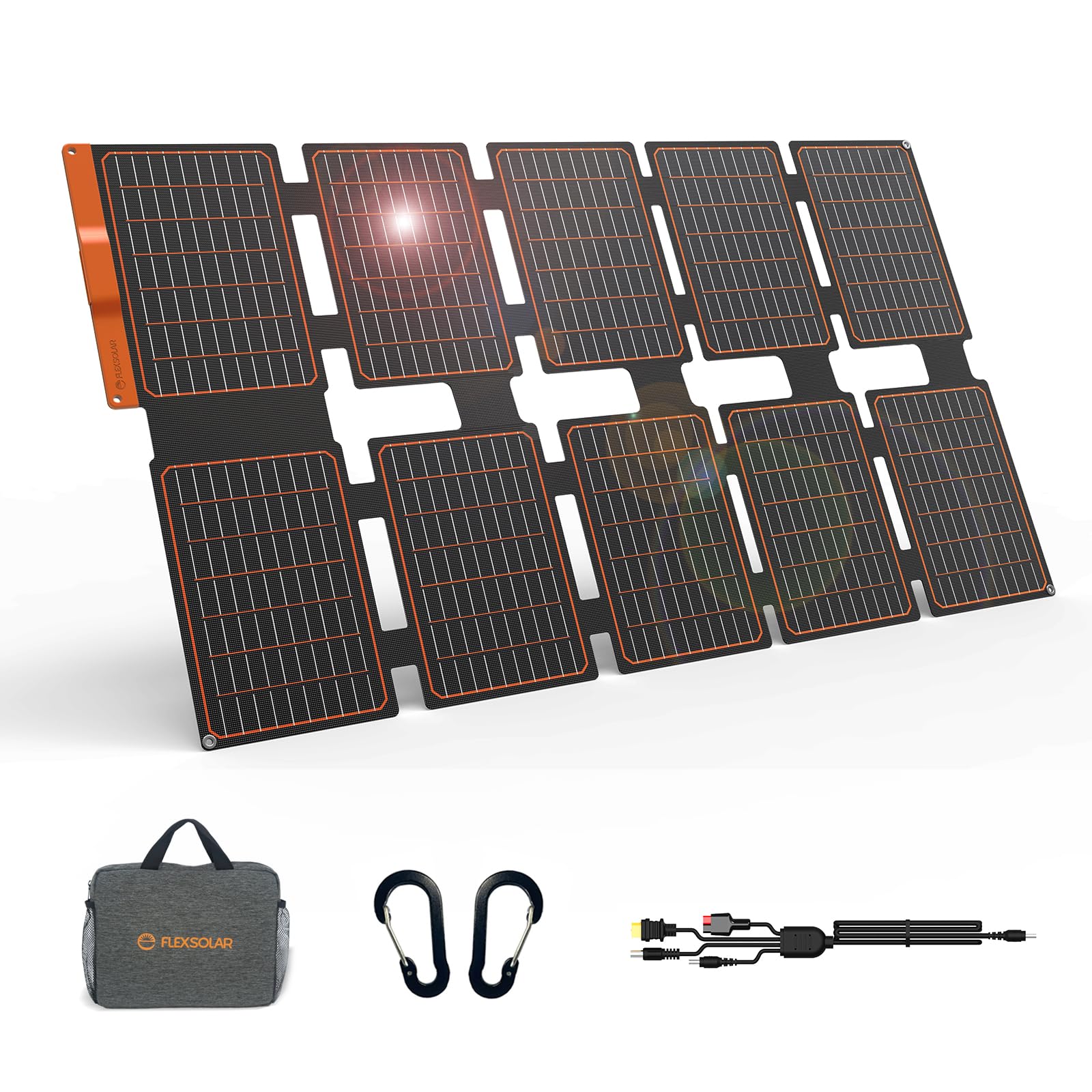
The FlexSolar 100W is the featherweight champion of this round at just 4.1 lbs, folding down to 12.99 x 10.43 x 2.17 inches—roughly notebook-sized when stored. The high-efficiency monocrystalline cells with E-Film lamination achieve over 23% conversion with IP67 waterproof and dustproof rating, making it genuinely submersible-resistant in rain and wet environments.
The 3-in-1 output includes a PD 3.0 45W USB-C port, an 18W USB-A port, and a 100W DC output. The included 4-in-1 charging cable (DC5521, DC7909, Anderson, XT60) provides broad compatibility with most portable power stations. The panel also includes corner carabiners for hanging from tent lines, trees, or vehicle windows.
User reviews confirm the panel reliably recharged CPAP batteries from 6% to 100% in 6-8 hours hung from a tent. The DC output delivers about 90W real-world, with USB-C reaching 56W measured output. Some users report USB port corrosion from rain exposure—cleaning the pins restores function but is difficult in permanent installations. The carry bag and overall build feel premium for the weight class.
Why it’s great
- Ultra-light 4.1 lb design with genuine IP67 waterproof rating
- 45W USB-C PD and 4-in-1 cable for broad power station compatibility
- Carabiner loops for versatile hanging and angled sun tracking
Good to know
- USB port corrosion reported with prolonged rain exposure
- No angle-adjustable kickstands; relies on hanging or terrain positioning
9. NESTOUT 14W Portable Solar Panel
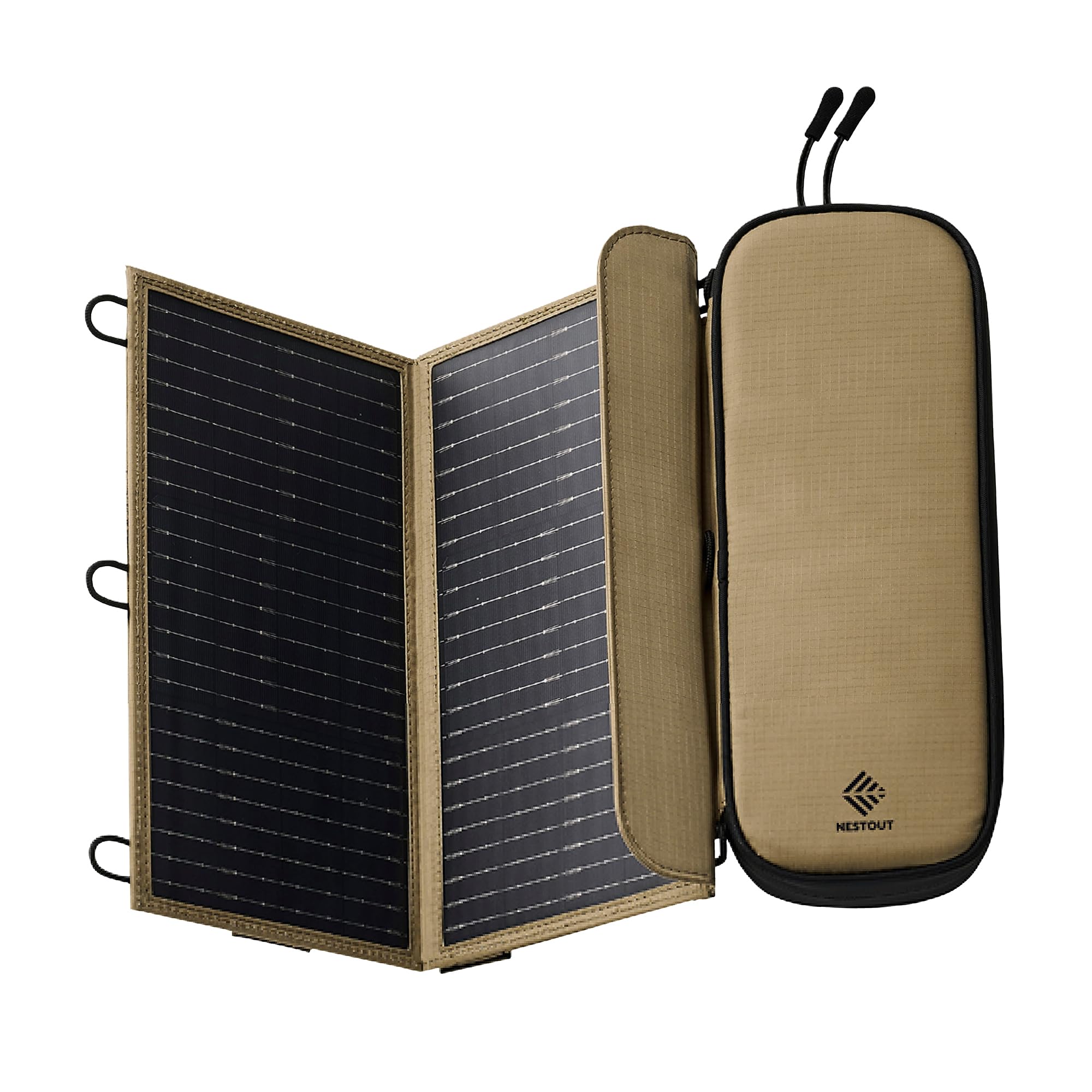
The NESTOUT 14W occupies a different niche—ultra-portable device top-up rather than full power station charging. Its polymer solar cells hit 24% efficiency in a package that weighs just 21.5 oz and folds to 5.9 x 11.0 x 2.2 inches. The iF Design Gold Award-winning construction uses water-repellent ripstop nylon with a PET-coated solar surface.
A built-in digital ammeter displays real-time charging current, allowing immediate feedback on panel positioning. The wide-angle adjustable stand and multiple hanging loops give flexibility for backpack, tent, or pack attachment. The integrated cable pocket stores a USB-C and USB-A port (5V/2.8A total output) plus the compatible NESTOUT battery pack.
Users report charging a 5000mAh power bank in about 2.5-3 hours under direct sun. The system integrates seamlessly with the NESTOUT ecosystem (battery, lantern, tripod) but is priced higher than competing 14W panels. The instructions are primarily in Japanese, which may slow initial setup. For ultralight backpackers who need reliable phone and GPS top-up without carrying a power station, this is the cleanest solution available.
Why it’s great
- Ultra-light 21.5 oz design with 24% efficient polymer cells
- Built-in digital ammeter for real-time sun tracking optimization
- iF Design Gold Award build with durable ripstop nylon shell
Good to know
- 14W output is only suitable for small devices, not power station charging
- Premium price point compared to similar-wattage competitors
- Instructions primarily in Japanese; digital English manual may be needed
FAQ
Can I mix portable and rooftop camper solar panels in the same system?
What size solar panel do I need to run a 12V camper fridge?
Does a bifacial solar panel work better on a camper roof?
Can I leave a portable solar panel in the rain?
Final Thoughts: The Verdict
For most users, the best camper solar panels winner is the Renogy 200W E.Flex because its 25% N-Type efficiency, 13.89 lb weight, and proven compatibility with major power stations deliver the best balance of power density and portability for both weekend trips and extended off-grid living. If you want a permanent rooftop install with Bluetooth monitoring and turnkey wiring, grab the Renogy 200W Kit. And for ultralight backpackers who need reliable device top-up without a power station, nothing beats the NESTOUT 14W.