
Our readers keep the lights on and my morning glass full of iced black tea. As an Amazon Associate, I earn from qualifying purchases.
Specs are compiled from manufacturer listings and verified buyer reviews and can change over time — please confirm the key details on the product page before buying.
Camping in summer heat is a battle you can actually win, and the right portable air conditioner for your tent is the weapon. The three units below are the ones worth your attention, and one of them will fit how you camp: the weekend tent camper, the van or RV traveler, or the overlander chasing desert nights.
I’m Min — the founder and writer behind Gadgets Feed. This guide is built by comparing the manufacturers’ published specifications and the patterns across verified customer reviews, so you get each pick’s real strengths and trade-offs instead of marketing spin.
Every pick here runs on real compressor cooling, not a fan blowing warm air around. We break down BTU, power source, and noise so you can match a unit to your setup. If you want the honest read on camping air conditioners for tents, start here.
Quick Picks
- Outohome Portable Camping Air Conditioner — Best Overall
- Cybertake S2 Pro Portable Camping Air — Best for Battery
- EF ECOFLOW WAVE 3 Portable Air Conditioner — Premium Pick
How To Choose The Best Camping Air Conditioners For Tents
Before you buy a tent air conditioner, answer three questions: how much cooling power you need, where the electricity comes from, and how loud it runs while you sleep. Get those three right and you will not waste money on a unit that cannot keep up with a summer tent.
Match BTU To Your Tent Size
BTU, or British Thermal Units, is the standard measure of how much heat a unit can pull out of the air. A higher BTU number means more cooling muscle, but it also usually means a bigger, heavier, and more power-hungry machine. Size your unit to the space you are actually cooling, because an oversized unit on a small power supply will drain your battery faster than you expect.
Sort Out Your Power Source First
A tent air conditioner is only as useful as the power you can feed it. Some units run off a standard wall outlet, some accept 12-volt or 24-volt vehicle power, and others can run cordless from a built-in or add-on battery. Decide where you camp most — a powered campsite, a van, or a remote site with a portable power station — before you pick a unit, because the wrong power setup makes even a strong cooler useless.
Do Not Ignore Noise And Venting
Compressors make noise, and you are sleeping inches from one, so a lower decibel rating matters more in a tent than it does in a house. Venting matters too: every portable unit needs to push hot exhaust air somewhere, usually out a window or tent port, and if that hot air stays inside, the cooling never catches up.
Quick Comparison
| Model | Best For | Cooling Power | Weight | Noise Level | Amazon |
|---|---|---|---|---|---|
| Outohome Portable Camping Air Conditioner | Small tents and spot cooling | 5200 BTU | 31.9 lb | 46-50 dB | Amazon |
| Cybertake S2 Pro Portable Camping Air Conditioner | Truck and tent camping on battery | 5100 BTU cooling, 6100 BTU heating | 21 lb | 40 dB | Amazon |
| EF ECOFLOW WAVE 3 | Van and RV overnight comfort | 6100 BTU cooling, 2000W/6800 BTU heating | 32 lb | 44 dB in sleep mode | Amazon |
In‑Depth Reviews
1. Outohome Portable Camping Air Conditioner, 5200 BTU 4-in-1 Portable AC Unit

A 5200 BTU compressor unit with cooling, dehumidify, sleep, and fan modes for small, sealed tents.
You get real cooling, not just moving air. This is a true air conditioner: it runs on a compressor with refrigerant (the same basic cooling tech as a window unit) and pushes 5200 BTU of cooling power, which the maker says drops the temperature by 10°C/18°F within 5 minutes — enough to take the edge off a hot afternoon inside your tent. Four modes cover your day and night: cooling, dehumidifying, sleep, and fan. You can set the thermostat anywhere from 16°C to 30°C (60°F to 88°F), so you dial in the temperature you actually want.
Portability is the strong suit here. It weighs 31.9 pounds, has a built-in grip so you can carry it one-handed, and the compact body slips into a truck, RV, or your kitchen during the off-season. The sleep mode runs at 46-50dB, which is roughly normal-conversation quiet — noticeable, but not the roar you might expect from a compressor. Buyers report it genuinely works in a real tent, with one noting it “brought the temperature down To a bearable temperature” in a six-person tent.
The honest caveat: cooling performance is the most-discussed topic, and the feedback is mixed. In extreme heat above 90°F, several owners found it could not keep up in a full-size space, and one suspected a damaged unit on arrival. This is a spot-cooler you point at where you sit or sleep, not a whole-tent climate system. In a small, well-sealed tent or a cracked vehicle window it does its job; in a big, leaky space under a brutal sun, it asks for help staying ahead.
Why It Earns The Top Spot
- 5200 BTU of true compressor cooling, not evaporative air
- Four modes including sleep and dehumidify, controllable by remote
- One-handed carry at 31.9 lb with an integrated grip
What To Think About First
- Cooling performance gets mixed owner feedback
- Struggles above 90°F in larger spaces
- Needs a strong power source — owners note it draws hard
Made for: small-tent campers and spot-cooling setups where you sleep within a few feet of the vent.
Think twice if: you camp in a large, uninsulated tent in triple-digit heat and expect the whole space to chill.
2. Cybertake S2 Pro Portable Camping Air Conditioner, Tent AC with 5100 BTU Cooling and 6100 BTU Heating
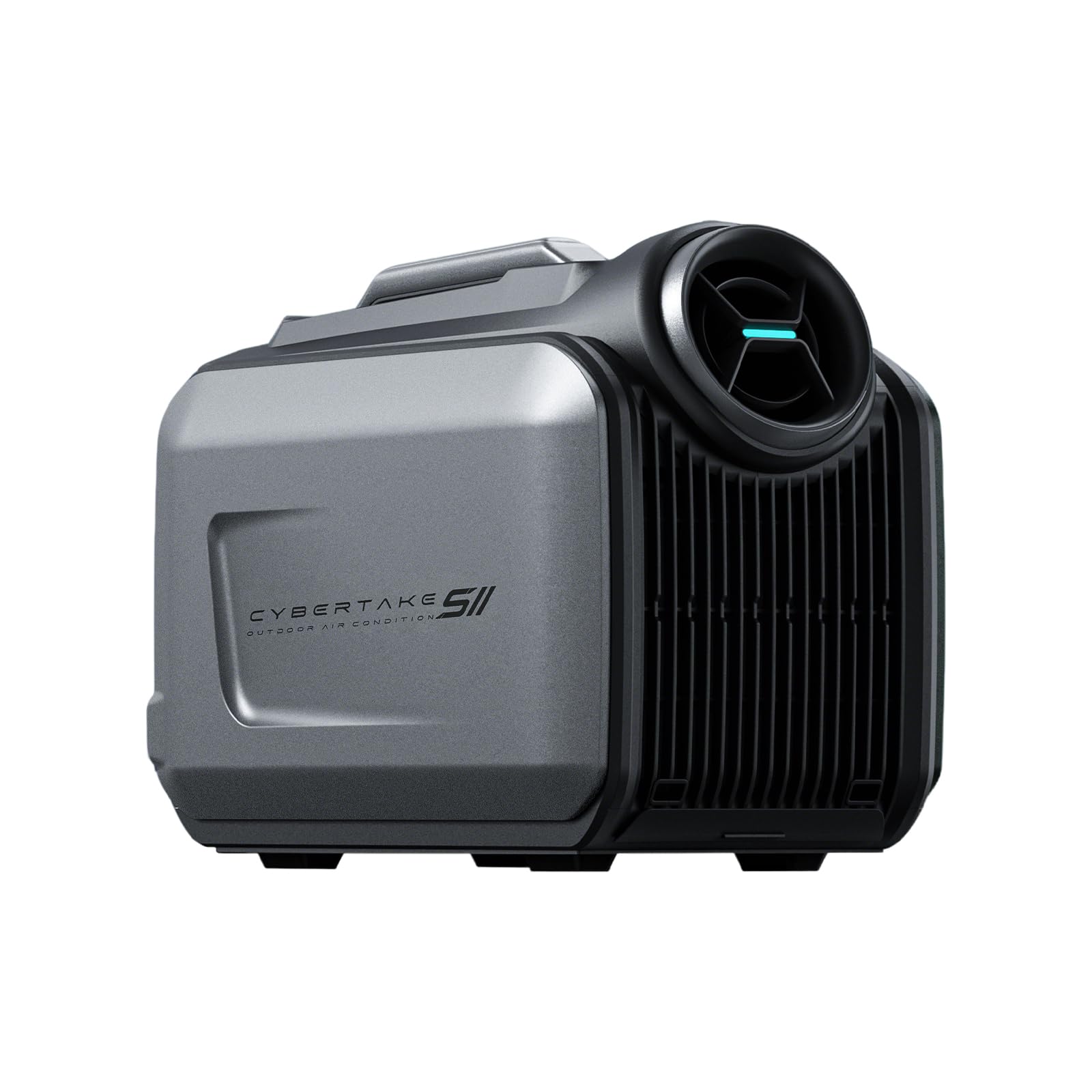
At 21 pounds it is the lightest of the three, and its 6100 BTU heating mode makes it a four-season unit.
If you run your setup off a battery or a truck, this is the pick that makes the most sense. It weighs 21 pounds — the Outohome above tips the scale at 31.9 pounds, so the Cybertake sheds a meaningful chunk of carry weight for a unit you are hauling in and out of a vehicle. It runs on three power paths: a 100-240V wall outlet, 12V or 24V vehicle power, or a 48V DC portable power station, and it is rated for 8 hours of cooling on 1kWh in Eco+ mode.
Performance is the aspect owners praise most, and it is the single biggest reason this unit earns its spot. It moves 5100 BTU of cooling and 6100 BTU of heating, which the maker rates for spaces up to 130 square feet, with an operating range of 41°F to 113°F. It also flips to heating when the temperature drops, so it is a four-season box rather than a summer-only toy. Owners mention the Eco mode stretches a power station a long way — one notes it runs “14hrs on Bluetti 300” with fan speed up to 4 drawing no extra power.
Know the trade-offs before you commit. It is the quietest unit here at 40dB (a sound level quieter than a dishwasher, per the maker), so it will not keep you awake at night. But its hot exhaust blows out the back, and that heat limits how much it can do when the unit sits inside a sealed vehicle. Several owners found it works best blowing cold air into a tent or truck bed from outside, not cooling the air around it inside a closed cabin. The app control is also a recurring sore point: it is not in the major app stores, so plan on the silicone buttons and a separately sold remote.
Best-fit buyer: truck campers, tent campers with a power station, and anyone who wants one box that handles both hot afternoons and cold nights.
The trade-off to size: that rear heat output means you point the cold air where you sleep and vent the hot side to the outside — it is not a set-it-inside-and-forget-it unit.
Reach for this if: you camp with a battery bank or vehicle power and want the lightest, quietest four-season option.
Look elsewhere if: you need app control from the start or expect it to chill a sealed cabin from the inside.
3. EF ECOFLOW WAVE 3 Portable Air Conditioner with Add-on Battery

A 1024Wh LFP battery delivers 8 hours of cordless cooling for van and RV overnight use.
This is the premium end of the tent-cooling world, and what buys the higher tier is the battery. A 1024Wh LFP battery delivers 8 hours of cordless running, and the maker says a 1000W fast charge refills it in 75 minutes through AC, car, solar, or an EcoFlow alternator charger. For overnight vanlife or RV tents, that cordless freedom is the whole point — you are not tethered to a running engine or a wall.
The cooling hardware is serious too. It delivers 6100 BTU of cooling and 2000W/6800 BTU of heating, covering 120-180 square feet, and its HyperSpeed mode is claimed to drop the temperature 15°F in 15 minutes under extreme heat. Setup is quick — the maker calls it ready in 30 seconds — and sleep mode runs at 44dB. Initial quality is what wins people over, and it shows: the build feels solid, charging is fast, and it cools a small space without drama.
Then there is the honest catch, and it is a big one. Battery life and durability draw the most pushback, and it is the not-worth-the-money verdict that keeps this from the top spot. Customers note the claimed runtime does not always hold up — one says the battery died two hours into a long haul and cooled little — and some report early failures swapped through warranty. It is also the heaviest battery-included unit here at 32 pounds. The premium price buys genuine convenience, but you are paying for that freedom, so go in knowing the trade.
Where it wins: cordless overnight operation, fast 1000W charging, and a 120-180 sq ft coverage rating that suits a van or a small RV.
Where it stings: the battery-life and durability feedback, plus the weight, mean it rewards buyers who value convenience over value.
Suits: van lifers and RV campers who want true cordless cooling and will pay the premium tier for it.
The honest limit: real-world runtime falls short of the claim for some owners, and the unit is heavy to move around.
Understanding the Specs
BTU: The Real Cooling Power Number
BTU stands for British Thermal Units, and it tells you how much heat a unit can remove from the air. Higher is more powerful, but more power usually means more weight and more electricity drawn per hour. The Outohome runs 5200 BTU, the Cybertake S2 Pro does 5100 BTU of cooling, and the EcoFlow Wave 3 leads at 6100 BTU. Match the number to your space: an oversized unit in a tiny tent is wasted power, and an undersized one cannot keep up in real heat.
Decibels: What You Will Actually Hear
A decibel, or dB, measures sound. For a compressor running inches from your head all night, lower is better. The Cybertake S2 Pro is the quietest of the three at 40dB, the EcoFlow Wave 3 runs 44dB in sleep mode, and the Outohome sits at 46-50dB. As a rough guide, 40dB is close to a quiet library, while 50dB edges toward a normal conversation — both are liveable, but they are not silent.
Power Source: Where You Can Run It
This is the spec that decides your camping style. The Outohome runs on AC wall power. The Cybertake S2 Pro takes three inputs — 100-240V wall, 12-24V vehicle, or 48V DC power station. The EcoFlow Wave 3 goes cordless with a 1024Wh LFP battery for 8 hours of run time. The bigger the power demand, the more you need a serious battery or generator, so pick the unit that matches how you actually camp.
Coverage Area: Clearing The Confusion
Coverage listings describe the space a unit is rated to condition. The Cybertake S2 Pro is rated for up to 130 square feet, and the EcoFlow Wave 3 covers 120-180 square feet. Treat these as guides, not promises: an uninsulated tent loses cool air fast, so a small, sealed space will always cool better than a large, drafty one, no matter what the rating says.
FAQ
Can a portable air conditioner actually cool a tent?
How many watts does a tent air conditioner need to run?
What is the quietest camping air conditioner for tent sleeping?
Can I run a tent air conditioner off a portable power station?
Do these units heat as well as cool?
How much space can each unit cool?
Do I need to drain water from a portable tent air conditioner?
Can I vent a tent air conditioner without cutting a hole?
What does the heater mode add for cold-weather camping?
Final Thoughts: The Verdict
For most tent campers, the winner is the Outohome Portable Camping Air Conditioner. It delivers real 5200 BTU compressor cooling, four modes, and one-handed portability at the lowest tier here, and it handles spot cooling exactly where you sleep. If you camp on battery or in a truck and want the lightest, quietest four-season unit, reach for the Cybertake S2 Pro. And if you want true cordless freedom for vanlife and overnight RV comfort, the EcoFlow Wave 3 is the premium pick worth considering.
How We Picked
We do not accept paid placement. Every pick is matched to a real buyer and a real use-case; we do not hands-on test units.
Sources & Methodology
Specifications: manufacturer listings and product documentation. Review insights: verified customer reviews, as of September 2026. Pricing: not shown on this page (it changes often); check the current price via the retailer link.
As an Amazon Associate, Gadgets Feed earns from qualifying purchases. This does not affect which products we feature.