
Our readers keep the lights on and my morning glass full of iced black tea. As an Amazon Associate, I earn from qualifying purchases.
Specs are compiled from manufacturer listings and verified buyer reviews and can change over time — please confirm the key details on the product page before buying.
A bad camping bed roll means you spend the whole next day with a stiff back, replaying the feeling of every root and pebble you rolled onto all night. A few inches of foam can make or break your trip. This guide covers the best options for car campers, overlanders, and tent campers — from simple foam pads to thick memory-foam mats.
I’m Min — the founder and writer behind Gadgets Feed. This guide is built by comparing the manufacturers’ published specifications and the patterns across verified customer reviews, so you get each pick’s real strengths and trade-offs instead of marketing spin.
if you need a packable pad, winter warmth, or a cot-friendly mattress, this guide covers every adventure style. This is the definitive guide to the camping bed roll.
Our Picks at a Glance

How To Choose The Best Camping Bed Roll
Foam type, thickness, and weight determine your sleep quality and travel style. Your choice depends on your destination and transport method.
Foam Type: Memory Foam vs Closed-Cell vs Self-Inflating
Memory foam bed rolls (like the CYMULA or Gaialoop) are the most comfortable — they feel like a real mattress and absorb pressure points well, but they are heavy and bulky when rolled. Closed-cell foam pads (like the Therm-a-Rest RidgeRest or AceCamp) are lightweight, nearly indestructible, and insulate well even when wet, but they are thin and firm. Self-inflating pads (like the Wevelel) mix foam with air, offering a good balance of comfort and packability but require a bit of effort to deflate fully.
Thickness and R-Value for Warmth
Thickness directly affects both comfort and insulation against cold ground. A pad with an R-value (a measure of its resistance to heat loss) of 2.0 is fine for summer camping, while an R-value of 5.0 or higher is needed for below-freezing nights. Closed-cell foam pads typically have a low R-value but never deflate, while thick memory foam pads depend on their density and bottom waterproofing to block cold.
Weight, Pack Size, and Your Vehicle
If you are backpacking, every ounce matters — a closed-cell pad like the AceCamp at 11 ounces is your friend. If you are car camping or using an SUV, a thick memory foam roll (weighing 6 to 11 pounds) that rolls up to the size of a large sleeping bag is a fine trade-off for a great night’s sleep. Always check the rolled dimensions against your trunk or gear bin.
Quick Comparison
| Model | Best For | Thickness | Weight | R-Value | Amazon |
|---|---|---|---|---|---|
| CYMULA 3 Inch Memory Foam★ Best Overall | Best Overall Comfort | 3 inches | 6.4 lbs | — | Amazon |
| TREKOLOGY UL R7Top Performer | Backpacking Insulation | 4 inches | 2 lbs | 7.2 | Amazon |
| Wevelel Self-InflatingBest Value | High R-Value Warmth | 3.1 inches | 6.59 lbs | 9.5 | Amazon |
| Therm-a-Rest RidgeRest Classic | Ultralight Durability | 0.63 inches | 1.3 lbs | 2.0 | Amazon |
| AceCamp Portable Foam | Budget Backpacking | 0.5 inches | 11 oz | 2.0 | Amazon |
| HomeMate Memory Foam | Versatile Guest Use | 3 inches | 7.8 lbs | — | Amazon |
| Lxotvae Memory Foam | OEKO-TEX Certified | 3 inches | 8.8 lbs | — | Amazon |
| Gaialoop 4 Inch Memory Foam | Luxury Side Sleeping | 4 inches | 11 lbs | — | Amazon |
| HEST Foamy | Home-Mattress Feel | 8.8 inches | 11 lbs | — | Amazon |
In‑Depth Reviews
1. CYMULA 3 Inch Memory Foam Camping Pad
Our pick — 4.5★ from 850+ verified ratings; the strongest balance of quality and price.
The crowd-favorite foam roll that turns a cot into a real bed.
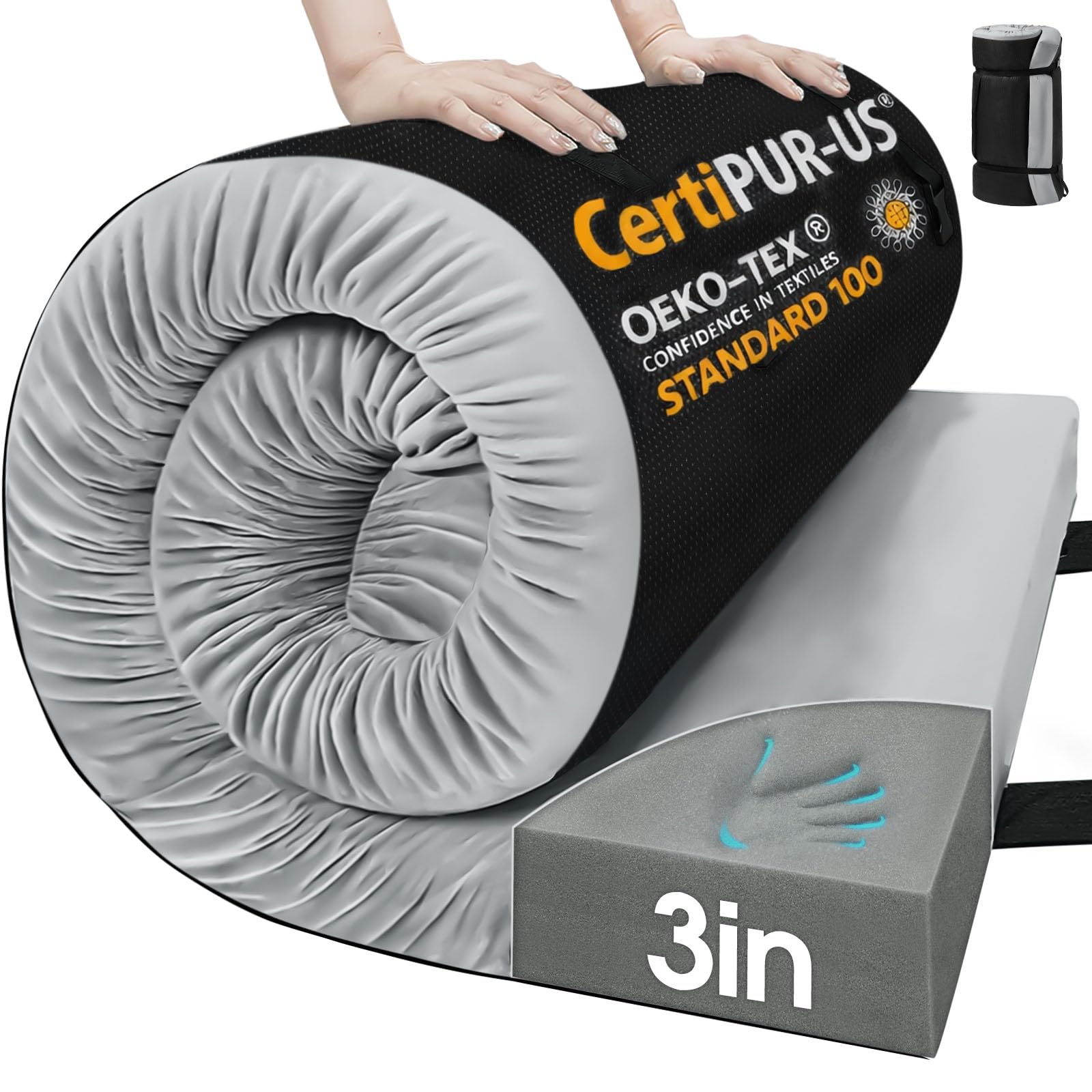
This is the most popular pick for a reason — comfort is the single most praised feature, and it shows in the numbers. The 3-inch thickness combines a carbon-fiber high-elasticity memory foam layer with a high-density base foam layer, creating a feel that owners say delivers “excellent warmth in 30s temps; most comfortable camping sleep ever.” Unlike an air mattress, this pad never deflates overnight, so you don’t wake up on the ground.
The waterproof bottom has rubberized anti-slip dots that keep it from sliding on a cot or tent floor, and the breathable fabric cover zips off for machine washing — a big plus for car campers who deal with mud and dust. At 6.4 pounds and 72 x 24 inches, it is heavy and bulky compared to an ultralight closed-cell foam pad, but buyers report the rolled size (straps included) is manageable for trunk storage. The only real trade-off is that some find it too narrow for wider cots, so measure your cot width first.
Versatility is a strong suit here. Owners use it for tent camping, on truck platforms, on guest room floors, and even for yoga and pet areas. The crowd favorite — 4.5 stars across 850+ owners — confirms that if you drive to your campsite, this pad gives you the closest thing to a real mattress without needing an RV.
Why owners love it
- Comfort is the most praised feature — over 130 owners single it out for warmth and support
- Removable, machine-washable cover keeps it clean after muddy trips
- Waterproof, non-slip bottom stays put on cots and tent floors
Who should think twice
- At 6.4 lbs, it is not for backpacking or hiking to a site
- Some owners find it too narrow (24″) for standard wide cots
- It has a chemical smell when first opened that needs airing out
Reach for this if: you car camp or use a cot and want the most comfortable memory-foam sleep that thousands of owners already swear by.
A fair warning: the storage straps can feel flimsy — a few owners replaced them with tension straps for a tighter roll.
2. TREKOLOGY Sleeping Pad UL R7
A lightweight air pad that packs down to a water bottle but keeps you warm in the teens.
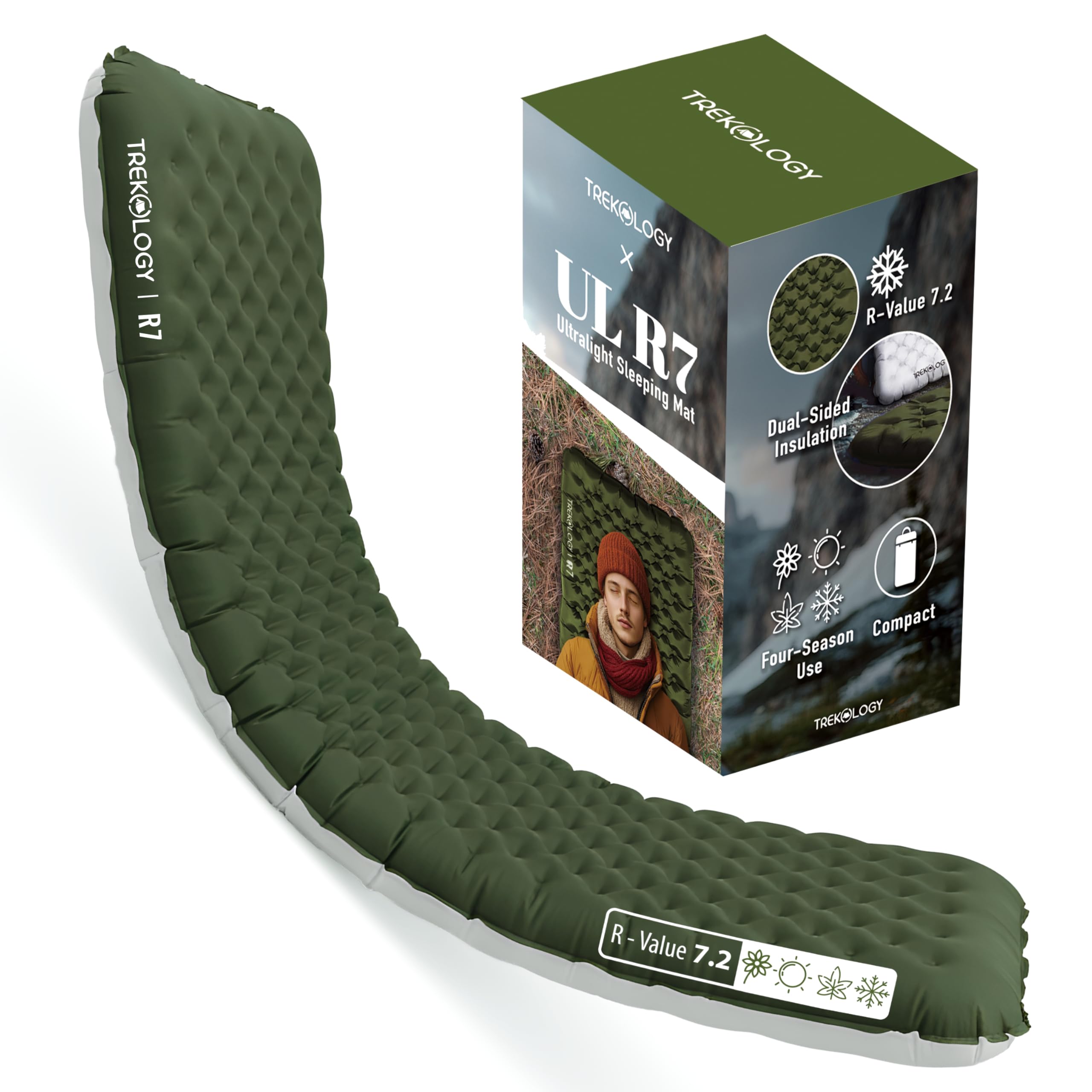
This inflatable pad solves the two biggest problems with thick memory foam rolls — weight and pack size. At just 2 pounds and rolling up to the size of a water bottle, the Trekology UL R7 is designed for backpackers and hikers who still want real insulation. The 7.2 R-value (certified by SGS) is the standout spec here, providing excellent ground insulation for three-season and even winter use. Owners mention it kept them warm in 22°F weather, and one noted it stayed inflated all night with no air loss.
Compared to the CYMULA memory foam pad (6.4 lbs), the Trekology is over 4 pounds lighter and compresses dramatically smaller, making it a far better choice if you carry your gear. It features a 40D ripstop nylon shell with a TPU coating, which resists tears and moisture. The surface is slippery, however — some owners recommend a shelf liner underneath to prevent sliding on a tent floor. Inflation is done by mouth or with a separate pump bag (not included), and while the patented anti-leak valve works well, deflation can be a bit of a workout due to the foil insulation inside.
The comfort and warmth praised most by owners — both mentioned over 60 times each — make this a compelling pick for anyone who values packable warmth over plush luxury. At 24 inches wide, it is spacious enough for most sleepers, but side sleepers may wish for a wider model.
What makes it great
- Weighs just 2 lbs and packs down to water-bottle size for true backpacking portability
- SGS-certified 7.2 R-value keeps you warm well below freezing
- Durable 40D ripstop nylon with TPU coating resists tears and moisture
What to plan for
- No built-in pump — you need a separate pump bag or lung power
- Surface is slippery; a liner or non-slip pad helps on tent floors
- Deflating can be slow and requires careful rolling to remove all air
Best for the weight-conscious camper: anyone backpacking or hiking who refuses to sleep cold and needs gear that shrinks down small.
Don’t get it if: you want instant setup with no blowing — this pad requires a few minutes to inflate and deflate.
3. Wevelel Memory Sleeping Pad
A self-inflating foam pad with an R-value that beats most air pads on the market.
The Wevelel sits in a unique spot — it combines memory foam with self-inflation, giving you the comfort of foam and the packability of an air pad. The headline spec is the 9.5 R-value, which is extremely high for a camping pad and means you can sleep on snow or frozen ground without losing body heat. It inflates in about 30 seconds (open the valves, let it expand for 10 seconds, then step on the front valve for 20 seconds), and supports up to 800 pounds without leaking.
At 3.1 inches thick and 77 inches long, it provides a roomy sleep surface that side sleepers appreciate. The built-in pillow and 50D stretch knit fabric (which is quiet and skin-friendly) add to the comfort. One owner called it “absolutely love this sleeping pad” after ten nights of camping, praising its dry, comfortable feel. The catch is that packing it back into the bag takes effort — the dual-use valve helps squeeze air out, but it is still bulkier than a pure air pad. Some owners also note that the actual width is 26 inches, not the 30 inches listed, which can be an issue for broad-shouldered sleepers.
This is a balance for car campers and overlanders who want serious winter insulation without the weight (6.59 lbs is reasonable for a 3.1-inch foam pad) and who don’t mind spending a few minutes on setup and takedown.
Where it excels
- 9.5 R-value is exceptional insulation for winter and below-freezing camping
- Self-inflates in about 30 seconds with a simple valve system
- Supports up to 800 lbs and is ASTM tested for 10,000 compressions
Where it struggles
- Packing it back into the bag can be a wrestling match
- Actual width is 26″ — narrower than some descriptions claim
- Bulky rolled size for a self-inflating pad, not ideal for backpacking
Perfect for cold-weather car campers: if you camp in winter or in high-altitude conditions, this pad’s R-value gives you warmth that few others at this price match.
Skip it for ultralight trips: the packing bulk and effort make it a poor fit for backpacking or long hikes.
4. Therm-a-Rest RidgeRest Classic Foam Pad
The nearly indestructible foam slab that has been a backpacking staple for decades.
If durability and weight are your priorities, this is the benchmark. The RidgeRest is made from cross-linked polyethylene foam — the same stuff that makes cutting boards and kayaks tough — so it is virtually impossible to puncture, tear, or wear out. At 1.3 pounds (19 ounces) and 77 inches long, it is at 1.3 lbs versus the CYMULA at 6.4 lbs, making it a go-to for backpackers and scouts who carry everything on their backs. Customers note: “Good Length and width for me who’s 6’1, decently comfortable, volume is not too large and weighs about 1 pound.”
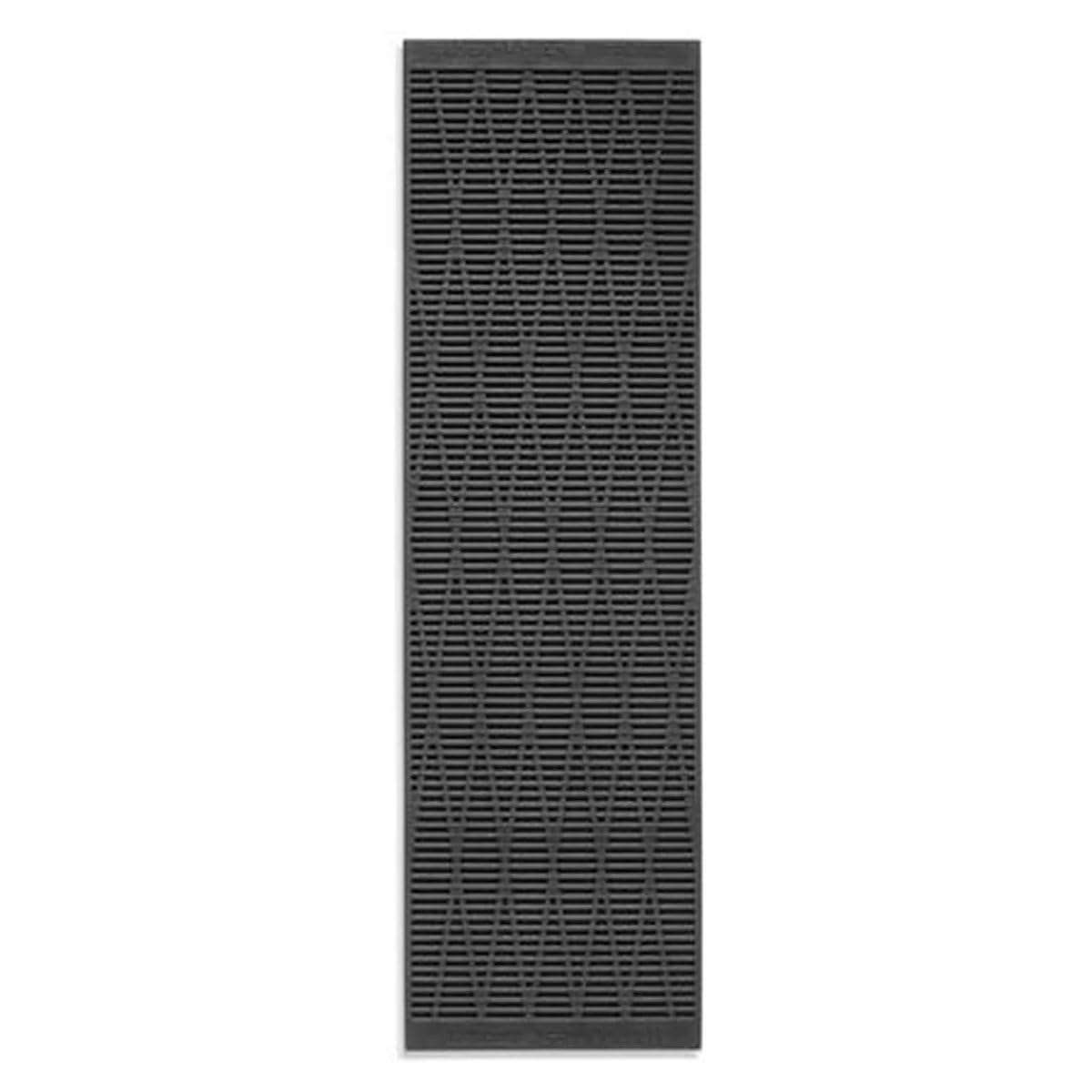
The surface has a distinct egg-carton texture with supportive peaks and heat-trapping valleys, which provides an R-value of 2.0 — enough for summer and mild shoulder-season camping, but thin for real winter use. At just 0.63 inches thick, this is not a luxury bed. Owners who use it on the ground note the indentations can feel uncomfortable, but many pair it under an inflatable pad for extra insulation and puncture protection. It also works perfectly on a camp cot as a firm mattress replacement.
Because it never absorbs water and never deflates, the RidgeRest is a favorite for rugged environments, kayak trips, and as a permanent dog bed (some owners cut it in half for exactly that purpose). Its only real flaw is bulk — it does not compress, so even though it is light, it must be strapped to the outside of a backpack.
Why it endures
- Weighs just 1.3 lbs and is virtually indestructible cross-linked polyethylene foam
- R-Value 2.0 provides reliable insulation for summer and mild cold
- At 77 x 25 inches, it fits taller campers (reviewers point out 6’1″ fits well)
Who might want more
- Only 0.63 inches thick — firm sleepers only; side sleepers may find it too thin
- Bulky and non-compressible, best strapped outside a pack
- Low R-value compared to insulated air pads, not for deep winter
For the minimalist or scout: if weight and ruggedness matter more than plush comfort, and you sleep on a closed-cell pad already, this is the reference standard.
Look elsewhere if: you are a side sleeper who needs cushioning, or you want a pad that packs small — this one is bulky no matter how you roll it.
5. HomeMate Memory Foam Camping Mattress Pad
A plush memory foam roll that doubles as a guest bed at home.
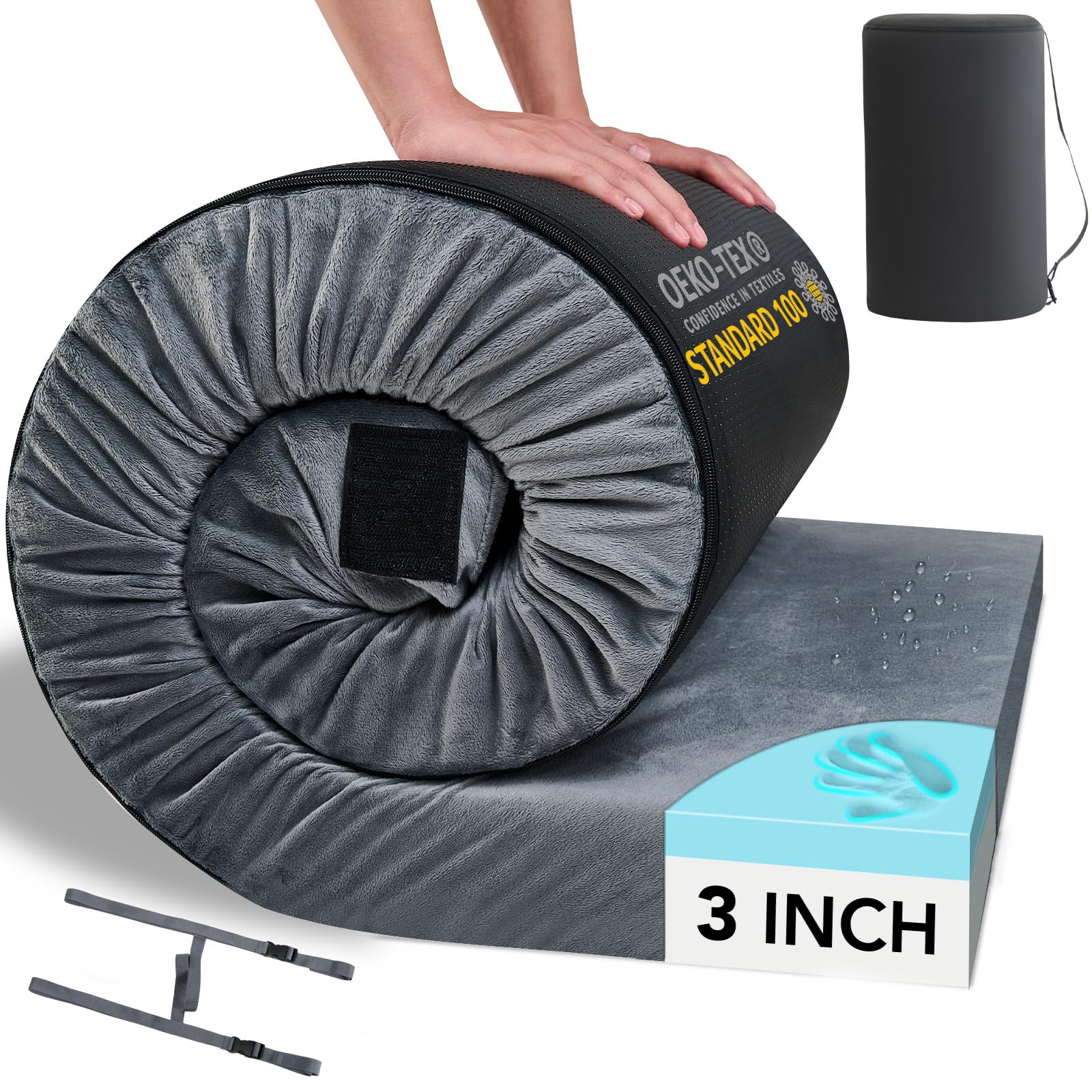
The HomeMate is very similar to the CYMULA in concept — a 3-inch memory foam pad with a removable washable cover and a waterproof bottom — but it adds a few thoughtful details. It comes with a storage bag and Velcro connectors that let you link multiple pads together for a larger sleeping area, which is handy for families or groups. The comfort is the most praised feature, with over 120 owners calling out how well it cushions on a cot or on the ground. One owner wrote: “I love this memory foam camping mattress. Very comfortable and I use it at home so that I can sleep on the floor so my senior pet doesn’t try to jump on the bed.”
At 7.8 pounds, it is about 1.4 pounds heavier than the CYMULA, so it is firmly in car-camping territory. The rolled size is significant — some owners note you may need a vacuum-seal storage bag to compress it for easier transport. The waterproof and anti-slip bottom works well on damp grounds, and the memory foam top layer provides the pressure relief that air pads lack. If you plan to use it both for camping and as an extra bed for guests at home, this is a strong contender.
One thing to know: it needs up to 72 hours to fully expand after unpacking, so do not rely on it for a trip the day it arrives. The quality and softness earn consistent praise, but the bulkiness when rolled is the recurring practical complaint.
What stands out
- Velcro connectors let you join multiple pads for a large sleep surface — great for families
- Comfort is praised by over 120 owners; great for pressure relief on hard surfaces
- Removable, washable cover and a storage bag make cleaning and transport easy
What to consider
- At 7.8 lbs, it is heavier than many similar memory foam pads
- Rolled size is large; needs a vacuum bag for compact storage
- Requires up to 72 hours to fully expand after unpacking
Ideal for the multi-use buyer: if you want one pad that works for car camping trips and also serves as a spare bed for house guests or kids’ sleepovers.
Pass on it if: you need a compact, easy-to-carry pad for a small vehicle or any hiking.
6. Lxotvae Memory Foam Camping Mattress Pad
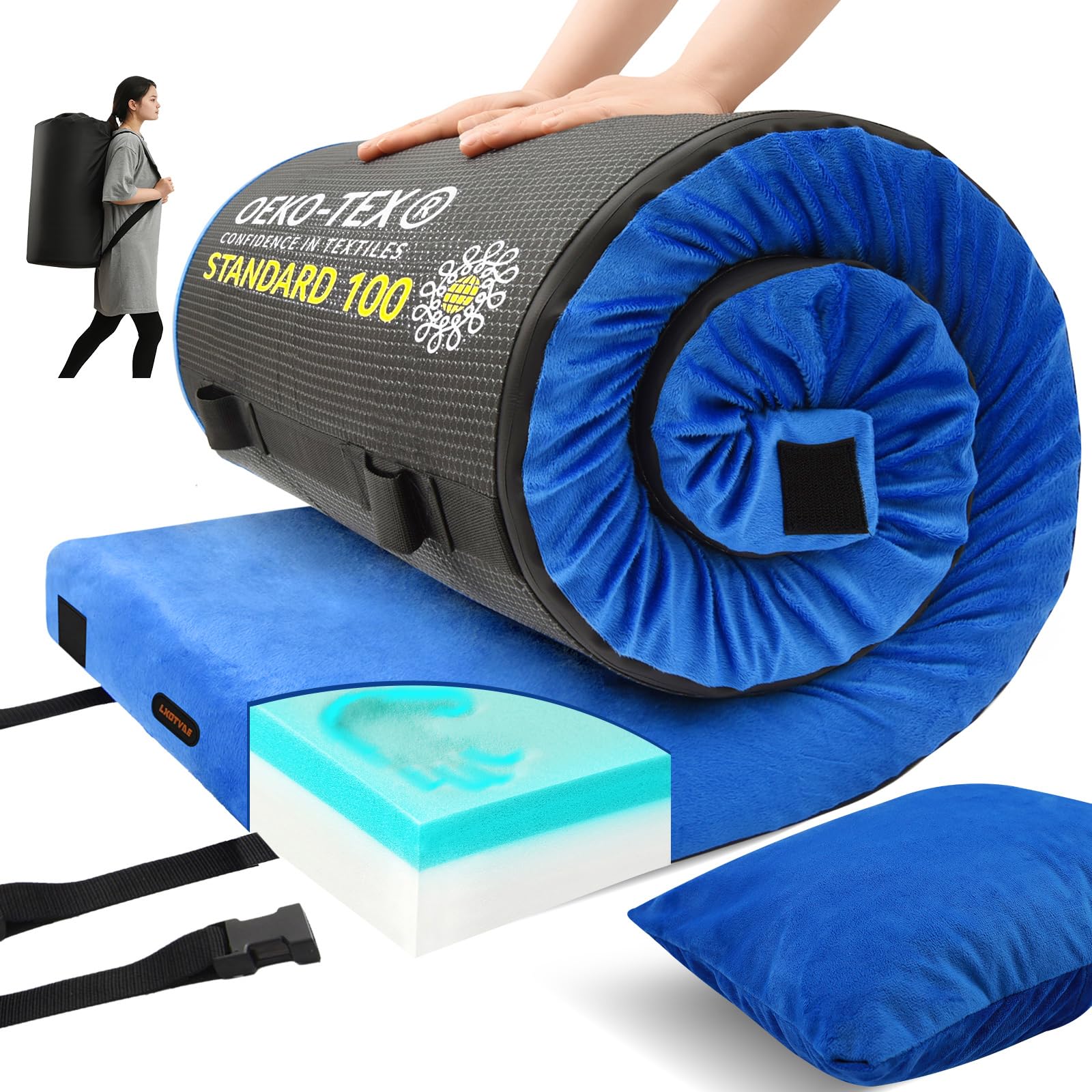
A double-layer memory foam pad certified safe, with a soft velvet cover.
This pad stands out for its OEKO-TEX certification, meaning the foam and fabrics have been tested for harmful substances — a nice peace-of-mind feature if you or your family are sensitive to chemical off-gassing. It uses a double-layer design: gel memory foam on top for body-conforming softness, and 30D high-density foam on the bottom for support. The top surface is a super-soft velvet fabric that feels noticeably nicer than standard nylon, and the entire cover is removable and washable. A TPU waterproof membrane on both the top and bottom protects the foam from rain and dew.
At 72 x 24 x 3 inches, it follows the same footprint as the CYMULA and HomeMate. Owners say the non-slip honeycomb bottom works well, and they appreciate the included small pillow (though some found it lumpy). Comfort is the most-praised feature, with nearly 100 owners calling it out. The catch is that it retains heat — the gel memory foam does not breathe as well as open-cell foam, so some owners note it can feel warm in summer. It also rolls up large (size of a laundry basket, according to one review), which is fine for car camping but not for any hike-in site.
The new-smell takes about a week to fully fade, but given the OEKO-TEX certification, it is likely just foam packaging off-gassing rather than anything alarming. For car campers who prioritize certified safety and a soft-to-the-touch cover, this is a solid pick.
Strengths
- OEKO-TEX certified materials for safety and confidence
- Double-layer design: gel memory foam for softness, high-density foam for support
- Velvet cover is removable, washable, and feels nicer than standard fabrics
Weaknesses
- Retains heat — can feel warm in summer weather
- Rolled size is very large (comparable to a laundry basket); heavy for any carry
- New smell takes about a week to fade completely
Best for the health-conscious car camper: if OEKO-TEX certification matters to you and you want a velvet-soft feel, this is your pad.
Not for summer-only campers: the heat retention makes this better suited for cooler nights or shoulder-season trips.
7. Gaialoop 4 Inch Memory Foam Camping Mattress
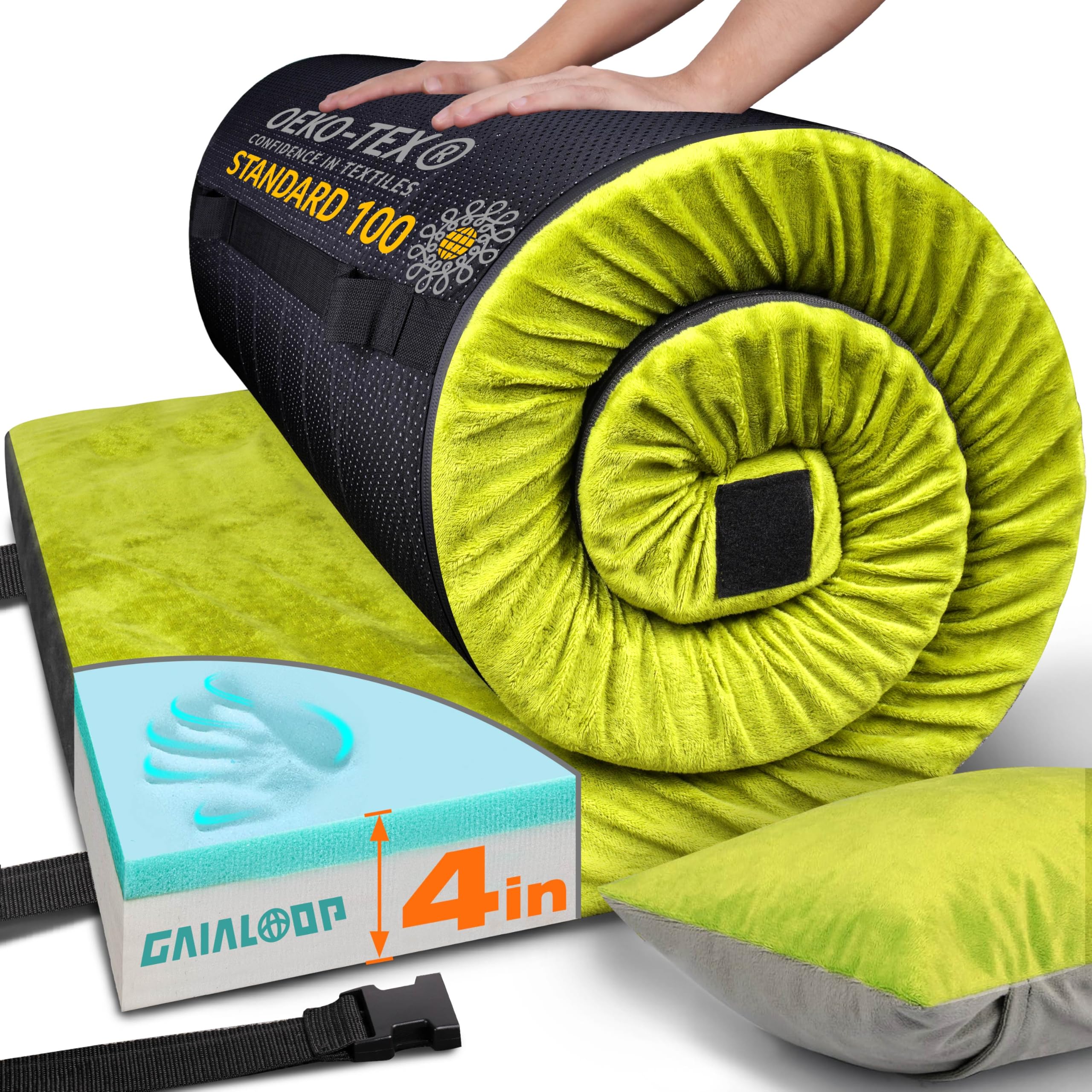
The thickest pure memory foam roll here — 4 inches of cushion for side sleepers.
If you are a side sleeper, you know the pain of a thin pad — your shoulder and hip dig into the ground and you wake up numb. The Gaialoop solves this with a full 4 inches of foam (a 1-inch 40D memory foam layer on top of a 3-inch 30D support foam layer). Owners confirm the thickness is accurate after full expansion, and side sleepers report no pressure points. The pad measures 72 x 24 inches, which is the same footprint as the CYMULA but 1 inch thicker — that extra inch makes a real difference for hip pressure relief.
It is made with OEKO-TEX certified materials and has a waterproof coating on the inside of the cover to protect the foam from moisture. The cover is a plush velvet fabric that is removable and washable. At 11 pounds and rolling up to about 2 feet in diameter and 5.5 feet long, this is a dedicated car-camping or van-life item. The zipper on the stuff sack and the strap stitching have been reported as weak points by some owners — one said the zipper broke on the second use, and the strap snapped. It is still a very comfortable pad, but you might want to have a backup strap.
For the price, this is a premium feeling product that earns a 4.5-star rating from nearly 500 owners. If you have the vehicle space to haul it, and you value a deep, soft sleep surface over packability, the Gaialoop delivers.
What makes it special
- 4-inch thickness is the thickest pure memory foam pad here — ideal for side sleepers
- OEKO-TEX certified materials; waterproof coating inside the cover
- Velvet plush cover is removable and washable
What to watch for
- At 11 lbs, it is heavy and needs real vehicle space to store
- Zipper and strap stitching on the stuff sack can fail — consider backup straps
- Rolling it up alone is tricky; two people make it easier
Ideal for the dedicated side sleeper: if you drive to your campsite and refuse to sacrifice hip and shoulder comfort, this 4-inch pad is the answer.
Do not buy this for backpacking: it is as heavy as a small car tire and just as hard to pack on foot.
8. AceCamp Portable Foam Sleeping Pad

The lightest and cheapest pad here — an ounce counter’s dream.
At 11 ounces and under, the AceCamp is the budget-friendly, ultralight champion. It is a closed-cell polyethylene foam pad that folds accordion-style, secured by two compression straps. Its R-value of 2.0 is identical to the Therm-a-Rest RidgeRest, but at 69.2 inches long and 21.6 inches wide, it is shorter at 69.2 inches versus the RidgeRest’s 77 inches, and narrower at 21.6 inches versus the RidgeRest’s 25 inches. That smaller footprint saves weight and cost, but taller campers (6 feet and up) will find it short. The most common positive feedback is its weight — owners say it is “fantastic light-weight sleeping pad, comparable to big brands at half the cost.”
Durability is a mixed story. The foam itself is puncture-proof like any closed-cell pad, but the surface shows wear over time — one owner noted “after a 12 day hiking trip. They started to show a little wear.” For overnight and weekend trips, it holds up fine. Many buyers use it as a protective layer under an inflatable pad, which extends its life and adds insulation.
This is a perfect entry-level or backup pad. It is light enough for a scout, cheap enough to buy two, and reliable enough to never let you down. Just know that at 0.5 inches thick, it is more about insulation from the cold ground than comfort for sleeping on it alone.
Why it works
- Weighs just 11 oz — the lightest pad in this guide for backpacking
- Closed-cell foam is puncture-proof: no air to leak, no inflating needed
- Excellent value for money and doubles as a sit pad or pack frame liner
Who should upgrade
- Only 0.5 inches thick — very firm; not comfortable for side sleepers without an extra pad
- Narrow at 21.6″ and shorter at 69.2″ than most competitors
- Surface wear shows after extended use (a dozen+ hiking days)
Best for the ultralight hiker on a budget: if grams matter and you want a reliable, no-fuss pad that costs less than dinner out.
Skip it for comfort: if you want to actually sleep well rather than just stay off the bare ground, get a thicker memory foam or air pad.
9. HEST Foamy Camping Mattress Pad

A massive 8.8-inch thick mattress that makes your tent feel like a studio apartment.
The HEST Foamy is the clear outlier in this list — it is a luxury camping mattress designed for those who drive to their site and refuse to rough it. At 8.8 inches thick, 30 inches wide, and 78 inches long, it is essentially a twin-sized foam mattress that rolls up. It uses two layers of high-performance memory foam that provide body alignment and pressure point relief that rivals a home mattress. One owner wrote: “More comfortable than my bed at home.” It does not pump up or inflate — you just unroll it, and the integrated compression strap doubles as a welcome mat for a dry surface to stand on.
The portability is the main contradiction. It weighs 11 pounds and rolls up to a very large cylinder, so it is strictly for trunk or van travel. The rollability is a mixed bag — some owners find it impossible to roll, others say it is easy with knee pressure. The value for money is also divisive: at a premium price, some feel it is worth every dollar for the sleep quality, while others consider it overly expensive. The most common positive feedback is sleep quality, called out by over 20 owners, which is high for a smaller review sample.
A pocket at the top holds your phone, and linking clips allow you to join two Foamies together for a double bed. This is the ultimate car-camping mattress for people who prioritize a perfect sleep surface over everything else.
The luxury experience
- 8.8 inches thick and 30 inches wide — the most spacious and cushioned pad here
- Dual-layer memory foam rivals a home mattress for body alignment
- Built-in pocket for phone and harness doubles as a changing mat
The honest trade-offs
- Premium price that not everyone finds justified for a camping pad
- Very bulky and heavy (11 lbs) — only for vehicle-based camping, no hiking
- Rolling it up can be difficult; some shoppers say it is impossible to re-pack alone
For the overlander who takes sleep seriously: if you have the space, this is more comfortable than many RV mattresses and makes you actually look forward to camping.
Not for minimalist campers: the bulk and price screen out anyone who values packability or a budget over sheer comfort.
Understanding the Specs
R-Value (Thermal Insulation)
R-value is a number that tells you how well the pad insulates you from the cold ground. A pad with an R-value of 2.0 (like the Therm-a-Rest RidgeRest) works for summer and mild nights. An R-value of 5.0 or higher is comfortable into freezing temperatures. The Wevelel pad has a 9.5 R-value, meaning it can handle snow camping. Thick memory foam pads often do not list an R-value, but their bulk itself provides some insulation — you can check the manufacturer for more detail if cold ground is a concern.
Closed-Cell vs Memory Foam vs Self-Inflating
Closed-cell foam pads (like the AceCamp and Therm-a-Rest) are light, cheap, and impossible to pop, but they are thin and firm. Memory foam pads (like the CYMULA and Gaialoop) are thick and soft, feeling like a real mattress, but they are heavy and bulky — great for car camping, bad for backpacking. Self-inflating pads (like the Wevelel) have foam inside that expands when the valve is opened, pulling in air. They weigh more than pure air pads but offer better insulation and comfort, and they do not require a pump.
FAQ
What is the best thickness for a camping bed roll?
Can I use a camping bed roll on a cot?
What does R-value mean and how much do I need?
Which is better: memory foam or closed-cell foam?
How do I clean a camping bed roll?
Will a camping bed roll fit in my backpack?
Does a camping bed roll need to be inflated?
What size camping bed roll fits a tall person?
How long does a memory foam camping pad take to expand?
Can I use a camping bed roll on the ground without a tent?
Final Thoughts: The Verdict
Across the board, the best camping bed roll is the CYMULA 3 Inch Memory Foam Pad because it delivers the most praised comfort across hundreds of reviews at a reasonable weight for vehicle camping. If you backpack or hike to your site, the TREKOLOGY UL R7 gives you the lightest packable warmth with an impressive 7.2 R-value. And for the ultimate luxury sleep experience in a van or SUV, the HEST Foamy is the one to reach for if you have the space and the budget.
How We Picked
We do not accept paid placement. Every pick is matched to a real buyer and a real use-case; we do not hands-on test units.
Sources & Methodology
Specifications: manufacturer listings and product documentation. Review insights: verified customer reviews, as of July 2026. Pricing: not shown on this page (it changes often); check the current price via the retailer link.
As an Amazon Associate, Gadgets Feed earns from qualifying purchases. This does not affect which products we feature.