
Fresh-ground coffee at a remote campsite is a specific luxury—one that usually gets sabotaged by a whirring electric blade grinder that needs an outlet, wakes the tent, and pulverizes beans into a dusty mess. The right manual grinder solves all of that with a quiet, deliberate motion that preserves the bean’s integrity and delivers a consistently ground dose for any brew method, from a French press to a single-shot espresso.
I’m Min — the co-founder and writer behind Gadgets Feed. I’ve spent hundreds of hours cross-referencing burr geometries, bearing tolerances, grind adjustment resolution, and real-world field reports to identify the hand grinders that actually survive a weekend in the backcountry.
After thorough analysis of burr materials, adjustment granularity, portability, and durability, this guide breaks down the best options for your next trip with the best camping coffee grinder at every value tier.
How To Choose The Best Camping Coffee Grinder
A camping coffee grinder needs to balance grind consistency, durability, and portability in a way a kitchen grinder doesn’t. You’re hauling it in a pack, grinding without a countertop, and cleaning it with limited water. Here’s what to prioritize.
Burr Type and Material
Conical steel burrs are the only option worth considering for camping. Ceramic burrs are brittle and prone to chipping if a stray pebble or hard bean hits them. Steel burrs (typically SUS420 or equivalent at 55-58 HRC) cut cleanly, resist wear over years of use, and produce a more uniform particle distribution essential for proper extraction in a pour-over or French press. Avoid any grinder advertising “blade” grinding—those shatter beans unevenly and create fines that clog filters.
Grind Adjustment Resolution
The number of click stops directly translates to how precisely you can dial in a grind size. A budget unit with 10-15 clicks gives you coarse, medium, and fine zones; a premium unit with 36-60 clicks lets you fine-tune between espresso and drip with sub-20-micron steps. For camping, you need at least enough range to go from a fine Aeropress grind to a coarse French press grind. Look for 24 clicks or more as a baseline—fewer than that sacrifices control on the trail.
Build Materials and Portability
Full-metal bodies (aluminum or stainless steel) survive drops on rocks and rain exposure far better than ABS plastic models. Weight matters—anything under 700 grams is packable, while units over a pound feel substantial but add bulk. A dual-bearing central shaft keeps the burrs aligned under load, preventing wobble and uneven grind. Catch cup capacity between 25g and 35g covers a single strong cup or a small French press without needing a mid-grind refill.
Quick Comparison
On smaller screens, swipe sideways to see the full table.
| Model | Category | Best For | Key Spec | Amazon |
|---|---|---|---|---|
| TIMEMORE Chestnut C2S | Premium | All-metal durability & precise grind | 38mm S2C steel burr, 36 clicks, 700g | Amazon |
| KINGrinder K6 | Premium | Ultra-fine espresso adjustment | 16 µm per click, 60 clicks, 620g | Amazon |
| HEIHOX H4 | Mid-Range | Compact all-metal with magnetic handle | 38mm steel burr, 24+ clicks, 870g | Amazon |
| Vivaant Manual Grinder | Mid-Range | Large 32g glass jar & 6 quick settings | Dragon tooth steel burr, 6 settings, 32g | Amazon |
| Alpaca Ventures Manual | Mid-Range | Easy-to-carry aluminum body | 420 steel burr, 12 settings, 1 lb | Amazon |
| Popsweeter C38 | Mid-Range | Full-metal build with silent grinding | 38mm CNC steel burr, 36 clicks, 1 lb | Amazon |
| KINGrinder P0 | Budget | Ultralight entry-level grinding | Conical steel burr, 30 clicks, 330g | Amazon |
In‑Depth Reviews
1. TIMEMORE Chestnut C2S

The TIMEMORE Chestnut C2S is the upgraded version of the wildly popular C2, and the biggest change is a full-metal unibody that eliminates the brittle top cap issue of its predecessor. The 38mm S2C stainless steel conical burr—CNC-machined to a hardness of 55-58 HRC—delivers a remarkably consistent particle distribution with minimal fines, making it equally capable of a clean pour-over or a rich French press grind.
At 700 grams, it hits a sweet spot between portability and a substantial feel that inspires confidence. The dual-bearing central shaft keeps the burrs perfectly aligned even under the torque of light-roast beans, and the handle has enough inertia to keep spinning for a moment after you release it—a small but satisfying detail that signals engineering refinement. The 36 click stops give you granular control across the full brew spectrum.
Disassembly for cleaning is tool-free, and the included carrying bag and brush make trail maintenance straightforward. The catch cup holds roughly 24 grams, which is enough for a single strong 12-ounce cup or a small Aeropress dose. For the camper who wants a premium, durable grinder without paying +, the C2S is the benchmark.
Why it’s great
- Full-metal unibody is far more durable than the C2’s plastic top
- 36-click adjustment with smooth, consistent detents
- Dual-bearing shaft ensures wobble-free grinding
Good to know
- Grind size adjustment knob can be fiddly to change frequently
- Catch cup capacity limited to ~24g
2. KINGrinder K6

The KINGrinder K6 is built for the camper who refuses to compromise on espresso at altitude. Its standout spec is the 16-micron-per-click adjustment—60 total clicks—making it one of the most precise manual grinders in its price band. This resolution lets you dial in a shot with the same granularity as electric grinders costing three times as much, which matters when you’re pulling espresso on a portable lever machine.
The full-metal design uses an aluminum body with a stainless steel burr set, and the dual-bearing system delivers exceptional concentricity. At 620 grams, it’s lighter than the TIMEMORE C2S yet feels equally solid in hand. The external adjustment ring is numbered for repeatability, and the catch cup holds 25-35 grams, accommodating a double shot or a single mug of pour-over without a mid-grind refill.
The straight handle design gives good leverage for medium roasts, though light-roast espresso can require some forearm effort—around 35-45 seconds for a 15-gram dose. The screw-on catch cup can occasionally bind, but zero retention means every gram of coffee ends up in the cup, not stuck in the burr chamber.
Why it’s great
- 16-micron click adjustment is class-leading for espresso tuning
- 60-click range covers every brew method with repeatable results
- Zero retention design wastes nothing
Good to know
- Screw-on catch cup can jam if over-tightened
- Light-roast espresso requires significant hand strength
3. HEIHOX H4

The HEIHOX H4 stands out for its rose red aluminum body and magnetic handle attachment—a convenience that prevents the crank from getting lost in a pack or rolling away at the campsite. Its 38mm stainless steel conical burr is paired with a double-bearing unibody structure, which keeps the grinding action smooth and the output uniform across 24+ click settings.
At 870 grams (just shy of 2 pounds), this is the heaviest grinder in the mid-range selection, but that weight comes from thick-walled aluminum that can survive a tumble off a picnic table. The grind adjustment is internal and provides an audible click with no external numbers, so you’ll need to remember your setting by count. Users report that the burrs produce a professional-looking espresso grind at 15 clicks and a coarse French press grind around 30-31 clicks.
The H4 includes a cleaning brush and a drawstring bag, and disassembly is tool-free. The main caveat is that the handle’s 5-inch crank arm creates a 10-inch rotation diameter, which can feel awkward during fine grinding sessions that last over a minute. For campers who prioritize build quality and a unique look over ergonomic perfection, the H4 delivers serious performance.
Why it’s great
- Magnetic handle is a small but practical field convenience
- Thick aluminum body withstands drops and abuse
- Consistent grind quality rivals higher-priced competitors
Good to know
- No visible grind size numbers—must count clicks
- Long handle arc can feel cumbersome during fine grinding
4. Vivaant Manual Coffee Grinder

The Vivaant grinder carves a unique niche in the camping category with its 32-gram glass jar catch cup—the largest capacity among the seven units here. That’s enough for a full 16-ounce French press without stopping to refill, and the jar doubles as a storage container with a tight-sealing lid, which means one less piece of gear to carry. The “dragon tooth” stainless steel conical burr is claimed to grind twice as fast as ceramic alternatives, and owners consistently confirm fast, uniform output.
The external numbered grind ring offers six settings from Turkish-fine (1) to French press-coarse (6), and switching between them requires no disassembly. The all-metal body and glass jar give it a sturdy heft, and the unit packs into a rugged box that survives transport. Grinding is quiet—no motor noise to disturb a quiet morning—and a full 32-gram load takes roughly one minute at a moderate pace.
The primary weakness is the glass jar: it’s breakable. Multiple customers report cracking the jar after a drop, but Vivaant’s customer service has a strong track record of sending replacement jars quickly, often with no charge. If you’re careful with your kit, this is a fantastic camping companion. If you’re rough on gear, the glass is a liability.
Why it’s great
- Largest catch cup capacity (32g) for group camping brewing
- External numbered ring allows fast grind adjustments
- Excellent lifetime warranty and responsive customer support
Good to know
- Glass jar can shatter if dropped on rocks
- Only 6 grind settings limits fine-tuning compared to 36-click units
5. Alpaca Ventures Manual Coffee Grinder

The Alpaca Ventures grinder packs a dual-bearing 420 stainless steel burr into a compact 5.5-inch body that weighs exactly one pound. The lengthened crank handle provides good leverage, making it notably less laborious than budget grinders with shorter arms. The grind adjustment dial offers 12 internal settings, and the unit is intended to cover everything from Turkish to French press with a simple twist.
The aluminum body with stainless steel burrs gives it a premium tactile feel that belies its mid-range price. Owners report that after an initial learning curve (the dial can spin without clicking if the handle isn’t properly engaged), the grinder produces a consistent particle size that noticeably improves coffee flavor compared to electric blade grinders. It includes a cleaning brush and disassembles for thorough cleaning without tools.
The main functional limitation is the lack of a rubberized base or grip ring—the smooth body can slide on a damp picnic table. Additionally, with only 12 internal stops, the adjustment resolution is coarser than the 36-click competitors, making it better suited for medium and coarse brews than precise espresso dialing. For campers who brew primarily with an Aeropress or French press, this grinder offers a solid balance of portability and performance.
Why it’s great
- Dual-bearing design delivers smooth, low-effort grinding
- Compact 5.5-inch length packs easily into any bag
- Stainless steel burrs resist rust and wear
Good to know
- No rubber base—unit slides on smooth surfaces
- 12 adjustment steps are coarse for espresso enthusiasts
6. Popsweeter C38
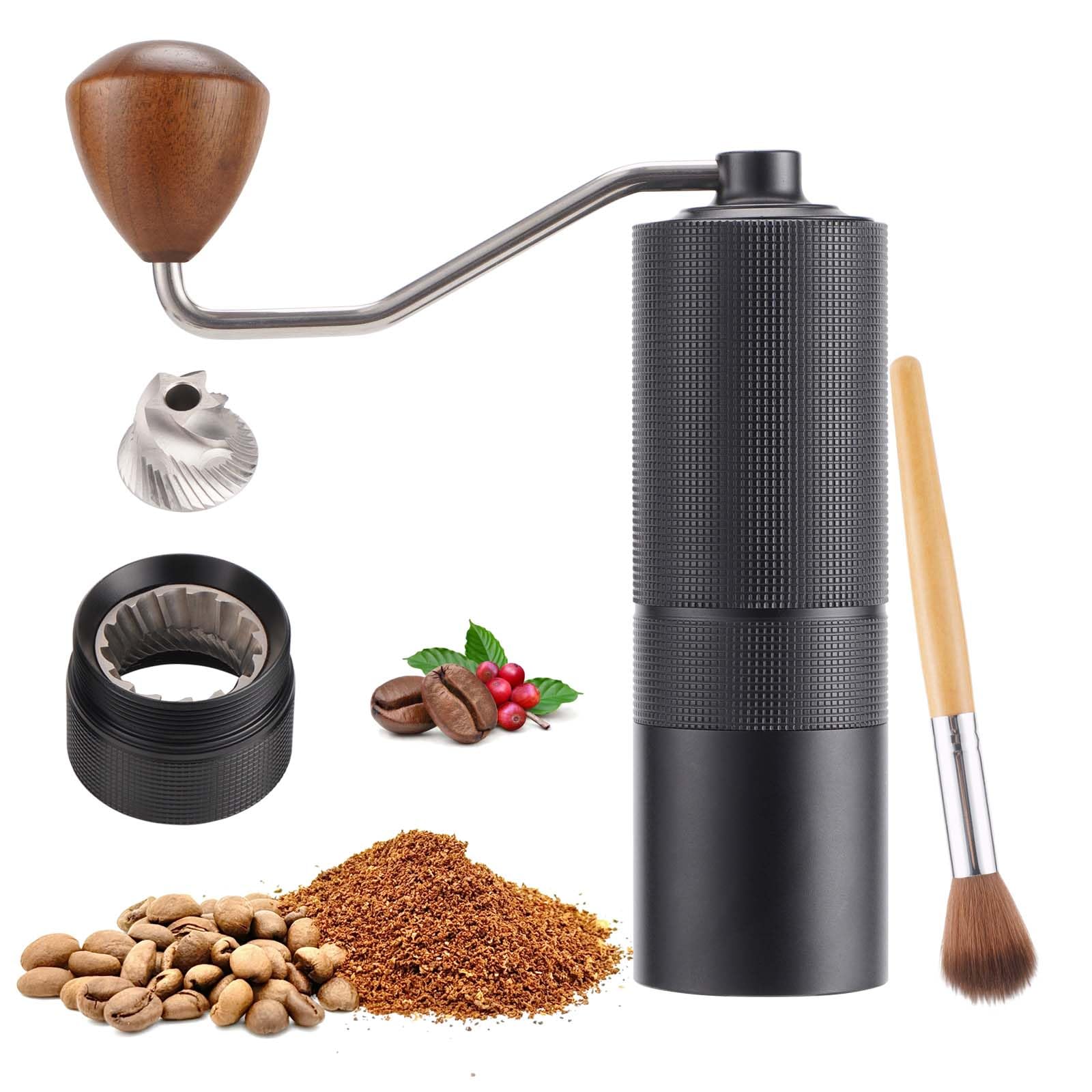
The Popsweeter C38 is an all-metal manual grinder with zero plastic parts—a rare trait that appeals to those who hate the creak and flex of ABS bodies. Its 38mm CNC-cut 420 stainless steel burrs (hardness 55-58 HRC) are paired with a precision double-bearing central shaft that provides exceptional concentricity and wobble-free rotation. The 36-click adjustment system covers the full spectrum from espresso to cold brew.
Weighing one pound flat, the C38 feels dense and premium without being backpack-unfriendly. The ergonomic long handle makes grinding easy on the wrist, and the silent operation is a genuine perk for early-morning campsite coffee when others are still asleep. Users consistently describe the grind consistency as “top notch,” with several comparing it favorably to the 1Zpresso ZP6 in flavor clarity—high praise for a unit at this price.
Disassembly is straightforward and tool-free: a simple twist separates the outer ring burr for deep cleaning of roasted coffee oils. The only downside is a relatively small catch cup—it holds roughly 25 grams, which means a refill is required for a full French press. For single-cup brewers who value build purity and flavor clarity, the C38 is a strong contender.
Why it’s great
- Zero plastic—every component is metal
- 36-click adjustment provides precise brew method control
- Silent operation won’t disturb campmates
Good to know
- Small catch cup requires refill for larger brews
- Slightly more expensive than similarly specced alternatives
7. KINGrinder P0

The KINGrinder P0 is the lightest grinder in this lineup at just 330 grams—roughly the weight of a full water bottle—making it a no-brainer for ultralight backpackers and thru-hikers who count every gram. Despite its entry-level price, it uses a conical stainless steel burr instead of a ceramic one, which is a meaningful advantage in durability and grind consistency at this tier. The ABS body keeps weight low but introduces some flex under heavy torque.
The adjustment system offers 30 clicks per rotation, with each click translating to a 0.0333mm adjustment. That’s actually finer resolution than some mid-range competitors, and owners confirm that the grind output is surprisingly uniform for the price point. The 20-gram capacity covers a single Aeropress or a small pour-over dose, and the included cleaning brush makes trail maintenance simple. Disassembly is tool-free.
The trade-offs are clear: the ABS body feels less premium than metal alternatives, and it won’t survive a tumble onto hard rock as gracefully as an aluminum unit. Additionally, the burrs are smaller than the 38mm standard, so light-roast beans take longer to grind. But for the price-conscious camper who wants a real conical burr grinder—not a blade chopper—the P0 is the best entry-level option available.
Why it’s great
- Ultralight 330g design is ideal for backpacking
- Conical steel burr outperforms ceramic and blade grinders
- 30-click adjustment offers surprisingly good precision
Good to know
- ABS body flexes under pressure and is less durable than metal
- Smaller burrs mean slower grinding for light roasts
FAQ
Is a manual grinder better than an electric for camping?
How many clicks do I actually need for camping?
Will a cheap blade grinder ruin my camping coffee?
Can I clean my manual grinder with water at the campsite?
What grind size should I use for a camping French press?
Final Thoughts: The Verdict
For most users, the best camping coffee grinder winner is the TIMEMORE Chestnut C2S because it combines a durable full-metal unibody with 36 precise click stops and a 700-gram weight that’s easy to pack but heavy enough to feel premium. If you want espresso-grade adjustment with 16-micron resolution, grab the KINGrinder K6. And for an ultralight trip where every gram counts, nothing beats the KINGrinder P0 at just 330 grams with a real conical steel burr.