
A dead battery at 2 AM in a remote campsite isn’t just an inconvenience—it’s a medical emergency for CPAP users. Standard portable power stations often lack the precise voltage regulation or dedicated DC barrel connectors your machine needs, leaving you with a brick instead of a lifeline. The right camping CPAP setup delivers consistent, clean power for multiple nights, letting you sleep soundly under the stars without compromising your therapy.
I’m Min — the co-founder and writer behind Gadgets Feed. I’ve spent countless hours analyzing battery chemistries, inverter efficiencies, and specific connector compatibilities across dozens of CPAP-focused power solutions to identify which units genuinely deliver on their runtime promises in real-world camping conditions.
After cross-referencing customer runtime tests with manufacturer specs and evaluating build quality, portability, and recharge versatility, I’ve built this definitive guide to the best camping cpap power solutions for every type of outdoor sleeper.
How To Choose The Best Camping CPAP
Selecting a camping CPAP battery isn’t about grabbing the biggest power station on the shelf. You need to match the battery’s voltage output, capacity in watt-hours, and connector compatibility to your specific machine model. Mistakes here mean a battery that either won’t power your device or dies halfway through the night.
Voltage Output and Connector Compatibility
Most ResMed machines, like the AirSense 10 and AirSense 11, require 24V DC input through a specific barrel connector. Philips DreamStation units often use 12V DC. A universal battery that auto-detects voltage or comes with multiple cable adapters eliminates the headache of buying separate converters. Always verify that the included cables match your CPAP model before purchasing—mismatched connectors are the single most common reason for returns in this category.
Battery Chemistry and Capacity
Lithium iron phosphate (LiFePO₄) cells dominate the premium tier because they deliver over 3,000 charge cycles, maintain stable voltage output as the battery depletes, and perform reliably in cold camping conditions down to around 14°F. Capacity, measured in watt-hours (Wh), directly determines runtime. A typical CPAP with humidifier disabled draws 30W to 60W, so a 100Wh battery delivers roughly 2 to 3 hours per 100Wh of capacity. For two full nights, aim for at least 200Wh of usable capacity.
Pass-Through Charging and Recharge Speed
Pass-through charging allows the battery to power your CPAP while simultaneously recharging from a wall outlet, solar panel, or vehicle 12V port. This feature is critical for RV camping where you might have intermittent AC power. Fast recharge—under 2 hours for a full charge via USB-C PD or AC input—means you can top up during a meal break or between campsites rather than waiting overnight.
Quick Comparison
On smaller screens, swipe sideways to see the full table.
| Model | Category | Best For | Key Spec | Amazon |
|---|---|---|---|---|
| Freedom CPAP Battery 160Wh | Mid-Range | Multi-night camping without humidifier | 160Wh, FAA-compliant | Amazon |
| EASYLONGER ES960 PRO | Mid-Range | ResMed AirSense/AirCurve owners | 297.6Wh LiFePO₄ | Amazon |
| Jackery Explorer 500 v2 | Power Station | Full campsite power + CPAP | 512Wh, 500W AC | Amazon |
| Medistrom Pilot-24 Lite | Travel | Ultra-light air travel + camping | 95Wh, TSA approved | Amazon |
| Zopec Explore Mini | Travel | Weight-conscious backpack campers | 1.1 lbs, auto-voltage | Amazon |
| Pilot Flex 98Wh | Travel | Compact universal CPAP backup | 98Wh, aluminum case | Amazon |
| Zopec Explore 5700 | Mid-Range | 3-night trips with no humidifier | 5700mAh universal | Amazon |
| Dabbsson 1008Wh | Power Station | Semi-solid LiFePO₄ tech | 1008Wh, 1200W AC | Amazon |
| EF ECOFLOW DELTA 2 | Power Station | Expandable home backup + camping | 1024Wh, 1800W AC | Amazon |
| BLUETTI Elite 200 V2 | Power Station | High-capacity extended camping | 2073.6Wh, 3900W lift | Amazon |
| PECRON F3000LFP | Power Station | Full off-grid home + CPAP | 3072Wh, 3600W AC | Amazon |
In‑Depth Reviews
1. Freedom CPAP Battery 160Wh
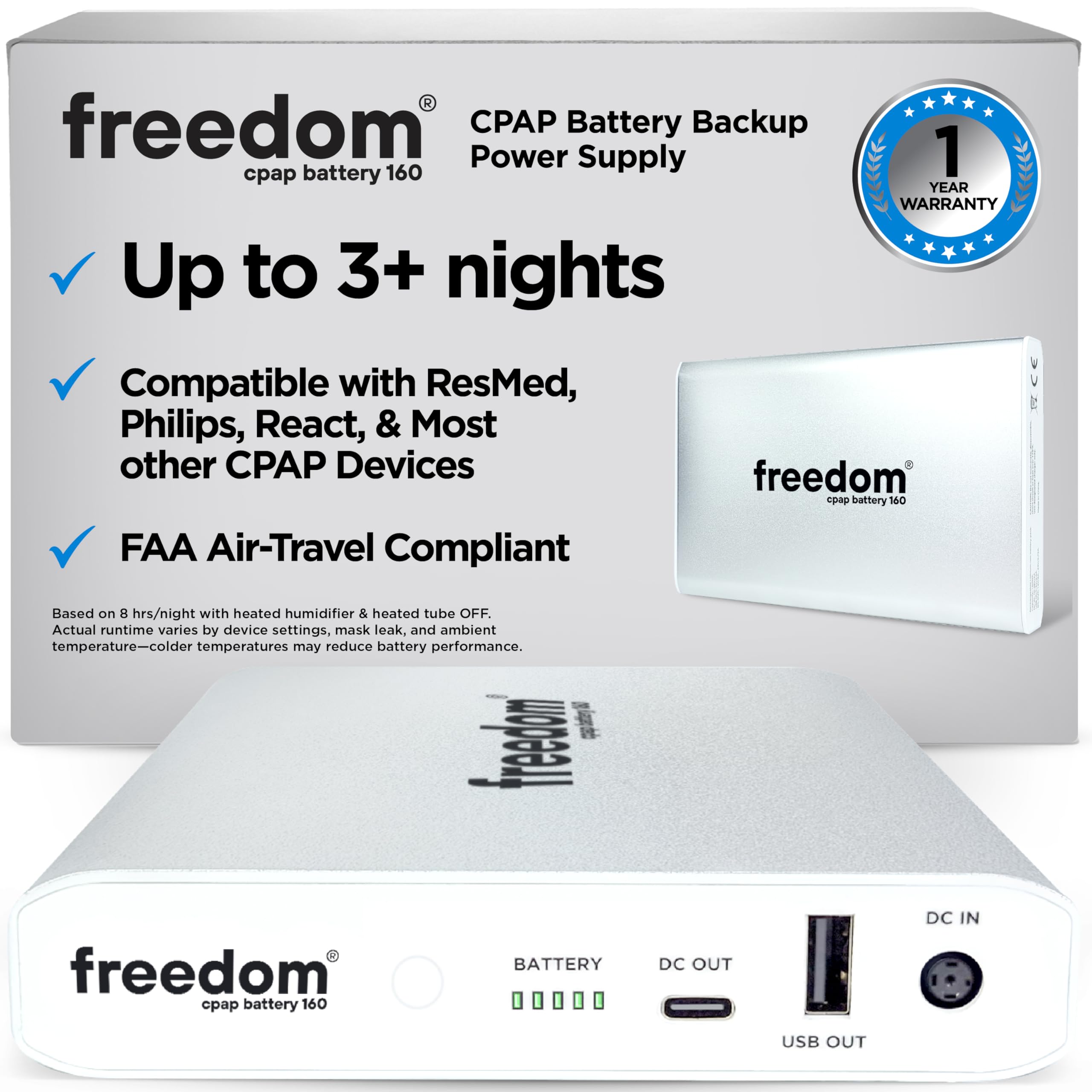
The Freedom 160Wh hits the sweet spot between capacity and portability for tent camping. It’s designed specifically for CPAP machines rather than repurposed from a general-purpose power station, meaning the DC output voltages and connectors are optimized for ResMed AirSense 10/11 and Philips DreamStation units out of the box. Customer-reported runtimes of up to 24 hours on an AirSense 11 without humidifier make this a genuine two-night solution for backpacking trips.
The slim 1-inch profile and 3.59-pound weight slip easily into the side pocket of a CPAP travel bag. It supports pass-through charging, so you can keep your therapy going while the battery recharges from a campsite RV hookup or portable solar panel. The LiFePO₄ cells deliver over 500 charge cycles, meaning years of weekend camping before capacity noticeably degrades.
At 160Wh, it maxes out the FAA carry-on limit, so you can fly with it domestically without hassle. The biggest performance note is that using the heated humidifier at full power cuts runtime by more than half—cold-weather campers should plan to run without the humidifier chamber active to maximize those multi-night claims.
Why it’s great
- 27 hours runtime on AirSense 11 without humidity (customer tested)
- FAA-compliant 160Wh for carry-on airline travel
- Includes cables for most major CPAP brands
Good to know
- USB-C port is not PD-compatible for fast laptop charging
- Some customers report runtime exaggeration at higher pressure settings
2. EASYLONGER ES960 PRO
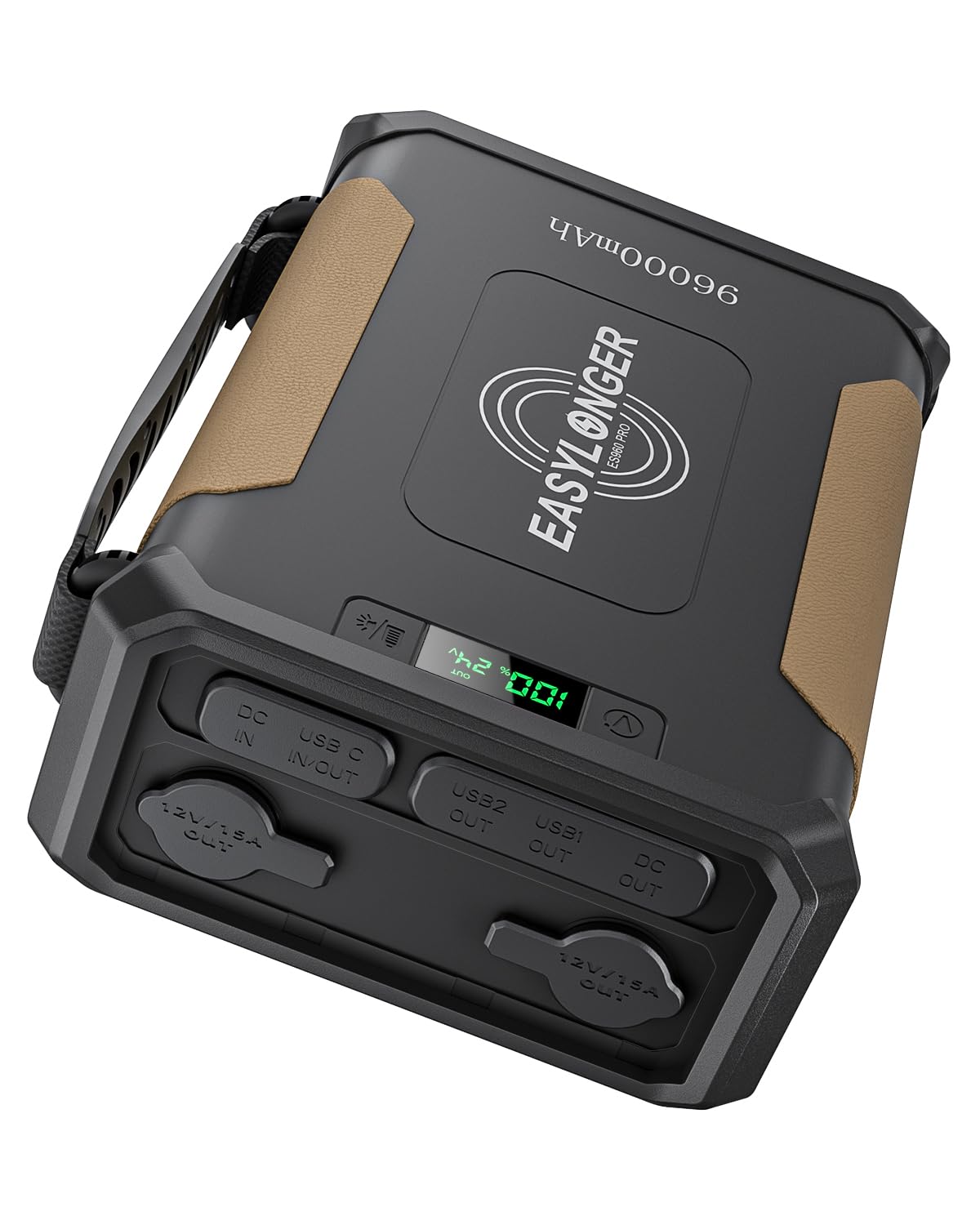
The ES960 PRO packs 297.6Wh of LiFePO₄ capacity in a compact 6.6-pound package, delivering two full nights on most ResMed machines without humidifier. Its 100W USB-C output doubles as a fast charger for laptops and tablets, reducing the number of separate bricks you need to pack for a camping trip. The 3,000-cycle lifespan ensures this battery will outlast your CPAP machine itself.
Multi-voltage output support (12V, 19V, 24V) means it works with ResMed AirSense 11/10, AirCurve models, Philips DreamStation, and Luna TravelPAP straight from the box with the included four-cable bundle. The memory function remembers your last output voltage setting, so you don’t have to reconfigure every time you power it on. A 5-hour wall recharge or 6-hour car recharge keeps downtime minimal between campsites.
Two caveats: at 297.6Wh, it exceeds the 160Wh FAA limit, so this unit is strictly for car camping, RV trips, or base-camp setups. Some customers experienced charge-calibration issues where the display stuck at 99%, though a replacement unit resolved the problem. The included fabric case provides basic protection but won’t survive a drop onto rocks.
Why it’s great
- 297.6Wh provides 2+ nights on most CPAP machines
- 100W USB-C PD output charges laptops and tablets
- 3,000+ cycle LiFePO₄ battery for decade-long durability
Good to know
- Exceeds FAA carry-on limit—not suitable for air travel
- Some early units had charge display calibration issues
3. Jackery Explorer 500 v2
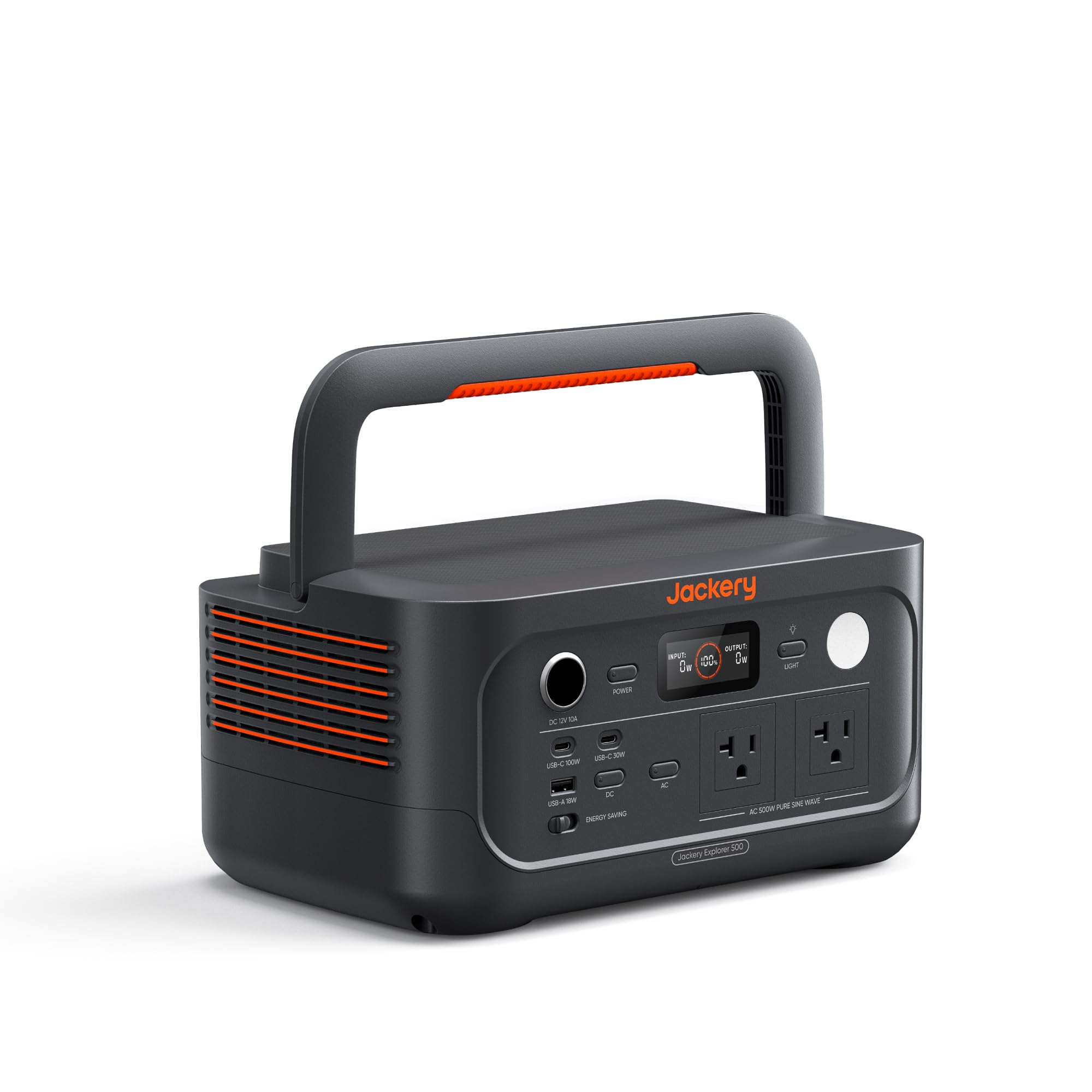
The Explorer 500 v2 is a full campsite power station that happens to be excellent for CPAP duty. Its 512Wh LiFePO₄ battery delivers roughly 8 to 12 hours of CPAP use with humidifier enabled, or over 24 hours without, and the extra AC outlets power your phone charger, camp lantern, and mini-fridge simultaneously. The 500W pure sine wave inverter ensures clean power delivery that won’t harm sensitive CPAP motors.
At 14 pounds, it’s heavier than dedicated CPAP batteries but still manageable for car camping. The 0-80% charge in 52 minutes via AC wall outlet is industry-leading for this capacity class. The 10ms UPS function means if campground power flickers, your CPAP doesn’t reset mid-sleep—a feature most dedicated CPAP batteries omit entirely.
The 6,000-cycle rating is double the industry standard for LiFePO₄, backed by Jackery’s strong customer service reputation. The built-in LED light with multiple modes is a nice bonus for tent setup after dark. The main downside is that you’ll need to carry the CPAP-specific DC barrel adapter separately, as Jackery doesn’t include CPAP cables in the box.
Why it’s great
- 512Wh capacity powers CPAP plus campsite electronics
- 0-80% charge in 52 minutes via AC wall outlet
- 6,000 cycle LiFePO₄ battery outlasts competitors
Good to know
- No CPAP-specific cables included in the box
- Heavier than dedicated CPAP batteries at 14 lbs
4. Medistrom Pilot-24 Lite

The Pilot-24 Lite is built specifically for ResMed 24V machines, bundling cables for the AirMini, AirSense 10, and S9 out of the box. Its 95Wh capacity delivers roughly 14 hours on an AirMini without humidifier—enough for two full nights on a backpacking trip or a cross-country flight plus a hotel stay. The aerospace-grade aluminum case is rare in this weight class and provides genuine drop protection.
Full recharge takes just 2-3 hours via the CPAP’s own AC adapter, eliminating the need for a separate charger brick. The built-in LED touch light is useful for finding your way in a dark tent without fumbling for a headlamp. At 2.25 pounds, it’s the lightest unit in this comparison that still includes a durable hard case rather than fabric.
Being TSA-approved under 100Wh and FAA-compliant means zero hassle at airport security checkpoints—just leave it in your carry-on. The main limitation is the 24V-specific design, so Philips DreamStation users will need the separate 12V version. Some customers report the charge time can stretch to 4-5 hours if using a low-amperage power adapter.
Why it’s great
- TSA-approved 95Wh for hassle-free air travel
- Aluminum case provides genuine drop protection
- Includes cables for AirMini, AirSense 10, and S9
Good to know
- 24V only—not compatible with 12V CPAP machines
- Charge time varies significantly with adapter amperage
5. Zopec Explore Mini

The Zopec Explore Mini is the world’s smallest and lightest CPAP battery at just 1.1 pounds and a 6.5 x 3 x 1-inch footprint. Its patented automatic multi-voltage technology detects and adapts to 12V, 19V, and 24V CPAP machines, making it the most versatile option for users who switch between travel and home machines. The Panasonic lithium-ion cells are the same cells used in electric vehicles, known for consistent voltage delivery.
Customer tests show this unit powers a ResMed AirMini for 2.75 nights with humidifier disabled, and it recharges in under 2 hours via the included 65W USB-C charger. The solid-state cooling system eliminates fan noise entirely—a major win for tent sleepers disturbed by the hum of traditional power station fans. The ability to chain multiple Explore Mini batteries together for extended runtime is unique in this weight class.
It’s FAA-compliant at 99.9Wh for carry-on. The main friction point is the cable system: the DC barrel connectors require very thorough insertion to maintain connection, and one customer reported the unit disconnecting mid-night due to a loose fit. The lack of a USB-A fast-charge port means charging your phone simultaneously will drain the battery faster than using the CPAP alone.
Why it’s great
- 1.1 pounds—lightest CPAP battery in the world
- Auto-voltage detection works with 12V, 19V, and 24V machines
- Fanless solid-state cooling for silent operation
Good to know
- DC barrel connectors can be finicky to seat correctly
- No USB-A fast-charge port for phone charging
6. Pilot Flex 98Wh

The Pilot Flex packs 98Wh into a sleek aluminum chassis that’s just 0.79 inches thick—thin enough to slide into a laptop sleeve. It comes with DC cables for the AirSense 11 and AirMini, with adapters available for Philips DreamStation and other brands. The dual-voltage support (12V and 24V) covers the vast majority of modern CPAP machines without needing an external converter.
TSA-approved at 98Wh, it’s a strong companion for air travel plus a single night of camping. Customer tests on an AirSense 11 without humidity delivered roughly 8 hours of runtime with one bar remaining on the indicator. The recharge time of 2-3 hours via USB-C fast charging is respectable, and the ability to connect multiple Pilot Flex batteries together for extended therapy is a thoughtful design touch.
The slim form factor means internal battery cells are tightly packed, contributing to a slightly higher price per watt-hour than bulkier competitors. A few customers reported that the cables required very firm insertion to maintain connection during sleep, occasionally waking them when the connection broke. The included carrying case is minimal—a padded sleeve rather than a hard case.
Why it’s great
- Ultra-slim 0.79-inch profile fits in laptop bags
- Dual-voltage support for 12V and 24V CPAP machines
- 100W USB-C PD fast charging included
Good to know
- Cable connection may require very firm insertion
- Higher $/Wh than bulkier competitors
7. Zopec Explore 5700

The Zopec Explore 5700 is designed for multi-night camping without sacrificing portability. It adapts to 110-240V input for international travel and automatically adjusts its output to match your CPAP brand—no adapters, no cable swapping. Customer reports confirm three full nights of CPAP use per charge when running without the heated humidifier, making it genuinely useful for weekend backpacking trips.
The 2-hour recharge from 20% to full via the included AC adapter means you can top up at a trailhead cafe or campsite with electrical hookup during a lunch stop. The FAA-compliant 5700mAh capacity (roughly 100Wh equivalent) slides through airport security without question. The built-in carrying handle integrates into the slim profile, measuring 7.7 x 5.7 x 1 inches.
The main complaint centers on runtime with heated humidification: with the heater active, the battery drains in about 3 hours per night, far short of the claimed 7-8 hours. This is a limitation shared by virtually all CPAP batteries in this weight class, but the marketing materials don’t clearly distinguish between humidifier-on and humidifier-off runtimes, which frustrates buyers expecting full-feature performance.
Why it’s great
- 3 nights of CPAP use per charge without humidifier
- Universal compatibility with most CPAP brands
- International 110-240V input for global travel
Good to know
- Heated humidifier drains battery in ~3 hours
- Runtime claims on packaging can be misleading
8. Dabbsson 1008Wh
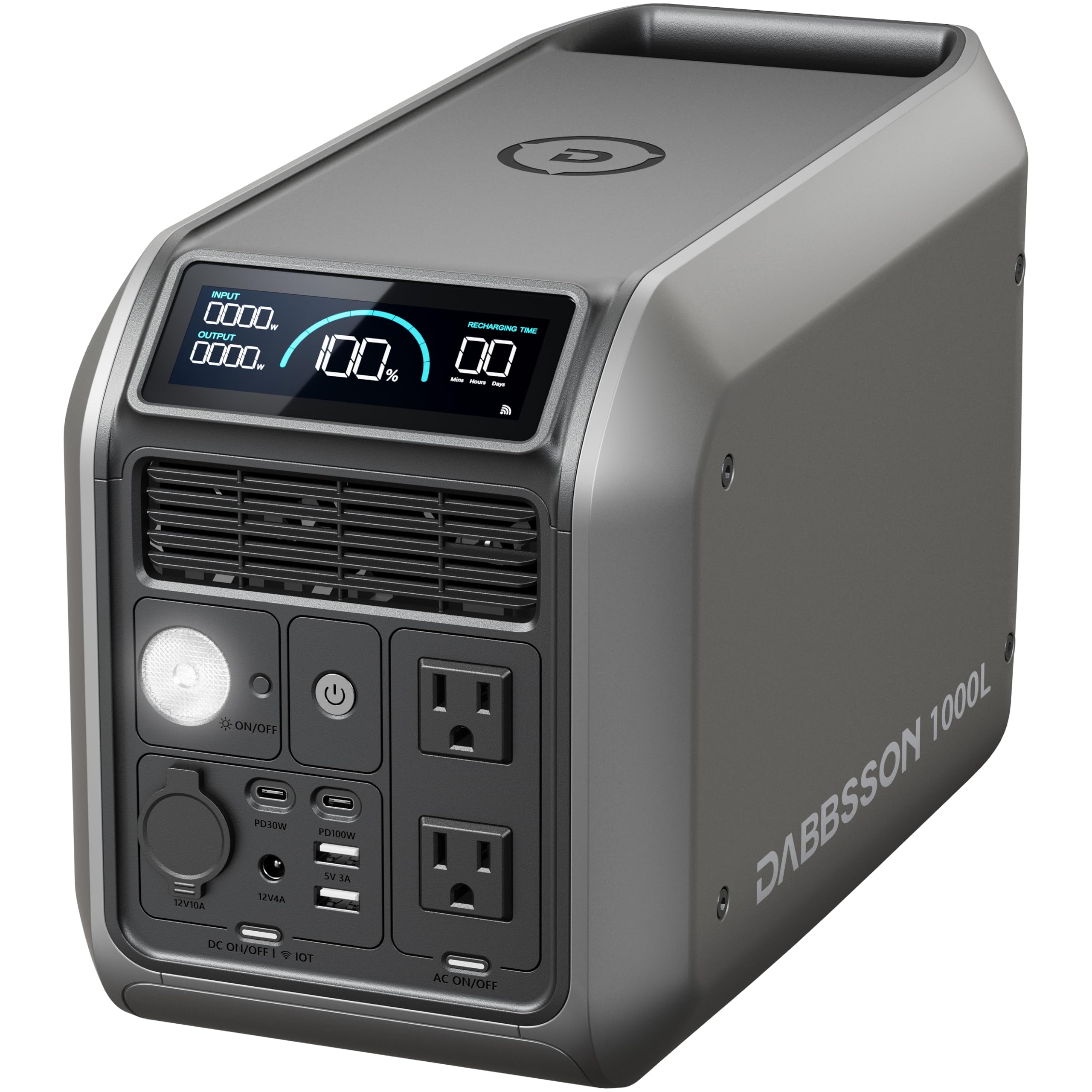
The Dabbsson 1000L uses semi-solid LiFePO₄ cells, a newer battery architecture that claims 1.3x longer runtime for appliances under 300W compared to traditional LiFePO₄. For a CPAP drawing 30-60W, this translates to an extra few hours per charge cycle. The 1008Wh capacity powers a CPAP with humidifier for 3-4 nights, plus runs a mini-fridge, camp lights, and phone charging simultaneously.
The 1200W pure sine wave inverter handles startup surges from CPAP motors without voltage sag. Recharge to 80% in 50 minutes via AC wall outlet, or use the 600W solar input to stay indefinitely off-grid. At 23.4 pounds and 36% smaller than average 1kWh stations, it’s portable enough for car camping. The smart app control lets you monitor battery level and adjust charging modes without leaving your sleeping bag.
The AC watt display can be inaccurate at very low loads—one customer measured an 11W actual draw while the display showed 30W, which would cause you to underestimate remaining runtime by a factor of nearly 3. The solar charging cable uses an XT60 connector rather than standard MC4, so you’ll need an adapter cable for most third-party solar panels.
Why it’s great
- Semi-solid state cells deliver extended runtime under 300W loads
- 1008Wh capacity powers CPAP plus full campsite
- Smart app control for remote monitoring
Good to know
- AC watt display inaccurate at low power draws
- Solar input requires MC4-to-XT60 adapter for most panels
9. EF ECOFLOW DELTA 2

The EcoFlow DELTA 2 is a 1024Wh workhorse that expands to 3kWh with an additional battery, making it viable for week-long camping trips where you need CPAP power plus full campsite electricity. The 1800W AC output handles not just CPAP machines but also electric coolers, coffee makers, and small space heaters. The 0-80% charge in 50 minutes via AC input means you can recharge during a dinner stop at a restaurant.
With 15 output ports, including 100W USB-C, you can charge your CPAP, phone, laptop, drone, camera, and camp lights simultaneously. The LFP (LiFePO₄) battery chemistry delivers 3,000+ charge cycles to 80% capacity, lasting a decade of weekly camping trips. Solar input up to 500W keeps you off-grid indefinitely if you have panels.
At 27 pounds, this is car-camping or RV-only territory, not backpacking gear. The fan runs audibly even under modest load—one customer measured the fan noise as disruptive at 100W draw, which could bother light sleepers in a tent. Some users also report frustration with the app-required control for certain settings, as it requires cloud authentication that might not work in remote camping areas.
Why it’s great
- Expandable from 1kWh to 3kWh for week-long trips
- 1800W AC output runs CPAP plus major appliances
- 0-80% charge in 50 minutes via AC wall outlet
Good to know
- 27-pound weight is car-camping only
- Fan noise may be disruptive at moderate loads
10. BLUETTI Elite 200 V2

The BLUETTI Elite 200 V2 crams 2073.6Wh into a compact footprint that’s 40% smaller than previous 2kWh units. This powers a CPAP with full heated humidifier for 5-7 nights, plus runs a mini-fridge, camp lights, and phone charging for a week-long base camp. The 2600W continuous inverter handles startup surges from CPAP compressors effortlessly, and the 3900W power lifting mode can even run power tools for campsite construction.
The CNAS-certified automotive-grade LiFePO₄ battery delivers 6,000 cycles—a 17-year lifespan with daily use. Three smart charging modes let you control charge speed and noise: Turbo mode (0-80% in 50 minutes), Standard mode (1.6 hours to full), and Silent mode (3 hours, 16-30dB). The silent mode is transformative for camping because it’s barely audible at 16dB, compared to the typical 30-50dB fan noise of other power stations.
At 53 pounds, this is strictly RV or truck-camping gear. The lack of a 30A RV port limits its use as a dedicated RV transfer switch if you need to power your entire rig. Some customers note that the included DC barrel cables are short, requiring the battery to sit very close to the CPAP machine on the nightstand or tent floor.
Why it’s great
- 2073.6Wh runs CPAP with humidifier for 5-7 nights
- 16-30dB silent charging mode for tent use
- 6,000 cycle automotive-grade battery
Good to know
- 53-pound weight limits use to RV or truck camping
- No 30A RV port for direct rig connection
11. PECRON F3000LFP
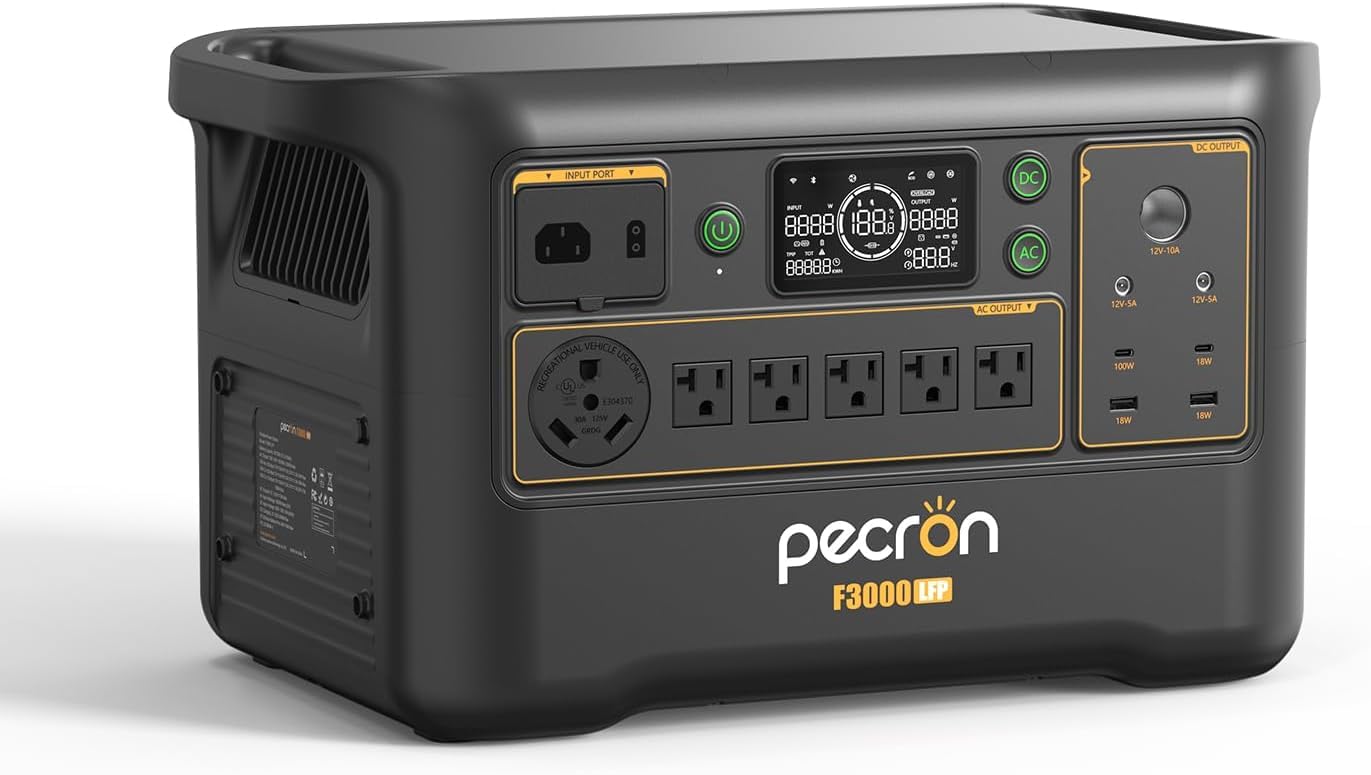
The PECRON F3000LFP is the endgame for CPAP campers who also need a full home backup solution. Its 3072Wh LiFePO₄ battery runs a CPAP with heated humidifier for 7-10 nights, plus powers a 120V refrigerator, sump pump, and internet router for days during a blackout. The expandable capacity up to 10,752Wh means you can daisy-chain additional batteries for extended off-grid living.
The 3600W pure sine wave inverter handles the most demanding CPAP motors and startup surges without voltage sag. The 0-100% recharge in 2 hours via 1800W AC input is 30% faster than similarly priced competitors. The 13 output ports include six AC outlets, two 100W USB-C PD ports for fast laptop charging, and two 18W USB-A ports for phones. The 8-20ms UPS switch keeps your CPAP running seamlessly during campground power fluctuations.
At 63 pounds, this unit requires two people to load into a vehicle. The app requires account authentication, which could be problematic if you’re camping far from cellular service. The fan is audible during charging and moderate loads—one customer described it as “noticeable but not bothersome” at 500W draw. For most CPAP campers, the F3000LFP is more station than needed, but for extended RV living or full-time van life, there’s no substitute.
Why it’s great
- 3072Wh capacity runs CPAP plus home appliances for days
- Expandable to 10,752Wh for full off-grid living
- 0-100% charge in 2 hours via 1800W AC input
Good to know
- 63-pound weight requires two people to transport
- App may not function reliably in remote camping areas
FAQ
Can I use any portable power station for my CPAP while camping?
How many nights will a 160Wh battery power my CPAP?
Can I fly with a CPAP battery in my carry-on luggage?
Does cold weather affect CPAP battery performance?
What is pass-through charging and why does it matter for camping?
Final Thoughts: The Verdict
For most users, the best camping cpap winner is the Freedom CPAP Battery 160Wh because it delivers genuine multi-night runtime in an FAA-compliant, CPAP-specific package that works with most major machines out of the box. If you want the ultimate in weight savings and airline-friendly portability, grab the Zopec Explore Mini — at 1.1 pounds with auto-voltage detection, it’s the most versatile travel companion on the market. And for extended off-grid camping where you need to power CPAP plus a full campsite, nothing beats the BLUETTI Elite 200 V2 with its 2073.6Wh capacity and near-silent operation.