
Our readers keep the lights on and my morning glass full of iced black tea. As an Amazon Associate, I earn from qualifying purchases.
Specs are compiled from manufacturer listings and verified buyer reviews and can change over time — please confirm the key details on the product page before buying.
You want a camping generator that starts on the first pull, runs quiet enough to hear the breeze, and sips fuel so you aren’t hauling jugs. Your real choice is how much power you need versus how much weight you can lift, and whether clean power for your phone or laptop matters more than raw watts for a big AC unit.
I’m Min — the founder and writer behind Gadgets Feed. This guide is built by comparing the manufacturers’ published specifications and the patterns across verified customer reviews, so you get each pick’s real strengths and trade-offs instead of marketing spin.
The 10 models here span everything from a 28-pound tailgating companion to a full-size RV workhorse, so you can find the best camping generator for your exact setup without wading through hundreds of listings yourself.
Our Picks at a Glance


How To Choose The Best Camping Generator
Choosing a camping generator starts with one question: what will you actually plug into it? A phone charger and a couple of lights need very little, but a rooftop AC unit or a microwave can demand several thousand watts at once. Match the generator’s running watts to your total appliance load, not the other way around.
Match Watts to Your Real Load
Every generator lists two power numbers: starting (or peak) watts for the moment a motor kicks on, and running watts for steady use. A fridge might pull 600 watts to run but spike to 1,800 watts when the compressor starts. Add up your biggest motor plus everything running at the same time, and that sum is your running-watt target.
Inverter vs. Open Frame
Inverter generators convert power into a cleaner, more stable flow that’s safe for laptops, phones, and other sensitive electronics — and they run quieter and more fuel-efficiently than traditional open-frame models. Open-frame generators are usually cheaper and heavier, with more raw wattage per dollar, but they’re louder and can produce power that isn’t ideal for delicate gear.
Weight and Noise Are Deal-Makers
A 100-pound generator might deliver plenty of power, but you’ll feel every pound loading it into a truck bed. Look at the listed weight and think about who will be lifting it. Noise is measured in dBA from 23 feet; anything under 60 dBA is roughly the volume of a normal conversation, while 70 dBA and up demands ear protection for long exposure.
Quick Comparison
| Model | Best For | Running Watts | Weight | Noise (dBA) | Amazon |
|---|---|---|---|---|---|
| Westinghouse 4650★ Best Overall | RV & home backup power | 3600 | 100.6 lbs | Approx. 52 | Amazon |
| Champion 4000WPremium Pick | Lightest 4kW class | 3000 | 48.1 lbs | 64 | Amazon |
| PowerSmart 4800Top Performer | Long runtime home backup | 3800 | 89 lbs | 59 | Amazon |
| Champion 4250 Dual Fuel | Gas or propane flexibility | 3500 | 79 lbs | 64 | Amazon |
| WEN 56360i | Quiet RV trips | 2900 | 46 lbs | Approx. 52 | Amazon |
| Oxseryn 4400 | RV camping on a budget | 3400 | 56 lbs | 72 | Amazon |
| ERAYAK 4500 | Clean power for electronics | 3500 | 55.12 lbs | 60.5 | Amazon |
| Oxseryn 2800 | Light camping with electronics | 2000 | 40 lbs | 58 | Amazon |
| AIVOLT 1600 | Ultra-quiet solo camping | 1260 | 28 lbs | 57 | Amazon |
| Aceup Energy 1200 | Budget phone & mattress power | 900 | 35.3 lbs | Not listed | Amazon |
In-Depth Reviews
1. Westinghouse 4650 Peak Watt Portable Generator
Our pick — over 4.5★ from 700+ verified ratings; the strongest balance of quality and price.
This 3600-watt workhorse starts on the first pull and runs up to 14 hours on a 4-gallon tank.
This Westinghouse is the one owners describe as “near-inverter quiet” — a remarkable compliment for a conventional open-frame unit. It puts out 3600 running watts and 4650 peak watts from a 212cc 4-stroke engine, and that 4-gallon tank with a readable fuel gauge keeps it running for up to 14 hours per fill. People have powered mini fridges, heaters, lights, Keurig machines, and even whole sharpening businesses off this single unit.
The stand-out story here is the value: buyers report it starts “first pull, 5x easier pull than Generac 3500xl.” It comes with oil, a funnel, a tool kit, and a manual so you can be running within minutes of unboxing. The cast-iron sleeve engine adds durability, while automatic low-oil and carbon monoxide shutdowns handle the safety side.
What wins people over is performance — it’s the most-praised aspect by a wide margin. There are two honest caveats. The pull cord sits at a slight angle due to the frame, so a few owners worry about long-term rope strain. And at 100.6 pounds, this is a two-person lift — it’s roughly 2.8x the weight of the budget Aceup below, so plan your loading strategy accordingly.
Why It Wins
- Up to 14 hours of runtime from a 4-gallon tank
- Easy first-pull start, per many owners
- Includes oil, funnel, and tool kit from the start
Heads-Up
- 100.6 lbs — heavy, best for RV or truck camping
- Pull cord angle may strain over time
Reach for this if: you want one generator that handles both RV trips and home outage backup without compromise.
Look elsewhere if: you need to carry it far from a vehicle — the weight will wear you out.
2. Champion Power Equipment 4000-Watt RV Ready Portable Inverter Generator
At 48.1 pounds, this is one of the lightest 4000-watt inverters available.
Champion’s 4000-watt inverter is the balance for RV owners who want real power without the back strain. At less than 49 pounds, it’s dramatically easier to lift than the 89-pound PowerSmart or the 100-pound Westinghouse, yet it still delivers 3000 running watts and 4000 starting watts — enough for a 15k BTU AC unit plus a fridge and lights, as owners mention.
The 149cc engine runs up to 10 hours per tank, and buyers mention it can stretch a 5-gallon fill across 24 hours of continuous use. The clean electricity (less than 3% THD) makes it safe for laptops and phones, and the CO Shield auto-shutoff adds confidence when camping near a tent. It includes a TT-30R RV outlet, a household duplex outlet, a 12V automotive-style port, and parallel outlets for doubling power later.
The thing everyone raves about is build quality — it’s the top-mentioned positive. Owners call it “small and light but lots of power” and note the tool-free oil door makes maintenance genuinely easy. The 64 dBA noise rating is fine for campgrounds, though not the quietest on this list. At 48.1 pounds it’s about 41 pounds lighter than the PowerSmart 4800, yet gives up only 800 running watts.
Light-power balance: genuinely rare to find 4000 starting watts in a sub-49-pound package that still runs an RV AC.
Trade-off: 64 dBA is audible; choose it for lifting ease over whisper-quiet operation.
Best for: RV owners who move the generator often and want the lightest path to 4000 watts.
Not for: those who need propane flexibility — this is gas-only.
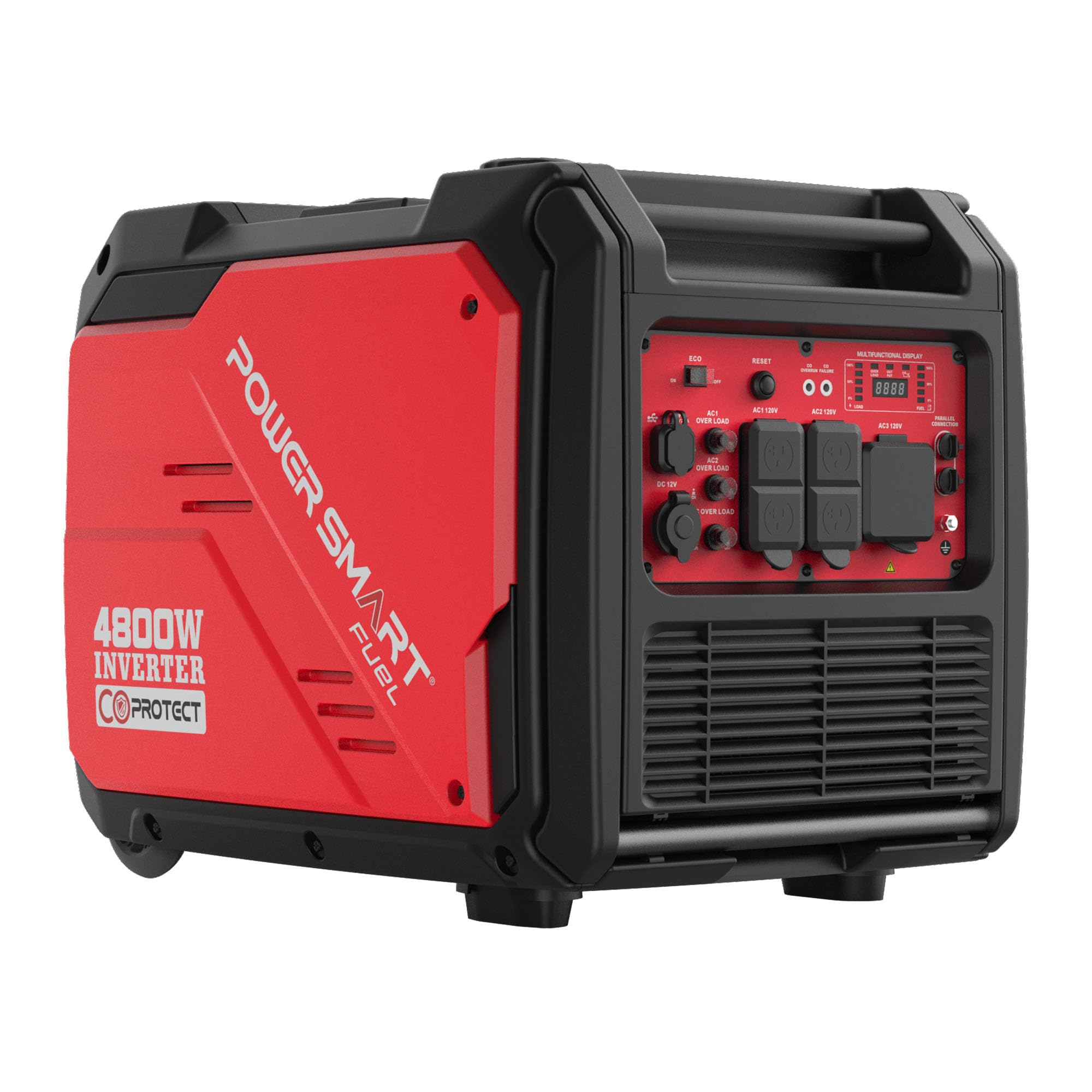
3. PowerSmart 4800 Watt Portable Inverter Generator
Its 3.43-gallon tank delivers 18 hours of runtime at 25% load, so you refuel once and forget it.
PowerSmart’s 4800-watt inverter is built for the “low-maintenance” crowd. With a 3.43-gallon tank and 18 hours of runtime at 25% load, it outlasts nearly everything else here — customers note running it 24 to 48 hours straight during storms. That 4800 starting watts and 3800 running watts powered 12 outlets at once, including a fridge, AC, and TV.
The 223cc engine stays quiet at just 59 dBA from 23 feet, and the digital display shows voltage, frequency, runtime, and total runtime. One owner noted it was “inaudible indoors 10ft away.” The control panel is generous: one RV-ready 30A outlet, four 20A household outlets, a 12V 8A DC port, and two USB ports. It meets EPA, ANSI/PGMA G300, and ANSI/UL 2201 standards for US safety.
Performance is the most-praised aspect, with reliability close behind. Contractor buyers chose it over Honda and Champion rivals for its efficiency and smooth operation. The honest downside is the weight — 89 pounds on the spec sheet, closer to 100-plus with oil and fuel — which makes loading it into a truck a two-person job. The wheels and handle ease the rolling, not the lifting.
Strengths
- 18-hour runtime is class-leading
- 59 dBA noise — quiet for its power class
- Digital display for voltage and runtime
Consider
- 89 lbs spec weight; heavier with fuel
- No dual-fuel option
Choose this for: long off-grid stays where refueling is a hassle and you need serious wattage.
skip it if: you’ll be lifting it solo — the Champion 4000W is far friendlier on your back.
4. Champion Power Equipment 4250-Watt Dual Fuel RV Ready Portable Open Frame Inverter Generator

Dual-fuel operation on gasoline or propane gives you storage-friendly flexibility.
Champion’s dual-fuel inverter is the answer for campers who hate stale gas. It operates on gasoline or propane, and that propane mode means you can store the unit for months without worrying about gummed-up carburetors. The 224cc engine delivers 4250 starting watts and 3500 running watts, with up to 22 hours of runtime on gasoline — the longest on this list.
Reviewers point out flawless use over two-week off-grid RV trips, powering Starlink, computers, printers, and small AC units. The 120V 30A RV outlet plus two 20A household outlets and a 12V DC port with dual USB adapter cover most setups. One owner ran both ACs in a fifth wheel, and the dual-fuel design proved itself on a 4,000-mile boondocking trip. Starting performance is the most-praised aspect, with the EZ-start dial getting specific compliments.
The 64 dBA noise level is respectable, though a few owners found it louder than expected — noise is the most-mixed aspect. At 79 pounds it’s mid-pack for weight, easier than the Westinghouse but heavier than the Champion 4000W. The integrated gas run-out shutoff and sturdy propane hose are thoughtful touches, and one buyer called the whole package “very high quality.”
Why It Stands Out
- 22-hour gasoline runtime leads the list
- Propane mode for low-maintenance storage
- EZ start dial praised by owners
Watch For
- 64 dBA — not the quietest inverter here
- 79 lbs needs a solid lift plan
Grab this if: you want fuel-choice flexibility and the longest runtime on the list for big RV loads.
Think twice if: absolute quiet is your top priority — the AIVOLT below is far stealthier.
5. WEN 3600-Watt Portable Inverter Generator (56360i)

This 46-pound inverter runs quietly enough to slip under a bunk and powers an AC all day.
WEN’s 56360i is the camping generator that disappears into your setup. At just 46 pounds, it’s light enough for one person to carry, and owners say it stores easily under an RV bunk. The 149cc engine produces 3600 surge watts and 2900 rated watts, with clean power safe for your phone, tablet, and laptop — the exact trio most campers carry.
The quiet operation is a recurring theme in reviews, with one owner describing it as “very quiet” and another impressed enough to buy a second unit. It ran a 13K BTU AC unit on a hot day and still got roughly 4 hours per tank. The fuel shutoff feature is a smart longevity trick — it burns the remaining fuel out of the carburetor before shutting down, which prevents gumming during storage. That’s a real money-saver over time.
Performance and noise are the two most-praised aspects, and starting on the first or second pull is a common report. The recurring caveat is reliability — most owners have zero issues, but a minority report it stopping after a few hours of heavy use, so treat it as a strong mid-range choice rather than an industrial tool. The 48-pound dry weight jumps to 68 pounds with oil and fuel, still very manageable.
Quiet champ: owners consistently call it quiet, and the fuel-shutoff feature adds real storage confidence.
Honest limit: a few units have shown reliability hiccups under sustained load — fine for trips, not for daily full-load work.
Pick this if: you want a light, quiet inverter for RV trips with phones, laptops, and a modest AC.
Pass if: you regularly run heavy tools — the PowerSmart 4800 has far more headroom.
6. Oxseryn 4400 Watts Inverter Generator
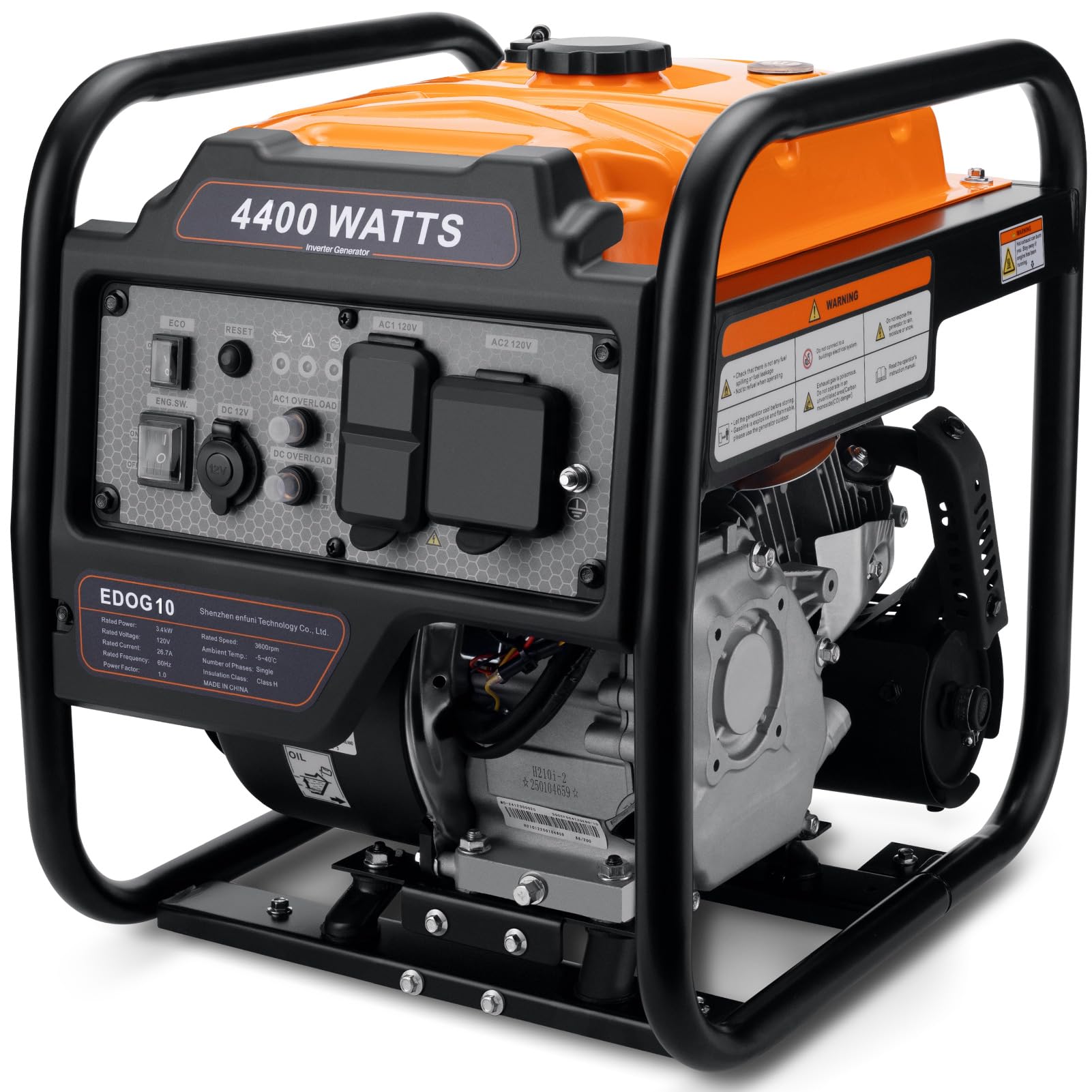
Off-grid shoppers say it weighs about two-thirds as much as a comparable Champion with similar power.
The Oxseryn 4400 is the value pick that punches well above its price class. It delivers 4400 peak watts and 3400 running watts from a 208cc 4-stroke engine, yet weighs just 56 pounds — one experienced off-grid user who logged 200-plus hours said it runs a fridge, freezer, AC, and microwave simultaneously, even a welder, all at roughly two-thirds the weight of a comparable Champion.
The 2-gallon tank with a fuel gauge gives up to 14 hours of runtime at 25% load in ECO mode. One owner reported the tank lasted about 4 hours running a sump pump and washing machine. The port selection is practical: two 120V AC ports, a 12V DC port, and an RV port. At under 72 dBA from 23 feet, it’s not the quietest here, but owners describe it as “slightly quieter than expected.”
Performance is the most-praised aspect, with value-for-money close behind — one buyer called it “outstanding value” and praised the one-person lift into a pickup. The honest trade-off is recurring reliability concerns: two owners reported units failing within weeks, alongside many more positive reports. The noise at full load also draws mixed feedback. It excels for light-to-moderate duty where price matters most.
What You Get
- 56 lbs — genuinely one-person portable
- 3400 running watts handles real appliances
- 14-hour run at 25% load in ECO mode
Keep In Mind
- Noise hits 72 dBA under load
- Reliability reports are mixed — best for light duty
Best for: budget-minded campers who want RV-grade power without the premium price tag.
Not ideal for: daily heavy use — established brands are safer for consistent work.
7. ERAYAK 4500W Portable Inverter Generator

Delivers laptop-safe power with one of the cleanest THD ratings on this list.
The ERAYAK 4500 stands apart with its extraordinarily clean output — a THD (total harmonic distortion, a measure of power cleanliness) of just 0.2% to 1.2% means it’s about as safe for sensitive electronics as a generator gets. Laptops, CPAP machines, gaming consoles, and TVs all run without worry. It produces 4500 peak watts and 3500 running watts from a 208cc engine.
Quiet operation is a highlight at 60.5 dB(A), and ECO mode dials engine speed to match demand, saving fuel. The numbers back it up: it consumes only 0.561 gallons per hour at rated load and just 0.21 gallons per hour at 25% load. Buyers report running it 10 to 12 hours on a tank, and one used it to power contractor tools like chipping and demolition hammers without complaint.
The 55.12-pound weight makes it easy to move, and it’s 50A parallel-ready — connect two units to deliver 7,000W rated and 9,000W peak. Performance is the most-praised aspect, with buyers calling it “very powerful” and “fuel-efficient.” The mixed reliability reports are the main caveat, though the 3-year warranty with lifetime support offers some buffer. A few owners hit a non-starting unit that Amazon fully refunded.
Standout Features
- Ultra-clean 0.2%-1.2% THD output
- 50A parallel-ready for doubling power
- 55.12 lbs with contractor-grade power
Things To Note
- Reliability reports are mixed
- Add engine oil before first use — low-oil protection blocks start otherwise
Choose for: CPAP users and gadget-heavy campers who need the cleanest possible power.
Reconsider if: you want maximum reliability assurance — the Champion 4000W edges it out there.
8. Oxseryn 2800-Watts Portable Inverter Generator
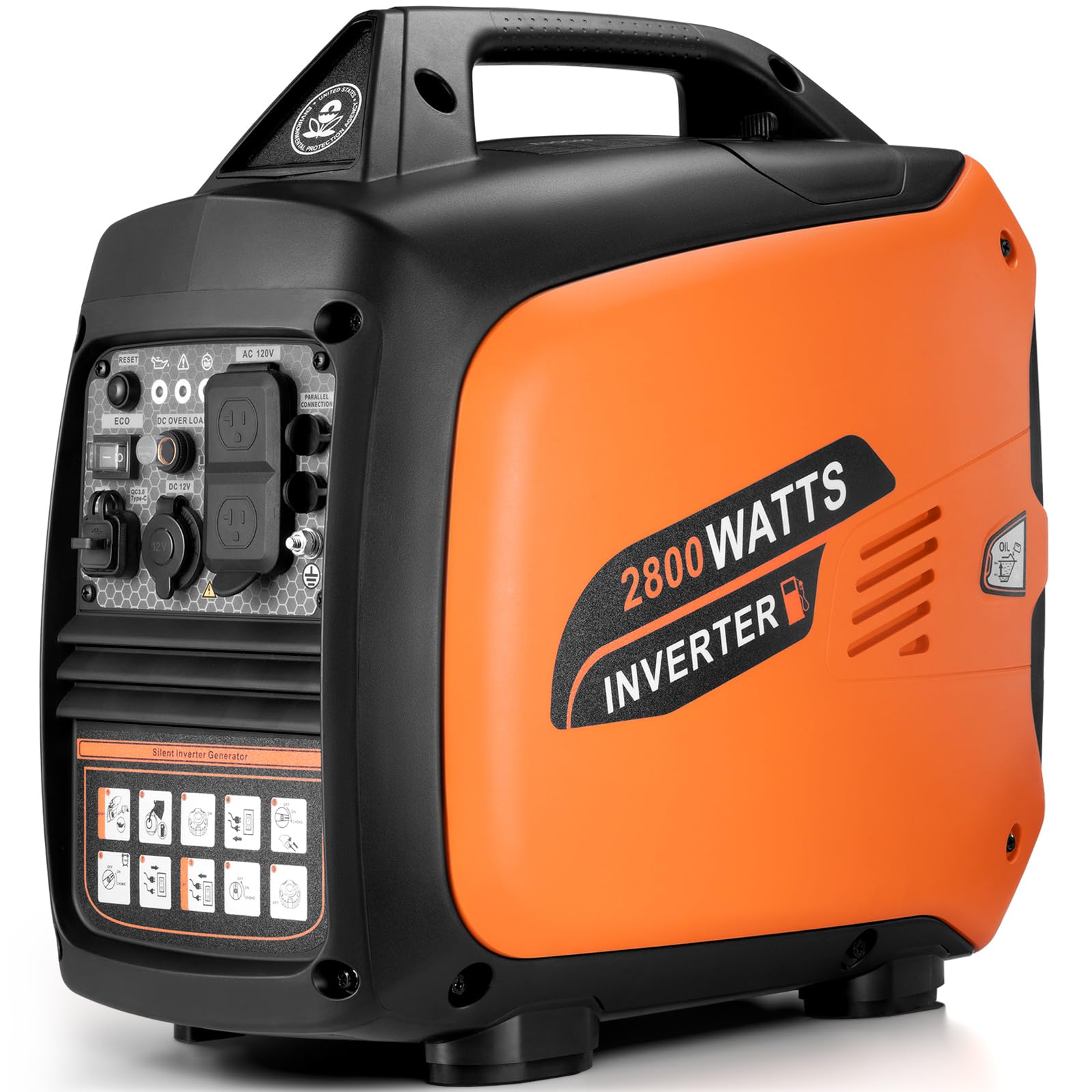
A 40-pound quiet inverter with Type-C and USB ports built for the digital camper.
Oxseryn’s 2800-watt inverter is the balance for campers who want clean power without hauling a monster. At 40 pounds with a built-in handle, it’s easy for one adult to carry from truck to tent. The 79.8cc 4-stroke OHV engine delivers 2800 peak watts and 2000 running watts from a 1.1-gallon tank, running up to 9 hours at 25% load.
Clean power is the selling point here — less than 3% THD, which the maker says is safe for phones, laptops, drones, and cameras, and even supports charging a power station. The port selection is unusually modern: two 120V AC ports, a 12V DC port, a USB port, and a Type-C port. At under 58 dBA from 23 feet, it’s quiet enough for campgrounds and RV nights.
Performance and noise are the two most-praised aspects, with owners noting it “cranks on the first pull” and runs a circular saw or vacuum without issue. One user ran a 15,000 BTU AC on old gas. The parallel function lets you double output with a second unit, and the ECO mode stretches fuel. The catch is altitude sensitivity — above 4,000 feet the maker recommends a high-altitude kit, and some owners found metal bits in the oil during break-in, so early oil changes matter.
Why It Fits Camping
- 40 lbs with a built-in handle — genuinely portable
- USB and Type-C ports for modern devices
- 9-hour runtime at 25% load
Watch Out
- High-altitude use needs an optional kit
- Break-in requires early oil changes to clear metal debris
Perfect for: car campers who want clean power for gadgets and a quick morning coffee.
Look past it if: you camp above 4,000 feet and don’t want to manage a high-altitude kit.
9. AIVOLT 1600W Super Quiet Inverter Generator

At 28 pounds and 57 dBA, this is the quietest, lightest true camping companion here.
The AIVOLT 1600 is proof that camping power doesn’t need to weigh you down. At just 28 pounds — the lightest on this list — it’s a genuine one-hand carry that’s 20% lighter than similar models, per the maker. The 60cc 4-stroke engine produces 1600 starting watts and 1260 running watts, plenty for phones, laptops, a camping fridge, and small tools.
The “super quiet” claim holds up: 57 dBA at 23 feet is quieter than a normal conversation, according to the maker, and owners confirm it’s quieter than they expected — some even say quieter than Honda or Yamaha units they’ve used. Runtime stretches to 8 hours at 25% load with the ECO mode switch, which adjusts fuel consumption automatically. The clean power (THD under 3%) keeps sensitive electronics safe.
Build quality is the most-praised aspect, and the panel is genuinely useful: two 120V outlets, plus USB Type-A and Type-C ports, with indicator lights and an hour meter. It can even parallel with a second unit to double output. For Florida owners, it’s proven itself as hurricane prep. The honest limit: you’ll need to let it cool fully before restarting, as a heat-triggered safety mode can block a hot restart for up to an hour.
Featherweight quiet: 28 pounds, 57 dBA, and clean enough power for a weekend of gadgets — the total package for solo campers.
Plan around: cool-down restart delays; once it’s running, it stays running as long as there’s fuel.
Ideal for: backpack-adjacent campers and tailgaters who want silent, easy power for small loads.
Not enough if: you need to run an AC unit — drop to the Oxseryn 2800 or WEN instead.
10. Aceup Energy 1,200W Gas-Powered Generator

A compact 900-watt generator that charges your gear and inflates mattresses while staying affordable.
The Aceup Energy is the entry-level champion for campers who just need the basics. It delivers 1200 peak watts and 900 running watts from a 71cc 2-cycle engine — enough to charge phones and laptops, run a small fan, or inflate air mattresses. It runs on a 50:1 gasoline-to-oil mix, so there’s no separate oil change to manage, and the 1.1-gallon tank enables about 6 hours of operation at half load.
Compact size is what wins people over — it’s the most-praised aspect by far, and the 35.3-pound weight makes it easy to move around camp. Owners mention it starts “easily on the first pull” and one seasoned 35-year mechanic praised the build quality for the price, noting the multiple 120V outlets and included 12V harness for battery jumping. It’s dramatically more portable than the 100.6-pound Westinghouse above — roughly a third of the weight — though with far less power.
The value story is strong: one owner compared it favorably against a battery bank for the same job. The mixed reviews center on performance and noise — some call it a little loud, and some report quality issues, with one defective unit among the reports. It also needs a grounding pole, produces a fuel odor, and can shut off with residual fuel in the tank. Buyers recommend fresh, stabilized fuel only.
What It Does Well
- 35.3 lbs — easy to move around camp
- 6-hour runtime on a 1.1-gallon tank
- 12V harness for battery jumping included
Know Before Buying
- Requires a grounding pole and tolerates fuel odor
- Noise and quality draw mixed feedback
Best for: budget campers who need light power for phones, laptops, and air mattresses.
Step up if: you want inverter-clean power for sensitive electronics — the AIVOLT is worth the extra cost.
Understanding the Specs
Running Watts vs. Peak Watts
Running watts is the steady power a generator produces continuously — it’s the number that matters for real appliances. Peak (or starting) watts is the brief burst of power needed to kick a motor on, like when a fridge compressor starts. Match your total running load to the running-watt figure, not the peak.
THD and Clean Power
THD (total harmonic distortion) measures how pure the electrical output is. Inverter generators typically deliver under 3% THD, which is safe for laptops, phones, and other sensitive electronics. Conventional generators can run 5% or higher, which risks damaging delicate gear over time. If you’re charging a CPAP or laptop, look for under 3%.
Noise in dBA
dBA is how loud the generator sounds from a set distance, usually measured at 23 feet. Normal conversation is about 60 dBA, so anything under that is genuinely quiet for a campground. Above 70 dBA, you’ll definitely hear it — and so will your campsite neighbors. Quieter units use inverter tech and enclosed designs.
Fuel Type and Tank Size
Gasoline is the standard, but propane adds storage flexibility since it won’t go stale. Tank size directly determines runtime — a 4-gallon tank can run 14 hours where a 1.1-gallon tank runs 6. Some units offer ECO mode, which automatically adjusts engine speed to match load, stretching fuel further at partial power.
FAQ
How many watts do I need for camping?
What is the difference between an inverter generator and a regular generator?
Can I run a camping generator overnight?
Is it safe to charge my phone and laptop from a camping generator?
What does CO sensor or CO Shield mean on a generator?
Should I get a dual-fuel generator that runs on gas and propane?
How much does weight matter when choosing a camping generator?
Can I connect two camping generators together for more power?
How long will a full tank of gas run a camping generator?
Do I need to add oil before first use?
Final Thoughts: The Verdict
For most campers, the camping generator winner is the Westinghouse 4650 because it blends 14-hour runtime, easy starting, and genuine value into one proven package that owners consistently recommend. If you want the lightest path to RV-grade power, the Champion 4000W delivers 4000 starting watts at under 49 pounds. And if you’re chasing absolute quiet and portability for solo trips, the AIVOLT 1600 at 28 pounds and 57 dBA is the one to reach for. The Westinghouse 4650 earns the top spot with a 4.6-star average from nearly a thousand owners, who consistently praise its value and performance.
How We Picked
We do not accept paid placement. Every pick is matched to a real buyer and a real use-case; we do not hands-on test units.
Sources & Methodology
Specifications: manufacturer listings and product documentation. Review insights: verified customer reviews, as of August 2026. Pricing: not shown on this page (it changes often); check the current price via the retailer link.
As an Amazon Associate, Gadgets Feed earns from qualifying purchases. This does not affect which products we feature.