
The difference between a capable camp knife and a useless blade is often a single sharpening session gone wrong. Most outdoor enthusiasts own a knife worth more than their sleeping bag, yet they trust its edge to the cheapest pull-through tool they can pocket. That mismatch kills performance faster than any rock.
I’m Min — the co-founder and writer behind Gadgets Feed. I’ve spent dozens of hours analyzing the grit composition, rod geometry, and angle guides of every compact sharpener built for trail-side use, measuring how each system handles serrated edges, gut hooks, and hardened steel alloys you actually carry into the backcountry.
This guide breaks down the mechanical differences between carbide, ceramic, diamond, and strop-based systems so you can confidently choose the right camping knife sharpener for your kit without sacrificing blade life for convenience.
How To Choose The Best Camping Knife Sharpener
Not all portable sharpeners are created equal. The abrasive material, number of grit stages, and whether the tool offers angle guidance determine how well it restores a working edge without removing excessive steel. Understanding these factors keeps your blade performing at peak sharpness for years of trail use.
Abrasive Material: Carbide vs Ceramic vs Diamond
Carbide draw-through slots remove metal fast and are excellent for repairing nicked or heavily dulled blades, but they leave a ragged wire edge that weakens cutting performance. Ceramic rods and slots refine that edge into a polished, smooth finish. Diamond-coated rods offer the best of both worlds — aggressive enough for reprofiling while leaving a cleaner finish than carbide. For premium blade steels like S30V or D2, diamond abrasives are the only sensible choice because carbide and standard ceramics struggle to cut those hard alloys efficiently.
Grit Progression and Edge Finish
A two-stage sharpener (coarse carbide plus fine ceramic) is the minimum acceptable configuration for field use. Three-stage systems that include an extra-fine diamond or ceramic strop produce a razor edge suitable for skinning game or slicing rope. The grit range matters: coarse 325-grit sets a new edge quickly, 600-grit refines it, and 1200-grit provides the polish that makes a blade glide through material rather than tear it.
Angle Guidance and Portability
Freehand sharpening requires muscle memory most campers lack, especially under fatigue after a long hike. Fixed-angle guides built into the tool body (typically 20 or 25 degrees) remove the guesswork and ensure both sides of the blade meet at a consistent apex. Pocket-sized sharpeners under four ounces are ideal for backpacking, while slightly larger kits around 135 grams work better for car camping where extra gear weight is less critical.
Quick Comparison
On smaller screens, swipe sideways to see the full table.
| Model | Category | Best For | Key Spec | Amazon |
|---|---|---|---|---|
| Work Sharp Guided Field Sharpener | Guided System | All-in-one field kit | 5 abrasives + angle guides + strop | Amazon |
| SHARPAL 178N 3-In-1 | Diamond Rod | Serrated & straight edges | 600-grit monocrystalline diamond | Amazon |
| SHARPAL 116N Diamond Card | Multi-Grit Flat | Curved blades & tools | 325/600/1200 three-grit set | Amazon |
| Smith’s Pocket Pal | Tactical Compact | Glass breaker & EDC carry | Carbide + ceramic + diamond rod | Amazon |
| Camillus GLIDE | Multitool Sharpener | Shears & fish hooks | Multi-angle + bit drivers | Amazon |
| Lansky Blademedic | 4-in-1 Pocket | Fast field touch-ups | Tungsten + ceramic + diamond | Amazon |
| Gatco Edgemate | Budget Carbide | One-tool simplicity | Tungsten carbide draw-through | Amazon |
In‑Depth Reviews
1. Work Sharp Guided Field Sharpener
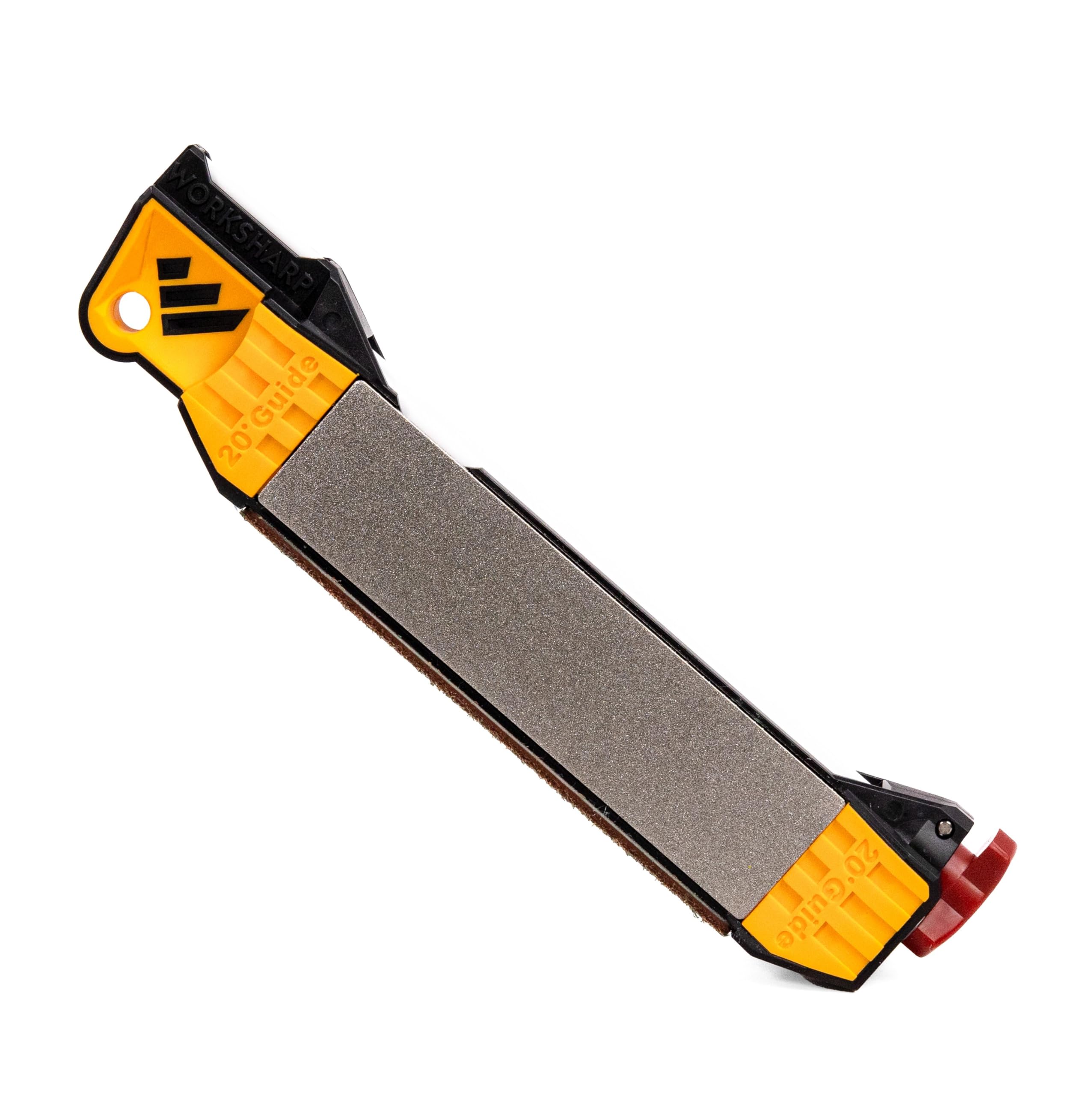
The Work Sharp Guided Field Sharpener is the only tool on this list that combines coarse and fine diamond plates, ceramic honing rods, and a real leather strop with compound — all inside a self-contained plastic case that also doubles as a broadhead wrench. The 20- and 25-degree angle guides built into the body let you lock in a consistent apex on both sides of the blade without any freehand wobble, which matters immensely when you’re sharpening under a headlamp after dark.
At 135 grams, it’s heavier than a pocket pull-through, but every gram earns its keep. The diamond plates handle reprofiling on hardened steels like M390 and CPM-3V, while the ceramic rods refine the edge and the strop finishes to a hair-shaving polish. The rotating ceramic rod also has a grooved surface dedicated to fish hooks, and the removable diamond plates expose a wrench that fits most broadheads — a rare level of utility for hunters who need one tool to cover every sharp object in camp.
Customer feedback consistently calls it the best purchase for anyone who wants guided consistency without carrying a full bench stone set. The only trade-off is that the angle guides are fixed at 20 and 25 degrees, which limits compatibility with edges ground below that range, and the coarse diamond plate leaves a scratch pattern that requires the finer grits to fully smooth out.
Why it’s great
- Five abrasive stages cover reprofiling, honing, and stropping in one compact package
- Built-in angle guides eliminate freehand inconsistency for repeatable results
- Leather strop with polishing compound delivers a true razor finish
Good to know
- Only offers 20- and 25-degree angle options — not adjustable for sub-20-degree edges
- Slightly larger than pocket pull-throughs, better for daypacks than lightweight ultralight kits
2. SHARPAL 178N 3-In-1 Pocket Knife Sharpener

The SHARPAL 178N eschews carbide entirely in favor of a monocrystalline diamond rod system that delivers consistent 600-grit refinement without the ragged wire edge typical of pull-through carbide slots. The round diamond rod handles straight edges, while the 3.5-inch tapered diamond rod reaches deep into serrations and gut hooks — areas where flat stones and fixed-angle guides simply cannot make contact. Both rods store inside the machined aluminum handle when not in use, and the included storage pouch and lanyard hole make it easy to keep within arm’s reach on a belt loop or pack strap.
Diamond abrasives on this hardness level cut through high-alloy blade steels that blunt standard ceramic rods. The fine 600-grit (25 micron) coating removes metal at a controlled rate, making it suitable for field touch-ups without over-grinding the edge. Owners report that the tapered rod excels at restoring serrated rescue knives and gut hooks that other portable sharpeners simply skip, and the rod geometry also works for fish hooks and pointed tools. At 0.14 kilograms, it adds negligible weight to a camp kitchen or hunting pack.
The design requires a bit of technique — you must maintain your own angle while drawing the rod across the blade — which means beginners may need a few practice sessions before achieving consistent results. Also, the diamond rod is aggressive enough that pressing too hard can gouge softer blade steels, so light strokes are essential.
Why it’s great
- Monocrystalline diamond rods cut hard steels like S30V and D2 efficiently
- Tapered rod specifically shaped for serrated blades and gut hooks
- Aluminum handle acts as storage sheath, keeping rods protected and clean
Good to know
- Freehand technique required — no built-in angle guide for beginners
- 600 grit only; no coarse option for heavy reprofiling or nicked edges
3. SHARPAL 116N Pocket Diamond Sharpening Card
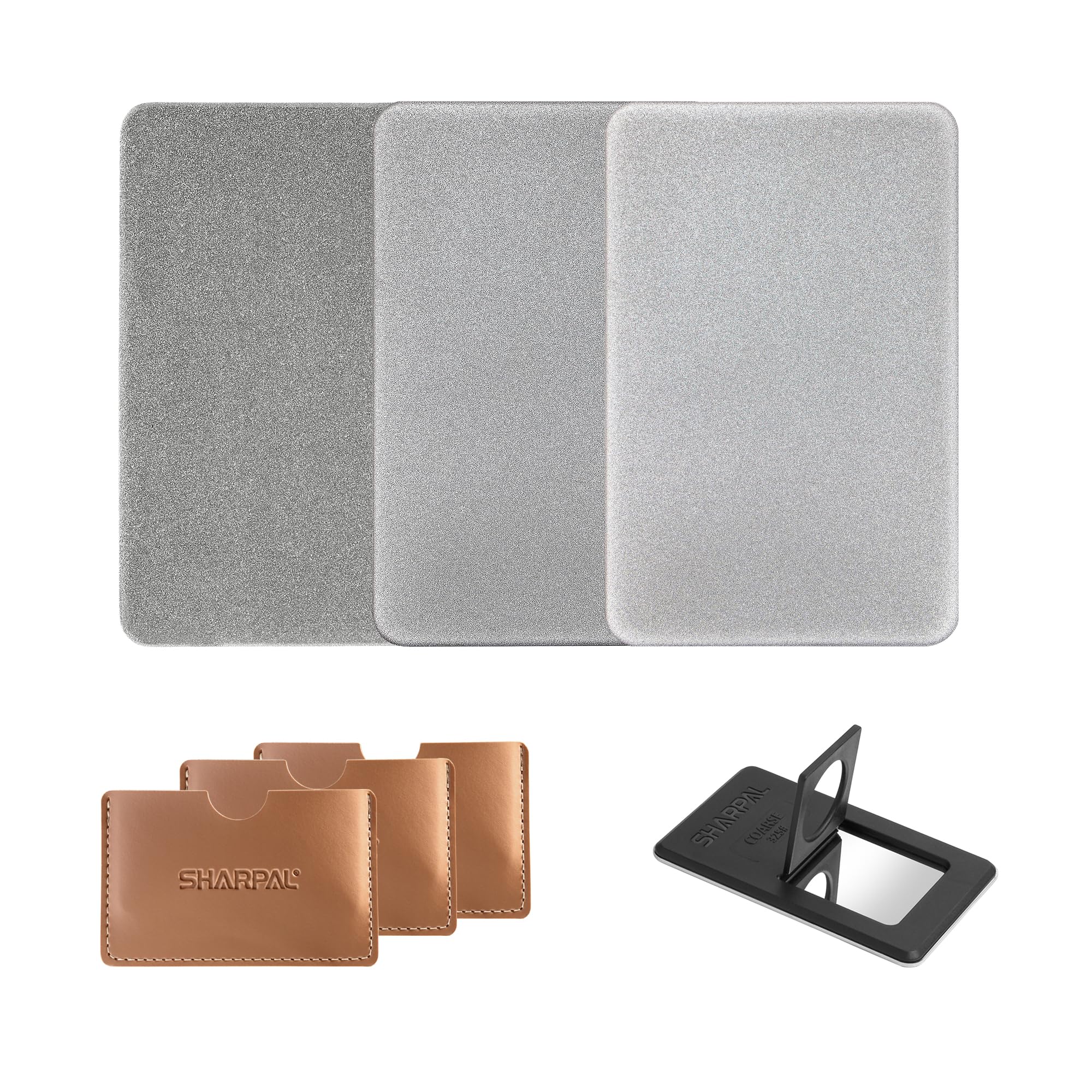
The SHARPAL 116N set includes three separate card-sized diamond stones in coarse 325-grit, fine 600-grit, and extra-fine 1200-grit, giving you a complete progression from edge setting to mirror polishing in a package that fits inside a shirt pocket. Each card measures 3.27 inches by 2.13 inches and is only 0.14 inches thick, making this the slimmest multi-grit system available for backpackers who refuse to carry bulk. The ring grip on each card provides a secure hold even with wet or cold hands, and the dry-sharpening design eliminates the need for oil or water in the field.
The three-grit range covers the full spectrum of blade maintenance: 325-grit reprofiles chipped edges quickly, 600-grit refines the scratch pattern, and 1200-grit polishes to a keen edge that glides through rope, meat, and wood fibers. These flat stones are ideal for curved blades like hook knives and hatchets because you drag the stone over the blade rather than forcing the blade through a fixed slot. The cards also work on carbide and high-speed steel tools, making them useful for maintaining camp axes and machetes beyond just knife edges.
Customers who have used the 116N set for over six years report that it handles even wear-resistant steels like D2 and M390 with consistent results, though removing the plastic backings and storing all three cards in a custom leather case improves portability significantly. The included storage pouch is serviceable but lacks the organization to keep the stones from rattling against each other during transit.
Why it’s great
- Three diamond grits (325/600/1200) provide a complete sharpening progression
- Ultra-slim card format packs flat in any pocket without bulk
- Ring grip and dry-use design work well in wet or cold field conditions
Good to know
- No angle guide — entirely freehand, requiring practice for consistent bevels
- Plastic backing adds thickness that prevents stacking in tight pouches
4. Smith’s Pocket Pal Tactical Knife Sharpener

The Smith’s Pocket Pal packs a carbide sharpening slot, a ceramic sharpening slot, a diamond-coated sharpening rod, and a tungsten carbide glass breaker into a body that measures just 3.22 inches long and weighs 2.4 ounces. The G10 handle and integrated pocket clip let you carry it like a folding knife, so it’s always accessible without digging through a pack. This is the sharpener you clip to your pocket on the way out of camp and forget about until you need it — then you’re glad it’s there.
The carbide slot restores a working edge on dull blades in three or four quick draws, while the ceramic slot polishes away the ragged carbide edge for a smoother cut. The diamond rod handles serrated edges and fine touch-ups, and the glass breaker adds genuine emergency utility for vehicle or structure situations. Owners consistently note that it sharpens everything from small pocket knives to hatchets with surprising speed for such a compact tool, and the pocket clip eliminates the “where did I put the sharpener” problem common with loose gadgets.
A small number of users report that the bottom plastic piece can crack under heavy pressure, though the core sharpening components remain functional even if that happens.
Why it’s great
- Pocket clip allows hands-free carry on a belt or pack strap
- Tungsten carbide glass breaker adds emergency survival capability
- Diamond rod provides serration sharpening that carbide slots cannot reach
Good to know
- Carbide slot removes metal fast — overuse wears down blade steel prematurely
- Plastic housing components can crack, though sharpening elements still work
5. Camillus GLIDE Compact Multitool Sharpener

The Camillus GLIDE is less a sharpener and more a pocket-sized sharpening workstation. It integrates multi-angle carbide and V-notch ceramic sharpeners, dedicated 20-, 30-, and 45-degree shear sharpening channels, a fish hook groove, and — surprisingly — T6, T8, T9, and T10 Torx drivers plus a flathead screwdriver. The glass-filled nylon body weighs only 68 grams yet holds all these tools in a single 7.5-inch-long package, making it the most functionally dense option for campers who maintain multiple tool types in the field.
The V-notch carbide sharpener handles knife edges at multiple angles, while the separate shear sharpening channels let you restore scissor and shears blades without disassembling them. The fish hook groove is a genuine addition for anglers who need to touch up barb points without carrying a dedicated hook file. Owners praise its durability after heavy use — the nylon body shows no wear even after repeated sessions on dirty blades — and the included Torx drivers let you tighten scope rings, knife pivot screws, or gear fasteners without carrying a separate multitool.
The GLIDE lacks a diamond rod entirely, which means it struggles with very hard blade steels and offers no fine-honing capability beyond what the ceramic V-notch provides. The ceramic block in some units has been reported to chip under heavy pressure, and the tool does not include a serration-specific sharpener beyond the basic V-notch.
Why it’s great
- Integrates carbide, ceramic, shear channels, and Torx drivers in one ultralight tool
- Dedicated 20/30/45-degree slots for scissors and shears without blade disassembly
- Durable glass-filled nylon body withstands repeated field use without cracking
Good to know
- No diamond abrasive — limited effectiveness on hardened alloy steels
- Ceramic V-notch can chip under aggressive pressure on thick blades
6. Lansky Blademedic 4-in-1 Knife Sharpener

The Lansky Blademedic packs four sharpening surfaces — a tungsten carbide draw-through slot, a ceramic draw-through slot, a ceramic serrations sharpener, and a tapered diamond grid serrations sharpener — into a metal body that measures just 3.25 inches long and weighs 100 grams. The robust metal chassis sets it apart from cheap plastic pull-throughs, giving it a solid feel that inspires confidence when you’re putting pressure on a stubborn blade. The diamond rod is held magnetically in its storage channel, so it stays closed during pack movement and opens only when you need it.
The carbide slot restores a working edge on dull blades in three or four strokes, and the ceramic slot refines that edge to about 90 percent of whetstone sharpness — impressive for a tool that requires zero technique. The tapered diamond grid excels at serrated edges, reaching into teeth that flat stones cannot access. Owners consistently buy multiples because they tend to gift them to camping partners, praising the balance between field speed and edge quality. The replaceable carbide and ceramic rods extend the tool’s life significantly compared to disposable sharpeners.
The carbide cutter is aggressive and leaves a wire edge that requires the ceramic stage to smooth out, and some users report that the diamond rod flops loosely when extended. The ceramic block can also chip if the tool is dropped on a hard surface, though the metal body provides better impact protection than all-plastic alternatives.
Why it’s great
- Robust metal body delivers durability far beyond all-plastic pull-throughs
- Four sharpening surfaces cover straight edges, serrations, and hooks
- Replaceable carbide and ceramic rods extend tool lifespan indefinitely
Good to know
- Carbide slot produces a wire edge that must be refined with ceramic stage
- Diamond rod flops loosely when extended; ceramic block can chip on impact
7. Gatco Edgemate Pocket Knife Sharpener
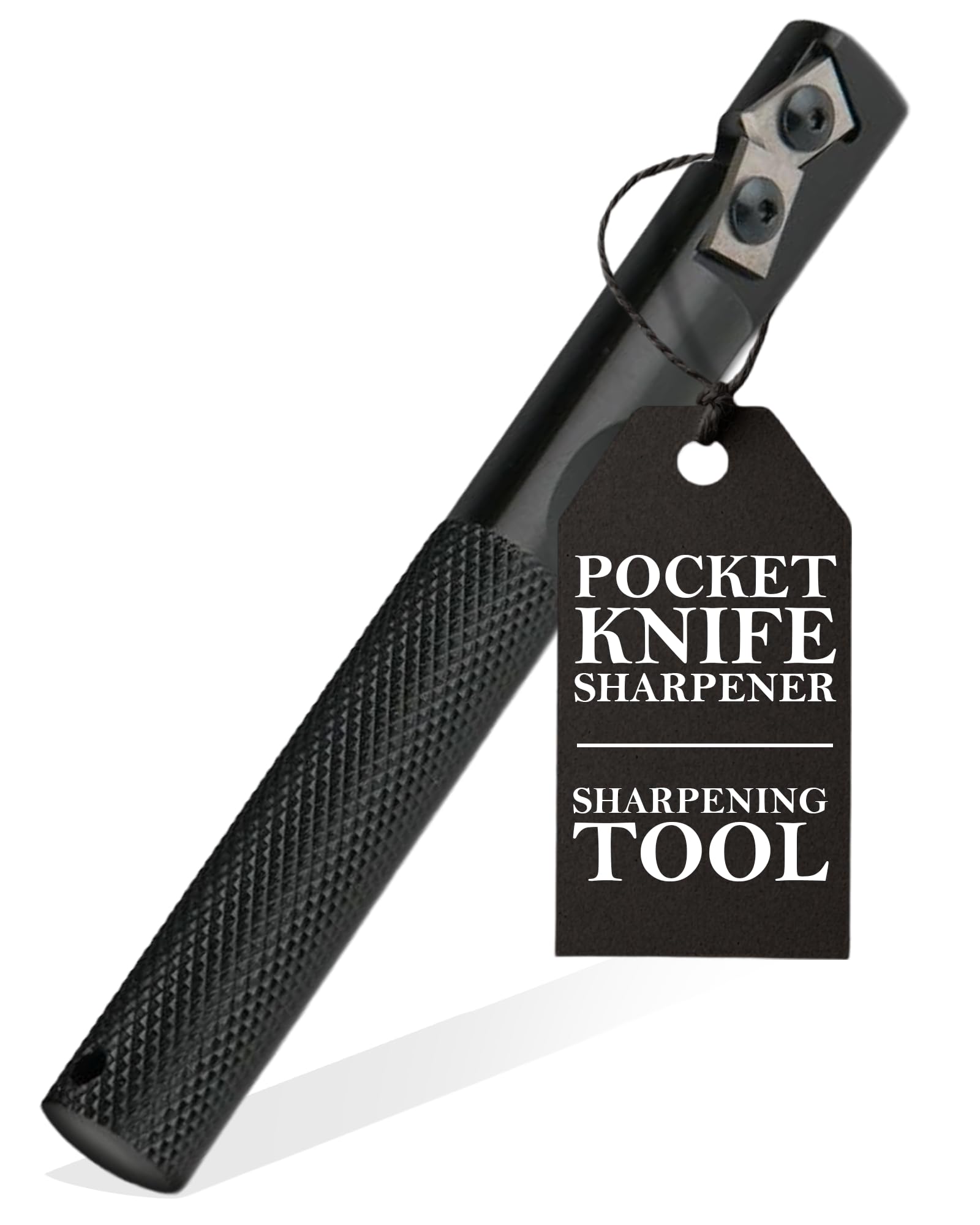
The Gatco Edgemate is a straightforward single-action tungsten carbide pull-through sharpener built for campers who want one motion and one result: a sharp blade, fast. The 8.25-inch handle provides a full grip for large or gloved hands, and the carbide slot puts a working edge on any dull blade within three to five strokes. There are no ceramic refiners, no diamond rods, no angle guides — just a tough carbide surface that removes metal until the edge is functional again.
This simplicity is both its strength and its limitation. For a camp kitchen knife that gets dull from cutting on a plastic board, or a beater knife that you do not mind losing some steel from, the Edgemate restores cutting ability in seconds. It also handles scissors and shears without issues. The tool weighs practically nothing (listed at 0.01 ounces, though that appears to be a listing error; actual weight is around an ounce or two) and slides into any pocket or gear bin without complaint.
The single carbide stage leaves a rough, jagged wire edge that will not satisfy anyone who needs a polished cutting surface for skinning or food prep. Overuse can quickly wear down a blade because the carbide removes metal aggressively with every pass. This sharpener is best reserved for emergency touch-ups on budget knives where speed matters more than edge quality.
Why it’s great
- Large ergonomic handle works well with gloved or wet hands
- Single-stage carbide cut restores dull edges in seconds with zero technique
- Lightweight and compact enough for any pack pocket or kitchen drawer
Good to know
- No ceramic or diamond stage means the edge stays rough and jagged
- Carbide aggressively removes steel — not suitable for high-value or thin blades
FAQ
Can I use a carbide pull-through on a premium folding knife without damage?
How does a diamond rod compare to a ceramic rod for serrated blades?
What is the practical difference between 600-grit and 1200-grit on a camp knife?
Final Thoughts: The Verdict
For most users, the best camping knife sharpener winner is the Work Sharp Guided Field Sharpener because its five-stage abrasive progression and built-in angle guides deliver consistent razor edges without guesswork. If you need a diamond rod system specifically for serrations and hard blade steels, grab the SHARPAL 178N. And for ultralight backpackers who want a full grit progression in a flat pocketable format, nothing beats the SHARPAL 116N Diamond Card set.