
Camping no longer means unplugging from everything—but the difference between a cramped, dead phone and a fully powered campsite comes down to how many watt-hours your portable battery can store and deliver. A capable camping power station handles everything from running a CPAP machine all night to keeping a mini-fridge cold, all without the noise, fumes, or refueling of a gas generator. The challenge is matching the right cell chemistry, inverter wattage, and recharge speed to your specific gear without hauling around dead weight.
I’m Min — the co-founder and writer behind Gadgets Feed. In researching the specs and real-world performance data for this guide, I spent hundreds of hours cross-referencing capacity claims, inverter output limits, battery cycle life ratings, and solar recharge compatibility across the most prominent units on the market.
Whether you’re planning a weekend off-grid excursion or need emergency power for storm season at the cabin, finding the right best camping power station means balancing actual kWh capacity against physical portability and charge speed.
How To Choose The Best Camping Power Station
Selecting the right unit for your campsite isn’t about buying the biggest number on the box. It’s about the real-world relationship between usable watt-hours, inverter wattage, battery chemistry longevity, and how quickly you can replenish the pack when the sun goes down. Misunderstanding these four factors is where most campers end up overpaying or underpowered.
Capacity vs. Portability: Finding the Right Wh
A 300Wh unit at 9 pounds fits in a duffel bag but will barely run a car fridge for 8 hours, while a 2000Wh unit at 40 pounds will power a full campsite for days but needs its own space. The key spec to compare is watt-hours per pound. LiFePO4 units in the 288Wh-500Wh range are ideal for solo backpackers or light overnight trips. For family car camping or CPAP-dependent sleepers, you’ll typically need 2000Wh or more to comfortably stretch across multiple nights without recharging. Anything under 250Wh is essentially a large backup phone bank, not a true camping power station.
Inverter Type: Pure Sine Wave Is Non-Negotiable
All units on this list use pure sine wave inverters, but it’s worth confirming before you buy. Pure sine wave provides clean, stable AC power that matches utility-grade electricity. Modified sine wave inverters can buzz, overheat, or permanently damage sensitive electronics like CPAP machines, laptop power bricks, and induction cooktops. Pure sine wave also runs AC motors in mini-fridges more efficiently, drawing less power from your battery reserve over the same runtime.
Recharge Speed and Input Flexibility
Wall charging speed is measured in hours from zero to full, but the critical spec for campers is solar input voltage and amperage range. A station with a max solar input of 100W will take a full day of strong sun to recharge a 500Wh pack, while units supporting 400W+ solar input can top off a 2kWh pack in under 3 hours. Look for a wide MPPT voltage window (typically 12V-60V) so you can pair it with common portable solar panel configurations without frying the charge controller. Car charging (12V/8A-10A) is slower but provides a backup option for extended road trips.
Quick Comparison
On smaller screens, swipe sideways to see the full table.
| Model | Category | Best For | Key Spec | Amazon |
|---|---|---|---|---|
| Anker SOLIX F2000 | Premium | Family camping & home backup | 2048Wh / 2400W inverter | Amazon |
| Jackery Explorer 2000 v2 | Premium | Lightweight 2kWh duty | 2042Wh / 2200W / 39.5 lbs | Amazon |
| DJI Power 2000 | Premium | Ultra-fast recharge | 2048Wh / 3000W / 30dB | Amazon |
| EF ECOFLOW DELTA Pro | Premium | Max expandable capacity | 3600Wh / 3600W inverter | Amazon |
| AFERIY P310 | Premium | High capacity & fast solar | 3840Wh / 3600W / 1.5H charge | Amazon |
| Anker SOLIX F3000 | Premium | Generator pass-through | 3072Wh / 3600W output | Amazon |
| BLUETTI Elite 30 V2 | Mid-Range | Ultra-portable entry | 288Wh / 600W / 9.4 lbs | Amazon |
| VTOMAN Jump 600X | Mid-Range | Car jump-start combo | 299Wh / 600W / LiFePO4 | Amazon |
| GRECELL EB500 | Budget | Budget-friendly starter | 519.48Wh / 500W pure sine | Amazon |
In‑Depth Reviews
1. Anker SOLIX F2000

The Anker SOLIX F2000 (formerly PowerHouse 767) sits at the sweet spot of the 2kWh class by pairing a 2048Wh LiFePO4 pack with a 2400W pure sine wave inverter that can surge to 3600W via SurgePad technology. HyperFlash charging gets you from zero to 80% in 1.4 hours, which is faster than any competitor at this capacity tier. The built-in wheels and telescoping handle make its 67-pound weight manageable for rolling across a campsite or garage floor.
The 12-device output suite includes 4 AC outlets, 3 USB-C ports (with PD support), 2 USB-A ports, 2 car outlets, and an RV port for direct trailer hookup. Users report powering a full-size Samsung fridge for over 24 hours on a single charge, and the unit’s 3000+ cycle life means it will still be delivering reliable power for a decade of weekend trips. The app connectivity allows real-time monitoring and power-saving schedules, which helps stretch capacity across longer off-grid stays.
Where it falls slightly short is weight—at 67 pounds it’s not a carry-on friendly unit, and the 1440W AC output limit in UPS bypass mode can be confusing for those expecting full 2400W automatic transfer. However, for anyone who needs a single unit that bridges camping, RV trips, and home outage backup, the F2000 delivers the best balance of recharge speed, port count, and long-term battery warranty.
Why it’s great
- HyperFlash 0-80% in 1.4 hours gives you nearly full power before a single round of campfire
- SurgePad handles 3600W spikes without tripping the inverter
- 10-year lifespan and 5-year full-device warranty
Good to know
- At 67 pounds, it needs wheels—not ideal for backpacking or tight trunk spaces
- UPS bypass is capped at 1440W AC output despite the 2400W rating
2. Jackery Explorer 2000 v2

The Jackery Explorer 2000 v2 uses CTB (Cell-to-Body) technology borrowed from EV battery packs to achieve a remarkable 39.5 pounds for a 2042Wh station—that’s 41% lighter than typical units at this capacity. The 2200W pure sine wave inverter handles most camping appliances, including compact refrigerators and induction cooktops, while the three AC ports and dual USB-C PD 100W outputs provide flexibility for groups of campers sharing one power source.
Fast AC charging reaches 80% in 66 minutes in standard mode, and the Emergency Super Charging mode via the app hits full charge in 102 minutes. Silent Charging mode drops below 30dB for sleeping without fan noise. The unit also features a 20ms UPS switchover that’s UL1778 certified, protecting sensitive gear during power transitions. Real-world tests show it running a fridge for over 21 hours on a single charge, making it a strong contender for long weekend trips.
The main downside is the solar barrel ports, which flex inward when plugging in panels, and the Bluetooth connection can be intermittent. The build is solid overall, but the frame around the charge ports feels less robust than Anker’s or EcoFlow’s construction. For campers who prioritize weight and portability over ruggedized chassis, this is the lightest fully-capable 2kWh unit available.
Why it’s great
- 39.5 pounds for 2kWh is unmatched in this capacity class
- Silent Charging mode keeps noise below 30dB inside a tent or RV
- CTB construction improves structural rigidity and safety
Good to know
- Solar input barrel ports have a weak frame prone to flexing under cable strain
- App Bluetooth connection drops occasionally during monitoring
3. DJI Power 2000
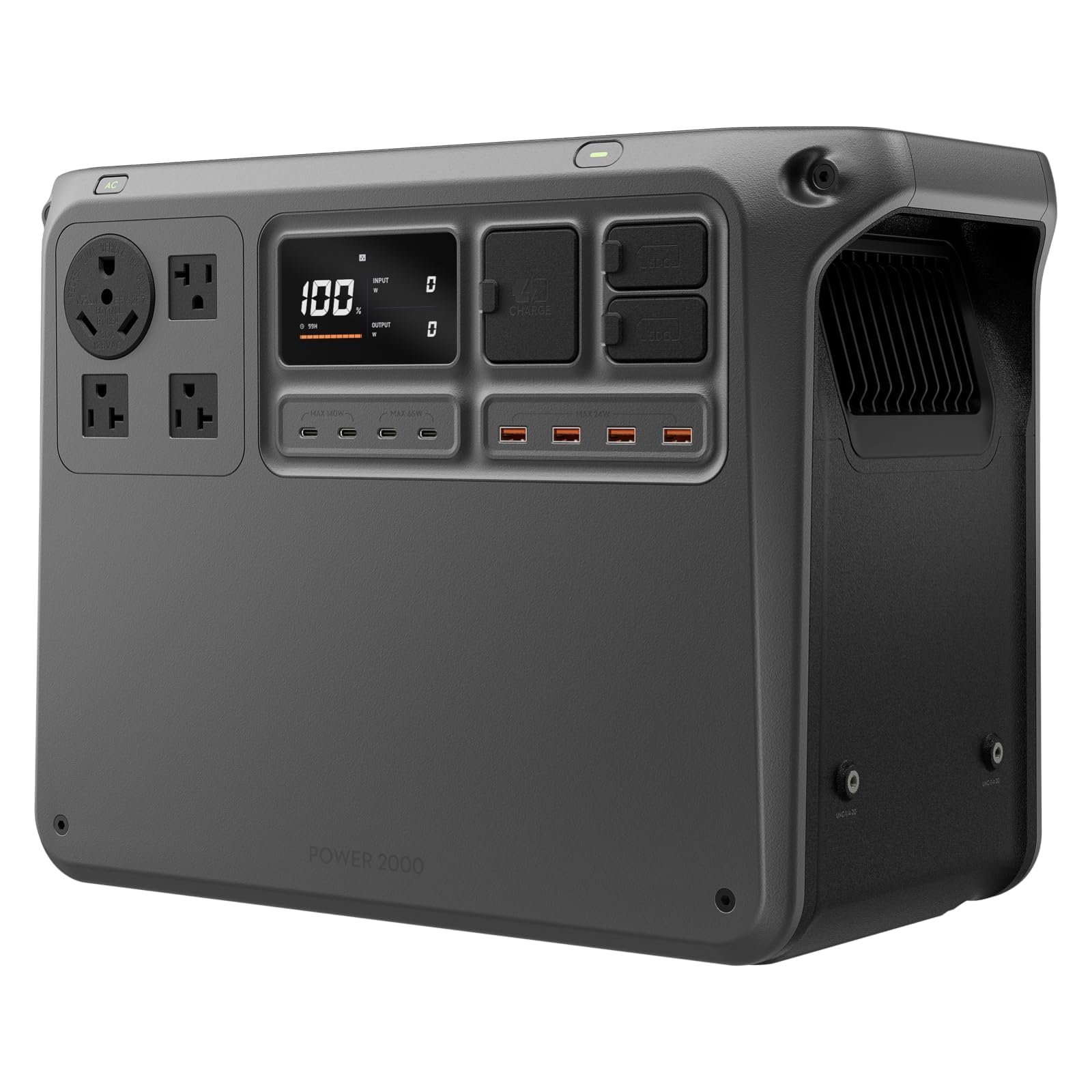
The DJI Power 2000 cuts the wait time for a full 2kWh charge down to an astonishing 55 minutes from zero to 80%—that’s over twice as fast as most competitors in the same capacity tier. The 3000W continuous inverter output with 4000W peak handles heavy appliances like electric kettles, saws, and high-wattage cookers that would trip smaller units. Noise is rated as low as 30dB, making it one of the quietest high-output stations for use inside RVs or near sleeping areas.
Safety engineering is a major focus here: sub-nano coating on the PCB protects against humidity and dust, flame-retardant housing, and 26 temperature sensors across the LFP battery pack. The 15-port array includes dual full SDC ports plus 4 USB-C outputs with two capable of 140W each for rapid laptop charging. The UPS switchover is rated at 10ms—twice as fast as the DJI Power 1000. Expansion to 22.5kWh with additional batteries supports extended off-grid stays, and the DJI Home app provides remote monitoring and schedule control.
On the downside, the unit lacks built-in MPPT solar modules and car charging capability out of the box—you’ll need separate adapters for both. Some early units shipped as gray-market Hong Kong models set to 50Hz, which caused compatibility issues in the US. The proprietary DC connectors also limit your choice of third-party expansion batteries. Despite these caveats, the recharge speed and whisper-quiet operation make it a top pick for anyone who values minimal downtime.
Why it’s great
- 55-minute 0-80% AC recharge is the fastest in the 2kWh class
- 3000W continuous output with 26 temperature sensors for thermal management
- Under 30dB noise level for disturbance-free camping nights
Good to know
- No built-in MPPT solar controller or car charging—requires separate adapters
- Proprietary connectors limit third-party expansion battery compatibility
4. EF ECOFLOW DELTA Pro
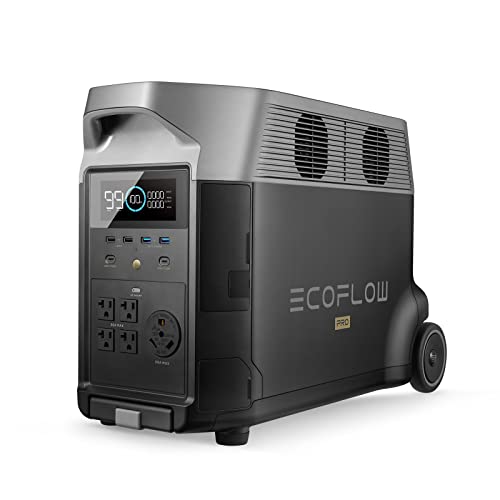
The DELTA Pro starts at a massive 3600Wh capacity with a 3600W AC output that can be boosted to 4500W using X-Boost technology, and two units can be paired for 7200W to run heavy-duty appliances like well pumps or RV air conditioners. The LFP battery supports expansion up to 25kWh with extra batteries, making it the most scalable option here for serious off-grid setups or whole-home backup during extended outages.
Five AC outlets, dual USB-C 100W ports, and 15 total output methods provide plenty of flexibility for powering a full campsite. X-Stream fast charging refills the pack to full in 1.8 hours on a 240V outlet or 2.7 hours on 1800W wall power. Solar charging with four 400W panels achieves a full charge in under 3 hours thanks to 23% conversion efficiency. The EcoFlow app provides granular control over input/output scheduling and real-time monitoring.
The main trade-off is weight: at 99 pounds, this is not a portable unit in the traditional sense—it’s a semi-permanent camp power solution or home backup device. The price also places it firmly in premium territory, though the expandability and 3600W inverter justify the investment for users who need serious capacity. Some users report the app can be slow to respond, and the unit’s large footprint requires dedicated floor space.
Why it’s great
- 3600Wh base capacity expands to 25kWh—most scalable option reviewed
- X-Boost delivers 4500W surge for high-draw tools and appliances
- Solar recharge in under 3 hours with 1600W panel input
Good to know
- 99-pound weight makes it a semi-stationary unit, not a carry-on
- App Wi-Fi connectivity can lag or drop during active monitoring
5. AFERIY P310

The AFERIY P310 packs 3840Wh of LiFePO4 capacity with a 3600W pure sine wave inverter (7200W peak) into a unit that undercuts most competitors at this capacity tier on cost. The 1.5-hour AC fast charge is competitive with premium brands, and the expandability to 11.5kWh using add-on batteries makes it a viable candidate for extended off-grid living. The UPS switchover time is under 10ms, providing seamless transitions during outages for sensitive electronics.
Fifteen output ports include 5 AC outlets, dual USB-C PD 3.0, USB-A, DC5521, XT60, and a 12V car socket. The smart app allows charge/discharge scheduling, light mode selection, and remote power-off. The unit also features a ruggedized pull handle and wheels for easier transport despite its 80-pound weight. Users report that paired with four 445W solar panels, it recharges lightning fast and runs entire RV setups except for air conditioning.
The build quality is generally solid, though a small number of early units had display segment issues that were resolved through customer support. The fan noise, while acceptable, is noticeable under high load, and the app interface is functional but less polished than Anker’s or EcoFlow’s offerings. For campers who need maximum watt-hours per dollar and plan to use solar extensively, the P310 offers the best capacity-to-price ratio in this lineup.
Why it’s great
- 3840Wh capacity at a price typically seen for 2kWh units
- Under 10ms UPS switchover protects CPAP and networking gear
- Expandable to 11.5kWh with add-on batteries
Good to know
- 80-pound weight requires the wheels—not for trunk tossing
- App interface is less polished than top-tier competitors
6. Anker SOLIX F3000
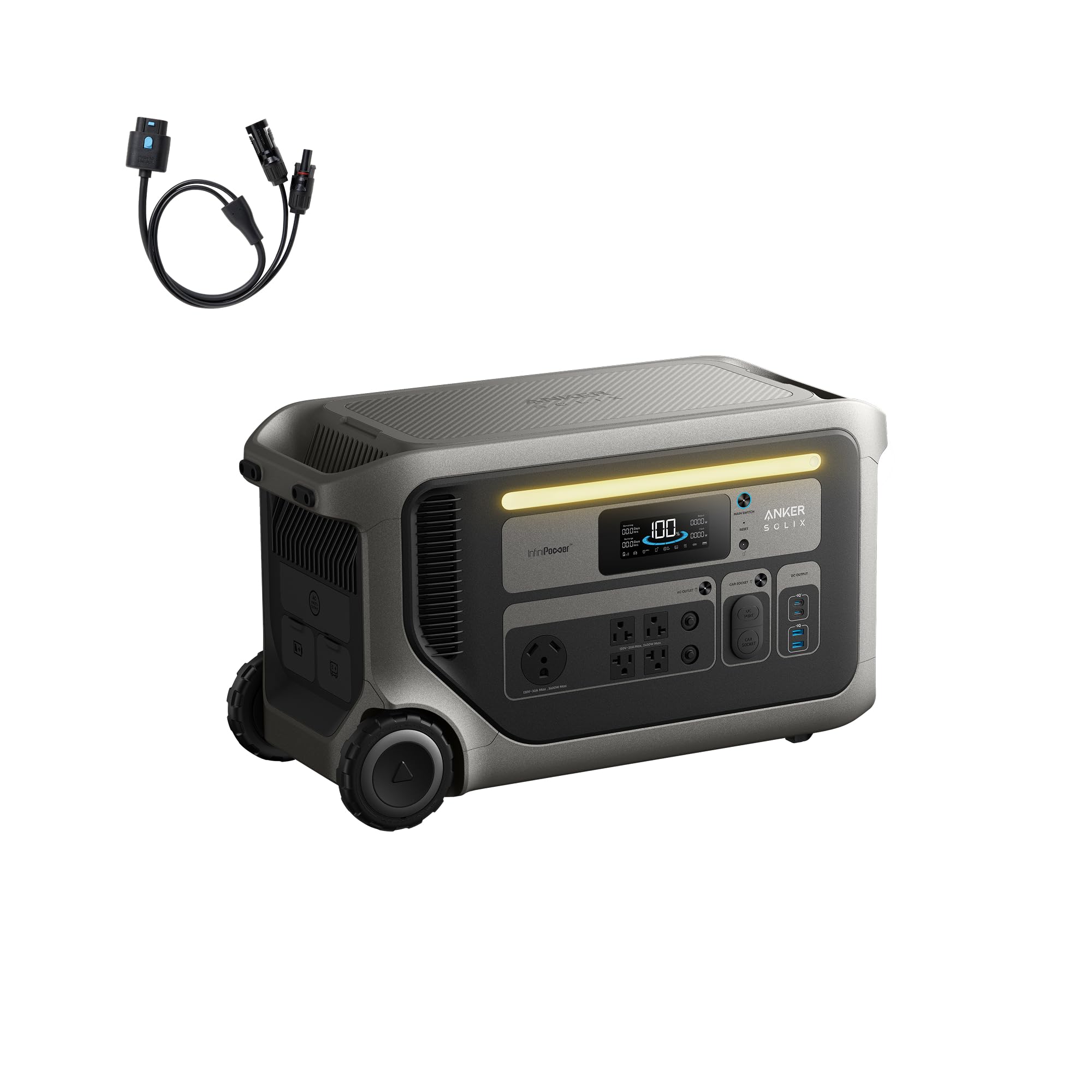
The Anker SOLIX F3000 stands out for its massive 3600W pass-through charging capability, meaning you can recharge the 3072Wh LFP battery from a 120V generator while simultaneously running high-wattage appliances. The unit also features ultra-low idle power consumption that delivers 125 hours of AC standby time or 42 hours running a 190W refrigerator. This makes it the most efficient choice for long-duration backup scenarios where every watt-hour counts.
With dual solar input ports supporting up to 2400W total solar recharge, the F3000 can replenish quickly even in partly cloudy conditions. The expandable architecture scales from 3kWh base capacity up to 24kWh with additional batteries, providing up to 80 hours of outage-proof energy for essential home or RV loads. The app allows you to enable power-saving modes and set charge/discharge limits, while the built-in 3600W inverter supports 240V split-phase when paired with a second unit.
At 91 pounds without the extension batteries, the F3000 is heavy even with the built-in wheels and handle. The USB ports draw a minimum 1W standby, which adds to idle consumption over days of use—some users solve this by using the 12V port with a distribution block. The price is steep, but the generator pass-through and 6000W input when combining generator and solar make this the top choice for users who want to integrate their power station with existing fuel-based backup systems.
Why it’s great
- 3600W pass-through charging allows simultaneous generator use and appliance running
- 125 hours AC standby—best idle efficiency in this capacity class
- Expandable to 24kWh for extended off-grid stays
Good to know
- 91 pounds is very heavy despite wheels—needs dedicated floor space
- USB ports have a 1W minimum draw that adds to standby consumption
7. BLUETTI Elite 30 V2
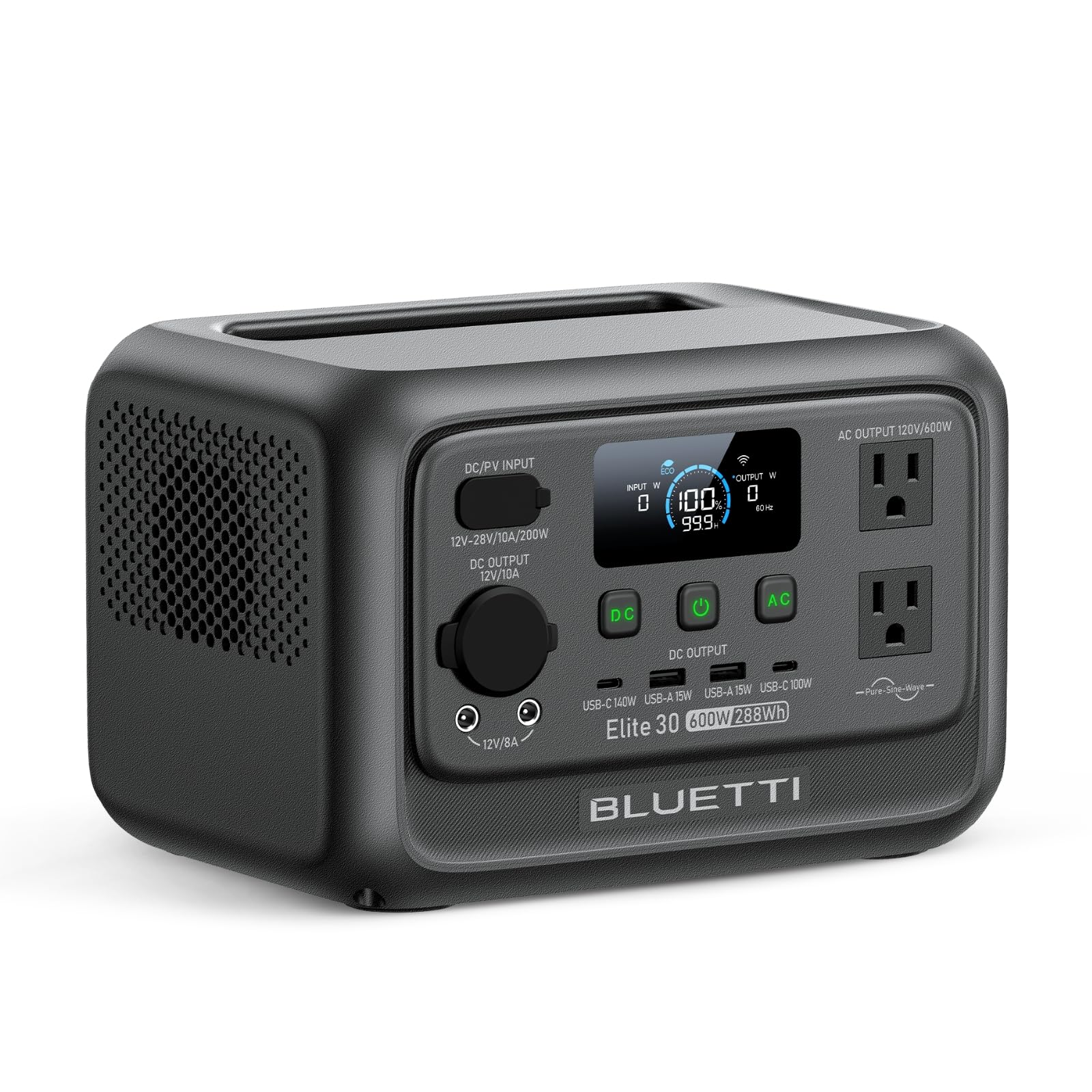
The BLUETTI Elite 30 V2 packs 288Wh of LiFePO4 capacity into a featherlight 9.4-pound chassis, making it the most portable fully-featured power station on this list. The 600W pure sine wave inverter with 1500W Power Lifting mode can briefly handle small kettles or toasters that would trip 300W units. The UltraCell tech and smart cooling system reduce power consumption by 50% compared to previous generation units, with standby power dropping to only 4.5W.
Charging is remarkably fast for this size class: 0-80% in 45 minutes and full charge in 70 minutes via the 380W AC input. The 10ms UPS switchover protects CPAP machines, laptops, and network equipment during power cuts. The eight charging modes include AC wall, solar, and car charging, giving campers multiple ways to top off the pack. The dual USB-C ports deliver 140W and 100W respectively, which is enough to fast-charge a MacBook Pro from dead to full without additional adapters.
The compact size means limited runtime for larger appliances—a 600W load drains the 288Wh pack in under 30 minutes. The fan kicks in after about three minutes under high load at a moderate noise level, and there’s no pass-through charging. For solo campers who just need device charging, camera batteries, and a small fan for the night, this is the most backpack-friendly option that still includes a real AC inverter.
Why it’s great
- 9.4 pounds with a real 600W inverter—fits in a daypack
- 380W AC charging delivers 0-80% in just 45 minutes
- Power Lifting handles 1500W surge for small cooking appliances
Good to know
- 288Wh capacity limits runtime on 600W loads to under 30 minutes
- No pass-through charging—cannot charge and discharge simultaneously
8. VTOMAN Jump 600X

The VTOMAN Jump 600X is a 2-in-1 unit that combines a 299Wh LiFePO4 power station with a 12V car jump start port, eliminating the need for a separate jumper pack. This makes it uniquely suited for road trippers who want to both power campsite gear and have emergency starting capability for their vehicle. The 600W constant-power inverter can sustain 600W output even when powering over-rated appliances, providing an emergency safety margin that standard units lack.
The expandable capacity design allows adding a VTOMAN extra battery to reach 939Wh, extending runtime without buying a whole new unit. The battery chemistry is rated for 3000 full cycles before degrading to 80% capacity. The output panel includes 2 AC outlets, 2 regulated 12V/10A DC5521 ports, 1 car port, 3 USB-A (one QC 3.0 at 18W), and a USB-C PD 60W port—enough to charge 9 devices simultaneously with pass-through support.
The 14.6-pound weight makes it relatively portable, though the boxy shape is less convenient to pack than the BLUETTI Elite 30 V2. AC charging takes about 3 hours to full, while solar charging takes 5-6 hours on 110W panels. Some users report the included charging cable can be fragile and needs replacement over time, and the jump start function requires separate jumper cables not included in the box. For those who prioritize roadside self-sufficiency alongside camp power, this is a uniquely space-saving solution.
Why it’s great
- Integrated car jump start port saves trunk space and avoids a separate device
- Constant-power 600W inverter keeps running even when slightly overloaded
- Expandable from 299Wh to 939Wh with add-on battery
Good to know
- Jumper cables for the jump start function are not included
- AC charging cable and connectors feel less durable than premium brands
9. GRECELL EB500
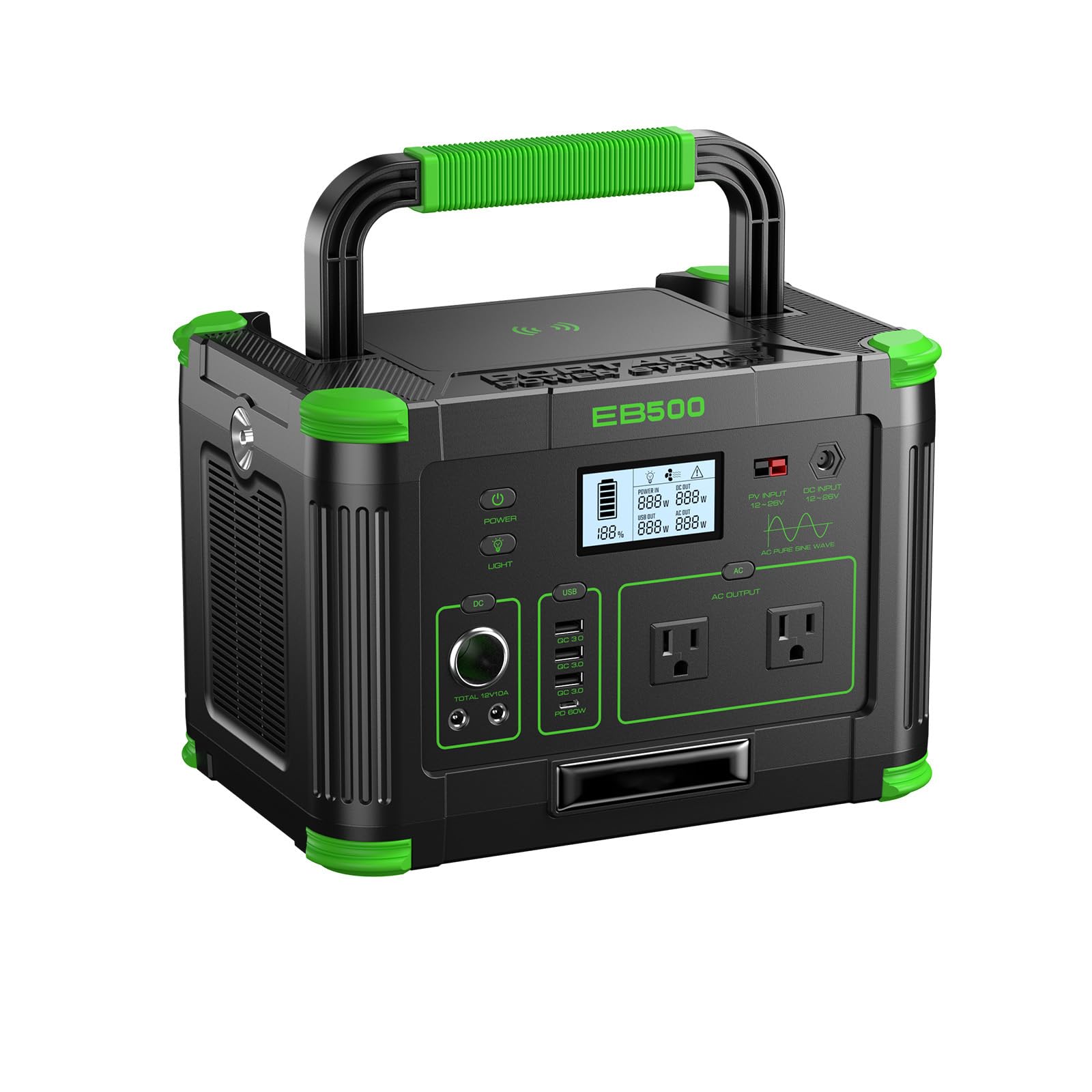
The GRECELL EB500 delivers 519.48Wh of pure sine wave power in a compact 13.4-pound package at an entry-friendly price point. The NCM lithium cells powered by a smart BMS provide real-time monitoring of temperature, voltage, and current, protecting sensitive gear like CPAP machines and laptops from dirty power. The 10-device output suite includes 2 pure sine wave AC ports (120V, 500W total), 3 USB-A QC3.0 ports (18W each), 1 USB-C PD 60W port, 2 DC outputs, 1 car port, and a 10W wireless charging pad on top.
Three recharge methods offer flexibility: 6-7 hours via wall outlet, 7-8 hours via 12V car outlet, or 6-9 hours with a compatible 100W solar panel. The built-in LED flashlight with strobe and SOS modes adds utility for nighttime camp setup or emergency signaling. Users running a 200W rice cooker report 44-50% battery drain per cooking cycle, while a mini PC lasts 4-5 hours of gaming or 6.5 hours of browsing, giving a realistic picture of real-world capacity.
The NCM chemistry, while cheaper, has a shorter cycle life than LiFePO4—typically around 500-800 cycles versus 3000+. The lack of pass-through charging means you can’t charge the battery and power devices simultaneously, which is a limitation for extended use. The fan is audible under load and kicks in after about 3 minutes of continuous high draw. For budget-conscious campers who need mid-range capacity for weekend trips and don’t plan on daily use for years, the EB500 offers respectable specs at the lowest cost per watt-hour in this review.
Why it’s great
- 519.48Wh at 13.4 pounds offers the best Wh-per-pound ratio for entry-level buyers
- 10W wireless charging pad eliminates cable clutter for phone charging
- LED flashlight with SOS mode adds emergency utility
Good to know
- NCM cells last 500-800 cycles versus 3000+ for LiFePO4
- No pass-through charging—cannot power devices while recharging
FAQ
How long will a 500Wh camping power station run my CPAP machine?
Can I charge my power station while simultaneously powering devices?
What size solar panel do I need to keep a power station topped off while camping?
Final Thoughts: The Verdict
For most users, the best camping power station winner is the Anker SOLIX F2000 because it balances 2048Wh capacity with HyperFlash charging speed, a 10-year lifespan, and enough ports to power a full family campsite. If you want the lightest 2kWh unit available, grab the Jackery Explorer 2000 v2. And for backpacking solo trips where every ounce counts, nothing beats the BLUETTI Elite 30 V2.