
Our readers keep the lights on and my morning glass full of iced black tea. As an Amazon Associate, I earn from qualifying purchases.
Specs are compiled from manufacturer listings and verified buyer reviews and can change over time — please confirm the key details on the product page before buying.
A freezing night on hard ground can ruin a whole camping trip. The right sleeping pad stops that by blocking cold from the earth and cushioning your hips and shoulders. Car camping lets you haul a thick, heavy pad for real-bed comfort. Backpacking demands something light enough to carry for miles. The secret is matching thickness, insulation rating (R-value), and pad type to how you actually sleep and travel.
I’m Min — the founder and writer behind Gadgets Feed. This guide is built by comparing the manufacturers’ published specifications and the patterns across verified customer reviews, so you get each pick’s real strengths and trade-offs instead of marketing spin.
Finding the right insulation and portable design makes all the difference when choosing a camping sleeping pad that keeps you warm and comfortable through the night.
Our Picks at a Glance

How To Choose The Best Camping Sleeping Pad
A camping sleeping pad is the layer between you and the cold ground. The three things that matter most are how warm it keeps you (its R-value), how thick it is for comfort and support, and how small it packs down for travel. Car campers can prioritize thickness, while backpackers need to watch every ounce and inch of packed volume.
R-Value: The Number That Tells You How Warm You’ll Stay
The R-value (a measure of thermal resistance) tells you how well a pad blocks heat loss to the ground. A higher number means more insulation: R-values around 2 are fine for summer camping, while values of 4.5 or above work well for three-season use. If you plan to camp in near-freezing conditions, look for an R-value of 7 or higher. Always match the R-value to your coldest expected nights.
Thickness, Comfort, and the Weight Trade-Off
Thicker pads generally feel more like a real mattress, especially for side sleepers who need cushioning for hips and shoulders. Closed-cell foam pads (a solid sheet of foam with no air chambers) are thin and lightweight but firm. Self-inflating pads combine foam and air, offering good comfort with a moderate packed size. Pure air pads are the lightest but require manual inflation and risk punctures.
Dimensions That Fit Your Body and Tent Space
Length and width determine whether you can stretch out fully or whether your arms fall off the edges. A standard regular size is around 72 inches long and 20 to 25 inches wide. Taller sleepers need a longer pad, and side sleepers often benefit from wider models that keep elbows and knees on the pad throughout the night.
Quick Comparison
| Model | Best For | R-Value | Thickness | Weight | Amazon |
|---|---|---|---|---|---|
| NEMO Equipment Switchback Foam★ Best Overall | Ultralight backpacking and durable ground layer | 2.00 | 0.9 in | 14.8 oz | $59.95Amazon |
| Therm-a-Rest MondoKing 3DLuxury Pick | Luxury car camping in extreme cold | 7.0 | 4.25 in | 5.5 lbs | $289.95Amazon |
| Hikenture 4 Inch Thick | Warm, thick car camping comfort | 9.5 | 4 in | 6.5 lbs | $99.99Amazon |
| Sea to Summit Camp Plus | Reliable self-inflating car camping | 4.3 | 2.6 in | 3.2 lbs | $99.00Amazon |
| Big Agnes Rapide SL | Ultralight backpacking comfort | 4.8 | 4.25 in | — | $169.95Amazon |
| Therm-a-Rest NeoAir Xlite NXT | Featherlight year-round backpacking | 4.5 | 3 in | 16 oz | $177.14$219.95Amazon |
| CYMULA 3 Inch Memory Foam | Budget-friendly cot or tent pad | — | 3 in | 6.4 lbs | $58.99$65.99PrimeAmazon |
In‑Depth Reviews
1. NEMO Equipment Switchback Foam Sleeping Pad
Our pick — over 4.5★ from 650+ verified ratings; the strongest balance of quality and price.
A featherlight closed-cell foam pad that doubles as a camp seat and gear protector.
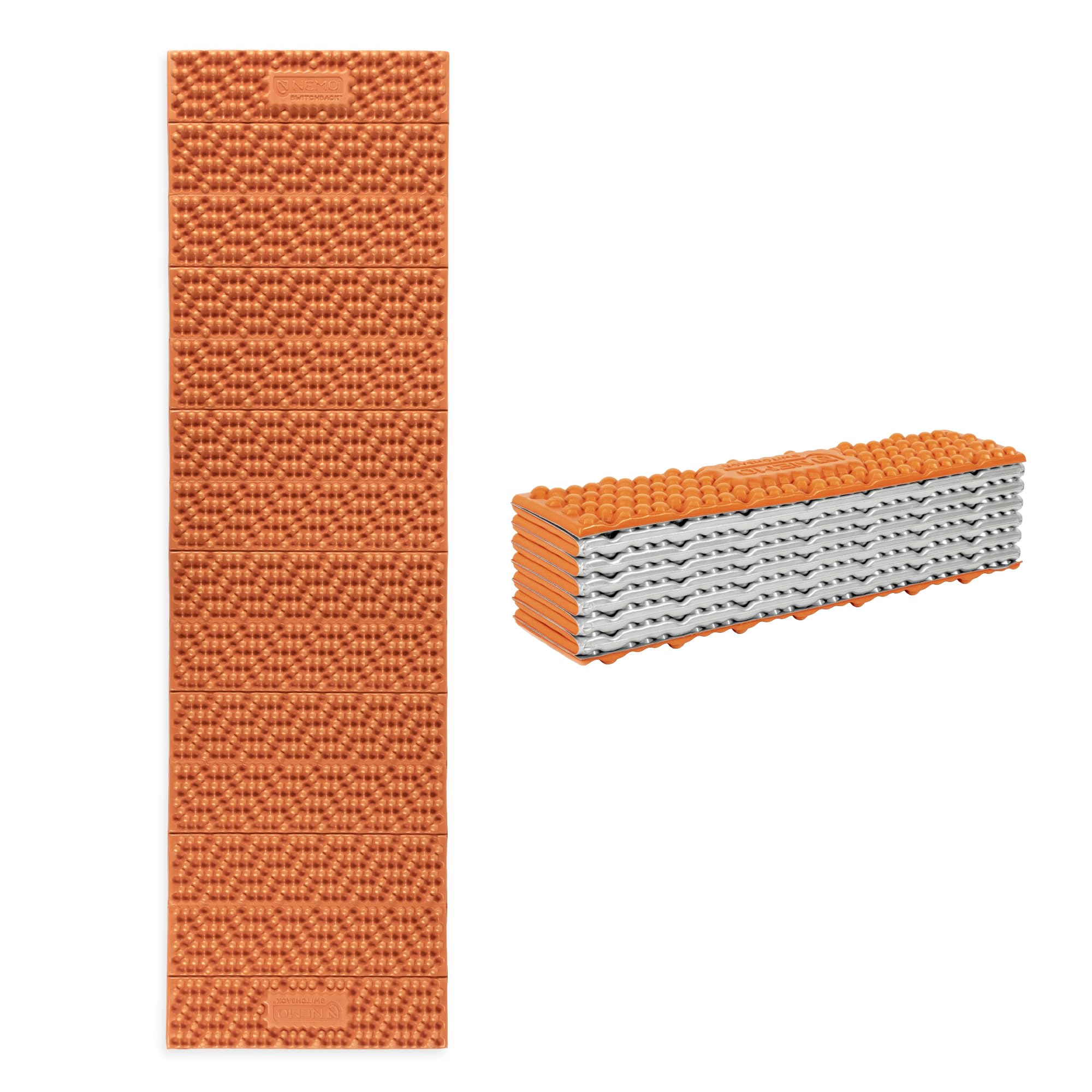
When weight and durability matter more than plush comfort, the Switchback is the answer. This closed-cell foam pad (a solid sheet of foam with no air chambers) weighs just 14.8 ounces — lighter than a full water bottle. It uses a hexagonal nesting pattern with taller nodes that trap more warm air around your body. The metallized thermal reflective film on one side bounces body heat back at you. One reviewer noted: “I used it for the first time last night on a concrete floor and it performed great” — high praise for a pad that is only 0.9 inches thick. At a 2.0 R-value, it works best for summer camping or as an insulating layer under an inflatable pad in colder months.
The premium dual-density Axiotomic foam has a soft layer for comfort and a dense layer for support. It folds up into a compact bundle that straps to the outside of a pack. Many owners cut it down to torso length and use the extra panels as a sitting pad or dog bed, calling it “three for the price of one.” It is not as comfortable as an air pad, and at 20x5x5.5 inches when folded, it takes up more pack space than a rolled inflatable despite being lighter. It is also not water-resistant, so keep it dry.
Advantages
- Ultralight at 14.8 ounces for pack weight minimalists
- Virtually indestructible — no punctures, no valves, no leaks
- Doubles as a seat pad around camp
Trade-offs
- Only 2.0 R-value — too cold for near-freezing ground without layering
- Thin foam is firm, not plush; side sleepers may find it hard
Best suited for: Ultralight hikers who need a bombproof pad for summer trips or as a base layer.
Not ideal if: You want a thick, soft pad for sleeping on your side.
2. Therm-a-Rest MondoKing 3D Self-Inflating Camping Sleeping Pad
The king-size pad that makes car camping feel like a real bed under the stars.
You drive to camp and want to sleep as well as you do at home. This pad gives you that with a 4.25-inch thickness that cushions your hips and a 7.0 R-value (thermal resistance rating) that stops ground cold even below freezing. The vertical sidewalls from the 3D construction boost the 80×30 inch surface so you do not roll off. Buyers report it is so comfortable at 300 pounds that one owner said they “slept better on this than on my own bed.” Compared to the CYMULA memory foam pad at 6.4 pounds, this one weighs 5.5 pounds.
The TwinLock valve system uses two separate one-way valves for inflation and deflation, making setup faster than older single-valve designs. StrataCore construction nests a continuous layer of thermal foam between alternating ridges of air and foam, giving it a plush feel while still insulating. It packs to 26×10.3 inches, which is bulky for backpacking but reasonable for a car camping luxury pad.
Why you’d want this
- 7.0 R-value blocks extreme cold better than almost any other pad here
- 4.25 inches thick with stretch knit fabric feels like a real mattress
- TwinLock valves make inflation and deflation fast and easy
Heads-up
- Too bulky and heavy for backpacking — this is strictly a car camping or basecamp pad
- A small number of buyers reported valve defects, so check function right away
Grab this if: You car camp in cold conditions and want near-bedroom comfort.
Look elsewhere if: You need to carry your sleep system on your back for miles.
3. Hikenture 4 INCH Thick Self Inflating Sleeping Pad 9.5 R Value

A 4-inch thick pad with an R-value over nine for serious winter warmth.
You will not find a warmer insulated pad at this price point. The Hikenture delivers a 9.5 R-value compared to the NEMO Switchback’s 2.00 R-value — and a 4-inch thick memory foam layer that cradles side, back, and stomach sleepers. At 80 inches long and 28 inches wide, it is the longest and widest pad here, so someone over 6 feet tall can stretch out. Owners mention the pad “stays inflated, durable, easy to inflate” and fits people up to 6’3″.
The self-inflating design works with a patented two-way valve: let it sit for a few minutes to self-inflate, then top off with the included pump sack. The polyester top is quiet during sleep, so you do not get the crinkly noise some air pads make. At 6.5 pounds, it is heavier than the similar-size Sea to Summit Camp Plus at 3.2 pounds and far too heavy for backpacking.
Where it shines
- 9.5 R-value is the highest rating in this entire list
- 80×28 inch surface fits tall and broad sleepers
- Self-inflates with a pump sack for easy setup
Watch out for
- Heavy at 6.5 pounds — only for car camping
- First unit had a manufacturing tear for one buyer, though the company replaced it
Reach for this if: You camp in freezing temperatures and want maximum warmth and thickness.
skip it if: Every ounce matters — this is strictly a car-camp or guest-bed pad.
4. Sea to Summit Camp Plus Self-Inflating Foam Sleeping Mat for Camping
A self-inflating foam pad that splits the difference between comfort and portability.
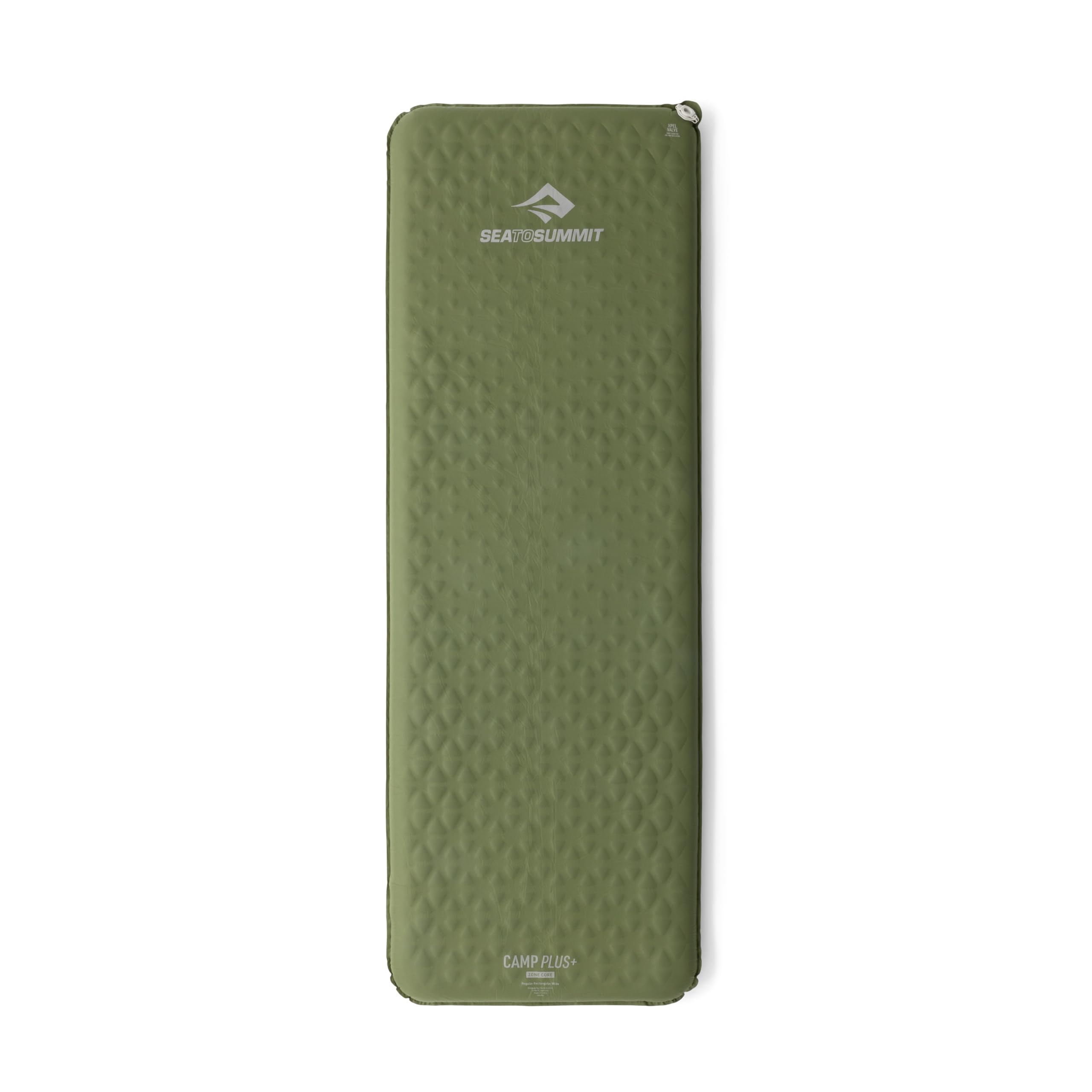
This pad weighs 3.2 pounds, while the CYMULA memory foam pad weighs 6.4 pounds, yet still gives you 2.6 inches of cushioned support with a 4.3 R-value for three-season warmth. The rectangular shape measures 72 x 25.2 inches, so you have room to stretch out without the tapered cut that some backpacking pads use. Customers note it is “extremely durable” and survived “desert sun, sand, rocks” without damage.
A key detail: the foam arrives vacuum-packed and can take days to fully expand to its full thickness. Do not open this at the trailhead expecting immediate use. The updated Xpel valve lets you roll the pad tighter for storage, and the included PillowLock patches let you attach a compatible Sea to Summit pillow so it stays put through the night. The body-mapped air zone construction cuts weight where you do not need support and keeps warmth where you do. If you want a pad you can use directly from the start, look at the Therm-a-Rest MondoKing instead — that one does not need days to expand.
Strengths
- 3.2 pounds is manageable for short carries and car camping
- 4.3 R-value covers spring through fall camping
- 75D polyester face fabric holds up to rough ground
Limitations
- Foam needs days to fully expand after unpacking
- Requires manual inflation of 10-15 breaths unless left for hours
Best for: Campers who drive to the site but want the option to walk a mile or two.
Not ideal if: You want a pad you can use immediately after opening the box.
5. Big Agnes Rapide SL – Insulated Sleeping Pad

An ultralight air pad with quilted comfort that packs down small enough for the trail.
For backpackers who refuse to sleep on a thin foam slab, the Rapide SL uses a quilted top and offset I-beam construction to create a cushioned, pillowy surface 4.25 inches thick, with larger outer chambers that keep you centered — no sliding off in the middle of the night. The R-value of 4.8 makes it warm enough for three-season backpacking, and the superlight double ripstop nylon with aviation-grade TPU lamination keeps weight low. Reviewers point out the pad is “comfortable, quiet, keeps you on the mat” with minimal noise despite active sleeping.
The included Pumphouse inflation sack fills the pad in seconds without blowing moisture inside, and the high-volume valve with micro-adjustment lets you dial in firmness. It packs slightly larger than the NeoAir Xlite NXT but folds and deflates faster. One caveat: some owners found it heavier than alternatives, though the comfort-to-weight ratio is among the best here. The pad comes in a 20-inch wide regular size, so wider sleepers should check the 25-inch version.
Why backpackers love it
- 4.25 inches thick yet ultralight with double ripstop nylon
- Quilted top and offset I-beams provide stable, quiet support
- Pump sack inflates in seconds without moisture
Things to consider
- 20-inch wide regular may feel narrow for broad-shouldered sleepers
- Bulky relative to the NeoAir Xlite NXT for some packs
Go for this if: You backpack regularly and want inflatable comfort without carrying a heavy pad.
Look elsewhere if: You need the absolute lightest ounce-counting option for multi-day treks.
6. Therm-a-Rest NeoAir Xlite NXT Ultralight Camping and Backpacking Sleeping Pad

The lightest full-size pad here, rolling up as small as a one-liter water bottle.
Weight-conscious backpackers stop reading here: the NeoAir Xlite NXT weighs just 13 ounces in the regular size and packs smaller than any other pad in this comparison — about the size of a 1-liter water bottle. Despite the featherweight build, it delivers a 4.5 R-value from reflective ThermaCapture technology and Triangular Core Matrix construction that blocks heat loss. The 3-inch thickness uses a baffled internal structure for stability, so you do not feel like you are sleeping on a wobbly pool float. One buyer called it “the best of the best” and noted it holds air for over 48 hours.
The WingLock valve makes inflation fast and deflation even faster. The NXT version is nearly silent, fixing a common complaint about older NeoAir models that sounded crinkly. The 25-inch wide regular size gives you room to move. The trade-off is that the 30-denier (a measure of fabric thickness) ripstop nylon is thin — careful site selection and a ground sheet are wise. A few buyers experienced quality control issues with valves, so inspect yours right after arrival. It costs more per ounce than any other pad here, but for ultralight hikers, every gram saved matters.
What makes it special
- 13 ounces and bottle-sized pack volume for ultralight treks
- 4.5 R-value is warm enough for year-round use in moderate climates
- Nearly silent compared to older NeoAir models
Potential downsides
- Thin 30D nylon requires careful ground placement
- Quality control issues with valves have been reported
For whom: Thru-hikers and gram-counters who need the lightest warm sleep system.
Not for: Car campers who value plush comfort over pack weight.
7. CYMULA 3 Inch Memory Foam Camping Pad
A thick memory foam pad that works as well on a guest room floor as in a tent.
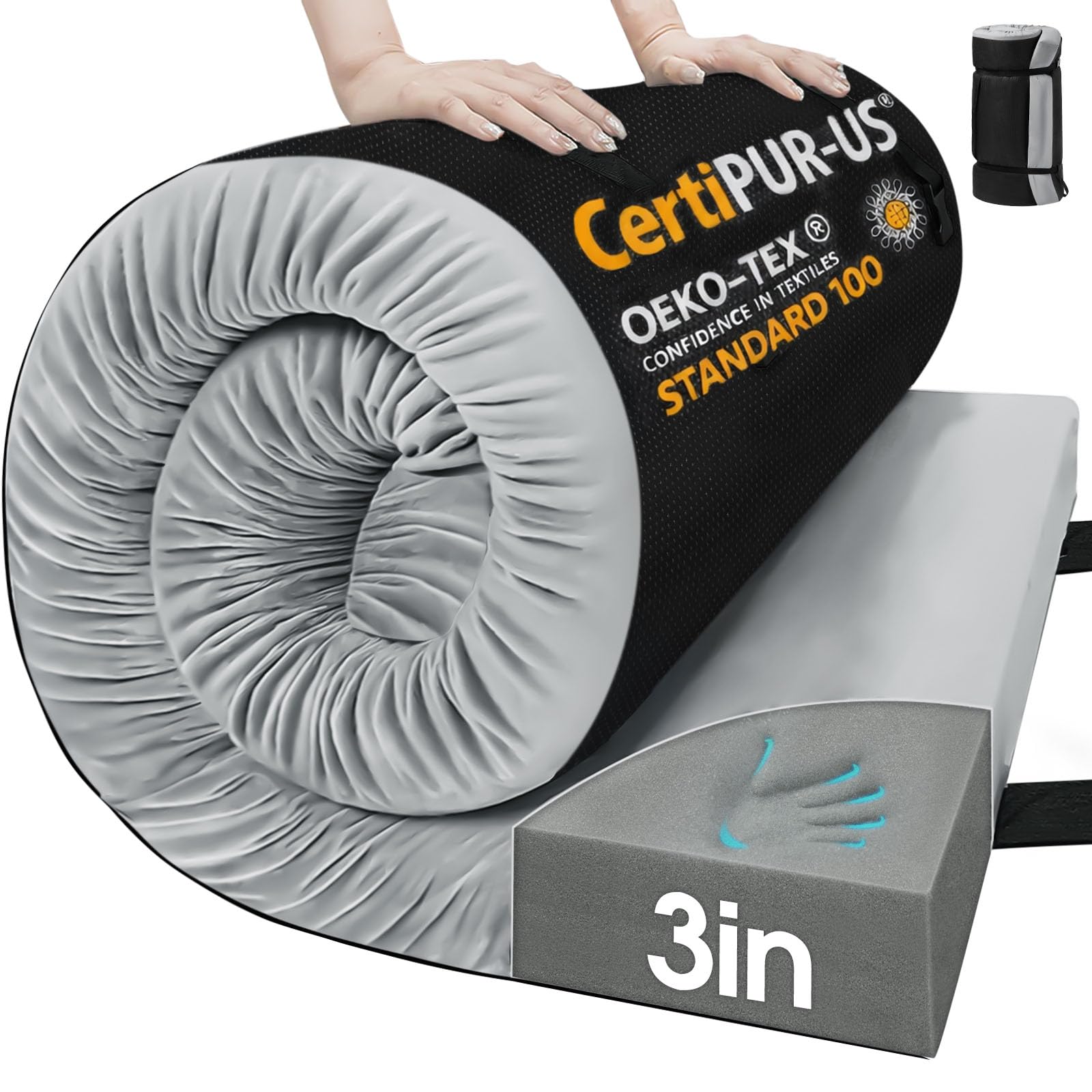
This is the budget-friendly option that delivers home-mattress comfort. The CYMULA uses carbon-fiber high-elasticity memory foam with a high-density base layer to create a 3-inch thick sleeping surface. It is designed for car camping, cots, truck beds, and even guest rooms. The waterproof bottom with rubberized anti-slip dots keeps it from shifting on hard surfaces, and the removable cover zips off for machine washing. One buyer used it on a cot for four days and reported “no back pain,” calling it “like home memory foam.”
At 6.4 pounds, it is the heaviest pad here except for the Hikenture, and it is 3.2 pounds heavier than the Sea to Summit Camp Plus — so this is strictly for car camping or home use. It rolls up with straps, but the roll is bulky and takes up significant trunk space. Some buyers noted a strong chemical smell from the start that needs ventilation to fade and that the included straps can be loose. For the price, though, it is tough to top if you value soft cushion over portability.
What works well
- 3 inches of memory foam feels like a real bed for side sleepers
- Removable, machine-washable cover keeps it fresh
- Waterproof bottom with anti-slip dots stays in place on cots and floors
Shortfalls
- Heavy and bulky — not for backpacking
- Chemical smell from the start; needs airing out
Buy this if: You drive to camp and want thick foam comfort at a budget-friendly cost.
Skip this if: You need to carry your pad any real distance.
Understanding the Specs
R-Value
This is the insulation rating that tells you how well the pad stops heat from escaping into the cold ground. A higher R-value means more warmth: 2.0 is fine for summer, 4.5 covers three-season use, and 7.0 or above handles below-freezing conditions. The NEMO Switchback has a 2.0 R-value suitable for warm weather, while the Hikenture hits 9.5 for serious winter camping.
Thickness and Comfort Layer
Thicker pads cushion your hips and shoulders better, especially if you sleep on your side. Closed-cell foam pads like the Switchback are about 0.9 inches thick and firm. Self-inflating and air pads range from 2.6 to 4.25 inches — the MondoKing and Hikenture lead at 4.25 and 4 inches respectively.
Weight and Pack Size
The ounces you carry matter if you backpack. The NeoAir Xlite NXT at 13 ounces is the lightest here, while the CYMULA memory foam pad at 6.4 pounds is for car camping only. Pack size determines whether a pad fits inside your backpack or straps to the outside.
Construction Type
Closed-cell foam is durable and never leaks but is thin. Self-inflating pads combine foam and air for comfort with automatic inflation. Pure air pads are the lightest and most packable but need manual inflation and can puncture. Memory foam pads offer maximum plushness but are heavy and bulky.
FAQ
What R-value do I need for cold-weather camping?
Can I use a camping sleeping pad on a cot?
How do I fix a leak in a self-inflating or air pad?
Is a closed-cell foam pad better than an inflatable pad?
Why does my new self-inflating pad not fully expand?
How do I clean a camping sleeping pad?
Can I use a camping pad for guests at home?
How long does a camping sleeping pad last?
What size pad should I get for backpacking?
Do I need a pump sack for an air pad?
Final Thoughts: The Verdict
If you want one dependable pick, the camping sleeping pad winner for sheer comfort and versatility is the Therm-a-Rest MondoKing 3D because its 7.0 R-value and 4.25-inch stretch knit surface deliver real-bed warmth and cushion for every car camping trip. If you want the best warmth-to-weight ratio for backpacking, grab the Big Agnes Rapide SL with its 4.8 R-value and compact pump-sack inflation. And for the ultra-minimalist who values durability over decadence, the standout is the NEMO Equipment Switchback for its 14.8-ounce weight and bombproof foam construction.
How We Picked
We do not accept paid placement. Every pick is matched to a real buyer and a real use-case; we do not hands-on test units.
Sources & Methodology
Specifications: manufacturer listings and product documentation. Review insights: verified customer reviews, as of July 2026. Pricing: not shown on this page (it changes often); check the current price via the retailer link.
As an Amazon Associate, Gadgets Feed earns from qualifying purchases. This does not affect which products we feature.
Related Guides
Product prices and availability are accurate as of the date/time indicated and are subject to change. Any price and availability information displayed on Amazon at the time of purchase will apply to the purchase of this product. As an Amazon Associate I earn from qualifying purchases.
CERTAIN CONTENT THAT APPEARS ON THIS SITE COMES FROM AMAZON. THIS CONTENT IS PROVIDED "AS IS" AND IS SUBJECT TO CHANGE OR REMOVAL AT ANY TIME.
Amazon and the Amazon logo are trademarks of Amazon.com, Inc. or its affiliates.