
Camping is about escaping the grid, not the power—modern gear demands a steady charge, and the right panel keeps your lights, fridge, and devices alive without anchoring you to a generator or a noisy campsite neighbor. The challenge is finding a balance between wattage, weight, and real-world output that won’t leave you rationing battery life halfway through your trip.
I’m Rikta — the co-founder and writer behind Gadgets Feed. I’ve spent years analyzing conversion efficiency data, voltage compatibility charts, and real customer output logs across the solar portable panel market to separate marketing specs from field performance. (And Homer 🐱 claimed the storage bag before I could unbox it.)
In this guide, I break down what actually matters: panel efficiency, connector versatility, build durability, and the wattage you can really expect from the best camping solar panels.
How To Choose The Best Camping Solar Panels
Picking a camping solar panel is not just about grabbing the highest wattage number. You need a panel that actually works with your power station, survives the elements, and delivers usable power even when the sun is playing hide-and-seek behind the trees.
Efficiency and Cell Type
Efficiency tells you how much sunlight the panel converts into electricity. Monocrystalline cells are standard, but N-Type cells with a 16-busbar design push efficiency past 24%, meaning more power from the same surface area. When you’re limited to a small folding panel, that extra 2-3% can mean the difference between a full battery and a partial charge by dusk.
Voltage and Connector Compatibility
Your power station likely expects a specific input voltage range — typically 10-30V or 40-60V. Pairing a 40V panel with a station limited to 30V max input is a direct mismatch that won’t work. Also check the connector: XT60 for EcoFlow, Anderson for Jackery, DC7909 for Bluetti. The best panels include a multi-connector cable, saving you the headache of hunting down adapters at the campsite.
Weight and Portability
A solar panel that stays in the car is useless. Look for foldable designs under 10 pounds for a 100W unit and under 15 pounds for a 200W unit. Magnetic closures beat Velcro for long-term durability, and a robust kickstand system lets you angle the panel toward the sun without propping it on your cooler.
Water and Dust Resistance
IP65 handles splashes and light rain. IP67 adds full dust protection and immersion up to 1 meter for 30 minutes. IP68 goes further. The coating also matters: ETFE is more transparent and heat-resistant than PET, so the panel lasts longer in direct summer sun without yellowing or delaminating.
Quick Comparison
On smaller screens, swipe sideways to see the full table.
| Model | Category | Best For | Key Spec | Amazon |
|---|---|---|---|---|
| Renogy E.Flex 200W | Premium 200W | High output, lightweight 200W camping | 25% N-Type efficiency, 13.9 lbs | Amazon |
| ZOUPW 450W N-Type | High Capacity | Massive off-grid RV power | 450W, 45.9V Voc, IP68 | Amazon |
| HQST 200W N-Type | Ultra-Light 200W | Ultralight 200W for backpackers | 25% N-Type, 11 lbs | Amazon |
| MHPOWOS 220W | Mid-Range 220W | Budget 220W with 40V output | 23.5% efficient, 40V | Amazon |
| Renogy E.Flex 100W | Premium 100W | Compact 100W for car camping | 25% N-Type, 7.28 lbs | Amazon |
| ZOUPW 100W | Value 100W | Entry-level 100W with 5-in-1 cable | 23.5% efficiency, IP67 | Amazon |
| EBL Solar Apollo 100W | Budget 100W | Affordable 100W starter panel | 23% efficiency, IP65 | Amazon |
In‑Depth Reviews
1. Renogy 200W Portable Solar Panel (E.Flex)
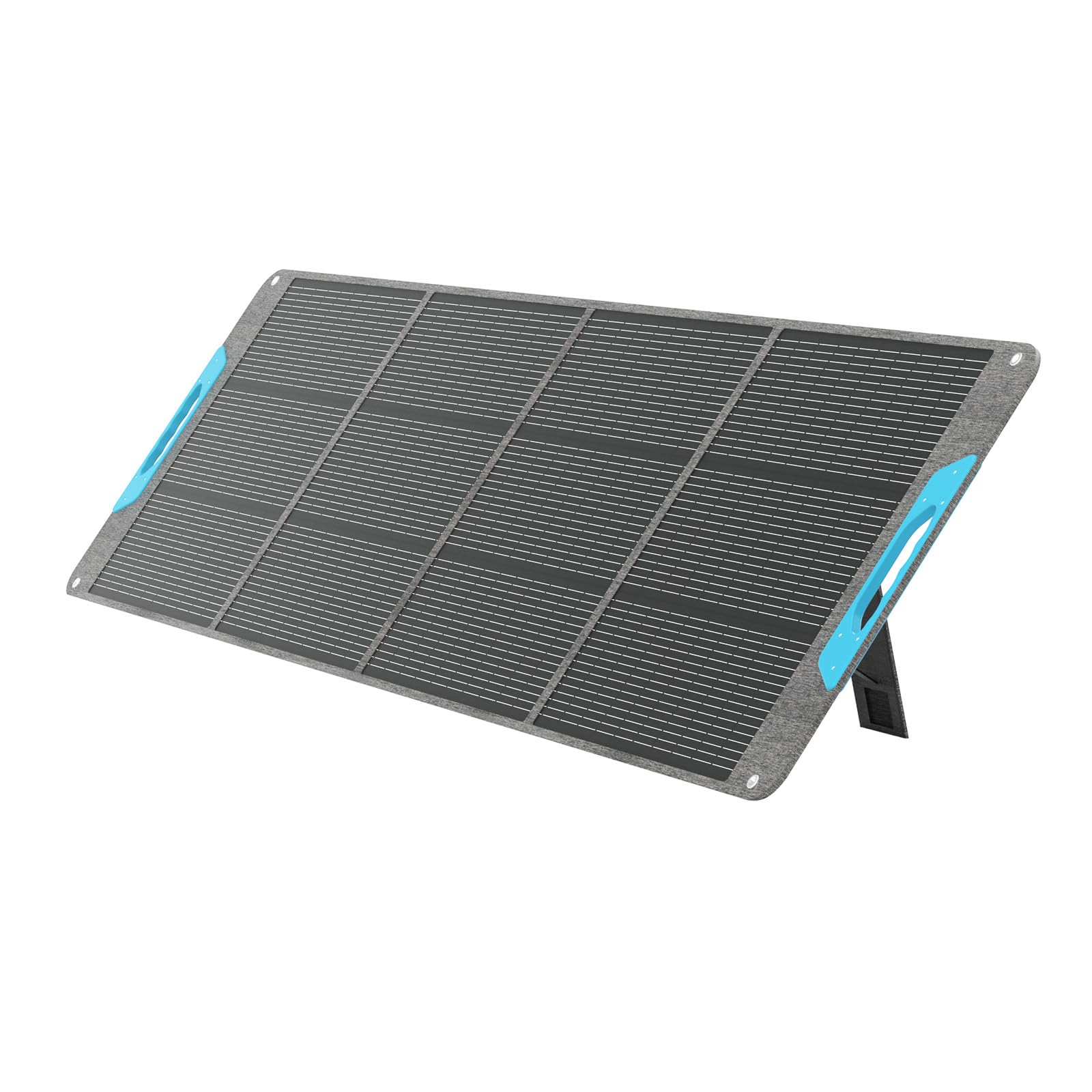
This is the sweet spot for serious campers who need real power without dragging a heavy suitcase. The Renogy E.Flex 200W uses 16BB N-Type cells to hit 25% efficiency, outperforming standard 9BB panels by a noticeable margin. Real-world reports show it consistently delivering between 170W and 200W in peak sun from a compact 13.9-pound foldable design. The magnetic closure system is a practical upgrade over Velcro, which tends to collect debris and lose grip over time.
The connector selection opens up broad compatibility: it includes an MC4 output for direct connection to power stations and also features USB-C PD (45W max) and two USB-A ports for device charging. Users have successfully paired it with both EcoFlow and Anker power stations, with one reviewer noting a recovery of 17% battery drain on a CPAP in under two hours of midday sun.
The three-angle kickstands (40°/50°/60°) help maintain ideal sun orientation, though the included nylon travel bag is basic and the pad material on the legs can be fussy when unfolding. For the combination of efficiency, weight, and UL 61730 certification, this is the panel to beat if you want 200W of reliable off-grid power.
Why it’s great
- 25% N-Type efficiency with 16BB cells
- Lightest 200W in its class at just 13.9 lbs
- Magnetic snap closure is more durable than Velcro
Good to know
- Only IP65 rated—not for heavy downpours
- Travel bag is basic and could be sturdier
- Leg pad material can be frustrating during setup
2. ZOUPW 450W Portable Solar Panel
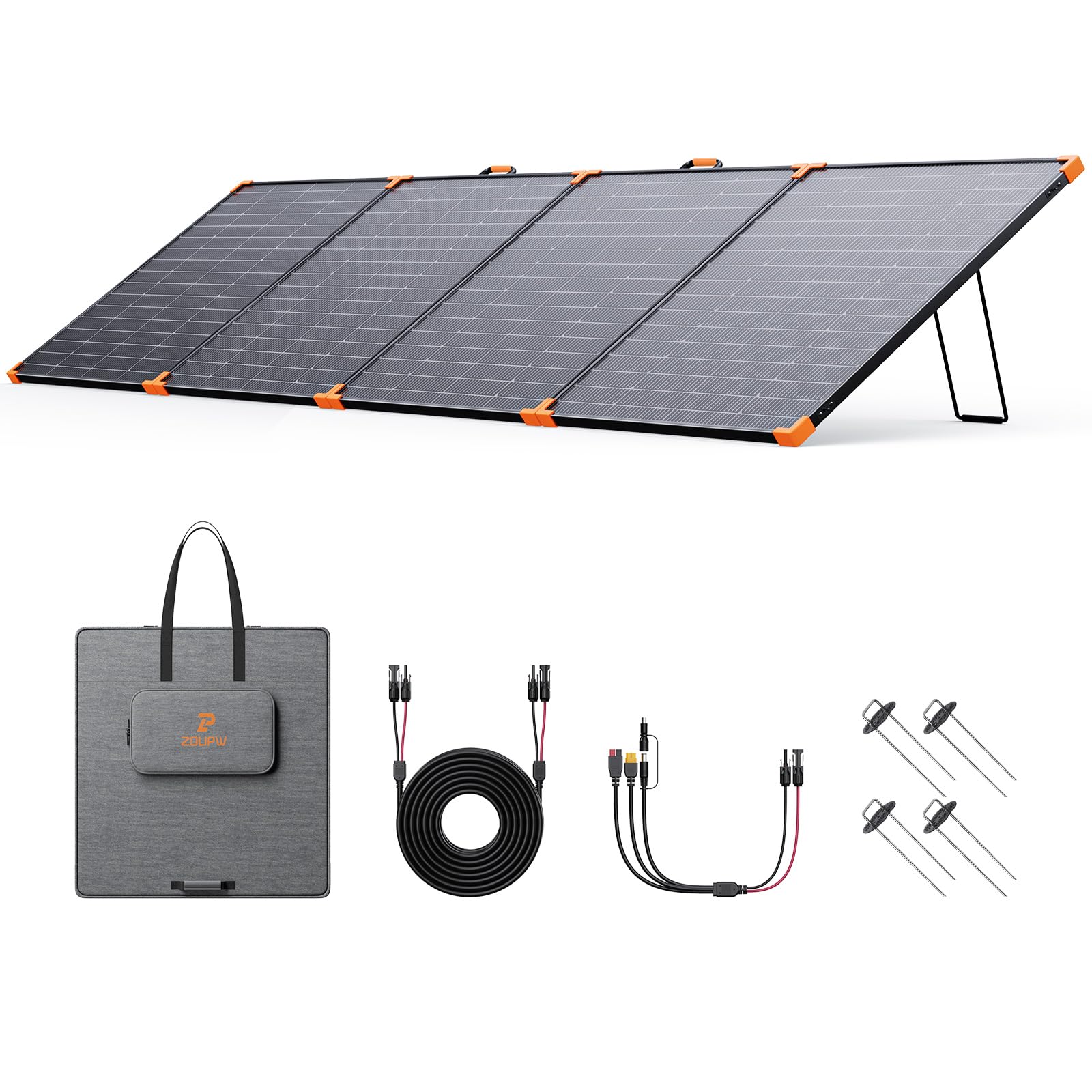
For RV boondocking or extended off-grid camps where you need to run a full-size fridge, lights, and devices, this panel is the heavy lifter. The ZOUPW 450W uses N-Type 16BB cells with 25% efficiency and a 45.9V open-circuit voltage, designed exclusively for high-capacity power stations with a 40-60V input range. Customers consistently report exceeding the rated 450W in good sun, with one reviewer measuring 500W-plus in tropical conditions.
The fiberglass-reinforced structure keeps the weight at 29.5 pounds—about 30% lighter than a comparably rated rigid panel—which makes a solo setup feasible. The 4-in-1 adapter cable (XT60, Anderson, DC7909, DC8020) covers virtually every major power station connector, so you don’t need to carry a bag of adapters. However, the 45.9V Voc means this panel is incompatible with low-voltage stations like the Jackery 500 or Bluetti EB70S.
Built-in smart bypass diodes ensure the panel continues producing power even when partially shaded, a common issue at heavily wooded campsites. The 36-month warranty provides extra confidence for the investment. If you need massive portable power and your station can handle the voltage, this is hard to beat.
Why it’s great
- Real-world output routinely exceeds 450W rated spec
- Fiberglass structure is lightweight for its power class
- 36-month warranty shows long-term confidence
Good to know
- Not compatible with low-voltage power stations under 30V input
- Legs are short and may need shimming for ideal angle
- Price is a significant investment for casual campers
3. HQST 200W Ultra-Light Portable Solar Panel
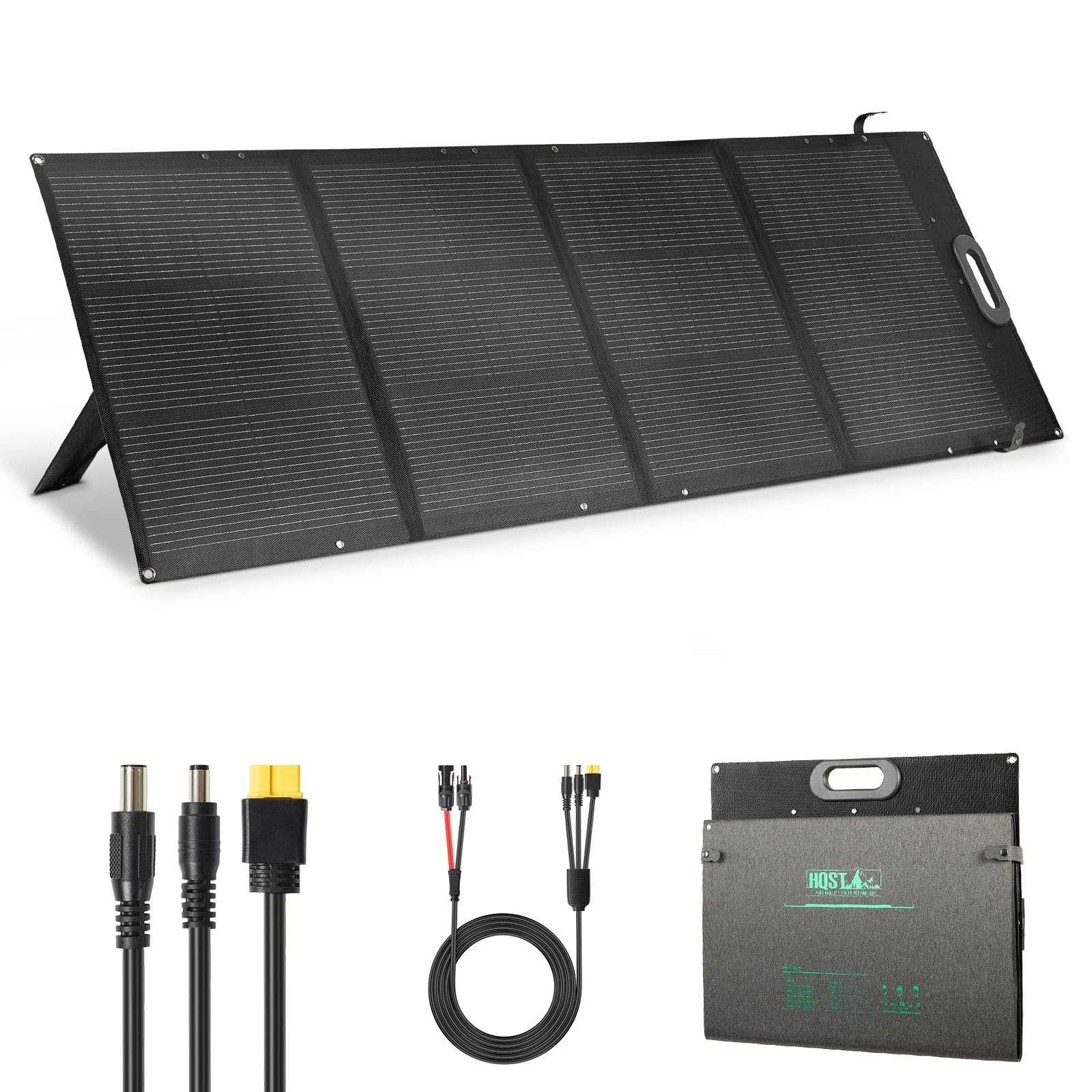
At just 11 pounds, the HQST 200W is a strong contender for campers who prioritize weight savings without sacrificing total wattage. It also uses 16BB N-Type cells for a claimed 25% efficiency, and the 3-in-1 adapter cable (XT60, DC7909, DC5521) covers Jackery, EcoFlow, Bluetti, and Anker power stations out of the box. The 2-inch folded thickness means it slides easily into tight trunk spaces.
The IP67 rating is a meaningful upgrade over the more common IP65, providing full dust protection and the ability to withstand rain or accidental submersion up to 1 meter. The PVDF-coated outer layer adds scratch resistance compared to standard PET laminates. The adjustable kickstands offer a 40-60 degree range, and users report that the rigid frame design stays stable on uneven ground without collapsing.
The main trade-off is that the adapter cable is only 4.9 feet, which may limit placement flexibility if your power station sits far from the panel. Also, some customers noted shipping damage to the panel frame due to inadequate packaging. For the weight-conscious camper, however, this is the lightest 200W folding panel on the market with a verified reputable build.
Why it’s great
- Only 11 pounds—up to 37% lighter than typical 200W panels
- IP67 rating handles rain, dust, and submersion
- Rigid frame with kickstands stays stable in wind
Good to know
- Short 4.9 ft adapter cable limits placement options
- Some reports of shipping damage to the frame
- Lacks USB ports for direct device charging
4. MHPOWOS 220W Portable Solar Panel

If your power station accepts a 40V input, this is one of the better mid-range options for squeezing more wattage without the premium upcharge. The MHPOWOS 220W uses monocrystalline cells at 23.5% efficiency and delivers a 40V output voltage that works well with EcoFlow Delta series and similar high-voltage stations. Real-world tests show 170-205W typical, with a peak of 207W at solar noon reported by one reviewer.
The quad-fold design with four kickstands gives stable positioning on flat surfaces, and the 7-in-1 adapter cable covers XT60, Anderson, DC7909, and other common connectors. The IP67 rating means rain and dust won’t shut you down. Users particularly appreciated the compact folded size of 23.5 x 21.25 x 2.3 inches.
The main caution is the 40V output voltage: a 40V panel is not compatible with power stations that have a maximum input under 30V. Customers also noted that the kickstand Velcro can be finicky and the included cables are somewhat short. For campers with compatible stations, however, this offers strong real-world performance per dollar.
Why it’s great
- Real-world output often hits 190-210W in peak sun
- IP67 waterproof and dustproof rating
- Quad-fold design with four stable kickstands
Good to know
- 40V output is incompatible with low-voltage power stations
- Kickstand Velcro can be annoying to manage
- Weight is heavier than premium N-Type competitors
5. Renogy 100W Portable Solar Panel (E.Flex)

The Renogy 100W E.Flex is the go-to for campers who need a reliable 100W panel that packs down small without skimping on efficiency. Using 16BB N-Type cells at 25% efficiency, it outperforms the typical 22.5% panels found in this class. The unit weighs only 7.28 pounds and folds to 22.99 x 22.54 x 1.57 inches, making it easy to strap onto a backpack or slide into a duffel.
The magnetic snap closure is a thoughtful touch—it avoids the lint-grabbing problem of Velcro and snaps shut clean every time. The built-in USB-C PD port (45W max) and two USB-A ports let you charge phones, tablets, and cameras directly. The MC4 output connects to most power stations, though users noted the MC4 cable is only 3 feet long, which may require an extension for flexible placement.
Real-world output peaks around 87W to 100W in full sun according to customer logs, which is in line with expectations for a portable panel. The three-angle kickstand system helps chase the sun, but users recommend adding ground stakes in windy conditions. For car campers or hikers who want a premium, compact 100W solution, this is the current standout.
Why it’s great
- 25% N-Type efficiency in a compact package
- Magnetic closure is more durable than Velcro
- USB-C PD 45W for direct device fast charging
Good to know
- Only IP65 rated, not for heavy rain exposure
- MC4 cable is short at just 3 feet
- May need stakes for stability in gusty conditions
6. ZOUPW 100W Portable Solar Panel

The ZOUPW 100W is a strong budget-friendly contender that punches above its price point, especially with its 5-in-1 connector cable that covers Jackery, EcoFlow, Anker, Bluetti, and generic batteries without needing extra adapters. Its 23.5% efficiency with A+ grade monocrystalline cells is solid for the class, and the IP67 rating means you can leave it out in a drizzle without worry.
The panel includes a USB-C PD port (15V/3A) and two USB-A ports (one QC3.0) for direct device charging—a feature often missing from cheaper panels. The 10-foot MC4 cable gives you flexibility to position the panel in sun while keeping your power station in the shade. Users successfully charged a Jackery Explorer 300 from 84% to 100% in about 20 minutes on a cloudy day.
At 9.48 pounds, it’s a bit heavier than the Renogy 100W, but the inclusion of a magnetic handle, adjustable kickstands, and a zippered pocket protecting the built-in controller add real utility. Some users noted it’s a bit awkward for long-distance hiking, but for car camping or base camp setups, it’s a top value pick.
Why it’s great
- 5-in-1 cable works with almost every power station
- IP67 waterproof with ETFE coating
- Includes USB-C and QC3.0 direct charging
Good to know
- Heavier than some 100W competitors at 9.48 lbs
- USB-C PD is limited to 45W, not 60W as expected
- Kickstands lack fine adjustment
7. EBL Solar Apollo 100W Portable Solar Panel
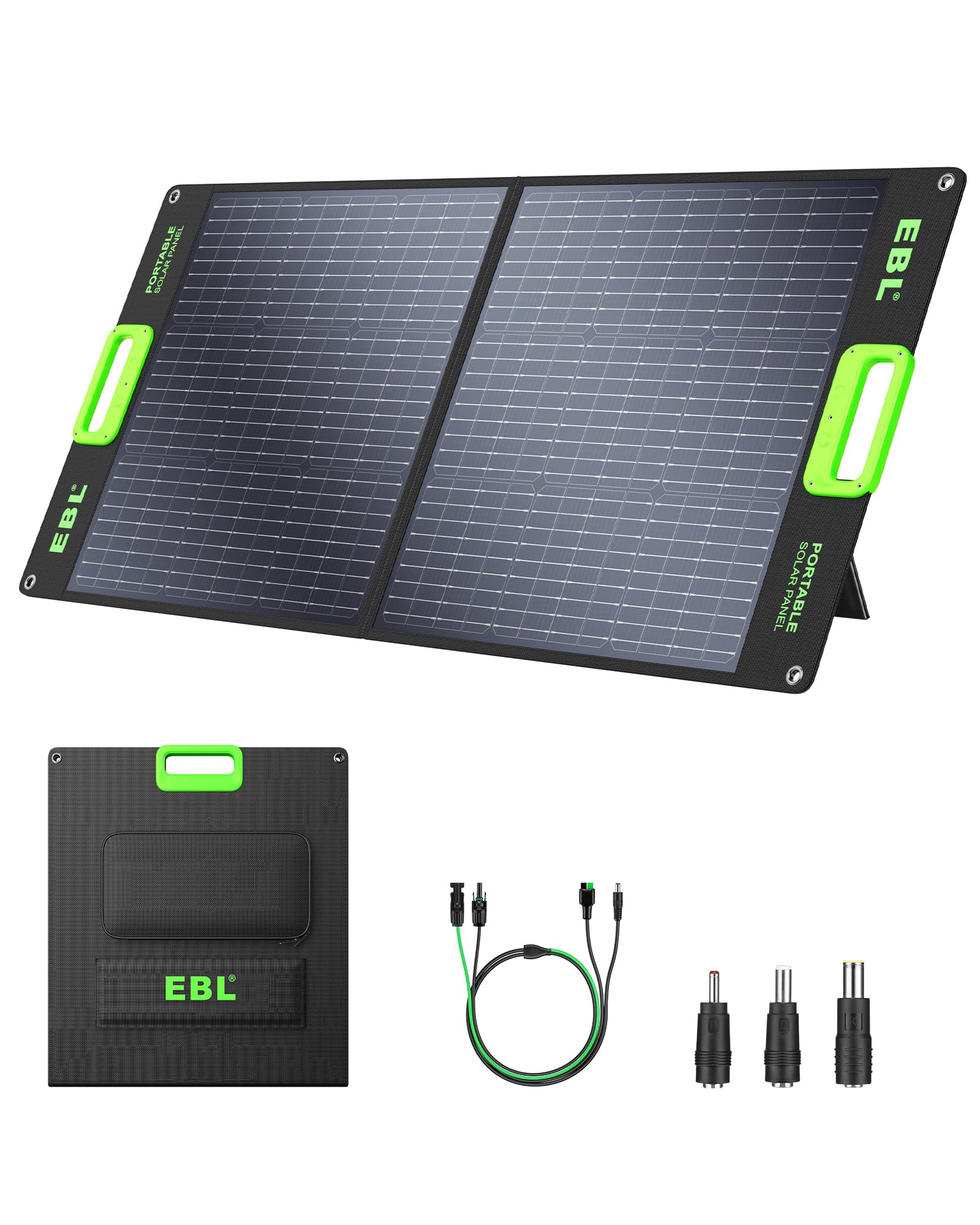
The EBL Solar Apollo 100W is a budget-friendly entry point for campers who want to dip into solar without a big investment. It uses monocrystalline cells at 23% efficiency—good for the price tier—and features a foldable design with two kickstands adjustable to 45 degrees for improved sunlight capture. The magnetic handle simplifies carrying and storage.
It comes with a selection of adapters (MC4 to Anderson, DC5521, and three barrel tip adapters) to cover most power stations, though you’ll want to double-check compatibility before relying on it as your primary charge source. User reports show real-world output around 65W to 85W in decent sun, which is on par with or slightly below more expensive 100W panels. The IP65 rating offers basic splash protection, but the panel is not waterproof—don’t leave it out in a heavy rain.
The 6-foot cable is relatively short, and some users noted the panel struggled to reach its full advertised wattage even in direct sun. Customer service from EBL received praise for handling a compatibility issue, which is a plus if something goes wrong. For a weekend camper with minimal power needs, this is a functional, low-risk start.
Why it’s great
- Low barrier to entry for solar beginners
- Included multi-adapter kit for broad compatibility
- Magnetic handle and foldable design for easy transport
Good to know
- Real-world output often below the advertised 100W
- Only IP65 rated—not suitable for heavy rain
- Short 6-foot cable limits placement options
FAQ
Can I connect two camping solar panels in series or parallel?
How much real power should I expect from a 100W camping solar panel?
Final Thoughts: The Verdict
For most users, the best camping solar panels winner is the Renogy 200W E.Flex because it offers the best balance of high N-Type efficiency, low weight, and reliable build quality for moderate to heavy off-grid use. If you want massive capacity for an RV setup, grab the ZOUPW 450W N-Type. And for ultralight backpacking, nothing beats the HQST 200W Ultra-Light.