
Our readers keep the lights on and my morning glass full of iced black tea. As an Amazon Associate, I earn from qualifying purchases.
Specs are compiled from manufacturer listings and verified buyer reviews and can change over time — please confirm the key details on the product page before buying.
Out on the trail, a dead zone on your phone means you’re flying blind. A good walkie talkie is the difference between a smooth trip and a stressful one, keeping your group linked when you’re spread out across a ridge or separated by the river. The key is knowing which specs actually matter for the backcountry, and which ones are just noise.
I’m Min — the founder and writer behind Gadgets Feed. This guide is built by comparing the manufacturers’ published specifications and the patterns across verified customer reviews, so you get each pick’s real strengths and trade-offs instead of marketing spin.
You will find the most reliable camping walkie talkie for your next trip, based on real-world battery life, range, ruggedness, and ease of use.
Quick Picks
- Rocky Talkie Mountain Radio — Top Performer
- Retevis RB48 FRS Walkie Talkies — Rugged Ready
- Motorola Solutions Talkabout T475 Extreme — Trusted Brand
- NXGKET Walkie Talkies for Adults — Great Value
- BAOFENG GMRS Radio GM-15 Pro — Licensed Power
- Retevis RT68 Walkie Talkies — Simple & Tough
- BAOFENG GT-18 Walkie Talkies — Budget Champion
How To Choose The Best Camping Walkie Talkie
Picking the right two-way radio for camping is about matching the tool to the terrain and your group’s needs. A simple family hike in a state park has different demands than a multi-day backcountry trek. Here is what cuts through the marketing and gets you the right radio.
Battery Life: The Real World Number
A radio with a bigger battery simply lasts longer on the trail. The battery capacity, measured in milliampere-hours (mAh, a unit of electrical charge), is the most honest indicator of how long a radio will last. A unit with a 1800mAh battery will generally outlast a 1200mAh unit by a noticeable margin. Ignore “hours of talk time” claims; look at the mAh and the battery life in days, remembering that constant transmitting drains the battery far faster than just listening or being on standby.
Range: A Mile in the Forest Is Not a Mile in the City
Manufacturers often advertise “35-mile range” under perfect, unobstructed line-of-sight conditions. In the real world, with trees, hills, and valleys, you should expect a range of 1 to 5 miles, so you can keep in touch across a valley or along a ridge. For camping, look for a radio that performs well in wooded terrain, and understand that higher wattage (the power of the transmitter) generally provides better penetration through obstacles, though it may require a license (as with GMRS radios).
Durability and Weather Resistance
Camping radios get dropped, splashed, and covered in dust. The IP (Ingress Protection) rating tells you how well a radio resists these elements, so it survives a drop into a puddle. An IP56 rating, for example, means it is protected against dust and powerful water jets. A rugged design, often tested to military standards like MIL-STD-810H (a set of U.S. military durability tests for drops, temperature, and vibration), is a good sign that the radio can handle a fall or a rainstorm.
Quick Comparison
On smaller screens, swipe sideways to see the full table.
| Model | Best For | Battery (mAh) | Max Range | Channels | Amazon |
|---|---|---|---|---|---|
| Rocky Talkie Mountain Radio | Serious Backcountry Adventurers | 1550 mAh | 35 Miles | FRS | $220.00Amazon |
| Retevis RB48 | Wet / Rough Conditions | 2000 mAh | — | FRS | $79.99Amazon |
| Motorola Solutions T475 Extreme | Reliable Brand / Family Use | 800 mAh | 35 Miles | 22 | $94.99$109.99Amazon |
| BAOFENG GM-15 Pro | Licensed (GMRS) Power | 1500 mAh | 5 Miles | 250 | $46.98Amazon |
| NXGKET Walkie Talkies | Large Groups / Long Battery | 1800 mAh | 5 Miles | 22 | $49.99Amazon |
| Retevis RT68 | Durable & Simple | 1200 mAh | — | FRS | $29.99$39.99PrimeAmazon |
| BAOFENG GT-18 | Budget / Kids & Beginners | 1500 mAh | 3 Miles | 22 | $28.99$35.99Amazon |
In‑Depth Reviews
1. Rocky Talkie Mountain Radio
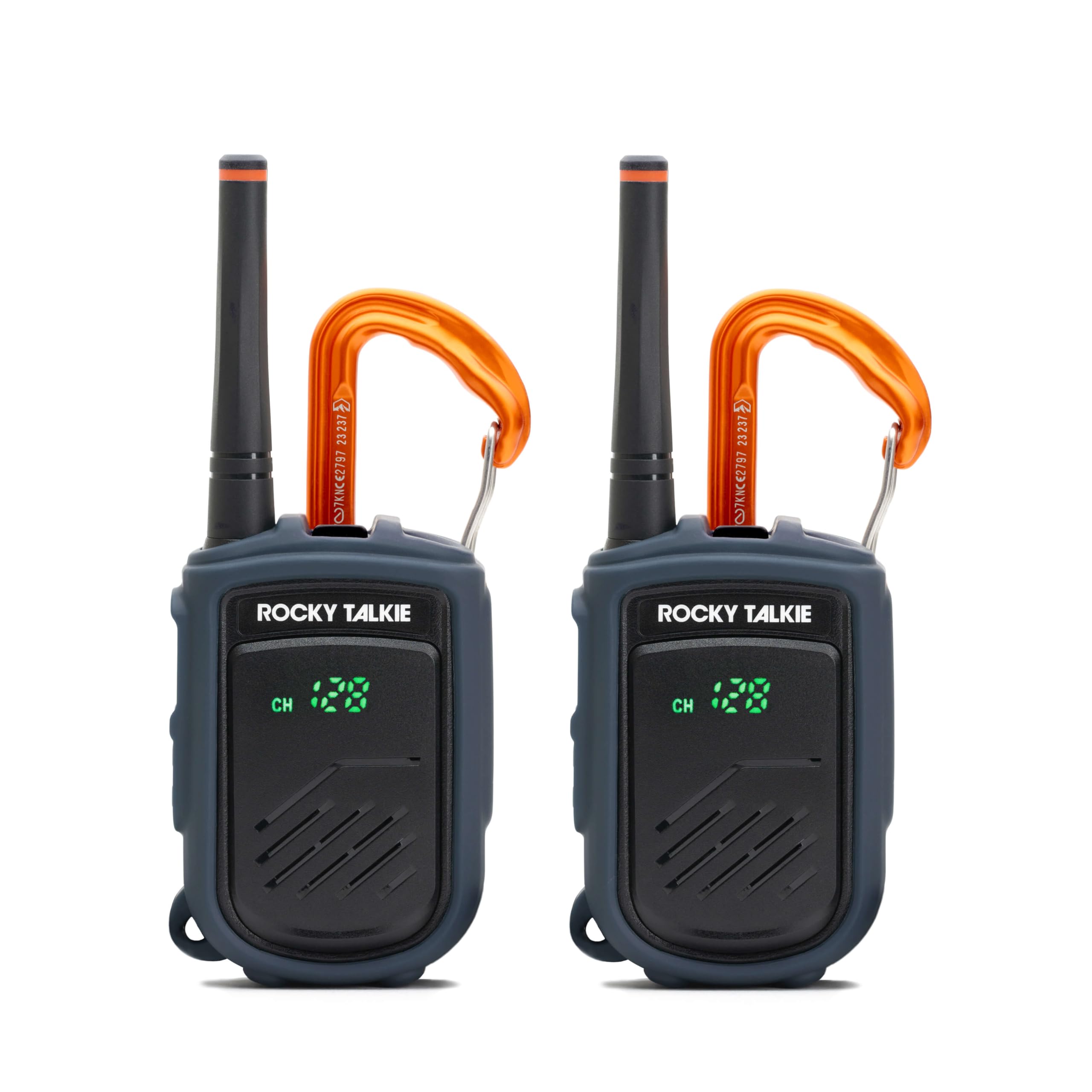
Built for the backcountry, not the backyard — ready for multi-day trips right from the start.
The Rocky Talkie Mountain Radio earns its top spot by being ready to use with zero setup, which beats the BAOFENG GM-15 Pro’s need for license programming for anyone who just wants to hit the trail. It transmits at the maximum legal power for a license-free FRS radio (2-watts) and boasts a claimed range of over 35 miles in perfect conditions, though you should expect 1 to 5 miles in typical mountain terrain, so you can reach across a ravine. One reviewer noted its “excellent range” even through a metal container, highlighting its real-world capability.
what separates it is its thoughtful design for outdoor use. The radio comes with an ultra-light climbing-rated carabiner and a metal-reinforced back-up leash, so you don’t have to worry about a brittle plastic clip breaking. The specialized rechargeable lithium-ion battery (the data specifies over 4 days of life in cold conditions) and its IP56 waterproof rating mean it can handle a rainstorm and a long weekend without dying. Unlike many budget picks, it is ready to use with zero configuration required.
The trade-off is the price, which is significantly higher than the BAOFENG options, making it a serious investment for dedicated hikers and climbers. It is also less useful for city or suburban use, as some buyers report poor performance in dense urban areas on low power.
What Makes It Great
- Exceptional build with shatterproof LED screen and rubberized armor
- 4-day battery life, even in very cold conditions
- Max-power 2-watt FRS transmitter with over 35 mile claimed line-of-sight range
Heads Up
- Premium price point compared to other FRS options
- City performance can be limited (~0.5 mile on low power)
Reach for this if: your camping involves multi-day backcountry trips and you need a bombproof radio with a climbing carabiner.
Look elsewhere if: you only need a basic radio for a family bike ride or a short hike in a local park.
2. Retevis RB48 FRS Walkie Talkies
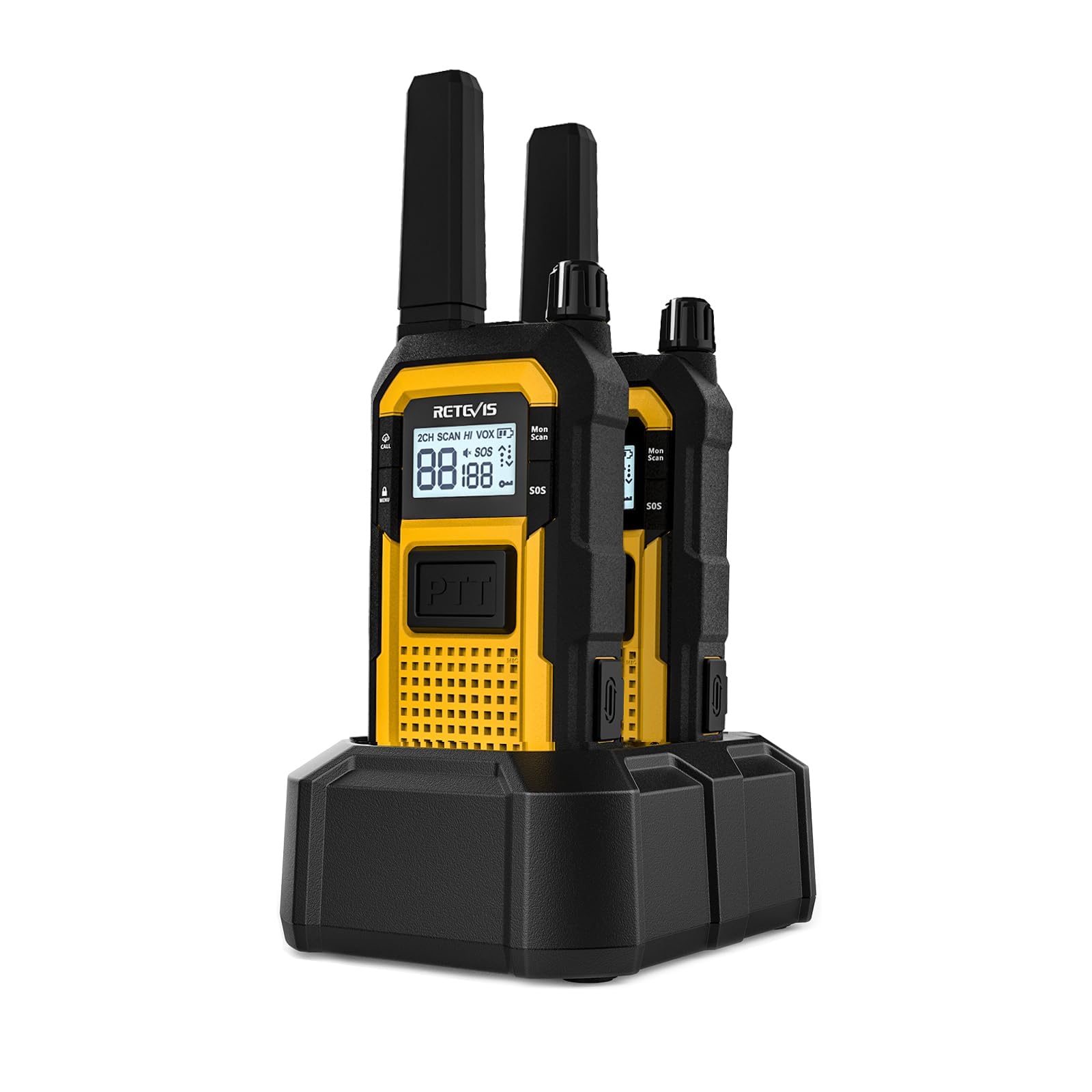
A rugged yellow machine that floats and survives the harshest weather without a license.
If you expect your gear to get wet, dropped, or covered in mud, the RB48 is a strong choice. It has an IP67 waterproof rating (meaning it can be submerged in up to 1 meter of water for 30 minutes) and is tested to the MIL-STD-810H military standard for drops and temperature extremes. It also floats, so you will not lose it if it goes overboard on a river trip — a unique feature among these picks. That makes it far more waterproof than the Motorola T475’s IPx4 splash rating.
Inside its tough yellow shell is a 2000mAh battery that provides up to 18-20 hours of life, making it competitive with the NXGKET on battery stamina. The dual PTT (Push-to-Talk) buttons and silicone-covered controls make it easy to use with gloves. A buyer who used the RB48 for months in all weather reported it had “no problems,” confirming its heavy-duty promise. It covers up to 300,000 sq.ft. or 25 floors of signal range, which is more about building penetration than open-air miles.
Who It’s For: This is the ideal companion for kayaking, fishing, or any job site where the radio will take a beating. It is a heavier unit (730 grams in the data) than something like the simple Retevis RT68, but the trade-off is class-leading protection.
Best for: wet, rugged conditions where durability is the top priority.
Warning: its bulk and weight make it less suited for ultralight backpacking trips.
3. Motorola Solutions Talkabout T475 Extreme
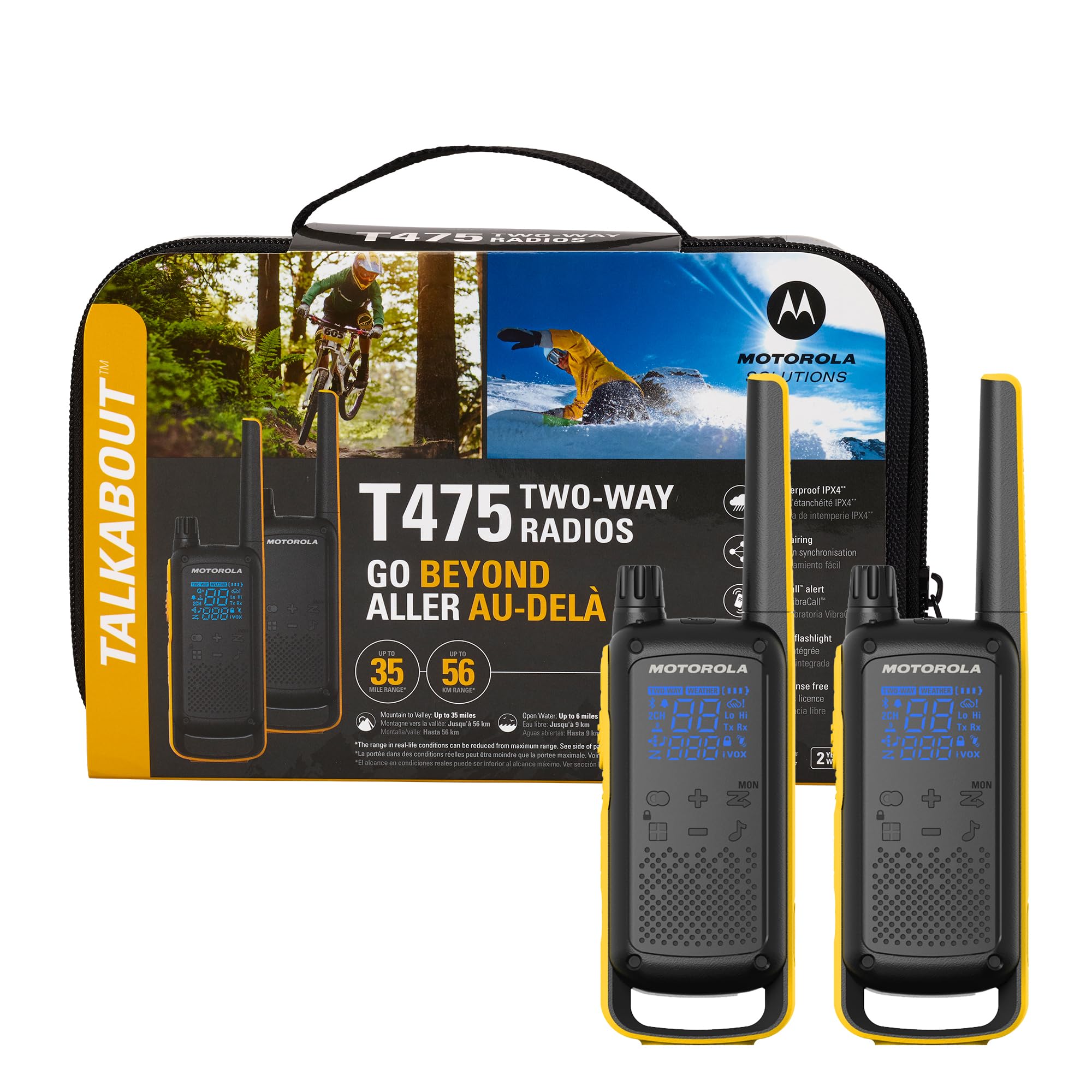
A name you know, with features that actually work for family trips and busy campsites.
The Motorola T475 is a dependable workhorse for families who want a simple, well-known radio. Its stand-out feature is the VibraCall alert (a vibration mode for incoming calls), which is incredibly useful if you are wearing the radio on a belt or have it in a pack and do not want to miss a call over the noise of a river. It uses an NiMH (Nickel-Metal Hydride) rechargeable battery that provides up to 12 hours of life, though the data specifies a typical battery life of 8 hours.
One reviewer in Kentucky with “lots of hills and trees” reported getting about 5 miles of range, which is solid for a mid-range FRS radio. It also features wind cancellation technology, which one user confirmed “works well at 20+ mph” winds, keeping your voice clear. The 22 channels and 121 privacy codes (totaling 2,662 combinations) help you find a clear channel even in a busy area. It has an IPx4 weatherproof rating, meaning it can handle splashes but not full submersion like the IP67-rated Retevis RB48.
A Common Compliment: Buyers frequently mention it works great from the start with excellent battery life for a full work day, with one noting it was so good “employer bought 12 units.”
Go for it if: you want a reliable brand with great wind cancellation and a vibration alert for noisy environments.
Consider another if: you need all-day continuous battery life for multi-day excursions without charging, as its 800 mAh battery is smaller than many competitors.
4. NXGKET Walkie Talkies for Adults
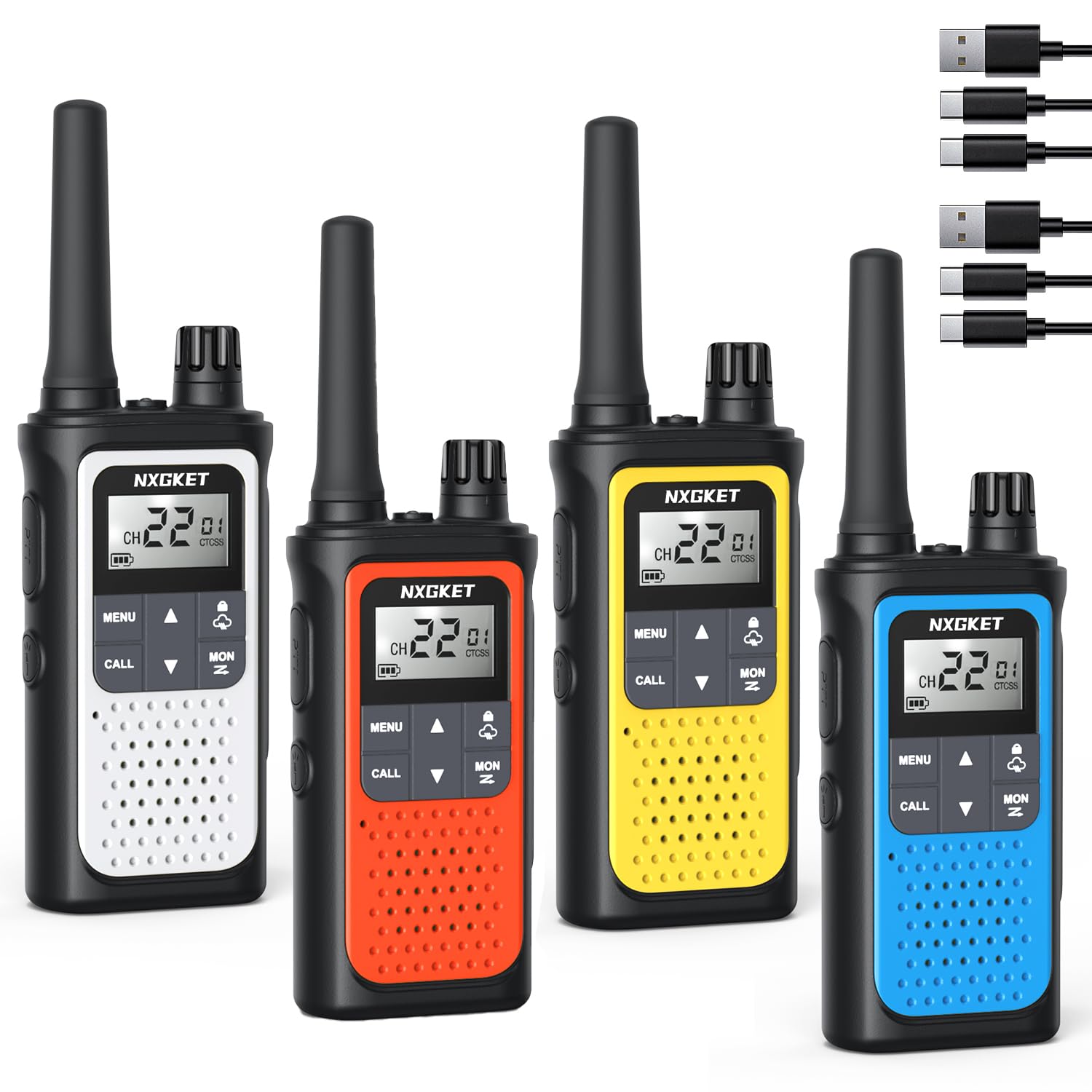
A four-pack with a massive battery that keeps a large group talking for days on end.
The 1800mAh battery in the NXGKET is the largest of any pick here, giving you up to 96 hours of standby, versus the BAOFENG GT-18’s 24-hour battery life, so you can leave the charger at home on a long weekend. One reviewer confirmed the battery lasted “over 4 days without charging.” It also supports NOAA weather alerts — a life-saving feature that scans 10 channels for emergency warnings.
It has a claimed 5-mile range and comes in a 4-pack with bright, visibility-enhancing colors. A buyer who covers an “accurate range <2 acres" mentioned it is "lightweight, durable, easy to hold" and works well with a solar charger. The upgraded speaker is 15 decibels of audible noise and the maximum volume is increased by 150%, making it easy to hear over campfire chatter. The USB-C charging cable can charge two radios at once, cutting down on clutter.
Why It Stands Out
- Class-leading 1800mAh battery for extended trips
- Supports NOAA weather scan and alert for safety
- 4-pack at a very accessible price point
The Details
- Not as rugged as the heavy-duty Retevis RB48
- Range is dependent on terrain as with all FRS radios
Perfect for: large families or groups on a budget who prioritize battery life and weather alerts.
Not for: those who need a waterproof radio for extreme weather or heavy-duty job site use.
5. BAOFENG GMRS Radio GM-15 Pro

Packs the punch of a GMRS license with 250 memory channels for serious radio enthusiasts.
The BAOFENG GM-15 Pro is the only pick that reaches 8 watts of transmit power, versus 2 watts for an FRS radio, so you can hit a repeater miles away for extended range. One reviewer confirmed a “4-mile urban range on high power” and communication with repeaters miles away. The numbers back this up: it has 250 memory channels versus the BAOFENG GT-18’s 22 channels, giving you massive flexibility for finding clear frequencies.
It also has 154 privacy codes (50 CTCSS and 104 DCS codes) to reduce interference from other groups. It receives NOAA alerts and has a repeater-capable function to extend your range. The 1500mAh battery provides up to 24 hours of battery life, and it features dual charging methods including USB-C. However, at 1.4″D x 2.2″W x 10.6″H, it is larger than the compact NXGKET, so it is not the most pocket-friendly design.
Power User Benefits
- 8W transmit power for extended range over FRS-only radios
- 250 memory channels for extensive scanning and storage
- GMRS repeater capable to boost signal over obstacles
The Catch
- Requires a GMRS license (fee, no test) which adds a step
- Speaker audio quality is described as “OK but not great” by one reviewer
Best for: radio hobbyists or groups who want the most power and channel options in the woods, and are happy to get a license.
skip it if: you want a simple, license-free radio for casual family use that works right out of the package.
6. Retevis RT68 Walkie Talkies
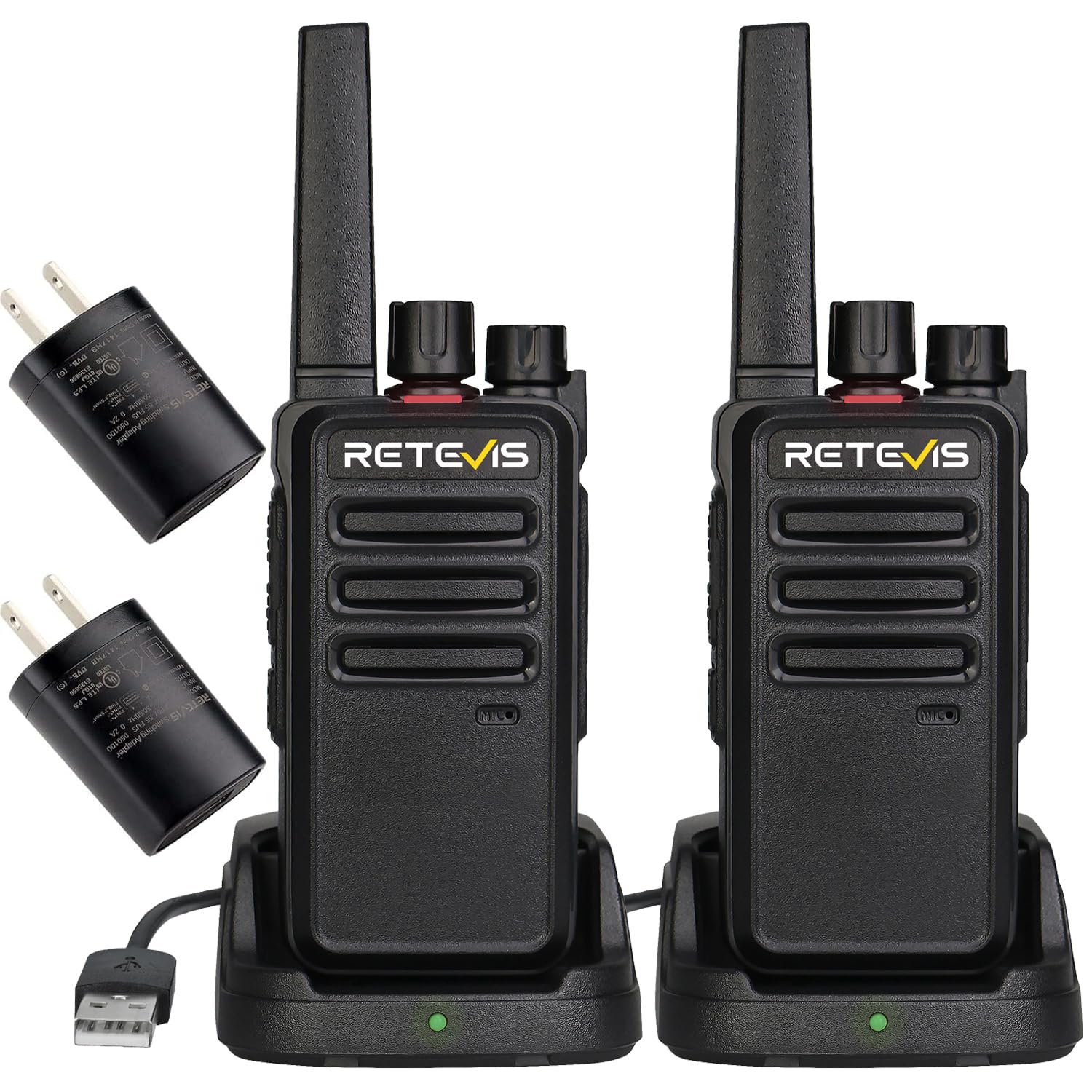
No-nonsense license-free radios built to take a drop and keep on talking all day.
The Retevis RT68 is a no-frills, license-free FRS radio that prioritizes durability. Its rugged enclosure is rated for a one-meter free fall, meaning you can drop it on the trail without expecting damage. It is a compact size at 1.37″D x 1.96″W x 4.56″H, making it among the most pocketable options here — much easier to stash than the bulky Retevis RB48. It has a 1200 mAh battery, versus the NXGKET’s 1800mAh, but it still provides up to 24 hours of battery life, and one buyer mentioned the charge is “excellent” and “keeps the charge all 8 hours day.”
It comes with a USB charging base, which is a neat feature for a desk or car, though it lacks a direct USB-C port like the NXGKET. It works from the start and is compatible with other FRS radios on basic channels. A buyer noted it is “clear and has a long range” for the price. However, compatibility with other radio brands can be limited; only channels 1-5 work with non-Retevis models, while higher channels have issues.
In short: A solid, straightforward choice for work or a day hike where you need something that will survive a tumble but not break the bank.
Choose this for: its tough build and simple operation, perfect for younger campers or as a backup radio.
Consider an upgrade if: you need a longer battery life (like the NXGKET’s 96 hours) or universal compatibility across all channels.
7. BAOFENG GT-18 Walkie Talkies

The most affordable route to a multi-pack of radios with USB-C modern convenience.
The BAOFENG GT-18 is the budget-friendly entry point for license-free FRS communication. It comes as a 3-pack in fun yellow, green, and blue colors, making it a great choice for kids and family outings. The 1500mAh battery and USB-C charging are impressive specs for the price, providing up to 3 days of battery life and the ability to charge from a power bank, computer, or car — a huge convenience older radios lack. Its 22 channels are standard for an FRS radio.
One owner reported it is perfect for “close-range communication” on the trail or bike ride, with a typical range of about 1 mile. The lightweight design and included lanyards make it comfortable for kids to wear. It includes NOAA weather alerts, a useful safety feature at this price. However, a buyer noted the audio can be “low” and that the low wattage means it is not a long-range powerhouse compared to the GM-15 Pro. It is ideal for close-proximity group use, not for backcountry spanning a ridge.
Final Word: An excellent, modern-feeling starter set. It is tough to top the value of a 3-pack with USB-C charging and NOAA alerts at this level.
Perfect for: a first-time buyer on a budget, or for giving to kids so they can stay in touch on a short hike or at a large campsite.
Skip if your use case requires: a powerful, long-range unit for a multi-day, backcountry expedition with significant distance between group members.
Understanding the Specs
Battery Capacity (mAh)
The battery life, measured in milliampere-hours (mAh, a unit of electrical charge), is the single most important spec for a camping trip. A higher mAh rating (like 1800mAh) will power the radio for days, so you don’t need to charge it mid-trip, while a lower one (like 800mAh) might need a nightly charge. Look for a number that matches your trip duration.
FRS vs. GMRS (Which License?)
FRS (Family Radio Service) radios are license-free and fine for basic, short-range use. GMRS (General Mobile Radio Service) radios require a paid FCC license but offer higher power (8 watts vs ~2 watts) and often better range. For most casual campers, FRS is the simpler, low-maintenance choice.
Weather Alerts (NOAA)
A radio that receives NOAA (National Oceanic and Atmospheric Administration) broadcasts can automatically warn you of approaching severe weather. This is a crucial safety net for any outdoor activity and is a feature worth paying extra for.
Durability (IP & MIL-STD)
The IP (Ingress Protection) rating tells you how resistant a radio is to dust and water. IP56 means it can handle powerful water jets; IP67 means it can be submerged. MIL-STD-810H is a military standard for surviving drops, vibration, and extreme temperatures. For camping, a radio with at least an IP56 rating is a good sign.
FAQ
How is the range of a camping walkie talkie measured and what should I expect?
Can I use any walkie talkie without a license for camping?
What does the NOAA weather alert feature do for camping safety?
How long should a walkie talkie battery last on a camping trip?
What is the difference between FRS and GMRS radios for camping?
Can I charge a camping walkie talkie with a solar charger or power bank?
Are more channels on a walkie talkie always better?
How important is the IP waterproof rating for a camping walkie talkie?
Final Thoughts: The Verdict
For most campers, the best camping walkie talkie is the NXGKET Walkie Talkies because of its winning combination of a massive 1800mAh battery, useful NOAA weather alerts, and a 4-pack at a mid-range price. If you push into serious backcountry and need a bombproof, premium radio, grab the Rocky Talkie Mountain Radio. And for an affordable starter set that works right from the start, the BAOFENG GT-18 is a fantastic value.
How We Picked
We do not accept paid placement, and we did not hands-on test every unit. Instead, we match each pick to a real buyer and use-case by comparing the manufacturers’ published specifications against the patterns in verified customer reviews — so you get each pick’s real strengths and trade-offs instead of marketing copy.
Sources & Methodology
Specifications: manufacturer listings and product documentation. Review insights: verified customer reviews, as of July 2026. Pricing: not shown on this page (it changes often); check the current price via the retailer link.
As an Amazon Associate, Gadgets Feed earns from qualifying purchases. This does not affect which products we feature.
Product prices and availability are accurate as of the date/time indicated and are subject to change. Any price and availability information displayed on Amazon at the time of purchase will apply to the purchase of this product. As an Amazon Associate I earn from qualifying purchases.
CERTAIN CONTENT THAT APPEARS ON THIS SITE COMES FROM AMAZON. THIS CONTENT IS PROVIDED "AS IS" AND IS SUBJECT TO CHANGE OR REMOVAL AT ANY TIME.
Amazon and the Amazon logo are trademarks of Amazon.com, Inc. or its affiliates.