
Our readers keep the lights on and my morning glass full of iced black tea. As an Amazon Associate, I earn from qualifying purchases.
Specs are compiled from manufacturer listings and verified buyer reviews and can change over time — please confirm the key details on the product page before buying.
Your morning run with your dog should feel like a shared power-stride, not an awkward wrestle of twisted straps and a dog that stops to scratch under its arms. The wrong canicross harness chafes, shifts sideways, or restricts your dog’s shoulder movement. That defeats the whole point of a sport where your dog pulls you forward. The right one distributes the load evenly across the chest and back, keeps the pulling ring where you need it, and lets your dog breathe freely at a full sprint.
I’m Min — the founder and writer behind Gadgets Feed. This guide is built by comparing the manufacturers’ published specifications and the patterns across verified customer reviews, so you get each pick’s real strengths and trade-offs instead of marketing spin.
You are either training for a race or just want a more structured run with a high-energy breed. Matching your dog’s body shape and sport demands to the harness’s construction, padding placement, and attachment point design is how you find the right fit.
Our Picks at a Glance


How To Choose The Best Canicross Harness
A canicross harness is different from a standard walking harness. The key difference is where the pulling attachment sits and how the straps route around the shoulders. A good one lets your dog pull from the midsection or back without pinching the front legs or pressing on the trachea (the windpipe). Start with these three factors.
X-Back vs Y-Neck Construction
A Y-neck harness, like the Non-stop dogwear Freemotion 5.0, creates a gap between the shoulder blades. This lets your dog’s front legs swing forward without rubbing against webbing (the harness straps). It is usually more comfortable for deep-chested breeds and dogs with long strides. An X-back design, used by Neewa and LASALINE, spreads pressure across the entire back and is a classic sled-dog pattern. X-back harnesses can sometimes bunch up when the pulling line is slack, but they excel at distributing weight during sustained pulling.
Padding and Chafing Points
Look at where the padding sits. A harness that lacks padding under the armpits or along the ribcage can cause chafing over longer runs. Buyers report that the PET ARTIST harness caused scabs under the arms after repeated use under load. The Freemotion 5.0 uses a thick padded neck opening to add stability. The Neewa Sled Pro harness pads the neck and ribcage with polypropylene foam (a lightweight, water-resistant synthetic). The goal is a harness that cushions the load-bearing areas without adding so much bulk that your dog overheats.
Attachment Point and Sizing
All canicross harnesses in this guide have a rear pulling ring. Some also feature a reflective loop that doubles as a handle. Sizing is the most common complaint in reviews across every product. A harness that is too loose shifts sideways under tension, while one that is too tight restricts breathing. Measure your dog’s neck girth, chest girth, and back length from the base of the neck to the base of the tail. Compare those numbers against the manufacturer’s size chart before ordering.
Quick Comparison
| Model | Best For | Weight | Material | Closure | Amazon |
|---|---|---|---|---|---|
| Non-stop dogwear Freemotion 5.0★ Best Overall | Deep-chested breeds, technical trail runs | 0.5 kg | Nylon | Buckle | Amazon |
| Neewa Adjustable Sled Pro (Pink)Premium Pick | Adjustable fit for blocky breeds, skate-joring | 183 g | Polypropylene (PP) | Buckle | Amazon |
| LASALINE XBack | Budget-friendly starter harness, multi-sport | 0.13 kg | Mesh | Pull On | Amazon |
| PET ARTIST Sled Harness | Large working breeds, weight-pulling training | 0.6 kg | Nylon (50mm webbing) | Buckle | Amazon |
| Neewa Sled Pro (Small) | Nordic breeds, sledding and bikejoring | 113 g | Polypropylene | Snap | Amazon |
In‑Depth Reviews
1. Non-stop dogwear Freemotion Harness 5.0
Our pick — over 4★ from 550+ verified ratings; the strongest balance of quality and price.
The Y-shaped neck that frees the shoulders for a natural, efficient pulling stride.
The Freemotion 5.0 uses an ergonomic Y-neck construction that keeps webbing away from the shoulder blades. This lets your dog’s front legs move freely without hitting straps. The design also helps minimize breathing constraints during hard efforts. The pulling force comes from the sides of the harness, distributing weight evenly so your dog can work efficiently during demanding activities like trail running or skiing.
The padded neck opening adds stability. The 3M reflective piping and a reflective loop improve visibility in low light. Owners mention that sizing can be tricky — one owner noted that a size 8 was too large for a 60 lb German Shorthaired Pointer, while a size 7 with a 19-inch neck fit well. Another reviewer with multiple harnesses called it a 10/10 recommendation for canicross or bikejoring, praising the adjustment points and long-term build quality.
It is pricier than several alternatives, but the Y-neck design addresses a real chafing point that X-back harnesses can create for deep-chested dogs. At 0.5 kg, it is noticeably heavier than the LASALINE XBack (0.13 kg), so it is built for durability over ultralight portability.
Shoulder-friendly design: The Y-neck shape supports free movement and even pressure distribution, making it a top pick for dogs with deep chests or long strides.
Fit requires patience: Measure twice — the size chart is accurate, but several buyers had to exchange sizes to get the neck and girth right.
Reach for this if: You run technical trails with a deep-chested breed and want a harness that won’t restrict shoulder movement or cause chafing.
Look elsewhere if: Your dog has a short, wide head relative to its neck — the Y-neck opening may be hard to get over the skull.
2. Neewa Adjustable Sled Pro Harness (Pink)
Eight adjustment points let you dial in the fit for blocky, hard-to-fit body shapes.
The Neewa Adjustable Sled Pro is the most customizable harness in this list, with eight adjustment points that let you fine-tune the neck, chest, and belly straps. Unlike fixed-size X-back harnesses (such as the standard Neewa Sled Pro), this model uses a buckle closure and can accommodate necks up to 28 inches. It is a strong option for broad-chested breeds like Pit Bulls, Rottweilers, and Newfoundlands that don’t fit standard sled-dog proportions.
Customers note that a 120 lb Alaskan Malamute fit perfectly and ran faster and longer with less fatigue due to the full-body pressure distribution. One owner uses it for skate-joring on a longboard. Another buyer noted that the medium size was too big for a 75 lb husky-malamute mix, with back straps staying loose even when tightened, so measuring is still essential despite the adjustability. The rear attachment lanyard (a short strap that connects the harness to the leash) makes controlling a distracted dog a bit awkward, but the back strap works well for pulling.
At 183 g, it is slightly heavier than the non-adjustable Neewa models (113 g and 132 g), but the extra weight comes from the buckles and straps that give you more fitting options. It is machine washable, which is a practical advantage over hand-wash-only competitors.
Tailored fit: The 8 adjustment points solve the biggest complaint in the category — harnesses that slip or pinch on non-Nordic body shapes.
Measured caution: Sizing is still inconsistent; several owners had to size down despite using the chart, so buy from a return-friendly seller.
Grab this for: A blocky, wide-chested dog that doesn’t fit standard sled harnesses — the adjustments let you dial in the fit.
skip it if: Your dog has standard Nordic proportions; the simpler Neewa Sled Pro will fit fine and costs less.
3. LASALINE XBack Canicross Harness

A featherweight X-back that lets your dog pull hard without carrying extra gear weight.
The LASALINE XBack is the lightest harness on this list at just 0.13 kg. That is a 4.6-times weight gap compared to the PET ARTIST sled harness at 0.6 kg. That weight difference matters when your dog is covering miles at a sprint — less gear mass means less energy wasted moving the harness itself. The X-back design distributes pressure evenly across the back and leaves the chest laterally free so breathing is unrestricted.
Reviewers point out that a 3X size fits a 100 lb Labrador well, though the harness can bunch up slightly when not attached to the pulling line. One owner of a 42 lb mixed-breed dog found that the medium size ran small and filled all the way up, so sizing up is a common workaround. The mesh material dries quickly after wet runs, and the reflectors add visibility during low-light training sessions.
The trade-off is the pull-on closure style, which lacks the adjustability of buckle-based harnesses. If your dog is between sizes on the chart, the fit may be hit or miss. It is best suited for recreational canicross and bikejoring rather than competitive sledding where a more sturdy webbing is preferred.
Weight advantage: At 0.13 kg it is the lightest harness tested here, ideal for dogs that tire easily or run warm.
Size sensitivity: The pull-on design leaves no room for adjustment, so accurate measuring is critical — when in doubt, size up.
Best for: Beginner to intermediate canicross runners who want a functional, lightweight harness without spending more.
Not for: Dogs with non-standard body proportions — the fixed sizing won’t adapt well.
4. Neewa Sled Pro Harness (Small, Red)

A purpose-built sled harness for Nordic breeds with a snap closure for quick hookups.
Neewa designed the Sled Pro specifically for wolf-like breeds such as Siberian Huskies and Alaskan Malamutes. The polypropylene construction with padding on the neck and ribcage provides comfort during sustained pulling. The X-back construction distributes pressure uniformly across the body. The snap closure is fast to put on and take off, which matters when you are handling a dog that is eager to run.
Shoppers say that the harness has 4 reflective strips for visibility. One owner said it reduced leg entanglement and choking compared to a standard walking harness. A 40 lb Border Collie cross fit perfectly in a small size. The material starts stiff but breaks in with use. The sizing runs large — one reviewer bought an XXXL for a deep-chested Doberman but thinks an XXL would have been better. At 113 g, it is slightly lighter than the 132 g yellow Large version, making it a nimble option for smaller pulling dogs.
The buckleless design can be complicated to put on the first few times. Some owners found the neck opening too narrow for dogs with broad heads, even when the neck measurement was correct.
Proportioned for Nordic builds: The snap closure and X-back shape match the body geometry of sledding breeds.
Stiff start: Material is stiff initially and the sizing runs large — invest time in the break-in period and measure twice.
Ideal for: Owners of purebred Siberian Huskies or Malamutes who want a dedicated sledding harness at a mid-range entry point.
Not ideal for: Mixed-breed dogs with wide chests or thick necks — the fixed sizing may not accommodate them.
5. PET ARTIST Dog Sled Harness (Large)
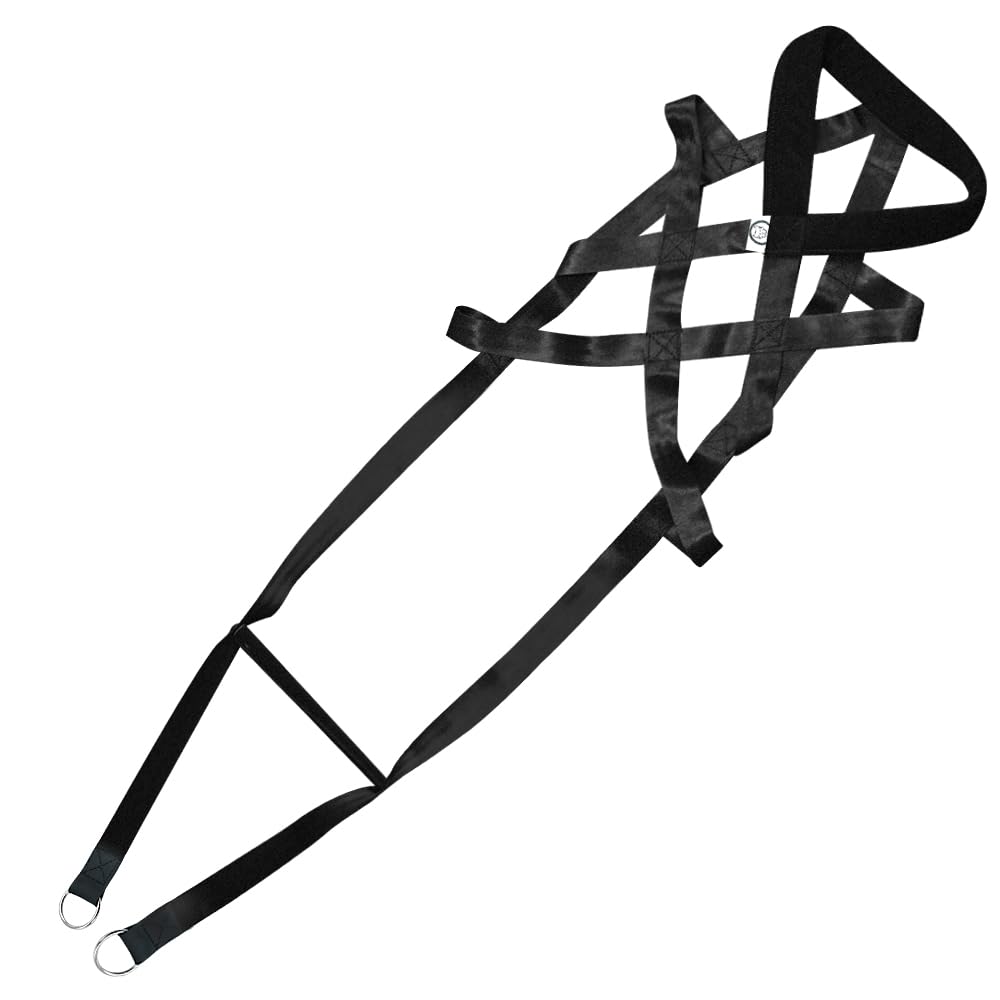
A heavy-duty nylon puller built for large working breeds and weight-training sessions.
The PET ARTIST sled harness is the heaviest harness here at 0.6 kg, and it is built accordingly. The 50mm wide nylon webbing with reinforced stitching offers a resistance rating of up to 1200 lbs. This makes it more suitable for weight-pulling training and sled prep than for casual trail running. It is specifically designed for large dogs with a neck circumference of 31.5 inches, fitting breeds like Alaskan Malamutes, American Bullies, and Rottweilers.
Buyers report that it works well for weight training — one owner used it for sled pulling prep with 30-35 lbs of weight for 20-minute sessions 2-3 times per week. However, the same buyer noted chafing and scabs under both arms from tightening under load, wishing for more padding in that area. Another owner with a 65 lb Pitbull found the Large size way too big. The harness is also heavy and awkward, with one reviewer saying it fatigued their full-sized German Shepherd during training.
Compared to the LASALINE XBack (0.13 kg), this harness is more than 4.6 times heavier. It is not ideal for high-speed canicross where every gram counts. It is best viewed as a training tool for building muscle and behavior, not as a daily running harness.
Built for power: The 1200 lbs resistance rating and 50mm webbing make it one of the strongest harnesses for weight-pulling work.
Chafing risk: The lack of sufficient padding under the armpits is a common complaint, especially under sustained load.
Intended for: Owners of large working breeds who need a heavy-duty harness for weight-pulling training, not high-speed running.
Not for: Lightweight canicross or dogs under 65 lbs — the harness is too bulky and heavy for smaller breeds or recreational jogging.
Understanding the Specs
X-Back vs Y-Neck
The X-back design is the traditional sled-dog pattern. The straps form an X shape across the dog’s back, distributing pulling force across the entire torso. This works very well for steady, sustained pulling but can rub the shoulders on dogs with deep chests. The Y-neck construction, found on the Freemotion 5.0, routes the webbing around the sides of the neck, creating a gap over the shoulder blades. This gives the front legs more freedom and reduces chafing on dogs with a pronounced chest or long stride.
Harness Weight and Material
The lightest harness in this guide (LASALINE at 0.13 kg) is a fraction of the weight of the heaviest (PET ARTIST at 0.6 kg). Lighter harnesses use mesh or thin polypropylene, which dries quickly and minimizes heat buildup. Heavier harnesses use dense nylon webbing and thick padding, which adds durability at the cost of extra weight and potential overheating. For canicross, where the dog runs at speed for miles, lighter materials generally reduce fatigue. For weight-pulling training, heavier materials provide the reinforcement needed for heavy loads.
FAQ
What is the difference between a canicross harness and a regular walking harness?
How do I measure my dog for a canicross harness?
Will an X-back harness fit my Pitbull or Boxer?
How long does a canicross harness last?
Can I use a canicross harness for everyday walks?
What is the right size for my 60 lb German Shorthaired Pointer?
Do I need a bungee leash for canicross?
How do I clean a canicross harness?
Can a small dog use a canicross harness?
What is the difference between the Neewa Sled Pro and Neewa Adjustable Sled Pro?
Final Thoughts: The Verdict
For most runners, the canicross harness winner is the Non-stop dogwear Freemotion 5.0 because its Y-neck design frees the shoulders and distributes pressure evenly. That is the single biggest factor in preventing chafing and keeping your dog comfortable on long runs. If you need an adjustable fit for a blocky, wide-chested breed, grab the Neewa Adjustable Sled Pro. And for a lightweight entry-level option that does not break the bank, the LASALINE XBack gives you a functional pulling harness at a fraction of the weight of heavier competitors.
How We Picked
We do not accept paid placement. Every pick is matched to a real buyer and a real use-case; we do not hands-on test units.
Sources & Methodology
Specifications: manufacturer listings and product documentation. Review insights: verified customer reviews, as of July 2026. Pricing: not shown on this page (it changes often); check the current price via the retailer link.
As an Amazon Associate, Gadgets Feed earns from qualifying purchases. This does not affect which products we feature.