
Our readers keep the lights on and my morning glass full of iced black tea. As an Amazon Associate, I earn from qualifying purchases.
Specs are compiled from manufacturer listings and verified buyer reviews and can change over time — please confirm the key details on the product page before buying.
If you want the short answer: buy a can that fills the gap size you actually have, not the biggest number on the label. That is the whole game with canned spray foam. A can built for inch-wide cracks will puff up and bow a window frame. A low-expansion can aimed at a gap the size of your thumb will leave you halfway through the job with an empty cylinder. Match the can to the gap and you seal it in one pass.
I’m Min — the founder and writer behind Gadgets Feed. This guide is built by comparing the manufacturers’ published specifications and the patterns across verified customer reviews, so you get each pick’s real strengths and trade-offs instead of marketing spin.
Foam that cures fast, sticks to the surface, and stops the draft is what separates a one-can job from a three-trip headache. Whether you are chasing a winter draft around a door or sealing a pipe penetration, here is how to compare canned spray foam insulation before you commit.
Our Picks at a Glance

How To Choose The Best Canned Spray Foam Insulation
The mistake almost every first-timer makes is grabbing the can that says it expands the most. Expansion is only useful when the gap is deep and empty. Around a window frame, the same aggressive foam puffs up after it leaves the straw and can push against the frame you are trying to protect. The fix is not a better brand. It is matching one number — the maximum gap the can is built for — to the opening in front of you.
Match the maximum gap size to your opening
A can rated for gaps up to 1 inch is the right tool for window and door trim, baseboard gaps, and small wall penetrations. A can rated for gaps up to 3 inches is built for the deep, ugly openings — the hole behind a rim joist or a pipe chase. Read that number first. If your gap is wider than the rating, you fill it in stages after the first layer cures rather than spraying a single thick blob that never sets properly.
Decide between a straw and a gun before you buy
A straw is the plastic tube taped to the can, and it is fine for one small job — a single crack under a sink. A gun is a reusable metal handle you screw onto larger cans, and it gives you a trigger you can feather instead of a button that dumps foam. If you have more than a couple of cans to spray, the gun pays off because you can shut the flow down between passes instead of wasting the can.
Plan for board feet, not can count
Board feet is the coverage measure — one board foot covers an area one foot square and one inch thick. Manufacturers print a rated coverage, and it usually assumes a perfect, even pass. Real walls are not perfect. Buy more than the math says you need, keep the receipt, and return the spares. This is the single most common regret in the reviews: running out three-quarters of the way through a job and stalling the project for a day.
Quick Comparison
| Model | Best For | Max Gap | Can Size | Pack Count | Amazon |
|---|---|---|---|---|---|
| Loctite Tite Foam Big Gaps★ Best Overall | Deep cavities and pipe chases | Up to 3 inches | 12 fl oz | 2 cans | Amazon |
| Red Devil 0914 Spray Foam & FillFrame Safe Pick | Window and door frames | Fills cavities | 12 oz | 1 can | Amazon |
| Akfix 805 Gap FillerBig-Can Value | Filling gaps and stopping leaks | — | 12 oz | 2 cans | Amazon |
| Sprayman Gaps and Cracks | Trim work you plan to paint | — | 12 oz | 2 cans | Amazon |
| Stanley F905 Gaps & Cracks | Controlled fill without frame distortion | Up to 3 inches | 12 oz | 2 cans | Amazon |
| Loctite Tite Foam Gaps & Cracks | Small gaps and pest exclusion | Up to 1 inch | 12 oz | 3 cans | Amazon |
| Magic Chems Spray Foam Insulation | Bigger DIY insulation projects | — | 25.4 oz | 1 can | Amazon |
| Sprayman Spraycoat Fire Rated Kit | Whole-room wall and attic insulation | — | 27.1 oz | 12 cans | Amazon |
| ixirpro Expanding Foam Sealant Spray | Soundproofing and large-area coverage | — | 26.46 oz | 1 can | Amazon |
In‑Depth Reviews
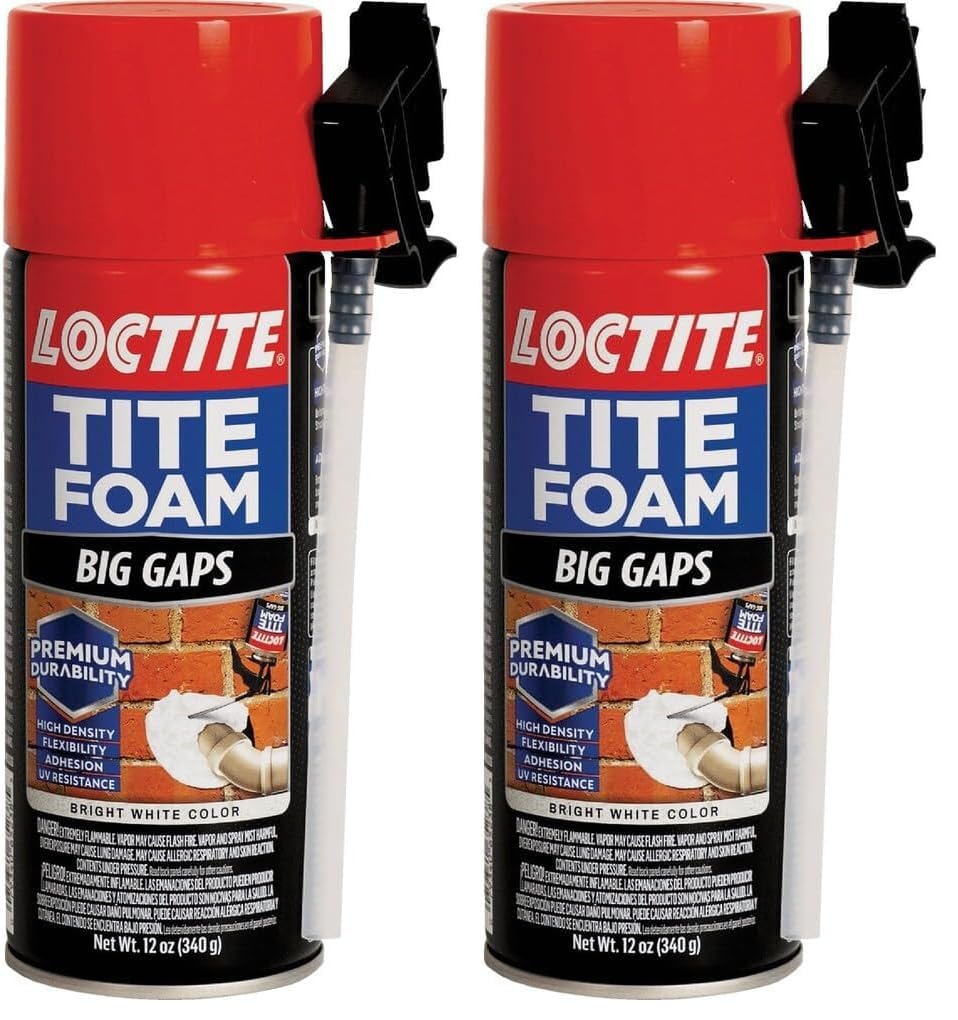
1. Loctite Tite Foam Big Gaps Spray Foam Sealant, Polyurethane Expanding Insulation – 12 fl oz Can, Pack of 2
Our pick — over 4.5★ from 900+ verified ratings; the strongest balance of quality and price.
The one can that swallows a three-inch gap without giving up its grip.
Look at the gap rating first, because that is the number that actually decides whether this can is right for your job. This foam is built to fill, seal, and insulate openings up to 3 inches wide. That is a genuinely large opening — wide enough to take a job that would eat three or four low-expansion cans and turn it into one pass. The two-pack matters here too: with two 12 fl oz cans in the box, you have a spare on the shelf instead of a stalled project.
The foam itself is high density with a uniform cell structure, which is the technical way of saying it cures into a solid, even block rather than a spongy mess with air pockets. That uniform structure holds up as a real insulation barrier for a remodel. It also stays flexible, so when a building or a material shifts with the seasons, the seal flexes with it instead of cracking open. Adhesion is broad — it bonds to wood, concrete, brick, stone, metal, and plastic.
Where owners consistently land is on how well it seals and how simply it applies. The recurring note is expansion so strong that you should resist overfilling a cavity — it keeps growing after you stop spraying. Expect to need gloves, because the foam sticks to skin while wet, and know that the dried foam trims and paints cleanly once cured. Unlike the ixirpro can that carries a mixed read on coverage and adhesion, this one earns its keep specifically on gap-filling, and the 4.6-star record across 900-plus buyers backs that up.
Where it pulls ahead
- Handles gaps all the way up to 3 inches in a single application
- High-density uniform cell structure makes a durable barrier
- Stays flexible so seals survive building movement
- Bonds to wood, concrete, brick, stone, metal, and plastic
- Two cans per order means an instant spare
Where it needs care
- Expands aggressively — overfilling can blow past your target
- Wet foam sticks to hands, so gloves are non-negotiable
- Deeper cavities still need the manufacturer’s cure-and-trim step
Reach for this if: your worst opening is deep, irregular, and wider than a window trim gap — this is the can sized to finish it.
Look elsewhere if: your job is a hairline crack around a door and you want almost no expansion.
2. Red Devil 0914 Spray Foam & Fill Window & Door Polyurethane Expanding Insulation Sealant, 12 oz, Off White, Pack of 1
Built for the crevice between a frame and a wall, not for a fist-sized hole.
If the opening you are sealing sits beside a window or door sash, the worry is bowing — foam that swells hard enough to push the frame out of square. This can is designed to answer exactly that. Its low-pressure formula will not damage frames and still provides a complete cavity fill. That combination — enough expansion to close the gap, not enough to deform it — is the reason to pick this one for interior trim work.
Coverage is the trade-off here, because this is a single 12 oz can next to options like the Loctite Big Gaps two-pack. One can, one job. The smaller format makes sense around openings where a big can would go stale before you finished, but it means you should buy the count you need up front rather than assuming one will see you through. Practical notes from owners: the foam is sticky and hard to remove, though a window cleaner and a rag handle hands when no gasoline is around, and gloves are recommended.
What buyers highlight is expansion in tight spaces — it fills crevices and does the rodent-exclusion job well. The honest caveat is a mixed record on effective sealing overall, so treat this as a targeted tool. One buyer flagged a real quirk: the can carries “THIS END UP” arrows, and spraying partly sideways can leave gas-only flow after about a third of the can unless you keep it bottom-up. Spray with the can oriented properly and it performs. Sealing beside a frame is its lane.
Why owners choose it: the low-pressure formula fills the cavity without risking a bowed window or door frame.
The trade-off to accept: a single 12 oz can and a mixed record on general sealing mean it is a frame specialist rather than an all-purpose filler.
Best matched to: DIYers tightening up around fixed frames where a low-pressure cure matters more than raw coverage.
Think twice if: you are filling several deep openings — buy a multi-can pack instead of stretching one can.
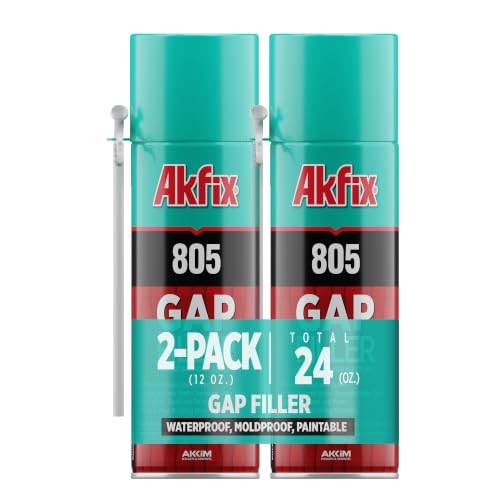
3. Akfix 805 Gap Filler Expanding Foam Sealant (2×12 Oz.) – Gaps and Cracks Spray Insulation Can
A two-can workhorse that dries rigid and holds up in brutal heat.
This is a single-component, moisture-curing foam — meaning it hardens by pulling moisture out of the air rather than by mixing two parts — and it dispenses through a straw built into each can. It cures in 3 to 5 minutes with a full cure at 24 hours, and once dry it turns rigid so it can be trimmed, shaped, and sanded. It is also over-paintable, which matters if you are finishing visible trim rather than hiding the work behind a baseboard.
What owners value most is that it seals and stops leaks, and the fast dry time keeps coming up — the job moves quickly because you are not waiting around for a tacky cure. One buyer used it as a filler on a small project and said it expanded quickly and dried fast — the right combination when you have a single afternoon for the job. It is also noted for holding up to serious heat, which suits attics and warmer climates.
The thing to know before you commit is the expansion spread — some cans expand immediately and others barely move, so results vary can to can. Owners also flag the stickiness as a double-edged trait: excellent adhesion, but it will ruin shoes and clothing on contact, and once it dries it is effectively permanent. Check the surface first, because it will not bond to polyethylene, teflon, silicone, or oil-contaminated materials. Two cans in the pack covers more ground than a single-can option like the Red Devil 0914.
What the buyers keep coming back for
- Effectiveness at filling gaps and preventing leaks
- Fast dry time keeps the job moving
- Cured foam trims, sands, and takes paint
- Shrugs off Texas-level summer heat
- Two cans give you real coverage headroom
Details that decide it for you
- Expansion varies noticeably from can to can
- Sticky formula ruins fabric on contact once cured
- Won’t bond to polyethylene, teflon, silicone, or oiled surfaces
Pick this when: you need two cans to close gap work fast and you want the option to paint or sand the finished seal.
Pass it over if: the surfaces you are sealing are slick plastics or oil-contaminated — the foam simply will not grip them.
4. Stanley F905 Gaps & Cracks Sealant (2×12 Oz.) – Polyurethane Spray Foam Insulation for Window & Door

The straw-and-low-expansion pairing that keeps you from over-popping a frame.
Straight to the spec that earns its keep: this is a low-expansion spray foam, meaning it stays modest as it cures instead of ballooning the way bigger-gap cans do. It is formulated to fill and seal gaps, cracks, and cavities up to 3 inches wide. That is a rare pairing — a wide gap rating with a controlled expansion — and it is why this one suits around windows, doors, pipes, and wall penetrations without risking frame distortion.
It is waterproof and weather-ready, forming a barrier against air and moisture for both indoor and outdoor use. The straw dispenser is included for targeted work in tight spaces, and the foam bonds to concrete, wood, drywall, and more. There is also a genuine safety credential here worth noting: the product is UL certified. That is a third-party safety mark, and it is a concrete reassurance when the foam is going inside a house you live in.
The recurring caution is uneven expansion — some applications foam up brilliantly and others cure small, and the cause is not obvious, so results are genuinely hit or miss. There is also a practical end-of-can issue: buyers report the applicator and nozzle clog and the can becomes unusable after the first session. Plan to finish the can in one sitting, and wear gloves because the white foam is messy and clings to skin. Compared with the Akfix 805, which is designed to keep flowing through a straw, this one rewards a single focused session.
Where it stands out: a low-expansion formula paired with a 3-inch gap rating plus a UL safety certification.
What to plan around: expansion is inconsistent from one application to the next, and the nozzle clogs, so treat each can as a one-sitting job.
Suited to: door and window installs where you want a controlled seal rather than a foam volcano.
skip it if: you expect to reopen a half-used can weeks later — the nozzle will have seized.
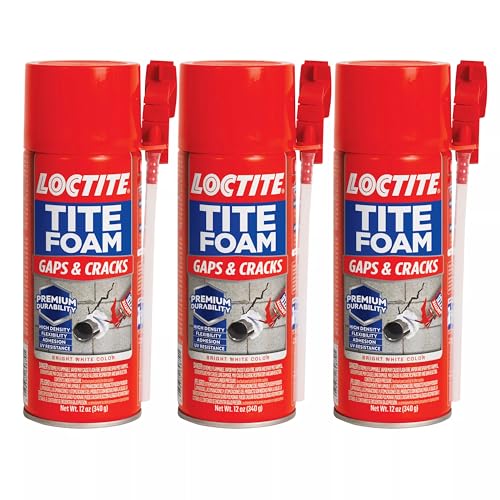
5. Loctite Tite Foam Gaps & Cracks, Bright White Insulating Foam Sealant, 12 oz Can, Pack of 3
The bright white foam that seals a small gap and stops pests in their tracks.
The number to start with is the gap rating: this Loctite fills, seals, and insulates gaps and cracks up to 1 inch in size. That is the small-gap specialist of the family — think baseboards, pipe penetrations, and the under-sink holes you want to close up. The bright white color is not just cosmetic, because it disappears against painted trim and reads as clean around interior work.
Where this one leaves the pack behind is durability. The polymer foam is built on purified and concentrated ingredients, and it resists harsh UV rays — the sun that bleaches and breaks down cheaper foams over time. High-density uniform cell structure gives it a solid, even cure. That combination is exactly what you want in an exterior opening where the foam sits exposed. Bonding is broad across wood, concrete, brick, stone, metal, and plastic.
What wins people over is how well it does the job on small gaps — including one buyer sealed several rodent entry points and was surprised at how fast it expanded and dried, curing in about 8 minutes and swelling to roughly three times the size of the holes. The honest note is a mixed read on overall quality, with a minority finding it poor, so it is a strong pick for small-gap sealing rather than deep structural work — that is the Loctite Big Gaps can’s lane. A recurring gripe is the dispenser design: the trigger clips onto the can and a few owners have had it fail and leak, so seat the nozzle firmly and keep the trigger clean.
The winning combo: a bright white finish, UV resistance, and a purified high-density foam built for openings that sit in the sun.
What to watch: a handful of buyers find the clip-on trigger finicky and prone to leaking if it is not fully seated, so set it before you spray.
Choose this if: you have several small interior gaps and exterior penetrations to seal and want a white foam that blends in and lasts.
Move on if: your opening is deeper than 1 inch — this can’s rating stops there.
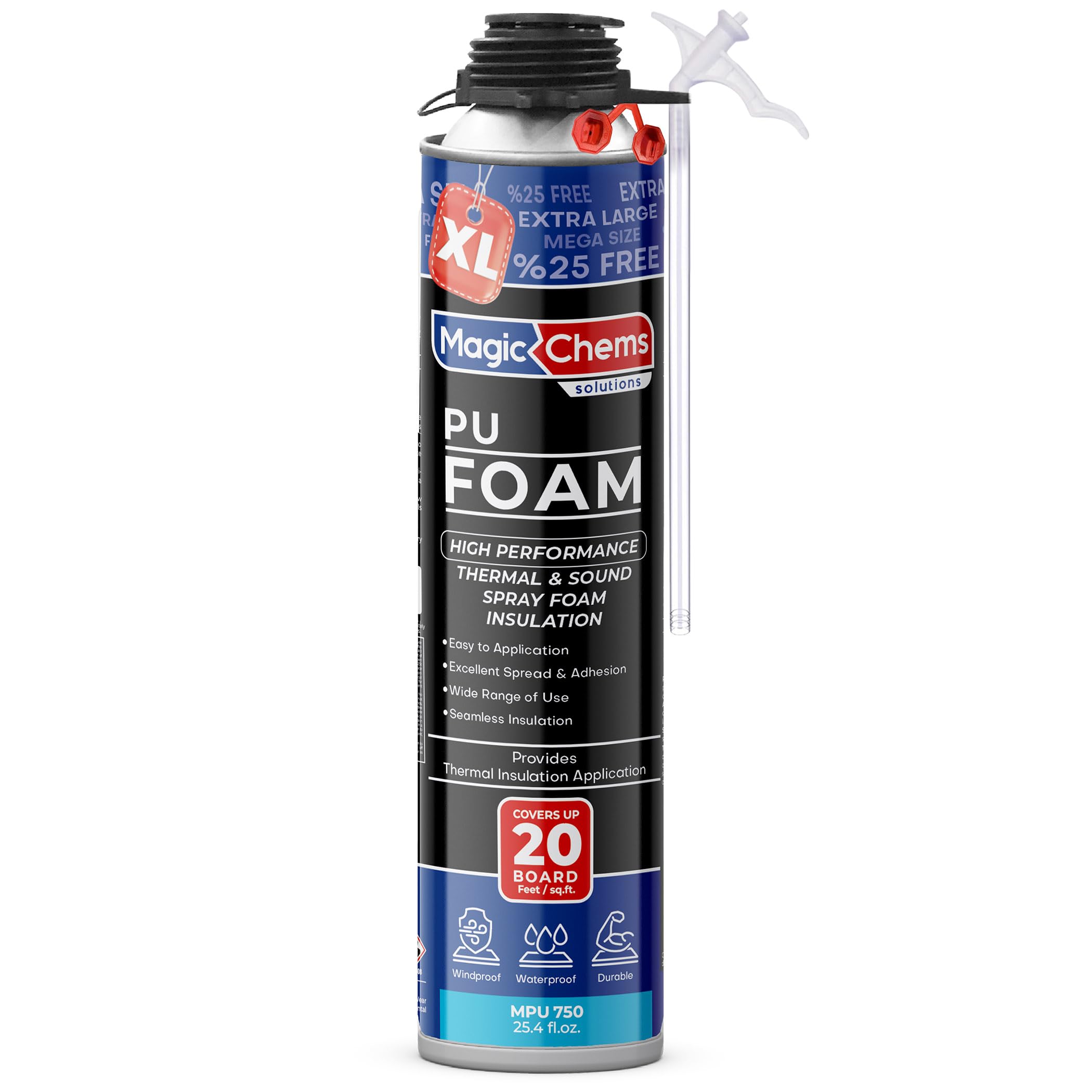
6. Magic Chems Spray Foam Insulation, Polyurethane Filler, 1 Pack-25.4 oz
A jumbo can for when the gap work is the whole afternoon, not the five-minute fix.
The 25.4 oz can is the story here. That is more than double a standard 12 oz can, and it means fewer trips up the ladder when you are spraying walls, ceilings, and cellars in one push. The formula is closed cell — meaning the foam forms sealed air pockets rather than open, connected ones — and it cures in 24 hours to a solid state you can trim or mold. It adheres through a spray gun or a straw, and the recommended technique is to dispense from about 25 to 30 cm away from the surface for an even coat.
What owners praise most is how straightforward it is to work with, and the spray performance earns solid marks too. One user insulated a rebuilt hunting trailer with it and called it very easy to use. It is marketed as suitable for indoor and outdoor areas, from attics and roofs to crawl spaces and basements.
The frustration that shows up is coverage. The recurring complaint is that the real-world spread falls well short of what the can promises — the manufacturer advertises up to 20 board feet, and the honest position is to plan for less and buy a buffer. There is also a safety note worth taking seriously: one buyer warned that gun pressure can release foam toward the face, so eye protection matters, and that in humid areas the foam may not adhere until the surface is misted with water first. Mask off surrounding surfaces, because this stuff blows back and gets on everything.
What works in its favor
- 25.4 oz can means more coverage per can than a standard size
- Closed cell formula for a tighter, more insulated seal
- Easy to use through a gun or straw
- Wide range of approved indoor and outdoor surfaces
What to plan for
- Real coverage tends to fall short of the rated board feet
- Gun pressure can release foam toward the face — wear eye protection
- Humid surfaces may not adhere until misted with water
Best for: a bigger insulation project at the wall and ceiling scale where a jumbo can keeps you off the ladder.
Not the one for: a single small crack — a smaller 12 oz can will finish that job with less waste.
7. Sprayman Gaps and Cracks Filler Foam – Polyurethane Expanding Foam Sealant – 12oz, 2 Pack

Foam built to be hidden, painted over, and trimmed flush before anyone sees it.
This one is aimed at the cosmetic side of gap filling. Once fully cured, the foam can be painted, sanded, or trimmed to match the surrounding surface, so a filled gap disappears into the wall instead of sitting there as raw foam. It also keeps working as insulation, with thermal and acoustic properties that help reduce noise transfer and cut heat loss. The clear, transparent color means it does not fight the finish underneath.
Adhesion is broad by design: it bonds firmly to wood, concrete, metal, and most common building materials. The exception list is worth memorizing — it will not stick to silicone, teflon, or oil-contaminated surfaces. There is a UV and weather angle too, since the foam is waterproof and paintable, so a sealed exterior crack can be finished to match the wall. It is also packaged as a two-can set, which gets you through more than one repair.
What owners like most is the ease of use — the instructions are simple, and it does what it advertises. One buyer sealed a chicken coop gap, and another trimmed the cured foam flush without crumbling. The frustration that recurs is adhesiveness: some owners mention it does not stick as well as expected, so a clean, dust-free surface matters. There is also a flow quirk worth knowing — a few cans come out fast and run out, and the can pushes a heavy initial spray before trickling. Use it for finishing work rather than deep structural fills and it delivers.
What it does well: cures paintable and sandable so the sealed gap vanishes under a coat of trim paint.
What to brace for: stickiness is inconsistent, and the cans pour fast at the start, so ease off the trigger.
Works for: interior trim and exterior cracks you plan to paint over and want invisible.
Look past it if: you need maximum grip on a slick, greasy, or silicone surface.
8. Sprayman Spraycoat Fire Rated Spray Foam Insulation Kit 240 Sq.Ft – High R-Value (11.32 / 2in) Closed Cell

The full-kit option when a single can won’t touch a whole wall or attic.
This is a different class of product from the single cans. It is a closed-cell polyurethane system that covers 240 square feet at 1 inch thickness, and it carries a Class-A Fire Rating tested according to ASTM E84 standards. The kit includes a reusable application gun, a gun cleaner, and 12 cans, plus a safety suit. That bundle is what makes a room-scale job possible in one go, where the smaller cans would mean a wall of separate orders.
The fire rating is the headline feature: a Class-A rating means the material passed a recognized surface-burning test for flame spread. The foam also cures into a rigid, dense structure that resists cracking, shrinking, and settling, and fills gaps, cracks, and cavities with an airtight seal. A dual-nozzle system is included — one nozzle for vertical walls and one for ceilings. It adheres to a long list of surfaces from drywall and wood to concrete, metal, and PVC, and suits uses from residential to marine and RV repair.
Where owners push back is application consistency. One warning worth heeding: misting the surface with water first matters, because the foam will not adhere to a dry metal wall. Some buyers also note that the gun’s air can push unstuck areas loose. On the plus side, the noise-blocking does real work — one reviewer noted it muffled train noise through a wall. It is the biggest-ticket, biggest-job option here.
Why the kit wins on big jobs
- 240 sq ft of coverage at 1 inch thickness handles whole-room work
- Class-A Fire Rating tested to ASTM E84 standards
- Reusable gun, cleaner, and safety suit included
- Dual nozzles for walls and ceilings
- Rigid, dense cure resists cracking and shrinking
What to know before ordering
- Coverage tends to come up short of the advertised square footage
- Messy application — tarps are essential
- Metal surfaces need water misting or foam won’t adhere
Reach for this kit if: you are insulating a wall, attic, or rim-joist run and want a fire-rated closed-cell system in one order.
Not for you if: your job is a few small cracks — a single can finishes those without the setup.
9. ixirpro Spray Foam Insulation, Expanding Foam Sealant Spray, 1 Pack x 26.46 oz
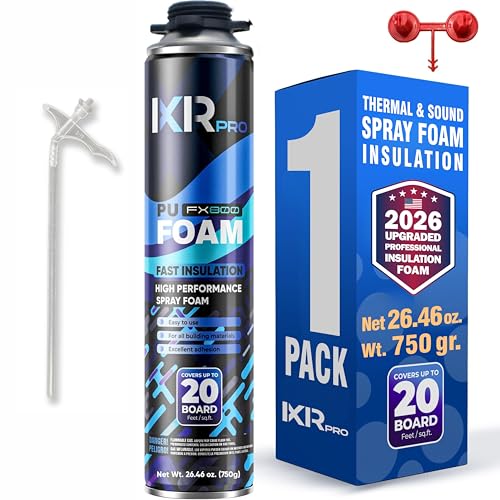
The jumbo can with the printed energy numbers, if you can dodge the coverage gamble.
This can actually publishes its thermal specs, which most don’t. It delivers an R-value of 5.6 per inch — R-value being the measure of how well a material resists heat flow, so higher means better insulation — and a K-value of 0.025, which measures how readily heat travels through it. It also lists a heat treatment application area and rates each can at up to 20 board feet, and it is designed for a spray gun, with a 25 to 30 cm spraying distance for even coverage. It bonds to glass, MDF, metal, concrete, stone, granite, and more.
That makes the pitch compelling: chase a heat loss problem with a foam that tells you its numbers. The problem is the performance record. The recurring gripe is that coverage is far below the 20 board-feet rating in practice, with one buyer reporting 12 cans that failed to cover a small pitched roof. Adhesion is the other soft spot — a few buyers found the foam did not stick properly, especially where the surface was not prepared. And the spray is messy: a fine mist coats everything nearby, so mask with plastic and tape before you start.
On the bright side, a clean application with proper surface prep does work. One buyer mentioned a noticeable drop in a metal building’s interior temperature after a first coat, and the included cleaner dissolves gun residue so the gun can be reused. Compared with the Loctite Big Gaps two-pack here, this can offers the bigger single can and the published R-value, but it trades the reliable multi-can count for that scale. This is one to buy with a buffer of extra cans, not a single optimistic order.
The draw: a printed R-value of 5.6 per inch and a 26.46 oz single can that covers more per container than a 12 oz option.
The catch: coverage regularly comes in below the rated board feet and adhesion depends on diligent surface prep, so plan a buffer.
Choose this if: you are a numbers-first buyer who wants the biggest can and a stated R-value, and you will prep surfaces carefully.
Look elsewhere if: you want a straightforward small-job filler with predictable coverage per can.
Understanding the Specs
Gap rating and expansion
The number that matters most is the maximum gap size a can is rated to fill. A 1-inch rating suits trim and small penetrations. A 3-inch rating suits deep, irregular openings. Expansion is the related variable — the amount the foam grows after it leaves the straw. Too much expansion in a framed opening can bow the frame, which is why a low-expansion formula is the safer pick around a window or door.
R-value and coverage
R-value measures how well the foam blocks heat, so higher means better insulation. Coverage is measured in board feet, and it is the number that decides how many cans you need. Every product on this list rates its coverage assuming a perfect pass, and every product’s reviews say the real-world figure is less than the label. Buy a buffer and keep the receipt.
FAQ
What gap size can canned spray foam insulation actually fill?
How many cans do I need to insulate a wall or attic?
Is canned spray foam insulation waterproof?
What surfaces will canned spray foam insulation not stick to?
Can I use canned spray foam around windows and doors without bowing the frame?
How long does canned spray foam take to cure?
Do I need a special gun to apply canned spray foam insulation?
Can canned spray foam insulation be painted over?
Is canned spray foam insulation safe to use indoors?
What R-value does canned spray foam insulation provide?
Final Thoughts: The Verdict
For most jobs, the canned spray foam insulation winner is the Loctite Tite Foam Big Gaps because it fills gaps up to 3 inches in a single pass, cures into a durable high-density seal, and comes as a two-can pack that won’t leave you stranded mid-job. If your priority is protecting a window or door frame, the Stanley F905 brings a low-expansion formula rated for gaps up to 3 inches plus a UL certification. And for a whole-room insulation project where a single can won’t come close, the Sprayman Spraycoat Fire Rated Kit delivers 240 square feet of closed-cell coverage with a gun and safety gear included.
How We Picked
We do not accept paid placement. Every pick is matched to a real buyer and a real use-case; we do not hands-on test units.
Sources & Methodology
Specifications: manufacturer listings and product documentation. Review insights: verified customer reviews, as of September 2026. Pricing: not shown on this page (it changes often); check the current price via the retailer link.
As an Amazon Associate, Gadgets Feed earns from qualifying purchases. This does not affect which products we feature.