
Our readers keep the lights on and my morning glass full of iced black tea. As an Amazon Associate, I earn from qualifying purchases.
Specs are compiled from manufacturer listings and verified buyer reviews and can change over time — please confirm the key details on the product page before buying.
You do not need to soak dried beans overnight to get that creamy, tender white bean in your soup or salad. A well-chosen can delivers the same texture and flavor in under two minutes — the trick is knowing which can to grab. The market is split between reduced-sodium staples, no-salt-added organic options, and versatile navy beans built for simmering, and each serves a different kitchen purpose.
I’m Min — the founder and writer behind Gadgets Feed. This guide is built by comparing the manufacturers’ published specifications and the patterns across verified customer reviews, so you get each pick’s real strengths and trade-offs instead of marketing spin.
Whether you are stocking a pantry for quick soups or hunting for a low-sodium protein base, the canned white beans worth buying come down to texture control, sodium level, and how clean the ingredient label reads.
Our Picks at a Glance
How To Choose The Best Canned White Beans
You are essentially picking between three things: the bean variety, the sodium level, and the can lining. White beans include Cannellini (larger with thick skin), Great Northern (medium, smooth), and Navy (small, dense). Each behaves differently when heated, so match the bean to your recipe — a Cannellini holds up in a cold bean salad while a Navy bean melts slightly into a soup.
Decide on your sodium floor
Canned beans pack around 300–500 mg of sodium per serving unless the label says “reduced sodium” (about 50% less) or “no salt added” (usually 10–20 mg). If you control your own seasoning, no-salt-added is the cleanest base; if you want an edible bean straight from the can with zero work, a reduced-sodium option gives you flavor without an excessive salt spike.
Check the can lining
Most standard cans use an epoxy liner derived from BPA (bisphenol A). Some brands now explicitly state “BPA-free” or “non-BPA lining” on the label. If that matters to you, look for those exact words — and know that Eden Organic has been using BPA-, BPS-, and phthalate-free cans since 1999, which is an unusually long track record.
Quick Comparison
| Model | Best For | Bean Type | Sodium per Serving | Can Count | Amazon |
|---|---|---|---|---|---|
| Bush’s Reduced Sodium Cannellini★ Best Overall | Everyday soups | Cannellini | 50% less than regular | 12 × 15.5 oz | Amazon |
| Eden Organic Cannellini | Clean-label pantry | Cannellini | None added | 12 × 15 oz | Amazon |
| Eden Organic Great Northern | Salads & quick sides | Great Northern | None added | 12 × 15 oz | Amazon |
| S&W Navy Beans | Budget soup base | Navy | Standard | 12 × 15.5 oz | Amazon |
In‑Depth Reviews
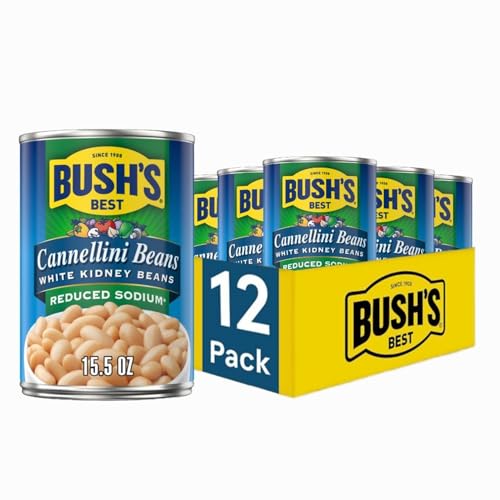
1. Bush’s Best Reduced Sodium Cannellini Beans, 15.5 oz (12 cans)
Our pick — over 4.5★ from 3,500+ verified ratings; the strongest balance of quality and price.
The everyday workhorse that cuts the salt without cutting the flavor.
If you want a bean you can pour straight into a pot and eat without tweaking, this is the one. Bush’s takes its regular Cannellini and drops the sodium by 50%, so you get a silky, nutty bean with 7 grams of protein and 6 grams of fiber per serving, but only half the usual salt load. It is fat-free, cholesterol-free, and naturally gluten-free, which makes it an easy fit for half a dozen dietary patterns at once. “Love the quality of all Bush beans!” one buyer reports, and that consistent quality across thousands of ratings (4.7 stars from over 3,600 reviews) speaks to a product that rarely disappoints.
The 15.5-ounce can is at 15.5 ounces versus Eden’s 15-ounce can, which matters if you are scaling recipes across a 12-can case (186 total ounces vs 180). The trade-off is the pre-added salt: even at the reduced level, the brine carries some seasoning, so if you are on a very low-sodium diet you cannot fully wash it off. Bush’s also does not tout its can liner material, unlike Eden’s explicit BPA-free claim, so that is worth a note if the lining matters to your kitchen.
Buyers find multiple uses: “you can enjoy as a side dish or drain the liquid and put in a salad” one reviewer says, while another notes the texture is firm and not mushy, ideal for homemade hummus.
The ready-to-eat advantage
- 50% less sodium than regular Cannellini — balanced flavor
- Silky, nutty texture with 7g protein per serving
- Huge trusted base (4.7 stars, 3,600+ ratings)
The salt trade-off
- Still some sodium in the brine — not fully customizable
- No BPA-free claim on the can liner
Best for: the cook who wants a pantry staple that tastes good straight from the can with zero extra work.
skip it if: you need a completely salt-free base or insist on a verified BPA-free lining.
2. Eden Organic Cannellini White Kidney Beans, No Salt Added, 15 oz (Pack of 12)

The no-salt Cannellini that lets you control every grain of seasoning in your pot.
If you build meals from scratch, this is the cleanest starting point you can open. Eden soaks the beans overnight and pressure-cooks them with no chemical additives, then packs them in cans that have been free of BPA, BPS, and phthalates since 1999 — a claim no other brand here matches. The bean is a true Cannellini (white kidney), with a thicker, more durable skin than a Great Northern, which means it holds its shape noticeably better when stirred into a minestrone or tossed with pasta. Buyers report that “one of the cans in the middle was dented though,” so check your box on arrival, but the interior quality earns consistent 5-star marks.
Compared to the Bush’s option below, the Eden beans come with zero built-in sodium, so you are free to season from zero up rather than compensating for a pre-salty brine. That is a meaningful difference if you are watching your daily intake — a typical serving of standard canned beans can eat up 30% of a daily sodium budget before you add anything. At 12 cans and 15 ounces each, the total 180-ounce case is almost identical in volume to Bush’s 186-ounce 186-ounce unit count, but the price lands at the premium end of the spectrum.
Reviewers love the versatility: one buyer called them “delicious and great source of protein” and a “go to when I am tired and can’t think of what to cook,” while another noted you “cannot get these in a no salt added in my local supermarkets.”
Why the label wins
- Zero salt added — you own the flavor from the start
- BPA-, BPS-, and phthalate-free cans since 1999
- Thick-skinned Cannellini holds shape in soups and salads
The shipping caveat
- Some cans arrive dented due to transit (owners mention this)
- Premium price compared to conventional grocery brands
Reach for this if: you cook from zero seasoning, need the cleanest ingredient list, and value a BPA-free history that predates the trend.
Look elsewhere if: dented cans annoy you or you want a ready-to-eat bean with some salt already in the brine.
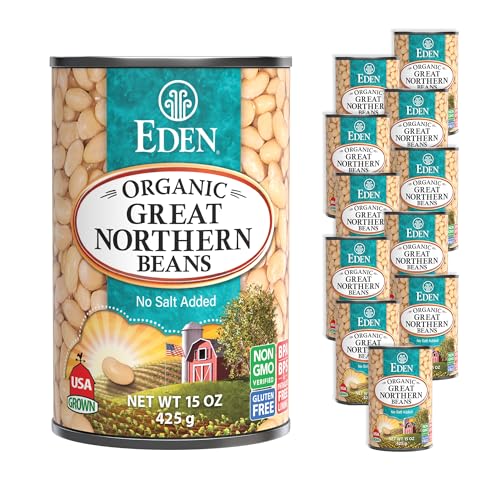
3. Eden Organic Great Northern Beans, 15 oz (12-Pack Case), No Salt Added
The smoother, salt-free Great Northern that shines cold in a salad bowl.
Where the Cannellini above has a thick skin, the Great Northern is softer and more delicate, making it a natural fit for cold dishes where you want a tender bite without exaggerated bean toughness. One buyer notes “the canned beans are a bit softer than the home cooked ones, but still retain their shape and are particularly handy for salads of all kinds.” That is the exact use case this case serves — you open a 15-ounce can (the smallest per-can size in this lineup) and fold the beans directly into a greens salad or a light pasta toss.
The no-salt-added approach mirrors the Eden Cannellini: you get complete control over seasoning. The 12.2 x 9.1 x 4.8-inch box dimensions are nearly identical to the Cannellini case (12.2 x 9.2 x 4.9 inches), , so your shelf space fits either case identically. But the Great Northern is priced at a mid-range point between the Bush’s and the premium Eden Cannellini, making it the compromise if you want Eden’s clean label but prefer a softer bean for cold meals.
One drawback: multiple buyers in the reviews note dented cans upon arrival, similar to the Cannellini case. The 12-pack includes 180 total ounces, which is 6 ounces less than Bush’s 186-ounce case, so the volume difference is minor .
Cold-kitchen strength
- No salt added — you season to taste
- Smoother, softer texture ideal for salads
- Non-GMO and organic
Transit risk
- Dented cans reported by multiple buyers
- 3% less volume per can vs Bush’s 15.5 oz
Reach for this if: your white bean life is salads, cold pasta, and light sides where a soft texture matters.
Look elsewhere if: you need a firmer bean that survives longer simmering without turning into mush.
4. S&W Canned White Beans, Navy Beans, Plant Protein and Fiber, Gluten Free, Vegan, 12 Pack of 15.5 oz Cans

The small navy bean that bulks up a soup without bulking up the bill.
S&W calls these “white beans,” but they are actually navy beans — the smallest and densest white bean variety available. Navy beans break down more easily during simmering, which makes them ideal for thick soups, stews, and bean dips where you want a creamy texture rather than whole individual beans. The 15.5-ounce cans ship as a 12-pack, and S&W explicitly states its can liner is non-BPA derived (they use the phrase “can liner not derived from BPA” — paired with PFAS-free packaging).
One buyer advises: “I add some real bacon crumbles and let it simmer a bit,” confirming the navy bean’s role as a flavor sponge that absorbs seasonings rather than dominating with its own bean character. The total weight of the case (13 Pounds) is 13 pounds, compared to the Eden Great Northern case at 1.17 pounds, largely because S&W packs the cans with a denser liquid brine rather than a lighter salt-free soak. The standard sodium level is higher than the reduced-sodium and no-salt options above, so if you are salt-sensitive, this is the least flexible base.
At 4.5 stars from 74 ratings, the buyer count is lower, but the consistent feedback is positive: “Good quality. Great taste. Will buy more” and “good source of vegetable protein” appear in the reviews. The price lands at the highest end of the lineup here, yet it delivers the smallest bean type — an odd pairing that makes sense only if your recipe demands a navy bean specifically.
Soup-build potential
- Non-BPA and PFAS-free can liners stated explicitly
- Navy beans break down for creamy soups and dips
- Vegan, gluten-free, fat-free
The salt and cost mismatch
- Standard sodium level — not customizable
- Highest price in the lineup for the smallest bean type
Best for: the soup maker who wants non-BPA packaging and a navy bean that melts into the broth.
pass on it if: you need a low-sodium option or prefer a larger, firmer bean for salads and sides.
Understanding the Specs
Bean Variety: Cannellini vs Great Northern vs Navy
Cannellini beans are the largest — about 1/2 inch long with a thick, creamy interior and a skin that stays intact during cooking. Great Northern beans are slightly smaller with a thinner skin and a smoother, more tender bite; they are the best cold-salad bean. Navy beans are the smallest and hardest; they soften and break down during long simmers, making them the classic choice for baked beans, chowders, and creamy soups. Choosing wrong means your salad beans turn to mush or your soup beans stay too firm.
The Sodium Ceiling in Canned Beans
A standard can of white beans typically contains 300–500 mg of sodium per serving (about 30% of the daily recommended limit). “Reduced sodium” cuts that by roughly half. “No salt added” brings the number down to 10–20 mg per serving, letting you season from zero. If you eat beans straight from the can, reduced-sodium gives you flavor without the spike. If you cook from scratch and control every ingredient, no-salt-added is the purest base. The brine itself matters too — denser brine means more sodium and a heavier case weight, as the S&W navy beans show (13 pounds vs 1.17 pounds for the Eden Great Northern case).
FAQ
Can I substitute Great Northern beans for Cannellini in a recipe?
How do I reduce the sodium in canned white beans after opening?
Are Eden’s cans really BPA-free?
Why does the S&W navy bean case weigh 13 pounds while the Eden case weighs 1.17 pounds?
Do white beans need to be cooked after opening the can?
Which white bean has the most protein per serving?
Can I freeze leftover canned white beans?
Are canned white beans gluten-free?
Why do some cans arrive dented from Amazon?
Final Thoughts: The Verdict
For the majority of shoppers, the canned white beans winner is the Bush’s Best Reduced Sodium Cannellini because it balances flavor, texture, and a 50% sodium reduction without needing any seasoning from your side. If you want a completely salt-free base, grab the Eden Organic Cannellini. And for cold salads and quick sides, the standout is the Eden Organic Great Northern for its tender, shape-retaining bite.
How We Picked
We do not accept paid placement. Every pick is matched to a real buyer and a real use-case; we do not hands-on test units.
Sources & Methodology
Specifications: manufacturer listings and product documentation. Review insights: verified customer reviews, as of July 2026. Pricing: not shown on this page (it changes often); check the current price via the retailer link.
As an Amazon Associate, Gadgets Feed earns from qualifying purchases. This does not affect which products we feature.