
That split-second light dim at every bass hit isn’t just annoying—it’s a sign your amplifier is starving for power. A stiffening capacitor bridges the gap between your electrical system’s supply and your amp’s demand, smoothing out voltage drops during demanding passages. Without one, your subwoofer draws from the same reserve that keeps your headlights bright, and physics always wins against the bulbs.
I’m Min — the co-founder and writer behind Gadgets Feed. I’ve spent hundreds of hours researching car audio power management, analyzing capacitance ratings, ESR figures, and surcharge handling to separate the capacitors that actually stabilize voltage from those that just look flashy under the dash.
After poring over technical datasheets and real-world stress tests across dozens of models, this guide delivers the definitive verdict on the best capacitor for car audio to keep your system hitting hard without draining your battery.
How To Choose The Best Capacitor For Car Audio
Matching a stiffening capacitor to your car’s electrical system isn’t about buying the biggest number on the box. The real balancing act involves your alternator’s output, the total RMS draw of your amplifiers, and the internal resistance of the capacitor itself. Get the formula right, and your system gains consistent headroom. Get it wrong, and you’ve just added another load that delays the voltage sag rather than preventing it.
Match Farad Rating to Your Amplifier’s RMS Draw
A common rule of thumb is 1 Farad of capacitance per 1,000 watts RMS. A 1,000-watt RMS system typically needs a 1 Farad cap, while a 2,500-watt setup benefits from a 2.5 to 3 Farad unit. Oversizing by too much can create a parasitic drain that outpaces your alternator’s charge rate, especially at idle. Use your amp’s RMS power—not peak—to calculate farad requirements.
Prioritize Low ESR for Instantaneous Power Delivery
Equivalent Series Resistance (ESR) dictates how quickly the capacitor can discharge stored energy. A lower ESR means faster surcharge response when your subwoofer demands a transient bass hit. Capacitors with aluminum construction and ceramic internals generally offer lower ESR than plastic-bodied units. If your system plays heavy, sustained bass, low ESR is non-negotiable.
Check the Voltage Display and Protection Features
A real-time digital voltmeter lets you monitor system voltage at a glance, confirming the cap is holding its charge. Look for automatic shutoff protection against over-voltage and reverse polarity—these safeguards prevent the cap from cooking itself or damaging your amplifier during a charging fault. Audible warning indicators are a nice extra for catching low-voltage conditions without staring at the meter.
Quick Comparison
On smaller screens, swipe sideways to see the full table.
| Model | Category | Best For | Key Spec | Amazon |
|---|---|---|---|---|
| Audiopipe BCAP5.5 | High-End | Systems up to 5,000W RMS | 5.5 Farad / 20V Surge | Amazon |
| Audiopipe BCAP3.3 Bullz Audio | Mid-Range | Medium systems up to 3,300W | 3.3 Farad / 20V Surge | Amazon |
| Rockville RXC4D | Premium | Large systems needing noise reduction | 4 Farad / 24V Surge | Amazon |
| Audiobank 3.5 Farad | High-End | Dual-sub systems up to 2,400W RMS | 3.5 Farad / Chrome Posts | Amazon |
| Rockville RXC2D | Mid-Range | Small to medium single-sub builds | 2 Farad / 24V Surge | Amazon |
| RECOIL R1D | Mid-Range | Entry-level systems up to 1,000W | 1 Farad / Low ESR | Amazon |
| Belva BB1D | Budget | Budget builds under 1,000W | 1 Farad / 16V | Amazon |
In‑Depth Reviews
1. Audiopipe BCAP5.5 Bullz Audio 5.5 Farad Capacitor
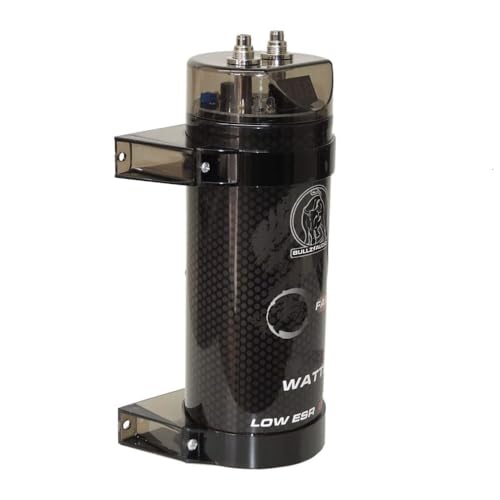
The Audiopipe BCAP5.5 brings a massive 5.5 Farad capacitance with a 20V surge rating, making it the ideal match for high-wattage amplifiers operating near their ceiling. The aluminum construction keeps ESR low, ensuring the stored energy is released fast enough to satisfy sustained bass lines without noticeable voltage sag. Users report zero headlight dimming even with 2,500-watt RMS systems, a strong sign the surcharge rate keeps pace with demand.
Installation requires a test light for initial charging, and the provided mounting hardware accommodates both floor and panel positions. The digital voltage display is clear but has been reported to go blank intermittently on some units—a minor inconvenience that doesn’t affect performance. The negative terminal may occasionally need re-tapping if the shipped thread is slightly tight, so keeping a tap-and-die set nearby is wise.
For systems exceeding 3,000 watts RMS where headlight dimming persists even after upgrading your big three wiring, the BCAP5.5 offers the raw capacitance reserve to buffer extended power draws. It also pairs well with a second battery, acting as a first-stage stiffener that smooths out voltage before the battery has to step in.
Why it’s great
- Massive 5.5 Farad reserve handles high-wattage systems
- Low ESR ensures fast discharge for heavy bass
- Solid aluminum build feels durable and over-engineered
Good to know
- Digital display may flicker or go blank on some units
- Terminal threading may require slight re-tapping
- Large physical size needs careful placement planning
2. Rockville RXC4D 4 Farad Digital Car Capacitor

The Rockville RXC4D delivers 4 Farad of capacitance with a 24V surge capacity for under , offering a rare balance of high farad rating and budget accessibility. Its lucite-encapsulated construction includes a full installation kit with mounting brackets, charging resistor, and ring terminals, so you don’t need to hunt for missing hardware on install day. The dual LED voltage monitoring—a red digital display paired with blue metering LEDs—gives real-time feedback on system voltage and charge/discharge cycles.
IC-controlled circuitry with integrated negative polarity protection adds a safety layer during installation, preventing accidental reverse-wiring damage. The rectangular shape and rack-mount compatibility make it easier to fit into tight enclosures compared to round caps that demand more vertical clearance. Some users note the included Allen key can strip the terminal screws if torqued too aggressively, so investing in a proper hex driver is recommended.
While users confirm it reduces headlight dimming, a few report the effect is partial rather than a complete cure. That’s a physics limitation—a 4 Farad cap can buffer some load, but a system pulling 2,500+ watts RMS will still tax the alternator during sustained bass. The RXC4D works best as a mid-system buffer for builds around 1,500–2,000 watts RMS where the alternator can largely keep up.
Why it’s great
- 4 Farad rating with 24V surge at a competitive price
- Full installation kit included—no extra parts needed
- IC-controlled polarity protection for safe setup
Good to know
- Terminal Allen heads strip easily—use a quality driver
- Physical size is larger than expected; measure your space
- May not fully eliminate dimming on very high-wattage systems
3. Audiobank 3.5 Farad Capacitor 3500 Watts

The Audiobank 3.5 Farad model packs a 3,500-watt power rating into an eye-catching chrome-plated housing with a bright red 3-digit voltage display. The chrome battery posts accept standard ring terminals without fuss and add a visual flourish under a plexi-glass enclosure or open install. At 3.5 Farad, it provides enough reserve for dual-sub systems in the 1,200–1,800 watt RMS range, and user feedback confirms it eliminates headlight dimming entirely in that power band.
Surface mount versatility is a key advantage—the round form factor with bottom mounting bracket fits tight spaces like under-seat subwoofer boxes or behind trim panels. The aluminum construction aids heat dissipation, which matters when the cap is cycling frequently during long listening sessions. A few units have arrived with cosmetic damage from shipping, so inspect the packaging before accepting delivery.
One important note: the 12V operating voltage means this cap is designed for standard automotive electrical systems, not heavy-duty dual-alternator setups. If your build runs at a consistent 14.4V, it handles that fine, but the listed 12V rating restricts its use in systems with continuous high-voltage spikes above 16V. For typical passenger vehicle builds, it’s a solid mid-premium choice that looks as good as it performs.
Why it’s great
- Chrome posts and bright display add visual appeal
- 3.5 Farad reserve eliminates dimming on mid-power builds
- Compact round design fits tight install spaces
Good to know
- 12V operating voltage limits use in high-voltage systems
- Packaging can be damaged in transit
- Some alternators may still struggle at idle to charge it fast enough
4. Rockville RXC2D 2 Farad Stiffening Power Capacitor
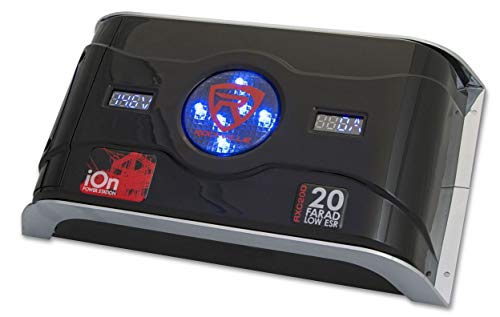
The Rockville RXC2D strikes a precise balance for single-subwoofer builds operating in the 500–1,000 watt RMS range. Its 2 Farad capacitance with 24V surge capacity provides enough reserve to smooth out transient bass hits without creating excessive load on the alternator. The clear Lucite mounting brackets and included stainless steel screws make installation straightforward, and the bundled charging resistor ensures you don’t fry the cap on first power-up.
The round shape with blue LEDs adds a visual element that enthusiasts appreciate, though the flashing LEDs under heavy load can be distracting—some users cover them with tape for a cleaner look. The digital voltmeter is accurate and matches multimeter readings within 0.1V according to buyer reports, giving you real-time confidence in system voltage. At 4.8 inches wide and 3.2 inches tall, it fits most under-dash or trunk environments without crowding.
For users running a single 12-inch sub at 2 ohms, this cap effectively prevents the current-starve issues that cause amp clipping at high volumes. It’s not designed to fix a fundamentally weak alternator—if your electrical system can’t supply the base current, a 2 Farad cap can only buffer so much. But on a properly wired system with decent alternator output, the RXC2D delivers exactly the stiffening effect needed for clean, consistent bass.
Why it’s great
- Ideal farad-to-system match for 500–1,000W builds
- Includes full install hardware and charging resistor
- Accurate digital voltmeter matches diagnostic readings
Good to know
- Flashing blue LEDs can be visually distracting
- May not fully cure dimming on systems above 1,500W RMS
- Some users report partial rather than complete dimming fix
5. RECOIL R1D 1.0 Farad Capacitor

The RECOIL R1D brings a 1 Farad capacitance in a compact round body with a blue digital voltmeter and automatic shutoff protection. The Low ESR design is the standout feature here—RECOIL optimized the internal ceramic-aluminum construction to minimize resistance, allowing the cap to discharge its stored energy faster than standard 1 Farad units. That translates to noticeably cleaner mids and highs in addition to helping the subwoofer current, because the amp isn’t being starved during transients.
Installation is drop-dead simple: the included ring terminals accept any gauge power wire, and the panel-mount design lets you bolt it to any flat surface. Weighing in at 2.5 kilograms, the R1D feels substantial in hand—it’s not a lightweight, hollow unit. The automatic shutoff triggers if voltage drops below 10V during startup, protecting your amp from brownout conditions.
Because it accepts any wire gauge, the R1D is forgiving for builders mixing 4-gauge power wire with 8-gauge amp leads. Some users found that even with the cap installed, headlight dimming persisted on 1,000-watt systems—this is the 1 Farad limitation showing its ceiling. For systems drawing less than 800 watts RMS, the R1D is a precise fit. Anything larger demands stepping up to the 2+ Farad tier.
Why it’s great
- Low ESR design delivers faster surcharge than standard 1F caps
- Great for cleaning up mids and highs on smaller systems
- Universal ring terminals accept any gauge power wire
Good to know
- 1 Farad rating limits use to systems under 800W RMS
- Lacks clear installation instructions—consider professional install
- Heavier than expected at 2.5 kg
6. Audiopipe BCAP3.3 Bullz Audio 3.3 Farad Capacitor

The Audiopipe BCAP3.3 delivers 3.3 Farad of capacitance with a 20V surge rating at a budget-friendly price, making it one of the most affordable ways to stabilize a medium-power system. Its round aluminum body with floor-mount design fits flat on trunk floors or under seats, and the integrated digital display shows system voltage at a glance. The Low ESR aluminum construction supports fast surcharge for the 1,500–3,300 watt range Bullz Audio markets it for.
Real-world feedback shows this cap significantly reduces headlight flicker on systems with around 1,450 watts of ampage, though users note it works best when the engine is revving above idle. At idle, the alternator may not supply enough current to keep the cap fully charged under heavy load, resulting in some remaining dimming. Multiple users found that running two BCAP3.3 units in parallel completely solved the issue on diesel trucks with high-output alternators, a testament to the cap’s scalability.
The included charging resistor is essential—failing to use it can weld terminals instantly, as one buyer discovered. The cap’s reputation for durability (some units lasting years in daily use) makes it a safe bet for the budget-conscious builder who values function over flash. Pair it with the big three upgrade for best results.
Why it’s great
- 3.3 Farad reserve at a very low cost per farad
- Low ESR aluminum build supports fast discharge
- Good durability—many users report years of reliable service
Good to know
- May not eliminate dimming at idle on systems over 1,500W
- Terminals can weld if resistor is skipped during first charge
- Round shape may not fit all installation locations
7. Belva BB1D 1.0 Farad Power Capacitor

The Belva BB1D is the entry-level workhorse for budget builds, offering 1 Farad of capacitance with audible warning indicators and a red digital voltage display. Its rectangular shape with surface-mount brackets makes it easy to install in cramped locations where round capacitors won’t fit. The automatic shutoff protection engages if voltage dips dangerously low, protecting both the cap and your amplifier from damage.
Users running 600-watt RMS subwoofer setups report the BB1D maintains 14+ volts, effectively preventing the voltage drop that causes headlight dimming at moderate volume. The included charging resistor takes a few minutes to bring the cap up to voltage, and customers who kept the resistor for later discharge found it useful for safe removal. A notable quirk: the bright blue flashing LED under load can be distracting, and some users applied tape to dim it without affecting functionality.
After four years of daily use, several buyers still report the BB1D working like new, indicating solid capacitor longevity despite its budget positioning. The main limitation is the 1 Farad ceiling—draws beyond 1,000 watts RMS will exceed its buffering capacity. For the first-time builder adding a subwoofer to a stock electrical system, the BB1D is a safe, proven starting point.
Why it’s great
- Proven longevity—many units last years without degradation
- Audible warning indicator adds safety layer
- Rectangular shape fits tight installation spots
Good to know
- 1 Farad maxes out around 1,000 watts RMS
- Flashing blue LED can be distracting in the cabin
- Charging instructions are not very clear
FAQ
What happens if I use a capacitor with a farad rating too high for my system?
Can a capacitor replace a second battery for a high-wattage system?
Do I need a specific gauge wire to install a car audio capacitor?
Final Thoughts: The Verdict
For most users, the best capacitor for car audio winner is the Audiopipe BCAP5.5 because its 5.5 Farad reserve and low ESR handle high-wattage systems without the parasitic drain issues of smaller caps paired inadequately. If you want a compact, budget-friendly solution for a single-sub setup, grab the RECOIL R1D. And for a mid-power system needing headlight dimming relief without breaking the bank, nothing beats the Audiobank 3.5 Farad.