
A 4-channel amplifier is the single most effective upgrade for a factory or aftermarket car audio system, transforming flat, lifeless audio into a stage of crisp highs and punchy lows. Unlike a basic head unit, a dedicated amp delivers the clean, consistent power necessary to make your speakers perform at their true potential without distortion at higher volumes.
I’m Min — the co-founder and writer behind Gadgets Feed. I’ve spent hundreds of hours tearing through datasheets, comparing RMS ratings across load impedances, and analyzing Class D versus Class AB topologies to cut through the marketing noise and find the amplifiers that genuinely deliver on their spec sheets.
Whether you’re building a ground-up system or just want to wake up a stock setup, this guide gives you a no-fluff breakdown of the current best options. Finding the right best car 4 channel amplifier comes down to matching your speaker load, available space, and power targets with an amp that has proven real-world output.
How To Choose The Best Car 4 Channel Amplifier
Choosing a 4-channel amp is a balance of real output power, physical size, thermal efficiency, and features like crossover flexibility and input connectivity. Most beginners chase the highest “max power” number but the real performance metric is RMS watts at the impedance you plan to run.
RMS Power at Your Speaker Load
Ignore peak power ratings. Focus on the continuous RMS rating at 4 ohms and 2 ohms. If your door speakers are 4-ohm (most are), the 4-ohm RMS figure is what you’ll actually use. If you plan to bridge two channels to a subwoofer, you need the 4-ohm bridged power rating. A mismatch here is the most common reason systems sound strained or clip early.
Class D vs Class AB Topology
Class D amplifiers are highly efficient (80-90%) meaning they draw less current from your electrical system and run significantly cooler, which is critical for tight installs under seats or in dashboards. Class AB amps deliver exceptional sound quality but generate more heat and pull more current. For a modern 4-channel amp running door speakers, Class D is usually the smarter choice unless you’re chasing a specific vintage sound signature.
Size, Inputs, and Crossover Flexibility
Measure your installation space before buying — some full-sized amps are over 14 inches long. Verify the amp accepts high-level (speaker wire) inputs if your head unit lacks RCA pre-outs. A built-in variable high-pass crossover (typically 12 dB/octave or 24 dB/octave) is essential for protecting your door speakers from bass frequencies they cannot reproduce cleanly.
Quick Comparison
On smaller screens, swipe sideways to see the full table.
| Model | Category | Best For | Key Spec | Amazon |
|---|---|---|---|---|
| Rockford Fosgate R2-500X4 | Premium | Maximum headroom & clarity | 75W x 4 @ 4Ω RMS | Amazon |
| Alpine KTP-445U | Premium | Ultra-compact plug-and-play | 45W x 4 @ 4Ω RMS | Amazon |
| Rockford Fosgate PBR400X4D | Premium | Compact build, versatile install | 50W x 4 @ 4Ω RMS | Amazon |
| Kicker 46CXA3604 | Mid-Range | Reliable power, wide voltage range | 60W x 4 @ 4Ω RMS | Amazon |
| Alpine S-A32F | Mid-Range | Sound quality and efficiency | 55W x 4 @ 4Ω RMS | Amazon |
| Pioneer GM-A6704 | Budget | Value with bridging versatility | 60W x 4 @ 4Ω RMS | Amazon |
| Taramps TS 800×4 | Budget | High wattage on a budget | 200W x 4 @ 2Ω RMS | Amazon |
In‑Depth Reviews
1. Rockford Fosgate R2-500X4 Prime 500-Watt 4-Channel Amplifier
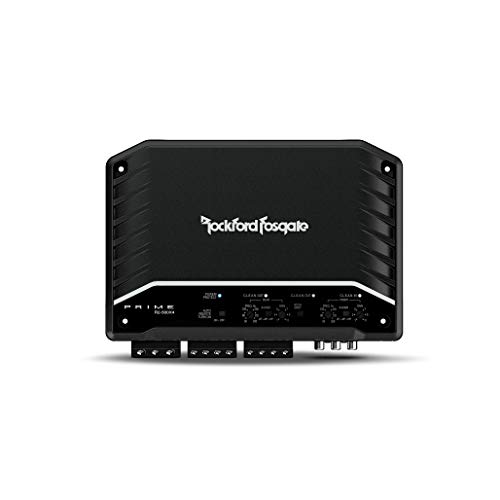
The R2-500X4 is the benchmark for a high-end 4-channel amplifier in its class, packing a genuine 75 watts RMS per channel at 4 ohms into a compact 10.1-inch chassis. Rockford Fosgate’s C.L.E.A.N. circuitry is a standout feature, providing a simple visual indication to help you set gain without distortion or expensive test equipment — a godsend for DIY installers. The Class D design keeps parasitic draw on the electrical system minimal, and the P.O.W.E.R. supply means output actually scales with voltage instead of sagging.
Real-world birth sheets have shown this amp delivering over 580 watts total RMS, well above the rated 500. The fully adjustable 12 dB/octave Butterworth crossovers (high-pass and low-pass) are independent per channel pair, giving you fine control for a bi-amped front stage or a dedicated sub channel via bridging. Balanced differential inputs eliminate ground loop noise, and the RCA pass-through makes daisy-chaining a subwoofer amp seamless.
At this performance tier, the R2-500X4 offers genuine headroom and rock-solid build quality that justify its premium positioning. Users consistently praise its clean output even when pushing a full set of component speakers and a bridged subwoofer. If your system demands transparent, distortion-free power and you want the peace of mind of a brand with decades of car audio expertise, this is the amplifier to anchor your build around.
Why it’s great
- C.L.E.A.N. gain setup eliminates guesswork
- Balanced differential inputs reject electrical noise
- Narrow 1.9-inch profile fits tight spaces
Good to know
- Premium price positions it above mid-range options
- Internal fan can be audible in silent cabins
2. Alpine KTP-445U Universal Class D 4-Channel Head Unit Power Pack

The KTP-445U is a purpose-built solution for the installer who wants to add substantial clean power without sacrificing any cargo space. At roughly the size of a deck of cards, it can be tucked behind the head unit or glove box. Its 45 watts RMS per channel at 4 ohms roughly doubles the output of most factory head units, providing a dramatic improvement in clarity and dynamic range without needing a dedicated power wire to the battery in many installations.
Alpine engineered this as a true plug-and-play device with speaker-level inputs and an auto-turn-on circuit that detects signal from factory radios. This makes it the ideal choice for late-model vehicles where retaining the OEM head unit is a priority. The adjustable gain switch is critical to set correctly — setting it too high with speaker-level inputs can introduce engine whine, as noted by a few users who resolved the issue by lowering the gain to zero and incrementally increasing it.
While it lacks the raw power of full-sized amps, the KTP-445U’s efficiency and footprint are unmatched. Users report it works flawlessly in motorcycles, behind car dashboards, and even in marine applications. For anyone wanting a clean, modest power boost without the complexity of a traditional amplifier install, this unit is the definitive choice in its niche.
Why it’s great
- Fits in literally any dashboard or fairing
- Speaker-level inputs work with stock radios
- No dedicated power wire needed in many vehicles
Good to know
- Modest power output not for high-SPL systems
- Gain setting is critical to avoid noise
3. Rockford Fosgate Punch PBR400X4D Compact Chassis 400-Watt 4-Channel Amplifier

The Punch PBR400X4D delivers 50 watts RMS x 4 at 4 ohms from an incredibly small chassis that measures just 1.5 inches tall by 4.25 inches wide by 6.75 inches deep — small enough to fit under a motorcycle seat or inside the fairing of a Harley. Its ultra-efficient Class D topology draws minimal current, making it a favorite for enthusiasts running audio in vehicles with limited electrical headroom, such as boats, classic cars, and motorcycles.
Rockford Fosgate includes high-level inputs with an auto-on feature, plus differential RCA inputs that maintain signal integrity even in electrically noisy environments. The selectable fixed 12 dB/octave Butterworth crossovers are channel-pair specific, allowing you to run a high-pass filter for front components and a low-pass filter for bridged rear channels driving a subwoofer. The build quality is immediately apparent — the aluminum heatsink is substantial for its size and effectively wicks away heat even during extended listening sessions.
Users mounting this in C6 Corvettes and Harley-Davidson tourers report it as a direct size match for OEM amplifier locations. While the lack of variable crossover frequencies is a minor trade-off for its size, the PBR400X4D’s legendary Rockford Fosgate reliability and pint-sized punch make it the go-to for installations where every cubic inch counts but sound quality cannot be compromised.
Why it’s great
- Extremely compact footprint for tight installs
- Differential inputs reject alternator whine
- Remote auto-on via signal sensing
Good to know
- Crossovers are fixed-frequency, not variable
- May require a cooling fan in enclosed spaces
4. Kicker 46CXA3604 CXA3604-4×90-Watt 4-Channel Full-Range Amp

The CXA3604 is a solid mid-range workhorse from Kicker, delivering 60 watts RMS per channel at 4 ohms in a Class A/B topology that prioritizes sound quality. Kicker’s reputation for conservative power ratings holds true here — independent bench tests have shown this amp outputting closer to 100 watts RMS per channel above its advertised rating, giving you genuine headroom for dynamic music peaks without audible compression.
It includes a variable 12 dB/octave crossover and KickEQ, a 6 dB variable bass boost that lets you dial in extra low-end punch for front speakers without needing a separate subwoofer. The amp’s wide input voltage tolerance (9 to 40 volts) makes it compatible with both low-voltage factory systems and high-output aftermarket head units. Kicker provides both vertical and horizontal mounting hardware, which simplifies customization of the install layout in different trunk or under-seat configurations.
Users note that the CXA3604 runs cooler than many Class A/B designs thanks to Kicker’s efficient power supply topology. The trade-off for its robust build and power delivery is its physical size — at 16 inches long, it requires more real estate than compact Class D rivals. For a buyer who wants proven, no-surprises Kicker reliability and doesn’t mind the larger chassis, this amplifier offers exceptional real-world value for the watt-per-dollar ratio.
Why it’s great
- Undisputed excellent build quality and reliability
- Wide voltage input range (9V-40V)
- Bench-tested above rated RMS output
Good to know
- Large chassis may not fit all spaces
- Class AB generates more heat than Class D
5. Alpine S-A32F, S Series Class D 4 Channel Digital Amplifier

The S-A32F from Alpine’s S-Series is meticulously tuned for transparency, delivering 55 watts RMS x 4 at 4 ohms with a signal-to-noise ratio exceeding 98 dB (referenced to rated power). This means exceptionally low noise floor — you hear the recording, not the amp. The Class D architecture keeps it running cool enough to mount under a seat or in a glove box without active ventilation.
Alpine designed this amplifier for the listener who values imaging and soundstage over raw volume. Its compact footprint (11 x 11 x 5 inches mounting area) and included hardware make installation straightforward. The wire terminals use small set screws, which require pin connectors or spade terminals for a secure connection — a common note from users who shifted from spring-clip terminals. The gain structure is linear and predictable, with a smooth taper that makes it easy to match to a wide range of head unit pre-out voltages.
Multiple users upgrading from entry-level amps report a noticeable improvement in midrange clarity and treble extension. One reviewer compared it directly against a Sony 15-amp unit and called the upgrade “remarkable.” For an audio build focused on critical listening rather than bass competition, the S-A32F is a strong contender that punches above its modest power rating through sheer signal purity.
Why it’s great
- High SNR (>98 dB) for clean, quiet output
- Class D efficiency keeps heat low
- Alpine’s legendary crossover and tuning precision
Good to know
- Set-screw terminals need pin connectors
- Power output is modest compared to competition
6. Pioneer GM-A6704 4-Channel Car Amplifier – 1000W Max, Class AB

The Pioneer GM-A6704 is the definition of a budget-friendly entry-level amplifier that punches well above its price tier. It produces a genuine 60 watts RMS per channel at 4 ohms in a Class A/B configuration, and its bridgeable design allows for flexible power distribution — you can run a 190-watt RMS bridged signal to a pair of subwoofers or power both front and rear speakers with clarity. The max power of 1000 watts is a marketing number, but real-world performance in the budget segment is excellent.
Pioneer includes variable high-pass and low-pass filters (12 dB/octave) that let you set frequency cutoffs precisely. The amp’s minimal crossover distortion ensures the source signal stays clean, a feature that matters when upgrading from factory head units. It is relatively large at 14 inches long and weighs almost 5 pounds, so planning the install location is necessary. Multiple long-term users report the GM-A6704 still running strong after 3+ years in their vehicles.
For the price-conscious builder, this Pioneer offers the best path to decent power without skimping on adjustability or reliability. Reviewers consistently note that setting the gain correctly with a voltmeter is critical to prevent clipping, but once dialed in, the amp runs cool and delivers clean, distortion-free sound. It’s an ideal upgrade for someone adding a first amplifier to a modest speaker set.
Why it’s great
- Proven long-term reliability over 3+ years
- Excellent entry-level price-to-performance ratio
- Bridging capability adds system flexibility
Good to know
- Large and heavy chassis requires planning
- Class AB generates more heat than Class D
7. Taramps TS 800×4 Car Audio Multichannel Amplifier 800 Watts Rms 2 Ohms

The Taramps TS 800×4 delivers massive power for its price, boasting 200 watts RMS per channel at 2 ohms in a Class D architecture. This amp is built for systems running lower-impedance speakers (2-ohm per channel) or for those who want to bridge channels into a high-power 2-ohm subwoofer load. The compact aluminum chassis measures under 7 inches wide and weighs only 1.9 pounds, making it one of the lightest high-power 4-channel amps on the market.
Taramps includes fixed 12 dB/octave crossovers, precise level control, and both RCA and high-level inputs. The safety circuitry shuts down the amp upon detecting a short circuit or an impedance lower than supported at the output — a critical feature given the high current this amp can draw. The manufacturer recommends a 40A circuit breaker or fuse, and the power/ground wiring should be at least 7 AWG for the supply cables.
Users upgrading from larger, more expensive amps consistently highlight how this small unit “woke up” their system with clean, loud output. It is not a sound quality champion — the fixed crossovers and lack of a subsonic filter limit fine-tuning — but for raw power output in the budget tier, the TS 800×4 is unrivaled. It requires careful electrical system planning but rewards you with output far beyond what its price suggests.
Why it’s great
- Highest raw power at the lowest price
- Compact and lightweight for its output class
- Safety shutdown protects against shorts
Good to know
- Fixed crossovers limit tuning flexibility
- Requires heavy-gauge wiring and a 40A fuse
FAQ
Can I bridge a 4-channel amp to power a subwoofer?
What gauge power wire do I need for a 4-channel amp?
What does the crossover on a 4-channel amp do?
Final Thoughts: The Verdict
For most users, the best car 4 channel amplifier winner is the Rockford Fosgate R2-500X4 because it pairs genuine RMS headroom with C.L.E.A.N. setup technology that virtually eliminates guesswork for distortion-free tuning. If you want the most compact, easy-to-install unit for a factory radio upgrade, grab the Alpine KTP-445U. And for the budget-conscious builder seeking maximum raw wattage, nothing beats the sheer value of the Taramps TS 800×4.