
The air inside your car cabin can be up to ten times more polluted than the air outside, trapping exhaust fumes, VOCs from plastics, pet dander, and stubborn smoke odors that a paper tree hanging from your rearview mirror simply masks. Relying on a fragrance to cover a problem doesn’t remove the microscopic irritants that trigger allergies and stale breathing—you need a device that physically or electrostatically scrubs the air.
I’m Min — the co-founder and writer behind Gadgets Feed. I’ve spent dozens of hours analyzing the filtration specs, CADR-equivalent metrics, and real-world usability feedback across the current market to separate gimmicks from genuinely effective in-vehicle purification.
The best car air cleaner combines a True HEPA or high-output ionizing/ozone system with a compact, vehicle-friendly footprint that won’t clutter your cup holder.
How To Choose The Best Car Air Cleaner
A car cabin rarely exceeds 100 cubic feet, so you don’t need a 600 sq ft home purifier, but you do need a unit that matches the vehicle’s specific pollutant profile—whether that is lingering smoke, pet dander, or volatile organic compounds offgassing from hot dashboard plastics. Three technical decisions define your filter choice.
Filtration Type: HEPA vs Ionizer vs Ozone
True HEPA filters (H13 or higher) physically trap particles down to 0.3 microns with 99.97% efficiency, making them the gold standard for allergy and asthma sufferers. Ionic purifiers use charged plates to attract particles but can produce trace ozone, while dedicated ozone generators produce high concentrations of O3 for short-duration odor elimination and must never be used while you occupy the cabin. For daily driving with passengers, go with HEPA. For a deep clean after smoke exposure, a portable ozone unit used inside an empty car is the stronger weapon.
Form Factor and Power Source
Cup holder designs keep the unit stable and out of sight, while dash-mountable units with long cords offer more placement flexibility. Most car air cleaners draw power through a USB-A or USB-C cable, which is convenient but limits the fan speed potential—some units draw up to 15W. Check that your vehicle’s port can deliver enough amperage. Battery-powered units provide the advantage of running the unit after the engine is off, ideal for overnight ozone sessions or continuous ionizing without draining the starter battery.
Quick Comparison
On smaller screens, swipe sideways to see the full table.
| Model | Category | Best For | Key Spec | Amazon |
|---|---|---|---|---|
| LUFTRUM Car Air Purifier | Premium | VOC & exhaust removal | H13 HEPA + PM2.5 sensor, 4-stage filtration | Amazon |
| Timeage Ozone Generator | Premium | Stubborn smoke & pet smells | 2-in-1 ozone + ionizer, 10000mAh battery | Amazon |
| Aucleia Mini HEPA Purifier | Mid-Range | Allergy relief on commutes | H13 HEPA + aromatherapy pad, 22dB noise | Amazon |
| Prasky Portable HEPA Purifier | Mid-Range | Bedroom/car dual use | H13 + activated carbon, 16dB silent mode | Amazon |
| Air Ionizers 3 Pack | Mid-Range | Multi-room plug-in freshness | Negative ion generator, no filter needed | Amazon |
| AUKUU Air Ionizer 4 Pack | Budget | Compact plug-in odor reduction | Plug-in ionizer, 450 sq ft coverage claims | Amazon |
In‑Depth Reviews
1. LUFTRUM Car Air Purifier

The LUFTRUM stands out with its Swedish design and a 4-stage filtration system that targets VOCs, formaldehyde, and exhaust fumes down to 0.1 microns—a crucial spec for anyone driving in heavy traffic or parking in a garage. The motor spins at 5300 RPM while drawing only 4W, meaning it cycles your cabin air up to ten times per hour without taxing your electrical system.
A built-in PM2.5 sensor gives real-time feedback on the dashboard, automatically adjusting the three fan speeds so you never have to guess when the air turns foul. The unit automatically powers on and off with your car’s ignition, which removes the hassle of manual toggling, and the 3-meter long cord allows discreet placement behind front seats or on the rear parcel shelf.
Some users report the auto-start feature depends on the vehicle’s auxiliary power routing, but the large filter area and CARB/ETL certifications provide peace of mind for daily use. It is the most scientifically complete car air cleaner currently available, especially for those sensitive to invisible chemical offgassing.
Why it’s great
- Real-time PM2.5 display for instant air quality feedback
- HEPA plus activated carbon handles both particles and VOCs
- Auto on/off with ignition for effortless operation
Good to know
- Higher price point than typical car ionizers
- Auto power feature may vary by vehicle wiring
2. Aucleia Mini Portable Air Purifier
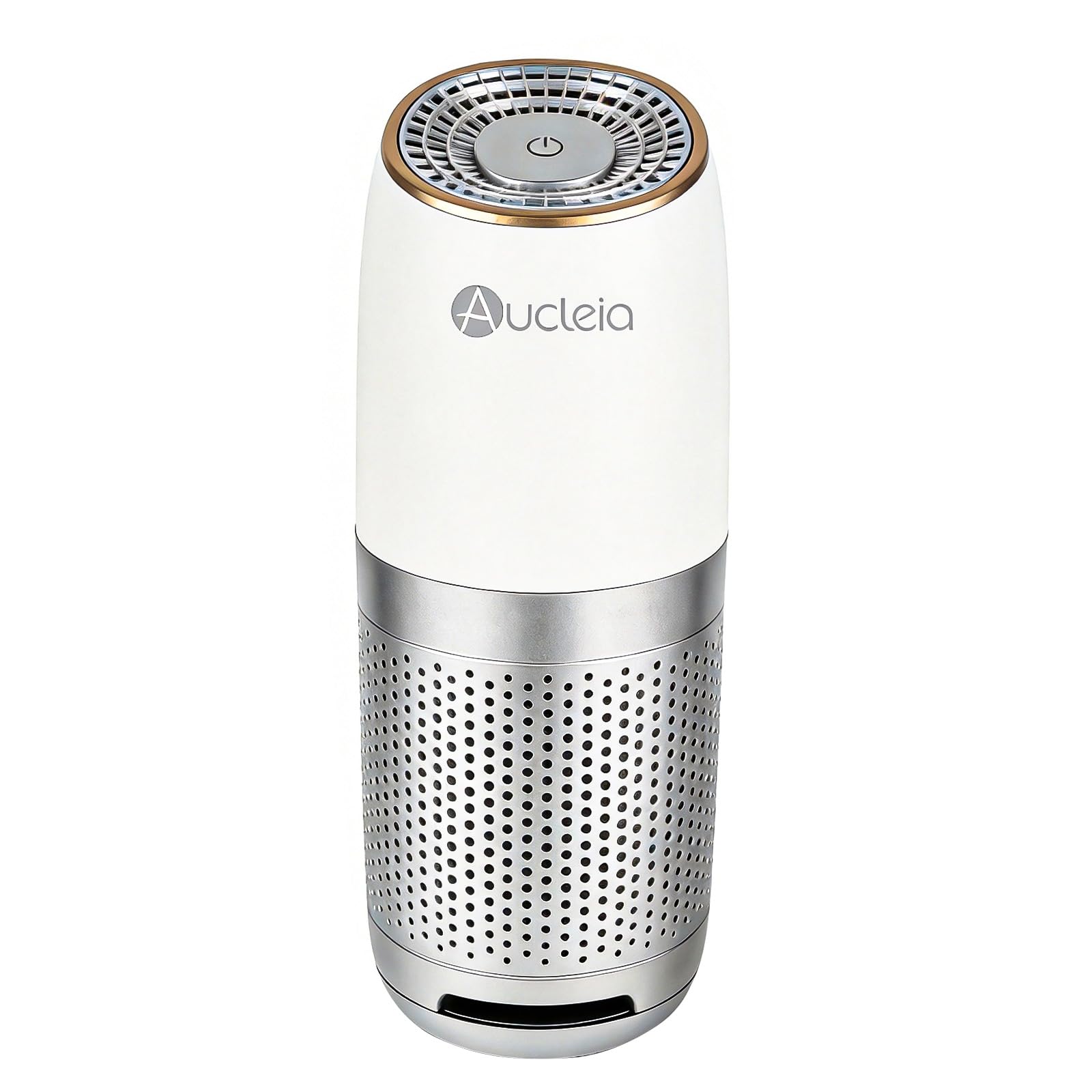
The Aucleia is a purpose-built car companion that drops into any standard cup holder and draws power from a USB-A port. Its H13 True HEPA filter captures 99.97% of airborne particles, and the three-speed touch control lets you toggle between standard, fast, and boost modes depending on whether you’re battling fast food odor or pollen after a countryside drive.
At only 22dB on the quietest setting, it is genuinely whisper-grade—softer than a library—which makes it invisible during phone calls or highway cruising. A clever aromatherapy pad on the intake side lets you add a few drops of essential oil, turning the purifier into a subtle scent diffuser without the chemical payload of a hanging cardboard freshener.
The filter replacement indicator beeps after 360 hours of runtime, and the three-stage speed system works well for cabins up to a mid-size SUV. Keep in mind that it requires constant USB power—there is no internal battery—so it stops cleaning when the car is off. For daily commuters, this is a smart, affordable balance of filtration and convenience.
Why it’s great
- True H13 HEPA in a compact cup-holder form factor
- Aromatherapy pad adds a customizable fresh scent
- Ultra-quiet 22dB operation for undisturbed driving
Good to know
- No internal battery; requires constant USB connection
- Fan airflow is modest even on highest boost setting
3. Timeage Ozone Generator 2-in-1
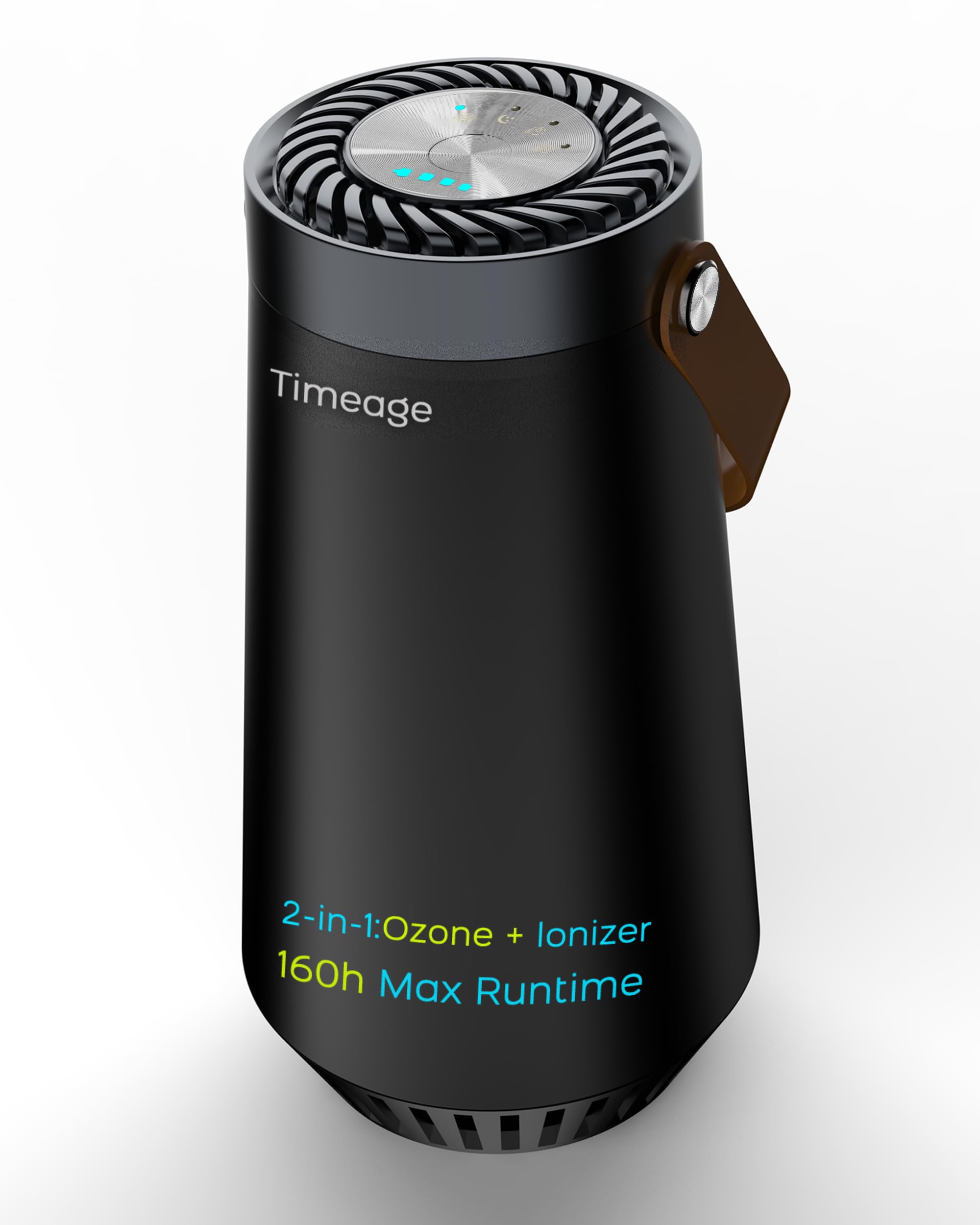
The Timeage 2-in-1 offers a fundamentally different approach: it combines a negative ion generator for continuous low-level purification with a dedicated ozone mode for short-burst, high-intensity odor elimination. The ozone generator outputs 300–500mg/h of O3, capable of breaking down even deep-set cigarette smoke and musty smells that HEPA alone cannot handle.
A massive 10000mAh rechargeable battery distinguishes this unit from almost every competitor, delivering up to 260 hours in ionizer-only mode or 360 hours in ozone mode. This means you can run a 30-minute ozone cycle in your parked car with the windows closed, or leave the ionizer running overnight in a small room—no USB tether required.
Four modes cover the full spectrum: Ionizer Mode for occupied spaces, Quiet Sleep Mode that drops below 5dB, Daily Ozone for intermittent one-hour deodorizing sessions, and Strong Ozone for a 30-minute deep clean. The portable 2.68 x 2.68 x 5.87-inch cylinder weighs under a pound, making it easy to transfer between car, closet, and bathroom.
Why it’s great
- Powerful ozone mode eliminates deep-set odors other filters miss
- Enormous 10000mAh battery enables cordless operation
- Filterless design means zero recurring filter costs
Good to know
- Ozone mode must never be used with people or pets inside the cabin
- Buttons are small and hard to see in low light
4. Prasky Portable HEPA Air Purifier
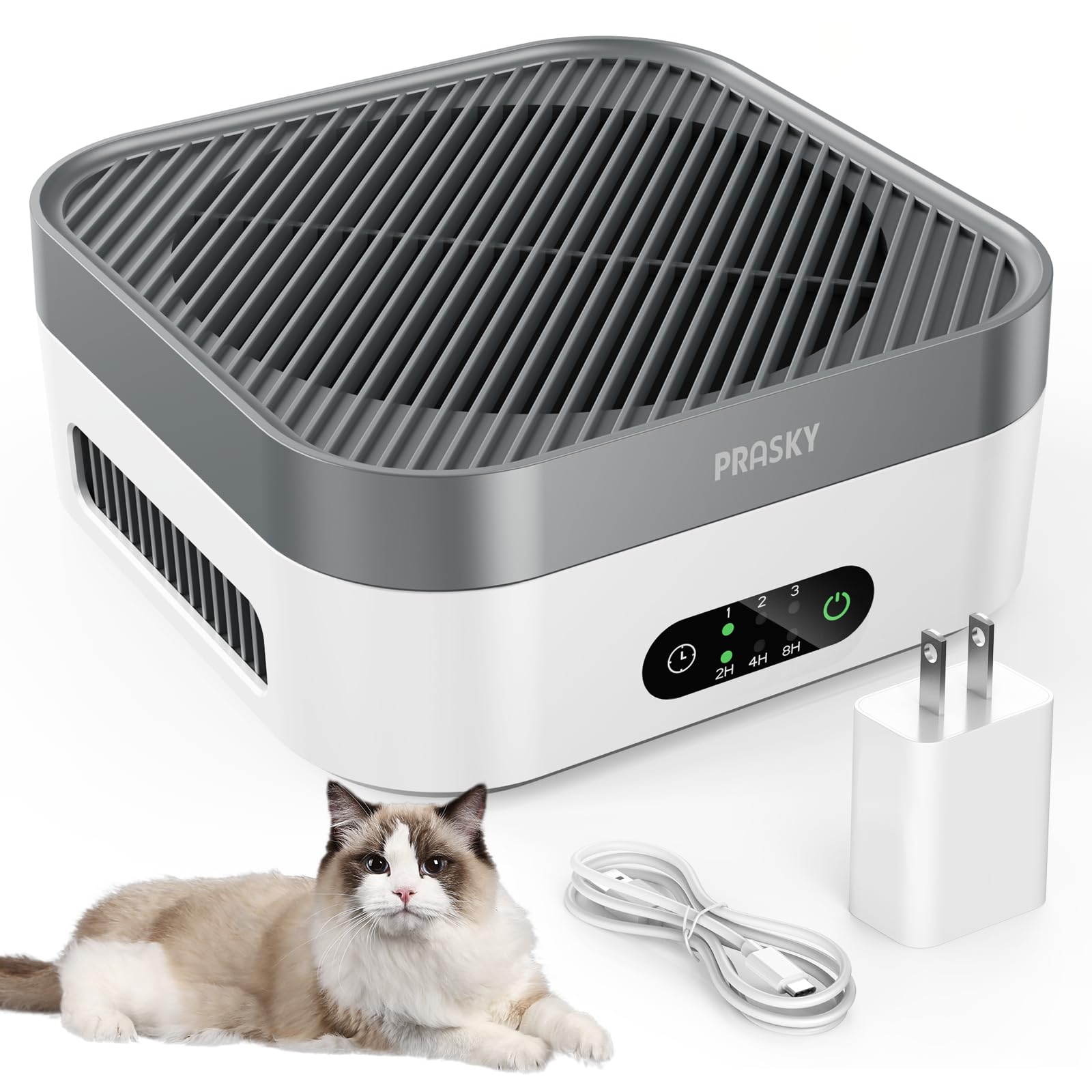
The Prasky brings an H13 True HEPA and activated carbon filter into a compact 7.4-inch cube that works in both car and home settings. A Type-C charging port means you can power it from a laptop or car USB-C adapter, and the 16dB minimum noise level makes it one of the quietest filter-based purifiers you can place on a nightstand or passenger seat.
Three fan speeds plus a 2/4/8-hour timer cover the essentials, and the magnetic top cover makes swapping the carbon + fiber filter pack a ten-second job. The unit covers up to 600 square feet in terms of CADR-estimated circulation, but in a car cabin it refreshes the air roughly four times per hour even on the medium setting, which is sufficient for most daily drives.
While the touch button can be slightly finicky—requiring a firm press to register—the overall build quality and ETL/FCC/CARB certifications are reassuring. For drivers who want one device to migrate between their desk and their dashboard, the Prasky offers genuine dual-purpose value.
Why it’s great
- True H13 HEPA with activated carbon in a compact design
- Almost silent at 16dB for undetectable overnight use
- Type-C charging and timer functions for flexible scheduling
Good to know
- Touch power button requires deliberate pressure to activate
- Auto-shutoff timer may restart if not set correctly
5. Air Ionizers 3 Pack
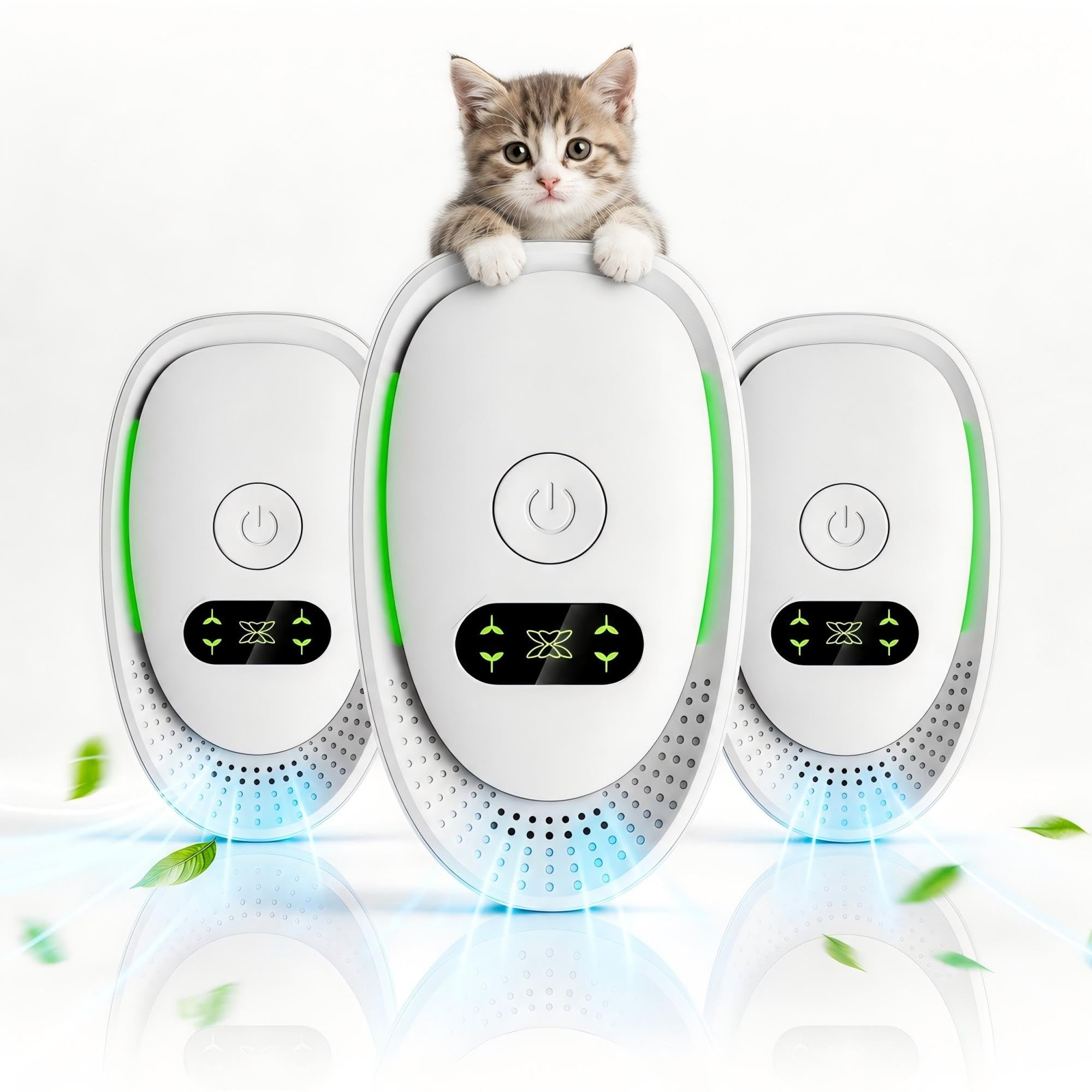
This 3-pack of negative ion generators is the pure value play for covering multiple zones—one in the car cabin, one in the kitchen, and one in a small bedroom—without spending on HEPA replacements. Each unit plugs directly into a standard AC outlet (or a 12V inverter) and uses a low-power chipset to emit negative ions that cause airborne particulates to clump and settle out of the breathing zone.
There are no fans, no filters, and no moving parts. That means zero ongoing consumable costs and a totally silent operation, which is ideal for light odor management in spaces under 150 square feet. Users consistently report noticeably fresher air in bathrooms and office cubicles, though ionizers struggle to remove VOCs and gases compared to activated carbon.
The 3-pack format allows you to place one unit in the rear footwell of the car, one in a travel trailer, and one in a cramped home office. It works best as a supplementary tool for day-to-day freshness, not as a standalone solution for heavy smoke or pet dander.
Why it’s great
- Three units in one purchase for multi-zone coverage
- Zero filter replacements or maintenance costs
- Completely silent, fanless operation
Good to know
- Ionizers are less effective against VOCs and strong smoke than HEPA units
- Requires an inverter for 12V car cigarette lighter use
6. AUKUU Air Ionizer 4 Pack
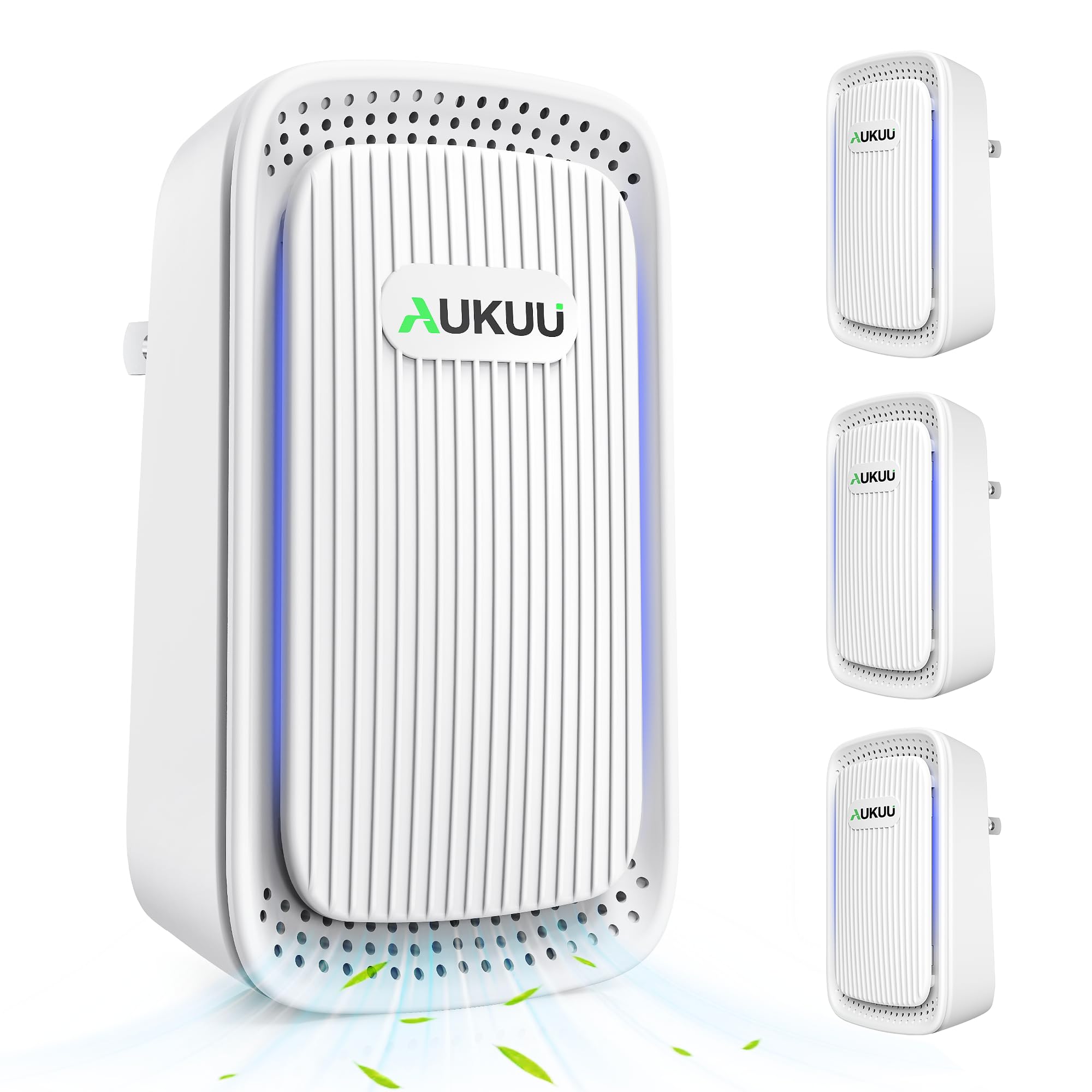
The AUKUU 4-pack takes the multi-zone concept further, delivering four plug-in ionizers that are barely 2.4 inches wide and 4 inches long. Each unit draws 15 watts and claims coverage for up to 450 square feet—though in practice the effective zone for odor reduction is closer to a single medium-sized room or car cabin without closed doors.
This is the most travel-friendly option in the budget tier. You can pack one in a glovebox, one in a gym bag, and leave two at home in the bathroom and laundry area. The lack of filters means you never worry about a clogged medium reducing performance, and the near-silent ionization runs continuously once plugged in.
As with all ion-only units, the primary limitation is chemistry: they do not capture gases or volatile compounds. For drivers dealing with exhaust fumes or new-car plastic offgassing, these are better used as a complement to a HEPA-based primary unit. But for everyday cooking odors and general staleness, the 4-pack is the most efficient budget solution.
Why it’s great
- Four units for less than the cost of a single HEPA purifier
- Extremely compact and unobtrusive wall-plug design
- Completely filterless and maintenance-free
Good to know
- Ionization alone may not eliminate strong smoke or VOCs
- Rated floor area is optimistic for heavy pollutant loads
FAQ
Can I run an ozone generator while I am driving?
How often should I replace the HEPA filter in a car purifier?
Will a car air cleaner drain my car battery if left plugged in?
Final Thoughts: The Verdict
For most users, the best car air cleaner winner is the Aucleia Mini Portable Air Purifier because it combines a real H13 HEPA filter with a purpose-built cup-holder form factor and a whisper-quiet fan that doesn’t disrupt conversations. If you fight deep-set smoke or pet odors that resist physical filtration, grab the Timeage Ozone Generator 2-in-1 for its powerful 300–500 mg/h ozone cycle and 10000mAh battery. And for an entry-level zero-maintenance approach to general cabin freshness, nothing beats the AUKUU Air Ionizer 4 Pack spread across your car, office, and home.