
Our readers keep the lights on and my morning glass full of iced black tea. As an Amazon Associate, I earn from qualifying purchases.
Specs are compiled from manufacturer listings and verified buyer reviews and can change over time — please confirm the key details on the product page before buying.
If your cabin still smells like last week’s fast food or a rainy dog, the fix is not another tree-shaped hanger. A real car air purifier traps odor, smoke, dust, and pollen in a filter instead of masking them with fragrance. The picks below are sorted by what each one does best — most buyers want quiet filtration that runs off the car’s USB port, and that is exactly where the best value sits today.
I’m Min — the founder and writer behind Gadgets Feed. This guide is built by comparing the manufacturers’ published specifications and the patterns across verified customer reviews, so you get each pick’s real strengths and trade-offs instead of marketing spin.
You will see which units plug into your 12V outlet or USB port, which ones run cordless on their own battery, and which filter type handles smoke versus dust. Before you spend anything, here is what separates a genuinely useful car air purifier from a scented plastic box that does very little.
Our Picks at a Glance
How To Choose The Best Car Air Purifier
The cabin is one of the smallest spaces you breathe in all day, and it is also the dirtiest — exhaust from the car ahead, plastic off-gassing from a new interior, pet dander, and whatever is growing in your cabin filter all circulate in a space roughly the size of a closet. That is why a portable purifier earns its place on the dash or in the cup holder. Three things decide whether one actually works for you.
Filtration type: HEPA versus filterless ionizer
A HEPA filter is a dense mesh that physically traps particles, and the H13 grade captures smoke, dust, and dander rather than just charging them. A filterless ionizer instead releases positive and negative ions that clump particles together so they settle out of the air, which means no replacement filters and no recurring cost. Neither is universally better — HEPA handles fine particulates more directly, while a filterless design suits someone who does not want to buy consumables every few months.
Power source and where it can sit
Most units here run off the car’s USB port or 12V socket, which means they only work while the engine or accessory power is on. Cordless models carry their own rechargeable battery, so they keep running in a hotel room or on a desk after you park. Form factor ties into this: a cup-holder base holds steady through turns, a vent clip keeps the dash clear, and a headrest mount puts the clean air right around your head.
Noise and coverage area
A purifier that whines will end up switched off within a week, so pay attention to the decibel figure at the lowest setting — the quietest units here run as low as 16 dB, which is quieter than a whisper. Coverage area matters too, since a unit rated for a small cabin will not keep pace in a full-size van. Match the coverage number to your vehicle, not to your living room.
Quick Comparison
| Model | Best For | Filtration | Power | Noise (low) | Amazon |
|---|---|---|---|---|---|
| Air Purifiers for Home, Plug-in, H13 True HEPA★ Best Overall | Small cabins, desks, and RVs on a budget | Pre-filter + H13 True HEPA + carbon | Plug-in (USB Type-C) | 16 dB | Amazon |
| Aucleia Portable Car Air PurifierBest Value | Cup-holder odor control in daily drivers | True H13 HEPA + negative ion | USB (12V) | 22 dB | Amazon |
| Yakry Mini Car Air Purifier Ionizer | Filter-free smoke and musty odor removal | Bipolar plasma ion (filterless) | USB-A to USB-C | — | Amazon |
| Pure Enrichment PureZone Mini | Travel and bedside use with its own battery | Carbon pre-filter + True HEPA | Rechargeable (up to 12 hrs) | — | Amazon |
| ALAZUR Portable Car Air Purifier | Cordless car and small-room coverage | Filterless ion / ozone mode | Rechargeable | — | Amazon |
| LUFTRUM Car Portable Air Purifier | Commuters who want exhaust-fume filtration | 4-stage + H13 True HEPA | 6-ft cord (engine-linked) | — | Amazon |
| IQAir Atem Car | Maximum filtration for allergy-sensitive drivers | HyperHEPA (0.003 microns) | Car power (headrest mount) | — | Amazon |
In‑Depth Reviews
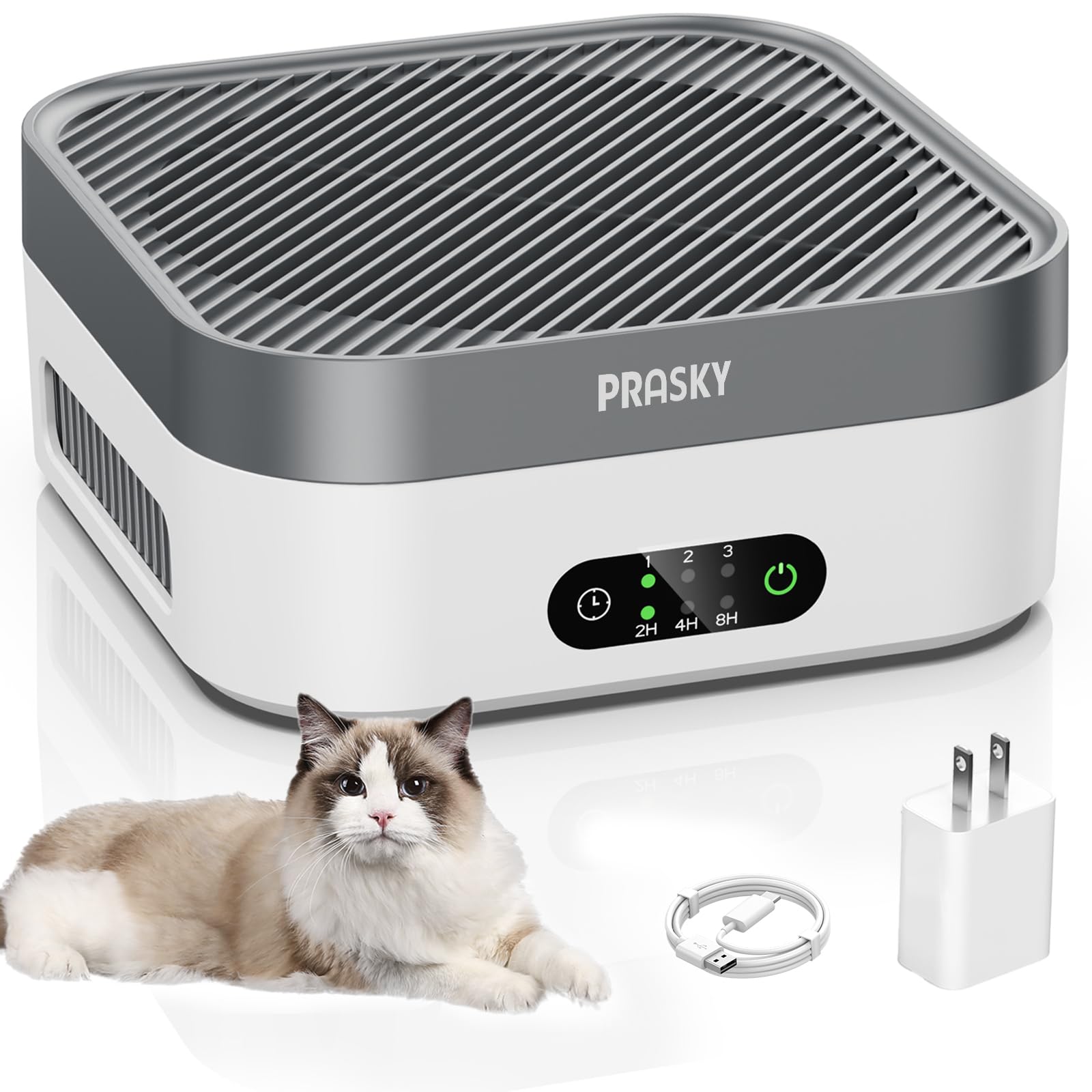
1. Air Purifiers for Home, Plug-in, H13 True HEPA Filter
Our pick — over 4★ from 60+ verified ratings; the strongest balance of quality and price.
The quietest pick here at 16 dB, sized to sit on a console without drawing attention.
This one filters in three stacked stages — a pre-filter that catches hair and lint, an H13 True HEPA layer that traps dust, smoke, and pet dander, and a fibrous carbon pad that soaks up cooking and pet odors. That third layer is the part that matters in a car, because a plain HEPA filter does not touch smells on its own. A single button cycles three fan speeds, and a touch panel handles 2H, 4H, and 8H timer programs so you can set it and walk away — or, in the car’s case, plug it into your USB port and forget about it.
The noise figure is the headline: 16 dB at low fan speed. That is quieter than a library, quiet enough to run beside you through a phone call without the person on the other end asking what the buzzing is. The 7 x 7 x 3-inch footprint sits flat on a console, and at 2.25 pounds it slides into a door pocket without complaint. What owners keep coming back to is how well it actually clears the air for a unit this size — and 4.4 stars across 60+ ratings backs that up — with one USB HEPA convert writing “The best out of 3 USB powered air cleaners,” citing the squirrel-cage fan as the reason it beats simpler box-fan designs.
One thing to size correctly: this is a personal-space purifier. It refreshes air four times an hour in a 230-square-foot room and covers up to 600 square feet in 40 minutes, which is more footprint than any cabin needs — but it will not keep a full-size van ahead of a fresh diesel cloud the way a higher-output unit can. It also has no battery, so it only runs while plugged in.
What quietly wins here
- 16 dB at low speed — effectively silent on a commute
- Three-stage pre-filter, H13 True HEPA, and carbon catches odor, not just particles
- Timer programs at 2H, 4H, and 8H, plus USB Type-C charging you can share with your phone cable
Where you should look elsewhere
- No built-in battery — needs a power source to run
- Touch switch is finicky; a few presses may be needed to turn it on
Snap it up if: you want the most filtration per minute for the smallest fuss — a quiet, compact unit for a hatchback, sedan, RV, or desk.
Think twice if: you need off-grid use on a camping trip or want to run cordless overnight.
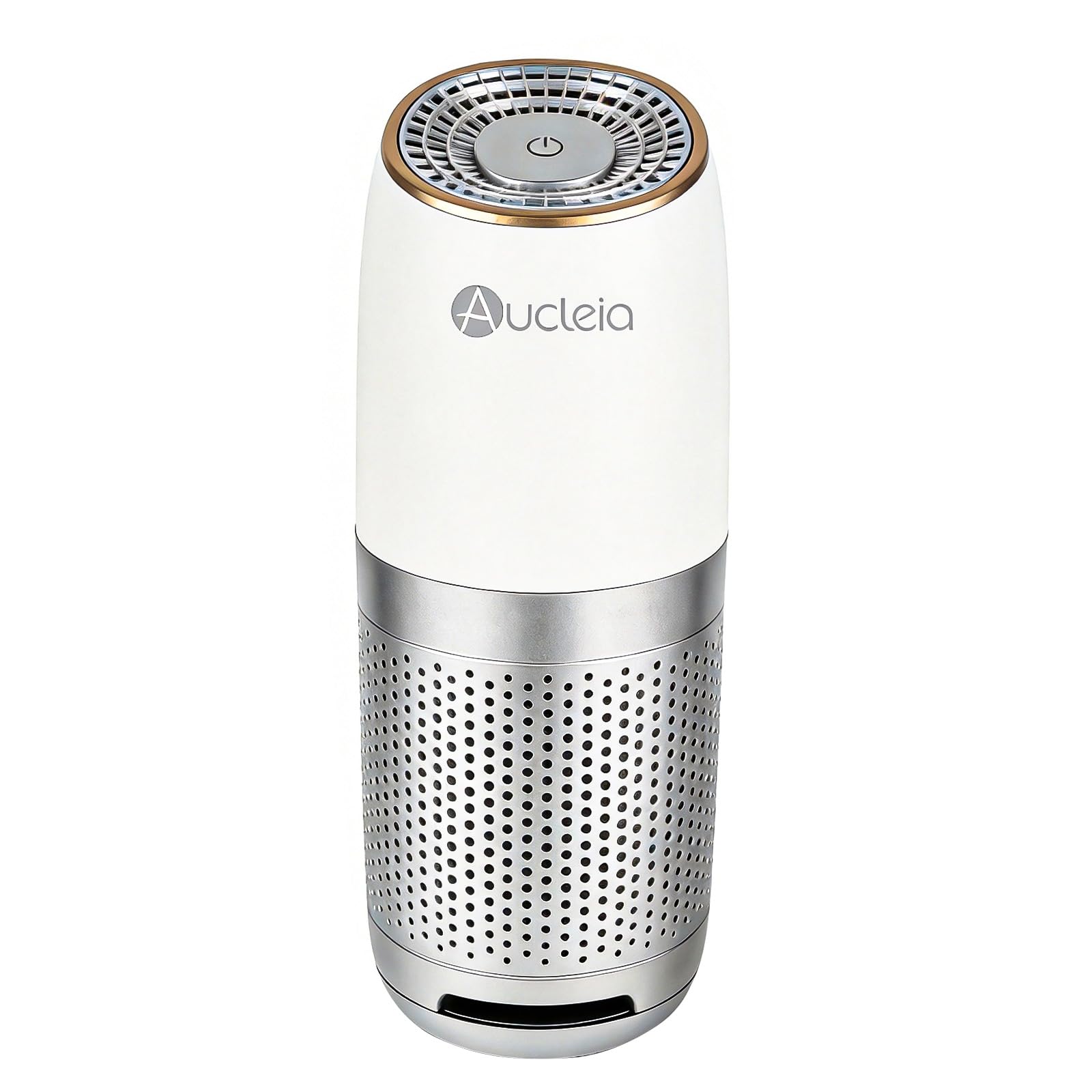
2. Aucleia Portable Car Air Purifier with H13 HEPA Filter
A cup-holder unit that filters H13 HEPA and negative ions without crowding the console.
For a purifier this small, the Aucleia packs two filtering methods at once: a True H13 HEPA filter that traps allergens, dust, pollen, pet hair, dander, and cigarette smoke at the source, plus a negative ion generator that adds airstream freshness. Three modes run on a simple color code — Blue for standard, Yellow for moderate odors, Red for stubborn smells — and they all sit inside a body just under 10 inches long, narrow enough to sit in a cup holder without blocking the shifter.
Where it comes up short against the broader field is raw air movement. Compared to the LUFTRUM pick below, the Aucleia is a whisper-to-medium affair rather than a headwind, which is why the recurring buyer note is that it works best with a bit of help from your cabin’s recirculation setting. It also runs on USB only, so a 12V socket or portable power bank is required for use — there is no internal battery to fall back on. But for a cup-holder-sized purifier, the footprint-to-filtration ratio is hard to argue with, and its build feels more premium than the price floor suggests.
The design detail that separates it from simpler plug-in units is the built-in aromatherapy pad — a slot near the intake where you can add a drop or two of essential oil or perfume if you want the air to carry a fragrance, not just be odor-free. The filter replacement indicator is the practical answer to that feature: after 360 hours of use, it beeps and flashes red until you swap in a fresh filter. No guesswork, no guessing when to act.
The honest trade-off: it will significantly improve air quality in a standard sedan or crossover, but do not expect it to keep a full-size van or a smoky pickup ahead of fumes on its own — that is not what a cup-holder unit is built for.
Reach for this if: you want a set-and-forget cup-holder purifier that handles everyday dust, dander, and food smells without hogging the console.
Look elsewhere if: your main enemy is heavy exhaust or persistent smoke, where a larger HEPA unit with faster air exchange is the better match.
3. Yakry Mini Car Air Purifier Ionizer
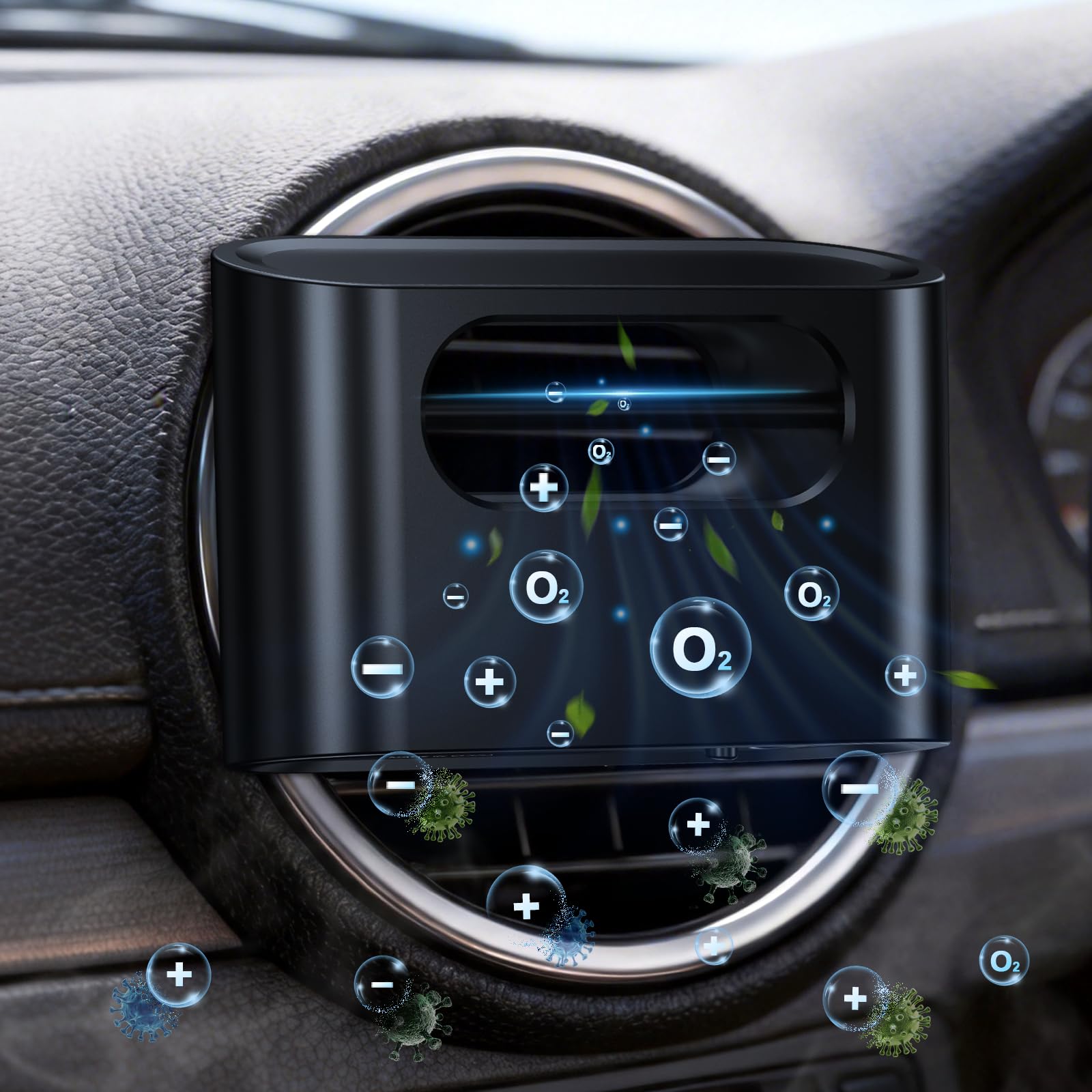
A filterless plasma ionizer that clips to a vent and needs no replacement filters.
If the idea of buying replacement filters every few months puts you off, the Yakry sidesteps that entirely. It runs on bipolar plasma ion technology, releasing both positive and negative ions to break down smoke, pet, food, and stale-cabin odors without trapping them in a mesh. The manufacturer says it purifies cabin air in about 25 minutes and mentions a 2-year warranty, but the physical reality of a filterless ionizer is worth being clear about: it does not trap particles in a filter, it relies on ions to neutralize and clump them. For smoke and musty smells, that approach works. For fine dust and pollen, an H13 HEPA unit like the one at the top of this list is still more direct.
The setup is about as simple as it gets. Clip it to a vent, plug in the included USB-A to USB-C cable, and drive — it fits horizontal, vertical, and round-style vents, and it avoids blocking your controls thanks to a 3.15 x 2.2 x 1.7-inch body that weighs just 3.2 ounces. The trade-off of that small size is airflow: there is no built-in fan, so the unit leans on your cabin’s vent air to carry the ions through the cabin. That is fine for a normal commute, but it means recovery speed on a heavy smoke smell is slower than a fan-driven HEPA unit.
What owners describe most often is a slow, deep clean rather than an instant zap. One reviewer noted the ionizer cleared the musty smell from a used SUV over roughly three weeks — not overnight — and another reported a pre-owned car’s cigarette smell gone almost immediately after setup. Both are believable for the same reason: this is a longer-haul tool for persistent odors, not a plug-in-and-breathe-easy-of-the-minute fix.
Big wins, tiny package
- Zero replacement filters, zero recurring cost
- Vent-clip design keeps the cup holder free and stays out of the way
- Suitable for smoke, pet, and musty odors including in used cars with prior owners
Notes worth absorbing
- No built-in fan; relies on vent airflow to spread ions, so coverage is slower to build
- A few units reportedly stop working after the first day — the plug-and-play simplicity cuts both ways
Best fit for: anyone chasing a persistent cabin smell — musty interiors, prior smoking, pet trips — who does not want to think about filters ever again.
Skip if: you want near-instant results on a heavy smoke event or are looking for HEPA-level particulate capture.
4. Pure Enrichment PureZone Mini Portable Air Purifier

The only pick with a built-in battery, running up to 12 hours on low after you park.
The Pure Enrichment PureZone Mini is the only unit here with a rechargeable lithium-ion battery built in, and that changes how you use it entirely. Instead of drawing power from your car’s outlet, it runs up to 12 hours on low, so it keeps filtering in a hotel room, on a plane tray table, or on a nightstand after the engine shuts off. Weighing under a pound and measuring 3.3 x 8.5 x 2.7 inches, it slips into a carry-on or glovebox without a thought. For commuters who hate fiddling with cables, that independence alone is worth serious consideration.
Filtration is a two-stage design: an activated carbon pre-filter that targets odors and harmful gases, plus a True HEPA filter that clears dust, dander, pet hair, pollen, mold spores, and smoke at 99.97% capture. The adjustable handle lets you stand it upright or lay it on its side, and you can remove the handle entirely if it is in the way. Three fan speeds round it out, and at the top setting the maker says it can double as a personal cooling fan — a nice extra for a hot car or a stuffy hotel room, though at that speed you will want it pointed away from your ear.
Buyers like the format and the quiet. What holds this pick back from a higher position is airflow: several describe barely feeling air movement on the highest setting, and the compact fan just cannot push as much volume as a larger HEPA unit. A few note that a cup holder can block the bottom-side vents, and the battery drains faster than the headline number suggests when you run it on high. None of that makes it a poor choice — it just means you should buy it for the portability, not for blasting a full cabin clean in ten minutes.
Cutting through the marketing: the battery is this unit’s entire reason to exist. If your day involves a car, a hotel room, and a desk, this is the one purifier that follows you between all three without needing an outlet.
Buy this if: you travel often and want one small filter that works in a car and a hotel room without hunting for power.
Choose a different model if: your priority is high air-exchange for a full car — a plug-in HEPA unit will move more air for less money.
5. ALAZUR Portable Car Air Purifier
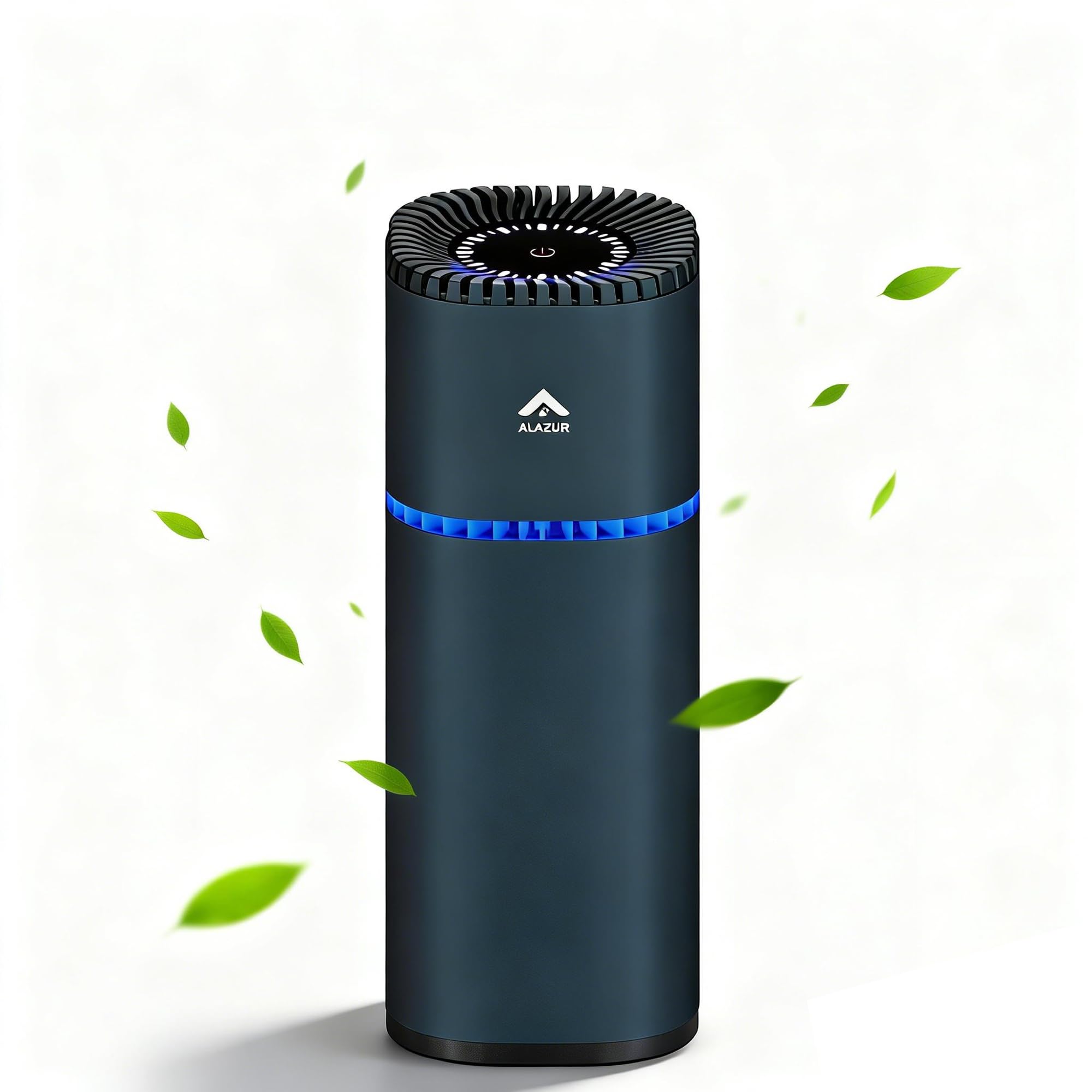
A cordless, filterless ionizer for the car console, nightstand, or desk, with no filters to buy.
For buyers who want one purifier to handle several spots, the ALAZUR is the most flexible pick on this list. It covers up to 216 square feet from a body 2.48 x 2.48 x 6.3 inches and 15.2 ounces, and it runs filterless — no replacement parts, no recurring cost. A cup-holder base keeps it stable on the move, and a rechargeable battery means it works away from the car as well.
Buyers describe it as well-made and easy to operate, and it takes on tough jobs in real-world testing — stale food, work truck, dog smell, and it holds its charge for weeks on the timed cycles. That said, the timed intensive modes are not something you want running while you are in the seat: the manufacturer’s own note is that these modes should only be used in unoccupied spaces with the doors and windows closed, then aired out before you get back in. That is worth taking seriously, and it means the deep-clean cycles are something you schedule, not a commute-long companion.
The trade-off against the Aucleia is coverage versus convenience. The ALAZUR handles a bigger space and sits in more locations thanks to cordless power, but it relies on ions rather than HEPA filtration, so it does not physically trap particles the way a filter does. Think of it as the stronger travel and multi-space option, and the Aucleia as the more direct filter-in-the-cabin choice for heavy particulates.
Worth grabbing if: you need one purifier that works in a car, then a bedroom, then a hotel room, and you would rather not buy filters on a schedule.
Pass if: you want HEPA-level particulate filtration in the cabin during every drive — a plug-in HEPA model is the better match there.
6. LUFTRUM Car Portable Air Purifier with H13 True HEPA Filter

A 4-stage HEPA unit with a PM2.5 sensor and auto on/off tied to your ignition.
If the air in your commute is the problem — not just the smell of last night’s takeout — the LUFTRUM is the pick built for it. It runs a 4-stage filtration system designed specifically to pull car exhaust, plastic off-gassing, and VOCs down to 0.3 microns, which is a much finer trap than a standard HEPA layer reaches on its own. The 5300 RPM fan cycles the air at 10 passes per hour, a 6-minute full filtration cycle per pass, on a fan rated for up to 60,000 hours of service life — which is a lot of school runs and road trips before it needs replacing.
The cleverest part is the built-in PM2.5 sensor. It reads the fine-particle level in the cabin in real time, so you are not guessing whether the air is actually improving — you watch the number drop. Combined with 3-speed fan control and an auto-on/auto-off feature that ties the unit to your engine ignition, it is designed to work without you ever pressing a button. That hands-off behavior is the reason it lands so well with high-mileage drivers and delivery vans — one owner noted commuting 250 miles a day in an older van and appreciating how it kept pace without any input.
Where it needs honest sizing: the LUFTRUM is a HEPA machine first and a personal comfort feature second. The 5300 RPM fan is audible on the highest speed, and the included cord is long enough for most installs but not all — buyers have found they needed a splitter or extension to reach the driver’s seat in some vehicles. It is also heavier at under a pound but not a featherweight, so a cup-holder placement is not an option the way it is for smaller units.
What makes the case for it
- 4-stage HEPA filtration targeting 0.1-micron particles, including exhaust fumes and VOCs
- Real-time PM2.5 sensor so you can see the air quality change
- Auto on/off with ignition — zero hands-on management
Honest caveats
- Fan is audible on the highest setting
- Included cord can be too short to reach some power sockets from a dash or armrest installation
Best for drivers who: sit in traffic and care about what is actually in the air — commuters, delivery vans, and anyone sensitive to exhaust or VOC exposure.
Check the install: before you buy, confirm where the power socket sits relative to your intended mount, since the cord may need an extension in some cabins.
7. IQAir Atem Car Portable HyperHEPA Air Purifier

The filtration ceiling of this list — engineered down to particles that most filters never touch.
IQAir’s Atem Car is the unit to consider when you want the finest filtration available in this category, and the numbers back that up. Its HyperHEPA filter is rated to capture particles down to 0.003 microns — the maker claims that is up to 100x finer than traditional HEPA — gathering everything from mold, pollen, and dust to smoke, NO2, SO2, pet dander, and ultra-fine biocontaminants. For someone commuting through traffic or living near a freeway, that filter grade is the entire pitch, and it earns it.
Installation is as car-specific as it gets: a headrest mount positions the unit directly behind or above the seat, which means the filtered air blankets your head zone rather than the whole cabin. An owner who was concerned about freeway pollution near their home reported noticing a clear difference in cabin air within a week of commuting, and attributed it to exactly that placement. A 6-ft power cord connects to the car’s outlet, so there is no charging routine to remember — it runs whenever the vehicle does.
What you pay for is the filter technology, and the trade-offs come with that territory. The app is a frequent point of friction — it requires full phone location services to work, which is more invasive than most buyers expect from a car accessory, and some owners prefer physical controls over app-based operation. The filter-life indicator has also been called unreliable by at least one user, who reported it still showing 97% after years of use. The Atem is also heavier than the other picks at 5.28 pounds, so plan the room for it before install.
What the extra spend buys: the closest thing to hospital-grade filtration this list offers. If you are in heavy traffic daily and want the finest particulate cutoff available, the Atem delivers it and then some.
Justified for: allergy-sensitive drivers, freeway commuters, and anyone whose primary concern is the smallest airborne particles rather than cabin smell alone.
A step too far if: you mainly want to remove everyday smells — the LUFTRUM handles exhaust and VOC filtration well for a fraction of the complexity.
Understanding the Specs
H13 HEPA and filtration grade
HEPA stands for High-Efficiency Particulate Air, and the number after it tells you how fine a particle the filter can trap. An H13 grade captures 99.97% of particles down to a set size, which is what makes it effective against smoke, fine dust, and pet dander. A True HEPA filter is a physical mesh — particles get caught in the fibers and stay there until you replace the filter. A pre-filter in front of it catches the bigger stuff like hair and lint so the HEPA layer lasts longer, and a carbon layer behind it handles odors and gases. When a unit claims 99.97% purification, that refers to particulate capture, not to killing germs or eliminating every odor molecule — those are different jobs handled by different filter stages or technologies.
Ionizers, plasma, and ozone
An ionizer works differently from a HEPA filter — it releases charged particles called ions into the air, which cause dust and smoke particles to clump together and drop out of circulation. A filterless ionizer never needs a replacement, which is why it appeals to buyers who want zero maintenance. However, some ionizing technologies can produce trace amounts of ozone as a byproduct, and that is why ozone-free and ozone-safe labels matter on any unit you plan to run in a closed cabin. Manufacturers with a CARB certification in this category have met California’s ozone emission standard for indoor air cleaning devices. For heavy smoke or fine particulate, HEPA filtration remains the more direct method; for persistent odor in a light use case, an ionizer with no filters is a low-effort alternative.
FAQ
Will a car air purifier actually help if my cabin already has a filter?
Do I need a HEPA filter or an ionizer for smoke smell?
Can I run a car air purifier while I’m driving with the windows up?
How often do I have to replace the HEPA filter?
Is a car air purifier worth it for a rideshare driver?
Will a portable purifier work in an SUV or van?
Does a car air purifier produce ozone?
Can I use a rechargeable car purifier at home too?
Do I need to keep the car running for the purifier to work?
Which car air purifier is best for someone with allergies?
Final Thoughts: The Verdict
For the money, the car air purifier that wins this list is the Air Purifiers for Home, Plug-in, H13 True HEPA Filter — 16 dB of near-silent operation, three-stage filtration that actually touches odors, and a footprint that fits a center console without fighting for space. If your main problem is exhaust fumes and cabin air quality rather than smell, the LUFTRUM Car Portable Air Purifier delivers 4-stage filtration and a real-time PM2.5 sensor. And if you want the finest particulate capture available regardless of cost, the IQAir Atem Car is the ceiling of this category. All three cut what you breathe on your commute — pick the one that matches your main complaint.
How We Picked
We do not accept paid placement. Every pick is matched to a real buyer and a real use-case; we do not hands-on test units.
Sources & Methodology
Specifications: manufacturer listings and product documentation. Review insights: verified customer reviews, as of September 2026. Pricing: not shown on this page (it changes often); check the current price via the retailer link.
As an Amazon Associate, Gadgets Feed earns from qualifying purchases. This does not affect which products we feature.