
Our readers keep the lights on and my morning glass full of iced black tea. As an Amazon Associate, I earn from qualifying purchases.
Specs are compiled from manufacturer listings and verified buyer reviews and can change over time — please confirm the key details on the product page before buying.
You spent good money on a sub and an amp, and now every hard bass note makes your headlights dip. A car audio capacitor is the fix — it stores power right next to your amplifier and releases it on the beat, so your amp never has to beg the car’s electrical system for a burst of current. The catch is that the farad rating (a measure of how much energy the cap can store) has to match your system’s wattage. Buy too small a cap and the dimming stays. So here is the short answer: match the farad number to your amp’s wattage, decide if you want a voltage display, and pick a unit from the seven below.
I’m Min — the founder and writer behind Gadgets Feed. This guide is built by comparing the manufacturers’ published specifications and the patterns across verified customer reviews, so you get each pick’s real strengths and trade-offs instead of marketing spin.
Farad rating, voltage ceiling (the maximum voltage the cap can handle), and wiring compatibility are the three things that decide whether a capacitor actually helps, and every pick on this list has been matched to a real system size, from a modest 250-watt setup to a 4000-watt wall of bass. The picks range from a 1.0 farad entry unit to a 4 farad workhorse, and each one has a clear job. Read on for the car audio capacitor that matches your amp’s wattage and stops the flicker.
Our Picks at a Glance


How To Choose The Best Car Audio Capacitor
Before you buy anything, you need two numbers in your head: your amplifier’s total RMS wattage (the continuous power it puts out, not the peak) and your car’s charging voltage. Those two numbers decide the farad rating you need. Get them wrong and the capacitor sits there doing nothing while your headlights keep flickering.
Match the farad rating to your amp’s real wattage
A farad is a unit of stored electrical energy. The rule of thumb in this category is roughly one farad for every 1,000 watts of total system power. A 1.0 farad cap suits systems rated up to around 1,000 watts — that covers a single sub and a modest amp. A 2.0 farad cap is the safe middle ground for systems up to roughly 2,000 watts. A 4 farad cap handles the biggest builds and heavy bass transients. Go too small and the capacitor simply has less stored energy than your amp demands on a hard hit, so the dimming continues.
Check the voltage ceiling against your vehicle
Every capacitor lists a maximum voltage — the highest surge it can survive without damage. A car charging system sits around 13.8 to 14.4 volts running normally, so anything rated 16 volts or higher gives you headroom. Some caps go far above that. If your installation ever includes a modified alternator, a higher ceiling protects the circuitry. The charging resistor included with most caps protects the cap itself during the first charge — that is the step you cannot skip.
Wiring and mounting practicalities
You will also want to know what gauge wire the cap accepts and how it mounts. The best connections use oxygen-free copper cable, and a cap that accepts ring terminals is easier to wire cleanly than one with bare posts. Physically, caps range from compact rectangles that tuck into an amp rack to tall cylindrical units that need vertical clearance. Measure your install space before you commit — and note that a capacitor gets charged and must be handled carefully around the terminals.
Quick Comparison
| Model | Best For | Capacitance | Voltage Ceiling | Mounting Type | Amazon |
|---|---|---|---|---|---|
| Rockville RXC4D★ Best Overall | Big systems with dual LED readouts | 4 farad | 24 volts | Rack Mount | Amazon |
| BULLZ AUDIO 2.2 FaradMost Versatile Pick | Mixed-use setups from 250W to 1450W | 2.2 farad | 12 volts | Pole or Snap-In Mount | Amazon |
| RECOIL R1D | Small systems where space is tight | 1 farad | 16 volts | Panel Mount | Amazon |
| Belva BB2D | Systems up to 2000W with a red readout | 2 farad | 16 volts | Surface Mount | Amazon |
| BOSS Audio CPBK2 | Amp racks needing a big voltage display | 2 farad | 16 volts | Panel Mount | Amazon |
| Sound Storm C22 | Budget builds with OFC wiring | 2 farad | 16 volts | Car Mount | Amazon |
| Belva BB1D | Entry-level systems up to 1000W | 1 farad | 16 volts | Surface Mount | Amazon |
In‑Depth Reviews
1. Rockville RXC4D 4-Farad Car Audio Capacitor with Digital Voltage Display
Our pick — 4.5★ from 450+ verified ratings; the strongest balance of quality and price.
The storage tank for serious bass rigs — four farads is the most headroom on this list
If your amp is big and your charging system is small, this is the one to reach for. The Rockville RXC4D stores 4 farads of energy — the largest reserve on this list. To put that in perspective: the Belva BB1D below holds 1 farad, so the Rockville stores four times as much. On a hard kick drum hit, that extra reserve is the difference between a headlight flicker and rock-steady voltage.
The voltage ceiling here is the most generous in the group: 24 volts. Compare that to the BULLZ AUDIO 2.2 Farad, which caps out at 12 volts — the Rockville gives you double the surge headroom. That matters if you ever upgrade your alternator or run a high-output charging setup, because the cap can absorb a spike the lower-rated units cannot. Around back, the lucite-encapsulated housing includes a red digital voltage display and blue LED metering, plus mounting brackets and a charging resistor in the box. As buyers report: “With a 1000 watt JL amp and 2 12″ subs my voltage stays at around 14 volts.” And the flicker? The dimming complaint is real enough that it is the one mixed note in the data — owners still report some flicker, just less of it.
The physical footprint is honest about what it is. At 5.32″W x 3.54″H, it is 18% wider than the Belva BB1D — bigger than most buyers expect, and one owner-sized note in the data warned it fits where the old capacitor sat only if you measure first. The quality score is the strongest signal here: 50 mentions, the most-praised aspect by a wide margin, with value for money next at 30. What wins people over is the combination of storage and build — the housing is heavy and rigid, and the digital readout gives you real-time confirmation that your voltage is where it should be. If you are running 4,000 watts, this is the class of capacitor that makes sense. If you are running a 250-watt starter setup, it is more tank than you need.
What earns its keep
- 4 farads of stored energy — the largest reserve here, four times the Belva BB1D
- 24-volt ceiling gives twice the surge headroom of the BULLZ AUDIO 2.2 Farad
- Complete kit: mounting brackets, unbreakable hardware, and charging resistor included
- Red digital display plus blue LED charge/discharge metering for at-a-glance voltage checks
- Integrated negative polarity protection guards the amp from a backwards connection
Where it asks you to compromise
- At 5.32″W x 3.54″H it is 18% wider than the Belva BB1D — measure your install spot
- The bright red readout glows hard; one build had to tape over it so it would not light up the cabin
- Overkill for systems under roughly 1,000 watts
Built for: high-wattage builds — think 2,000 watts and up — where you want the most stored energy and the highest voltage ceiling available here.
Look elsewhere if: your amp is a modest single-sub setup; a 1.0 or 2.0 farad cap will do the same job with less bulk and less glow.
2. BULLZ AUDIO 2200 Watt 12 Volt BCAP Digital Car Power 2.2 Farad Capacitor
One cap that scales from a starter amp to a 1450-watt wall without complaint
If you are not sure how far your build will go, the BULLZ AUDIO BCAP carries 2.2 farads — a touch more stored energy than a plain 2.0 farad unit — and it lands in a balance for systems that sit between 250 watts and roughly 2,200 watts. As owners mention: “Works well on both cheap (250W) and high-power (1450W @ 1 ohm) setups.” That kind of range is unusual for a single cap, and it means you can buy once and grow your system into it.
The 12-volt maximum is where this one parts ways with the Rockville above. Where the Rockville’s ceiling is 24 volts, the BULLZ caps at 12 — so it is built for a standard car charging system, not a modified high-output setup. The 2.2 farad rating and the low ESR (Equivalent Series Resistance — a measure of how freely the cap passes current) mean it charges fast and releases that charge quickly on a heavy bass hit. The housing is round and compact compared to the boxy Belva units, and the pole or snap-in mounting keeps the install tidy.
The honest catch is the auto shut-off feature and the charging circuit. Auto shut-off is the highest-mention aspect in the data and it comes in mixed — some owners love that the cap powers down with the vehicle, others report the blue LED and voltage display staying lit and slowly drawing on the battery. There is a separate report of a unit that would not charge past around six volts, and the data notes the resistor (a small part that limits current during charging) is not included, so you supply your own. With tight connections, this cap delivers a compact, good-looking 2.2 farad unit that covers 250W to 1450W setups for the money. The appearance is the top positive aspect in the data — it is a good-looking piece of gear under the seat or on the amp board.
The real selling point: range. Very few capacitors in this category claim to cover both a 250W starter amp and a 1450W monster build, and that flexibility is exactly what a system you plan to upgrade needs.
What to plan around: the 12-volt ceiling means no headroom for a modified charging system, and the auto shut-off behavior is inconsistent enough that you should wire it with care and check that the LED actually goes dark when the car is off.
Go for it if: you want a compact, attractive cap that can follow your build from a small amp up to a 1450-watt setup and you are working with a standard charging system.
Pass on it if: you run a high-output alternator or need a ceiling above 12 volts — the Rockville RXC4D covers that ground with far more headroom.
3. RECOIL R1D 1 Farad Car Audio Energy Storage Reinforcement Capacitor

Trim footprint, sturdy shell — a small-system cap that feels far heavier than its size suggests
For the install where space is at a premium and the amp is modest, the RECOIL R1D is the tidy choice. It stores 1 farad — the same reserve as the Belva BB1D below — and is sized for systems up to 1,000 watts. Its distinctive angle is physical: buyers consistently describe it as beefy and heavy, a solid chunk of aluminum, ceramic, and plastic that feels like a serious component rather than a hollow shell. It weighs more than its footprint suggests, and that heft translates into a build that sits firm once mounted.
The 16-volt ceiling is a step up from the 12-volt BULLZ unit above, and the 10-to-16 volt DC operating range means it works with a normal charging system without stress. Functionality is what carries this one — by far the top-cited aspect in the data, with value for money running a clear second. Customers note it does exactly what a small cap should: it supplies extra power to the amp on the hard hits, cleans up the mids and highs, and holds voltage without a drop. Blue digital voltage readout, low ESR, and automatic shutoff protection round out a genuinely functional package.
The catch is the size of the solution. At 1 farad, this cap fixes voltage sag on a small system — one owner ran it with a 500W monoblock amp and a 12″ sub and still saw lights dim at idle, an outcome that depends on the cap simply being too small for that load. The battery life note in the data is mixed, so if your alternator is weak you may want to look at a bigger cap or address the charging system first. For a sub-1,000W setup on a healthy electrical system, though, this is a compact, well-made piece that does its job and looks good doing it. The ring-terminal input accepts any gauge of wiring, which makes a clean install easier.
The high points
- Compact round housing fits amp racks where boxy caps will not
- 16-volt ceiling and 10-to-16V DC operating range
- Low ESR for fast charge and discharge on bass hits
- Ring terminals accept any gauge of wire for a cleaner harness
- Automatic shutoff protection built in
Worth knowing
- 1 farad is not enough storage for high-wattage builds — one 500W setup still saw dimming at idle
- The mixed battery-life note means a weak charging system could still struggle
Worth it for: small-system installs — a single sub and an amp up to 1,000 watts — especially when you are short on mounting space and want a cap that looks and feels substantial.
Think twice if: you are anywhere near 1,500 watts or more; the storage here is not enough and a 2.0 or 4 farad cap will serve you better.
4. Belva BB2D 2.0 Farad Capacitor with Digital Red Display, Perfect for Systems up to 2000W

The middle-ground Belva that covers up to 2000W in a tidy surface-mount box
If your system sits above what a 1 farad cap can support but you do not want the bulk of a 4 farad unit, the Belva BB2D is the natural landing spot. It stores 2 farads and is rated for systems up to 2,000 watts, which covers a large share of real-world builds. The quality theme runs through the owner data more than anything else — the most-praised aspect by a wide margin, with value for money and appearance following. Owners describe it as solid, well-made, and neatly finished, and the red digital display makes the install look intentional.
Its dimensions match the smaller Belva BB1D almost exactly — 4.5″W x 3.5″H — so it fits the same surface-mount footprint despite carrying twice the capacitance. That is the practical win here: double the storage without giving up space. The 16-volt ceiling and the surface-mount brackets work with a standard charging system, and the audible warning feature gives you a signal if something is wrong on the connection side. Ring terminals and a charging resistor come in the box, though the data notes the resistor’s procedure is worth reading carefully — one owner relied on a light bulb in series instead for the first charge and discharge.
Where you should pause: charging behavior and durability are the two areas with mixed-to-negative signals in the data. Most owners cut voltage drop on hard bass hits successfully, but a share report charging troubles, and the plastic clamps have drawn durability complaints. Treat the clamps with care and double-check your first charge and this cap delivers the 2 farad reserve its rating promises. For a beginner-to-mid build under 2,000 watts, it is a sensible, trustworthy pick — the kind of cap that gets you out of dimming without overbuying capacity you will never use.
The practical read: the same small Belva footprint with double the storage of the BB1D below, rated for systems up to 2,000 watts, with a red display that tells you your voltage at a glance.
Plan for this: follow the first-charge procedure exactly — the mixed charging reports make the resistor step non-negotiable — and handle the mounting clamps gently, as plastic-clamp durability is a noted weak point.
Best fit: a system between roughly 1,000 and 2,000 watts where you want more storage than a 1.0 farad cap but do not need the bulk of a 4 farad unit.
Skip if: your build runs past 2,000 watts, or you want a cap with a larger surge ceiling than 16 volts — the Rockville RXC4D takes both of those jobs.
5. BOSS Audio Systems CPBK2 Car Capacitor – 2 Farad, Energy Storage, Enhance Bass From Stereo, 3 Digit Voltage Display, Charging Status LED
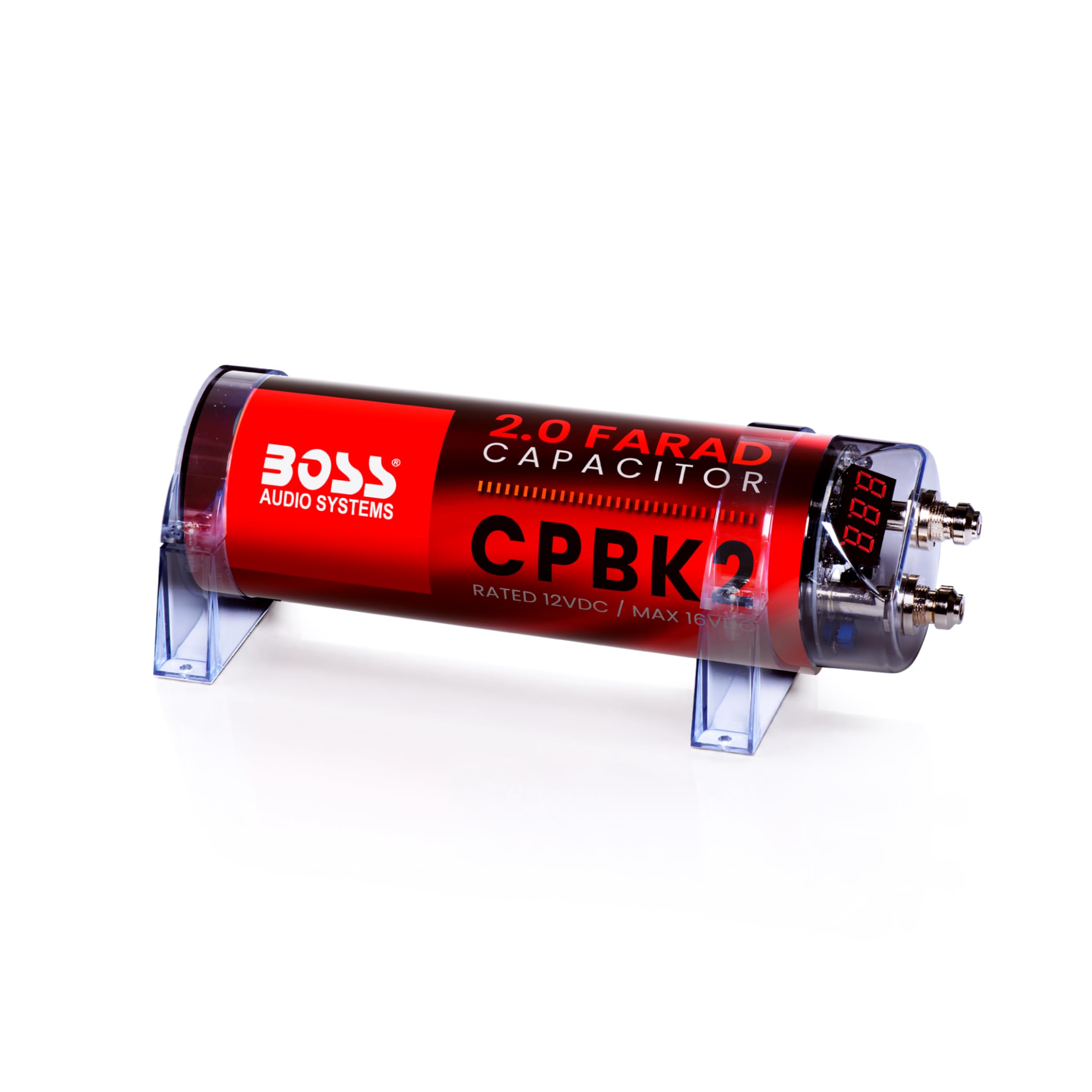
A tall display-forward cap that treats your amp rack like a dashboard
For the buyer who wants to actually see what the electrical system is doing, the BOSS Audio CPBK2 leads with information. It carries a 3-digit voltage display that is accurate to within plus or minus 0.1 VDC (volts of direct current) — a tight tolerance that lets you trust the number you are reading. It also throws in a charging status LED and audible warning tones for low battery voltage and an over-voltage condition. That combination makes it the most informative 2 farad cap in this group, and it earns its place for anyone who likes watching their voltage hold steady on a hard hit.
Functionality is the aspect owners cite most by a striking margin, with installation and lighting dimming tied for a clear second. In real terms: reviewers point out zero dimming of vehicle lights on a range of setups, and the natural fit that surprises people is using the cap as a distribution block. The tall, narrow shape (3″W x 10.3″H) makes it easy to run wiring through it, so the amp rack stays cleaner than it would with a separate distribution block. Two farads give it the storage to smooth out bass transients, and the working voltage runs to 16 VDC — same ceiling as the RECOIL and the Belva BB2D above.
The honest trade-off is a size-versus-output mismatch on the biggest builds. Power capacity is a mixed area in the data: owners crank a 675-watt RMS system with no clipping, but some report that a 1,600-watt amp is beyond what this cap can support. Durability also carries a negative note in the review data, so treat the housing with a little care during the install. If your system sits in the 300-to-1,000 watt range and you want the clearest readout in the group, this is a strong buy. If you are pushing a 1,600-watt amp, you will want to step up to a 4 farad unit like the Rockville.
Why it stands out
- 3-digit voltage display accurate to plus or minus 0.1 VDC
- Charging status LED plus audible warning tones for over-voltage and low battery
- Doubles as a distribution block thanks to the tall, narrow shape
- Reliable zero-dimming performance for small-to-mid systems
What to weigh
- Not the cap for a 1,600-watt amp — the data notes that ceiling is above what it handles
- Durability carries a negative flag, so protect the housing during installation
- Exposed terminal posts — keep the install isolated to avoid shorting
Reach for this if: your build sits in the 300-to-1,000 watt range and you want the most readable voltage display available here plus the wiring convenience of a distribution-block shape.
Go bigger if: your amp pushes past roughly 1,500 watts, where this cap is out of its depth and a 4 farad unit is the safer call.
6. Sound Storm Laboratories C22 2 Farad Car Capacitor for Energy Storage

Four separate warning tones make this the most cautious cap in the group
Where most caps give you a display and leave the diagnosis to you, the Sound Storm C22 talks. It carries audible warning tones for three separate conditions: reverse polarity, low battery voltage, and voltage overload. Reverse polarity is the one that protects your amp — hook the wires backwards and the cap sounds the alarm before damage rolls down the line. It stores 2 farads with a 10% capacitance tolerance and a 16 V / 20 V surge rating, and it is built for systems where you want feedback rather than just a reading.
The voltage ceiling sits at 16 volts, matching the Belva BB2D and the BOSS CPBK2 above. Low ESR (equivalent series resistance, a measure of how efficiently the cap moves energy) keeps the charge and discharge quick, and the manufacturer specifically recommends 4-gauge or 8-gauge oxygen-free copper cable for the cleanest install — that is the wire spec to buy if you want to do this properly the first time. Buyers running serious power report it holding up: one owner ran a 2,500-watt amp on a 2,500-watt sub with no failures, and another solved headlight dimming on a 900-watt RMS 5-channel Alpine setup entirely.
The honest note is that the value story here is mixed in the data. The most-cited aspect in the review data is value for money, and it comes in mixed — some owners consider it fantastic for what they paid, others feel it does not deliver. There is also a report of a unit that would not charge and a voltmeter that did not read, so buy from a source with a straightforward return path and test the cap on the bench before you mount it. The audible warnings, the 2 farad storage, and the 3-year parts and labor coverage give this cap a real case for a carefully-installed budget build. At this price, the 2 farad storage and four warning tones earn it a spot in a carefully-installed budget build.
What it does well: four warning functions, 2 farad storage, and OFC wire guidance make this a cap you can install confidently and audit at a glance — especially useful if you are learning as you build.
The honest caveat: mixed value reports and an occasional dead-on-arrival unit mean you should bench-test this cap and keep the packaging until you have confirmed it charges and reads correctly.
Choose this if: you want a 2 farad cap with real diagnostic feedback — audible alarms for wiring mistakes and voltage problems — and you are comfortable bench-testing before the install.
Look at the Belva BB2D instead if: you would rather have a more consistent quality record and a simpler install with fewer moving parts.
7. Belva BB1D 1.0 Farad Car Audio Power Capacitor with Red Digital Voltage Display

The cheapest way onto the board — a compact 1 farad cap for a modest single-sub setup
If your build is small and you just want the dimming gone, the Belva BB1D is the entry ticket. It stores 1 farad and is rated for systems up to 1,000 watts. That is the same reserve as the RECOIL R1D above, but the Belva comes in a slightly smaller package (4.5″W x 3.5″H) and includes surface-mount brackets and a charging resistor. It is also the lightest 1 farad cap in this group, so it hangs on a panel without straining anything.
The proof that a 1 farad cap does real work shows up in the owner data. One buyer with a 600W RMS amp and sub reported the cap holding 14+ volts steadily, and another fixed a radio shutdown caused by voltage sag on a ~200W RMS Alpine setup entirely with this unit. The 16-volt ceiling matches the RECOIL and the Belva BB2D, and the red digital display gives you the same at-a-glance voltage feedback you get from pricier caps. Auto shutoff protection and mounting brackets are in the box, and the appearance earns specific praise in the data — the top positive aspect cited, quality running second.
What to know before you buy: charging behavior is the most-discussed area in the data and it comes in mixed. Some units charge slowly, and the included resistor has a reputation for being the slow route — buyers recommend keeping the resistor even after the install, and being patient on the first charge. A small number report units that never turn on at all, so test the cap before you mount it. For a modest rig under 1,000 watts, this 1 farad cap covers the job at an entry-level price. It is not the choice for a 2,000-watt wall of bass — for that, step up to a 2.0 or 4 farad unit like the ones above.
The entry play: 1 farad of storage in the smallest, lightest body here, with a red voltage display, surface-mount brackets, and automatic shutoff protection — plenty for a single sub and a 600-to-1,000 watt amp.
Do this first: bench-test the cap before mounting it, and be patient on the initial charge — the mixed charging reports make the included resistor the step to get exactly right.
Suits you if: your system is under 1,000 watts, you want a real voltage readout, and you are shopping at the entry end of the range for a simple install.
Outgrown quickly if: you plan to add amps or subs — 1 farad has a ceiling and any meaningful upgrade will want a 2.0 or 4 farad cap.
Understanding the Specs
Capacitance (measured in farads)
Capacitance is the size of the cap’s energy tank. One farad stores a small reserve; four farads store four times as much. The practical rule for this category is roughly one farad for every 1,000 watts of amp output — a 1.0 farad cap suits builds up to around 1,000 watts, a 2.0 farad unit fits up to about 2,000 watts, and a 4 farad cap covers the biggest rigs. Buy too small and the cap’s reserve runs dry on the hard hits, so the dimming you were trying to fix sticks around.
Voltage ceiling and ESR
The maximum voltage is the highest surge the cap can absorb without damage. A normal car charging system runs a little above 12 volts, so a ceiling of 16 volts gives you headroom, and higher-ceilinged units can survive a modified alternator or a charging spike. ESR (Equivalent Series Resistance) measures how freely the capacitor passes current — a lower number means faster charge and discharge, which matters more the harder your amp hits. Both numbers appear in the specs of every pick on this list.
FAQ
What size car audio capacitor do I need for my amplifier?
Will a capacitor stop my headlights from dimming on bass hits?
How do I charge a car audio capacitor before installing it?
Is a 1 farad capacitor enough for two 12 inch subs?
Does a capacitor actually help or is a bigger alternator better?
What does the voltage display on a car capacitor actually show me?
Can a capacitor damage my amplifier or battery?
What gauge wire should I use to wire a car audio capacitor?
Do I need a capacitor if I already have a second battery?
How long does a car audio capacitor last?
Final Thoughts: The Verdict
For most builds, the car audio capacitor that earns the top spot is the Rockville RXC4D, because it holds the largest reserve on this list at 4 farads, and its 24-volt ceiling gives you the most headroom of any pick here. That combination covers everything from a modest single-sub setup to a 4,000-watt wall of bass. If you run a smaller system and want the most readable voltage display in a compact box, grab the BOSS Audio CPBK2. And for an entry-level build up to 1,000 watts where you just want the flicker gone, the Belva BB1D is the straightforward, affordable way in. Any of the three will do the job — the Rockville is simply the one with the most room to grow.
How We Picked
We do not accept paid placement. Every pick is matched to a real buyer and a real use-case; we do not hands-on test units.
Sources & Methodology
Specifications: manufacturer listings and product documentation. Review insights: verified customer reviews, as of September 2026. Pricing: not shown on this page (it changes often); check the current price via the retailer link.
As an Amazon Associate, Gadgets Feed earns from qualifying purchases. This does not affect which products we feature.