
Our readers keep the lights on and my morning glass full of iced black tea. As an Amazon Associate, I earn from qualifying purchases.
Specs are compiled from manufacturer listings and verified buyer reviews and can change over time — please confirm the key details on the product page before buying.
The moment you hear that whine rise with the throttle, you know the signal path is the weak link in your install. A good set of RCA cables is the difference between a system that disappears into the music and one that constantly reminds you it’s there. This guide breaks down the picks that actually keep noise out and signal clean.
I’m Min — the founder and writer behind Gadgets Feed. This guide is built by comparing the manufacturers’ published specifications and the patterns across verified customer reviews, so you get each pick’s real strengths and trade-offs instead of marketing spin.
You want your music to come through clean, without engine whine or static, and the car audio rca cables you pick decide that. The key is how well they block interference (shielding), what the wire inside is made of (conductor purity), and how solid the plugs are (connector quality).
Our Picks at a Glance


How To Choose The Best Car Audio RCA Cables
An RCA cable carries the low-voltage audio signal from your head unit to your amplifier. Because that signal is weak, it’s easy prey for interference from engine electronics and power wires. Picking the right cable is really about defending that signal.
Look for Shielding and Twisted-Pair Design
Shielding wraps the inner conductor in a protective layer, like a grounded metal blanket, to keep outside electrical noise from leaking in. Twisted-pair construction twists the two conductors around each other, which helps cancel out hum and static before they reach your amp. Both are your best defense against that dreaded whine.
Conductor Material Matters: OFC vs. Standard Copper
Oxygen-free copper (OFC) is copper refined to remove impurities and oxygen. The result is lower resistance and better conductivity, which means the signal arrives stronger and cleaner. Pure, high-count copper also stays flexible, making it easier to route through tight dashboards and door sills without kinking.
Connector Quality: Plating and Grip
The ends of the cable see the most wear. Gold plating resists corrosion and provides a clean contact point, while nickel plating is tougher and a common choice in car installs. Equally important is the grip of the connector on your amp’s input jack — a loose fit is a sure path to intermittent sound and noise problems.
Quick Comparison
| Model | Best For | Conductor | Design | Length | Amazon |
|---|---|---|---|---|---|
| Primeda Audiophile★ Best Overall | Audiophile-grade single runs | 4N OFC | Shielded | 3 feet | Amazon |
| RECOIL RCI217-2Quiet Runner | Engine-noise rejection | 100% OFC | Twisted Pair | 17 feet | Amazon |
| Stinger SI6217 | Flexible routing | OFC | Twisted Pair | 17 feet | Amazon |
| CNCESS 12 Gauge | Short, interference-free runs | 12AWG | Coaxial Shielded | 2 feet | Amazon |
| RECOIL RCI412 | 4-channel amp installs | 99.99% OFC | Twisted Pair | 12 feet | Amazon |
| Install Link | Long, flexible single runs | OFC | Double Conductor | 20 feet | Amazon |
| DS18 R16 | Simple single-line routing | OFC | Braided | 16 feet | Amazon |
In‑Depth Reviews
1. Primeda Audiophile 2RCA Male to 2RCA Male Stereo Audio Cable
Our pick — over 4.5★ from 950+ verified ratings; the strongest balance of quality and price.
The studio-grade contender that replaces far pricier names with a braided sheath and a tight, confident grip.
This Primeda cable is for the listener who hears the difference between a good connection and a great one. It uses a high-density 4N oxygen-free copper core (copper with impurities removed for cleaner signal flow) wrapped in shielding that fights outside electrical interference. Buyers report a fuller, wider soundstage with added depth that makes the system feel more alive.
The build is a genuine standout at this level. Ultra-thickness 3U gold-plated connectors resist corrosion, and the polished metal rings with arrow marks help you keep signal direction straight when wiring from a CD player to an amplifier. A red-and-black braided weave adds durability while keeping the cable flexible enough for tidy routing. At just 0.18 kg, it is noticeably lighter than the RECOIL RCI412’s 0.27 kg, which speaks to its streamlined single-cable design.
The recurring praise centers on quality — over 130 owners single out the overall construction, and value for money is the second-most-cited strength. One honest caveat: this cable runs high capacitance, which some phono cartridge setups may find limiting, so if you’re feeding a moving magnet turntable specifically, do your homework first.
budget shielded: you want premium-level sound and build without paying for a brand name.
flexible needs: you need a long run across the car or are wiring a phono cartridge that’s sensitive to capacitance.
2. RECOIL RCI217-2 17ft 2-Channel RCA Audio Cable
The truck-install hero that banishes engine whine and fits a 17-foot route with zero static.
When a 2002 Tacoma’s old RCAs let in a steady engine whine, this Recoil cable was the cure. Its 100% oxygen-free multi-strand copper core works with twisted-pair technology (two conductors braided to cancel interference) to keep the signal clean from head unit to amp. Owners mention zero static even after a full subwoofer install.
At 17 feet long, it gives you real flexibility for routing around seats and door sills, and the flex frosted PVC jacket keeps it pliable in tight spaces. Nickel-plated split-tip connectors grab the input firmly for reliable contact. The consensus is strong: it delivers excellent value for money and solid performance, with durability that suits a daily-driver build.
The one mixed note is noise level in certain setups, with a few owners reporting it picks up engine noise. That’s a reminder that routing away from power wires matters with any cable, regardless of build quality.
long runs: you’re running a long, single pair from a head unit to an amp and want proven noise rejection.
tight spaces: your power and signal wires must run parallel for a long stretch — plan your route first.
3. Stinger 17 Feet 2-Channel Hyper-Flex RCA Interconnect

A 17-foot snake that feels like a soft-touch sleeve and keeps your bass clean and tight.
If routing a stiff cable under carpet or through a kick panel is your nightmare, this Stinger is the relief. The matte soft-touch jacket is genuinely smooth and pliable, and at 17 feet (measured out at 204 inches) it reaches anywhere in a typical car. Oversized OFC conductors keep signal strong over that distance.
Sound quality is the headline — owners note their bass came through cleaner and with better frequency response than their previous RCAs. Directional twisted-pair design plus Mylar shielding (a thin polyester film that blocks interference) work together to protect the signal. Color-coded channels make left-right hookup straightforward.
The fair caveat is the connectors: a few owners find they fit loosely on the amp’s inputs. It’s not universal, but it’s worth a snug check during install. The wins — clean sound and an easy-to-live-with cable — carry it for most buyers.
flexible install: an easy install where flexibility and a clean, tight bass response are the goals.
tight budget: your amp jacks have worn or oversized posts that need an extra-tight connector grip.
4. CNCESS Low Noise 12 Gauge Premium RCA Audio Line Patch Cable (2 Feet)
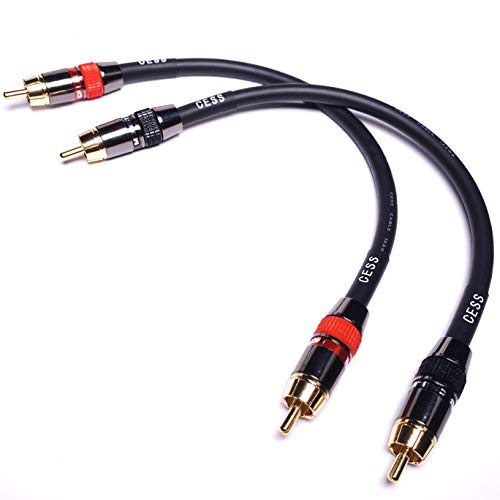
A short, thick 12AWG patch that killed the RF buzz two other sets couldn’t shake.
For a 2-foot run between a processor and an amp, this CNCESS cable is the quiet specialist. It’s built from 12AWG coaxial cable (a thick center conductor inside a shielding layer) to block EMI and RFI, the electrical noise that ruins a signal. In a camper trailer, it was the third set tried — and the one that finally eliminated the buzzing from the amp.
Each end is wrapped in waterproof glue and a heat-shrink sleeve for lasting protection, and the embedded, color-coded rubber rings give your fingers a firm grip when pushing the 24k gold-plated connectors home. Owners call it thick yet supple, well insulated, and visually reassuring. It measures exactly 2 feet, so it’s strictly a short-hop tool.
Flexibility gets mixed reviews — some find it surprisingly bendy, others note it’s not the most flexible. Either way, it’s heavy shielding doing its job. Quality is the clear theme, with owners noting a clean, hiss-free signal over a solid connection.
low noise: you need a short, heavily shielded patch to stop interference between two components.
easy routing: your run is longer than a couple of feet — this one is built for tight, specific hops.
5. RECOIL RCI412 12ft 4-Channel RCA Audio Cable

A 12-foot quad-runner with a premium feel that carries four channels without static or popping.
Wiring a 4-channel amplifier means running four separate signals, and this Recoil bundles two pairs into one tidy cable. It uses 99.99% oxygen-free multi-strand copper with twisted-pair technology to keep maximum signal transfer free of static and popping. Owners describe it as strong, thick, and premium to the touch.
The 12-foot length suits a typical front-and-rear speaker setup, with enough slack to route cleanly. Nickel-plated split-tip connectors hold firmly in the amp, and the flex frosted PVC jacket makes the quad cable easier to bend than you’d expect. At 0.27 kg, it’s the heavier of the two Recoils here, reflecting the extra conductors inside.
Build quality is what owners praise most. Sound performance draws mixed notes — many report clean, quiet operation for car installs, while a few hit persistent hum in specific setups. For most amp-to-speaker runs, it delivers exactly what the label promises.
multi-channel: a four-channel amp install where one cable should handle both front and rear pairs.
longer runs: if your amp sits far back, 12 feet may come up short — plan the route before ordering.
6. Install Link RCA Audio Cable (20 Feet) 2-Male, Subwoofer & Stereo (OFC)

The 20-foot budget workhorse that feels heavier and connects more firmly than its price suggests.
When your amp sits in the trunk and the head unit is up front, 20 feet of reach is a lifesaver. This Install Link cable stretches from dashboard to trunk with room to spare, and owners say the improvement in sound is immediate. The high-grade oxygen-free copper core keeps resistance low over that long distance.
The soft, flexible silicone jacket (called SoftFlex) resists temperature swings and UV rays while staying easy to thread through tight spaces. Owners say the connectors bite firmly into inputs, and the cable feels heavier and looks higher quality than expected. It’s a genuine value pick for extended runs.
The honest flag: a small number of owners hit a grounding issue that caused a hum in the subwoofer. It’s not a pattern across the board, and value for money is still the most-cited strength. If you do meet hum, checking the ground path is the first fix to try.
subwoofer duty: a long trunk-to-dash run where budget and reach matter more than brand cachet.
critical audio: you’ve had grounding trouble in your vehicle before and want maximum insurance against hum.
7. DS18 R16 RCA Cable Ultra Flex 16 Feet

The 16-foot single-line cable that keeps multiple runs slim, tidy, and easy to hide.
Running several RCA cables side by side usually means wrestling with a thick bundle of wires. DS18’s single-line design solves that — each channel is its own slim cable, so routing multiple lines stays manageable without the bulk of a multi-channel jacket. Installers love how easy this makes a clean, professional-looking setup.
The construction pairs oxygen-free copper with a braided jacket for long-term durability, and the dual male connectors work with any standard stereo left/right output. Sound quality earns consistent praise as high-quality gear for any head unit or amp install without the overpriced name. At 16 feet, it covers most car layouts comfortably.
Quality wins people over, with good value close behind. There’s no major recurring complaint — just straightforward, solid performance for a straightforward price.
flexible routing: you’re running multiple cables and want each route slim and easy to conceal.
high power: you need a bundled multi-channel cable for a single tidy pull.
Understanding the Specs
Shielding and Twisted-Pair Design
Shielding is a grounded layer around the inner conductor that blocks outside electrical noise from entering your signal. Twisted-pair construction twists two conductors together so that interference hits both equally and cancels out. Together, they’re your main defense against engine whine and static, especially in a car where power and signal wires run close together.
Oxygen-Free Copper (OFC)
OFC is copper processed to remove oxygen and impurities, which lowers resistance and improves conductivity. You’ll see claims like 4N or 99.99% purity — that refers to how refined the copper is. Higher-purity copper carries the signal more cleanly, though the audible difference can be subtle. What matters more is that pure copper stays flexible and resists the corrosion that degrades sound over time.
Connector Plating and Grip
The connector is where signal meets amp, so its quality matters. Gold plating resists corrosion and keeps a clean contact, while nickel plating is tougher and common in car installs. Split-tip connectors use a split design that grips the input more firmly. A connector that fits loose invites noise and intermittent dropouts — the tightest fit usually wins.
Gauge and Length
Gauge refers to conductor thickness — a lower number like 12AWG means a thicker wire that carries signal with less loss. Length matters because every foot of cable is a chance to pick up noise, so the shortest run that fits your layout is ideal. Long runs need better shielding to stay quiet, which is why budget long cables can disappoint in noisy vehicles.
FAQ
Why do my car audio RCA cables pick up engine whine?
Is gold plating better than nickel plating on RCA connectors?
How long can an RCA cable run before signal quality drops?
What does OFC mean and why should I care?
Can I use home theater RCA cables in my car?
What is a twisted-pair RCA cable?
Does a thicker cable gauge really sound better?
Why do some RCA cables have direction arrows on them?
Final Thoughts: The Verdict
If you want one dependable pick, the car audio rca cables winner is the Primeda Audiophile because it pairs studio-grade build quality with a clear, full sound that owners compare to far pricier brands. If you want rock-solid engine-noise rejection on a long run, grab the RECOIL RCI217-2. And for a flexible, clean-routing install, the Stinger SI6217 is the one to reach for.
How We Picked
We do not accept paid placement. Every pick is matched to a real buyer and a real use-case; we do not hands-on test units.
Sources & Methodology
Specifications: manufacturer listings and product documentation. Review insights: verified customer reviews, as of September 2026. Pricing: not shown on this page (it changes often); check the current price via the retailer link.
As an Amazon Associate, Gadgets Feed earns from qualifying purchases. This does not affect which products we feature.