
Car body filler is the difference between a repair that screams “I was in a crash” and one that blends into the factory sheet metal like it never happened. The wrong filler leaves you with pinholes, shrinkage cracks, and sandpaper that clogs after two passes. The right filler cuts your block-sanding time in half and accepts primer without ghosting every imperfection underneath.
I’m Min — the co-founder and writer behind Gadgets Feed. I’ve spent hundreds of hours cross-referencing technical data sheets, customer failure reports, and real-world cure-time tests to isolate the fillers that actually deliver on their advertised workability and adhesion claims.
This guide breaks down the seven most capable formulas on Amazon right now, from lightweight creams for big dents to fiberglass-reinforced pastes for structural rust repair. After reading, you will confidently choose the best car body filler for your specific repair project.
How To Choose The Best Car Body Filler
Picking the wrong body filler wastes cure time, doubles your sanding labor, and can cause paint failure months later. Three factors determine whether a filler performs or frustrates: the base resin type, the filler’s density and weight, and the work time versus cure speed balance.
Lightweight vs. Standard vs. Fiberglass-Reinforced
Lightweight fillers contain microspheres that make them easier to sand and less prone to sagging on vertical panels, but they sacrifice a small amount of impact strength. Standard polyester fillers (like common Bondo) are denser, cheaper per gallon, and reliable for dent repair on steel panels. Fiberglass-reinforced fillers include chopped strand mat or milled fibers that span gaps and bridge rust holes, making them the only choice when you’re filling perforations or repairing fiberglass boat hulls.
Cure Time and Workability
A filler that cures in 15 minutes sounds great until you have a gallon-sized repair that needs shaping while still soft. Work time (pot life) tells you how long you can spread and contour before the material kicks. Faster curing formulas demand smaller batch mixing and confident application. Slower formulas give beginners breathing room to feather edges, but delay the sanding step.
Stain Resistance and Pinhole Prevention
Cheap fillers bleed through paint layers, especially when moisture wicks through micro-cracks, producing visible rings that ruin a finish job. Vacuum-processed fillers remove trapped air during manufacturing, which virtually eliminates pinholes. Stain-free formulations don’t discolor when basecoat or clearcoat is applied, saving you from having to seal the filler before painting.
Quick Comparison
On smaller screens, swipe sideways to see the full table.
| Model | Category | Best For | Key Spec | Amazon |
|---|---|---|---|---|
| 3M Platinum Plus Filler 01131 | Premium | Professional finish on galvanized steel and aluminum | 15-20 minute cure time | Amazon |
| Evercoat Rage Gold Body Filler | Premium | Stain-resistant repairs under basecoat/clearcoat | 20-minute set time | Amazon |
| Duraglas Fiberglass Filled Filler | Specialty | Rust hole bridging and fiberglass repair | 15-minute full cure | Amazon |
| Bondo Body Filler 00265 | Standard | Classic dent repair on steel and aluminum | Non-shrinking formula | Amazon |
| Evercoat Z-Grip Lightweight Filler | Lightweight | Big dents with easy sanding | Clog-free sandpaper performance | Amazon |
| U. S. Chemical Special Lite Filler | Value | Sculpting and large-area filling on a budget | 0.8 gallon volume | Amazon |
| 3M Bondo 907 Glazing Putty | Spot Repair | Filling pinholes and rock chips before paint | 30-minute sand-ready | Amazon |
In‑Depth Reviews
1. 3M Platinum Plus Filler 01131

The 3M Platinum Plus is vacuum-processed to eliminate air entrapment, so you get a pinhole-free spread that sands to a smooth finish without ghosting every bubble back up during priming. Its adhesive promoter chemically bites into galvanized steel and aluminum, areas where standard Bondo often delaminates after thermal cycling.
Users consistently report that its creamy consistency spreads like thick butter, filling large areas in fewer passes. The tack-free surface sands cleanly with 80 grit without loading the paper — a huge time saver when you’re blocking a quarter panel. Curing remains reliable even at 35°F, extending the working season into cooler months.
The main drawback is the price point, which sits notably higher than commodity fillers. Each gallon includes less catalyst than some competitors, so you may need to buy extra hardener for a full vehicle job. The tack-free, stain-free nature makes it a favorite among pros who can’t afford paint bleed-through on customer cars.
Why it’s great
- Vacuum-processed for pinhole-free finish
- Bonds aggressively to aluminum and galvanized steel
- Sands easily without clogging paper
Good to know
- Premium price relative to standard fillers
- Spare catalyst not included in generous quantity
2. Evercoat Rage Gold Body Filler

Evercoat Rage Gold is engineered with Hattonite, a proprietary additive that reduces friction heat during sanding, allowing you to feather edges aggressively without the paper glazing over. The result is a surface ready for primer in roughly 20 minutes with virtually no pinholes — users describe the finish as “smooth as glass” after a quick sanding pass.
This filler is explicitly stain-resistant, meaning basecoat and clearcoat can be applied directly over it without bleed rings appearing weeks later. It bonds well to galvanized steel and aluminum, and it spreads smoothly enough to use on cosmetic fiberglass and composite repairs, not just metal panels.
Experienced users commonly mix Rage Gold 50/50 with Rage Extra to extend working time on large jobs. The formula sets predictably, and long-term users report zero failures in decades of use. The price is higher than Bondo, but the time saved on sanding — especially sanding out pinholes — more than compensates.
Why it’s great
- Hattonite additive prevents sandpaper clogging
- Stain-resistant under paint layers
- Spreadable with very few air pockets
Good to know
- Higher cost per gallon than standard fillers
- Mixing with Rage Extra recommended for beginners
3. Duraglas Fiberglass Filled Filler
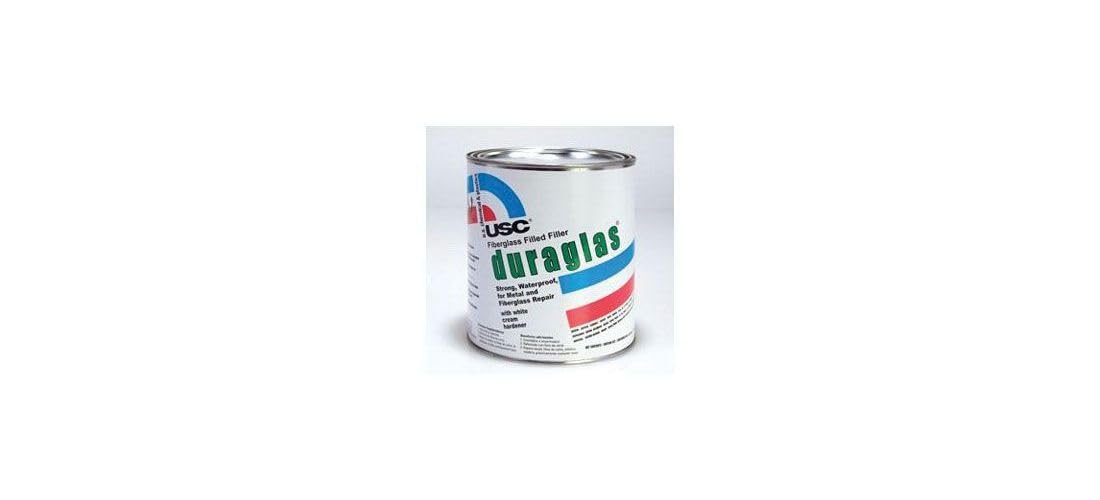
Duraglas embeds short-strand fiberglass fibers directly into the polyester resin, creating a structural filler that bridges small rust holes and reinforces cracked fiberglass without requiring a separate mat layer. This makes it the go-to choice when you’re repairing perforations in floor pans, trunk floors, or boat hulls where standard filler would just fall through.
The blue-green paste kicks fast — fully curable in about 15 minutes, especially in warm weather. Users recommend hitting it with 80 grit while partially cured for easier shaping. The cured material is waterproof, so it works for below-waterline boat repairs where moisture intrusion would destroy standard fillers.
Duraglas is not designed as a finishing filler. The fiberglass strands leave a rough surface that requires a skim coat of standard filler or gel coat to achieve a paint-ready smooth finish. Users also note the material sticks aggressively to spreaders and mixing boards, so disposable tools are recommended.
Why it’s great
- Fiberglass strands span holes and reinforce cracks
- Waterproof for marine and rust repairs
- Fast 15-minute cure cycle
Good to know
- Requires finishing filler for paint-ready smoothness
- Sticks tenaciously to tools
4. Bondo Body Filler 00265

This is the filler that built the category. The 3M Bondo Original Formula two-part compound is a salmon-colored polyester putty that mixes easily, spreads smoothly, and cures in about 20 minutes with minimal shrinkage. It sticks to steel, aluminum, fiberglass, wood, and even concrete, making it the most versatile single can on this list.
Users consistently rely on it for repairing dents, dings, and rusted areas, but also for non-automotive applications like repairing cast iron sewer pipes and filling wood gouges during house painting. The cure time is temperature-dependent — warmer conditions speed it up, cooler conditions extend your working window — but it remains predictable across normal shop environments.
The primary complaint is that the labeled gallon can often arrives only three-quarters full, which feels misleading even though the weight is correct. Bondo also requires proper technique: layering it over bare metal (not over rust or paint) and avoiding excessive hardener that shortens work time and creates brittle spots. For the price, it remains the most accessible entry point for beginners.
Why it’s great
- Proven formula with decades of real-world use
- Works on steel, aluminum, fiberglass, wood, concrete
- Non-shrinking with reliable 20-minute cure
Good to know
- Can volume may appear less than expected
- Requires proper surface prep for best adhesion
5. Evercoat Z-Grip Lightweight Filler

Evercoat Z-Grip is built around a clog-free formula that keeps sandpaper cutting rather than gumming up. The lightweight microsphere construction makes it ideal for large-area repairs where you’d otherwise spend hours block-sanding a heavy traditional filler. Users report noticeably less arm fatigue when working a full door or fender.
Hattonite additive is present here too, reducing friction heat during sanding so you can use 80 grit aggressively without the paper losing its bite. The filler bonds to steel, aluminum, and fiberglass, though it is not recommended for direct application over galvanized surfaces without proper etching primer.
Long-term users praise its consistency — “smooth, spreads easy, and no pinholes” is a recurring theme. The downside is that some units ship poorly packed, leading to lid separation and spillage in transit. The lightweight formula also means less structural strength compared to standard or fiberglass-reinforced fillers, so it’s best for cosmetic fills, not structural bridging.
Why it’s great
- Clog-free sanding reduces sandpaper waste
- Lightweight formula less fatiguing on large jobs
- Smooth, pinhole-free spread
Good to know
- Not for structural or load-bearing repairs
- Packaging can leak during shipping
6. U.S. Chemical Special Lite Lightweight Filler

The U.S. Chemical Special Lite delivers an 0.8-gallon can of lightweight, creamy filler at a price point that undercuts most competitors. The off-white paste mixes smoothly with the blue cream hardener and cures hard within four hours, making it suitable for sculpting, mold making, and large-area automotive body repair.
Users who work with fiberglass and polyester resin find this filler excellent for building support shells when mixed with fiberglass mat. The pot life sits around 10 minutes, giving you enough time to spread across a panel but requiring quick work on larger batches. The cured material sands to a smooth professional finish with minimal pinhole issues.
The biggest complaint isn’t the product — it’s the shipping. Multiple reports describe cans arriving without lid clips or padding, resulting in spilled filler that creates a safety hazard. On vertical surfaces, the lightweight formula can sag if applied too thickly, so multiple thin layers are recommended. If the can arrives intact, the value per gallon is excellent.
Why it’s great
- Large 0.8-gallon volume at competitive price
- Creamy texture spreads easily for sculpting
- Cures hard with smooth sanding finish
Good to know
- Shipping packaging often leads to lid failure
- Can sag on vertical surfaces in thick coats
7. 3M Bondo 907 Glazing and Spot Putty

The 3M Bondo 907 is a two-part glazing putty designed specifically for the final finishing stage: filling pinholes, rock chips, road rash, and sanding scratches after the main filler coat has cured. The black putty comes in 4.5-ounce tubes, and a single squeeze covers a surprising number of small defects.
The 3-minute work time is extremely short — you must mix small batches and apply immediately. Drying is fast enough to sand in 30 minutes, and the cured material sands very smooth without shrinking or staining the paint layer above it. Users report using multiple tubes on a single door to achieve an ultra-smooth finish before primer.
The tube design is both a strength and a weakness: it dispenses directly into small dents without waste, but some units arrive with leaking tubes that create a runny mess. The strong odor demands ventilation, and cleanup requires acetone for tools. For anyone chasing a mirror-smooth paint job, this glazing putty is the finishing touch that hides the last imperfections.
Why it’s great
- Perfect for filling pinholes and rock chips
- Dries fast and sands ultra-smooth
- Tube dispensing minimizes waste
Good to know
- 3-minute work time requires fast application
- Strong odor — use with good ventilation
FAQ
Can I apply car body filler directly over rust?
How thick can I apply body filler in one coat?
Why does my body filler keep leaving pinholes?
Final Thoughts: The Verdict
For most users, the best car body filler winner is the 3M Platinum Plus Filler 01131 because its vacuum-processed pinhole-free formula sands effortlessly and bonds aggressively to problem surfaces like galvanized steel and aluminum. If you want professional stain resistance and the fastest sanding experience, grab the Evercoat Rage Gold Body Filler. And for rust hole repair and fiberglass work where structural bridging matters, nothing beats the Duraglas Fiberglass Filled Filler.