
Our readers keep the lights on and my morning glass full of iced black tea. As an Amazon Associate, I earn from qualifying purchases.
Specs are compiled from manufacturer listings and verified buyer reviews and can change over time — please confirm the key details on the product page before buying.
A front-and-rear dash cam ends the he-said-she-said of a fender-bender with video proof. This guide breaks down the highest-rated dual-channel cameras (a front lens plus a second lens that watches behind you) by what really matters: clarity at night, how wide the lens sees, and whether the recording survives a crash.
I’m Min — the founder and writer behind Gadgets Feed. This guide is built by comparing the manufacturers’ published specifications and the patterns across verified customer reviews, so you get each pick’s real strengths and trade-offs instead of marketing spin.
You want a reliable witness that captures crisp plates both day and night. Our best car camera front and rear picks balance image quality, parking protection, and easy setup for daily drivers.
Our Picks at a Glance
How To Choose The Best Car Camera Front And Rear
Shopping by resolution alone is the biggest mistake. A 4K front image matters little if the rear camera washes out at night or the memory card fills up mid-drive. You want a balanced system where both lenses pull their weight in the conditions you actually drive.
Night Vision is the real test
Most accidents and hit-and-runs happen in low light. Look for a wide aperture (a lens opening that lets in more light, shown as F1.6 or F1.55) and HDR (high dynamic range, which balances bright headlights against dark shadows). A camera with a STARVIS sensor (a Sony chip designed for low-light recording) will read plates that cheaper sensors miss.
Field of view vs. clarity
A 170° front lens captures more lanes and intersections, which is great for evidence. But a wider angle can distort edges and make distant plates harder to read. A 125° lens captures less, but often with sharper center detail. Match the angle to your driving: city drivers benefit from wider, highway cruisers can prefer tighter and sharper.
Storage and the G-sensor
Loop recording (automatically overwriting old footage) keeps the card from filling, but a built-in G-sensor (a small motion detector that feels impacts) locks the current clip so it can’t be overwritten after a crash. Ensure the camera supports a large card — 128GB to 512GB — so you don’t run out during a long trip.
Quick Comparison
| Model | Best For | Front Resolution | Field of View | Max Storage | Amazon |
|---|---|---|---|---|---|
| TERUNSOUl 3-Channel★ Best Overall | Rideshare & cabin coverage | 4K UHD | 170° | 512 GB | Amazon |
| 70mai A410Compact Pick | Compact discreet setup | 2.5K | 125° | 256 GB | Amazon |
| FAIMEE F6Best Value | Wide highway coverage | 4K UHD | 170° | 256 GB | Amazon |
| Coolcrazy N8 | Smooth high-speed footage | 4K UHD | 170° | 256 GB | Amazon |
| 70mai A800SE | Fast wireless transfers | 4K | 140° | 512 GB | Amazon |
| ROVE R2-4K PRO | Serious night driving | 4K | 150° | 1 TB | Amazon |
| REDTIGER F77 | Touchscreen controls | 4K | 160° | 128 GB (built-in) | Amazon |
| Vantrue N5S | Full 360° coverage | 2.7K | 360° | 1 TB | Amazon |
| VIOFO A329S | Maximum storage & cabin view | 4K | 210° (cabin) | 4 TB SSD | Amazon |
In‑Depth Reviews
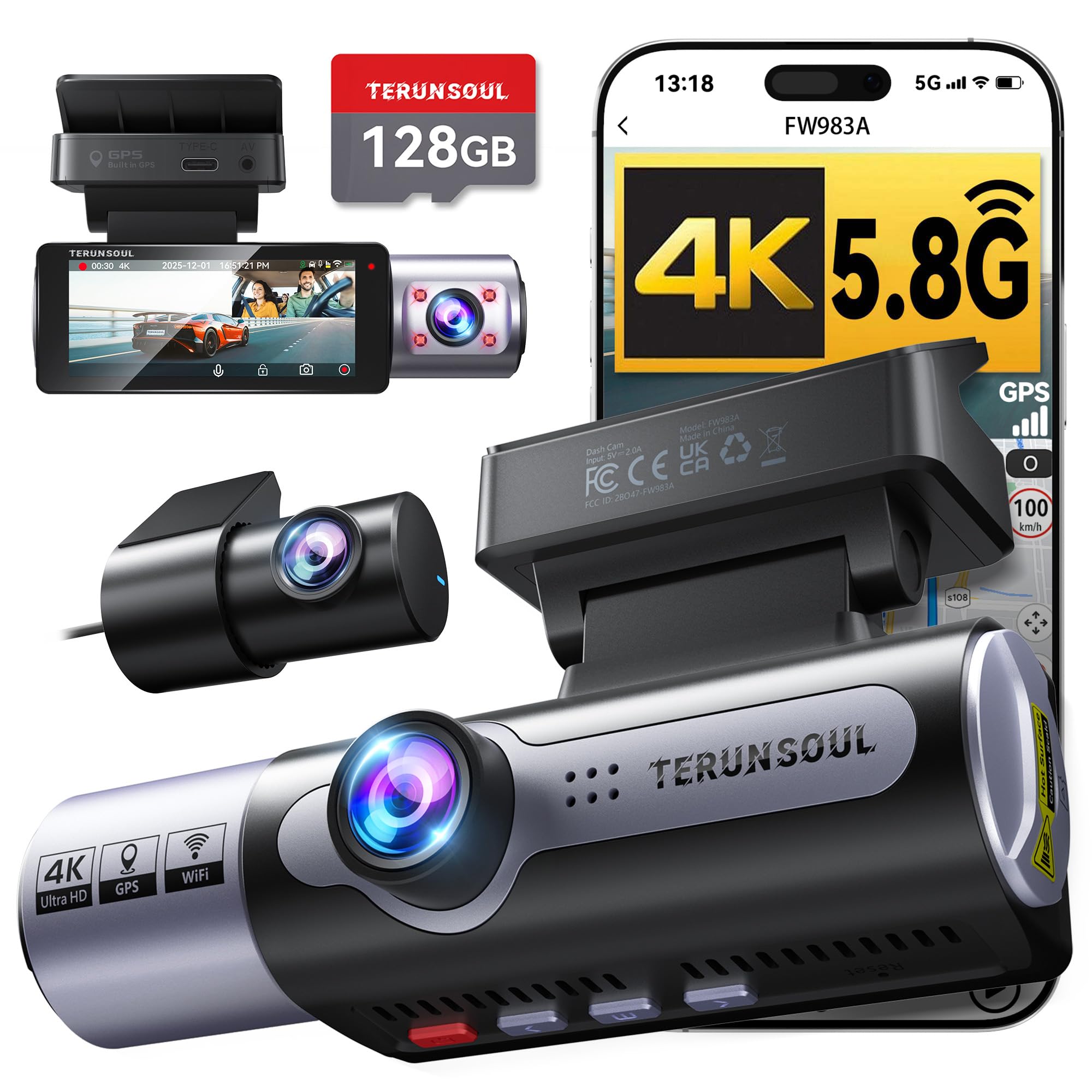
1. TERUNSOUl 4K Dash Cam Front and Rear
Our pick — over 4.5★ from 400+ verified ratings; the strongest balance of quality and price.
The rideshare-ready witness that records your cabin, your road, and your tail in one tidy 3.16″ screen.
For Lyft and Uber drivers, this is the unit that checks every box. It records simultaneously in UHD 4K up front, 1080P in the rear, and 1080P inside the cabin — so you have a full picture if a passenger dispute or a rear-end collision ever happens. The front lens spans a 170° view, while the rear and cabin lenses each cover 165°, nearly wrapping your whole vehicle in sight.
The box arrives ready to work: a 128GB memory card is pre-installed, and the collision sensor (a shock detector) locks footage automatically when it feels a severe impact. At night, the starlight-grade five-layer lens with an F1.6 aperture (a wide opening that captures more light) and HDR keeps details readable in dim parking lots. Buyers report the rear camera cable runs a bit short, but it’s manageable, and the included extra sticky pads make a clean install simple.
Built-in GPS (a chip that logs your location and speed) embeds driving routes, real-time speed, and a timestamp directly into the video. You review that data through the free app or the GPS player for Windows and Mac. The 5.8GHz WiFi (a fast wireless band) lets you pull videos at 20MB/s and update the firmware without touching a cable.
Why owners stick with it
- Build quality is the most-praised trait — owners overwhelmingly call it solid and dependable
- Sharp 4K front footage that stays clear both day and night
- Included 128GB card, GPS, and WiFi make it a true all-in-one
The honest trade-offs
- Rear cable runs short — plan your routing before you stick it down
- Parking mode needs a separate hardwire kit you buy yourself
The crowd favorite: This is the pick for rideshare pros and families who want cabin protection plus front and rear evidence in one dependable package.
Think twice if: You want true 24-hour parking coverage from the start — that requires an extra hardwire kit purchase.
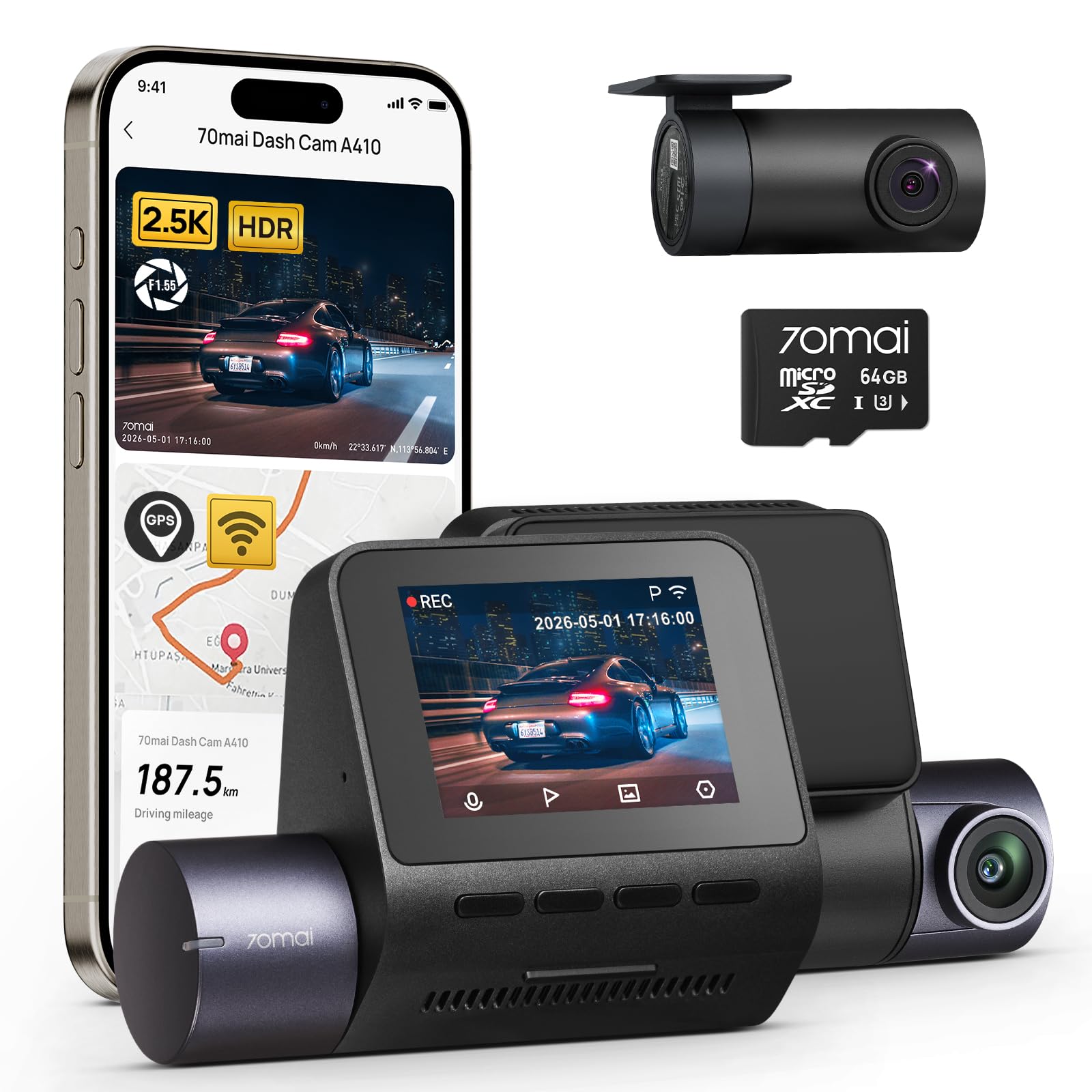
2. 70mai Dash Cam Front and Rear A410
The tiny cam that vanishes behind your mirror while quietly catching four lanes of traffic.
If a discreet setup is your priority, this 70mai excels. The 2.5K (2560x1440P) front camera and 1080P rear camera tuck neatly behind the rearview mirror — owners say you barely notice the back camera at all. Its 125° lens is tighter than the 170° of the TERUNSOUl above, but that narrower angle keeps the center of the frame sharper, which helps with reading plates.
Night driving is handled by an F1.55 ultra-large aperture (a very wide lens opening) paired with HDR and enhanced night vision. That combo reveals plates and street signs in near-total darkness, turning unlit parking lots into documented territory. A built-in G-sensor locks clips instantly on impact, and loop recording overwrites the oldest files when the included 64GB card fills.
The cable story here is the opposite of the TERUNSOUl — owners mention the cable is very long, almost too long, which makes routing easy in larger vehicles. Owners also note the electrostatic sticker mount holds firmly without leaving sticky residue, ideal if you lease your car or move the unit between vehicles.
What wins people over: The front camera quality is the top praise by far, followed by how easy it is to install — most have it running in under five minutes.
The recurring gripe: Connectivity hiccups come up now and then, so be patient pairing the app the first time. It’s a value champion for the price.
Perfect for: Daily commuters and lease drivers who want a tiny, high-quality cam that takes minutes to set up and hides out of sight.
Look elsewhere if: You need an ultra-wide 170° view for city intersections — the 125° lens trades some width for sharper center detail.
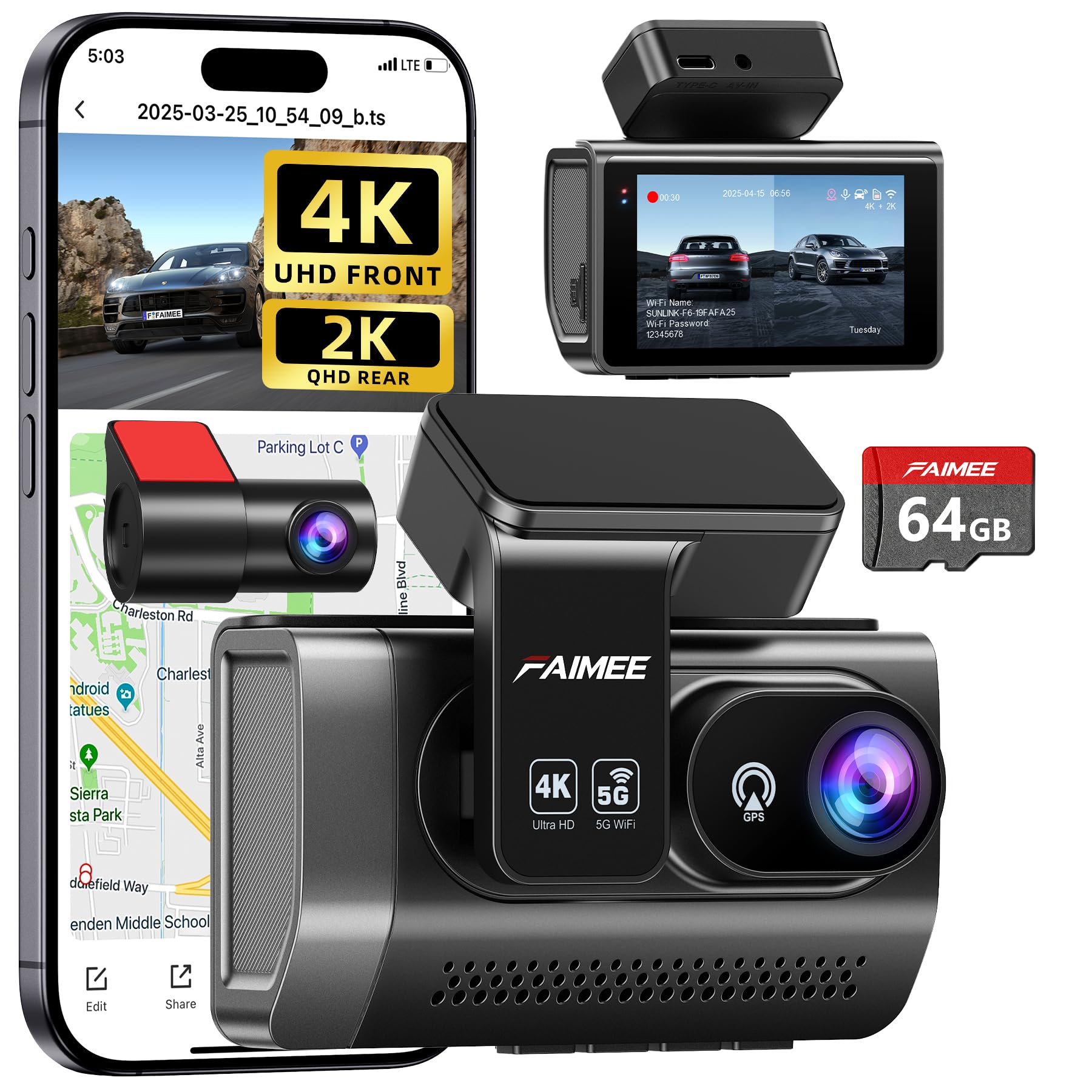
3. FAIMEE 4K Dash Cam Front and Rear
A budget-friendly 4K system with a 170° front lens that swallows six full lanes of traffic.
This FAIMEE brings premium specs to a friendlier price. The front camera shoots 4K UHD (3840x2160P) and the rear shoots 2K (2304x1296P), both through 170° wide-angle lenses that cover up to six lanes. An F1.8 aperture (a wide lens opening) with enhanced WDR (wide dynamic range, which balances bright and dark areas) keeps footage balanced in high-contrast sun or low light.
You can start recording immediately because it includes a 64GB high-endurance card (a card built to handle constant writing), and you can expand storage up to 256GB. If you get into a sudden collision, the G-sensor (a small motion sensor that detects a bump) locks the video instantly so the evidence is saved. Loop recording automatically overwrites the oldest footage, so you never have to manage files manually. Dual-band WiFi (5.8GHz and 2.4GHz) gives you a faster, more stable connection to the FAIMEE app for live views and instant downloads.
The compact 3-inch IPS screen (a high-quality display type) installs discreetly behind your rearview mirror without blocking your view. Owners describe setup as easy, with good coverage area and very good video quality. It’s a popular pick for a reason — this model carries the highest review volume on this list.
The standout: Owners consistently call the video crisp and the app straightforward, praising the simple software over fussier rivals.
One quirk: A few note the on-screen text can’t be removed when viewing through the phone app. Minor, but worth knowing if you want a clean feed.
Reach for this if: You want 4K front and 2K rear coverage with a six-lane-wide view without spending premium money.
Who it’s not for: Anyone who needs a cabin-facing lens — this is a pure two-channel front and rear system.
4. Coolcrazy 4K Dash Cam Front and Rear
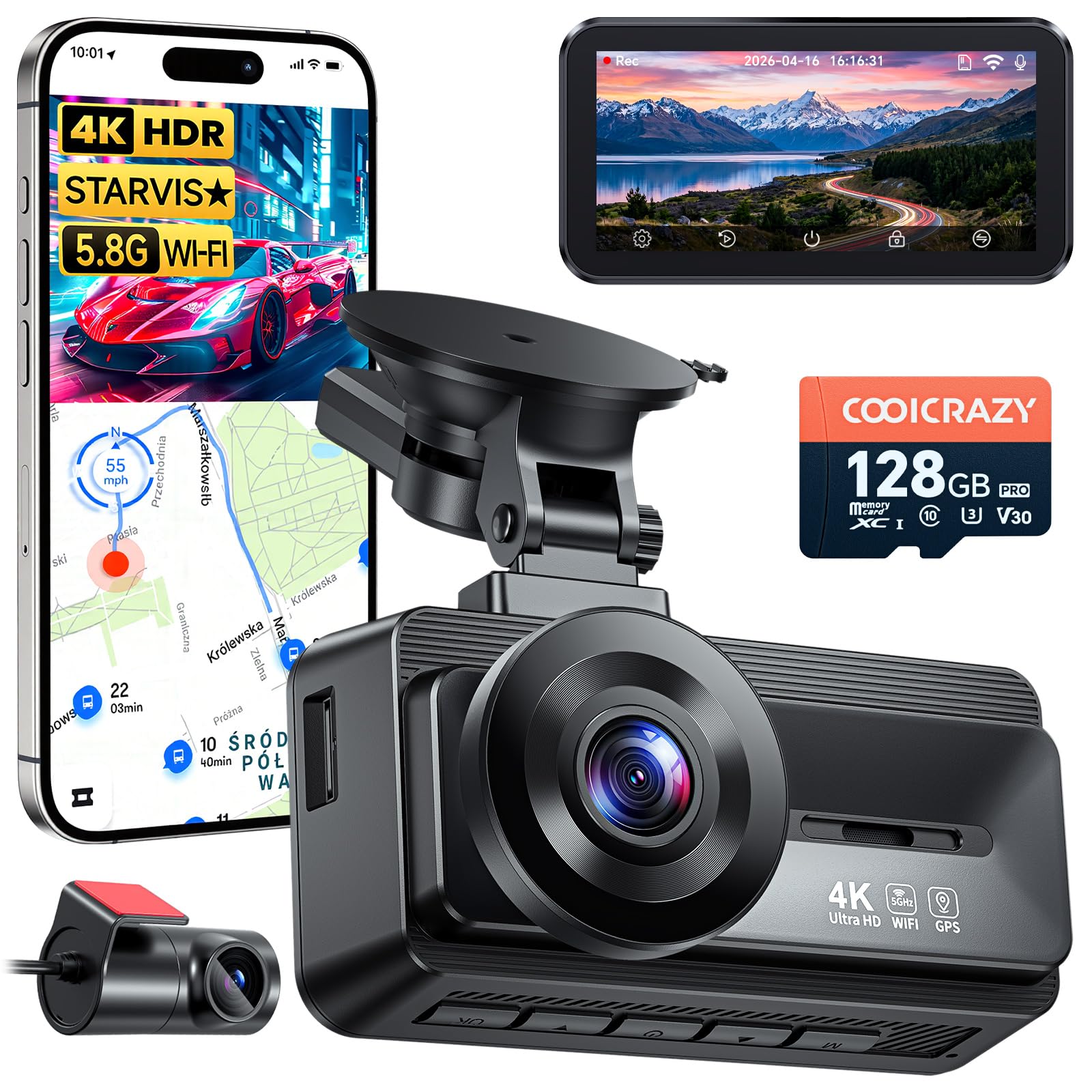
The 60fps high-speed specialist that keeps footage smooth even when you’re flying down the interstate.
Most dash cams record at 30 frames per second, but this Coolcrazy pushes 4K UHD at 60fps (frames per second — the smoother the motion, the sharper plates at speed). Its 170° front and 150° rear ultra-wide lenses capture full vision coverage, and that high frame rate keeps fast-moving details from blurring on congested city streets or highways.
Night performance leans on a STARVIS starlight sensor (a Sony chip built for low light) paired with large-aperture WDR technology. It cuts glare from oncoming headlights and boosts dark-area detail — exactly what you need on rainy nights, in tunnels, or in unlit underground garages. The included 128GB card handles automatic loop recording, and the G-sensor locks critical footage during collisions or emergency braking.
Owners specifically praise the night vision and build quality, with long wires that hide cleanly during installation. The suction cup mount makes it a great rental-car companion — you can remove it nightly in seconds. A 20.3ft rear cable gives you plenty of slack for trucks and larger SUVs.
Praise points
- True 4K clarity day and night, with readable plates
- Excellent build quality and easy 30-45 minute install
- Suction mount removes quickly for rentals or overnight security
Fine print
- 24-hour parking mode requires a separate hardwire kit purchase
- Wi-Fi pairing gets mixed feedback — some connect instantly, others struggle
Best for: Rideshare drivers and highway commuters who want buttery-smooth 60fps footage that catches plates at speed.
skip it if: You expect plug-and-play 24-hour parking monitoring — that needs extra hardware this box doesn’t include.
5. 70mai 4K Dash Cam Front and Rear A800SE
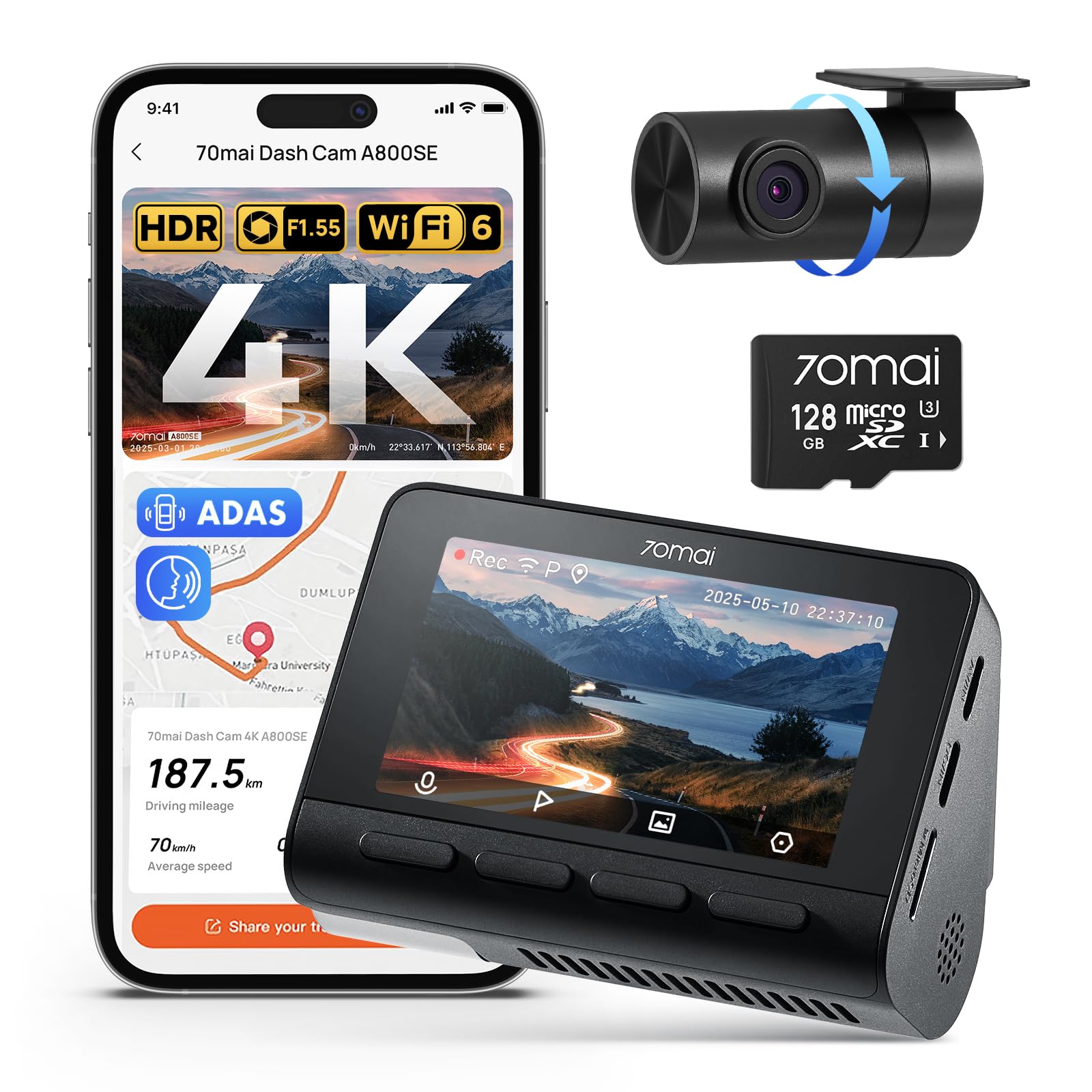
The smartest 70mai on this list, with Wi-Fi 6 transfers and voice alerts that watch the road with you.
This 70mai takes the brand’s reliability and adds genuinely smart safety features. The 4K front and 1080P rear cameras capture plates and road signs with sharp clarity, and the adjustable rear lens can record inside the cabin or behind the vehicle — your choice. A 7-layer glass lens with an F1.55 aperture (a wide opening for low light) and Dual HDR keeps footage brighter and clearer in tunnels, rain, and glare.
What sets this apart is the ADAS (Advanced Driving-Assistance System) — it gives real-time voice alerts for lane departure and forward collisions, helping you avoid the accident instead of just recording it. Built-in Wi-Fi 6 (the newest wireless standard) transfers data up to 5× faster than traditional Wi-Fi dash cams. That means a 4K clip lands on your phone in moments, no SD card removal needed.
The free 128GB card is included, with support up to 512GB. Owners consistently describe 4K daytime clarity as superb, with plates readable at a glance, and the companion app gets high marks for being easy to navigate. Installation suits beginners, and the 18-month warranty covers you with optional in-person service centers in New York and California.
Why it stands out
- Superb 4K daytime clarity, praised as top-tier by owners
- Fast Wi-Fi 6 makes pulling footage easy
- ADAS alerts add active safety, not just recording
Where it stumbles
- The rear camera struggles in very low light — dark tint plus night can mean dark footage
- Reliability gets mixed notes, with occasional reports of the back cam stopping
Choose this for: Tech-savvy drivers who want fast phone transfers and driver-assist alerts in a proven brand.
The catch: The rear cam’s low-light performance trails the front — consider this if you park in unlit areas.
6. ROVE R2-4K Dual PRO Dash Cam Front and Rear
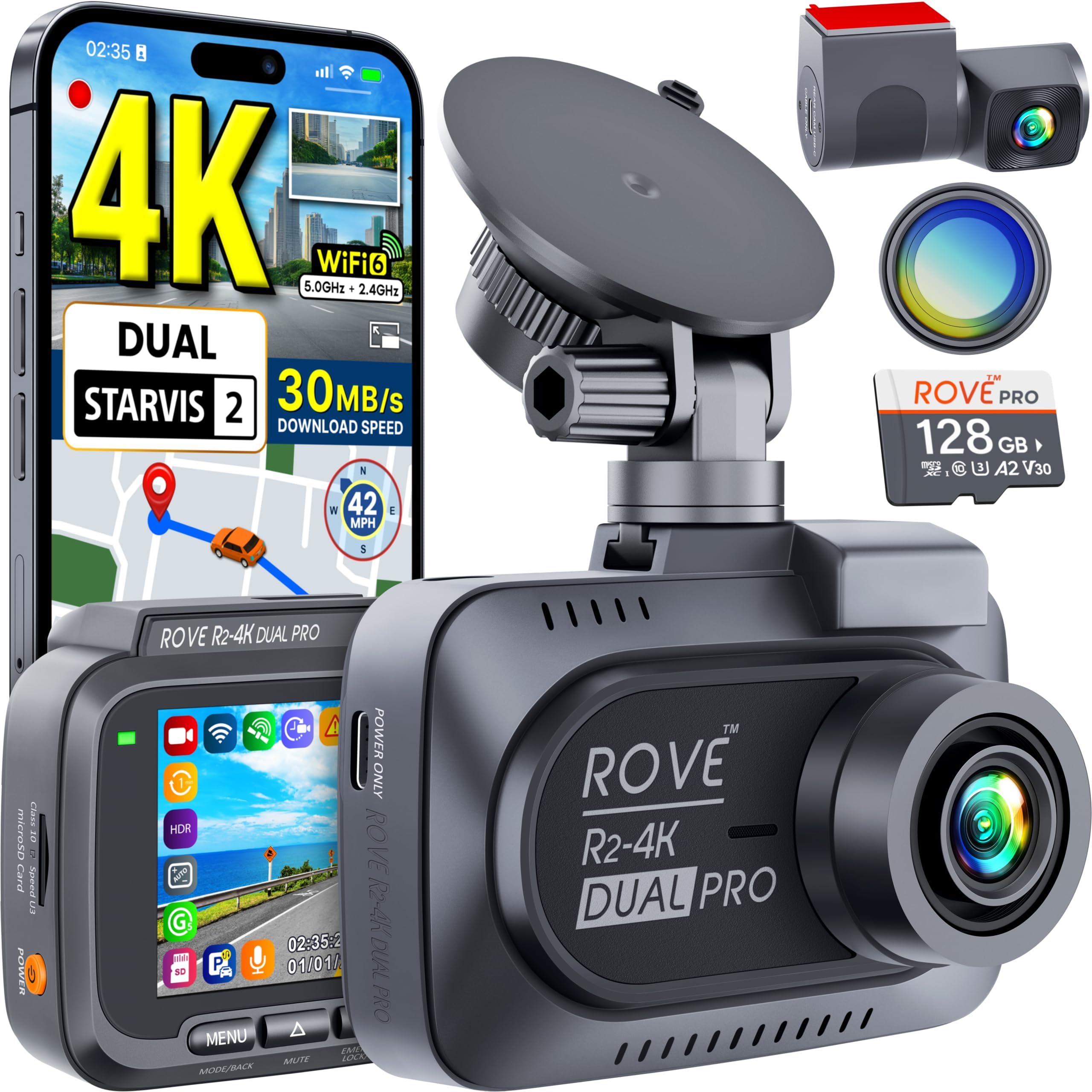
Night-driving royalty: twin Sony STARVIS 2 sensors in both cameras for the clearest dark-road footage here.
If you do serious night driving, this is the one to beat. The ROVE R2-4K DUAL PRO records sharp 4K video (3840×2160 pixels) from the front at 30fps (frames per second) and 2K video (2560×1440 pixels) from the rear at 30fps. Both cameras use Sony’s latest STARVIS 2 sensors — the IMX678 (8MP) up front and the IMX675 (5MP) in the rear — which are designed to boost light sensitivity and cut image noise in tunnels, rain, and headlight glare, so number plates stay readable at night on both ends of the car.
The lens specs back it up: an F1.7 opening up front and F1.55 in the rear, with a 150° front and 140° rear ultra-wide view. Customers note plates stay readable day and night, with clean low-light footage that beats most rivals. Included in the box is a 128GB ROVE PRO microSD card plus a CPL filter (a polarized lens that cuts windshield glare and reflections) for clearer daytime footage.
Dual-band Wi-Fi 6 delivers transfer speeds up to 30MB/s — a full 4K clip downloads in moments. Built-in Quad-Mode GPS tracks GPS, BEIDOU, GALILEO, and GLONASS satellites (four global positioning systems), displaying live speed and compass while recording your exact route. It also supports cards up to 1TB, so long road trips never run out of space.
The rave: Owners call it a high-quality system with excellent clarity, especially at night, and praise the straightforward installation and generous cable lengths.
The caveat: A few SUV owners found the rear cable runs short for very large vehicles — measure your route before you commit. Setup takes care and patience.
Worth it for: Night owls and long-distance drivers who demand the best low-light clarity from both cameras.
Not ideal if: You want the absolute simplest installation — this one rewards careful, unhurried wiring.
7. REDTIGER F77 4K+4K Dual Dash Cam
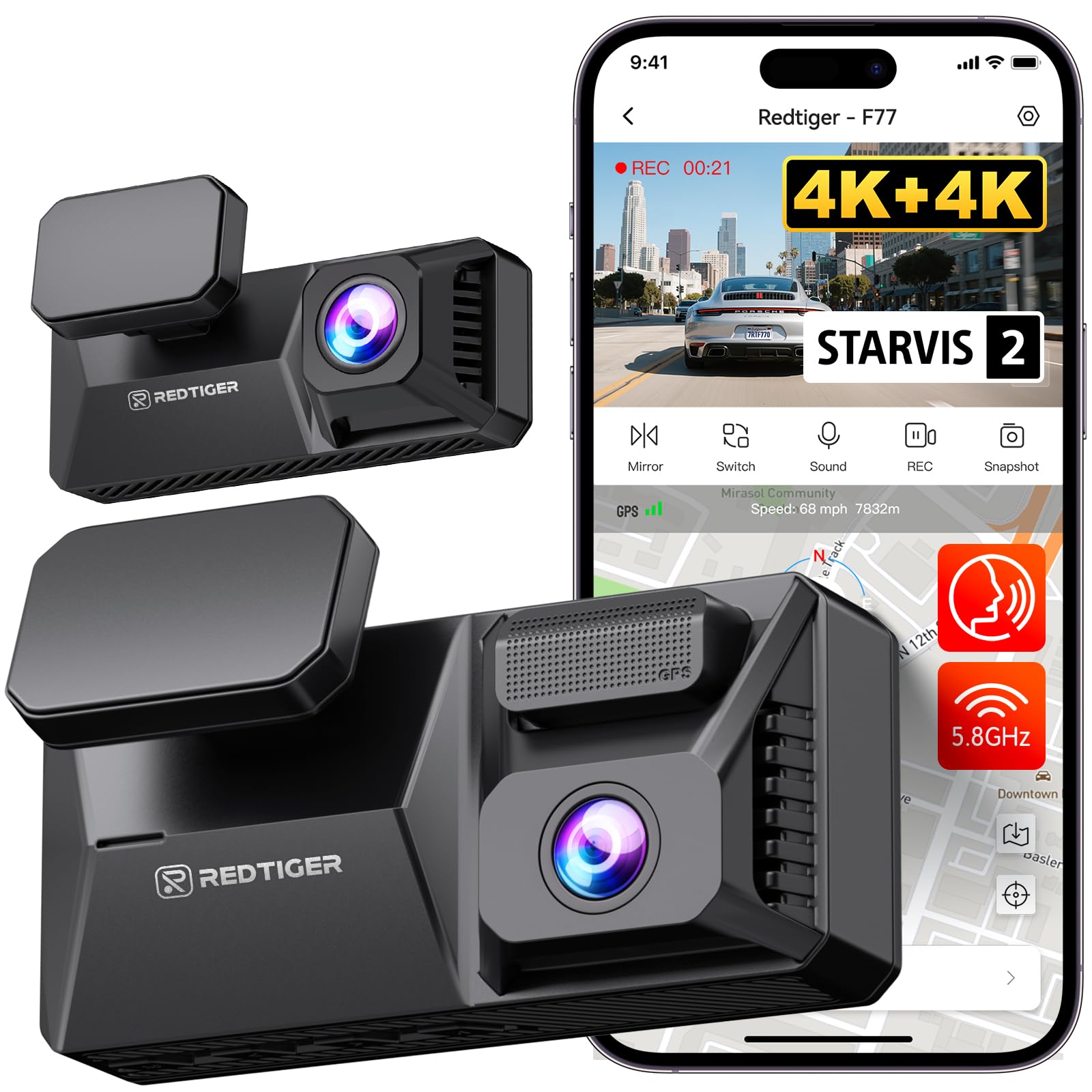
The flagship with dual 4K eyes, a 4-inch touchscreen, and built-in storage that needs no memory card at all.
This is the first unit on the list to record both front and rear at full 4K — 4K at 30fps on each end, powered by dual STARVIS 2 IMX678 sensors (Sony’s top low-light chips). A 7-layer glass f/1.8 aperture lens with 4K HDR/WDR technology automatically balances light and dark for a much clearer image than most. The rear camera cable spans a generous 21.3ft, enough for trucks and SUVs.
The defining feature is storage: instead of a removable card, it has built-in 128GB eMMC memory (a type of flash storage soldered to the board). That supports about 5 hours of loop recording, and eMMC avoids the video damage that can happen when a memory card pops out on impact. You never buy a card, and you never worry about a cheap card corrupting your evidence.
Control is split between a 4-inch touchscreen (the largest display here) and 12 voice commands for hands-free operation. Built-in 5.8GHz WiFi connects to the REDTIGER app for quick viewing and downloads. Owners praise the excellent picture quality and easy installation, calling it the best dash cam they’ve owned in years.
Flagship strengths
- Dual true 4K recording with top-tier STARVIS 2 sensors both ends
- Built-in 128GB storage — no card to buy or corrupt
- Large 4″ touchscreen plus 12 voice commands
Known weak spots
- Cameras adjust only up and down — no left/right rotation for angled windshields
- The mounting screw can loosen over time; stability gets mixed feedback
Grab this if: You want the sharpest possible dual-4K evidence and hate fiddling with memory cards — the built-in eMMC just works.
Consider alternatives if: Your windshield is steeply angled and you need full camera rotation to aim it properly.
8. Vantrue N5S 4 Channel 360 Degree Dash Cam
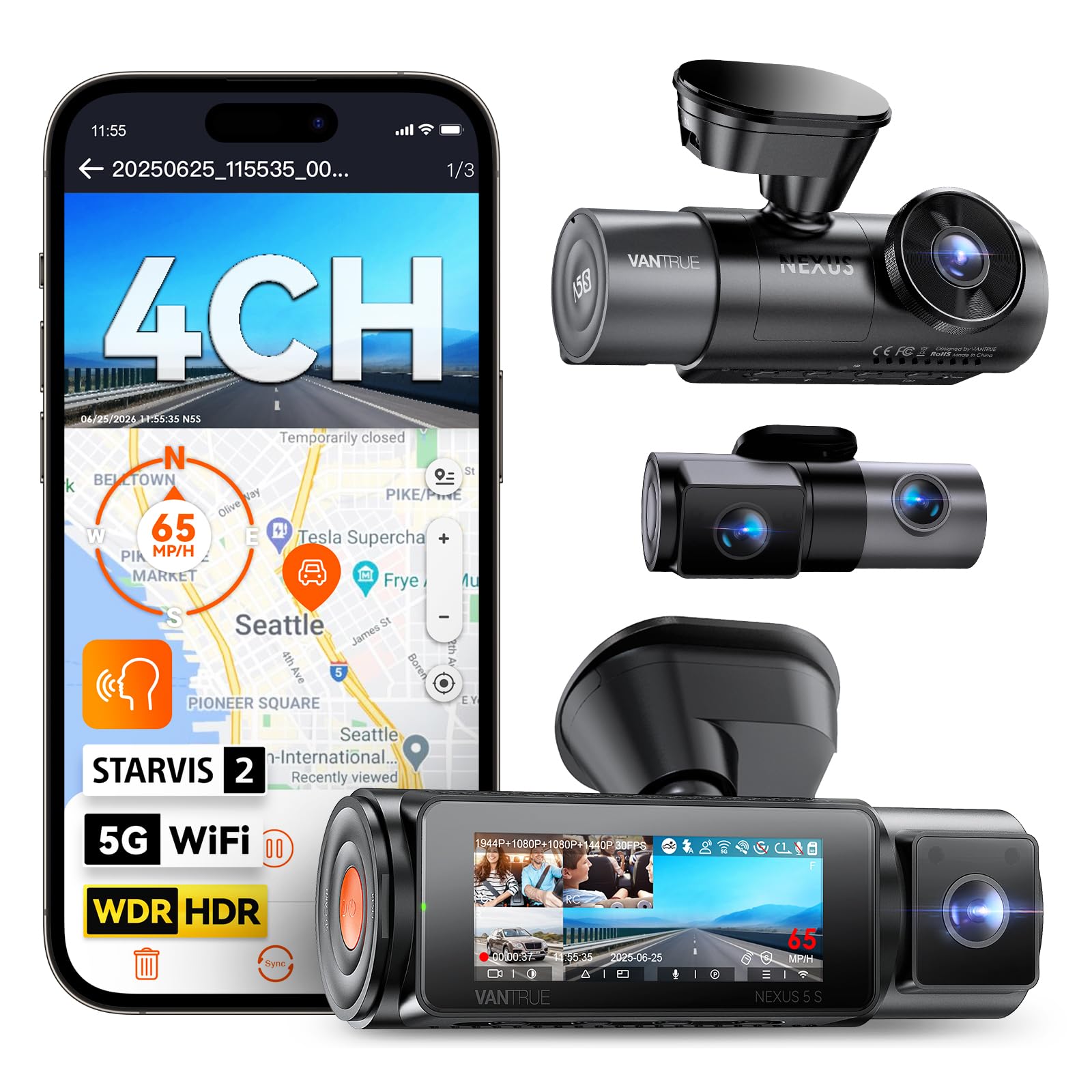
The ultimate no-blind-spot machine: four cameras wrapping your car in a 360° shield of evidence.
When front and rear just isn’t enough, this Vantrue adds two interior cameras for complete 360° coverage. The system records 2.7K up front, 1080P on two interior channels, and 1440P in the rear — and you can run any combination of 1, 2, 3, or 4 channels depending on the drive. With infrared lights on the cabin cams, you get clear interior footage even in complete darkness, perfect for rideshare or monitoring kids and pets.
All four cameras use STARVIS 2 technology (Sony’s low-light sensor line) for better night performance and license plate capture. The rear camera uses a premium IMX675 sensor with HDR for sharper footage in rear-end collision scenarios. A 3-axis G-sensor detects collisions and locks the current clip in a protected event folder, so it can’t be overwritten.
The 5GHz WiFi (a fast, less-crowded wireless band) provides 4× faster data transfer than older standards, and dual-system GPS logs your route. The unit handles extreme climates between -4℉ and 140℉ thanks to a super capacitor (a component that stores power without a traditional battery, which handles heat better). Owners describe the video as crisp with full vehicle coverage.
The headline: Buyers consistently report crisp video quality and true 360° coverage that eliminates blind spots entirely, according to owner reviews.
The trade-off: Four channels fill an SD card fast, so a large card is essential. A few units arrive with defective mounting pins — check yours immediately on delivery.
Perfect for: Rideshare pros, families with rear passengers, or anyone who wants zero blind spots and 24-hour parking vigilance.
Not for: Budget shoppers or those who want a quick install — four cameras mean more wiring and a bigger time investment.
9. VIOFO A329S 4K+2K+2K Dash Cam

The storage king: record for weeks on a 4TB external drive while a 210° fisheye watches your whole cabin.
This is the most advanced system here, built for owners who want zero storage worries. The A329S records 4K at 30fps up front, 2K in the rear, and 2K interior — and supports external SSDs up to 4TB or microSD cards up to 512GB. That’s over three weeks of uninterrupted recording before loop recording even kicks in. Perfect for cross-country trips or commercial use.
All three channels deploy STARVIS 2 sensors: the IMX678 up front and IMX675 for the rear and cabin. The interior camera uses a 210° ultra-wide fisheye lens (a lens that captures an extremely wide, dome-like view) that eliminates blind spots for rideshare drivers. The rear camera’s IMX675 sensor delivers 2.5 times wider dynamic range than standard STARVIS pixels, capturing sharp detail in fast-moving traffic.
Installation is a highlight: dual slim 2.8mm coaxial cables (a type of cable that resists interference) tuck neatly behind trim and are less susceptible to electromagnetic disturbance. An included CPL filter (a polarized lens) reduces glare from glass and road surfaces. Voice control lets you start or stop recording, take photos, and toggle WiFi — all hands-free.
The verdict from owners: Excellent image quality across all channels with simple installation and good connectivity; many call it best in class.
The honest catch: Reliability earns mixed feedback, with some units stopping after a few weeks. The fisheye interior cam’s adhesive can also fail in heat. It’s a premium tool that rewards careful install.
For the enthusiast: Choose this model if you want the largest storage capacity (up to 256GB), a full cabin view, and top-tier image quality across all three channels — front, rear, and interior.
Think twice if: You’d rather not invest in an external SSD or deal with a more complex multi-channel setup.
Understanding the Specs
Resolution (4K vs 2.5K vs 2K)
Resolution determines how much detail the camera captures. 4K (3840x2160P) is the sharpest and lets you zoom into plates after the fact. 2.5K (2560x1440P) and 2K (2304x1296P) are slightly softer but still plenty clear for evidence. Higher resolution also means larger files, which fills your card faster and slows downloads.
Night Vision & Aperture
An aperture (the lens opening, shown as F1.55 or F1.8) controls how much light reaches the sensor — a lower number means more light and better night footage. HDR (high dynamic range) balances bright headlights against dark shadows, while a STARVIS sensor (a Sony chip designed for low light) dramatically improves dark-road clarity.
Field of View
Field of view, measured in degrees, is how wide the lens sees. A 170° lens captures six lanes and most intersections; a 125° lens sees less but keeps the center sharper. Cabin and rear cameras often have their own angles — the VIOFO’s 210° interior fisheye catches nearly the whole cabin in one frame.
G-Sensor & Parking Mode
A G-sensor (a shock detector) feels impacts and locks the current video so it can’t be overwritten. Parking mode keeps the camera watching while your car is off — most require a hardwire kit (a cable connecting to your fuse box) that is sold separately. Time-lapse and collision detection are the two common parking modes.
FAQ
Will a front and rear dash cam drain my car battery when parked?
What size memory card do I need for a dual dash cam?
How hard is it to install a front and rear camera myself?
Does a wider field of view mean better footage?
What does the G-sensor actually do?
Is parking mode worth paying extra for?
How do I get video off the camera to share or save it?
What is the difference between WDR and HDR in a dash cam?
Final Thoughts: The Verdict
Start with the car camera front and rear winner — the TERUNSOUl 4K — because it pairs the highest owner satisfaction with triple-channel coverage, a pre-installed 128GB card, and GPS for a price that undercuts rivals. If you want the sharpest possible night footage, the ROVE R2-4K PRO with dual STARVIS 2 sensors is the one to reach for. And for maximum storage and a full cabin view, the VIOFO A329S leads the premium pack.
How We Picked
We do not accept paid placement. Every pick is matched to a real buyer and a real use-case; we do not hands-on test units.
Sources & Methodology
Specifications: manufacturer listings and product documentation. Review insights: verified customer reviews, as of August 2026. Pricing: not shown on this page (it changes often); check the current price via the retailer link.
As an Amazon Associate, Gadgets Feed earns from qualifying purchases. This does not affect which products we feature.