
Our readers keep the lights on and my morning glass full of iced black tea. As an Amazon Associate, I earn from qualifying purchases.
Specs are compiled from manufacturer listings and verified buyer reviews and can change over time — please confirm the key details on the product page before buying.
Car camping lives or dies on one thing: whether your tent goes up before the light dies, and whether you stay dry once it does. The picks below are sorted by how they actually behave at a campsite you drove to — pitch time, standing height, floor space, and what happens when the rain starts sideways. You will not find ultralight backpacking shells here, because those trade comfort for weight you do not need when the car is parked ten feet away.
I’m Min — the founder and writer behind Gadgets Feed. This guide is built by comparing the manufacturers’ published specifications and the patterns across verified customer reviews, so you get each pick’s real strengths and trade-offs instead of marketing spin.
The list starts with the crowd favorite that keeps showing up in family driveways, then moves through instant cabins, screen-porch setups, and blackout four-season shells. Every entry is a genuine car camping tent with the numbers behind it, so read on to find the best car camping tent for how you actually camp.
Our Picks at a Glance


How To Choose The Best Car Camping Tent
You want to pull up to your site, get the tent up before dark, and still have energy to cook dinner. A car camping tent only has to solve four problems: pitch fast enough that you still want to cook dinner, stand tall enough that you are not crawling into a sleeping bag, hold enough floor for the people and gear you brought, and keep rain outside. Everything else is decoration.
Pick your setup style first
Traditional pole-sleeve tents thread fiberglass or steel poles through sleeves, which is slower but packs smaller and costs less. Instant tents use pre-attached poles that fold out and click into place, which is why brands quote build times under five minutes. If you usually arrive at the site after sunset, that difference decides your evening.
Match floor area to how you sleep
Sleeping-bag campers need far less floor than airbed campers. A tent labeled for six people can feel snug once two queen airbeds go in, so check the published floor length and width instead of trusting the capacity label. A 100 square foot floor and a 56 square foot floor are entirely different rooms.
Read the waterproof numbers
Fabric is rated by how many millimeters of water pressure it resists before water pushes through. A higher number like PU 3000MM or 5000mm handles sustained rain better than a thin coating. Sealed seams and a full-coverage rainfly matter just as much as the fabric rating, because water usually enters through stitching and gaps, not through the fabric itself.
Decide if you want a porch or a blackout shell
A screened porch gives you a bug-free spot to sit, store gear, and take off muddy boots without tracking grit inside. A blackout fabric blocks sunlight so you can sleep past sunrise, which matters in summer when the sun comes up long before you want to.
Quick Comparison
| Model | Best For | Floor Area | Center Height | Setup Time | Amazon |
|---|---|---|---|---|---|
| Coleman Sundome Camping Tent★ Best Overall | Families who want proven value | 100 sq ft | 6 ft | About 10 mins | Amazon |
| Happy Travel Camping TentBudget Champion | Budget weekend trips | 69.6 sq ft | 61 in | 3 mins (two people) | Amazon |
| FanttikOutdoor Instant Cabin TentFastest Setup | Fastest pitch after dark | 90 sq ft | 66 in | Under 60 seconds | Amazon |
| CORE 4 Person Cabin Tent | Standing room on a budget | 56 sq ft | 72 in | About 10 mins | Amazon |
| DMH OUTDOORS Cabin Tent with Screen Porch | Bug-free sitting space | 140 sq ft | 78 in | 15 mins (two people) | Amazon |
| Coleman Skydome Camping Tent | Headroom without crawling | 86 sq ft | 6 ft | Under 5 mins | Amazon |
| CORE Instant Cabin Tent | Space for cots plus gear | 99 sq ft | 72 in | 60 seconds | Amazon |
| Naturehike Village Instant Tent | Blackout sleep and winter camping | 65 sq ft | About 4.9 ft | About 60 seconds | Amazon |
| OneTigris JOVIAN 4 Person Tent | Two cots in a compact shell | 53.24 sq ft | 4.9 ft | Minutes | Amazon |
In‑Depth Reviews
1. Coleman Sundome Camping Tent with Rainfly, 2/3/4/6 Person Tent
Our pick — over 4.5★ from 23,000+ verified ratings; the strongest balance of quality and price.
The tent that shows up in more family driveways than any other — and holds up in real rain.
If you want the safest possible first car camping tent, this is it. The Sundome is a 100 square foot floor with a 6 foot center height, so you get about 10 feet by 10 feet of standing room instead of a crawl space. That floor fits two queen airbeds, which is the honest test most capacity labels fail. Large mesh windows and a ground vent push heat up and out, so it does not turn into a greenhouse on a July afternoon.
The WeatherTec system — welded corners and inverted seams that channel water away from the stitching — is why this tent keeps earning repeat buyers. That seam work is the whole point of the design, since water normally enters a tent through needle holes and corner joints, not through the fabric. A 5 foot 10 inch sleeper has reported they cannot stand fully upright, so if you are tall, budget for a bend at the waist. Plan on roughly 5 to 7 minutes of solo setup and remember the rainfly needs a little patience to seat properly.
What wins people over is the build quality and the value stacked together. This one holds the crowd-favorite spot at 4.6 stars across 23,000+ ratings, and owners consistently call it dry in heavy downpours and stable in stiff wind. The honest trade-off is material thickness. The floor tarp and shell are thin, and some buyers report poles failing on first use, so treat the frame gently and pack a ground tarp. It is a casual-use tent that rewards care, not a mountaineering shell. Owners mention it arrives complete with the tent, rainfly, three fiberglass poles, and nine steel stakes.
What earns its keep
- 100 square feet of floor fits two queen airbeds
- WeatherTec welded corners and inverted seams keep rain out
- Large mesh windows and ground vent push hot air up and out
- Snag-free pole sleeves and Insta-Clip attachments speed setup
What to watch for
- 5’10” sleeper reported they cannot stand fully upright
- Thin floor tarp and shell benefit from a ground tarp underneath
- Some poles fail during first use, so set up gently
Best for: families and couples who want a roomy, proven tent they set up a few times a season.
Think twice if: you are tall enough to need full standing height or you camp in hardcore cold-weather conditions.
2. Happy Travel Camping Tent, 4/6 Person Dome Tents for Camping with Rainfly
A 69.6 square foot dome that fits a queen airbed, packs to 8.6 pounds, and pitches in three minutes.
This is the pick for weekend trips where the tent gets carried in one hand and the cooler in the other. The 190T polyester taffeta shell is rated PU 3000MM, and the base uses a heavier 110g PE fabric rated PU 4000MM, so the floor is more waterproof than the walls. Seven guylines and 9.5mm fibreglass poles give you all-round anchoring when the wind picks up. The dome form factor means it sheds weather reasonably well and stays simple to pitch.
Compared with the Coleman Sundome above, this one gives up 30.4 square feet of floor — you can see it in the table, 69.6 square feet against 100. Solo campers and couples will not miss it. Four people with gear will feel every inch. The 61 inch center height means most adults sit up fine but cannot stand, which is the honest cost of a dome this light. Headroom can be squeezed further because the rainfly must come off to use it as a stargazing tent, and customers note warm nights can get stuffy without more zippered windows.
What buyers actually praise here is the setup speed and the quality for the entry-level tier — 4.2 stars across 400+ ratings with durability mixed and the zipper as the recurring gripe. Set it up in the dark on a cliff, and owners say it held against the cold and dewy morning just fine. One owner summed up the rainfly issue plainly: the rainfly is too small and lacks full flaps, which means exposed sides in heavy weather. Treat it as a warm-weather tent, not a storm shelter.
Where the money goes: into the waterproof floor and a double-end zipper that slides smoothly, both of which do the daily work.
Reach for this if: you camp in warm weather, travel light, and want a fast-pitching dome without overspending.
Look elsewhere if: you need standing height or you regularly camp where storms blow rain sideways.
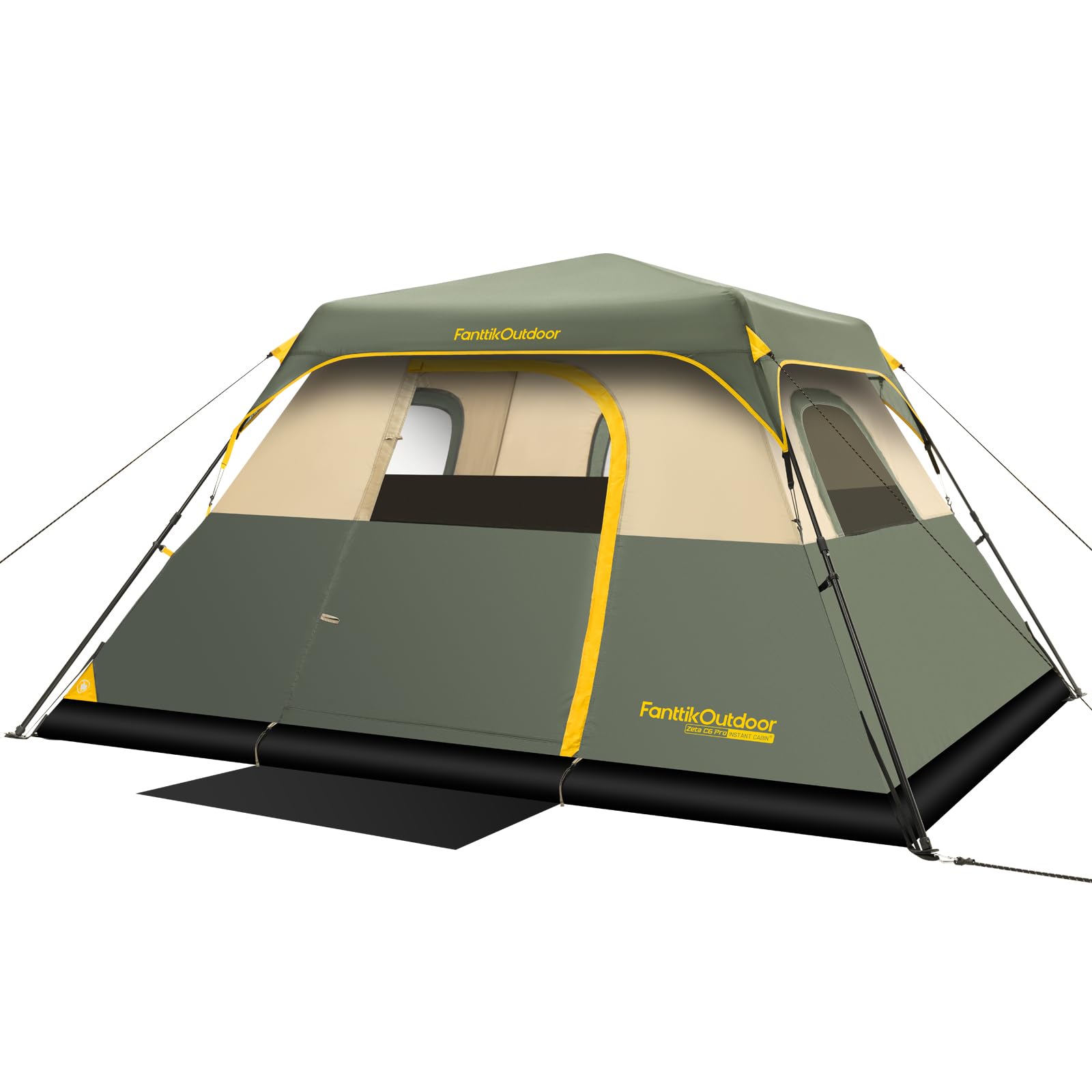
3. FanttikOutdoor Camping Tent 4/6/8/10 Person Instant Cabin Tent
A 120-inch-long cabin that unfolds to full height in under a minute — no pole threading, no arguing with sleeves.
Instant cabin tents earn their money at the campsite, not on the spec sheet. This one uses pre-installed poles (the poles stay attached to the tent) and a smooth construction, so you unfold it, extend the legs, and stake it. The 120 inch by 108 inch floor gives you 90 square feet and a 66 inch ceiling you can stand under, so you can change clothes without crouching. A queen air mattress drops in without a fight. SBS zippers (a water-resistant zipper brand), B3 mesh windows (fine bug-proof mesh) on all four sides, and a mesh ceiling keep the air moving, so summer afternoons inside do not roast you.
Here is where it beats the Happy Travel dome above: 18 inches more floor length and 14 inches more floor width, which is the difference between a queen mattress filling the whole floor and a queen mattress plus a duffel bag. Downside? At 16.8 pounds it is heavier than the dome, and repacking into the carry bag takes real effort according to owners. The inner tent roof is mesh and is not waterproof on its own — the outer tent or rainfly (the waterproof cover that goes over the top) must go on in rain, which is a step people skip and then regret.
What owners keep talking about is the setup speed. Solo pitch reported at under a minute, with owners noting they never want to go back to pole tents after this. The frame is carbon structural steel with protective sleeves, and it is rated to stand up to 35 MPH wind. Water resistance shows up as a positive theme too, with dry nights through prolonged rain and only minor corner seepage blamed on condensation. The door zipper flap can catch when wet, so guide the fabric clear as you zip.
The real win: front and center on a rainy evening, when unfolding beats assembling by a wide margin.
Suits you if: you want to arrive, park, and be inside with a hot drink before dark.
Not your pick if: you walk to your site and cannot carry 16.8 pounds one way.
4. CORE Tent for Family Camping, 4 Person & 6 Person Portable Camp Tent

Nearly straight walls and a 72-inch ceiling turn a compact 8 by 7 cabin into genuine standing room.
Over-60 campers and anyone with a bad back should start here. The straight-wall design is the point — it gives you 72 inches of center height so you change clothes and stretch without crawling, on just 56 square feet of floor. That is roughly half the floor of the DMH cabin further down the list, which is the trade you make for a smaller, easier-to-handle footprint. Lower vents pull cool air in at ground level while the mesh ceiling lets hot air escape, and the gear loft plus storage pockets keep small items off the floor.
Weather protection comes from H20 Block Technology — 1200mm fabric, a fully taped rainfly, sealed seams, and fully zipped windows. Fully taped and sealed means water is blocked at the stitching as well as the fabric. Guylines and steel stakes add stability in a breeze. Reviewers point out minor water entry through the mesh and fly gap and some door drips in hard wind, which is normal for a tent in this tier, not a failure.
What stands out across reviews is the look and the sense of space — owners describe it as well-built with modern materials and appreciate that the carry bag is roomy enough to repack without a wrestling match. One owner used theirs for 42 consecutive days with no issues, though the poles showed wear after four years. Included tent pegs are the weakest link; owners swap them out. A pole arrived cracked on rare occasions, so inspect the frame on the first pitch.
Why it wins a slot
- 72-inch center height on a compact 8 by 7 floor
- H20 Block taped rainfly and sealed seams
- Gear loft plus storage pockets keep gear organized
- Roomy carry bag packs without fighting
Honest limitations
- 56 square feet fits one queen airbed with no extra room
- Included tent pegs are weak — replace them
- Some water can enter via the mesh and fly gap in hard wind
Worth it for: solo campers and couples who value standing height and easy packing over raw floor space.
skip it if: you need to sleep four people or fit two airbeds side by side.
5. DMH OUTDOORS 6/8/10 Person Tents for Camping Cabin Tent with Screen Porch
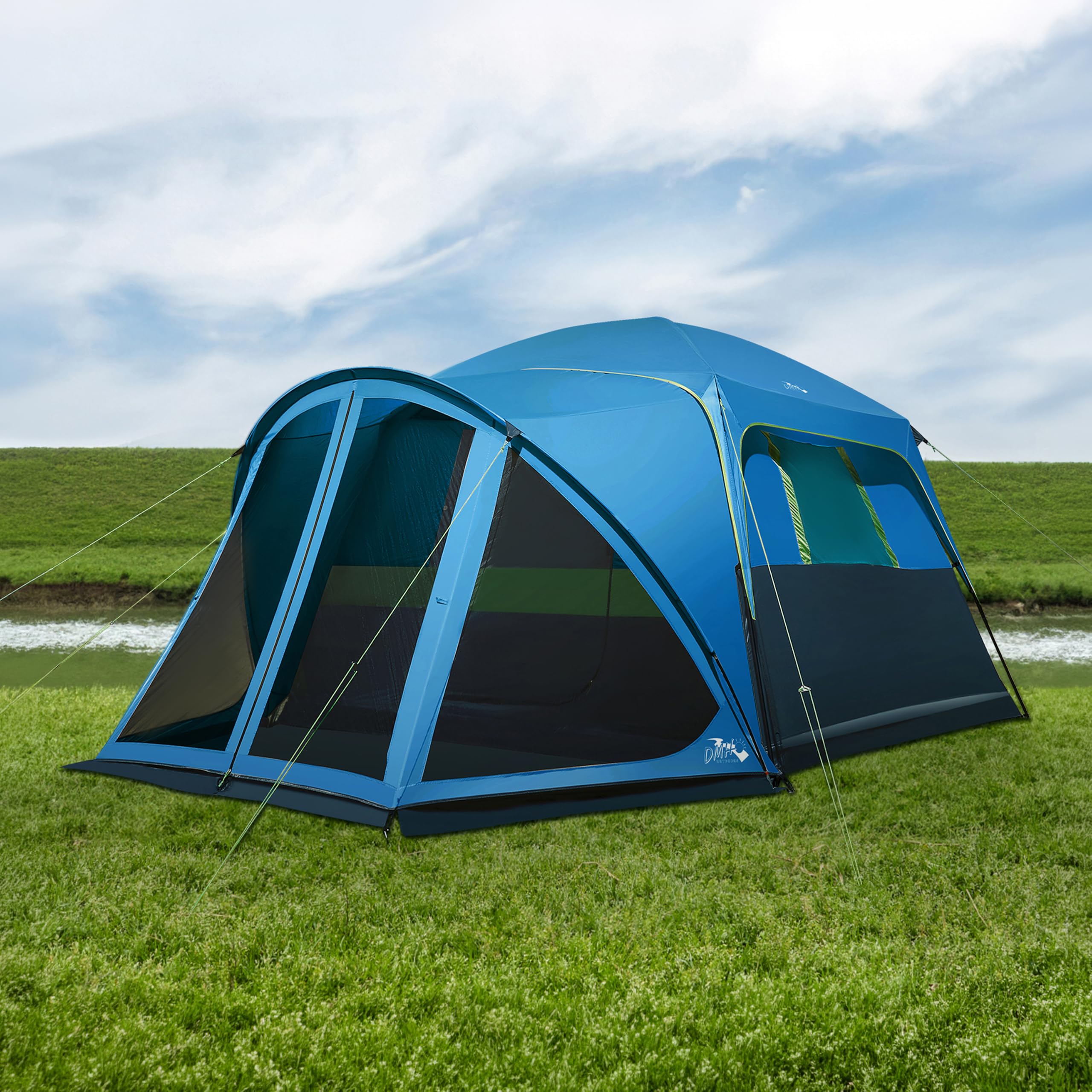
A cabin plus a bug-free porch — the 140 square feet you want when the whole family shows up.
The 140 square foot floor is the biggest on this list, and the 78 inch center height is the tallest, so this is the tent where you stand fully upright and store gear in a separate covered space. The screened porch — a floorless vestibule with a mesh door and bug screen — is what owners single out as the reason they bought it. You get a bug-free spot to sit, keep coolers, and take off muddy boots without tracking grit inside. Mesh windows and a mesh top keep the air moving through both rooms.
Water resistance uses a rainfly, taped seams, a tent skirt, and waterproof fabric, plus a rain-resistant E-Port for running a power cord inside to a fan or fridge. That E-Port is small but genuinely useful for a car camping setup. Setup takes about 15 minutes with two people using labeled poles. The instructions are the weak spot — shoppers say the better technique is to seat poles into the top elbows first rather than the bottom pins, and to put the rainfly on before raising the tent.
What owners mention most is the quality and the space. It comfortably fits a queen-size air mattress with all your belongings, and one owner counted about 16 feet of hanging space across two clothes lines plus 11 interior pouches. The rainfly lacks full coverage, so it handles straight-down rain better than blowing storms. The carry bag is undersized relative to the packed tent, which is the recurring complaint. Treat the bag as a courtesy, not a container.
Setting expectations: this is an occasional-trip family tent, not a four-season mountaineering shelter, and it plays that role well.
Storage surprise: the interior pouches and hanging loops make organization genuinely easy — 11 pouches and two clothes lines add up.
Go here if: you camp with the whole family and want a sitting porch plus stand-up interior.
Consider something else if: you camp solo frequently, because 15-minute two-person setup adds up when you do it often.
6. Coleman Skydome Camping Tent with 5 Minute Setup, 2/4/6/8 Person

Nearly vertical walls and a wide door — the tent that says stop crawling and start walking in upright.
The Skydome solves the biggest complaint about dome tents: you cannot stand up in them. Nearly vertical walls deliver 20 percent more headroom than traditional Coleman dome tents, and the 6 foot center height means 6 foot and 5 foot 8 inch sleepers can both move around without folding in half. The 10 feet by 8.5 feet floor gives you 86 square feet. A wider door makes hauling in airbeds and sleeping bags noticeably easier, which is a small spec that becomes a real spec when your arms are full.
The WeatherTec system with welded corners and inverted seams keeps water away from the stitching, and the frame is tested to hold up to 35 MPH winds. Pre-attached poles are why setup runs under 5 minutes. Compare this to the Sundome above: the Skydome trades 14 square feet of floor for a much easier door and more vertical wall space. If you pitch a tent for one or two people, the Skydome wins on entry and exit. If you need maximum floor, the Sundome takes it.
What owners appreciate most is the quality and the setup speed, and the headroom earns particular praise — 6 foot and 5 foot 8 inch users both confirm they are not crawling. The trade-off is durability at the poles, where a run of buyers report breakage on the first trip. Owners also flag that setup is not actually 5 minutes in practice — a small honesty gap worth knowing before you plan around it. Owners mention the previous generation of this tent lasted 20-plus years.
What you are buying: the easiest entry and exit at this size, plus vertical walls you can actually stand behind.
Pick it if: you are tired of crouching at the doorway and want a fast pitch without the lightest wallet hit.
Look past it if: you need the widest possible floor and would rather have more square feet than more headroom.
7. CORE Instant Cabin Tents, Family Cabin Multi Room Pop Up Tents

A 99 square foot instant cabin that fits two queen airbeds or two cots — and pitches in a minute.
If you camp with cots, this is the CORE to pick. The 11 by 9 foot floor gives 99 square feet, and owners confirm two cots fit with spare room to walk around them — a genuine luxury in a pop-up cabin. The 72 inch center height means you straighten up inside. Pre-attached poles lock into place for setup in 60 seconds or less, and takedown happens via four side release buttons. Lower vents bring cool air in and a mesh ceiling lets heat escape, and the rainfly snaps on over the top.
Inside, a hanging organizer and gear loft keep small items off the floor, and the pack size is 47 by 9 by 9 inches at 23 pounds. That is manageable for car camping but heavy to hand-carry to a walk-in site. H20 Block Technology with 1200mm fabric, a fully taped rainfly, sealed seams, and fully zipped windows covers the weather side. Guylines and steel stakes hold it down. Customers note it survived 40 MPH gusts and seven days of heavy rain, outlasting larger tents at the same site.
The recurring gripes are the entry zippers, which snag where the rain flap overlaps, and the included stakes, which owners call worthless. Some buyers had trouble breaking down the frame, which wants two people for the last fold. Avoid the Amazon Warehouse listing on this model if you can — one buyer received a broken tent sold as mint condition and had their trip cut short. Buy new, inspect the frame on arrival.
Why it earns a spot
- 99 square feet fit two queen airbeds or two cots
- 60-second pop-up setup with pre-attached poles
- H20 Block rainfly with taped seams and sealed windows
- Hanging organizer plus gear loft keep gear off the floor
Where it falls short
- Entry zippers snag where the rain flap overlaps
- Included stakes are weak — replace them
- Breaking down wants two people for the last fold
Made for: cot-based campers and couples who want instant setup with real walking room.
Think twice if: you camp alone and depend on comfort during takedown.
8. Naturehike Village Instant Tent, 4 Person 8 Person Camping Tent with Full Rainfly

Blackout fabric, a snow skirt, and a full rainfly — the tent that sleeps you past sunrise in any season.
The 150D Ti Black Technology fabric is what separates this from everything else on the list. The maker claims UPF 12500+ sun protection and a blackout effect that blocks light in both directions, so you can sleep past sunrise in summer. The double-wall design — separate inner tent and rainfly — with a snow skirt means this one is built for winter camping and shoulder-season trips, not just summer. Two big mesh windows and a top screen window keep airflow through the double layer.
Setup is instant with pre-attached poles and an automatic structure, claimed at 60 seconds and reported closer to 2 minutes solo in practice. Compare it to the Coleman Skydome above: the Naturehike trades ~21 square feet of floor — 65 against 86 — for the blackout shell and snow skirt. Reviewers point out the blackout works in both directions and the tent stayed leak-free through 45 MPH winds and eight days of rain in the Badlands. That is the kind of weather report that justifies the price tier.
The subtle pain: the rainfly must go on before you extend the legs, and the top pole is stiff. One buyer found the porch flap can pool water if you leave it slack, and the floor is thin — not bathtub-style — so a ground tarp is genuinely advisable. The rainfly also leaked in overnight showers for one early buyer, though Naturehike replaced it and the replacement stayed dry through eight days of rain. Buy from the official store so warranty replacements are easy.
Who it is really for: campers who want to sleep in past 7 a.m., or camp past October, and are ready to handle a heavier setup routine.
This is your tent if: blackout sleeping and cold-weather durability are the two things that matter most to you.
Move on if: you want a no-thought pitch, since the rainfly timing and stiff top pole add real setup steps.
9. OneTigris JOVIAN 4 Person Camping Tent 3 Season Family Shelter

A bomber two-door dome with a 5000mm floor, a 2000mm rainfly, and a footprint included in the bag.
The waterproof numbers do the talking here. The 210T taffeta outer tent is rated 2000mm, while the 210D Oxford floor and the included floor mat are rated 5000mm — a thicker floor than most tents this size carry. That 5000mm floor is the spec that matters when you pitch on wet grass after a storm. Separate inner and outer tents let the rainfly sit above the mesh, so condensation does not drip back onto your sleeping bag. Two doors make life easier when you are camping with cots, and full mesh on the walls keeps airflow high in warm weather.
Setup uses a user-friendly dome design with flexible poles, stakes, and guy-lines (the cords that anchor the tent to the ground), and everything ships in one stuff sack — inner tent, outer tent, footprint (a ground sheet that protects the floor), frame, stakes, and guy-lines. It weighs 12.3 pounds and packs to 9 by 9 by 19.6 inches, compact for a tent this weatherproofed. Compare it to the CORE 4 Person Cabin above: this one gives up about 2.76 square feet of floor — 53.24 against 56 — for a much stronger floor membrane and better weather protection, which is the trade serious campers make. The 4.9 foot peak means standing is not on the menu; this is a sitting-height shelter.
What owners rave about is the build quality and the space for cots, chairs, and gear. Ventilation earns its own praise for keeping condensation down in heavy rain, and windproofing shows up as a recurring theme with one owner describing the tent riding out hurricane conditions. The rain-cover bungys are the one recurring durability complaint — they can tear — so inspect them and treat the tie-downs gently. A 5 foot 8 inch camper reports they can almost stand, which is the honest read on a 4.9 foot peak.
The fit argument: two cots plus floor space to walk between them in a shell that stays dry when the weather does not.
Buy this if: you camp in wet or windy conditions and want a floor that shrugs off water ingress.
Leave it if: you insist on standing inside — 4.9 feet is a sitting-height ceiling.
Understanding the Specs
Waterproof Rating (mm)
The waterproof rating measures how many millimeters of water column the fabric resists before water pushes through. A 3000mm rainfly handles steady rain; a 5000mm floor shrugs off water that pools under your sleeping pad. Ratings above 2000mm are generally considered adequate for camping. Never trust the fabric alone — sealed seams, welded corners, and a full-coverage rainfly stop water at the stitch line, which is where leaks usually start.
Center Height and Floor Area
Center height is measured at the peak, so a 78 inch ceiling means you can stand in the middle — near the walls, you are shorter. Floor area is length times width, and sleeping capacity is a marketing stretch. A 100 square foot floor holds two queen airbeds; a 53 square foot floor holds one cot and a bag. Match the number to how you sleep, not to the label on the box.
Setup Time and Frame Type
Instant tents use pre-attached poles that unfold and lock — brands quote 60 seconds to 5 minutes. Traditional pole-sleeve tents thread fiberglass or steel poles through sleeves, which takes longer but packs smaller. Pre-attached poles also mean a heavier packed weight, so instant tents suit car camping while sleeve tents suit short walks. Match the frame to whether you park at the site or walk in.
Form Factor: Dome vs Cabin
Dome tents slope to a peak, which sheds wind well and stays light. Cabin tents have near-vertical walls, which give you standing headroom and a usable floor edge to edge. Domes suit couples and solo campers who prioritize weather resistance and weight. Cabins suit families and car campers who prioritize livable space. Neither is better in the abstract — they solve different problems.
FAQ
How much floor area do I need for a queen airbed?
Is an instant pop-up tent worth it over a traditional pole tent?
Can I use a three-season tent in winter?
How long does a car camping tent last?
Do I need a ground tarp under my tent?
What does the mm rating on a tent actually mean?
Can I stand up inside a car camping tent?
Does blackout fabric actually keep a tent cool?
How many people really fit in a six-person tent?
Can I run power into a car camping tent?
Final Thoughts: The Verdict
For most people, the car camping tent winner is the Coleman Sundome because 100 square feet of floor, a 6 foot ceiling, and WeatherTec sealed seams (waterproof tape over the stitching) hit the right balance of space, weather protection, and value — and it holds the crowd-favorite reputation for a reason. If fast pitch matters most, grab the FanttikOutdoor Instant Cabin, which unfolds in under a minute into a 90 square foot room you can stand in. Want a parking spot for the whole family plus a porch to sit in? The DMH OUTDOORS Cabin Tent with 140 square feet and a screened vestibule (a covered entry porch with mesh walls) is the roomiest pick here. For cold mornings and blackout sleeping, the Naturehike Village earns its premium label with its snow skirt (a fabric flap that blocks drafts at the base) and 150D Ti Black Technology fabric (a thick, dark-coated fabric that blocks light). Whichever way you go, check the floor area against how you and your group actually sleep — that single number settles most of this decision before you ever get to the campsite.
Model
Best For
Capacity
Floor Area
Center Height
Setup
Waterproof
Amazon
How We Picked
We do not accept paid placement. Every pick is matched to a real buyer and a real use-case; we do not hands-on test units.
Sources & Methodology
Specifications: manufacturer listings and product documentation. Review insights: verified customer reviews, as of September 2026. Pricing: not shown on this page (it changes often); check the current price via the retailer link.
As an Amazon Associate, Gadgets Feed earns from qualifying purchases. This does not affect which products we feature.