
Our readers keep the lights on and my morning glass full of iced black tea. As an Amazon Associate, I earn from qualifying purchases.
Specs are compiled from manufacturer listings and verified buyer reviews and can change over time — please confirm the key details on the product page before buying.
If someone sideswipes your car in a parking lot, the only thing that settles the argument is footage of the actual hit — and a single front-facing camera usually misses it. You want the angle that catches the damage, the plate, and the face, and you want it running even when the engine is off.
I’m Min — the founder and writer behind Gadgets Feed. This guide is built by comparing the manufacturers’ published specifications and the patterns across verified customer reviews, so you get each pick’s real strengths and trade-offs instead of marketing spin.
Below you will find nine vehicle cameras split by how many angles they cover and how much footage they hold, from a three-lens commuter setup to full fleet DVR kits. Every pick here is judged on the same question: does it catch what you would otherwise have to prove in words? That is the core test behind any serious car cctv camera shortlist.
Our Picks at a Glance
How To Choose The Best Car CCTV Camera
The mistake most first-time buyers make is shopping by resolution alone. A 4K lens pointed only at the road ahead still leaves your doors, your rear bumper, and your cabin completely unrecorded. Start with coverage, then worry about pixels.
Count your lenses before anything else
A two-channel setup means one camera facing forward and one facing rearward — good for rear-end collisions and reversing. Three channels typically add an interior lens aimed at the cabin, which is what rideshare drivers need. Four channels add side views, so a door ding or a side-swipe gets caught instead of shrugged off.
More lenses is not automatically better for you. Each extra channel splits your recording storage and adds another cable to route. If you drive a compact car and park it in a garage, two or three channels covers realistic risks.
Resolution and aperture decide whether a plate is readable
The lens aperture is the size of the hole that lets light in, written as an f-number. A smaller number is a bigger hole. An F1.55 aperture pulls in more light than an F1.8, which is the difference between a plate you can read and a white smear when headlights hit it.
HDR, or high dynamic range, is the processing that balances a very bright sky against a dark road. It matters more than raw resolution at night, because a bright plate blown out to white is useless at any resolution.
Parking mode needs a hardwire kit — budget for it
Nearly every camera here can record while you are parked, but almost none of them ship with the cable that makes it possible. That cable is called a hardwire kit, and it taps your fuse box instead of the cigarette lighter. Check whether the model you want includes it or sells it separately before you commit.
Match storage to how long you park
Loop recording means the oldest open up clip gets overwritten when the card fills. A larger card simply buys you more days of history before that happens. Files locked by the G-sensor — the small motion sensor that detects a bump — are protected from being overwritten, so a collision clip stays put.
Quick Comparison
| Model | Best For | Channels | Max Card | Connectivity | Amazon |
|---|---|---|---|---|---|
| 70mai 4K T800E 3-Channel★ Best Overall | Everyday drivers and rideshare | 3 (4K front, 1080P inside, 1080P rear) | 512 GB | Wi-Fi 6 | Amazon |
| Icesky S03 4-ChannelBest for Side Coverage | Side-swipe and door-ding coverage | 4 (4K front, 1080P rear/left/right) | 512 GB | Wi-Fi 6 | Amazon |
| IIWEY N6 PRO 4-ChannelBest Night Detail | Night driving and cabin detail | 4 (4K front, triple 1080P) | 512 GB | Wi-Fi 6 (5GHz) | Amazon |
| TOOXYZ J13 3-Channel | Wide-angle road and cabin recording | 3 (4K front, 1080P inside, 1080P rear) | 256 GB | 5G Wi-Fi | Amazon |
| BOTSLAB G980H 4-Channel | Touchscreen playback and pre-impact clips | 4 (3K multi-angle) | 512 GB | 5.8GHz Wi-Fi | Amazon |
| Dash Cam Front and Rear 4K+1080P | Tightest budget entry | 2 (4K front, 1080P rear) | 256 GB | 5GHz Wi-Fi | Amazon |
| JOINLGO 4-CH 1080P MDVR Kit | Vans and small fleets | 4 (1080P, 30fps) | 2 × 512 GB | 4-pin wired | Amazon |
| Weivision 360° Bird View Kit | Buses, fire engines, long trailers | 4 (1080P, 190° fish eye) | 64 GB | Mini HDMI / USB | Amazon |
| JOINLGO 4G LTE Fleet DVR Kit | Remote fleet monitoring | 4 (1080P, 30fps) | 2 × 1 TB | 4G LTE / Wi-Fi / GPS | Amazon |
In‑Depth Reviews
1. 70mai 4K T800E 3-Channel Dash Cam
Our pick — 4.5+★ from 700+ verified ratings; the strongest balance of quality and price.
Three lenses, one cabin, one rear bumper — and barely a cable in sight.
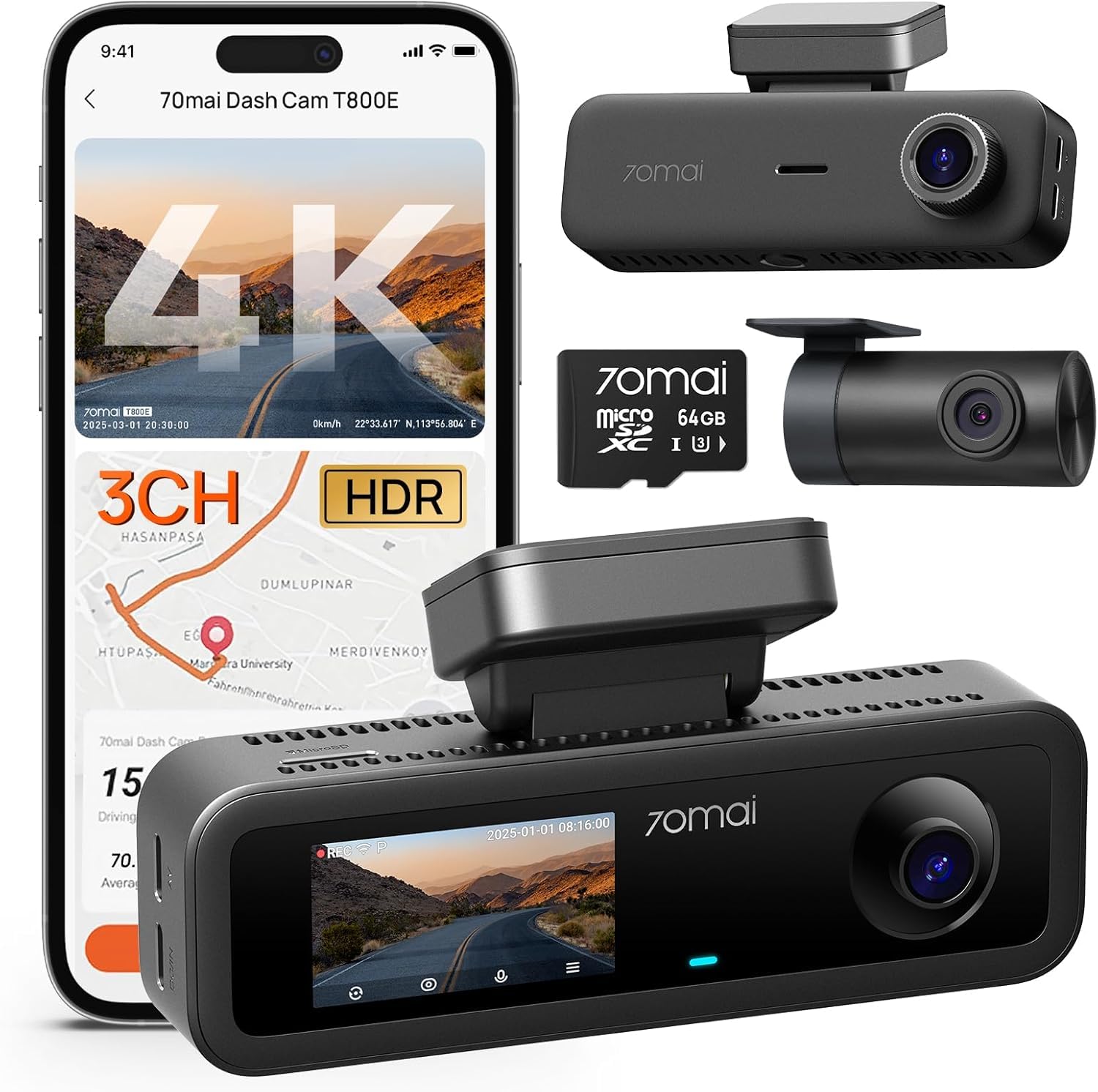
Coverage is the headline. This camera records 4K from the front lens and 1080P from both the interior and rear cameras at the same time, so you get the road ahead, the people in your back seat, and whatever is tailgating you. For a rideshare driver or a parent with kids in the car, that cabin lens is the one that answers the questions nobody expects to need answering.
What wins people over here is the picture itself — sharp video from a wide field of view that sits out of the driver’s line of sight. Night footage holds up too, thanks to HDR imaging and 3D noise reduction, which is the processing that cleans up the grainy speckle low light creates. The interior camera also has a switchable infrared mode you can turn on for a dark cabin and off again when you do not want the glow.
The numbers get serious on storage and transfer. It ships with a 64GB card and accepts up to 512GB, versus 256GB on the budget two-channel pick below. Wi-Fi 6 moves clips to your phone at up to 10 MB/s, which the maker pitches as up to 5× faster than Wi-Fi 4. A super capacitor replaces the lithium battery, and the maker rates it for 14°F to 140°F — the kind of summer dashboard heat that kills ordinary battery cameras.
The catch is the parking setup. This unit does not support 4G connectivity, so remote viewing from your phone while you are away is off the table. Continuous parking surveillance also needs a hardwire kit sold separately. Day-to-day it is a strong all-rounder with a wide-reaching 4.5+ stars behind it — the top-scoring family pick in this whole roundup.
What earns its place up front
- 4K front plus 1080P cabin and rear recording simultaneously — every angle that matters for a normal car.
- Accepts a 512GB card, versus 256GB on the two-channel budget pick.
- Super capacitor rated from 14°F to 140°F instead of a lithium battery.
- Ships with the 64GB card, rear camera, crowbar, and adhesive mounts.
Where it asks you to compromise
- No 4G, so no remote live view while you are away from the car.
- Parking surveillance requires a separately sold hardwire kit.
- Three channels still miss a side-swipe that lands behind the front doors.
Reach for it if: you want front, cabin, and rear recording in a single tidy install and plan to feed it a big card.
Think twice if: you specifically need side coverage — the four-channel Icesky below is built for that.
2. Icesky S03 4-Channel Dash Cam
Four lenses that finally watch your flanks, not just the road ahead.
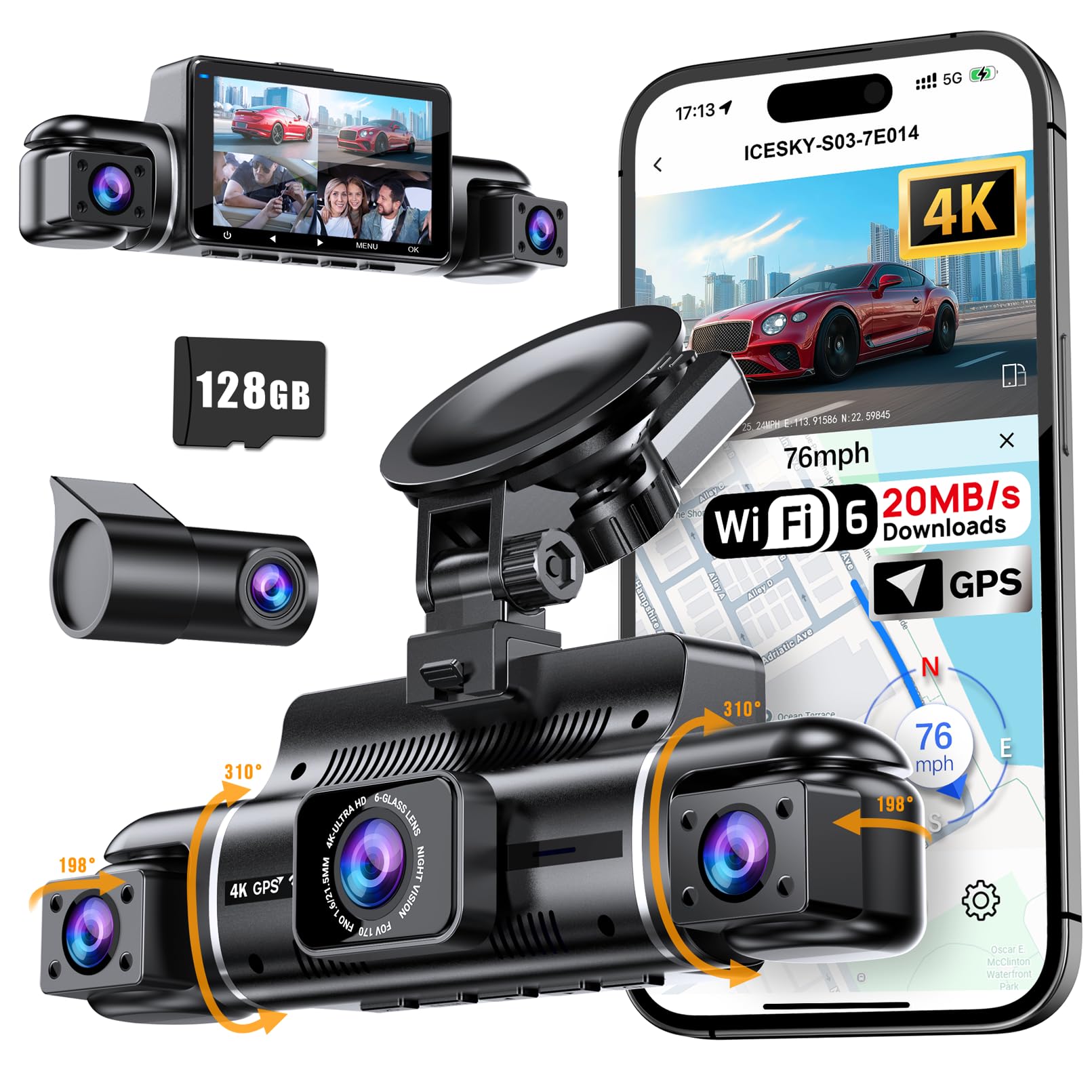
A car park is where most damage actually happens, and it is the one place a two-channel system is blind. This setup covers 4K at the front and 1080P from the rear, inside, left, and right lenses at once, for a claimed 360° view around the vehicle. The built-in 3-inch screen can show several angles side by side, which is handy when you want a quick check without pulling out a phone.
The side cameras carry 8 infrared lights each, and you can switch those infrared modes on or off separately. That matters in a dark car park, where a side lens without illumination records a black rectangle. WiFi 6 downloads run at up to 20MB/s, and the maker lists the connection as 5.8GHz — a step up in transfer speed from the typical older Wi-Fi link.
Storage is generous from day one. It arrives with a 128GB card and takes up to 512GB, so a long commute does not fill it in a week. Built-in GPS logs speed, route, location, and time, which is the data an insurance claim usually asks for. Reliability is what buyers talk about most after the picture quality — this is a system people leave running and stop thinking about.
One honest limit: the 24-hour parking mode needs a hardwire kit that does not come in the box. Budget for that separately, or you lose the protection you bought the side lenses for.
Who it is built for: drivers who park on streets and in shared lots, and want the side of the car on record. Four channels plus a 128GB starting card is a serious package at this level.
Set your expectation: this is a battery-cell unit, not the super-capacitor design used on the 70mai above — note if your car sits in extreme heat all day.
Pick this one when: side-swipes and door dings are the damage you actually fear, not a highway rear-ender.
Leave it if: you want an entirely plug-and-play parking setup from the start.
3. IIWEY N6 PRO 4-Channel STARVIS 2 Dash Cam
When the streetlights fail, this is the camera that still sees faces.
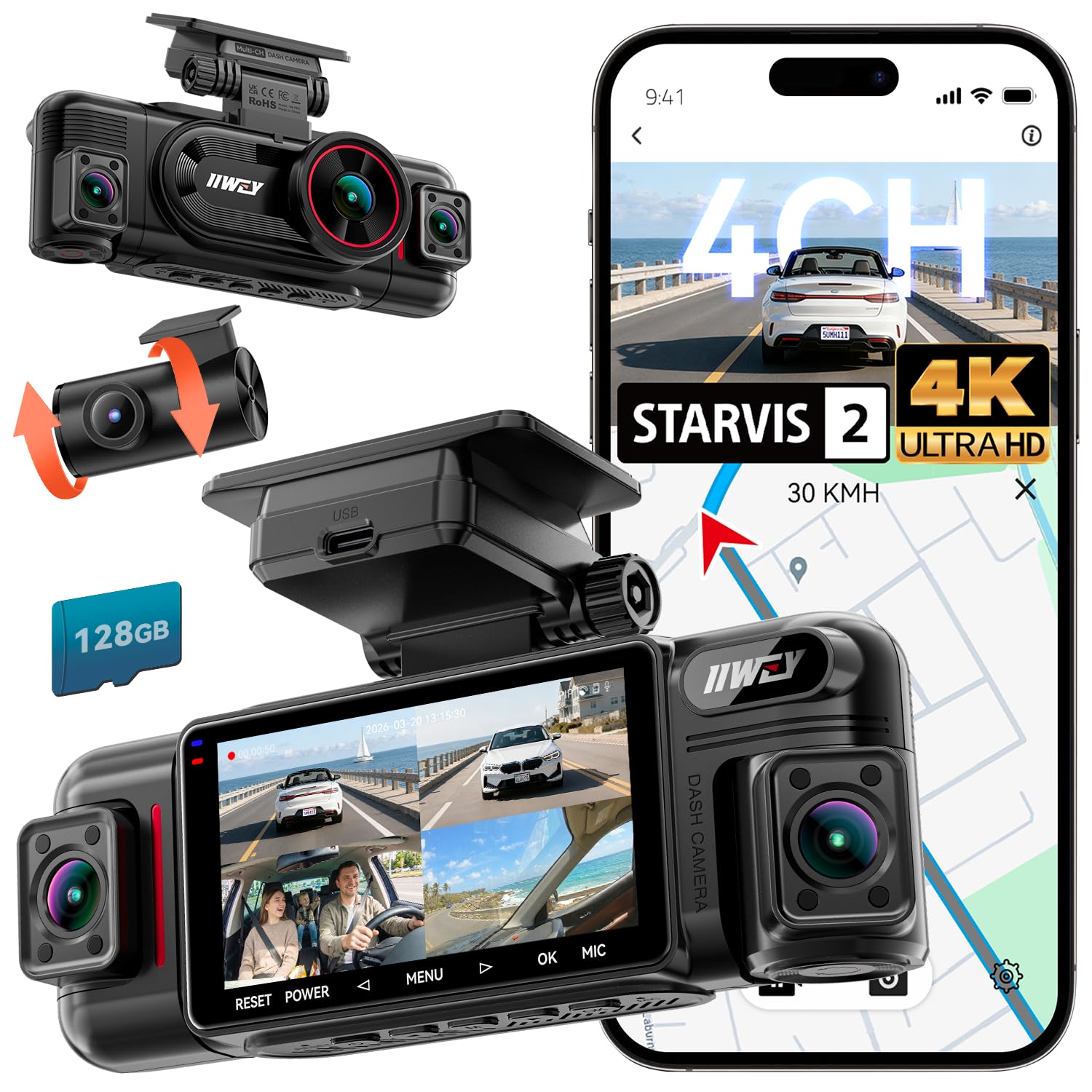
Recording runs native 4K at the front and 1080P across the left, right, and rear lenses together. The maker calls it a 360° protective bubble, and the practical version of that claim is simple: a side-swipe that a two-channel cam would miss entirely lands in HD here. The field of view is listed at 160 degrees.
The sensor is the real story. Sony STARVIS 2 is a low-light image sensor, and the maker claims it captures 6× more light than standard sensors. HDR processing then handles the white-out problem where a headlight turns a number plate into a blank white blob — the single most common reason night footage fails as evidence. Eight discrete IR lamps light the cabin and sides without throwing glare onto the windscreen.
Downloads move over 5GHz Wi-Fi 6 at up to 10MB/s, which the maker puts at 300% faster than 2.4GHz models. The included card is a high-endurance 128GB, chosen because four simultaneous streams are heavy on a card, and the system takes up to 512GB. It carries an 18-month warranty.
Read the power requirement before buying. This unit must run on the supplied car charger, and USB-C to USB-C cables are not supported — if your car has no cigarette lighter socket, you need a compatible hardwire kit. That same kit is also what activates 24/7 parking mode. Functionality is the one area where owner experience splits, so a careful setup on day one pays off.
Where it separates from the pack: the STARVIS 2 sensor and 8-IR array make this the most night-capable unit in the roundup, which matters more than raw pixel count once the sun drops.
Owners do flag: the size of the front unit in a small car’s sightline. Measure your windscreen space before committing.
Worth it for: night-shift drivers, rideshare operators, and anyone who regularly parks on unlit streets.
skip it if: your car lacks a cigarette lighter socket and you do not want to buy a hardwire kit alongside it.
4. TOOXYZ J13 3-Channel Dash Cam

A 170° front lens that catches the cross street other cameras cut off.
Most dash cams frame the lane in front of you. This one frames the junction. The front lens covers 170 degrees, the interior and rear lenses cover 120 degrees each, and all three record at once — 4K up front, 1080P from the cabin and rear. At a T-junction or a busy roundabout, that extra angle is what catches the car approaching from the side.
The 3.16-inch IPS screen gives you an on-camera view without reaching for your phone — genuinely useful if you want to check a clip at the roadside. Footage transfers through the Viidure app over 5G Wi-Fi at up to 8MB/s. The maker is upfront that the app’s basic functions need no membership: live viewing, switching between front and rear, playback, downloads, and sharing are all free.
What buyers praise most is the overall build quality, and the picture quality is right behind it, with the coverage and the app connection rounding out the list. It comes with a 64GB card and records loop-style, overwriting the oldest open up clips. Collision-locked and manually locked clips are protected from that overwrite.
Parking monitoring needs a separately sold kit, and the camera supports cards up to 256GB, versus 512GB on the 70mai above, so plan your retention window accordingly if you park for long stretches.
Angles it wins on
- 170° front view — the widest front lens on any three-channel pick here.
- 3.16″ IPS screen for checking footage without a phone.
- Core app functions are free, no VIP subscription required.
- 1-year warranty with a dedicated support team behind it.
What you trade away
- 256GB card ceiling, so less history before the loop overwrites.
- Parking mode requires a hardwire kit sold separately.
- Some app extras, like speed adjustment and cloud upload, sit behind a membership.
The right fit: city driving where junctions, merge lanes, and tight parking are the daily risk.
Not the right fit: drivers who want side coverage — you need a four-channel unit for that.
5. BOTSLAB G980H 4-Channel Dash Cam
The clip starts eight seconds before the bang — that is the feature worth paying for.
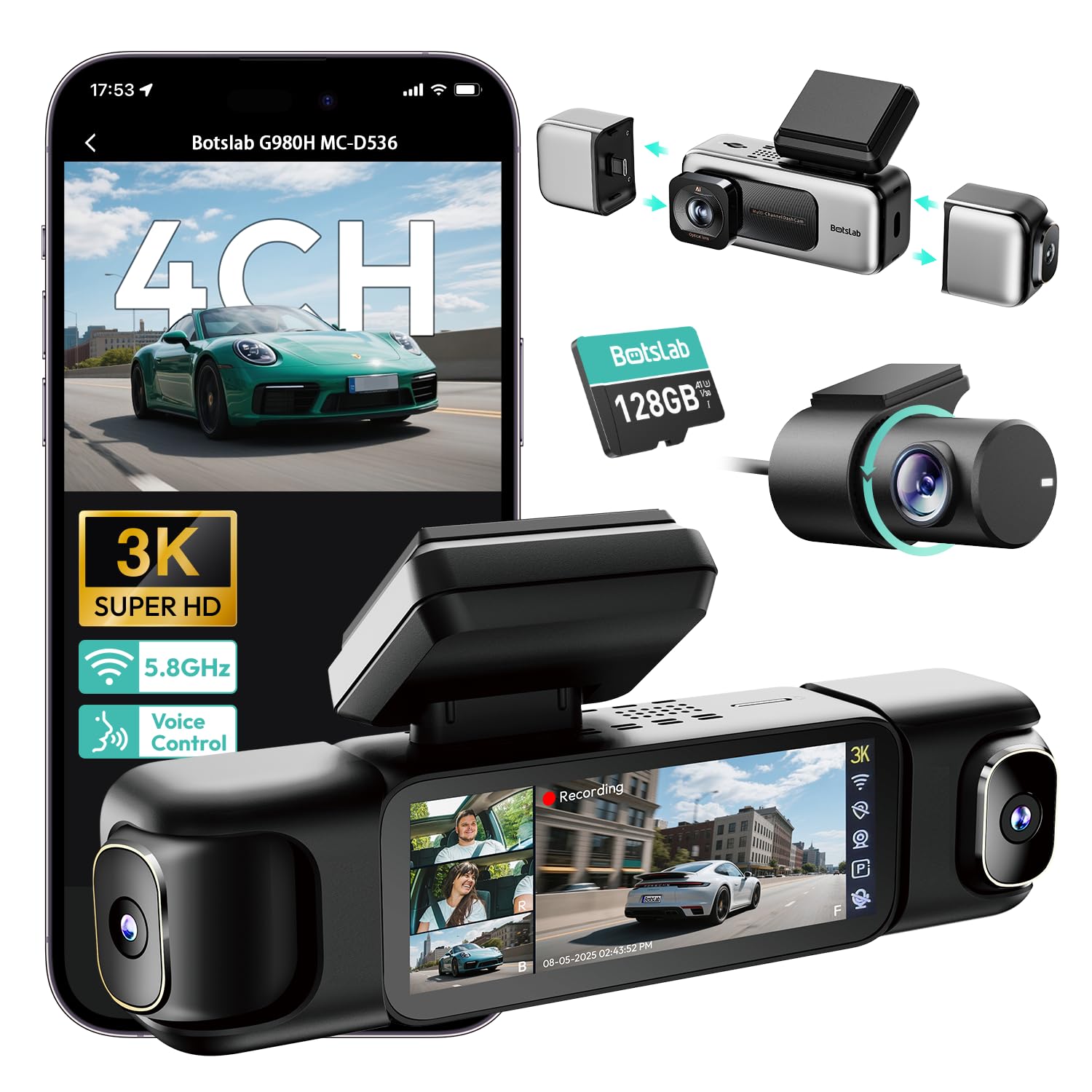
Most cameras begin recording at the moment of impact, which means the footage opens on the crash and shows nothing of how it happened. This one keeps an 8-second pre-record buffer, so when the G-sensor detects a collision, the clip includes the eight seconds before it. If you have ever had to argue that you did not cut someone off, you know exactly why that matters.
The screen handles the playback side. A 3.18-inch touchscreen supports a four-way split view, so all camera angles sit on one display while you work out what actually occurred — no flicking between feeds mid-investigation. Voice control covers starting a recording or snapping a photo without lifting a hand from the wheel.
Night recording relies on an F1.8 aperture, six lenses, 940nm infrared LEDs, and wide dynamic range. A built-in GPS module logs location, speed, and route, and the companion software can turn that into a route animation on your PC. Transfer runs over 5.8GHz Wi-Fi, which the maker pitches at 300% faster than 2.4GHz networks. A 128GB card is in the box, and the system takes up to 512GB.
Parking mode comes in three flavours — a one-frame-per-second time-lapse, a sentry mode that fires when the front camera spots movement within 5 meters, and impact locking — but all of them need a hardwire kit sold separately. Reliability is the mixed note in owner feedback, so set it up carefully and check the footage is landing in the app before you rely on it.
The standout: that 8-second pre-impact buffer is a genuine edge over every other pick in this list, and the four-way split screen makes reviewing all angles a single glance.
One thing to plan for: the hardwire kit is on you, and the unit needs a careful first setup.
Go for this if: you want to see the seconds before an incident, not just the aftermath, and you like reviewing on the camera itself.
Look elsewhere if: you want parking protection included in the box.
6. Dash Cam Front and Rear 4K+1080P with 64GB Card
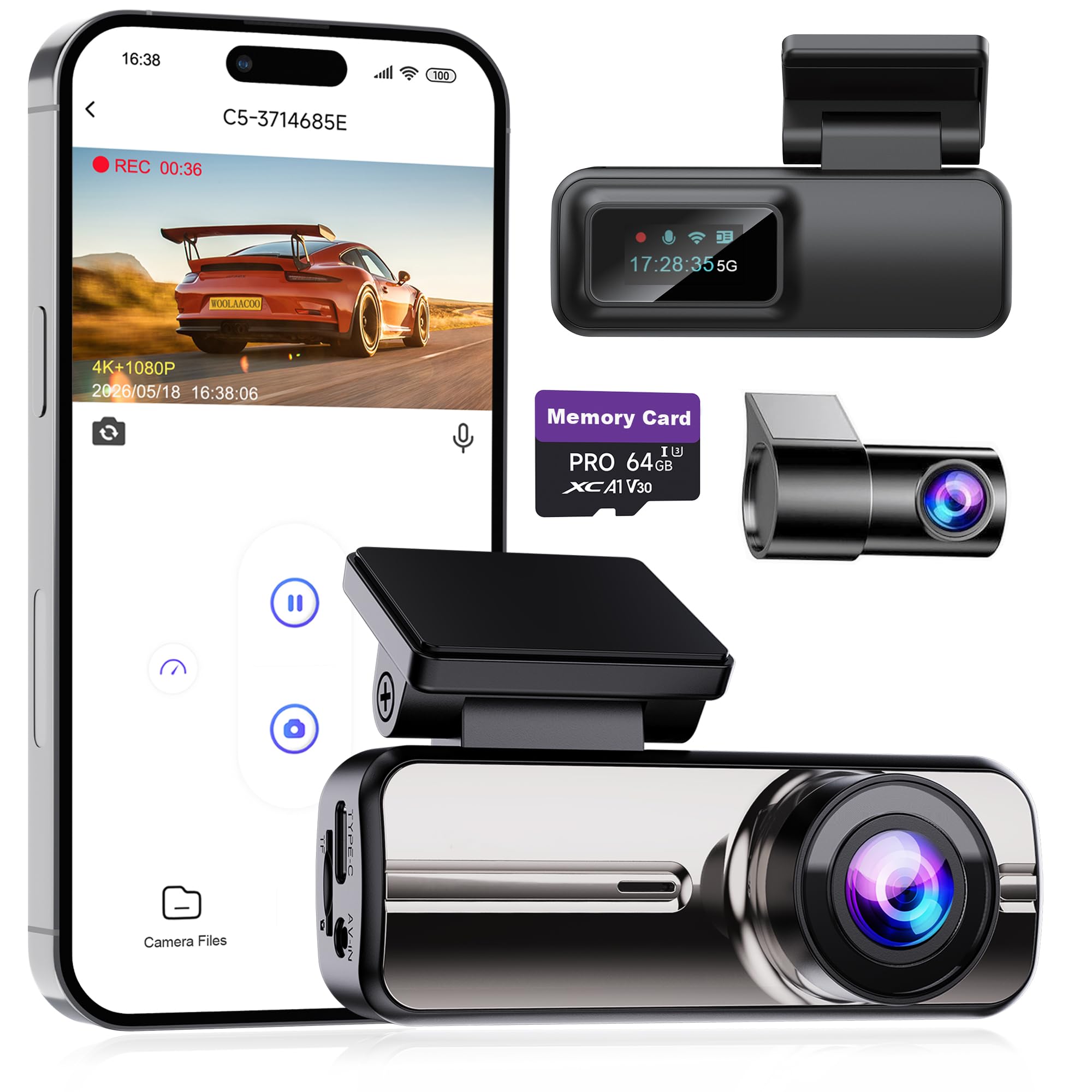
Two lenses, 65 grams, and the easiest install in the whole list.
If you drive a small car and just want the basics done well, this is the sensible starting point. A 4K front lens and a 1080P rear lens record together, which covers the two collisions that actually happen most: rear-enders and reversing bumps. The unit weighs 65 grams, so it sits on the glass without pulling at the mount.
Setup is the thing this camera gets praised for most. Buyers single out how straightforward the install is and how easily it pairs with a phone, then mention the value they got for the money. The compact body does not block the windscreen, and the supplied cables reach where they need to. An F1.8 aperture handles night and rain reasonably, and a spare USB port lets you charge a phone while it records.
It ships with a 64GB card already in the slot, takes up to 256GB, and includes the car charger, mount, crowbar, and cable clips. Loop recording overwrites the oldest files, while the G-sensor locks collision footage so it cannot be erased by the loop. A dedicated button lets you lock a clip manually.
Two limits are worth knowing up front. Wi-Fi range is only 3–5 meters and will not connect from indoors, so downloading a clip means sitting in or beside the car. Parking mode also requires a 3-lead hardwire kit sold separately, and the camera must be plugged into power to run at all — there is no battery inside.
Straight talk on value: a 4.0+ star read-out, driven by easy installation and honest footage quality. It is the least fussy camera in the roundup.
Where it stops: no cabin view and no side view. If you drive for a living, spend more.
Best entry point for: a first dash camera on a daily commuter car, or a second car that needs basic coverage.
Move up the list if: you carry passengers you need to record, or you want parking protection wired in.
7. JOINLGO 4-CH 1080P Mobile Vehicle DVR Kit

A proper wired DVR kit, not a windscreen gadget — built for a van that works.
This is a different class of equipment from the dash cams above. It is a four-channel mobile DVR with a separate 7-inch IPS monitor at 1024×600, wired over secure 4-pin connectors rather than Wi-Fi. All four channels record 1080P at 30 frames per second using H.265 compression, so a fleet gets real-time coverage rather than a phone-friendly highlight reel.
The cameras themselves are IP68 waterproof — that rating means they survive full immersion, which is the standard a rear camera on a truck or a side camera on a van actually needs. IR LEDs handle night vision, and the housings are full metal. The DVR body is an aluminium die-cast chassis with no fan, designed for the kind of dust and vibration that kills consumer electronics.
Fleet features are where it pulls ahead. A G-sensor logs hard acceleration, sudden braking, speeding, and impacts. There are four alarm inputs that trigger a full-screen view and lock the footage automatically. Motion detection has adjustable alarm time and detection area, and delay record keeps capturing for up to 24 hours after shutdown by drawing from the vehicle’s battery. A built-in capacitor provides 8 seconds of backup power instead of a battery that ages out.
Storage is the biggest number here: two card slots, each up to 512GB, on standard SD cards rather than micro. Cards are not included, so that is a separate purchase. The honest caveat is long-term reliability — some units have stopped working and monitor screens have cracked. It comes with a 2-year warranty and free replacement during that period, which is the right cover to have on equipment that runs all day.
Fleet-grade strengths
- Four 1080P channels at 30fps with H.265 compression and a dedicated 7″ monitor.
- IP68 waterproof, full-metal cameras with IR night vision.
- Two card slots supporting up to 512GB each on standard SD cards.
- 2-year warranty with free replacement during the covered period.
Honest trade-offs
- SD cards are not included — you supply both.
- It is a wired kit, so installation is a job, not a five-minute stick-on.
- Some units develop faults over months of use; the warranty is the safety net.
Built for: van, minibus, and small truck operators who want a monitor on the dash and wired reliability.
Not for you if: you drive a hatchback and just want a windscreen camera.
8. Weivision 360° Bird View Surround Camera System

Four fish-eye lenses stitched into one overhead picture of the whole vehicle.
Reverse-parking a box truck or swinging a fire engine into a tight bay is where mirrors stop helping. This system builds a bird’s-eye view from four 1080P fish-eye cameras, each with a 190° field of view and a horizontal angle above 170°. The stitched result shows what is beside and behind you as if you were looking down from above.
The low-light figure is worth noting: a 0.1 lux rating is the amount of light it needs to produce a usable image, and a low number means it keeps working as dusk fades. It records on loop and handles up to 64GB of storage, outputting 1080P video to the included 9-inch display.
The compatibility note is the one to read twice. This kit uses an LVDS signal, which only works with the special 9-inch Weivision monitor in the box — it will not drive a third-party screen. Buy it as a complete system, not as cameras you add to an existing display.
It is engineered for long-wheelbase and heavy vehicles: RVs, trailers, school buses, fire engines, and industrial plant. The maker offers OEM support if you need a custom fit. If your daily driver is a sedan, this is genuinely more system than you need.
The core value: a true surround view that eliminates the blind zones a single rear camera leaves on a long vehicle.
Know before you buy: the 64GB maximum is modest for four channels of continuous recording, and the monitor lock-in means no mixing brands.
Right answer for: bus, RV, fire engine, and trailer operators who need to see all four corners at once.
Wrong answer for: anyone hoping to reuse an existing dashboard monitor.
9. JOINLGO 4G LTE Fleet DVR Kit with GPS

Watch your fleet from a desk two states away — that is the whole point.
A built-in 4G module plus Wi-Fi is what separates this kit from the wired-only DVR above. It streams live video to a PC, a web page, or an iOS or Android phone, so a fleet manager can check a vehicle without being anywhere near it. The GPS module logs the vehicle’s position via satellite and writes that location straight into the video stream, which turns footage into a time-and-place record.
The recording core is four channels at 1920×1080 and 30 frames per second, looped so the oldest footage overwrites. Cameras are IP68 waterproof with full metal builds, IR LEDs for night vision, real 2.0MP sensors with an IMX323 chip and wide dynamic range. The 7-inch IPS monitor runs at 1024×600 and the aluminium die-cast chassis is fanless, so there is no cooling fan to clog with dust.
Fleet control goes further than recording. A geofence feature sets routes and alerts you when a vehicle deviates from them. Four alarm inputs trigger a full-screen view and lock the footage automatically. Delay record keeps running up to 24 hours after shutdown drawing on the vehicle battery, with 8 seconds of capacitor backup. Mirror image flip lets you mount any camera upside down or sideways and correct the picture in the menu. HDMI output sends playback to a TV or monitor.
Storage is the highest in this list — two card slots, each up to 1TB, and it takes full-size SD cards rather than micro. Cards are not included. Build quality is what owners talk about most, followed by how straightforward the install proves to be, and it carries a 2-year warranty.
Why fleets pick it: live remote viewing plus GPS logging plus geofence alerts, all in one box with a 2-year warranty behind it.
The honest cost: you supply your own SD cards, and the remote features depend on an active 4G connection.
Choose it for: businesses running several vehicles who need live oversight and route accountability.
Overkill if: it is one car and you are the only driver — the wired JOINLGO kit above keeps the savings.
Understanding the Specs
Channel count and field of view
Channel count is how many cameras record at once. Two channels cover front and rear, three adds a cabin lens, and four adds the sides. Field of view is the width of the scene a single lens captures, written in degrees — a 170° lens sees much wider than a 120° one. More degrees means more of the junction gets recorded, but the edges of a very wide image curve slightly, which is normal for fish-eye optics.
Aperture and WDR
Aperture is the size of the lens opening, written as an f-number — F1.55 is a wider opening than F1.8, so it gathers more light for night footage. WDR, or wide dynamic range, is processing that keeps both the bright and dark parts of a scene readable at once. Together they decide whether a number plate stays legible when headlights hit it, which is the problem resolution alone cannot fix.
G-sensor and loop recording
A G-sensor is a small motion sensor that notices a bump, a hard brake, or an impact. When it fires, the current clip is locked so loop recording cannot overwrite it. Loop recording itself is what lets a card run continuously — once it fills, the oldest open up footage is replaced by the newest. You never have to delete files by hand.
Hardwire kits and parking mode
Parking mode records while the ignition is off, but it needs a hardwire kit — a cable that taps the fuse box instead of the cigarette lighter — and that kit is usually sold separately. Delay record and time-lapse are the two common ways to keep power draw low while parked. Check the box contents before you assume parking protection is included.
FAQ
Do I need a hardwire kit for parking mode on these cameras?
Will a four-channel dash cam drain my car battery when parked?
How large a memory card can these car CCTV cameras take?
Is 4K actually better than 1080P for reading a number plate?
What is the difference between a dash cam and a mobile DVR kit?
Will a super capacitor camera survive a hot dashboard in summer?
Does the Wi-Fi on these cameras work when I am away from the car?
Can I install a four-channel system myself?
Which channel count should a rideshare driver pick?
Do these cameras record audio from inside the cabin?
How long does footage stay on the card before it is overwritten?
Final Thoughts: The Verdict
For most drivers, the car cctv camera worth buying is the 70mai 4K T800E. It watches front, cabin, and rear at the same time, so a parking knock or a lane scrape gets caught from more than one angle. It takes a 512GB card (a memory card that holds weeks of clips before it overwrites), and it uses a super capacitor (a power part that survives heat and cold better than a lithium battery) rated from 14°F to 140°F — so it keeps working through a hot summer dash and a freezing winter morning. That covers a normal car’s real risks without asking you to wire a fleet system. The other two-channel pick may sit on a larger review base, but this one holds the higher score at 4.5+ stars.
If the damage you fear most happens in car parks, the Icesky S03 adds left and right lenses and starts you on a 128GB card. Night-shift and rideshare drivers should look at the IIWEY N6 PRO, where the STARVIS 2 sensor and eight IR lamps do the work that resolution alone cannot.
Running a van or a small fleet instead? The JOINLGO 4-CH 1080P kit gives you a 7-inch monitor and IP68 waterproof cameras, while the 4G LTE version adds live remote viewing and geofence alerts for operators who need eyes on several vehicles at once.
How We Picked
We do not accept paid placement. Every pick is matched to a real buyer and a real use-case; we do not hands-on test units.
Sources & Methodology
Specifications: manufacturer listings and product documentation. Review insights: verified customer reviews, as of November 2026. Pricing: not shown on this page (it changes often); check the current price via the retailer link.
As an Amazon Associate, Gadgets Feed earns from qualifying purchases. This does not affect which products we feature.