
Choosing the wrong engine coolant is a gamble with your head gasket. A single boil-over on a hot highway or a freezing night can crack blocks and warp cylinder heads, turning a routine maintenance item into a repair. Modern engines run hotter, use more aluminum, and demand specific additive packages — the era of grabbing the cheapest green jug off the shelf is over.
I’m Min — the co-founder and writer behind Gadgets Feed. After hundreds of hours parsing technical data sheets, reading through thousands of owner repair logs, and cross-referencing manufacturer spec bulletins, I’ve mapped out exactly which coolant formulations protect your specific cooling system metals and which ones are just dyed water with a marketing sticker.
Losing coolant on a road trip or chasing puddles under your car is a stress no driver needs — which is why I put together this guide to help you find the best car coolant for your specific engine, climate, and maintenance schedule.
How To Choose The Best Car Coolant
The wrong chemistry eats water pump seals and radiator cores from the inside out. Matching the coolant type to your vehicle’s metallurgy and the manufacturer’s original fill spec is the single most important step — everything else (color, brand, price) is secondary.
Chemistry Type: OAT, HOAT, Si-OAT, or IAT
OAT (Organic Acid Technology) coolants use organic acids like sebacate and 2-EHA to protect aluminum without silicates. HOAT (Hybrid OAT) adds a small silicate dose for extra protection on older cast-iron engines. Si-OAT blends silicon-based additives specifically for aluminum-dominant engines found in European makes. IAT (Inorganic Additive Technology) is the old-school green stuff — short life, heavy on silicates and phosphates, best left for pre-1990s radiators. Picking the wrong type accelerates galvanic corrosion inside your heater core.
Concentrate vs. 50/50 Pre-Diluted
Concentrate gives you control over the final mixture ratio — 50/50 for most climates, 60/40 for extreme cold, 70/30 for track days — and yields two gallons of useable coolant per jug. Pre-diluted 50/50 is a convenience play: open the bottle, pour it in, zero mess. If your tap water is hard or you don’t trust yourself to measure, pre-diluted eliminates the risk of a wrong ratio that lowers the boiling point.
Freeze and Boil Protection Ratings
A proper 50/50 ethylene glycol mix protects down to -34°F and resists boiling up to 265°F under pressure. If you live in a region where winter temps drop below -40°F, a 60/40 concentrate ratio (60% coolant, 40% water) pushes protection to -62°F. For high-performance or turbocharged engines that run above 240°F under load, consider a waterless coolant with a 375°F boiling point that never vaporizes.
Quick Comparison
On smaller screens, swipe sideways to see the full table.
| Model | Category | Best For | Key Spec | Amazon |
|---|---|---|---|---|
| EVANS Waterless Coolant | Waterless | High-heat & track cars | 375°F boiling point | Amazon |
| ACDelco DEX-Cool | OAT | GM & Chrysler vehicles | OEM GM concentrate | Amazon |
| Honda Type 2 Coolant | HOAT | Honda & Acura engines | Blue HOAT, 60K mi life | Amazon |
| Zerex G40 Concentrate | Si-OAT | European & aluminum engines | Phosphate & nitrite-free | Amazon |
| PEAK Global Lifetime Concentrate | OAT | Universal fill for mixed fleets | Universal OAT concentrate | Amazon |
| PEAK OET Green for Asian Vehicles | POAT | Hyundai, Kia, Nissan, Subaru | 400K mi / 15 yr life | Amazon |
| Zerex American Vehicle 50/50 | OAT | Domestic cars & light trucks | 150K mi guarantee | Amazon |
In‑Depth Reviews
1. EVANS Cooling Systems High Performance Waterless Engine Coolant

The EVANS Waterless Coolant operates on a fundamentally different principle than everything else on this list — it contains zero water. With a boiling point of 375°F under zero pressure, this coolant simply cannot vaporize, which means boil-overs and after-boil are mechanically impossible. For owners of high-horsepower builds, turbocharged engines, or classic cars without pressurized caps, this eliminates the single most common cause of catastrophic engine failure: steam pockets that cause localized hot spots and crack cylinder heads.
The real-world data from LX-platform owners running 6.1L HEMI engines shows max coolant temps peaking at 209°F with stock fans and radiators, dropping to 190°F after the system stabilizes — all without a pressurized cap. The requirement for a near-zero water residual (under 3%) means you must use EVANS Prep Fluid during installation, which adds an extra step and increases the total investment. But once installed, this fluid is permanent — drain it, filter it, reuse it across multiple engine swaps with zero degradation.
The biggest trade-off is the upfront cost, which runs roughly double that of conventional premium coolant. For daily drivers in moderate climates, the performance benefit is marginal. But for any vehicle that regularly sees 230°F+ oil temps, track sessions, or extreme desert driving, this is the only coolant that removes boiling from the equation entirely.
Why it’s great
- 375°F boiling point eliminates boil-over and vapor lock completely
- Zero water content stops all corrosion, electrolysis, and cavitation erosion
- Reusable indefinitely — drain, filter, and pour back into the next engine
Good to know
- Requires strict installation procedure with EVANS Prep Fluid to remove water residue
- Premium price — expect to pay double the cost of standard coolant
- Not recommended for vehicles with internal head gasket coolant passages that easily clog
2. Honda Genuine Extended Life Antifreeze/Coolant Type 2
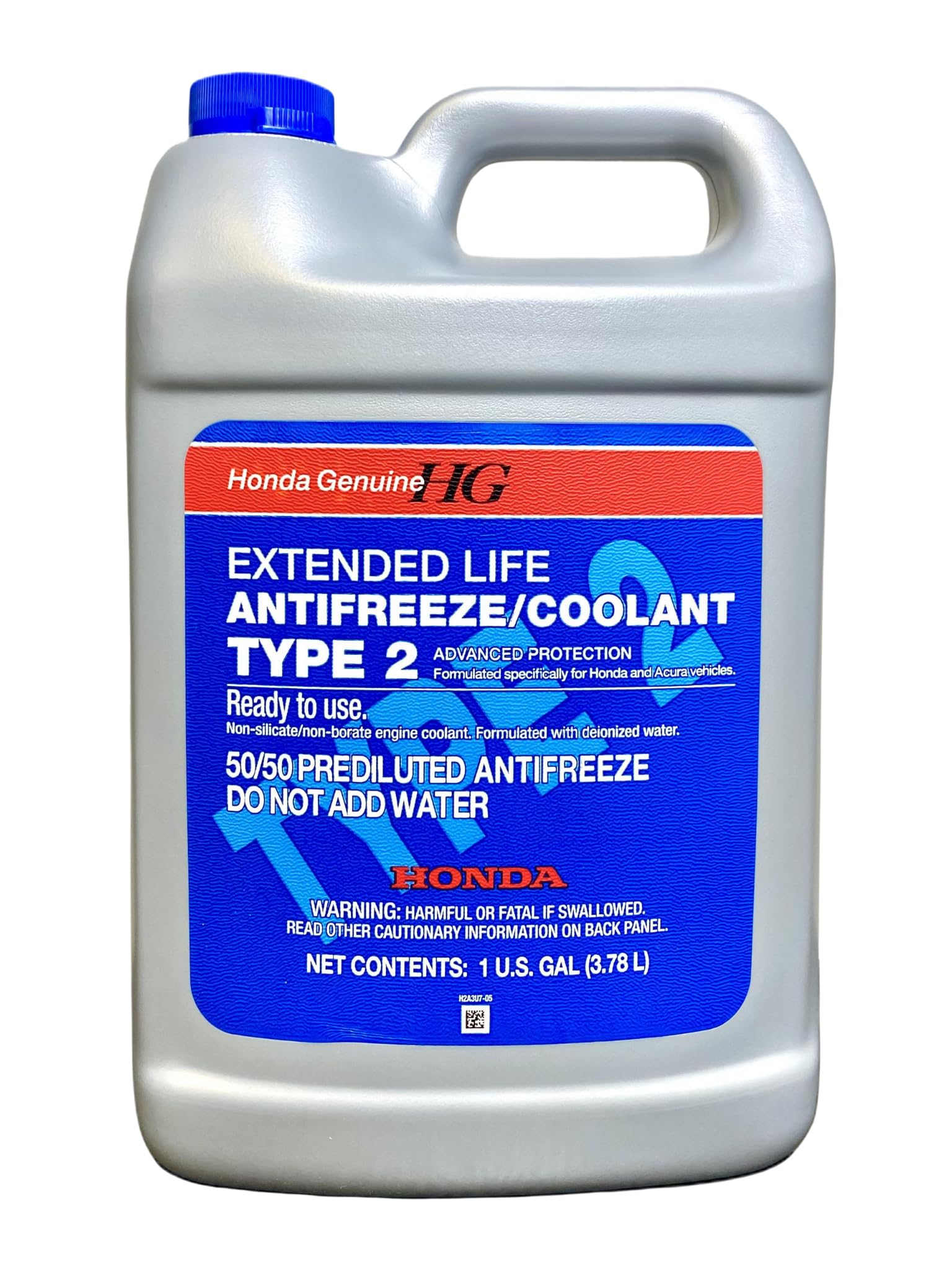
Honda Genuine Type 2 Coolant is the factory fill for Honda and Acura vehicles requiring the blue HOAT (Hybrid Organic Acid Technology) formulation. The phosphate-free, silicate-free chemistry is specifically engineered to protect the aluminum alloys and water pump seals found in K-series, J-series, and Earth Dreams engines. Unlike universal coolants that rely on generic corrosion inhibitors, this formula contains the exact additive package Honda validated for 60,000-mile or 5-year service intervals under normal driving conditions.
Owner feedback confirms the pre-diluted 50/55/50 mix is ready to pour directly into the reservoir without any mixing math. The blue dye also makes leaks easier to trace compared to conventional green or orange coolants. Users have reported successful use beyond Honda applications — the aluminum-safe chemistry works well in Suzuki, Mazda, and even some motorcycle engines with all-aluminum radiators and water jackets. The bottle replaces Honda part number OL999-9011 and matches the factory fill spec for all Type 2 systems.
The downside is price — this is a genuine OEM product and carries a premium over aftermarket alternatives. It is also vehicle-specific, so it cannot be used in Ford, GM, or Chrysler engines that require DEX-Cool or Yellow HOAT formulas. If you own a non-Honda vehicle, you are paying for additive chemistry you do not need.
Why it’s great
- Exact OEM chemistry for Honda/Acura Type 2 systems — no guesswork
- Pre-diluted 50/50 mix means zero measuring or distilled water required
- Blue dye makes leak detection far easier than conventional coolant colors
Good to know
- Only suitable for Honda/Acura or vehicles explicitly requiring blue HOAT
- Premium price compared to universal alternatives
- 60K mi interval means more frequent changes than long-life OAT coolants
3. Zerex G40 Phosphate and Nitrite Free Concentrate Antifreeze/Coolant
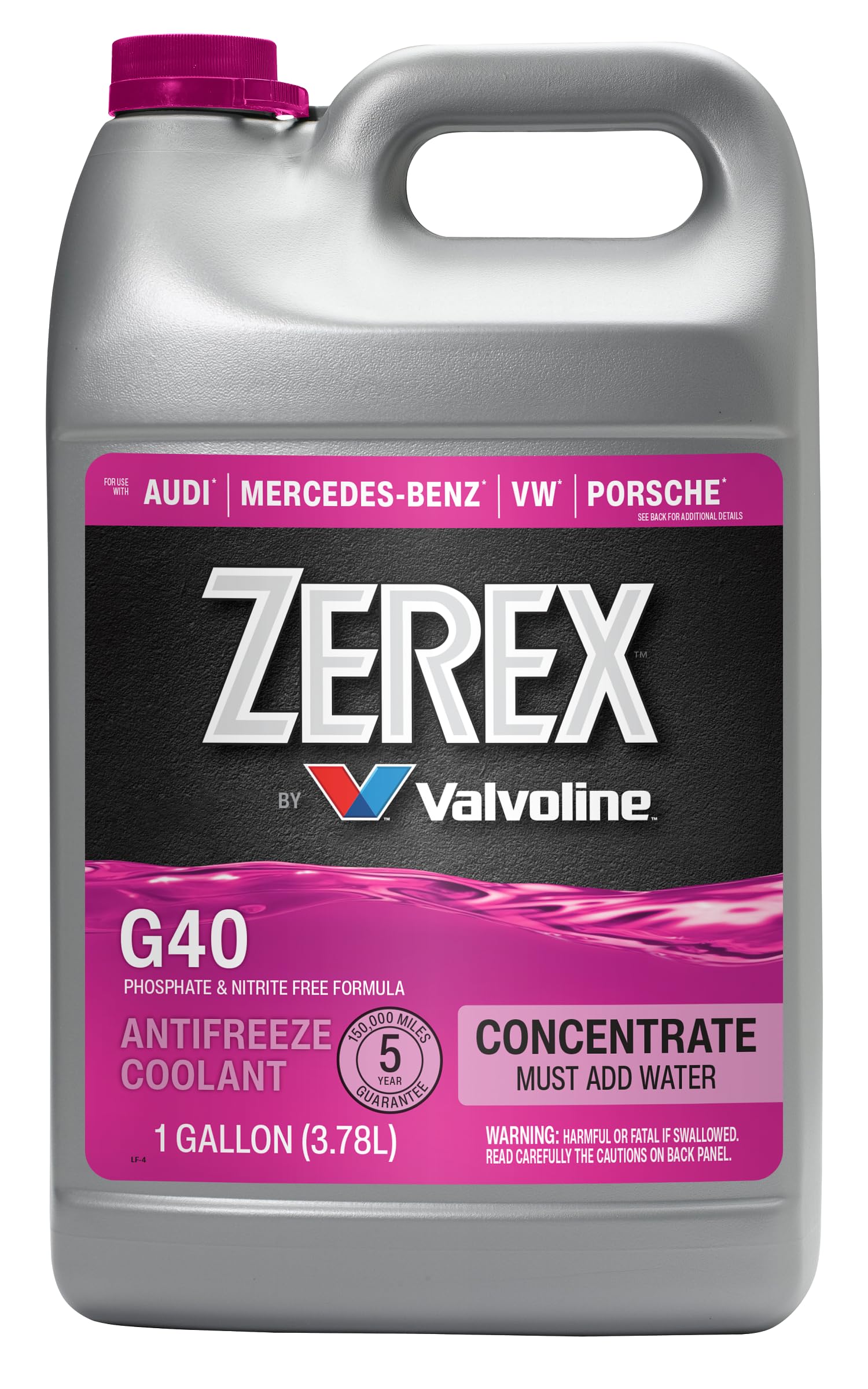
Zerex G40 uses Silicon-Organic Acid Technology (Si-OAT), making it the correct choice for European vehicles that specifically forbid phosphates and nitrites in their cooling systems — including BMW, Mercedes-Benz, Audi, Volkswagen, and Volvo. The violet concentrate formula provides unsurpassed freeze protection down to -84°F at a 70/30 mix ratio, and the 5-year, 150,000-mile guarantee matches or exceeds most OEM service intervals. The Si-OAT chemistry deposits a microscopic silicate layer on aluminum surfaces that prevents pitting without clogging narrow water jacket passages found in modern turbocharged engines.
Owners report that this coolant costs significantly less per gallon than what dealerships charge for the same spec fluid, especially when factoring in that each gallon of concentrate yields two gallons of useable coolant after dilution with demineralized water. The batch-tested quality control from Valvoline means consistent additive concentration across every jug — no variation between production runs. The bittering agent (denatonium benzoate at 30-50 ppm) prevents accidental ingestion, which is a standard safety feature across all modern coolants.
The main drawback is that this is a concentrate, not a pre-mix. If you use tap water instead of distilled or demineralized water, the minerals can react with the additives and shorten the coolant’s effective life. You also need to buy a gallon of distilled water separately, adding to the total cost and effort. For those who prefer convenience, a 50/50 pre-diluted version would be simpler.
Why it’s great
- Si-OAT chemistry meets strict European OEM requirements — phosphate and nitrite free
- Concentrate yields 2 gallons of coolant per jug, cutting cost per useable gallon
- 150,000-mile guarantee with proper maintenance and mixing
Good to know
- Concentrate requires mixing with distilled water — not a pour-and-go product
- Violet color can be mistaken for pink or red coolants, risking a chemistry mix-up
- Not approved for GM DEX-Cool or Asian POAT systems
4. General Motors ACDelco DEX-Cool Coolant Antifreeze

ACDelco DEX-Cool is the factory-recommended coolant for General Motors vehicles from 1995 onward, including Chevrolet, GMC, Cadillac, and Buick models that left the assembly line with orange coolant in the reservoir. The OAT (Organic Acid Technology) formula uses a carboxylate additive package that provides extended life protection up to 150,000 miles without the silicates and phosphates that can precipitate and form gel deposits in GM V8 and V6 cooling systems. This is the same GM part number 12346290 that dealerships charge double for.
Real-world owner data confirms this coolant handles the notorious thermal cycling of GM’s 5.3L and 6.0L V8 engines, including the AFM (Active Fuel Management) engines that run hotter on the rear cylinders. Users report stable operating temperatures and no visible corrosion in the radiator neck after 50,000 miles. The concentrate format means you get two gallons of coolant by mixing one gallon of concentrate with one gallon of distilled water — effectively cutting the per-gallon cost in half compared to buying pre-diluted bottles.
Be aware that DEX-Cool has a controversial history with some early formulations causing intake manifold gasket failures in late-90s and early-2000s GM vehicles. While the current formula has addressed those issues, some owners of older GM vehicles still prefer a conventional green IAT coolant or a DEX-Cool-compatible HOAT alternative. The label also arrived on some units in a foreign language, which can cause confusion at a glance.
Why it’s great
- Exact OEM GM factory fill — guaranteed compatibility with all DEX-Cool systems
- Concentrate yields 2 gallons of coolant, making it the most cost-effective OEM option
- 150,000-mile service life with proper maintenance
Good to know
- Only compatible with GM and some Chrysler vehicles — not for Asian or European makes
- Incompatible with older green IAT coolant — mixing causes gel formation
- Some units shipped with alternate labeling, creating packaging confusion
5. PEAK Global Lifetime Concentrate Antifreeze and Coolant

PEAK Global Lifetime Concentrate is designed to be the one-jug solution for multi-vehicle households that own a mix of American, Asian, and European cars. The amber-colored ethylene glycol formula uses Organic Acid Technology without silicates, phosphates, or nitrites, making it compatible with virtually all cooling system metals including aluminum, cast iron, copper, brass, and solder. PEAK claims this coolant provides “lifetime” protection, meaning it should never need replacement as long as the cooling system remains sealed and properly maintained.
The concentrate format delivers exceptional value: one gallon of concentrate plus one gallon of distilled water gives you two gallons of useable coolant at roughly half the cost per gallon of pre-diluted competitors. Owners running mixed fleets — for example, one household with a Dodge truck and a Mazda sedan — report using the same jug for both vehicles without any temperature or corrosion issues. The universal amber color means it will not discolor or interact with whatever coolant remains in the system during a top-off, provided the leftover chemistry is OAT-based.
The “lifetime” claim requires that the coolant never be contaminated with hard water or mixed with incompatible IAT (green) coolant. Additionally, PEAK has replaced this product line with their Titanium series (15-year/500K mile rated), so this Global formula is being phased out. Once current stock is exhausted, finding a matching replacement for top-offs may become difficult.
Why it’s great
- Universal compatibility across American, Asian, and European vehicles
- Concentrate yields 2 gallons of coolant for maximum dollar efficiency
- Amber color is non-staining and safe for top-offs without system flush
Good to know
- Being discontinued — future top-offs may require the PEAK Titanium replacement
- Lifetime claim is contingent on never introducing hard water or incompatible coolant
- Not a factory-spec coolant — no OEM approvals for specific makes
6. PEAK OET Extended Life Green 50/50 for Asian Vehicles
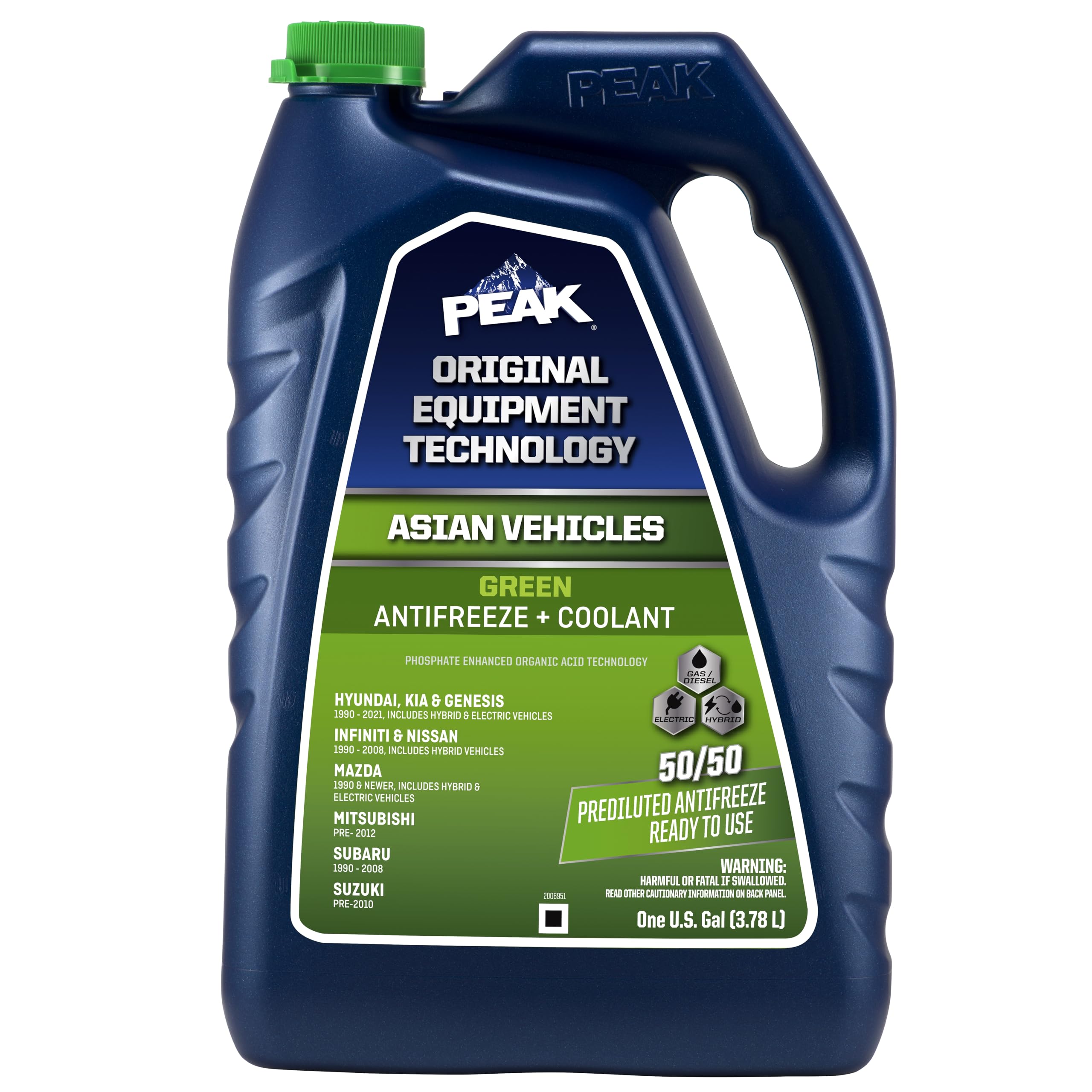
PEAK OET Extended Life Green Coolant is formulated with Phosphate-enhanced Organic Acid Technology (POAT) specifically for Asian vehicle manufacturers including Hyundai, Kia, Genesis, Nissan, Infiniti, Mazda, Mitsubishi, Subaru, and Suzuki. The green color matches the factory fill used by these manufacturers, and the phosphate additive package is critical — Asian cooling systems use aluminum radiators and water pump impellers that are particularly vulnerable to corrosion from silicate-heavy coolants designed for domestic cars. PEAK guarantees up to 400,000 miles or 15 years of service life when installed as part of a complete system flush and fill.
Owner reports confirm this coolant works perfectly as a direct replacement for OEM fluids in Hyundai and Kia GDI engines, Nissan VQ series, and Subaru boxer engines. One Ford Fusion Hybrid owner with a Mazda-sourced engine (MZR 2.5L) reported over 365,000 miles on Texas heat cycles with coolant viscosity unchanged after three years. Another user filled a Kia Soul cooling system post-70K mile drain and verified stable temps across a long road trip. The pre-diluted 50/50 formula eliminates mixing errors and is ready to pour straight into the reservoir.
The limitation is vehicle specificity — this coolant should not be used in GM, Ford, Chrysler, or European vehicles that require DEX-Cool, Yellow HOAT, or Si-OAT formulations. The green color also makes it indistinguishable from older IAT (inorganic) coolant, so careful labeling is required to avoid mixing incompatible chemistries in a system that previously held conventional green coolant.
Why it’s great
- Phosphate-enhanced OAT chemistry matches Asian OEM factory fill requirements
- 400,000-mile, 15-year service life when installed during a full system flush
- Pre-diluted 50/50 — no mixing, no distilled water needed
Good to know
- Only for Asian vehicles — incompatible with GM DEX-Cool and European Si-OAT systems
- Green color can be confused with old-school IAT coolant, risking chemistry mismatch
- Not recommended for Honda/Acura vehicles that require blue HOAT Type 2 coolant
7. Zerex American Vehicle 50/50 Ready-to-Use Antifreeze Coolant

Zerex American Vehicle 50/50 offers a silicate-free HOAT formula engineered specifically for domestic cars and light trucks from Ford, Chrysler, and GM that do not require DEX-Cool. The pre-diluted orange coolant provides -34°F freeze protection and 265°F boiling resistance right out of the bottle, making it a straightforward choice for topping off or refilling systems after a water pump replacement, radiator swap, or heater core repair. The 5-year, 150,000-mile guarantee from Valvoline backs the corrosion protection and freeze/boil performance across all cooling system metals including aluminum, cast iron, and copper-brass radiators.
Owner feedback from 2012 Chevy Cruze 1.4L turbo owners and Ford modular V8 platforms confirms the coolant maintains stable operating temperatures without silicate dropout or water pump seal degradation. The addition of denatonium benzoate bittering agent (30-50 ppm) is a standard safety measure that makes the coolant taste extremely bitter to deter ingestion by children or pets. The orange color is distinct enough to avoid confusion with green IAT coolants, and the pre-mix eliminates the need to source distilled water.
The main limitation is that this is a budget-oriented product with a simpler additive package compared to premium or OEM-specific coolants. It offers only a 5-year service life versus the 10-15 year claims of higher-end OAT coolants. Additionally, while it is labeled for American vehicles, it may not meet the specific phosphate or silicate requirements for some older Chrysler or GM engines that call for a specific factory fill chemistry — always double-check your owner’s manual before choosing this as a full-system replacement.
Why it’s great
- Excellent value for money — pre-diluted and ready to pour at a low per-gallon cost
- Silicate-free HOAT formulation safe for American vehicle cooling system metals
- 5-year, 150,000-mile guarantee backs performance with minimal risk
Good to know
- Shorter service life (5 years) compared to premium OAT coolants (10-15 years)
- Not suitable for Asian or European vehicles with specific POAT or Si-OAT requirements
- May not match every American OEM spec — verify compatibility with your owner’s manual
FAQ
Can I mix orange DEX-Cool with green conventional coolant?
How often should I flush and replace my engine coolant?
Is it better to use concentrate or pre-diluted 50/50 coolant?
Why does coolant come in different colors and can I use any color?
What happens if I use the wrong type of coolant in my engine?
Final Thoughts: The Verdict
For most users, the best car coolant winner is the EVANS Waterless Coolant because its 375°F boiling point eliminates boil-over and corrosion completely for any high-heat or performance engine. If you want genuine factory-matched chemistry at the best per-gallon cost, grab the ACDelco DEX-Cool for GM vehicles or the Honda Type 2 Coolant for Hondas. And for a versatile universal option that works across American, Asian, and European cars at a budget-friendly price, nothing beats the PEAK Global Lifetime Concentrate.