
Our readers keep the lights on and my morning glass full of iced black tea. As an Amazon Associate, I earn from qualifying purchases.
Specs are compiled from manufacturer listings and verified buyer reviews and can change over time — please confirm the key details on the product page before buying.
A hot cabin drains your energy, overworks the AC, and ruins long drives. The right insulation blocks engine, exhaust, and radiant heat before it reaches the cabin. This guide cuts through the specs to show which materials stop heat versus sound.
I’m Min — the founder and writer behind Gadgets Feed. This guide is built by comparing the manufacturers’ published specifications and the patterns across verified customer reviews, so you get each pick’s real strengths and trade-offs instead of marketing spin.
Whether you’re quieting a road-trip beater or a weekend audio build, a good car insulation for heat makes every drive feel cooler and calmer without breaking your budget.
Our Picks at a Glance


How To Choose The Best Car Insulation For Heat
Before you buy, you need to know one key thing: there are two very different jobs in car insulation, and most products only do one well. Butyl mats are dense, heavy, and made to stop vibration and rattles. Closed-cell foam with an aluminum face is what actually reflects radiant heat away from your cabin. Many people buy butyl expecting it to cool the car down, then wonder why the floor still gets hot.
Match the material to the heat source
For a hot firewall, hood, or floor pan, you want a reflective foil layer sitting over a dense foam core — that combo is what bounces engine and exhaust heat back before it soaks into the metal. If your real problem is road noise and rattling doors, a heavier butyl mat is the better tool. Products that claim to do both are usually a layered composite, which costs more but can save you from buying two separate materials.
Read the thickness honestly
Thickness is measured in mils (thousandths of an inch) or millimeters, and it drives how much material you’ll need to cover a panel. A 6.2mm heat-shield roll is over half again thicker than a 4mm closed-cell foam sheet, which means it insulates more but is also harder to bend around tight curves. Check your coverage area first and buy enough — running out halfway through a door is a frustrating way to end a project.
Quick Comparison
| Model | Best For | Thickness | Coverage | Core Material | Amazon |
|---|---|---|---|---|---|
| KILMAT 80 mil★ Best Overall | Vibration damping first | 80 mils | 36 sq ft | Butyl | Amazon |
| Abahub 236 mil Heat ShieldBest Heat Shield | Hood & firewall heat blocking | 6.2 mm | 16 sq ft | Foil + foam | Amazon |
| Siless Hybrid 3in1 | Heat & noise combo in one layer | 0.2 in | 25 sq ft | Butyl + foam + membrane | Amazon |
| Siless LinerPRO 2in1 | Loud cabins with hot panels | 0.2 in | 36 sq ft | PE foam + Bmastic | Amazon |
| VOISEN 157 mil (4mm) | Budget heat & road noise | 4 mm | 36 sq ft | PE foam | Amazon |
| CHAOGANG 200 mil | Wide heat coverage on a budget | 5 mm | 36.16 sq ft | PE foam | Amazon |
| CUKWUYBY 80 mil | Rattle-free doors & trunk | 80 mils | 36 sq ft | Butyl | Amazon |
In-Depth Reviews
1. KILMAT 80 mil Butyl Sound Deadening Mat
Our pick — over 4.5★ from 26,000+ verified ratings; the strongest balance of quality and price.
The crowd-pleasing butyl mat that’s 5x cheaper than Dynamat, per owners.
Here’s the honest framing: this is a vibration and rattle killer, not a heat shield. At 80 mils of butyl and foil, it adds mass to panels so doors close solid and subwoofers don’t buzz the trunk. The review pages sum it up — “not as good as Dynamat but 5x cheaper, only slightly thinner butyl.” For doors, roofs, and back walls, that trade-off wins over tens of thousands of owners.
This self-adhesive sheet is very sticky, cuts and forms easily, and includes a built-in installation indicator: the foil has an embossed pattern that you roll out until it’s perfectly smooth, telling you the soundproofing is seated correctly. It covers 36 square feet and comes as a combo set of handy-size sheets. Reviewers point out it fixes squeaks and rattles in older vehicles and say it doubles the quality of a stereo upgrade.
Owners praise its quality and noise reduction, with adhesion close behind. It’s lighter than thicker mats, so you can cover more area without packing on weight, but that means the foil edge can be sharp — wear gloves and press it down with a roller. One owner notes it’s best for minor noise, not major engine drone, so set your expectations for cabin-level smoothing rather than a completely silent ride.
Why it wins fans
- 36 sq ft of 80 mil butyl that sticks firmly to clean metal
- Embossed foil indicator confirms your install is done right
- Easy to cut and shape around doors and wheel wells
The trade-offs
- Not a heat barrier — buy foam separately for that job
- Sharp foil edges can cut; handle with care during install
Reach for it when: rattles, resonance, and hollow door thunk are the problem you’re solving first.
Pair it, don’t replace it: if heat is also on your list, layer a foam sheet on top rather than expecting butyl to cool things down.
2. Abahub 236 mil Heat Shield Automotive Insulation Roll
A thick reflective shield that keeps hoods cool even after hard drives.
If your problem is a hood that radiates heat like a stove, this is the pick that solves it. At 6.2 millimeters thick, it’s the stoutest heat barrier in this roundup — that’s over half again thicker than the 4mm VOISEN foam below, which is exactly why it’s the go-to for replacing worn-out factory hood insulation. Owners have swapped it onto a turbo VW and reported the hood stays cool after hard driving where it used to run very warm, and it kept a Polaris XP900 seat tolerable on short trips instead of scorching.
The 3-layer build combines a reflective foil face, a dense sound-dampening foam core, and a strong adhesive back so it can handle engine-bay temperatures and still stick to painted metal. It covers 16 square feet in a single 59″L x 39″W sheet, which is more than enough for a hood plus a small firewall section, and it trims easily with scissors on complex curves. The trade-off is that the foil surface is fragile — it tears if you’re not careful, so owners suggest sealing any rips with foil tape and applying it precisely the first time.
Buyers report the biggest win is the temperature drop on the other side of the panel, while the noise reduction is more modest than a butyl mat would give you. Insulation is the thing everyone raves about here, and the adhesive is the one catch to plan around. A couple of installs found the peel-and-stick backing less reliable than the foam itself, and those owners solved it by switching to a spray adhesive for a permanent bond.
Cooler panels, fast: the standout for blocking radiant engine and exhaust heat, with 6.2mm of material between you and the sun.
Handle with care: the aluminum face tears easily, so measure twice and cut once.
Reach for this if: heat is your #1 enemy and you want the thickest single-layer shield for your hood or firewall.
Look elsewhere if: your main goal is killing road noise — you’d want a butyl mat for that instead.
3. Siless Hybrid 3in1 200 mil Sound Deadening Mat

Three layers in one sheet that dulls vibration, heat, and bass rumble together.
Siless engineered this as a three-layer composite — a butyl mastic base, a PE foam middle, and a mass-loaded butyl membrane on top — so a single layer can attack vibration, heat, and low-frequency drone at once. Owners who’ve used it on everything from a Fiesta ST to a full van build say it cuts cabin noise drastically and even contains bass from a subwoofer. One review sums up the consensus: “Better than Dynamat.”
At a full 0.2 inches (200 mil) thick, it’s substantial enough to feel like real progress as you lay it down, and it trims cleanly with scissors without needing a roller. It’s priced below buying separate heat and sound products, and owners say it outperforms pricier brands. The included 25 square feet covers a full set of doors plus a rear wall, but you’ll want to measure before assuming it does a whole floor.
The one honest quirk is the adhesive when things get hot. Because it’s so tacky, owners say the backing can be stubborn to remove on warm days and the material can stick to itself — cooling it down first makes the job far easier. Even so, the durability holds up: people have used it on four separate vehicles and would do it again.
One-stop layer: kills noise, heat, and panel resonance in a single 5mm composite, saving you from buying two materials.
Cool it first: the ultra-sticky adhesive gets harder to manage in hot weather installs.
Choose this for: a do-it-all upgrade where you want max results from one product and don’t want to layer multiple mats.
skip it if: you only need heat blocking on a hood — the simpler Abahub does that alone for less cash.
4. Siless LinerPRO 2in1 200 mil Closed Cell Foam

A thick waterproof foam that quiets engine drone and reflects cabin heat.
This one pairs a 157 mil closed-cell foam with a 50 mil Bmastic layer to handle both sound vibration and heat insulation in one sheet. It’s rated to shrug off radiant heat up to 215 degrees Fahrenheit, so a scorching firewall is exactly the kind of job it’s built for. Owners mention it quieted the engine drone in a Polaris Xpedition with zero failure on an exterior panel, despite constant heat, mud, and water — a serious durability vote.
At 0.2 inches thick with 36 square feet of coverage, you get a lot of material to work with, and it’s flexible enough to install with or without a roller. The closed-cell construction resists moisture and has no odor, which matters if you’re covering floors or wheel wells that see humidity. It’s also genuinely lighter than a full butyl mat, so you can insulate multiple panels without piling on as much weight.
The recurring note in owner feedback is the stickiness — it’s the most-discussed aspect, and it lands as a fit note rather than praise. The self-adhesive is strong when applied carefully to clean surfaces, but a few found it less forgiving if the panel wasn’t prepped well. Do the prep work, vacuum and wipe the metal down first, and you’ll get the “night and day” sound difference that keeps coming up.
Dual duty roll: one 36 sq ft sheet that blocks both heat and vibration without needing a separate butyl layer.
Prep is everything: the adhesive performs best on squeaky-clean metal, so don’t rush the surface cleaning.
Grab it when: you want broad 36 sq ft coverage at 5mm thickness and a material that can live on hot, humid panels.
Think twice if: you’re chasing low-frequency bass control — the Hybrid’s extra membrane layer does that better.
5. VOISEN 157 mil (4mm) Closed Cell Foam Mat

A true closed-cell foam that’s stiffer and more effective than cheap knockoffs.
For a budget-friendly heat and noise layer, this is the one that owners call “true CCF” — meaning the adhesive and foam hold up where cheaper material falls flat. It’s a 3-layer build of 4mm high-density closed-cell foam, a solid back glue, and a release paper, covering a full 36 square feet in one roll. It’s designed to block radiant heat, and paired with a butyl mat on top, owners say it tightens the cabin and kills hollow door sounds.
This material bends around curves and sticks to aged paint, so you can cover tricky spots like wheel wells without fighting flat sheets. Customers note it holds firmly to 30-year-old painted metal in back hatches and wheel wells. It weighs less than a full butyl mat, which helps when you cover a large floor area. It delivers more square feet per dollar than most alternatives.
The honest catch is that it’s a heat barrier, not a heat-resistant material. Owners explicitly warn against putting it in the engine compartment, since the foam isn’t built for that kind of direct heat. Keep it to the cabin side — doors, trunk, firewall inside the car — and it does its job well. The adhesion is the most-discussed point and it’s genuinely strong, but gear the install around careful placement the first time.
What it does well
- 36 sq ft peel-and-stick roll covers a full cabin on one buy
- Flexes around tight curves and sticks to aged painted metal
- Pairs cleanly with a butyl layer for serious noise control
Know the limits
- Foam is not heat-resistant, so keep it out of the engine bay
- Adhesive means precise placement — it’s a one-shot stick
Best budget pick when: you need a big 36 sq ft heat and vibration layer and want to keep costs down.
Not for you if: you need the heavy vibration damping of butyl — this is the foam partner, not the replacement.
6. CHAOGANG 200 mil (5mm) Closed Cell PE Foam

A 5mm foil-faced foam with a wide -40°C to +149°C working range.
If you need to cover floors, doors, and a back wall on one roll, this 200 mil (5mm) closed-cell PE foam gives you 36.16 square feet of coverage in a single sheet. It’s built with a 5A-grade aluminum foil face that resists oil, water, and heat, and it’s designed to block UV radiation and radiant heat while dampening noise. Owners have used it on a VW Taos and a Ram 1500, and combined with butyl matting they reported no road noise at 55 mph with the AC running.
The working range of -40°C to +149°C makes it far more versatile than basic foam — it can live on hot firewall panels and cold floorboards alike without degrading. It packs into a roll with a soft, crease-free surface, and people say it cuts easily with a carpet knife and sticks well to clean, dry metal. Its forgiving surface and cut-to-fit approach suit first-time installers.
The main caveat from owner experience is a fit note on the adhesive. It works great when you’re delicate and intentional with it, but the foam itself is a bit fragile and the tack isn’t aggressive. That means prepping the panel properly and handling it gently is the key to a clean result. And remember the manufacturer’s warning: don’t cover chassis wiring or air holes when you lay it down.
One-roll cabin: 36.16 sq ft at 5mm thick with a heat-reflecting foil face and a wide temperature tolerance.
Handle gently: the foam is a little fragile and the adhesive rewards a careful, deliberate install.
Ideal when: you want maximum coverage per purchase and a material that lives happily across hot and cold panels.
Pass if: you have super-tight curves — the stiffer VOISEN foam conforms a touch easier.
7. CUKWUYBY 80 mil Butyl Sound Deadening Mat
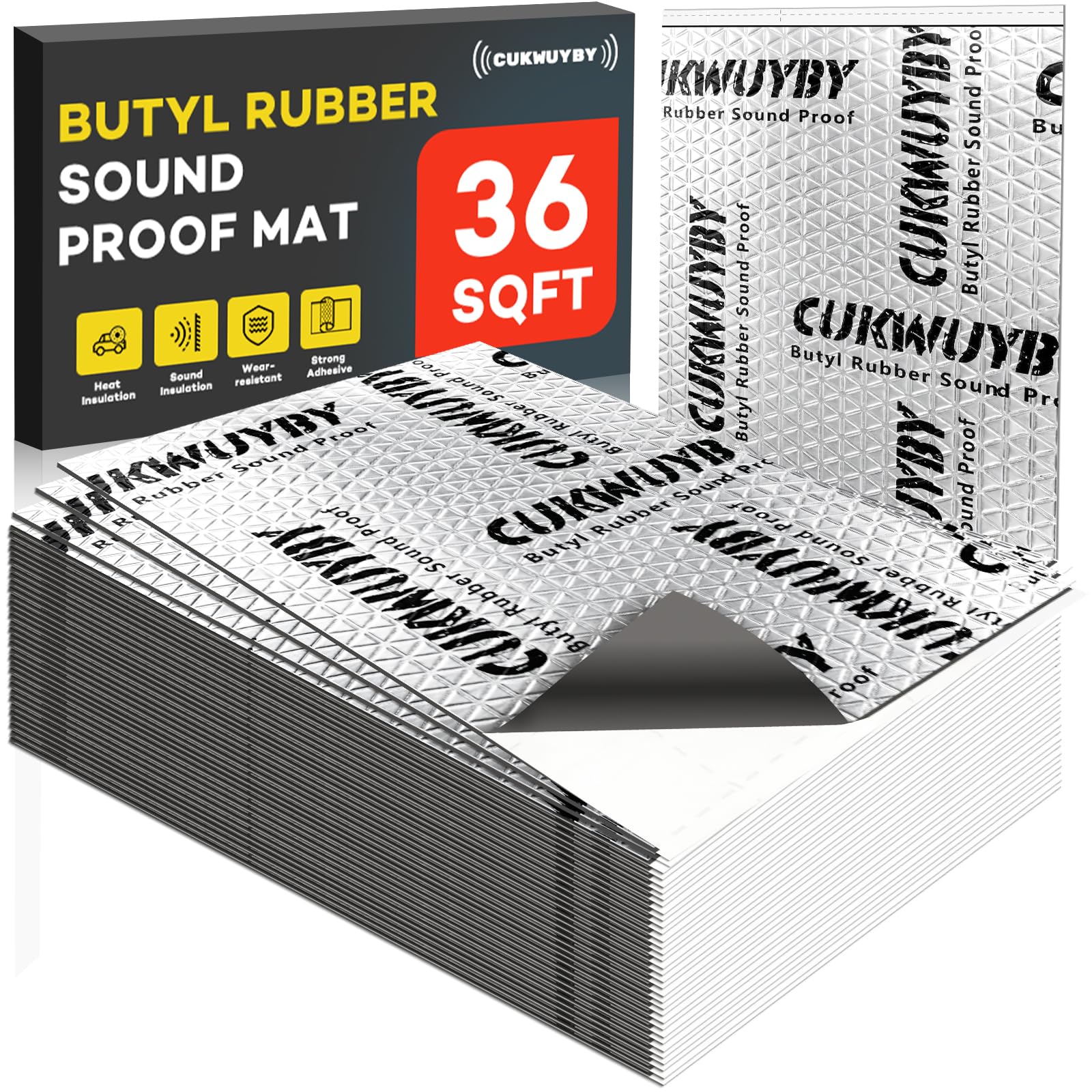
A sticky butyl sheet that eliminated audio rattles on a 2018 Durango overnight.
This 80 mil butyl mat adds an 8-wire reinforced foil face to the usual butyl core, which gives it a bit more heat reflection than a plain pad. It covers 36 square feet in 33 pieces, each with pre-cut lines that make sizing a panel quick. People who’ve built out Broncos and camper vans say a single layer greatly reduces panel resonance and leaves doors feeling solid, not hollow.
Owners consistently call out the aggressive adhesive as a highlight — one full interior build on a 2000 Tahoe with 90% of the doors and tailgate covered went smoothly, and it sticks well even in 20-degree weather. The immediate payoff for audio fans is the rattle elimination; on a 2018 Durango, one box covered the tailgate and all doors, and the change was night-and-day. For a camper build, the same material made a massive difference in how the space sounds and feels.
The thickness gets mixed feedback — it’s not the thickest butyl out there, so don’t expect the heft of a 200 mil composite. And the foil can lift on tight bends, so plan your seams on flat sections. The 90% noise-reduction claim is unverifiable marketing, but owners consistently report strong rattle control.
Rattle eraser: 36 sq ft of pre-cut butyl with an 8-wire foil face that sticks hard and stays put.
Flat-seam rule: foil can lift on tight bends, so keep seams on flat panels for a clean hold.
Pick this for: door and trunk rattle control with an aggressive adhesive that survives cold weather.
Look past it if: you need serious heat blocking — that’s a foam or composite job, not this mat’s role.
Understanding the Specs
Mils vs Millimeters
Thickness shows up in two units, and you’ll need to compare them directly. One mil is one-thousandth of an inch, so 80 mil is about 2mm, while 200 mil is roughly 5mm. The rule is simple: more thickness means more insulation, but it also means the material bends less easily around tight curves. A 6.2mm heat-shield roll is over half again thicker than a 4mm foam sheet, which is a real difference in heat blocking but also a real difference in flexibility during install.
Butyl vs Closed-Cell Foam
These two materials do different jobs, and knowing which is which saves you from buying the wrong thing. Butyl is a dense, heavy rubber-like sheet that stops vibration and rattles by adding mass to a panel — it’s the sound deadener. Closed-cell PE foam with an aluminum face reflects radiant heat, so it’s the actual heat blocker. Composites like the Siless Hybrid combine both into one layer, which is convenient but costs more per square foot than buying a single-purpose material.
FAQ
What is the difference between sound deadening and heat insulation for a car?
Will butyl mat stop heat from entering the cabin?
How much car insulation do I need for a full car?
Can I install peel-and-stick car insulation myself?
Does car insulation help keep the car cooler in summer?
What happens if my insulation rear adhesive fails?
Is closed-cell foam safe to put in the engine compartment?
Does car insulation reduce road noise or just heat?
Final Thoughts: The Verdict
If your goal is one material that does the heavy lifting on heat, the Abahub 236 mil Heat Shield is the smartest buy — its 6.2mm thickness blocks engine and exhaust heat effectively, and owner reports confirm it keeps hoods cool where factory insulation failed. For a do-it-all single layer that handles heat and sound together, the Siless Hybrid 3in1 is the one to reach for, since it fuses butyl, foam, and a mass-loaded membrane into one sheet. And if you just want solid coverage without the premium price, the VOISEN 4mm foam delivers 36 square feet of genuine closed-cell heat blocking that pairs cleanly with a butyl mat.
How We Picked
We do not accept paid placement. Every pick is matched to a real buyer and a real use-case; we do not hands-on test units.
Sources & Methodology
Specifications: manufacturer listings and product documentation. Review insights: verified customer reviews, as of August 2026. Pricing: not shown on this page (it changes often); check the current price via the retailer link.
As an Amazon Associate, Gadgets Feed earns from qualifying purchases. This does not affect which products we feature.