
Our readers keep the lights on and my morning glass full of iced black tea. As an Amazon Associate, I earn from qualifying purchases.
Specs are compiled from manufacturer listings and verified buyer reviews and can change over time — please confirm the key details on the product page before buying.
Walking out to your garage and seeing a swirl-marked, hazy finish after a full afternoon of work is the kind of frustration that makes you want to throw the polisher across the driveway. The right machine for the job changes that — it lifts scratches, deepens gloss, and actually makes the process enjoyable rather than a chore. This guide cuts through the marketing noise to find the polisher that delivers real results without burning through your paint or your patience.
I’m Min — the founder and writer behind Gadgets Feed. This guide is built by comparing the manufacturers’ published specifications and the patterns across verified customer reviews, so you get each pick’s real strengths and trade-offs instead of marketing spin.
Whether you are a weekend warrior or a seasoned pro, finding the best car machine polisher means matching power, pad size, and ease of use to the jobs you actually tackle — from heavy correction to a quick wax.
Our Picks at a Glance


How To Choose The Best Car Machine Polisher
Picking a car polisher is not just about grabbing the one with the highest speed number. You need to match the machine’s type, power delivery, and ergonomics to your skill level and the kind of work you plan to do — a heavy correction job needs a very different tool from a simple wax application.
Dual-Action vs. Rotary: The Safety Factor
The single biggest decision you will make is between a dual-action (DA) polisher and a rotary polisher. A dual-action polisher moves the pad in a random orbit, which means it is nearly impossible to burn through the clear coat or create holograms — making it the safe choice for beginners and pros alike who value a mistake-proof finish. A rotary spins on a fixed axis and generates more heat and cut, which is ideal for professional paint correction but comes with a steep learning curve.
Power and Speed: Amperage and RPM
Power is measured in amperage for corded models and voltage for cordless ones. A higher amperage number (like 12 amps on the DEWALT) means the motor can sustain heavy cutting without bogging down under pressure. Speed is measured in rotations per minute (RPM) or orbits per minute (OPM), and a variable-speed dial lets you start low for spreading wax and finish high for polishing.
Pad Size and Throw: Coverage vs. Precision
Larger pads (9–10 inches) cover big flat panels like hoods and roofs much faster but struggle around tight curves and door jambs. Smaller pads (5–6 inches) offer better control and are easier on the arms for detailed work. The throw — the distance the pad moves in its orbit — typically 8mm or 9mm, determines how much surface area the pad covers with each rotation, directly affecting how quickly you can correct paint.
Quick Comparison
| Model | Best For | Power Source | Speed (RPM/OPM) | Pad Size | Amazon |
|---|---|---|---|---|---|
| DEWALT DWP849★ Best Overall | Professional daily use | Corded (12 A) | Variable (600–3500 RPM) | 7″ / 9″ | Amazon |
| CRAFTSMAN CMCE100BCordless Freedom | Cordless waxing | Battery (V20) | 2800 OPM | 10″ | Amazon |
| AVID POWER AEP176Best Value | Best value beginner kit | Corded (5 A) | 2700–6500 OPM | 5″ / 6″ | Amazon |
| Vkdemer Cordless | Lightweight cordless kit | Battery (21V) | 5500 RPM | 6″ | Amazon |
| Niusken PGJ-21V | Versatile cordless with LED | Battery (21V) | 2800–5800 RPM | 5″ | Amazon |
| CRAFTSMAN CMEE100 | Large-vehicle corded waxing | Corded (1 A) | 2800 OPM | 10″ | Amazon |
| ZOTA Mini G83 | Tight spots & detail work | Corded (380 W) | 3000–7200 RPM | 2″ / 3″ | Amazon |
| BATOCA B02PO24 | All-in-one kit for beginners | Corded (700 W) | 1000–3800 OPM | 6″ | Amazon |
| Griot’s Garage G9 | Quiet, smooth paint correction | Corded (1000 W) | 2000–6400 OPM | 6″ | Amazon |
In‑Depth Reviews
1. DEWALT Variable Speed Polisher (DWP849)
Our pick — over 4.5★ from 950+ verified ratings; the strongest balance of quality and price.
The 12-amp workhorse that pro detailers trust for eight-hour shifts.
This is the one that professional detailers reach for when they have a full day of correction ahead. The DEWALT DWP849 draws a hefty 12 amps of power — at 12 amps versus the AVID POWER’s 5 amps — which means it keeps its speed locked in under heavy pressure rather than bogging down on stubborn swirls. It accepts both 7-inch and 9-inch backing pads, so you can tackle large flat panels quickly or swap down for tighter work.
The variable-speed trigger and thumb wheel give you fine control from around 600 RPM all the way up, which owners call “very convenient” for switching between spreading wax and heavy cutting. The trade-off is weight — at nearly 9.6 pounds, it is heavy, and as the customer consensus notes, the heft earns mixed feedback. Buyers report a professional boat detailer “uses daily for 8+ hours,” praising its smooth torque and instant trigger response. That kind of daily-driver trust is rare.
The tool is built to be maintained: owners recommend changing the carbon brushes every three months for a lifespan well over a year in professional use. It is not cheap, and it is not light, but if you want a polisher that will still be running strong after hundreds of hours of correction, this is the one.
What makes it great
- 12-amp motor holds speed under load — no bogging down on heavy correction
- Accepts both 7-inch and 9-inch backing pads for versatile coverage
- Variable-speed trigger and thumb wheel for precise control from a crawl to full power
- Pro-level durability with replaceable carbon brushes for extended life
Consider this
- Heavy at nearly 10 pounds — arm fatigue is real on long jobs
- Premium price point that reflects professional-grade build
Your best bet if: You are detailing professionally or have a big correction project that demands sustained torque and reliability day after day.
Think twice if: You want a lightweight machine for occasional wax jobs — this is overbuilt for light duty and will wear you out.
2. CRAFTSMAN V20 Cordless Buffer Polisher (CMCE100B)
A lightweight cordless waxer that finishes a whole truck on one battery.
If the main thing you want is to apply wax without wrestling a cord around the car, this Craftsman polisher is your buy. Its 10-inch orbital pad covers large surface area quickly — owners mention applying two coats of wax to a full-size Ram 1500 in short order, using only a single 2Ah battery. At a speed of 2800 OPM, versus the AVID POWER’s top speed of 6500 OPM, but that gentle motion is precisely what makes it safe for laying down a swirl-free finish.
The tool is notably lightweight, and the contoured overmold grip makes it comfortable for a full car wax without your hand cramping. The variable-speed dial gives you control, though the motor is on the gentler side — owners note it is not aggressive enough for effective swirl mark removal, so keep this one for wax and sealant application rather than heavy correction. Buyers sum it up: it is “great for wax application” and “did the whole truck.”
One thing to plan for — the 10-inch pad size makes finding replacement bonnets harder than standard 6-inch or 7-inch sizes, so stock up early. This is a bare tool, so you will need a Craftsman V20 battery and charger to run it.
Best for waxing: If your primary job is applying and removing wax or sealant on large vehicles, this light cordless machine eliminates cord hassle and gets it done quickly.
Not for correction: The gentle 2800 OPM motion and lightweight build are not strong enough for removing swirls or scratches — keep it for finishing only.
3. AVID POWER Dual Action Buffer Polisher (AEP176)
The dual-action kit that punches far above its price tag for beginners and boat owners.
This is the polisher that keeps showing up in “saved my paint” stories. The AVID POWER delivers a dual-action random orbit that is safe for beginners — it is much harder to burn through clear coat than a rotary — while still offering enough cut for serious work. Customers note restoring a 10-year-old boat gel coat on a 22-footer in just three hours, a job that would have cost them over a thousand dollars at a shop.
With six variable speeds from 2700 to 6500 OPM, you can dial it down to 2700 for spreading wax and crank it to 6500 for heavy correction — that top speed is the highest in this lineup. The motor draws 5 amps and includes both 5-inch and 6-inch backing plates plus foam pads for both sizes. The rubberized body and adjustable D-handle give you a secure grip even when the pad is grabbing.
The honest trade-off is heat. The customer consensus notes that the tool “gets concerningly hot during use,” especially during extended sessions. Durability feedback is mixed — some units run strong for years while others have issues. But for the price, the sheer value (functionality is the #1 praised aspect) and the included accessories make it the most approachable entry point for a DIY detailer.
Beginner’s dream: Safe dual-action motion, six speeds, and both pad sizes included — everything a first-timer needs to learn without fear.
Watch the heat: It runs hot under sustained high-speed use, so take breaks and do not push it for hours on end.
4. Vkdemer Cordless Car Buffer Polisher

A 3-pound cordless polisher that finishes a Corvette on a single battery pack.
The standout feature here is how much runtime you get from a machine that weighs next to nothing. At just 3 pounds, the Vkdemer is the lightest cordless option in the list, and it comes with two 21V 2000mAh batteries — reviewers point out buffing entire Corvettes on a single pack. The LCD display shows remaining battery capacity, so you are not guessing when it is about to die.
The 6-inch random orbital pad spins at up to 5500 RPM across eight variable speeds, and the 9mm throw orbit distributes force evenly for a swirl-free finish. Owners consistently praise the performance and battery life (those are the top two most-mentioned aspects). It handles waxing and light swirl removal well, but it is not built for aggressive paint correction — keep expectations realistic for deep scratches.
The kit is generous: two batteries, a fast charger, and a dozen pads and bonnets for different jobs. The one-year warranty on the body adds confidence. For a quick weekend detail without dragging out a cord, this is a very capable grab-and-go option.
Grab-and-go detailing: At 3 pounds with two long-lasting 21V batteries, this is ideal for quick wax jobs and light polishing on a Sunday afternoon.
Light duty only: Not for heavy correction or deep scratch removal — it is a finishing tool, not a cutting tool.
5. Niusken Cordless Car Buffer Polisher (PGJ-21V)
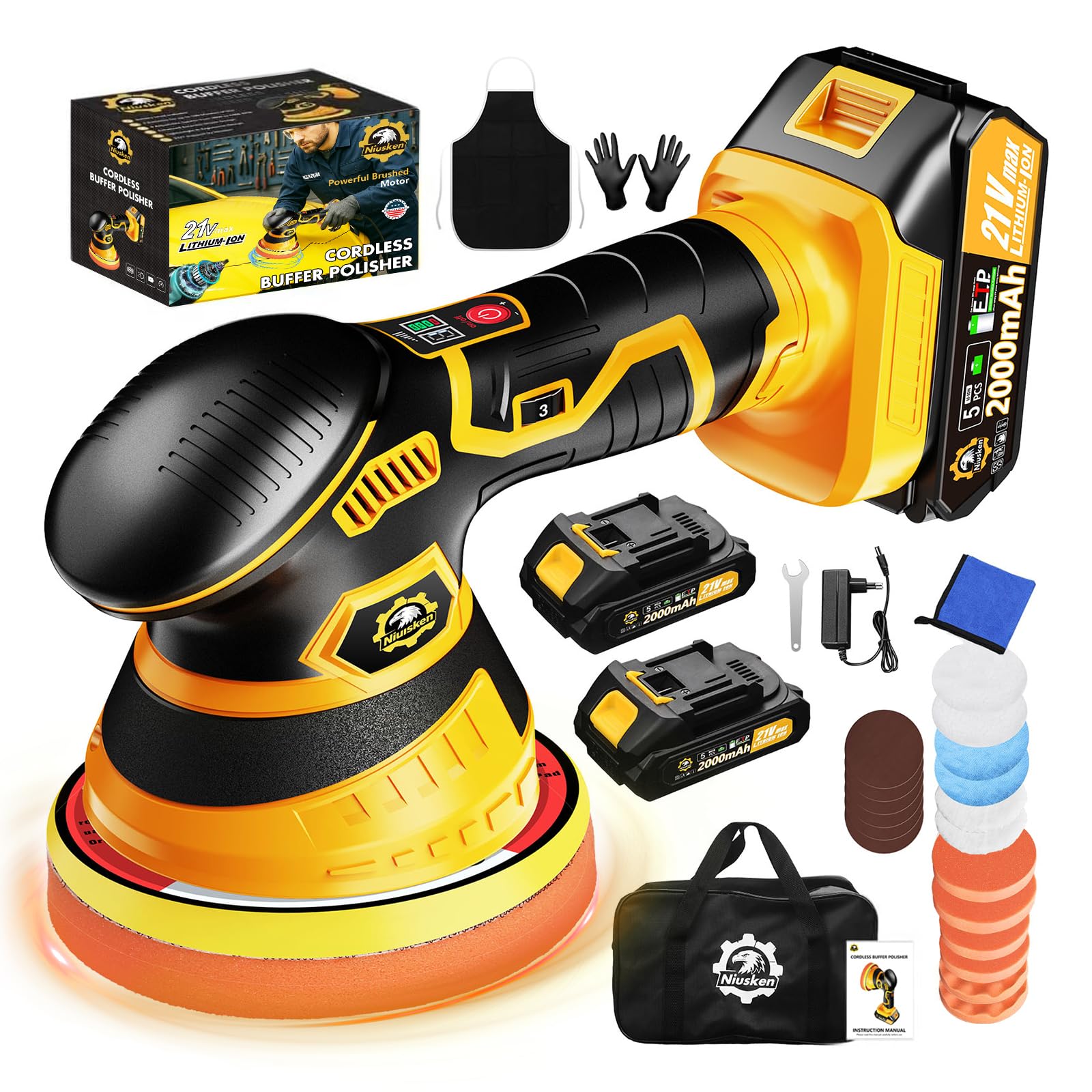
A feature-packed cordless buffer with an LED screen that shows speed and battery in real time.
The Niusken is designed to be the most complete cordless detailing package, and it gets close. The pure copper brushed motor drives a 5-inch random orbital pad through six speeds from 2800 to 5800 RPM, and an integrated LED screen keeps you informed of both the current speed setting and remaining battery charge. Owners like the fact that the 8mm dual-action motion delivers even wax coverage with low noise and good heat control.
The kit comes with two 21V 2000mAh batteries and a fast charger, and shoppers say being able to do a full-size Silverado — apply and remove — on a single charge. The feedback is excellent on functionality and quality, with the machine praised for removing clear coat scratches on Jeep Grand Cherokees and polishing out 2018 Mercedes GLS 550s using a light cut polish.
The battery system is proprietary (not compatible with DeWalt), and the overheating protection means the tool may shut off after 20 minutes of continuous high-speed use — let it cool and restart. At 3.3 pounds with an ergonomic grip, it is comfortable for a full car detail. The 18-piece accessory kit covers you for everything from sanding to final buffing on cars, boats, furniture, and more.
Loaded kit for DIY: Two 21V batteries, fast charger, and 18 accessories — you can go from sanding to buffing on multiple surfaces right from the start.
Proprietary battery: The battery system is unique to Niusken, so you cannot use existing power tool batteries. Plan for the included packs.
6. CRAFTSMAN Polisher, 10 inch, Corded (CMEE100)

A straightforward corded waxer that flies across big panels on boats and trucks.
If your main vehicle is a large truck, an SUV, or a boat, the 10-inch pad on this Craftsman is a serious time-saver. The bigger surface area means fewer passes to cover a hood or a side panel. The variable-speed dial gives you control, and the contoured overmold grip helps manage the weight during a full wax job.
The motor runs at a gentle 2800 OPM, which makes it a wax application and removal tool rather than a paint correction machine. Owners appreciate its quality and ease of use, but note that the performance is mixed — some find it perfect, while others report it slowing down under load. The durability feedback is the main caution: one owner mentioned it broke after 5 months, and vibration is higher than some would like. Compared to the cordless Craftsman, this corded version gives you unlimited runtime but less portability.
It includes both an applicator bonnet and a remover bonnet. Replacement bonnets in 10-inch size are harder to find than standard sizes, so buy a spare set when you order. This is a good value pick for the owner of a large vehicle who wants fast, even wax coverage without a heavy investment.
Speed on large surfaces: The 10-inch pad covers a truck hood or boat deck in much fewer passes than a standard 6-inch polisher.
Watch the durability: Some buyers report reliability issues over time, and the motor is not designed for heavy correction work.
7. ZOTA Mini Polisher (G83)

The mini polisher that gets into door jambs and A-pillars where full-size machines cannot reach.
When you have polished the main panels and still see swirls in the tight spots — around headlights, door jambs, the A-pillar, or motorcycle tins — a full-size polisher is useless. The ZOTA Mini is purpose-built for those exact areas. It comes with both a 3-inch and a 2-inch backing plate, and you can switch between them in seconds. The 8mm random orbit motion and six-speed control (up to 7200 RPM) give you precision correction in small spaces.
The 380-watt motor is surprisingly punchy for a tool this compact — owners mention doing full compound, buff, and polish cycles on a 22-foot boat without the machine overheating. Effectiveness and size are the most-praised aspects, with owners noting it is excellent for tight areas like body lines and door jambs. It is about 4 pounds, which is not ultralight, but its balanced design makes it manageable for prolonged detail work.
The included pads are functional but some owners find them lower quality than aftermarket options, so budget for better pads if you plan to use it heavily. At this price, it is an essential second tool for anyone who wants a show-quality finish — use it as a companion to a larger polisher for the final 20% of the car.
Essential for tight spots: With 2-inch and 3-inch backing plates, it reaches A-pillars, door jambs, headlight housings, and motorcycle parts that full-size polishers cannot touch.
Swap the pads: The included foam pads get the job started, but owners recommend upgrading to better-quality pads for optimal results.
8. BATOCA 6 Dual Action Random Orbital Polisher (B02PO24)
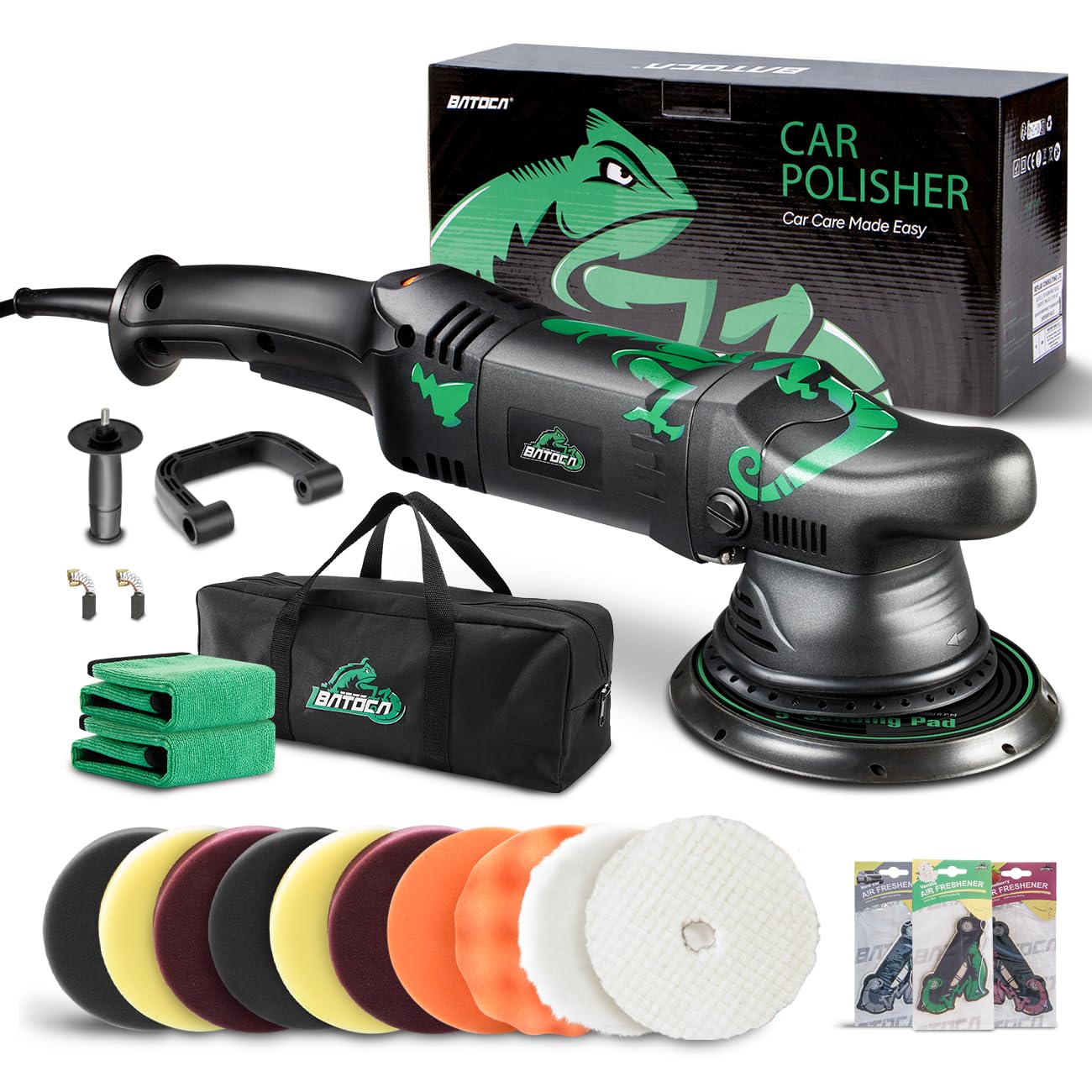
A beginner-focused kit that throws in everything but the expertise — pads, towels, even gloves.
The BATOCA is the polisher equivalent of a starter kit that actually has everything you need. The box includes the 700-watt dual-action polisher, six flat foam pads, wool pads, polishing bonnets, sanding paper, a microfiber towel, a pair of gloves, both a straight handle and a D-handle, a tool bag, and even spare carbon brushes. For someone buying their first polisher, that adds up to massive value — you will not need to order anything else to get started.
The machine runs at 1000 to 3800 OPM across six speeds, with a 6-inch pad. The eccentric shaft design (the random orbital mechanism) makes it safe for beginners because the wax is absorbed into the paint without burning the clear coat. Quality and functionality are the top-rated aspects. Customers note using it for 8 hours straight detailing three cars, running “flawlessly.”
The honesty here: the included pads are a bit stiff fresh from the start and benefit from a break-in period before they perform at their best. Durability has mixed feedback — some owners love it, a small number report the head coming off. Keep the included carbon brushes for the scheduled replacement at 6 months, and it should serve well for years of weekend use. At this price with this accessory set, it is the best starter bundle on the list.
Best starter bundle: Pads, bonnets, sandpaper, towels, gloves, two handles, a carry bag, and spare carbon brushes — you are ready to polish immediately.
Break in the pads: The included foam pads are stiff initially and need a short break-in period before they perform optimally.
9. Griot’s Garage G9 Random Orbital Polisher (10901)

A quiet, low-vibration machine that proves premium smoothness matters as much as raw power.
The Griot’s Garage G9 is the polisher you buy when you want a tool that just feels right in the hands — and has the muscle to back it up. Its 1000-watt motor (8.5 amps) drives a 9mm orbit throw through a 6-inch vented backing plate, and the fan-cooled counterbalance and premium bearing construction keep vibration low enough that owners call it “quiet” and “smooth.” That low vibration means less fatigue and better control during a full paint correction session.
Six variable speeds run from 2000 to 6400 OPM, and the speed dial is accessible from both sides for left- and right-handed users. Reviewers point out successfully performing two-step corrections on scratched trucks using microfiber pads, achieving excellent results even as first-time users. The machine runs cool even under extended use, which separates it from the AVID POWER’s heat issues. Quality and performance are the most-praised aspects here.
The G9 can be converted to a 5-inch pad system with the optional backing plate, and the 10-foot quick-connect cord gives you good reach. The honest downsides: some owners find the trigger lock poorly designed and the plug may need a slight trim for some outlets. It lacks a removable right-angle handle, which some detailers prefer for control. But for smooth, powerful, beginner-friendly paint correction, this is the pick that owners consistently recommend.
What makes it great
- 1000-watt motor with fan-cooled counterbalance for exceptionally smooth, low-vibration operation
- 9mm orbit throw provides efficient paint correction without burning through clear coat
- 6 variable speeds from 2000 to 6400 OPM with an accessible speed dial for both hands
- Converts to a 5-inch pad system with an optional backing plate for tighter work
Consider this
- Trigger lock design is criticized as awkward by some long-time owners
- No removable right-angle handle limits some control preferences
- Premium price — you pay for the smooth operation and build quality
Reach for this if: You want a smooth, quiet, and powerful dual-action polisher that is forgiving enough for a novice yet capable of pro-level correction.
Look elsewhere if: You need the raw torque of a 12-amp rotary for daily professional use, or you are on a tight budget.
Understanding the Specs
Dual-Action vs. Rotary
The dual-action (DA) polisher moves its pad in a random orbit — that means the pad never spins in the exact same spot twice, which makes it nearly impossible to burn through your clear coat. A rotary polisher spins on a fixed axis, generating more heat and cut, but requires skill to avoid holograms. For nearly all home users, a DA polisher is the right choice because you get correction without the risk.
Amperage and Wattage
For corded polishers, amperage tells you how much sustained power the motor can deliver. A 5-amp motor like the AVID POWER works fine for occasional waxing and light polishing, but a 12-amp machine like the DEWALT keeps its speed locked in under heavy pressure for serious correction. For cordless models, voltage (21V) gives you an idea of power, but battery capacity (2000mAh) determines runtime.
Speed (RPM/OPM) and Variable Control
Speed is measured in rotations per minute (RPM) on rotary polishers and orbits per minute (OPM) on dual-action polishers. A variable-speed dial is essential — you need low speed (1000–2800 OPM) for spreading wax, medium speed for polishing, and high speed (5000–6500+ OPM) for cutting and defect removal. Without variable speed, you are stuck with one motion for every job.
Pad Size and Throw
Pad size affects both coverage and control. A 10-inch pad flies across a truck hood but cannot get into tight curves or around mirrors. A 5-inch or 6-inch pad offers better maneuverability and is easier on the arms. The throw (typically 8mm or 9mm on DA polishers) is the diameter of the orbital motion — a larger throw covers more surface area with each pass, making correction faster.
FAQ
Can a car machine polisher damage my paint?
What is the difference between a DA polisher and a rotary polisher?
How many amps or watts do I need in a car polisher?
Is a cordless car polisher powerful enough for paint correction?
What pad size should I choose for my car?
How long does a car polisher battery last?
Can I use a car polisher on my boat or motorcycle?
What is the “throw” on a DA polisher and does it matter?
How do I prevent swirl marks when using a car polisher?
Do I need to replace carbon brushes in my car polisher?
Final Thoughts: The Verdict
Across the board, the best car machine polisher is the DEWALT DWP849 because its 12-amp motor, variable-speed control, and professional-grade build quality make it the long-term winner for anyone doing serious correction work. If you want a smooth, beginner-friendly option that still packs a punch for paint correction, grab the Griot’s Garage G9. And for the best value that gets a first-time buyer started with everything included, the AVID POWER is the one to reach for — the crowd favorite with over 900 owners backing its price-to-performance ratio.
How We Picked
We do not accept paid placement. Every pick is matched to a real buyer and a real use-case; we do not hands-on test units.
Sources & Methodology
Specifications: manufacturer listings and product documentation. Review insights: verified customer reviews, as of July 2026. Pricing: not shown on this page (it changes often); check the current price via the retailer link.
As an Amazon Associate, Gadgets Feed earns from qualifying purchases. This does not affect which products we feature.