
If your hands-free calls sound like you’re shouting through a tunnel in a windstorm, the culprit isn’t your phone — it’s your microphone. A dedicated car microphone separates your voice from the cabin rumble, road hiss, and air conditioner roar, turning garbled conversations into crisp, professional-grade audio on both ends of the line. Whether you’re using a visor-mounted speakerphone, an auxiliary Bluetooth receiver, or a wired lapel mic for content creation in your vehicle, the right mic dramatically improves clarity without requiring a new stereo system.
I’m Min — the co-founder and writer behind Gadgets Feed. I spent dozens of hours analyzing signal-to-noise ratio specs, Bluetooth codec support, mic element types, and inline noise cancellation implementations to separate the true performers from the static-filled pretenders in this segment.
After digging through hands-on feedback and technical datasheets for the most popular options in this space, I compiled this guide to the best car microphone solutions — covering wired lavaliers, visor speakerphones, and auxiliary Bluetooth receivers — so you can stop shouting and start being heard.
How To Choose The Best Car Microphone
Not every microphone labeled “for car” delivers the same voice clarity. The choice depends on whether you need a permanent hands-free solution for daily calls, a removable speakerphone for older vehicles without Bluetooth, or a wired lapel mic for in-car recording and streaming. Matching the microphone type to your specific use case is the first critical decision.
Microphone type: wired, wireless receiver, or standalone speakerphone
Wired lavalier microphones like the PowerDeWise or Sony ECM-LV1 offer zero-latency audio and studio-grade clarity, but they require a 3.5mm jack and often an adapter for modern phones. Auxiliary Bluetooth receivers (like the JOYROOM or BESIGN BK01) tap into your car’s stereo via the AUX port, giving you a hidden mic that routes audio through factory speakers — but call volume depends on your radio’s output. Visor-mounted speakerphones (AGPTEK, Besign BK06) act as standalone devices with their own speaker and mic, making them the quickest to install but introducing potential echo if the volume is too high.
Noise cancellation and mic element quality
In a car, the mic competes with engine drone, tire roar, wind, and HVAC fans. Look for dual-microphone arrays with Environmental Noise Cancellation (ENC) or CVC 8.0 technology, which use a secondary mic to sample ambient noise and subtract it from the primary voice signal. A single omnidirectional capsule can pick up everything — including the passenger’s conversation — while a cardioid or noise-cancelling electret element focuses on the driver’s mouth. The Sony ECM-LV1 uses a 360-degree rotation clip with an omnidirectional condenser element that delivers stereo ambient pickup, but that level of sensitivity works best for recording, not noisy highway calls.
Connectivity and power logistics
Bluetooth 5.3 (found in the BESIGN BK01 and AGPTEK models) offers lower power draw and faster reconnection than Bluetooth 5.0 or 5.1. If you choose a wired mic, verify that your smartphone supports a 3.5mm TRRS connection or that the included adapters (USB-C or Lightning) carry audio — not just charging. Standalone speakerphones need internal battery capacity: the AGPTEK claims 16 hours of talk time on a 2-hour charge, while the Besign BK06 packs a 1000mAh cell good for 20 hours. Wired lavaliers need no battery but require the host device to supply plug-in power, typically 1.5V to 5V through the 3.5mm jack.
Quick Comparison
On smaller screens, swipe sideways to see the full table.
| Model | Category | Best For | Key Spec | Amazon |
|---|---|---|---|---|
| JOYROOM Bluetooth 6.0 AUX Adapter | Receiver | In-dash stereo hands-free calls | Dual-mic ENC + CVC 8.0, 100ft range | Amazon |
| GM Genuine Parts 84437087 | OEM Replacement | Factory replacement for GM vehicles | 20Hz-20kHz, 4 Ohm impedance | Amazon |
| BESIGN BK01 | Receiver | AUX cars with ground loop isolation | Bluetooth 5.3, ground loop filter | Amazon |
| AGPTEK Car Speakerphone | Speakerphone | Old radios without AUX input | 3W mic, 16h talk, Bluetooth 5.3 | Amazon |
| PowerDeWise Lavalier Mic | Wired Lavalier | In-car video/recording content | 13-ft cable, TRRS+USB-C+Lightning | Amazon |
| Besign BK06 | Speakerphone | Loud highway calls, dual speakers | Dual 2W speakers, 1000mAh battery | Amazon |
| Sony ECM-LV1 | Wired Lavalier | Stereo ambient + clean voice recording | Omnidirectional, 20Hz-20kHz, -30dB | Amazon |
In‑Depth Reviews
1. JOYROOM Bluetooth 6.0 AUX Car Adapter
 See price on Amazon
This AUX receiver marries dual-microphone environmental noise cancellation with CVC 8.0 echo suppression, two features that together filter out tire roar and wind better than most single-capsule competitors. The Bluetooth 6.0 radio claims a 100-foot working range and low-latency audio transmission, and the built-in voltage, overcurrent, short-circuit, and overheat protection circuitry makes it a safe long-term fixture in any 12V cabin.
The physical button layout — separate up/down track, volume, and call answer — reduces distracted fiddling while driving, and a 3M adhesive pad keeps the module tucked discreetly on the dash or center console. It also reads TF cards directly, useful if you keep offline music on a microSD. The always-on LED ring is bright, but some users found the button illumination helpful for night operation.
The only real compromise is the lack of an on/off switch: power cycles with the USB port, so cars with always-live cigarette lighters will drain the car battery unless you unplug it. For anyone with a 2012-era car stereo that has an AUX jack, this is the most technically complete hands-free upgrade under typical mid-range budget constraints.
Why it’s great
- Dual-mic ENC + CVC 8.0 filters road noise effectively even at highway speeds
- Multifunction buttons for music and calls reduce driver distraction
- Multi-protection circuitry (voltage, overcurrent, short-circuit) adds reliability in the car’s electrical environment
Good to know
- No physical power switch — must unplug USB to prevent battery drain on always-live outlets
- Always-on LED ring may be distracting in low-light driving conditions
2. Sony ECM-LV1 Compact Stereo Lavalier
 See price on Amazon
The Sony ECM-LV1 is an omnidirectional electret condenser lavalier that delivers true stereo audio pickup within a housing that measures 0.43 x 1.26 x 0.43 inches and weighs almost nothing. Its frequency range covers 20Hz to 20kHz, and the plug-in power system draws from the recording device — no battery required. A 360-degree rotation clip allows precise positioning on a seatbelt, lapel, or sun visor fabric, and the included windscreen reduces the pop of blasting HVAC vents.
In the car, this mic shines for content creators recording vlogs, interviews, or live streams from the driver’s seat. Its omnidirectional capsule captures ambient road texture (engine tone, turn signals, passenger voice) while keeping the primary voice clear and warm — it’s fundamentally a recording mic, not a noise-cancelling communication mic. The short cable forces the use of an extension, so budget for the separately purchased 3.5mm TRRS adapter if your phone lacks a combo jack.
Most buyers praised the sound quality for music and nature recording, but in-car call use is limited because the mic does not offer active noise cancellation. It is better suited for podcast-style recording inside a parked car or during low-speed cruising than for daily hands-free calling on the interstate.
Why it’s great
- Genuine stereo omnidirectional pickup with 20Hz-20kHz frequency range captures rich ambient and vocal detail
- Compact clip-on design with 360-degree rotation fits perfectly on a seatbelt or visor
- No battery required — plug-in power works with any 3.5mm TRRS device
Good to know
- Short cable requires an extension for typical driver-to-dashboard distance
- No active noise cancellation — not ideal for hands-free calls on noisy highways
3. BESIGN BK01 Bluetooth Car Kit
 See price on Amazon
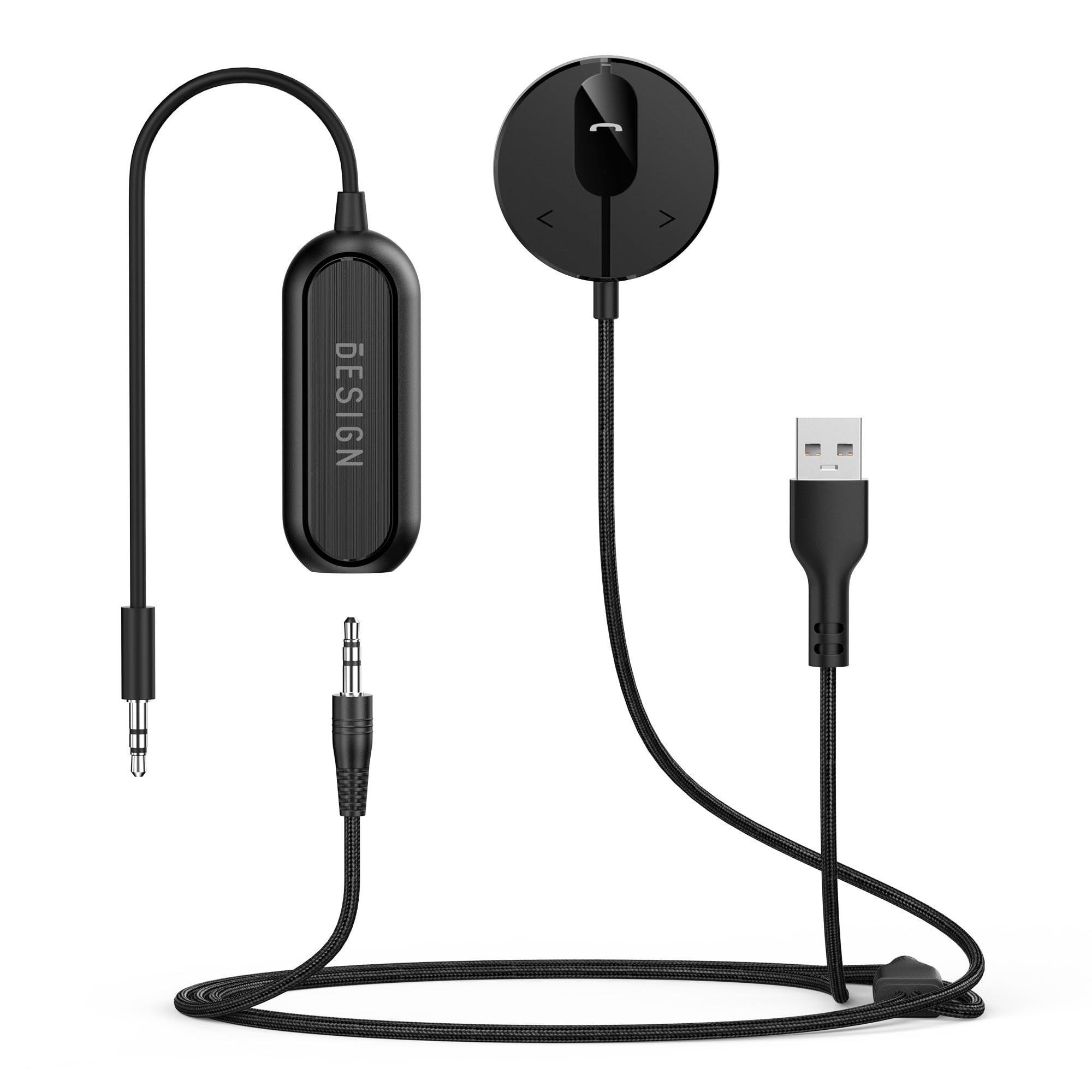
The BESIGN BK01 runs on Bluetooth 5.3 — the most current consumer radio standard at this price point — which brings lower power consumption than Bluetooth 5.0 and faster reconnection to the last paired device. It includes a physical ground loop noise isolator, a rare inclusion that kills the 60-cycle alternator whine common in older cars with marginal electrical grounding. You plug the USB power into a cigarette adapter and the 3.5mm plug into the AUX port; the unit auto-powers on with the ignition.
Call quality is surprisingly clean thanks to the integrated microphone, though some users noted call volume runs quieter than music playback — you’ll need to adjust the radio volume separately for calls. The wiring is long enough to route under the center console, making for a near-invisible install. It supports dual-device pairing, so both the driver’s and passenger’s phones can stay connected.
The magnet on the detachable base is weak enough that the module can slide off under hard cornering, but that same base clips securely onto a shirt pocket if you need to move the unit between cars. For a Bluetooth 5.3 receiver with an included ground loop filter, this is the strongest mid-range value in the roundup.
Why it’s great
- Bluetooth 5.3 provides stable, low-latency connection and auto-pairing with the last phone
- Included ground loop isolator eliminates alternator whine without extra purchase
- Long cables allow clean under-console routing for an invisible installation
Good to know
- Call volume is noticeably lower than music volume — requires separate radio adjustment
- Weak magnetic mount can detach during aggressive driving
4. AGPTEK Car Speaker with Bluetooth 5.3
 See price on Amazon
The AGPTEK is a self-contained Bluetooth speakerphone that clips magnetically to the sun visor, bypasses the car’s stereo entirely, and projects call audio through its own 3W speaker. The built-in noise reduction and echo processing are tuned for the cabin environment, and early buyer reports confirm that call clarity remains high even with windows down at 50 mph. It uses Bluetooth 5.3, the same current-gen radio as the BESIGN BK01, and supports dual-device multipoint connection.
Battery performance is the headline feature here: a 2-hour USB charge yields 9–10 hours of continuous music playback and up to 16 hours of talk time. That talk-time figure exceeds most visor speakerphones at this tier, making it a strong choice for rideshare drivers who spend full days in the car. The magnetic visor clip doubles as a removable base, so you can lift the speaker off and use it at a desk or on a picnic table — the 3W output is enough for a small room.
The catch is that music quality drops into distortion above 80% volume, and the visor clip’s magnetic grip weakens after repeated removal. The lack of auto power-on (no motion sensor) means you must manually press the power button each trip. But for anyone with a car that lacks both Bluetooth and an AUX jack, this is the simplest way to add hands-free calling.
Why it’s great
- 16-hour talk time on a 2-hour charge — best endurance of any speakerphone tested
- Magnetic visor clip with detachable base enables quick transfer between car and desk
- Bluetooth 5.3 with Siri/Google Assistant button activation improves driving safety
Good to know
- Audio distorts at high volume — keep below 80% for clear output
- No auto power-on — requires manual button press each time you enter the vehicle
5. PowerDeWise Professional Lavalier Mic
 See price on Amazon
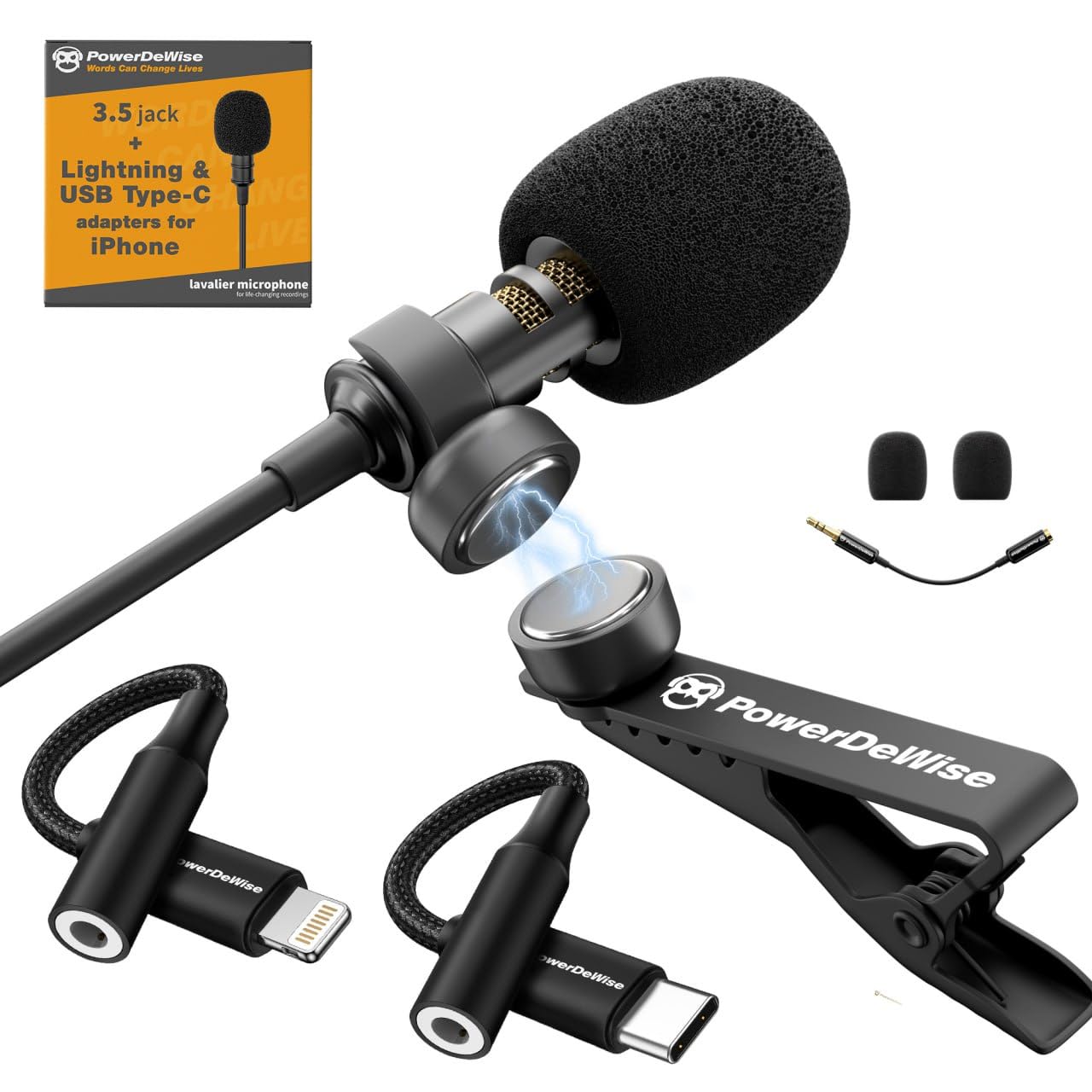
The PowerDeWise is a wired omnidirectional lavalier that bypasses Bluetooth latency entirely by delivering analog audio directly down a 13-foot shielded cable. That shielding is the real advantage in a car: it rejects EMI from the alternator, ignition coils, and phone radios that can introduce buzzing in unshielded cables. The kit includes both USB-C and Lightning adapters, so it connects to essentially any modern phone without a headphone jack out of the box.
This mic is designed for content creation inside the car — dashcam commentary, car-review walkarounds, or in-vehicle interviews. The omnidirectional pickup catches the engine note and road texture while keeping the speaker’s voice forward, and the 20Hz–20kHz frequency response handles the full vocal range without tinny roll-off. The clip-on system is tool-free and rotates to clip onto a shirt collar, seatbelt, or visor edge.
Because it requires a wired connection, you cannot use this mic for hands-free calling while charging the phone wirelessly — the 3.5mm port occupies the phone’s only audio input. The included windscreens only reduce moderate wind noise; a strong draft from an open window will still clip the capsule. For in-car recording work, this is the best wired value in the lineup.
Why it’s great
- Fully shielded cable blocks alternator whine and EMI from car electronics
- Includes both USB-C and Lightning adapters for direct phone connection
- 13-foot total cable length provides freedom to move around the cabin while recording
Good to know
- Wired connection blocks simultaneous charging on most single-port phones
- Windscreens are only effective up to moderate wind — open-window driving may cause clipping
6. Besign BK06 Bluetooth Car Speakerphone
 See price on Amazon
The Besign BK06 is a visor-mounted speakerphone with a motion sensor that auto-powers on when it detects the car door opening — eliminating the “forgot to turn it on” problem. Two 2-watt speakers fire from the housing, delivering enough volume to overpower cabin noise at highway speeds without distorting. The 1000mAh lithium-polymer battery provides up to 20 hours of talk time, making it the highest-capacity model in this comparison.
Bluetooth 5.0+EDR supports multipoint connection to two phones simultaneously, so a passenger can stream music while the driver handles calls. A dedicated Siri button activates voice assistants on both Android and iOS. The clip fits visors up to 19mm thick, which covers most factory and aftermarket visors including those with built-in garage-door openers. Audio quality gets high marks for loudness and clarity, though the lack of a display means you rely on audio cues and a single LED for status.
The tradeoff is a slightly slower Bluetooth reconnection than the 5.3-equipped models — some users reported needing to press the connect button after starting the engine. The body is larger than the AGPTEK, taking up more visor real estate, and the motion sensor can false-trigger from potholes if you forget to manually power it down. If you primarily drive on highways with heavy road noise and want the loudest possible hands-free audio, this BK06 delivers.
Why it’s great
- Dual 2W speakers provide highway-usable volume without distortion
- Motion sensor auto-powers on when the car door opens — no manual switch needed
- 1000mAh battery delivers 20-hour talk time, the most in this roundup
Good to know
- Bluetooth 5.0 reconnects more slowly than newer 5.3 models — may need manual pairing
- Motion sensor can false-trigger from road bumps if not manually switched off
7. GM Genuine Parts 84437087 Gray Mobile Telephone Microphone
 See price on Amazon
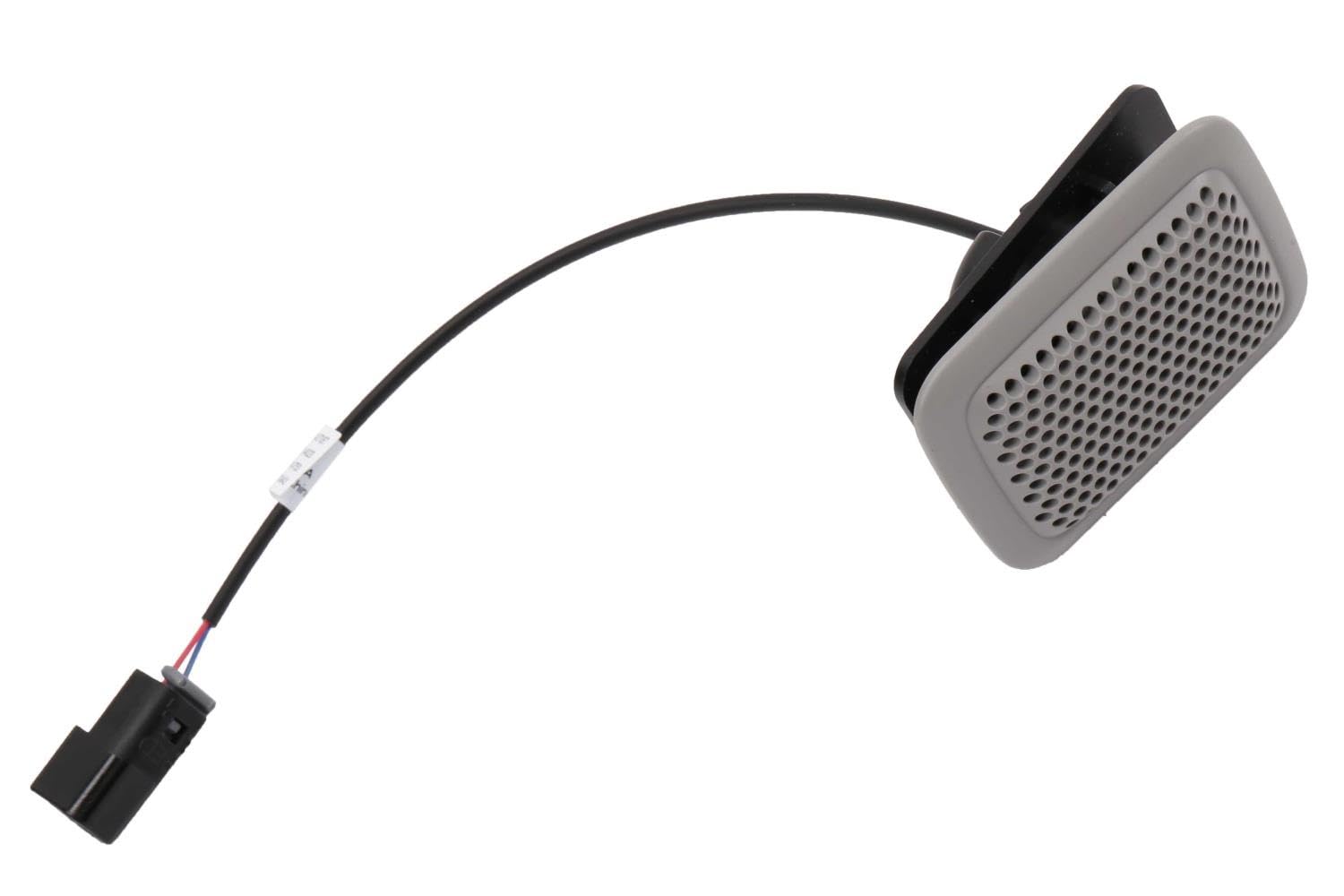
This is a direct OEM replacement microphone for GM vehicles including Chevrolet, Buick, GMC, and Cadillac models that use the factory hands-free system. It connects via an XLR-style connector — not the standard 3.5mm jack — so this mic is not a universal upgrade; it fits the specific harness in vehicles like the 2019 Tahoe and 2010-era Silverado. The gray housing matches the factory headliner color on most interior trims.
The microphone element is designed to pick up the driver’s voice from the overhead position where GM traditionally mounts it — just behind the rearview mirror or above the visor. The 20Hz-20kHz frequency response gives it a wide capture range that covers both male and female voices without favoring either. The 4 Ohm impedance is a telltale sign this was designed for a specific amplifier circuit in the car’s telematics module.
If your GM vehicle’s factory mic started crackling or stopped transmitting, this is the exact part to restore clarity — no modifications needed. But because it lacks a standard 3.5mm connector, it cannot be adapted to aftermarket stereos or phones without cutting the plug and soldering a new one. It is a parts-bin replacement, not a general-purpose car microphone.
Why it’s great
- 100% OEM fit and finish for GM vehicles — drops into the factory spot in the headliner
- Designed and validated by General Motors for proper impedance matching with the telematics unit
- Wide 20Hz-20kHz frequency response covers natural vocal range for both men and women
Good to know
- XLR connector is vehicle-specific — not compatible with aftermarket stereos or universal 3.5mm inputs
- No active noise cancellation — relies entirely on the factory system’s echo processing
FAQ
Can I use a lavalier mic plugged into my phone for hands-free driving calls?
Why does my car microphone pick up road noise even when I talk directly into it?
What does a ground loop noise isolator do in a car Bluetooth receiver?
Will a visor-mounted speakerphone interfere with my car’s sun visor operation?
Final Thoughts: The Verdict
For most users, the best car microphone system is the JOYROOM Bluetooth 6.0 AUX Adapter because its dual-mic ENC and CVC 8.0 combination provides the strongest road noise rejection for hands-free calling through your car’s existing stereo. If you need a standalone speakerphone for a vehicle without an AUX port, grab the AGPTEK Car Speaker with Bluetooth 5.3 for its 16-hour talk time and magnetic visor convenience. And for in-car video recording where latency-free audio matters most, nothing beats the PowerDeWise Professional Lavalier with its shielded cable and universal adapter kit.
Product prices and availability are accurate as of the date/time indicated and are subject to change. Any price and availability information displayed on Amazon at the time of purchase will apply to the purchase of this product. As an Amazon Associate I earn from qualifying purchases.
CERTAIN CONTENT THAT APPEARS ON THIS SITE COMES FROM AMAZON. THIS CONTENT IS PROVIDED "AS IS" AND IS SUBJECT TO CHANGE OR REMOVAL AT ANY TIME.
Amazon and the Amazon logo are trademarks of Amazon.com, Inc. or its affiliates.