
That constant low-frequency drone from the tires, the tinny vibration of thin door panels, and the heat radiating off the transmission tunnel are more than annoyances — they dictate how drained you feel after a long drive.
I’m Min — the co-founder and writer behind Gadgets Feed. Every recommendation in this guide comes from weeks of cross-referencing real customer install data, thermal performance claims, and adhesion tests across dozens of SKUs to isolate which butyl formulations and foam composites actually silence structure-borne noise without peeling off after a hot summer.
Whether you are quieting a daily commuter or prepping a camper van for silent nights, the right best car noise insulation package balances thickness, coverage, and adhesive tenacity to transform a rattly cabin into a refuge from the road.
How To Choose The Best Car Noise Insulation
Selecting the right insulation for your vehicle involves matching material density and thickness to the specific noise source you are fighting. Vibrational energy from the engine and road requires mass-loaded butyl sheets, while high-frequency hiss from wind and tires demands a closed-cell foam decoupler. Most effective installations combine both layers.
Material Composition: Butyl vs. Asphalt vs. Foam
Butyl-rubber based mats like those from Siless and Dynamat remain pliable and odor-free across temperature extremes. Asphalt-based alternatives can harden and emit a tar smell in hot climates over time. Closed-cell polyethylene foam serves as an excellent thermal break and airborne noise absorber, but it does little to stop panel vibration — you need a heavy butyl layer directly on the metal first.
Thickness and Surface Density (Mils & Weight)
Panel resonance dampening scales with mass. A 50-mil (1.3mm) sheet adds roughly 0.5 lbs per square foot, enough to kill the ringing in a door skin. For floors and firewalls where low-frequency engine rumble lives, 80-mil (2mm) to 120-mil (3mm) layers are preferred. Thicker composite barriers at 200-mil (5mm) integrate foam and butyl for a true 3-in-1 solution, but be careful with clearance near door cards and window regulators.
Coverage Area and Adhesive Quality
A typical sedan door requires about 6-8 square feet per side. A full floor and trunk can demand 40-60 square feet. Premium adhesives — measured by their ability to stay bonded after a day in direct summer sun — separate effective kits from ones that sag. Look for reviews mentioning long-term adhesion without the backing releasing or the mat sliding on vertical panels like the firewall or rear wheel wells.
Quick Comparison
On smaller screens, swipe sideways to see the full table.
| Model | Category | Best For | Key Spec | Amazon |
|---|---|---|---|---|
| Siless Hybrid 3in1 200 mil | Premium Composite | Full cabin heat + noise | 200 mil / 5mm thickness | Amazon |
| Siless Max 120 mil | Premium CLD | Maximum vibration damping | 120 mil / 3mm thickness | Amazon |
| Dynamat Xtreme Door Kit | Premium Brand | Door speaker clarity | 12 sq ft / 2-door kit | Amazon |
| VEVOR 50 mil Butyl | Mid-Range | Full-car coverage on budget | 50 mil butyl / 52 sq ft | Amazon |
| KILMAT 80 mil | Mid-Range | Floor/trunk mass loading | 80 mil butyl / 36 sq ft | Amazon |
| AggSound 394 mil Foam | Entry-Level Multilayer | Heat + foam sound barrier | 10mm closed-cell foam | Amazon |
| uxcell 236 mil Foam | Budget Shield | Hood heat reflection | 6mm aluminum foam | Amazon |
In‑Depth Reviews
1. Siless Hybrid 3in1 200 mil

This three-layer design combines a butyl mastic damper, a PE foam decoupler, and a mass-loaded butyl membrane all in one 200-mil sheet. That means a single application simultaneously kills panel vibration, absorbs road noise, and blocks heat from the exhaust tunnel — exactly what you need for a full floor or firewall treatment. Users report cabin temperature drops of over ten degrees Fahrenheit alongside a dramatic reduction in low-frequency drone.
The flexibility is surprising for a 5mm thick mat; it cuts easily with standard scissors and conforms to corrugated floor pans and curved transmission humps without buckling. The adhesive is extremely tacky, which is great for longevity but means careful placement is required because repositioning is difficult. Reviewers consistently note that a single box can cover the front footwells and rear seat floor of a midsize SUV.
Some professionals still recommend adding a separate 50-mil butyl layer underneath on the largest flat panels for maximum constrained-layer damping, but for most DIY installers, this 3-in-1 compound provides the highest noise reduction per square foot of any option here. Just be mindful of total thickness where door panels or trim clips have limited clearance — test fit before committing.
Why it’s great
- Triple-layer design saves installation time vs. stacking separate products
- Noticeably reduces cabin temperature while killing vibration
- Pliable enough to mold around complex floor contours
Good to know
- Very sticky adhesive makes repositioning nearly impossible
- 25 sq ft may not cover a full van floor without buying two boxes
2. Siless Max 120 mil

At 120-mil thick and weighing roughly 0.8 lbs per square foot, this pure butyl sheet provides the mass needed to stop large metal panels from resonating. It is the go-to choice for sedan doors and trunk floors where low-frequency boom is the primary complaint. Many users have documented transforming a stiff Civic into a cabin that rivals entry-level luxury cars in hush factor after applying this to the doors and rear deck.
The bmastic compound adheres aggressively to clean, bare metal and does not emit any lingering odor, even after sitting in a hot parking lot. Installation requires a solid roller to ensure full contact — the embossed foil surface is designed to go from textured to perfectly flat when properly bonded. A heat gun helps on curved surfaces in cooler weather, but the material remains workable down to about 50°F.
Coverage of 30 square feet is generous, but note that this is strictly a vibration damper — it has no closed-cell foam layer for thermal insulation. Pair it with a separate foam decoupler (like the AggSound 394 mil) if you also need to block radiant heat from the firewall or roof. For pure structure-borne noise, however, this is the most effective single-layer solution available at this price point.
Why it’s great
- Exceptional adhesion that stays bonded through seasonal temperature swings
- No off-gassing or odor even under direct sun exposure
- Ideal thickness for door panels without interfering with window operation
Good to know
- Does not include a thermal barrier layer
- Requires a roller tool for proper installation
3. Dynamat Xtreme Door Kit

Dynamat remains the benchmark brand that most other sound deadeners are compared against. This specific door kit includes four 12”x36” sheets — pre-cut to a manageable size for the inner and outer door skins of two standard cars. The butyl formulation is slightly more forgiving during installation than some of the ultra-tacky competitors, allowing you to lift and reposition the sheet before pressing it down permanently.
The impact on speaker performance is immediate. Users report that door rattles vanish at high volume, mid-bass response tightens noticeably, and the hollow “tin-can” sound when closing the door gives way to a solid, expensive thud. In a BMW X5 E53 application, one reviewer noted a 60% reduction in perceived road noise after installing two kits across all four doors.
At roughly 68-mil thick, it is thinner than the Siless Max, meaning it works well in tight door cavities but provides less total mass per square foot. For a full vehicle treatment, you would need to buy multiple kits or switch to a bulk roll. The premium price per square foot reflects the brand reputation and consistent quality control from the Ohio manufacturing facility.
Why it’s great
- Forgiving adhesive allows repositioning during installation
- Immediately improves door speaker bass response and clarity
- Trusted brand with decades of automotive audio use
Good to know
- Higher cost per square foot compared to butyl alternatives
- 12 sq ft only covers two doors — plan for multiple kits
4. VEVOR 50 mil Butyl 52 sq ft

The VEVOR kit delivers 52 square feet of 50-mil butyl across 47 individual sheets, making it the most coverage you can get without jumping to a premium price tier. Each sheet measures roughly 9.8” by 15.7”, which is a comfortable size for cutting into strips for door beams and wheel wells. Since 50-mil material weighs about 0.5 lbs per square foot, the total package adds over 26 pounds of mass to the vehicle — enough to make a noticeable dent in road noise.
Users building out camper vans have found this particularly effective for the side walls and wheel well arches. The butyl has no asphalt smell, and the adhesive holds firm on vertical surfaces after warming the sheet in the sun. With a target of 40% surface coverage (the standard recommendation for tuning panel resonance), a single box can treat an entire midsize van cargo area.
The 50-mil thickness is sufficient for killing panel ting and mid-frequency vibration, but it lacks the heft to fully absorb deep subwoofer frequencies that a 120-mil or 200-mil layer handles. Additionally, the included instructions are minimal — make sure you have a roller and a sharp knife ready. For the price, however, the cost per square foot is among the lowest for genuine butyl.
Why it’s great
- Massive 52 sq ft coverage suitable for full vehicle treatment
- No smell and strong adhesion on properly cleaned surfaces
- Excellent value for camper van and SUV builds
Good to know
- 50 mil is best for mid-range frequencies, not deep low-end rumble
- Requires a separate heat gun or warm weather for best stick
5. KILMAT 80 mil 36 sq ft

KILMAT’s 80-mil formulation hits a sweet spot between the lightweight 50-mil options and the heavy 120-mil+ sheets. At 0.5 lbs per square foot, it provides enough mass to kill the resonant ringing in sedan doors and trunk decks without adding excessive weight that could affect fuel economy. The included embossed foil surface serves as a visual installation guide — you roll it until the pattern flattens, confirming full adhesive contact.
Reviews from customers working on classic cars like a ‘71 Barracuda show that a double layer on the floor can drop interior decibel levels by 5-6 dB, which translates to roughly half the perceived loudness. The material cuts cleanly with a utility knife and the adhesive grabs instantly on clean painted metal. Unlike some butyl blends, KILMAT remains pliable in colder weather so you can still press it into curved transmission tunnels without the material snapping back.
One nuance to be aware of is that the foil edges can be sharp enough to cut skin — handling gloves are advised during the cutting phase. The 36-square-foot coverage works well for the front floor and trunk of a compact sedan, but you may need two boxes to fully cover an SUV or van. For the price, the per-square-foot cost is competitive with the VEVOR but gives you thicker material for better low-frequency performance.
Why it’s great
- 80 mil offers a meaningful upgrade in low-frequency damping over 50 mil
- Embossed foil indicator confirms proper roller compression
- Stays pliable in cooler temperatures for easier installation
Good to know
- Foil edges can be sharp — wear gloves when cutting
- 36 sq ft may not be enough for full-vehicle treatment
6. AggSound 394 mil 18.47 sq ft

The AggSound 394 mil uses a 10mm thick closed-cell foam core sandwiched between reflective aluminum foil and an industrial-strength adhesive, making it a proper thermal barrier first and a sound absorber second. It excels in applications like the firewall, floorboard, and hood where engine bay heat radiates into the cabin. The triple-layer construction blocks radiant heat transfer effectively while also absorbing some airborne mid-frequency noise.
Users performing engine swaps have reported significant reductions in both transmitted heat and engine clatter after installing this on the firewall and transmission tunnel. The 18.47 square feet is enough to cover a sedan’s front floor and the lower half of the firewall. The foam is thick enough that you need to check clearance around pedals and HVAC boxes — it is not suitable for tight door cavities where window regulators need room to move.
This product is not a direct replacement for butyl-based CLD mats. If you install it on thin sheet metal without a butyl layer underneath, it will not stop the panel from vibrating. Its strength is as a second-stage barrier: lay butyl on the metal first, then cover with this foam for heat and airborne noise. Some users also tape the seams with aluminum tape to create a continuous vapor and heat seal.
Why it’s great
- Excellent thermal insulation for firewall and exhaust tunnel areas
- Closed-cell foam does not absorb moisture or degrade over time
- Reflective foil layer reduces solar heat gain through the roof
Good to know
- 10mm thickness limits installation to areas with generous clearance
- Minimal vibration damping — best paired with a butyl CLD layer
7. uxcell 236 mil 16.36 sq ft
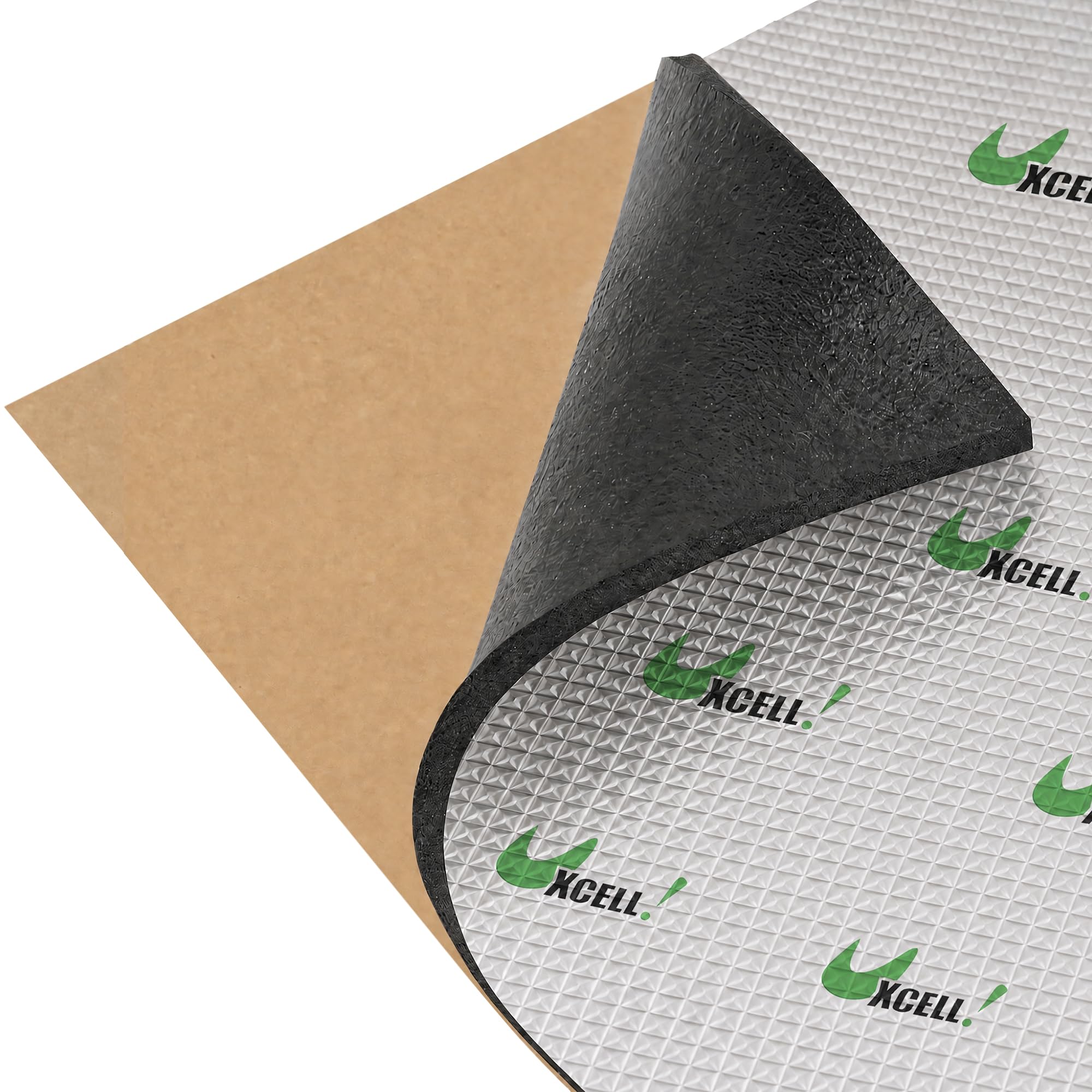
The uxcell 236 mil mat is a 6mm aluminum foil foam sheet designed primarily for heat shielding in the hood, engine compartment, and trunk. It is not a heavy butyl mass damper — its strength lies in blocking radiant heat from the engine and exhaust to keep the cabin cooler and reduce air conditioning load. At roughly for nearly 16.4 square feet, it is the most accessible entry point for anyone wanting to start a sound and heat insulation project on a tight budget.
Users have installed it on the underside of hoods on 2004 Camrys and on UTV panels between the driver and engine bay, reporting immediate reductions in perceived heat and minor decreases in mechanical noise. The self-adhesive backing works well on clean, dry surfaces, though some reviewers noted the adhesion can fail after a week on a hot hood if the surface was not properly prepped or if the mat was applied in cold weather. In those cases, retaining clips or high-temperature tape fixed the issue.
For pure sound deadening, this material does not add enough mass to stop panel resonance. If your goal is to quiet road noise, combine this with a butyl mat underneath. Its 6mm thickness is slim enough to fit under most hood liners and tight engine bay gaps. Think of it as a thermal bandage rather than a full acoustic treatment — a good starting point for an older vehicle that runs hot.
Why it’s great
- Very affordable entry point for hood and trunk heat shielding
- Lightweight and easy to cut with standard scissors
- Thin profile fits under factory hood liners without interference
Good to know
- Adhesive may require supplemental clips in high-heat applications
- No significant vibration damping — must combine with butyl for noise
FAQ
How many square feet of deadener do I need for a standard sedan?
What is the difference between 50 mil and 120 mil butyl in real-world driving?
Can I install sound deadening on outdoor panels like wheel wells?
Will sound deadening material make my car noticeably heavier?
Do I need to remove the factory moisture barrier in the door?
Final Thoughts: The Verdict
For most users, the best car noise insulation winner is the Siless Hybrid 3in1 200 mil because its integrated foam and butyl layers solve vibration, airborne noise, and heat in a single application, saving enormous labor compared to stacking separate products. If you need maximum low-frequency damping for a door or floor where heat is less of a concern, grab the Siless Max 120 mil. And for a full vehicle treatment on a budget, nothing beats the coverage of the VEVOR 50 mil 52 sq ft kit.