
Our readers keep the lights on and my morning glass full of iced black tea. As an Amazon Associate, I earn from qualifying purchases.
Specs are compiled from manufacturer listings and verified buyer reviews and can change over time — please confirm the key details on the product page before buying.
Buying a car paint sprayer is really a decision about three things: how much air your compressor can push, what finish you are chasing, and how brutal you want cleanup to be. Get the air supply wrong and even a great gun lays down dry, textured coats. Get the nozzle size wrong and your clearcoat sags. This guide cuts straight to the air-spray guns that serious DIY painters and small shops actually keep in the cabinet, from budget-first steel bodies to a starter kit that turns nozzle changes into a two-second job.
I’m Min — the founder and writer behind Gadgets Feed. This guide is built by comparing the manufacturers’ published specifications and the patterns across verified customer reviews, so you get each pick’s real strengths and trade-offs instead of marketing spin.
If you are refinishing a daily driver, a project car, or a set of motorcycle tins in the garage, the goal is simple: match the gun to your compressor, then match the nozzle to the coating. That single pairing decides whether your finish comes out flat and even or covered in orange peel, which is exactly what separates the truly useful car paint sprayers from the ones that sit on a shelf.
Our Picks at a Glance


How To Choose The Best Car Paint Sprayers
A car paint sprayer is only as good as the compressor feeding it and the coating running through it. Before you look at brands, work out two numbers for your setup: how much air your compressor can deliver in CFM (cubic feet per minute) and what pressure it holds steady. Everything else follows from those two figures.
Match the gun’s air consumption to your compressor
Air consumption is the amount of air the gun pulls while you are spraying, measured in CFM. A high-consumption gun on a small compressor will starve mid-panel, which shows up as dry, flaky texture. Low-CFM guns run happily on the average garage compressor, so check that number before you fall in love with a finish.
Pick nozzle size by the coating, not the car
Nozzle size sets how much material leaves the gun. Smaller nozzles atomize finer for base and clear; bigger ones move thick primers. If you plan to shoot primer, base, and clear with one gun, a kit that includes multiple atomizing sets saves you buying a second unit.
Quick Comparison
| Model | Best For | Air Consumption | Cup Capacity | Nozzle Sizes | Amazon |
|---|---|---|---|---|---|
| 3M Performance Spray Gun Starter Kit, 26778★ Best Overall | All-round refinishing with quick-swap heads | 13 CFM+ (per review) | PPS 2.0 cup system | 1.2, 1.3, 1.4 mm | Amazon |
| AEROPRO Tools R500 LVLPBest Value | Low-overspray finish work | 3.0–3.9 CFM | 22 oz disposable cups | 1.5 mm tip (per review) | Amazon |
| Astro EUROHE103 EuroProMost Versatile | Dedicated clearcoat gun | 10.5–12.5 CFM | 600 ml | 1.3 mm | Amazon |
| NEIKO 31213A Air Spray Paint Gun | Budget clearcoat and base work | 4.5 CFM | 600 CC | 1.3 mm | Amazon |
| PNTGREEN HVLP Siphon Feed 1000CC | High-volume coverage on fences and trailers | 18 CFM | 1000 CC | 1.8 mm | Amazon |
| InoKraft D1 LVLP Spray Gun Kit | Versatile one-gun garage setup | Low air volume (LVLP) | 22 oz disposable cups | 1.3, 1.5, 1.7 mm | Amazon |
| BEETRO HVLP Air Spray Gun | Primer, base, and clear on one gun | 14.3 CFM | 1000 ml | 1.4 mm, 1.8 mm | Amazon |
| StartingLine HVLP Complete Auto Painting and Priming Kit 802343 | DIY primer and panel work | — | — | — | Amazon |
| Master Elite Performance PRO-88 HVLP | Full-range basecoat-to-primer kit | — | 1 L | 1.3, 1.4, 1.8 mm | Amazon |
In‑Depth Reviews
1. 3M Performance Spray Gun Starter Kit, 26778
Our pick — over 4.5★ from 450+ verified ratings; the strongest balance of quality and price.
The kit that swaps nozzles in seconds and cleans up in minutes, not hours.
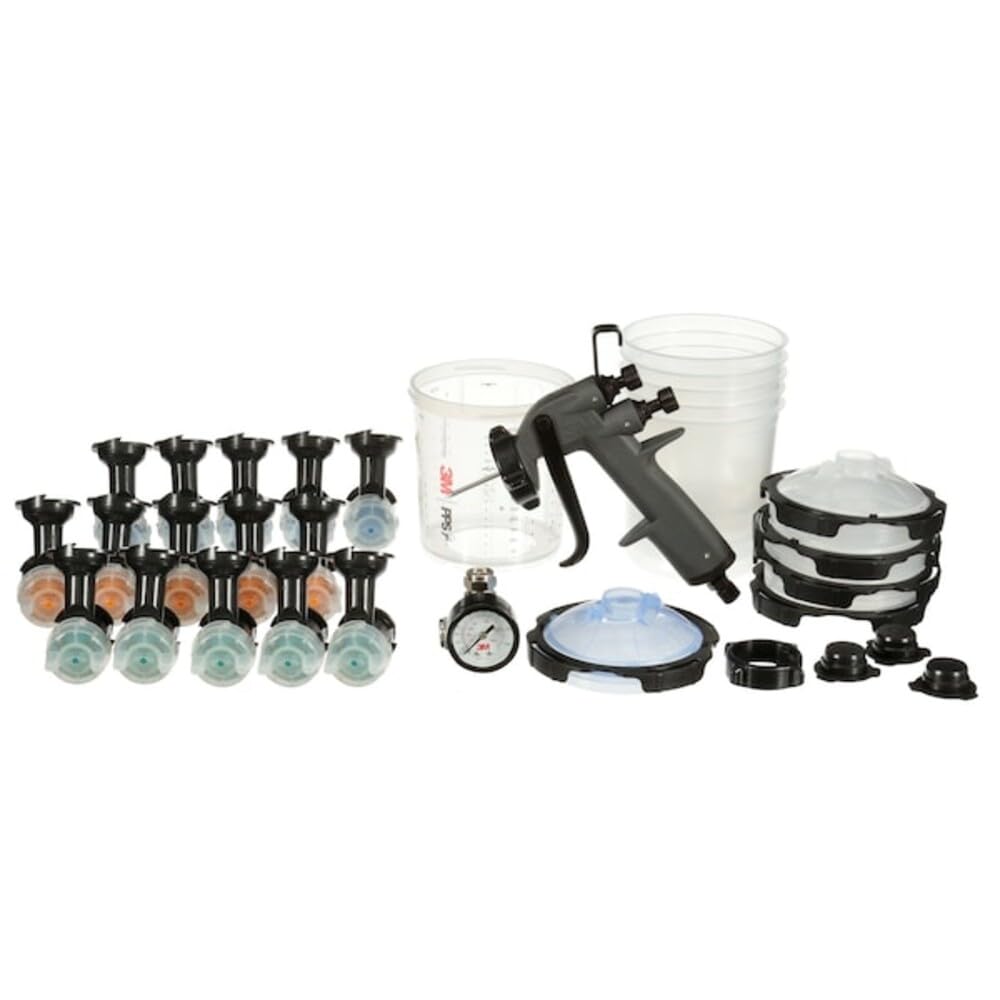
What sets this apart is the swap-and-toss design: the kit ships with 15 replacement gravity HVLP atomizing heads, five each in 1.2 mm, 1.3 mm, and 1.4 mm sizes, so a fresh nozzle takes seconds and you never rebuild a needle. The gun itself is built from stainless-steel reinforced composite, which 3M states is up to 50% lighter than conventional metal spray guns — you feel it at the end of a long clearcoat session.
At 3 pounds it outweighs the PNTGREEN’s 1.9 pounds on paper, but the composite body carries that weight away from the trigger hand. This is the 3M PPS 2.0 system: the 3M PPS Series 2.0 spray cup includes five lids and liners, so paint never touches the mixing cup. Coverage runs across solid colors, pearls, metallics, clearcoats, sealers, and primers. What wins people over is the cleanup: the disposable liner setup makes a two-minute rinse genuinely possible rather than aspirational, and that single trait is why this kit is the one most garage painters keep bolted to their compressor rig.
Its 9.37″W x 9″H body is wider than the NEIKO’s 5.83″W x 8.94″H, so there is slightly more surface to wipe down after a panel. An air control valve on the gun lets you trim pressure at the grip instead of walking back to the compressor. The one recurring caveat: no atomizing head in this kit is larger than 2.0 mm, so gel coat or very heavy texture material sits outside its comfort zone — you would want a dedicated gun for those, not a compromise here.
What earns its place
- 15 replaceable atomizing heads across 1.2, 1.3, and 1.4 mm sizes, five of each
- Stainless-steel reinforced composite body is up to 50% lighter than metal guns
- PPS 2.0 cup system with 5 lids and liners for near-zero cleanup
- Handles solid colors, pearls, metallics, clearcoats, sealers, and primers
Where it asks patience
- Buyers report it wants 13 CFM or better — a small compressor will starve
- No atomizing head above 2.0 mm, so gel coat falls outside its range
- The regulator is the recurring gripe; budget a better one if yours is tired
Reach for this if: you refinish solid colors, clear, or primer regularly and want to stop rebuilding needles between jobs.
Look elsewhere if: you own a small compressor pushing low CFM or need a nozzle bigger than 2.0 mm for gel coat.
2. AEROPRO Tools R500 LVLP Air Spray Gun with 22 Ounce Disposable Paint Cups
A low-pressure gun that sips air and lays clearcoat flat under a 30-gallon compressor.
LVLP here means Low Volume Low Pressure: the gun moves a small amount of air at low pressure so the paint reaches the surface as a fine, controlled mist. The published figure is 3.0–3.9 CFM, which is a fraction of what a standard HVLP wants — you can run it on a modest shop compressor without losing steady flow mid-panel. Two-lever trigger gives you a dry blast for dust before the paint stage. The 280 mm spray width and 65% paint utilization rate are quoted from the maker’s spec sheet.
Overspray control is the standout: LVLP atomizes at lower pressure, so bounce-back is reduced compared to traditional HVLP, which means less material floats away and more of it lands on the panel. Owners mention near-zero overspray and a flat, orange-peel-free finish on base and clear that needs no wet sanding or polishing. That is not marketing; the pattern geometry is the reason — smaller droplets at lower velocity simply have less energy to throw sideways.
What is honestly weaker is the disposable cup hardware: owners describe the cups as flimsy and prone to wobble, and the included air regulator as the first part to replace. The cups do seal — no leakage noted in use — but if you are buying this gun, factor in a better regulator before your first full panel. The gun body itself is Teflon coated on the A610 upgrade, so cleanup stays easy, but the peripheral parts are the trade-off you accept at this tier.
Why owners keep it
- Only 3.0–3.9 CFM, so it runs on smaller compressors than HVLP rivals
- 65% paint utilization rate and 280 mm spray width from the maker’s specs
- Teflon-coated body on the A610 upgrade for easier wipe-down
- Two-gear trigger separates dust blow-off from painting
The honest fine print
- Disposable cups wobble; owners describe them as flimsy though they seal fine
- Included regulator is the weak spot — a replacement is a sensible add-on
- Recommended nozzle sizes beyond the installed 1.5 mm tip are sold separately
If overspray is your enemy: this LVLP lays base and clear flat with minimal bounce-back, even on a lower-volume compressor.
If you value factory hardware: plan to upgrade the regulator and accept that the disposable cups are consumables, not a permanent feature.
3. Astro EUROHE103 EuroPro High Efficiency/High Transfer Spray Gun with 1.3mm Nozzle and Plastic Cup
A dedicated clearcoat gun that atomizes fine at low pressure and moves serious material.
High transfer means the gun puts more of what you load onto the panel and less into the air, and the published numbers here back that up: 29 psi operating pressure, 10.5–12.5 CFM average consumption, and an 11″–13″ (280–330 mm) max pattern at 6″ to 8″ distance. The 1.3 mm nozzle is set up for clearcoat and pearl; owners describe it pulling 4:1 clear with minimal orange peel at 22–25 psi rather than the 30 psi many budget guns need.
What this gun is not is a general-purpose unit. Its own spec sheet and owner experience both point to a dedicated heavy-material gun: with unthinned high-build urethane primer and 4:1 clearcoat, it lays glass-smooth. With thin basecoat, the same high transfer rate can leave runs if you are new to trigg er control, and owners describe it as heavy for sealer work.
If you already own a basecoat gun and want a clearcoat specialist, the 1.3 mm and 29 psi pairing makes this a simple choice. If you want one gun for everything from sealer to pearl-metallic, look at the 3M kit or the BEETRO instead — both cover more material types from the start. The 600 ml cup volume is a natural limit too: for large clears on a full respray, expect to refill mid-panel.
Straight read: one of the smallest nozzles in this group at 1.3 mm, paired with 29 psi low-pressure atomization that lays clearcoat almost flat. The integrated regulator keeps setup simple, and the pattern width of 11″–13″ at 6″ to 8″ is broad enough for panels without a fan-pattern sprint.
The trade-off owners flag: it is a heavy-material gun first and a finesse gun second. Basecoat or metallic work takes practice; sealing after prime takes muscle. Plan this as part of a two-gun setup rather than a solo act.
Buy it for: clearcoat, tri-coat pearl, and heavy material where the goal is fewer passes and thicker coverage.
Not the one: for thin metallics or a first-timer wanting one gun to do every stage.
4. InoKraft D1 LVLP Spray Gun Kit with 22 Ounce Disposable Paint Cups
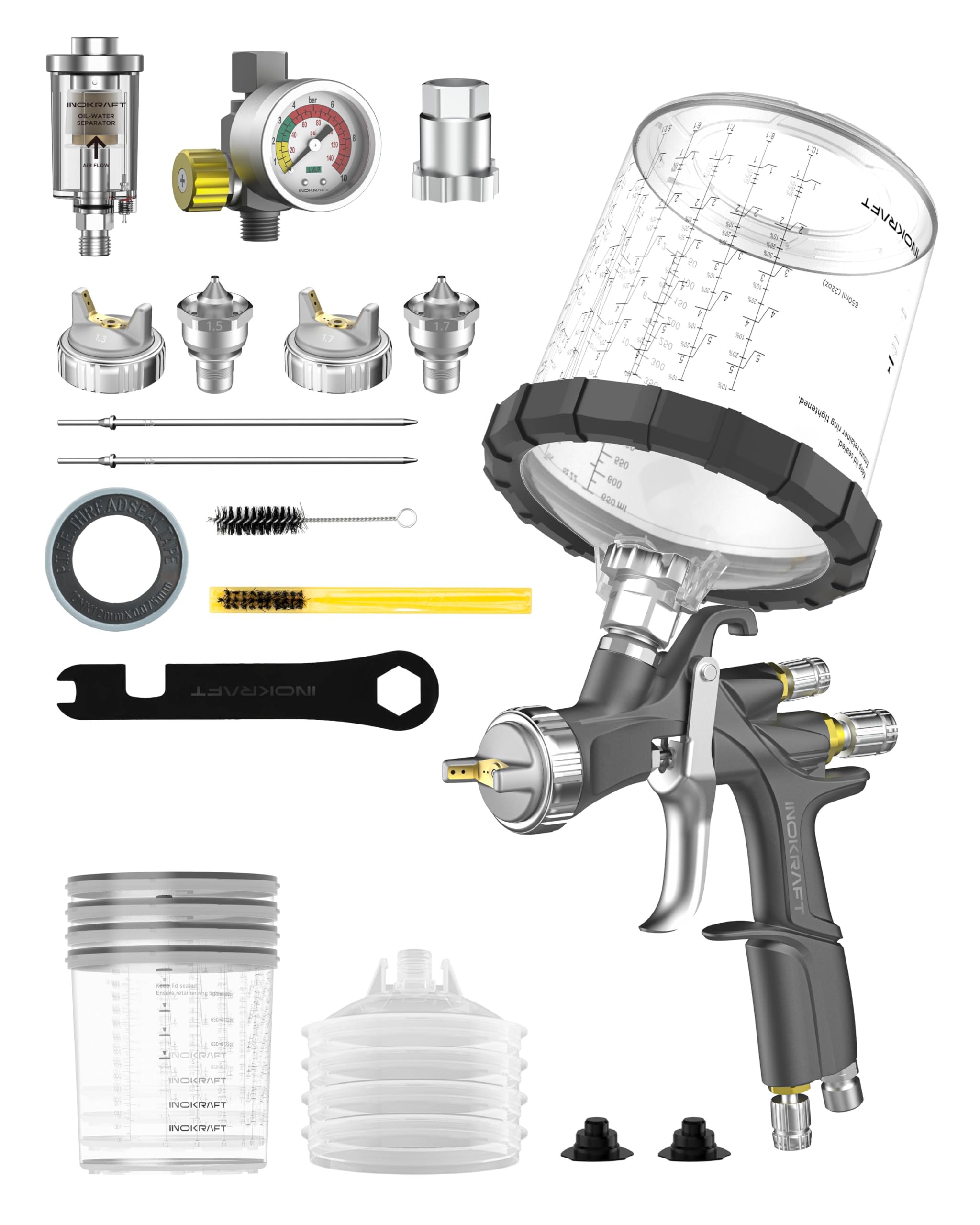
Three nozzles, disposable cups, and low air demand — a garage-first kit for mixed-material jobs.
The kit ships with 1.3, 1.5, and 1.7 mm needle-and-seat sets, which is the practical answer to the question of “can one gun shoot primer, base, and clear?” For a 40 PSI compressor stepping down to 25 PSI at the gun through a 50-foot hose, LVLP is exactly the right architecture: low volume means the pressure drop along a long hose hurts less. Multiple tip sizes is the feature that wins people over, and the ones who tune the mixture get an even, fairly flat finish rather than heavy texture.
Setup is the honest catch: customers note a needle-and-seat mismatch on arrival, where the 1.3 seat is paired with the 1.7 needle plus varnish residue from a prior test. If you get that configuration and do not spot it, paint volume control goes erratic with latex and every coating after it feels wrong. Check the seat and needle pairing before your first spray job. It is a five-minute inspection that saves a whole panel.
What it does well is compete above its tier. Against the 3M kit above, it does not match the 15-head swap system or the PPS 2.0 cup, but for a hobbyist who reaches for the gun two or three weekends a year, the three-nozzle coverage and low air demand makes it a stronger fit than the extra hardware you would pay for elsewhere. Last closers here are practical: the exposed body styling and the absence of an included air regulator are the honest trade-offs.
The case for it: three nozzle sizes in one box, LVLP architecture that tolerates long hose runs, and disposable cups for fast cleanup between colors.
What to check: seated needle and nozzle pairing before the first spray — the recurring issue is a mismatched set straight from the box.
Good fit for: hobbyists who spray occasionally and want a single gun covering primer through clear.
Look past it if: you spray weekly and want every part factory-fitted with no inspection step.
5. BEETRO HVLP Air Spray Gun, 1000ml Capacity 14.3CFM 29-32psi 1.4mm/1.8mm Nozzles Stainless Steel with Type 2 Adapter Air Control Valve and Filter

One gun from basecoat to primer, with transfer efficiency that keeps more paint on the panel.
BEETRO claims up to 85% transfer efficiency and up to 30-40% material savings from the HVLP architecture — those are the manufacturer’s figures, not measured here. Air demand is 14.3 CFM at 29-32 psi, with a 3.0 bar (43 psi) maximum working pressure. The 1.4 mm nozzle is pre-installed for basecoat and general uses, and a 1.8 mm set covers primer; both atomizing sets are stainless steel with a brass cap so solvents and thinners do not chew them up.
The No O-ring design is the practical detail: fewer seals means less to swell or degrade from cleaning solvents, which is why owners describe cleanup as simply wiping the body rather than rebuilding the gun. The 1000 ml aluminum cup is the biggest capacity of the HVLP feeding guns in this group, and the included Type 2 adapter lets you run disposable liners when you want to skip cup washing entirely.
Where it falls short of a tier-topper: the plastic lid on the cup fits loosely and owners describe it as the first thing to replace or tape down — a minor hardware gripe, not a performance problem. The HVLP air appetite of 14.3 CFM is the practical ceiling: on a small compressor you will not hold steady pressure at the 29-32 psi window. Match this gun to a compressor that can actually deliver 14 CFM continuously.
Why it works: two nozzle sizes pre-graded for basecoat and primer, up to 85% transfer efficiency per the maker’s spec, and 1000 ml capacity that pushes less refilling mid-job.
The catch: the 14.3 CFM appetite demands a real compressor, and the plastic cup lid is the one part owners routinely reinforce.
Right for: painters who want a single gun that handles primer, base, and clear without swapping hardware between stages.
Wrong for: low-CFM garage compressors — the 14.3 CFM draw will outrun anything under a true shop unit.
6. NEIKO 31213A Air Spray Paint Gun, HVLP with Gravity Feed, 1.3 MM Nozzle, 600 CC Capacity

A one-piece steel-body gravity gun that punches well above its entry-level price tag.
At 4.5 CFM average air consumption and 40 psi max with 10 psi working pressure, this is the least air-hungry gun in this comparison — a small garage compressor keeps up easily, where the PNTGREEN siphon gun below needs 18 CFM to run at the same level. That is the key number if you are spraying in a home garage with a 20-gallon tank. The 1.3 mm blue-coded nozzle is set for clearcoat and light-to-medium automotive work, and the 600 CC aluminum cup holds enough for a bumper panel or a set of small parts before refilling.
The one-piece all-steel gun body and stainless-steel nozzle with solid brass cap earn their keep. Gravity feed means the fluid runs down from the top-mounted cup, so material flows without pulling air, and three adjustable valve knobs cover fluid volume, air, and fan pattern. Owners describe it handling a welded steel-frame project and a clearcoat job well, often comparing it favorably against cheaper guns they had already owned.
The honest limitation is the air regulator: it breaks easily per multiple buyers, and the gauge face fogs when solvent cleaning. For the money it is still a good gun to keep as a dedicated clearcoat unit or an entry point for someone learning to spray. Just budget for a replacement regulator and do not expect replacement parts for a broken needle seat.
Where it earns the price
- Only 4.5 CFM average air consumption — runs on a modest garage compressor
- One-piece steel body, stainless-steel nozzle, and solid brass cap
- Three adjustable knobs for fluid, air, and fan pattern control
- 600 CC aluminum cup with lid, and simple metal-to-metal seal design
What you accept
- The included air regulator is the weakest link and fails periodically
- No replacement parts from the manufacturer — it is treated as semi-disposable
- The paint cup seal loosens after a few uses on some units
Reach for this if: you own a modest compressor and want a capable, low-consumption clearcoat or general work gun for a modest outlay.
skip it if: you need factory replacement parts or plan months of daily use — the regulator and cup seal are the visible ceilings.
7. HVLP Spray Gun Air Paint Sprayer Siphon Feed 1000CC Capacity, with 1.8mm Nozzle

The siphon-feed workhorse with the largest cup, built for big coverage jobs.
Start with the two numbers that matter most: 18 CFM air consumption at 50 psi, and 1000 CC cup capacity. Compared with the NEIKO above at 4.5 CFM and 600 CC, this is a very different tool — the siphon feed design pulls material up from the cup below the gun, which is why the 1000 CC volume works without starving the spray stream. That is also why it holds four times the air demand of the NEIKO: it needs a real compressor, not a small tank.
The 1.8 mm stainless steel nozzle with a brass cap is set up for medium to heavy viscosity material: primer, house paint, latex, enamel. Reviewers point out no clogs and even coats on a six-coat trailer, enamel fencing, and latex mixed with 5 oz Floetrol plus 1 oz water per 20 oz paint, even on a low-powered compressor. The nozzle direction rotates 360 degrees, which side-mounts the cup so you can angle the gun without rotating your wrist.
The recurring gripe is the cup lid — it does not screw down tight, and when you tip the gun paint pours out. Tape or a replacement lid is the fix. What this gun is not is a fine-finish clearcoat tool; the feed and nozzle geometry point squarely at coverage work rather than a glass-flat single-stage finish.
What it brings: 1000 CC siphon cup, 1.8 mm stainless nozzle, and 360° nozzle adjustment for awkward angles.
The catch: the lid does not seal tightly and paint will pour out when tilted — a one-piece fix worth doing before your first panel.
Order it if: your job is fences, trailers, furniture, or house paint and you want maximum cup volume and a nozzle that handles thick material.
Leave it if: your target is automotive clearcoat or a fine single-stage finish — the 1.8 mm nozzle and siphon feed are too coarse for that work.
8. StartingLine HVLP Complete Auto Painting and Priming Kit 802343

A weekend-warrior auto painting kit that handles high-build primer without spitting or clogging.
The role this kit plays is primer and panel work. Shoppers say it spraying thick 2K high-build primer and then basecoat/clearcoat on a repainted trunk, and ’70 Barracuda restorers call it solid for the entry-level price. The gravity feed and high volume low pressure design combine to keep material flowing evenly, and the kit is marketed for priming and painting rather than fine detail work.
Where it asks attention: the spray pattern is inconsistent on stop-and-start strokes, which is normal for HVLP at this tier but noticeable. The metal cup can crack at the fitting under stress, and one unit arrived with a stripped spreader valve thread — a delivery-quality issue rather than a design problem. Owners running it on a commercial compressor in cold weather report consistent flow with no clogging or spitting once settings are dialed in.
One warning worth printing: the recommended PPS adapter is frequently listed incorrectly, so buyers report ordering the wrong size. Confirm the correct adapter before buying if you want to run disposable liners with this kit.
For the garage painter: a primer-first HVLP kit that sprays high-build material evenly and covers base and clear after.
The practical caveats: check the cup fitting for cracks over time, and independently verify the PPS adapter size before ordering accessories.
Buy it for: home garage primer and panel work where the goal is coverage and control, not a competition finish.
Consider skipping if: you plan to run a full PPS liner system from day one — adapter compatibility is easy to get wrong here.
9. Master Elite Performance PRO-88 HVLP Automotive Spray Paint Gun with 3 Tips

Three fluid tip sets and a one-liter cup — the kit that covers light to heavy coatings with one gun.
The PRO-88 covers the widest material range of any gun here: three complete atomizing sets in 1.3 mm, 1.4 mm, and 1.8 mm with matching needles and air caps, all running on the same stainless-steel body with a 1-liter aluminum cup. The 1.3 mm set is installed. The smaller tips take base coats, clear coats, single stage, and primer-sealers; the 1.8 mm set takes primers, 2K primers, and heavy viscosity surfaces. It ships with an air pressure regulator gauge and an MPS adapter for disposable cups, and the stainless-steel internals are advertised as suitable for waterborne coatings.
Owners call its base and clearcoat atomization glass-smooth and competitive with higher-priced guns, with an even fan pattern and a smooth trigger. Against the 3M kit above, the coverage is similar in scope but the swap system is different: 3M uses replaceable atomizing heads on a fixed body, while this gun swaps full needle/nozzle/aircap sets. That means more cleaning steps but a lower consumable cost per new size.
The honest rough spot is material and finish on the screws inside: one owner found the needle and internal threads rusted after cleaning before waterborne paint, since the main paint channel is galvanized rather than fully rustproof. Another reviewer flagged plastic knobs where metal would be expected. Neither is a fatal flaw, but if you spray waterborne regularly, dry the gun thoroughly after every use.
What works: three atomizing sets across 1.3, 1.4, and 1.8 mm covering basecoat through primer, with a 1 L aluminum cup and included regulator and MPS adapter.
What to watch: dry the internals after every clean — waterborne paint and the galvanized main channel can leave rust if moisture sits.
Choose it if: you want one gun and three nozzle sizes covering automotive base, clear, single stage, and primer without buying a second unit.
Keep looking if: you only spray waterborne and want a fully corrosion-resistant channel — this one wants disciplined drying.
Understanding the Specs
HVLP vs LVLP
HVLP stands for High Volume Low Pressure — the gun moves a lot of air at low pressure to atomize the coating gently. LVLP is Low Volume Low Pressure, the same low pressure idea at lower volume. In practice the labels tell you two things: HVLP wants a bigger compressor and lays a broader fan; LVLP is friendlier to smaller compressors and narrower hoses, and tends to reduce overspray because there is less air moving droplets around. If you are spraying in a home garage on a smaller tank, LVLP wins on practicality; if you want the largest coverage per pass, HVLP delivers it.
Nozzle Size and Air Consumption
Nozzle size is the diameter of the fluid tip and it sets which coatings the gun handles well. Smaller nozzles (1.2 mm to 1.4 mm) atomize finer and suit base coats, clear coats, and thin materials. Larger nozzles (1.8 mm and up) move thick primer and high-build products. Air consumption in CFM is the second number to check — a gun rated at low CFM will run on a modest compressor, while one calling for 14 CFM and up needs a serious unit. Mismatch either one and your finish suffers long before your technique gets blamed.
FAQ
What size air compressor do I need to run an HVLP car paint sprayer?
Is HVLP or LVLP better for spraying a car at home?
What nozzle size should I use for basecoat versus primer?
Do I need a water oil separator with a car paint sprayer?
How do I clean an HVLP spray gun without damaging the seals?
Can a car paint sprayer handle water-based or waterborne paint?
How many ounces or liters do I need in the cup for a full car panel?
What is the difference between a gravity-feed and a siphon-feed spray gun?
Pick it for: high-volume coverage jobs where cup capacity and 360° nozzle reach mean fewer breaks on long panels.
Think twice if: you need fine automotive clearcoat — the siphon feed and 1.8 mm nozzle are set for thick material, not a glass-flat finish.
Final Thoughts: The Verdict
For most buyers working on a full car or a serious set of panels, the car paint sprayers winner is the 3M Performance Spray Gun Starter Kit, 26778. The 15 replaceable atomizing heads, lightweight composite body, and disposable PPS 2.0 cup system squeeze cleanup down to minutes and let you switch coatings without rebuilding the gun — the highest-rated finish tool in the group for a reason. If fine overspray control on a smaller compressor is the priority, the AEROPRO Tools R500 LVLP is the one to reach for, and its LVLP architecture lays a flat finish without the air demand of a full HVLP setup. And for primer-first garage work that keeps the bill modest, the NEIKO 31213A covers small clearcoat and panel jobs on a 4.5 CFM air draw that most home compressors can actually feed.
How We Picked
We do not accept paid placement. Every pick is matched to a real buyer and a real use-case; we do not hands-on test units.
Sources & Methodology
Specifications: manufacturer listings and product documentation. Review insights: verified customer reviews, as of September 2026. Pricing: not shown on this page (it changes often); check the current price via the retailer link.
As an Amazon Associate, Gadgets Feed earns from qualifying purchases. This does not affect which products we feature.