
Our readers keep the lights on and my morning glass full of iced black tea. As an Amazon Associate, I earn from qualifying purchases.
Specs are compiled from manufacturer listings and verified buyer reviews and can change over time — please confirm the key details on the product page before buying.
Sunlight hits your hood and suddenly every swirl mark and fine scratch is glowing like a roadmap. A good polishing kit removes those defects and restores a deep gloss, but the difference between a compound and a one is huge. This guide cuts through the confusion so you pick the right abrasives and the right machine for your paint.
I’m Min — the founder and writer behind Gadgets Feed. This guide is built by comparing the manufacturers’ published specifications and the patterns across verified customer reviews, so you get each pick’s real strengths and trade-offs instead of marketing spin.
Your paint’s condition and your patience decide which car polishing kit you need—a simple hand-applied compound or a full machine setup.
Our Picks at a Glance


How To Choose The Best Car Polishing Kit
Polishing removes a tiny layer of clear coat (the transparent top layer of your paint) to level out scratches and swirls. Your choice depends on how damaged your paint is and whether you plan to work by hand or with a machine.
Grit and Abrasive Type
The grit number tells you how aggressive the abrasive is. A lower number like 400 cuts faster and removes deeper scratches, while a higher number like 2000 is an ultra-fine finish that only polishes. Match the grit to the job: heavy oxidation needs a coarse cut first, then a fine polish to restore gloss.
Hand Application vs Machine
Hand-applied compounds work for light swirls and minor scratches but take serious elbow grease. A dual-action (random orbital) machine is beginner-friendly and safe on clear coat because it doesn’t generate the heat or pressure of a rotary buffer. Cordless models add convenience but limit runtime, so check the battery setup.
One-Step vs Multi-Step Systems
A one-step product can’t both cut deep and finish glossy — those are opposite jobs. Two-step kits combine a compound to remove defects with a polish to refine the surface. Three-step systems add a heavier cut for severe damage but demand more time and skill.
Quick Comparison
| Model | Best For | Grit Number | Item Weight | Application | Amazon |
|---|---|---|---|---|---|
| Meguiar’s Mirror Glaze Bundle★ Best Overall | Scratch removal by hand | 1200 | 8 oz | Hand / DA / Rotary | Amazon |
| Adam’s Hand Correction SystemBudget Champion | Budget scratch fix | 400 | 0.34 kg | Hand | Amazon |
| Adam’s 2-Step Polishing SystemTop Performer | Machine swirl removal | 400 | 12 oz | Machine | Amazon |
| Chemical Guys C4 & P4 Kit | Show-quality gloss | 2000 | 1.03 kg | Hand / DA / Rotary | Amazon |
| menzerna 3-Step System | Heavy defect correction | 1000 | 24 oz (set) | Machine | Amazon |
| Vkdemer Cordless Buffer | Beginner machine polishing | — | 3 lbs | Cordless (21V) | Amazon |
| KITLUCK Rotary Polisher | Heavy cutting power | — | 5.5 lbs | Corded (1400W) | Amazon |
| AUTIWOZ Cordless Buffer | Budget cordless value | — | 3 lbs | Cordless (21V) | Amazon |
| VERVEWAVE for DeWalt | DeWalt battery owners | — | 2.4 kg | Cordless (DeWalt 20V) | Amazon |
In‑Depth Reviews
1. Meguiar’s Mirror Glaze Bundle
Our pick — over 4.5★ from 350+ verified ratings; the strongest balance of quality and price.
The crowd-pleasing duo that erases swirls without the risk of burning your clear coat.
The quality here is what wins people over — owners consistently report these two bottles handle light scratches and swirls with real results. The M105 Ultra-Cut Compound cuts through up to 1200 grit sanding marks, making it strong enough for moderate oxidation and acid rain spots, while the M205 Ultra Finishing Polish refines the paint to a deep, swirl-free gloss afterward.
What makes this kit so versatile is that you can apply both formulas by hand, with a dual-action polisher, or with a rotary buffer. That flexibility means a total beginner and a seasoned detailer can both get professional-looking results from the same two bottles.
Value gets mixed feedback — some call it the only product they’ll ever buy for polishing, while a few find the price steep. Buyers report it “works pretty well, but ultra cut really only works for very minor abrasions,” so set your expectations for light-to-moderate defects.
What Owners Rave About
- Clear coat safe on all glossy finishes
- Works by hand, DA, or rotary buffer
- Removes oxidation, swirls, and etching
Reality Check
- Ultra-cut only tackles very minor abrasions
- Some technique required — tricky at first
Reach for this if: you want one trusted two-step system for light scratches and swirl restoration on any paint type.
Look elsewhere if: you’re chasing deep key marks that need a more aggressive compound first.
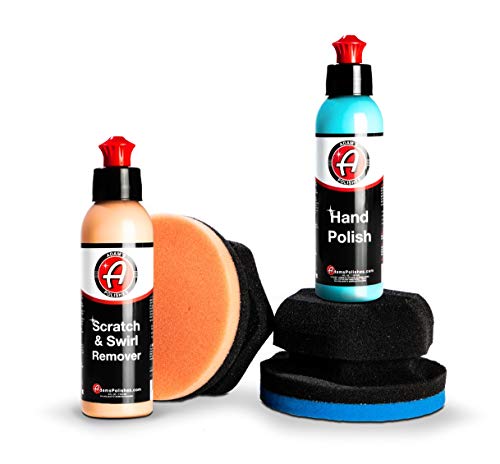
2. Adam’s Polishes Hand Correction System
The budget two-step that fixes scratches by hand without needing a machine.
Scratch retention is the thing everyone raves about here — owners talk about removing door dings, keyed panels, and paint transfer with just elbow grease. The 400-grit aluminum oxide formula is fine enough to be safe on all paint types and colors, including black and dark finishes.
Owners mention it “worked perfectly” fixing scratches on a 2016 Mazda 3 before trading it in — every ugly mark gone. The diminishing abrasives break down as you polish, which restores clarity without leaving new swirls behind, and the dustless formula performs even in direct sunlight.
The realistic limit: this is hand correction, so it takes real effort and works best on minor imperfections. Deeper scratches that you can feel with a fingernail will only lighten, not vanish, and some owners found results better on lighter-colored paints.
What Makes It Work
- Dustless even in direct sunlight
- No waxes, silicones, or fillers
- Effective on black plastic swirls
Where It Falters
- Heavier scratches only become less visible
- Hand application demands physical effort
Best for: the weekend detailer fixing light scratches and paint transfer on a budget without buying a polisher.
Think twice if: your scratches are deep enough to catch a fingernail — you’ll need a machine step-up system.
3. Adam’s Polishes 2-Step Polishing System
The machine-ready two-bottle system that makes typical swirls disappear.
Owners chasing swirl removal find the 12-ounce combo genuinely effective — the compound cuts imperfections while the polish finishes to a mirror gloss even on black paint. It’s formulated for clear coat, gel coat, and single-stage finishes, so it’s not just for modern cars.
The color-coded system pairs with Adam’s blue foam and white finishing pads, and it’s versatile enough to work with cutting, microfiber, wool, or polishing pads. Users report you can often skip the heavy microfiber pad entirely and start with blue foam, then finish with white foam for incredible results.
At 12 ounces it carries 50% more product than the Meguiar’s 8-ounce bundle, giving you more passes per bottle. Value still gets mixed reviews, but the effectiveness and ease of use win the majority over.
Why It Shines: diminishing abrasive technology cuts and finishes in one smooth workflow, with a formulation safe on dark finishes.
The Trade-off: it’s built for machine work — polishing by hand won’t open up the same cut and gloss.
Grab it for: DA polisher owners who want a reliable two-step that handles typical daily swirls without drama.
Who it’s not for: hand-only users who need a compound that works with pure muscle power.
4. Chemical Guys C4 & P4 Paint Correction Kit
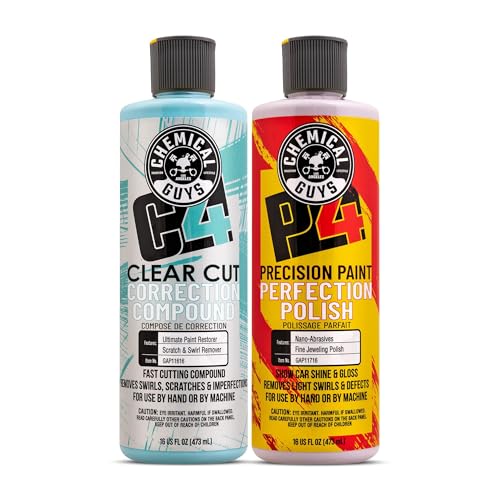
The ultra-fine pair that leaves paint looking factory-new and glossy.
Effectiveness is the overwhelming consensus — customers note removing 95% of off-road scratches and restoring an 8-year-old black truck to a glossy, brand-new look. The C4 Clear Cut Compound chews through oxidation, swirls, and etching, then the P4 Precision Polish refines micro-marring into a show-quality finish.
Both bottles are safe on clear coat, single-stage, and ceramic-coated vehicles, and they work with dual-action, rotary, or hand application. The 2000-grit ultra-fine polish is finer than most competitors, which makes the final gloss exceptionally deep.
There’s honest nuance here: C4 cut less than expected on a hard 1999 Corvette clear coat, and value gets mixed opinions. But on typical modern paint, owners describe the shine as “outfreakingstanding” and say the kit is worth every dollar for DIY correction.
The Standout Wins
- Works on ceramic-coated vehicles
- Easy to spread with low mess
- Leaves a finish easy to refine
Watch For
- Hard clear coats resist the cut
- Some owners call the price high
Choose this when: you want a fine-grit finish that prioritizes gloss and depth over raw cutting power.
skip it if: your paint has deep scratches that need the aggressive cut of a 400-grit compound.
5. menzerna 3-Step Polishing Set
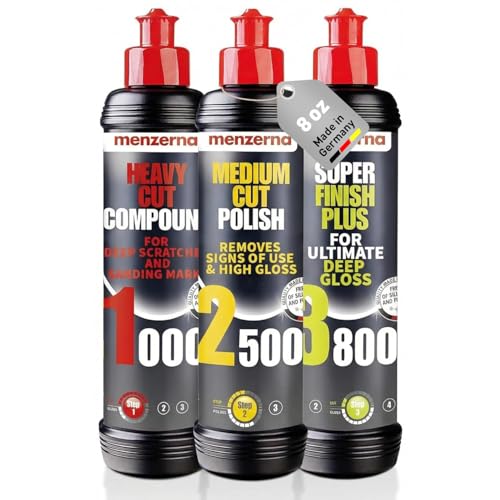
The three-bottle professional sequence for heavy defect correction.
Functionality and quality are the twin pillars here — the three-step system gives you a dedicated product for each stage of correction. The HCC1000 heavy cut compound removes light scratches and imperfections, the MCC2500 medium cut eliminates holograms and polishing marks, and the 3800 super finish creates a deep, mirror-like gloss.
Reviewers point out a “showroom shine” on a black Tacoma, with the HCC1000 knocking out door handle scratches before the follow-up steps smoothed everything. The set totals 24 ounces across three 8-oz bottles, giving you a full arsenal for serious correction work.
Some owners note the bottles arrive only half full, and scratch repair results are mixed on deeper damage. But those who follow the sequence with proper pads call it the trio that finally delivered the glassy finish they’d been chasing.
Why It’s a Pro Tool: three dedicated stages (heavy cut, medium cut, super finish) handle everything from scratches to final gloss.
Honest Catch: you’re committing to a full three-pass workflow, which is labor-intensive and demands correct pad selection.
Pick this for: enthusiasts and professionals correcting serious paint defects who want labeled stages instead of guessing.
Pass if: you only have light swirls — a two-step will save you time and effort.
6. Vkdemer Cordless Buffer Polisher

The featherweight cordless orbital that fits one hand and a small budget.
Performance is what owners praise most, especially for detailing and waxing — the dual-action random orbital motion prevents heat buildup so you can’t burn your clear coat. The 3-pound body and ergonomic grip make it manageable with one hand, and the LCD display shows battery level so you’re never caught mid-panel.
Two 21V 2000mAh batteries mean you can rotate them and skip the charging wait entirely. Six speed settings top out at 5500 RPM, giving you low-speed waxing and high-speed defect removal in one tool, with a 9mm throw orbit for even coverage.
The caveat is honest: owners note the batteries drain in about an hour at full speed, and it’s best for waxing and light swirls rather than deep scratch correction. The switch can also trigger accidentally with large hands, but the included 12 accessories and one-year body warranty make it a solid entry point.
What Makes It Easy
- Beginner-safe random orbit motion
- Two hot-swappable 21V batteries
- 12-month body warranty included
Know Before Buying
- Battery lasts about an hour at top speed
- Not built for deep scratch correction
Great starting point for: first-time machine polishers who want safety, portability, and a full accessory kit.
Upgrade away if: you’re correcting serious oxidation regularly and need corded runtime.
7. KITLUCK Rotary Polisher
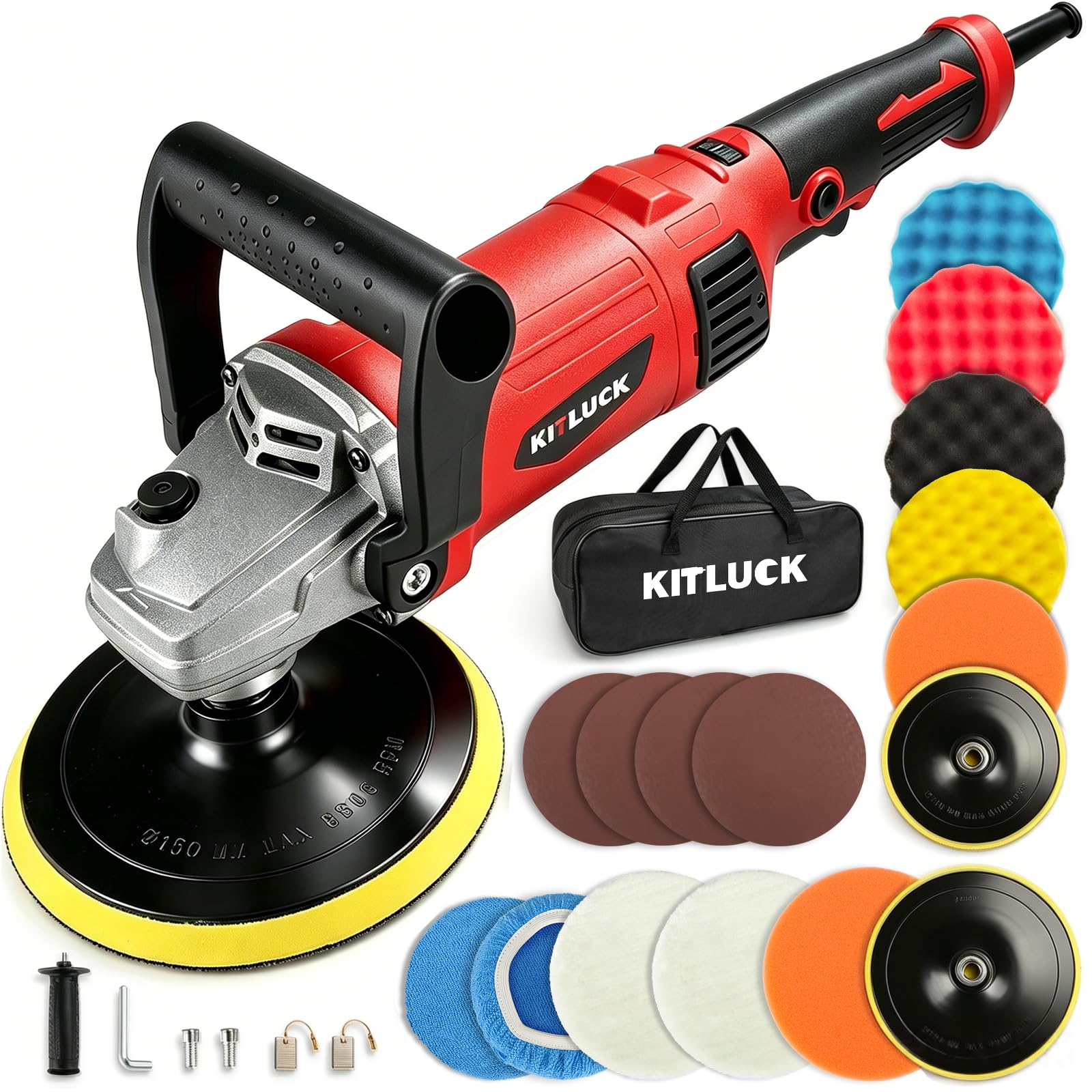
The corded 1400W rotary with the muscle for stubborn defects and oxidation.
Owners call the build quality better than expected at this price, with lots of accessories included — the kit bundles foam pads, wool bonnets, sandpaper, and a storage bag. The 1400W pure copper motor spins from 800 to 3500 RPM across seven speed levels, with dual-row heat dissipation for longer working sessions.
The M14 spindle lets you swap between 6-inch and 7-inch base pads freely. Low speeds (1-2) handle waxing, medium (3-4) polish, and high (5-7) remove defects and oxidation — a clear labeled workflow that new users appreciate.
Be honest about the trade-offs: reviews flag durability concerns with units breaking after a couple of uses, and it runs hot quickly. The two-part trigger takes getting used to, and the 5.5-pound weight plus vibration means your arms feel it over long panels.
What It Delivers: rotary cutting power that compounds faster than any orbital, ideal for heavy oxidation and wet-sanding removal.
The Reality: durability and heat are the recurring gripes — treat it gently and give it breaks during long jobs.
Reach for it if: you know how to handle a rotary and need aggressive cutting power for serious defects.
Steer clear if: you’re a beginner on modern clear coat — a rotary burns paint when used wrong.
8. AUTIWOZ Cordless Buffer Polisher

The 5-inch cordless orbital that pairs value with true beginner ease.
Value for money is the clearest consensus here — owners say the price feels right for what you get: two 21V batteries, a charger, and multiple pads. The 5800 RPM top speed with six settings stretches from gentle buffing to aggressive scratch removal, while the 8mm orbital keeps the motion uniform.
The 3-pound body with concave rubber grip absorbs vibration, so long sessions don’t fatigue your hands. Owners note the batteries never run out because the second is always charged and ready, and the 12-month replacement guarantee backs the tool.
The honest limits: stock pads are considered weak, and owners recommend swapping in Rupes pads for real results. High-speed work drains batteries fast — one owner saw them die after 1.5 hours at speed 6, though recharging is quick.
The Value Wins
- Two batteries for uninterrupted work
- Beginner-friendly dual-action motion
- Vibration-reducing ergonomic grip
What’s Compromised
- Included pads are weak — upgrade needed
- Battery life drops fast at speed 6
Best for: weekend DIYers wanting a cheap cordless DA for waxing and light polishing on one or two cars.
Not for: pros who need consistent runtime at high speed for full-panel correction.
9. VERVEWAVE for DeWalt 20V Battery
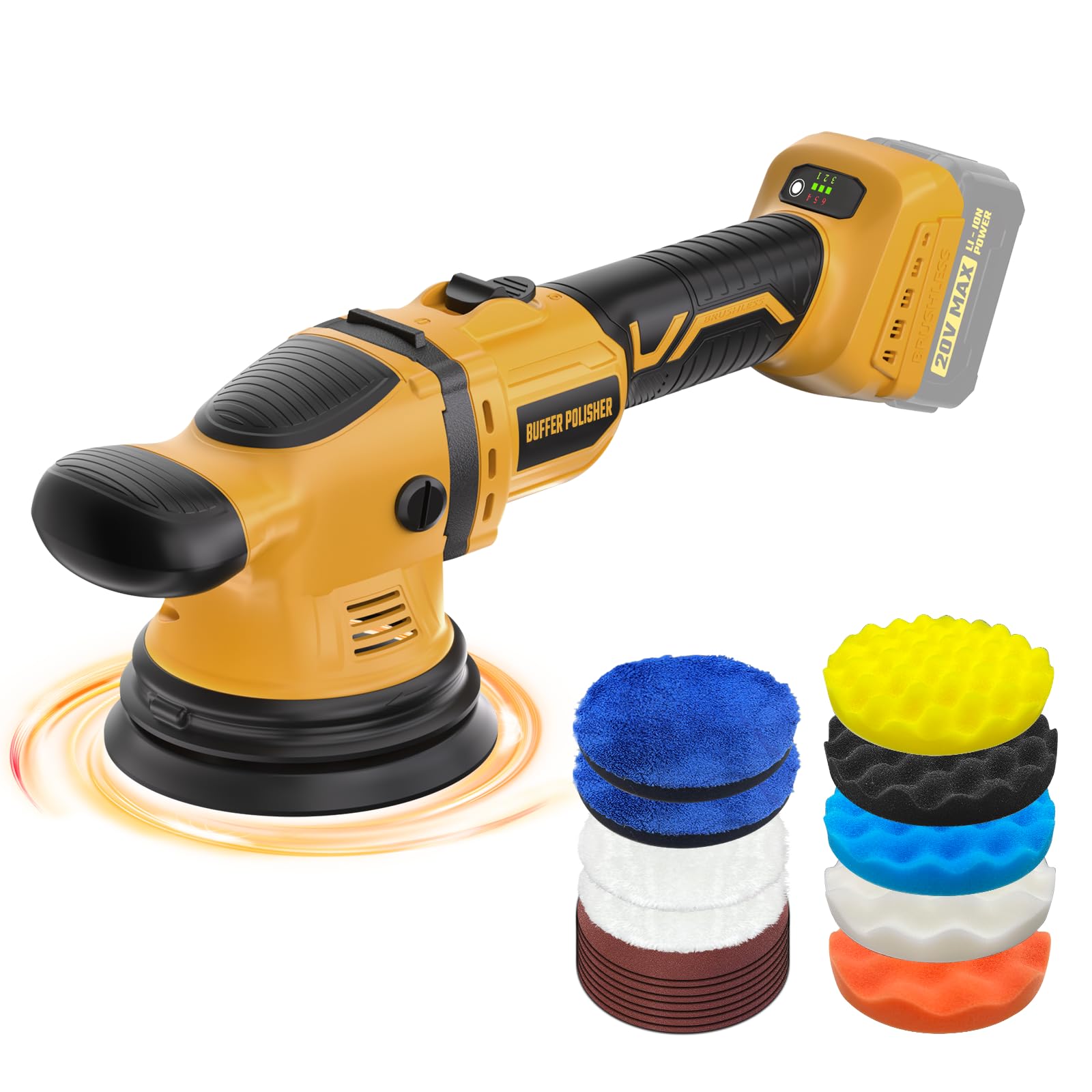
The tool-only orbital that taps your existing DeWalt batteries to save money.
Quality is the overwhelming winner here, with owners calling it well-built and worth the money even before counting the battery savings. Since it runs on DeWalt 20V lithium-ion batteries (DCB200 through DCB240), anyone already in the DeWalt ecosystem avoids the extra cost of proprietary batteries and chargers.
The upgraded brushless motor delivers more power with less noise, and the 6 speeds from 1800 to 5500 RPM cover waxing, polishing, and defect removal. The lock switch prevents accidental startups, and the extended handle design improves grip and angle control.
The kit includes 17 pieces — five foam pads, two wool pads, two waxing pads, and eight sandpapers. A 6Ah DeWalt battery completes a full car on one charge, and owners note it runs cool for about an hour of continuous work. The only confusion: it’s tool only, so battery-less buyers must already own DeWalt gear.
The Smart Angle: one tool that slots into an existing DeWalt battery collection, eliminating charger clutter and battery anxiety.
Remember: no battery or charger ships in the box — this only makes sense if you’re already a DeWalt owner.
Choose it if: you own DeWalt 20V batteries and want a lightweight, capable orbital without buying another charging system.
Look past it if: you have no DeWalt batteries — you’d pay extra just to get started.
Understanding the Specs
Grit Number and Abrasive Type
The grit number tells you the size of the abrasive particles in the compound. Lower numbers like 400 are coarser and cut faster, removing deeper scratches but leaving a duller finish. Higher numbers like 2000 are ultra-fine, polishing to a high gloss but removing almost no material. Coarse compounds use materials like aluminum oxide, while finishing polishes use diminishing abrasives that break down as you work, letting you go from cut to gloss in one pass.
Dual-Action vs Rotary Motion
A dual-action (DA) polisher uses random orbital motion that never stays in one spot, so it spreads heat and pressure evenly and won’t burn your clear coat — ideal for beginners. A rotary polisher spins in a fixed circle, cutting much faster but generating more heat, which makes it risky on modern thin clear coats unless you know exactly what you’re doing. Cordless DA models trade some power for portability, while corded rotaries offer unlimited runtime for heavy jobs.
FAQ
What grit number should I use for light swirl marks?
Can I use a car polishing compound by hand or do I need a machine?
Is a dual-action polisher safer than a rotary for my clear coat?
How long do cordless buffer batteries last?
Will a polishing kit remove deep scratches I can feel with my fingernail?
What is the difference between a compound and a polish?
Can I use these compounds on ceramic-coated or single-stage paint?
Does a higher RPM buffer mean better results?
How many pads and accessories should a complete kit include?
Do I need a machine if I only have light oxidation?
Final Thoughts: The Verdict
For most people, the car polishing kit winner is the Meguiar’s Mirror Glaze Bundle because it balances trusted quality, clear coat safety, and versatility across hand and machine application. If you want a machine-ready two-step that handles typical swirls, grab the Adam’s 2-Step Polishing System. And for a cordless, beginner-friendly tool that erases wax and light scratches without burning paint, the Vkdemer Cordless Buffer is the one to reach for.
How We Picked
We do not accept paid placement. Every pick is matched to a real buyer and a real use-case; we do not hands-on test units.
Sources & Methodology
Specifications: manufacturer listings and product documentation. Review insights: verified customer reviews, as of August 2026. Pricing: not shown on this page (it changes often); check the current price via the retailer link.
As an Amazon Associate, Gadgets Feed earns from qualifying purchases. This does not affect which products we feature.